Datavault AI: The Numbers No Longer Count, the Bitcoin Couldn’t Be Withdrawn — and the Cash Drawer Held $1.4 Million
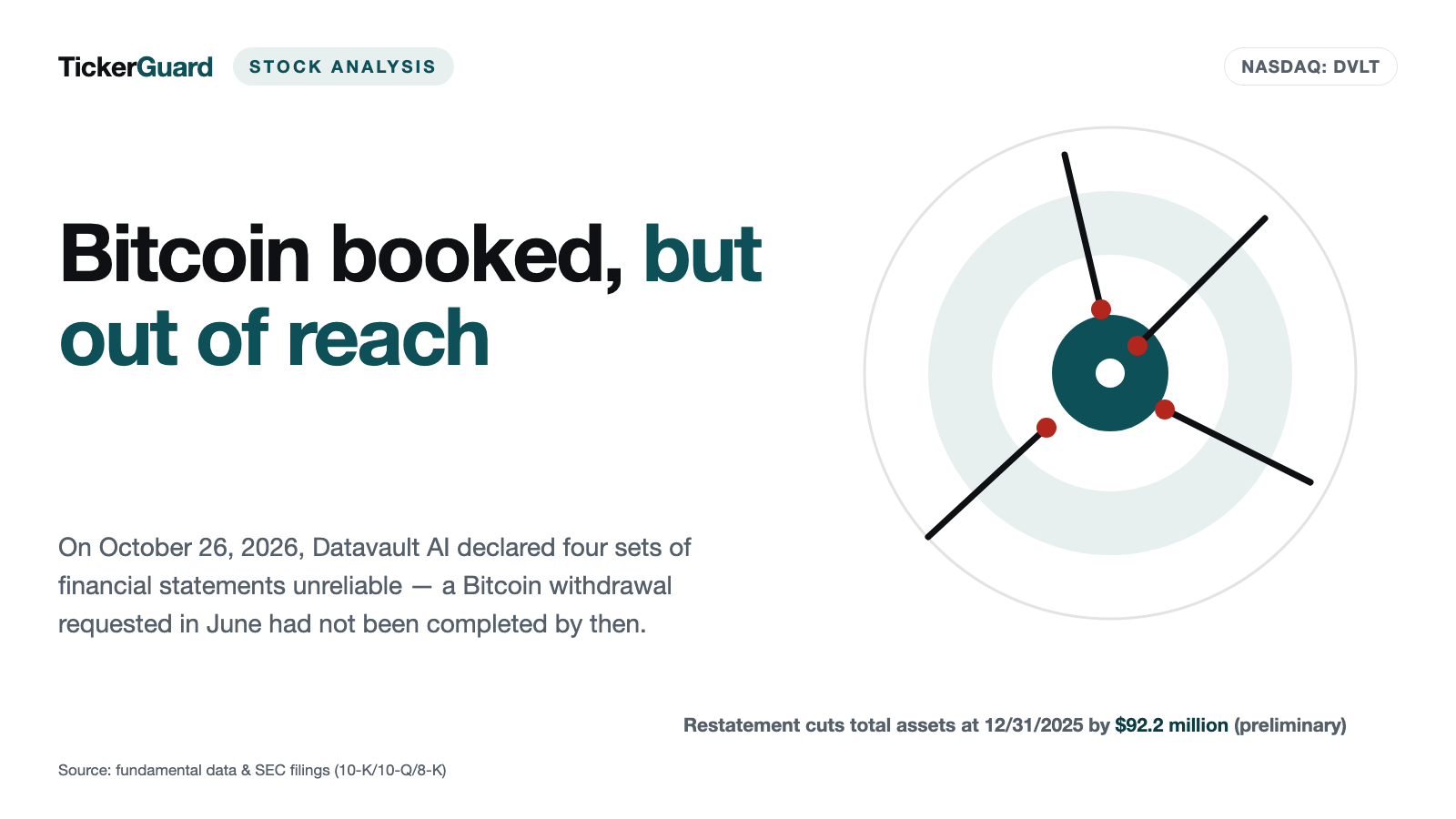
On October 26, 2026, Datavault AI told investors not to rely on its 2025 annual report and three quarterly reports. The reason is 1,309 Bitcoin that major shareholder Scilex credited to a Datavault wallet at the platform Biconomy as payment for shares: they no longer count as company assets, and a withdrawal requested in June 2026 had not gone through as of October 26, 2026. The day after the filing, the stock closed at $0.067. We read the company’s filings with the U.S. securities regulator through October 30, 2026. What remains is a balance sheet built on receivables from related parties and on a flood of new shares.
 Thomas Mücke
Founder & Publisher
As of Today
As of: October 30, 2026
- Closing price
- 0.0719 $ -10.20%
- Market Capitalisation
- 63.0 $M
- Growth Score
- 5/10
- AAQS
- 4/10
This analysis has a cut-off date. The Stock Guard tells you when something material changes in the numbers. Reserve your free spot
Chart
Interactive price chart (TradingView).
52-week range: 0.067 $ to 2.60 $ · Last price: 0.0719 $ (As of: October 30, 2026)
Note: pure fact-based analysis, not investment advice and not a solicitation to buy or sell. All figures without guarantee.
Picture your bank statement showing a healthy balance. You walk up to the ATM, and the screen says: “Withdrawal currently not possible.” Which one do you believe — the statement or the machine? Most of us believe the printed page for a surprisingly long time. Psychologists call this authority bias: whatever looks official, with a stamp, an auditor and a neat table, feels true even when reality has already disagreed. In the stock market it sounds like this: “But it says so in the annual report.”
At Datavault AI, that sentence broke on October 26, 2026. On that day the company itself said its audited 2025 annual report and three quarterly reports can no longer be relied upon. At the core: Bitcoin held at the platform Biconomy, 837 coins worth $49.0 million as of June 30, 2026, that sat on the balance sheet and could not be withdrawn. The stock had already fallen hard, from its highest 2025 close of $3.42 on October 24, 2025, to $0.133 — and the next day it lost another half, closing at $0.067. Before you decide anything about this stock, let’s read together what Datavault filed with the U.S. securities regulator, the SEC — and what of it still stands.
The tension running through this analysis: Datavault talks in big numbers. License deals with milestones of up to $2.55 billion, a planned financing of up to $2 billion, a $150 million share sale paid in Bitcoin, acquisitions in rapid succession. The small numbers tell a different story: $1.4 million in cash at June 30, 2026, and just over a billion shares. In the end, you decide which numbers to believe.
What Datavault AI Actually Does
Datavault AI is a Delaware corporation headquartered in Philadelphia. The company is older than its name: until February 2025 it was WiSA Technologies, before that Summit Wireless Technologies, a maker of wireless audio chips and modules for speakers. That “Acoustic Sciences” business still exists; according to the 2025 annual report, its modules are used by customers such as Bang & Olufsen, Harman Kardon and Klipsch.
The new story is “Data Sciences”: a platform meant to capture, value and monetize data, with programs called Data Vault, DataValue and DataScore. The actual data marketplace, the Information Data Exchange (IDE), is being built on IBM’s watsonx.ai platform and was expected to launch in 2026, per the annual report. On top of that, Datavault keeps buying businesses: the assets of event services provider CompuSystems (May 2025), media technology firm API Media for $14.0 million in cash (January 2026) and ad marketplace NYIAX for 74.8 million new shares (August 2026). It has also agreed to buy Canadian security firm CyberCatch for about $86.2 million in cash and WDT, the parent of a Wyoming special purpose bank, for about $22 million plus $35 million of capital commitments. In March 2026, the company had 194 employees.
Rule of thumb: an AI name is not AI revenue. Our company-specific AI rating therefore classifies Datavault as “uses AI”: in the filings, AI shows up as a development tool and an announcement, not as a documented revenue source.
Company history for investors
-
2023
First reverse split, 1-for-100
In January 2023, then WiSA Technologies combines its shares 1-for-100. The price rises on paper; the value of a holding does not.
-
2024
Second reverse split, 1-for-150
In April 2024 comes the next reverse split, 1-for-150. Afterwards there are 52.0 million shares at year-end 2024 — the base for the dilution that followed.
-
2025
WiSA becomes Datavault AI
In February 2025 the company renames itself Datavault AI. The market story shifts from wireless audio to data, AI and licensing.
-
2025
Scilex pays $150M in Bitcoin
On 9/25/2025 Scilex buys shares and a warrant for Bitcoin; 1,309.04 Bitcoin are credited at Biconomy. The stock climbs to $3.42 by 10/24/2025.
-
2026
Vivasor stake almost fully written off
In Q2 2026 Datavault buys 2 percent of Vivasor for $56.2M in its own stock and writes down $55.4M of it in the same quarter.
-
2026
Financial statements declared unreliable
On 10/26/2026 Datavault declares four sets of financial statements unreliable because the Bitcoin are not its assets. The next day the stock closes at $0.067.
-
2026
Third reverse split on the agenda
On 10/30/2026 Datavault calls its annual meeting for 12/16/2026: votes on a 1-for-2 to 1-for-50 reverse split and on more shares for the Streeterville convertible note.
How the Stock Landed on Our Desk
No metrics screen flagged Datavault; other investors’ attention did: in late October 2026, our in-house Reddit hype scanner picked up the ticker DVLT. That is not a buy or sell signal — it means a stock is being discussed heavily in the forums. The reason is easy to find: the stock closed at $0.133 on October 26, 2026, and at $0.067 the day after the filing — a one-day drop of about 50 percent on roughly 249 million shares traded. On October 30, 2026, it closed at $0.0719 (source: fundamental data).
Our scanner’s metrics help little here, because they rely on numbers the company itself has just declared unreliable. One figure still says something: on October 30, 2026, the stock sat about 98 percent below its highest 2025 close ($3.42 on October 24, 2025). Live price and metrics data are on our Datavault stock page.
On the reporting picture: the fiscal year is the calendar year. The latest periodic report is the quarterly report (10-Q) for June 30, 2026, filed August 19, 2026 — and it is one of the four reports that no longer count since October 26, 2026. After it came current reports (8-K) on a convertible note, acquisitions, a Nasdaq extension, board changes and the restatement, and most recently, on October 30, 2026, a preliminary proxy statement (Form PRE 14A) with a new share count. The quarterly report for September 30, 2026 was not available at the time of writing; the company itself flags the risk that it will be delayed.
The Numbers Over the Years — An Honest Look
First, what genuinely impresses: Datavault has grown. Revenue was $2.1 million in 2023 and $2.7 million in 2024, per the annual reports. For the first half of 2026 the company reported $10.1 million, up from $2.4 million a year earlier; the events business alone contributed $5.3 million. Gross margin in the second quarter of 2026 was 43 percent, versus 2 percent a year earlier. Named customers and business lines stand behind these figures.
Now the caveat that applies to everything from the third quarter of 2025 on: these figures sit in reports the company declared unreliable on October 26, 2026. So far, the correction mainly concerns the Bitcoin holdings and the gains and losses on them, but Datavault explicitly says additional errors may be identified. The same caveat covers 2025: $39.1 million of revenue and a $79.0 million net loss, after losses of $51.4 million (2024) and $18.7 million (2023). The first half of 2026 brought a $141.2 million loss, including $58.9 million of impairments on investments and $25.1 million of losses on Bitcoin.
The growth was paid for mainly with new shares. In 2023 and 2024 the company had already done two reverse splits, 1-for-100 in January 2023 and 1-for-150 in April 2024. Since then:
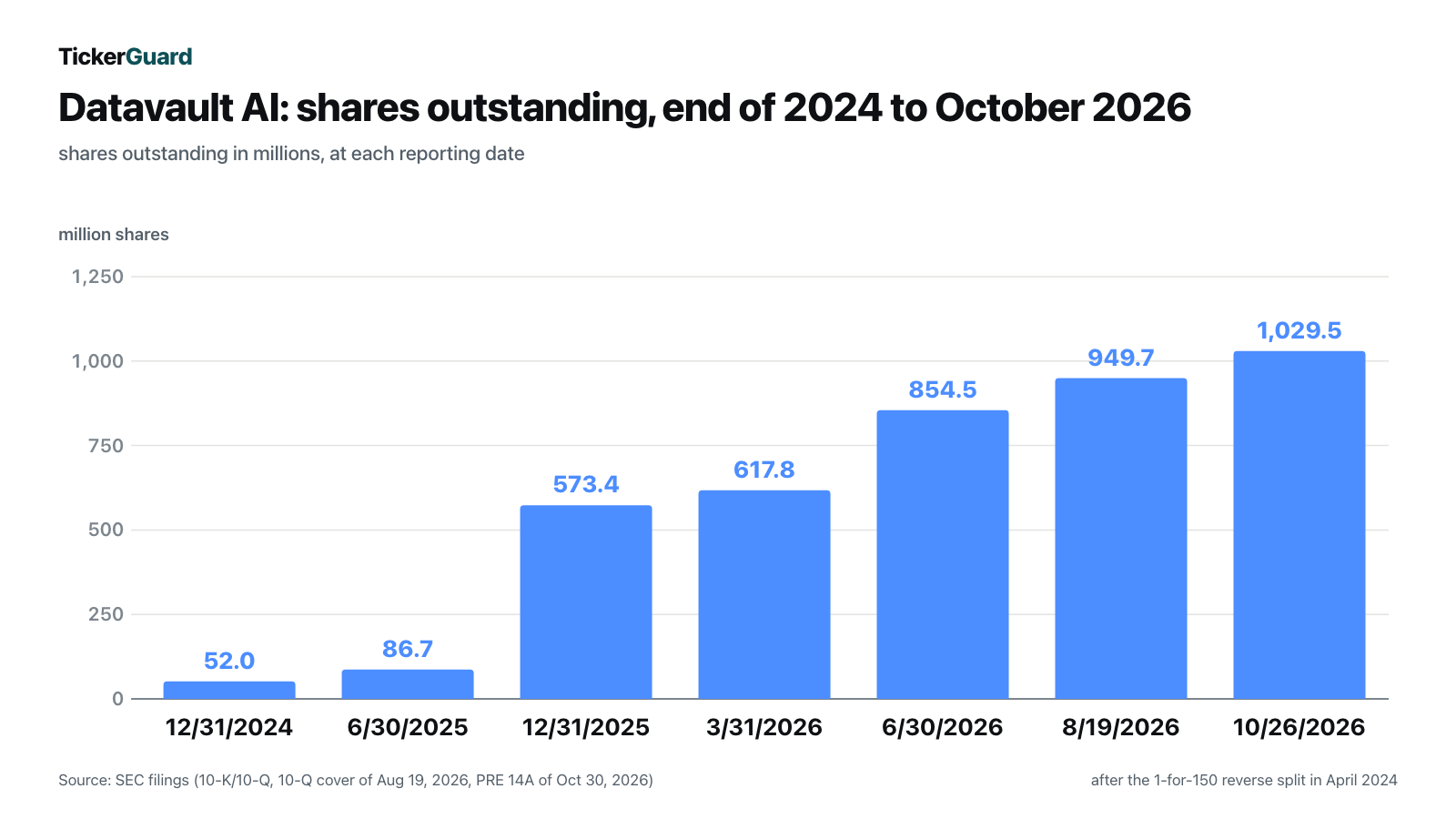
Through August 15, 2026, an at-the-market program raised $32.4 million net, and a May registered direct offering of 109 million shares at $0.55 raised $55.7 million net. Your slice of the pie didn’t shrink; it became a crumb: someone who owned 1 percent of the company at the end of 2024 held about 0.05 percent in late October 2026 without buying more. Between August 19 and October 26, 2026 alone, almost 80 million shares were added; the proxy statement gives only the new total; the breakdown should come with the quarterly report for September 30, 2026. Rule of thumb: when the share count grows faster than revenue, mostly the others are growing.
So much for the numbers Datavault reported. Now let’s read what makes the company itself doubt them.
What the Filings Say — The Uncomfortable Truths
A report to the SEC is filed under penalty of law. That makes it all the more serious when a company declares its own reports unreliable.
Uncomfortable Truth No. 1: Four Reports No Longer Count
On October 20, 2026, Datavault’s audit committee and management concluded that the financial statements for September 30, 2025, fiscal 2025, March 31 and June 30, 2026 should no longer be relied upon. The company disclosed this on October 26, 2026 under Item 4.02 of a current report — the item the SEC reserves for exactly this situation:
“Investors, analysts and other persons should not rely on the Affected Financial Statements or related financial information described above until restated financial information is made available.”
— Datavault AI, current report 8-K of October 26, 2026, Item 4.02

Translated into plain English: the tables that prices, analyst models and our own scanner lean on are not a reliable basis until further notice. Datavault calls its quantification of the error “preliminary, unaudited”, and there is no date for the restatement. The backstory fits: former auditor BPM resigned effective immediately on June 15, 2026, without disagreements according to the company. CBIZ has audited since July 10, 2026. Whether the controls have a material weakness, management had not yet concluded, according to the filing. A lawsuit has been pending for longer: on August 5, 2026, a shareholder filed a class action in Pennsylvania against Datavault and certain current officers, alleging false or misleading statements about the business, customer contracts and commercialization prospects for purchases between September 4, 2024, and October 30, 2025. According to the quarterly report, the company considers the claims without merit.
Uncomfortable Truth No. 2: Bitcoin That Can’t Be Withdrawn
The story begins on September 25, 2025. Major shareholder Scilex Holding agreed to buy 15 million Datavault shares and a pre-funded warrant for another 263.9 million shares for $150 million — paid in Bitcoin, at $112,915.52 per coin. Scilex then credited 1,309.04 Bitcoin to a Datavault digital wallet maintained at the crypto platform Biconomy — via an “off-chain” transfer. Off-chain means the transfer exists only in the platform’s own books, not on the blockchain itself. Between September 26, 2025, and January 30, 2026, according to the 8-K, 491.431 of those Bitcoin went back to Scilex the same way, for about $40.5 million. The 10-Q for June 30, 2026, gives the holdings at two dates: 1,054 Bitcoin at year-end 2025 and 837 Bitcoin with a fair value of $49.0 million at June 30, 2026. According to the same report, Datavault used 217 Bitcoin during the first half of 2026 to repay $18.1 million of cash advances from Scilex. On June 24, 2026, Datavault signed a binding term sheet with Scilex to sell exactly those 837 Bitcoin for $50.0 million, payable in tranches through December 31, 2028 (Q2 2026 10-Q, risk factors). In the same month, the real problem began:
“In June 2026, the Company requested a withdrawal of Bitcoin from the digital wallet maintained at Biconomy to an external account and has, as of the date of this Current Report on Form 8-K, been unable to complete the withdrawal.”
— Datavault AI, current report 8-K of October 26, 2026, Item 4.02

The balance sheet consequence: after review, these Bitcoin do not meet the requirements to be recognized as Datavault’s own asset. Instead, the purchase price becomes a subscription receivable from Scilex, deducted from equity — as if a buyer had not yet paid for the shares. Based on preliminary estimates, total assets fall by $92.2 million at December 31, 2025, and by $49.0 million at June 30, 2026; the recorded Bitcoin gains and losses are reversed. Whether Datavault ever collects the money from Scilex or the Bitcoin from Biconomy is open, per the filing. For contrast, our Metaplanet stock analysis shows a company whose business model is a Bitcoin treasury it holds itself, and our Eightco stock analysis shows another small cap whose balance sheet hinges on crypto-linked holdings.
Uncomfortable Truth No. 3: The Going-Concern Call Rested on That Bitcoin
An annual report has to say whether the company can carry on for the next twelve months — the “going concern” assessment. In its 2025 annual report filed March 18, 2026, Datavault considered that doubt alleviated. The reasoning:
“The fair value of digital assets is subject to market volatility; however, such assets are actively traded and may be liquidated, if necessary, to support operating needs.”
— Datavault AI, annual report 10-K for 2025, Note 2

Those very assets are now off the balance sheet, and the withdrawal requested in June 2026 had not been completed as of the 8-K. No filing reports that the planned sale to Scilex has closed. According to the 8-K, management is therefore reassessing the going-concern evaluation for fiscal 2025 and the first quarter of 2026. For June 30, 2026, the quarterly report had already reinstated the doubt:
“As a result, the substantial doubt about the Company’s ability to continue as a going concern has not been alleviated.”
— Datavault AI, quarterly report 10-Q for the second quarter of 2026, Note 2
The position at June 30, 2026, in three numbers: $1.4 million in cash, $80.0 million of operating cash outflow in the first half (including a $43.3 million increase in prepaid expenses and other current assets), and resources the quarterly report says are “not expected to be sufficient” for the next twelve months. How tight things were shows in a loan from May 5, 2026: $2.0 million, repaid at $125,000 a week and due October 16, 2026, an effective annual interest rate of 183.5 percent, personally guaranteed by CEO Nathaniel Bradley and CFO Brett Moyer. As of October 31, 2026, no filing reports whether it was repaid on time.
Uncomfortable Truth No. 4: Revenue and Assets Depend on Related Parties
Who paid most of Datavault’s 2025 revenue is in the annual report: Vivasor accounted for 51 percent, Scilex for 26 percent. Both are related parties. In November and December 2025, Datavault granted them exclusive patent licenses — Vivasor for $20.0 million, Scilex for $10.0 million, each with royalties and milestones of up to $2.55 billion. At year-end, neither had paid: $30.0 million sat on the balance sheet as a receivable, still $24.0 million at June 30, 2026. The following year brought another deal within the same circle:
“During the three and six months ended June 30, 2026, the Company recognized an impairment loss of approximately $55.4 million related to its investment in Vivasor.”
— Datavault AI, quarterly report 10-Q for the second quarter of 2026, Note 10

In everyday terms: Datavault gave Vivasor 75.9 million of its own shares for a stake of about 2 percent and wrote that stake down almost entirely in the same quarter. Vivasor is run by Henry Ji, who is also chairperson, CEO and president of Scilex, according to Datavault’s proxy statement of October 30, 2026. The ties go further: in the first half of 2026, Datavault bought a patent from three inventors, including Henry Ji and Scilex CFO Stephen Ma, for 7.5 million shares. And on August 20, 2026, Scilex transferred 50 million Datavault shares to Vivasor as a drawdown under a credit line Scilex had extended to Vivasor. Scilex’s stake in Datavault fell from about 43 percent at the end of 2025 to 17.2 percent in August 2026; the proxy statement puts it at 15.9 percent as of October 26, 2026, with Vivasor at 4.9 percent. Rule of thumb: when customer, supplier, major shareholder and investee all come from the same circle, revenue says little about what an outside buyer would pay.
Uncomfortable Truth No. 5: Big Commitments on a Near-Empty Till
With $1.4 million in cash at June 30, 2026, Datavault has taken on obligations of a completely different size: $25 million of non-refundable fees for a planned financing of up to $2 billion from Helmex Global, of which $5 million had been paid by the end of June; about $86.2 million in cash for CyberCatch; $35 million of capital for the Wyoming bank. Together that is about $141 million of open commitments ($20 million remaining Helmex fee, $86.2 million for CyberCatch, $35 million of bank capital), before the purchase price for WDT. Per the quarterly report, all of this is to be paid with new equity or debt.
One source of that money is in the filing of August 19, 2026: a $25.03 million convertible note sold to Streeterville Capital, plus 15 million pre-delivery shares. From January 1, 2027, and under one condition already from October 1, 2026, the investor may convert at 92 percent of the lowest daily volume-weighted average price of the last seven trading days — the lower the stock, the more shares. A limited portion may already be converted at that market price between September 1 and December 31, 2026, following a “Limited Redemption Event” as defined in the note. Since October 15, 2026, a floor of $0.0632 applies — expressly to the fixed conversion price; whether it also covers market-price conversions, the filing leaves open; on October 27, 2026, the stock traded as low as $0.0605 intraday and closed at $0.067. Datavault reserved 300 million shares for conversions. Converting the full principal at the floor would create, by our rough math, about 396 million new shares, close to 40 percent of the 1.03 billion shares outstanding on October 26, 2026 — more than were reserved. Because Nasdaq Rule 5635(d) caps issuance without shareholder approval, shareholders are to vote on December 16, 2026 on lifting that cap for Streeterville; the company itself warns this “may result in substantial dilution.” Also new is a rule adopted on October 1, 2026: directors who resign in connection with certain transactions get their unvested equity immediately and, after at least two years of service, an advisory contract worth $72,000 plus 120,000 shares. It has already been applied twice: Robert Tobias (October 2) and Wendy Wilson (October 12, 2026) vacated their board seats for designees of the acquired ad marketplace NYIAX and are entitled to these benefits.
Valuation: What the Market Pays for Datavault AI
At the $0.0719 close on October 30, 2026 and 1,029,489,970 shares (as of October 26, 2026, per the proxy statement), Datavault’s market value is about $74 million. As of October 31, 2026, the fundamental data still used the 949.7 million shares from August 19, 2026, and arrived at about $68 million; the metrics at the top of this page carry their own data date. On top of that come 46.6 million shares underlying warrants and 0.9 million unvested restricted stock units. As a cross-check: on August 17, 2026, the prospectus cited a last sale price of $0.3203 with 855.8 million shares outstanding, or about $274 million. What stands against that? Our rough math at June 30, 2026, subject to the pending restatement:
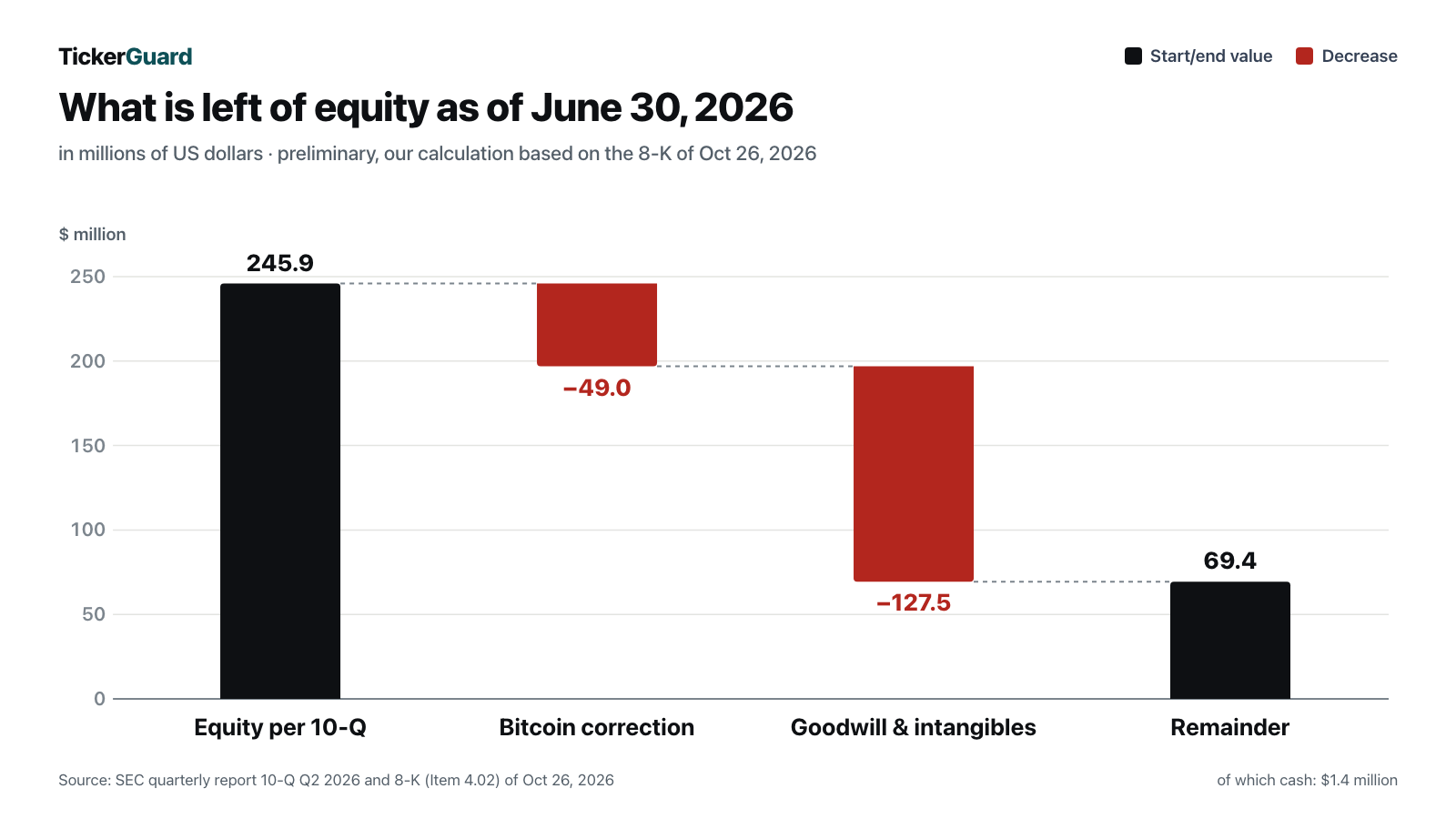
- Price-to-book: After the Bitcoin correction, about $196.9 million of equity remains; the market value was about 0.4 times that. Sounds cheap — but $127.5 million of it is goodwill and intangibles from acquisitions and patent purchases, often paid for in stock.
- What is left: The largest items behind the remaining $69.4 million are $40.1 million of prepaid expenses and other current assets and $24.0 million of receivables from related parties. Cash: $1.4 million.
- Price-to-sales: On 2025 revenue of $39.1 million, about 1.9. Excluding the patent licenses to Vivasor and Scilex, $9.1 million of revenue remains — then about 8.
- No P/E: Meaningless without earnings.
The pros’ view helps little: according to fundamental data, two analysts rate the stock, with an average price target of $2.00 (as of October 31, 2026). Average means all targets added up and spread evenly — with only two ratings, that is no consensus. The target is about 28 times the October 30, 2026 price. A deadline matters more: the stock has closed below $1 since January 9, 2026 (source: fundamental data), and Nasdaq’s deficiency letter arrived on February 24, 2026. The exchange gave Datavault until February 22, 2027 to close at $1 or more for ten consecutive trading days; the company explicitly names a reverse split as a way to get there. On October 30, 2026, it put one on the agenda of the December 16, 2026 annual meeting: a ratio between 1-for-2 and 1-for-50, to be set by the board within twelve months. Only from about 1-for-14 would the October 30, 2026 price land above $1 on paper. It would be the third reverse split since 2023 — and it changes the number of your shares, not the value of your stake.
Upside and Risks at a Glance
What speaks for Datavault AI:
- Real operating growth. First-half 2026 revenue of $10.1 million versus $2.4 million a year earlier, mostly from events and API Media; second-quarter gross margin of 43 percent.
- Patents and known audio customers. Per the annual report, Bang & Olufsen, Harman Kardon and Klipsch use its wireless modules.
- Time on Nasdaq. Minimum bid deadline of February 22, 2027.
- New auditor, open receivable. CBIZ has audited since July 2026; the restatement may bring clarity. Per the filing, the company is pursuing collection from Scilex or Biconomy’s cooperation.
What speaks against it:
- Numbers without validity. Four sets of financial statements since Q3 2025 declared unreliable, no restatement date.
- Going concern in doubt. $1.4 million in cash at June 30, 2026, doubt not alleviated, a short-term loan from May 2026 at a 183.5 percent effective annual rate.
- Related parties. 77 percent of 2025 revenue from licenses to Vivasor and Scilex, $24.0 million of receivables, Vivasor stake almost fully written off.
- Dilution. Share count up almost 20 times since the end of 2024, a convertible note with market-price conversion, 300 million shares reserved, 2 billion authorized.
- Commitments above cash. Remaining Helmex fee, CyberCatch, the Wyoming bank — together about $141 million, more than the market value.
- Delisting risk. Stock well below $1; without success by February 2027, removal from Nasdaq looms.
A Human Bottom Line
Remember the bank statement and the ATM? At Datavault, the ATM has spoken — and on October 26, 2026, the company itself agreed with it. Authority bias was especially tempting here: an audited annual report, licenses with billion-dollar milestones, a major shareholder paying in Bitcoin. None of it was invented. But each of those papers says less today than it promised.
Is everything lost? Not necessarily. Datavault has customers, employees, patents and time on Nasdaq until February 2027. But the company first has to rewrite its own numbers, then collect money owed by related parties, while paying commitments many times larger than its cash. The next checkpoints are clear: the restated financial statements, the quarterly report for September 30, 2026 with cash and share count, the fate of the Bitcoin at Biconomy, and the December 16, 2026 votes on the reverse split and the convertible note.
What you make of it is your call. And that’s exactly how it should be.
Sources and Data Cutoff
- Current report 8-K of October 26, 2026, Item 4.02 (non-reliance, Bitcoin at Biconomy, going-concern reassessment)
- Quarterly report 10-Q for the second quarter of 2026 (period ended June 30, 2026, filed August 19, 2026, latest periodic report) and 10-Q for the first quarter of 2026 (May 15, 2026)
- Annual report 10-K for 2025 (March 18, 2026) and annual report 10-K for 2024 (March 31, 2025)
- Current reports 8-K: auditor BPM resigns (June 22, 2026), new auditor CBIZ (July 14, 2026), second-quarter results (August 19, 2026), Streeterville convertible note (August 19, 2026), NYIAX acquisition (August 19, 2026), WDT/BankWyse agreement (August 19, 2026), CyberCatch agreement (August 18, 2026), Nasdaq extension (August 25, 2026), rule for departing directors (October 6, 2026), board change Wilson/Tirman (October 15, 2026), convertible note floor price (October 15, 2026)
- Prospectus supplement 424B5 of August 19, 2026 and Scilex ownership filing SC 13D/A (August 24, 2026)
- Preliminary proxy statement PRE 14A of October 30, 2026 (share count as of October 26, 2026, reverse split 1-for-2 to 1-for-50, Streeterville issuance approval, ownership table, Henry Ji at Scilex and Vivasor)
- Price and metrics data: source fundamental data, as of October 31, 2026 (closing prices through October 30, 2026 and volume; analyst count and price target as of October 31, 2026)
Data cutoff: Company figures as of December 31, 2025 (fiscal 2025) and June 30, 2026 (latest periodic report, filed August 19, 2026); all figures from the third quarter of 2025 onward are subject to the October 26, 2026 non-reliance disclosure. We reviewed the SEC filing list through October 31, 2026. Prices: closes of October 24, 2025, and October 26, 27 and 30, 2026, the October 27, 2026 intraday low, plus the August 17, 2026 price cited in the prospectus. Calculated values (market value, share count multiple, ownership after dilution, equity after correction, price-to-book and price-to-sales, potential conversion shares, total commitments, minimum reverse split ratio) are our rough math and labeled as such.
Note: This article is journalistic analysis, not investment advice, and not a solicitation to buy or sell securities. Stocks trading below $1 can be extremely volatile; you can lose some or all of your money. Positions held by the operator are disclosed daily; where one exists, it appears as a notice at the top of this deep dive.
Key figures at a glance
All monetary figures in millions of $; earnings per share as reported.
| Metric | 2021 | 2022 | 2023 | 2024 | 2025 |
|---|---|---|---|---|---|
| Revenue | 6.5 | 3.4 | 2.1 | 2.7 | 39.1 |
| Operating Income (EBIT) | -11.5 | -18.0 | -21.5 | -21.1 | -32.5 |
| Net Income | -11.8 | -16.2 | -18.7 | -51.4 | -79.0 |
| Net Margin | -180.7% | -480.0% | -898.8% | -1,922.6% | -202.1% |
| Earnings Per Share | -190.62 $ | -7.29 $ | -5.39 $ | -12.25 $ | -0.52 $ |
Source: fundamental data & SEC filings (annual and quarterly reports, 10-K/10-Q)
Our Bottom Line at a Glance
- Reliability of the numbers negative
- Financial statements Q3 2025 through Q2 2026 unreliable per 8-K of 10/26/2026, no restatement date; auditor BPM resigned on 06/15/2026.
- Liquidity negative
- Cash $1.4M at 06/30/2026, $80.0M operating outflow in H1, going concern in doubt; $49.0M of Bitcoin at Biconomy not retrievable.
- Related parties negative
- 77% of 2025 revenue from licenses to Vivasor and Scilex; Vivasor stake bought for $56.2M in stock and written down by $55.4M (Q2 2026).
- Dilution negative
- Share count from 52.0M (12/31/2024) to 1,029.5M (10/26/2026); convertible note with market-price conversion and a $0.0632 floor, approval to exceed the Nasdaq cap up for a vote on 12/16/2026.
- Operating business neutral
- H1 2026 revenue $10.1M versus $2.4M, Q2 2026 gross margin 43%; subject to restatement, growth driven by acquisitions.
Datavault AI has declared its financial statements since the third quarter of 2025 unreliable because Bitcoin from major shareholder Scilex does not count as its own asset and cannot be withdrawn. Cash is nearly gone, going concern is in doubt, revenue and assets depend on related parties, and the share count has grown almost 20-fold. Not investment advice.
What Our Rating Means
Substance risk
We found at least one documented issue that threatens the company itself — regardless of how the stock is currently valued.
Red because the company declared four sets of financial statements unreliable, the quarterly report says going-concern doubt has not been alleviated, cash stood at $1.4 million at June 30, 2026, the Nasdaq listing depends on a deadline in February 2027 and related parties supplied three quarters of 2025 revenue — the low stock price is a price question, and the decision is yours.
A journalistic assessment by our editorial team at the time of the deep dive, based on public sources — not investment advice and not a solicitation to buy or sell. Your personal circumstances (investment goals, risk capacity, taxes) cannot be taken into account. What our levels mean, how verdicts are formed, and what conflicts of interest exist →
Worth Noting
- Why we looked: our in-house Reddit hype scanner picked up the ticker in late October 2026, after the plunge from $0.133 (10/26/2026) to $0.067 (10/27/2026) following the non-reliance filing — not a metrics hit.
- All figures from the third quarter of 2025 onward come from reports Datavault declared unreliable on 10/26/2026; per the company, the correction is preliminary, unaudited and may reveal additional errors.
- Basis: 10-K 2024 (3/31/2025) and 2025 (3/18/2026), 10-Q Q1 and Q2 2026 (5/15 and 8/19/2026), 8-Ks through 10/26/2026, 424B5 (8/19/2026), Scilex SC 13D/A (8/24/2026), PRE 14A (10/30/2026); SEC filing list reviewed through 10/31/2026, no Form 15, no Form 25.
- Calculated values are our rough math: market value from 1,029,489,970 shares (10/26/2026) times $0.0719 (10/30/2026); equity after correction = $245.9M minus $49.0M assuming unchanged liabilities; potential conversion shares = $25.03M divided by $0.0632, before make-whole interest.
Stock Watch
This analysis is as of October 31, 2026. Stock Watch will tell you what's changed at DVLT since then.
Later $1 a month per stock — signing up is free, and you'll be the first to know when it launches.
The full analysis as a PDF for later
We will send you this analysis as a PDF — to print, file away, and read at your own pace. And we will add you to the free Stock Watch list for Datavault AI Inc. (DVLT), so you hear about it when something material in this analysis changes.
Frequently Asked Questions
Datavault AI, based in Philadelphia and known as WiSA Technologies until February 2025, sells wireless audio modules for speakers, runs event and media services through acquired businesses and is building a platform to value and monetize data. Most of its 2025 revenue came from patent licenses to the related parties Vivasor and Scilex.
On October 26, 2026, Datavault disclosed that the Bitcoin Scilex used in 2025 to pay for shares (1,309.04 credited, 837 still on the balance sheet at June 30, 2026) should not have been recorded as company assets. The reports for September 30, 2025, fiscal 2025, March 31 and June 30, 2026 are affected. Based on a preliminary, unaudited estimate, total assets at June 30, 2026 are expected to fall by $49.0 million.
In 2025, Scilex credited a total of 1,309.04 Bitcoin to a Datavault wallet at the platform Biconomy, recorded only in Biconomy’s books rather than on the blockchain. Scilex bought back 491.431 Bitcoin for about $40.5 million. A withdrawal to an external account requested in June 2026 had not been completed as of October 26, 2026.
Datavault had 1,029,489,970 shares outstanding on October 26, 2026, up from 52.0 million at the end of 2024 — almost 20 times. On top of that come 46.6 million shares underlying warrants and potential shares from a $25.03 million convertible note, for which Datavault reserved 300 million shares. Two billion shares are authorized; reverse splits took place in 2023 and 2024, and a third is up for a vote on December 16, 2026.
Scilex is major shareholder, customer and lender at once. It held about 43 percent of the shares at the end of 2025; with an unchanged 163.8 million shares (per its August 24, 2026 filing), that works out to about 15.9 percent on October 26, 2026, purely because the share count grew. Scilex paid for shares in Bitcoin, made short-term advances at 15.42 percent interest and took a $10.0 million patent license in 2025. Vivasor, also a licensee, is run by Henry Ji, who also heads Scilex.
The stock has closed below $1 since January 9, 2026, and Nasdaq sent a deficiency letter on February 24, 2026. The exchange gave Datavault until February 22, 2027 to close at $1 or more for ten consecutive trading days; shareholders are set to vote on a reverse split of 1-for-2 to 1-for-50 on December 16, 2026. If that fails, delisting looms, which Datavault could appeal.
Only partly. Datavault calls itself an AI platform and is building its data exchange on IBM’s watsonx.ai, with the costs booked as research and development. The filings do not document an AI revenue source, though: 2025 revenue came from patent licenses, live events and audio components. Our AI rating is therefore “uses AI”.
Found an error?
Did you spot a factual error, an outdated number, or a typo in this deep dive? Let us know briefly — your report goes straight to the editorial team.