Chroma ATE: Almost Two-Thirds of the Record Profit Came From an Apartment
Chroma ATE has more than quintupled in twelve months — no surprise, the company builds the test systems that virtually every Nvidia AI chip has to pass through. A look inside the quarterly reports tells a different story: almost two-thirds of the celebrated "record profit" in the third quarter of 2025 came not from the test business, but from the sale of a staff apartment — and the company's old second leg of business has nearly vanished in eighteen months. Not investment advice.
 Thomas Mücke
Founder & Publisher
Thomas Mücke
Founder & Publisher
FOMO — the fear of missing out — works best with a chart that goes straight up and a story anyone can grasp in one sentence: "They build the machines that every Nvidia AI chip has to pass through before it ships." That is exactly the pull currently working on shares of Chroma ATE, a Taiwanese test-equipment maker most people outside the industry have never heard of. The stock has more than quintupled from its 52-week low to its 52-week high, and headlines about a "record profit" in the third quarter of 2025 made the rounds across Asian financial media. We read the quarterly reports before letting the headline do the deciding for us. The result: a good chunk of that celebrated record profit had nothing to do with the test business. Every figure in this analysis is evergreen and carries its own as-of date; the NT$2,010 price is used only as a valuation anchor dated Aug. 28, 2026.
What Chroma ATE actually does
Every semiconductor, power supply and battery has to be tested before it ships — otherwise nobody knows whether the component lives up to its datasheet. Chroma ATE, founded on Oct. 23, 1984 by four electrical-engineering graduates of National Chiao Tung University as a trading firm called "Ko Mao Technology," has built its business on exactly that: test systems for semiconductors (so-called system-level tests, or SLT, where a fully packaged chip is tested under real operating conditions), for power electronics (power supplies, battery backup units, AI server power delivery), for electric vehicles and batteries, and classic measurement and test instruments. By the company's own account in its July 30, 2026 earnings presentation, roughly 60 percent of its power-electronics test business is now tied to AI server applications (power delivery, battery backup) — a market segment that barely existed at this scale a few years ago.
Several independent trade outlets, including CommonWealth Magazine and the analysis site SemiWiki, report that Chroma is the sole supplier of the system-level test equipment that Nvidia's packaged AI chips must pass through before shipping — a claim the company neither confirms with customer names, citing confidentiality, nor denies. Its own July 30, 2026 investor presentation names "SLT from AI / HPC / ASIC" — system-level tests for AI chips, high-performance computing and application-specific chips — as an explicit growth driver for the second half of 2026. For comparison: we previously covered Jentech Precision, another Taiwanese supplier to the AI server chain that solves a different piece of the same boom with heat spreaders and liquid cooling — both companies show the same pattern of an explosively growing AI business sitting next to a smaller, older core business.
Company history for investors
-
1984
Founded as a trading firm in Taiwan
Four electrical-engineering graduates found "Ko Mao Technology" on Oct. 23, 1984 — the seed of today's test-equipment maker.
-
2025
Q3 2025 record profit with a hidden one-time item
The Oct. 30, 2025 earnings presentation discloses a NT$3.185 billion gain from an apartment sale — nearly two-thirds of that quarter's net income.
-
2025
Leadership transition approved
The board appoints I-Shih Tseng as the new CEO effective Jan. 1, 2026, on Dec. 3, 2025; founder Leo Huang remains chairman.
-
2026
Record revenue in the second quarter
The July 30, 2026 earnings presentation shows revenue up 110 percent year over year — with the CEO transition already completed and a new CFO, Lawrence Wu, per Digitimes.
How this stock landed on our desk
The trigger for this analysis is the price chart itself: according to trading history, the stock marked a 52-week low of NT$534.48 and a 52-week high of NT$2,771.56 — a move of more than five times within a single year, accompanied by "record profit" and "record revenue" headlines in each of the past four quarterly reports. That kind of chart produces exactly the psychological pressure that defines FOMO: the fear of missing a move that has already largely happened. We wanted to know whether a business stands behind the fireworks that fully justifies the move — or whether one of the headlines itself already contains a distortion.
The numbers over the years
Chroma ATE's consolidated revenue grew from NT$15.53 billion (2020) through NT$17.58 billion (2021), NT$22.07 billion (2022, an interim high), NT$18.68 billion (2023, a pullback) and NT$21.60 billion (2024) to NT$28.31 billion in 2025 — up 31 percent year over year. Net income followed the same pattern with far sharper swings: from NT$2.32 billion (2020) to NT$5.11 billion (2022), a pullback to NT$3.98 billion (2023), then NT$5.26 billion (2024) and finally NT$11.69 billion in 2025 — up 122 percent, more than double the pace of revenue growth. The first half of 2026 accelerated further: NT$11.86 billion in revenue in the first quarter, NT$13.53 billion in the second — a combined NT$25.39 billion, up 91 percent year over year.
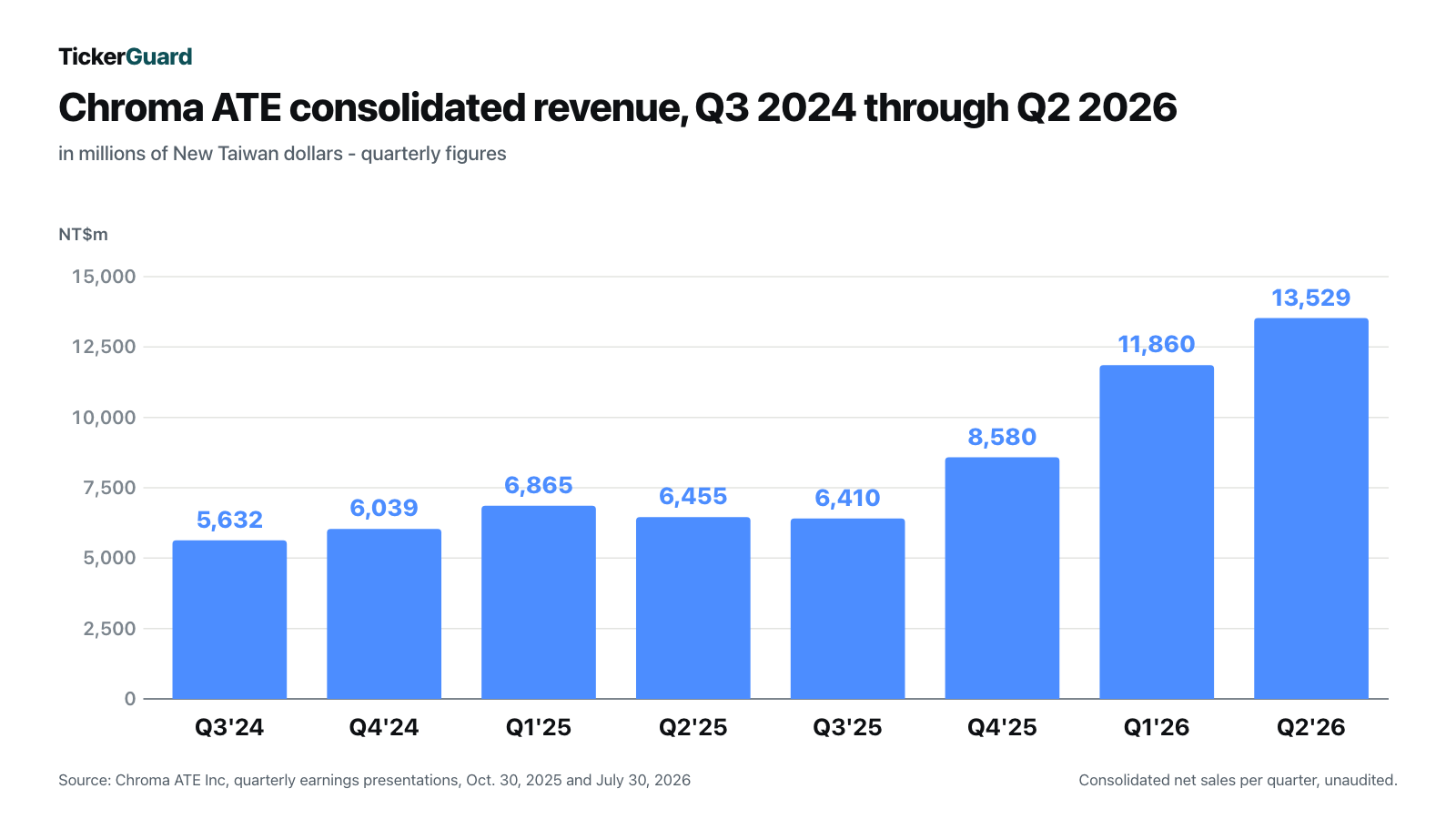
The balance sheet grew in step: as of June 30, 2026, cash and short-term investments stood at NT$13.68 billion against just NT$578 million in short-term and NT$3.20 billion in long-term debt — a clear net-cash position. Shareholders' equity rose from NT$25.45 billion (December 2024) through NT$32.56 billion (December 2025) to NT$33.71 billion (June 2026), while total assets grew about 71 percent over the same period, from NT$37.31 billion to NT$63.70 billion. Free cash flow in the first half of 2026 came to NT$3.24 billion, up 48 percent from NT$2.19 billion a year earlier, despite inventory climbing from NT$7.92 billion to NT$11.36 billion.
What the earnings materials show
An honest caveat up front: no publicly available word-for-word transcripts with a question-and-answer section exist for Chroma ATE — an automated check of our transcript database (as of Aug. 31, 2026) found zero entries for ticker 2360.TW. Instead, we relied on the official earnings presentations from Oct. 30, 2025 and July 30, 2026, which include documented management remarks from the respective calls, supplemented by press summaries of additional calls (fourth quarter 2025, first quarter 2026) via services such as Gurufocus and BigGo Finance.
The outlook for the second half of 2026 is unambiguous: "The second half will be fueled mainly by semiconductor contributions, outperforming the first half with drivers of SLT from AI / HPC / ASIC and Photonics from optical communication / CPO." The same presentation adds "AI server power (included HVDC)" as a continuing driver of the power-electronics test business. Both statements come verbatim from the company's own earnings presentation — not a single word points to broadening the business beyond AI-adjacent end markets.
"The second half will be fueled mainly by semiconductor contributions, outperforming the first half with drivers of SLT from AI / HPC / ASIC and Photonics from optical communication / CPO." (Earnings presentation, July 30, 2026, p. 10, "Year 2026 Guidance")

Effective Jan. 1, 2026, founder and chairman Leo Huang (Huang Chin-Ming) handed the CEO role to I-Shih Tseng, a longtime executive who joined the company in 1998 and previously led its integrated system solutions and optical inspection systems units — a unanimous board decision "to support organizational development and enhance its governance structure," according to Digitimes (Dec. 4, 2025), with no apparent governance problem or activist pressure behind it. On the second-quarter 2026 earnings call, outgoing CEO Huang called the results "very, very impressive numbers" (per BigGo Finance, July 30, 2026) — the company delivered its second consecutive record quarter shortly before his departure.
The uncomfortable truths in the numbers
Uncomfortable truth No. 1: Nearly two-thirds of the record profit came from an apartment
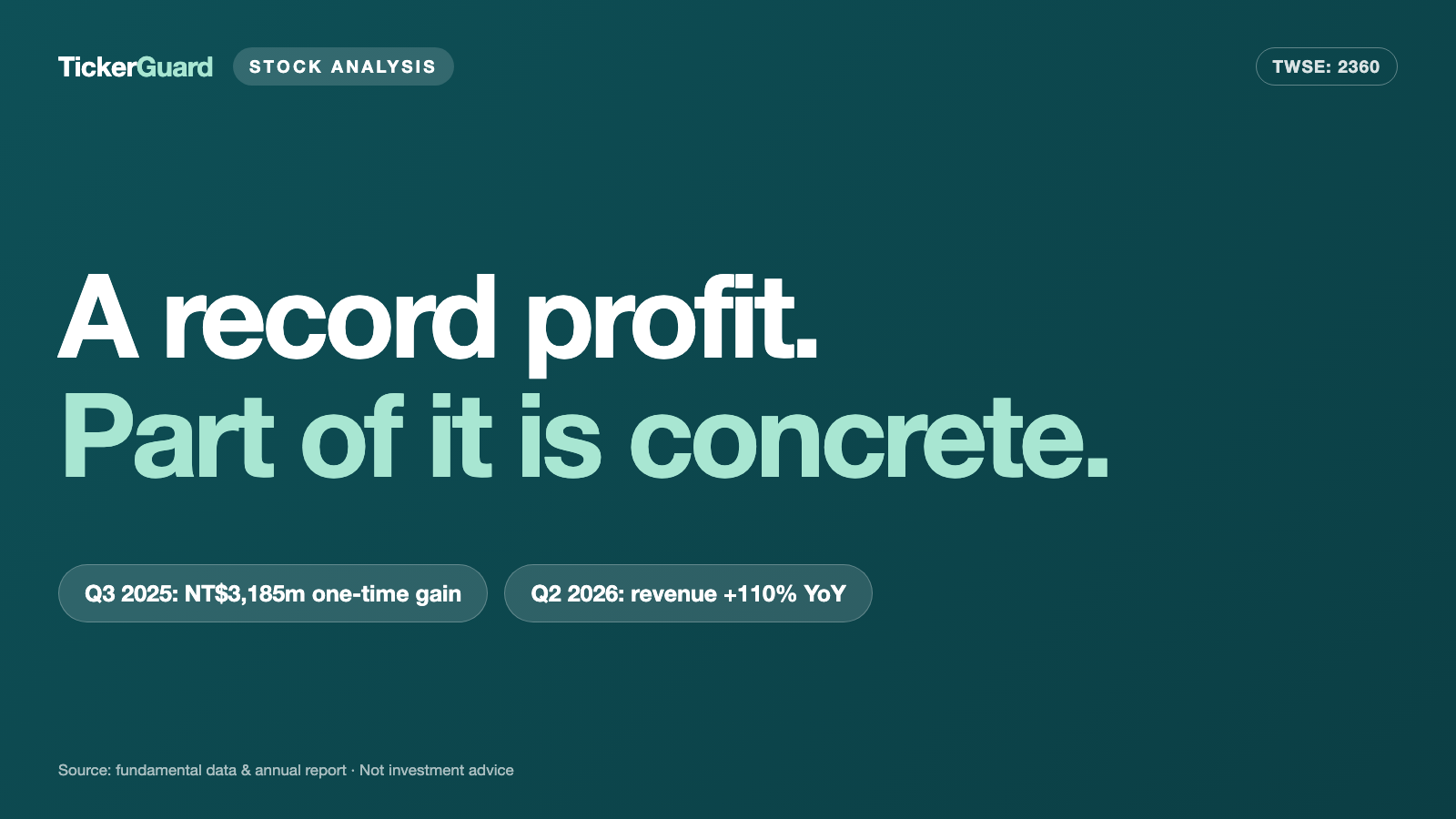
The headline was the same everywhere: net income up 253 percent year over year in the third quarter of 2025, a "record quarter." What most summaries left out sits as a single sentence beneath the results table in the company's own earnings presentation: "Gain from disposal of residential apartment held for sale (to employees) of NTD 3,185 million." Of the NT$5.066 billion in net income attributable to shareholders in the third quarter of 2025, roughly 63 percent came from this one-time real-estate sale — not from the test business. Operating income that same quarter was only NT$1.848 billion, up 23 percent year over year — real growth, but nowhere near a tripling.
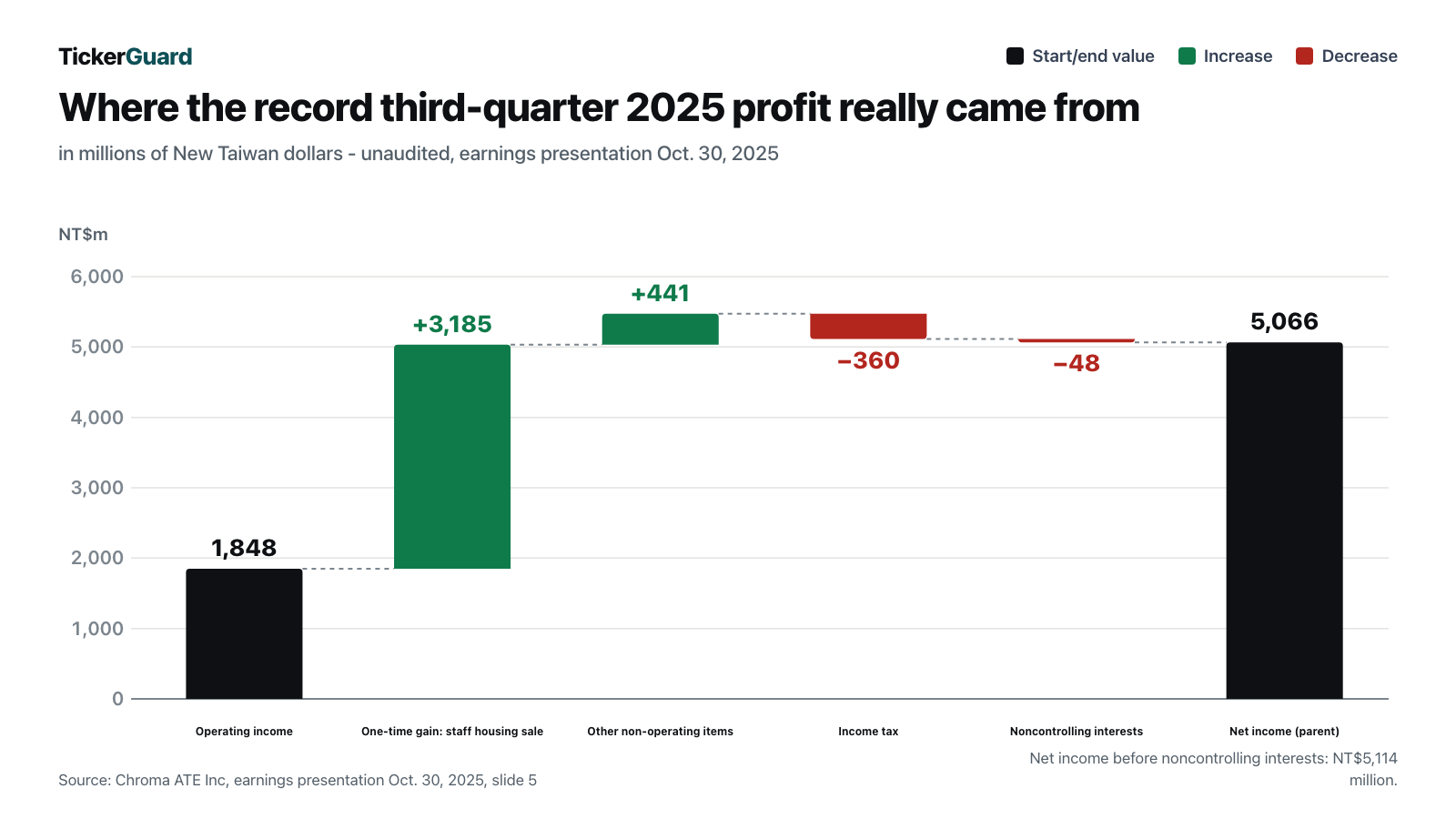
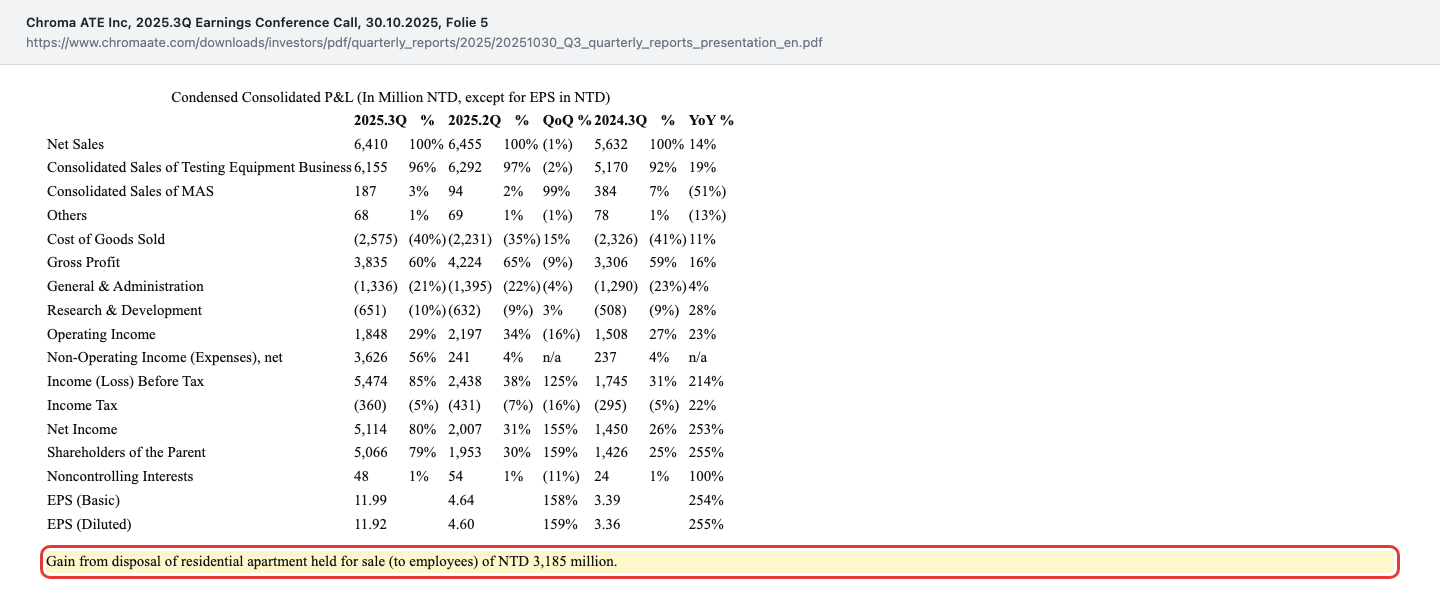
Notably candid: the same presentation states that its reported return on equity (29 percent for the first nine months of 2025) is calculated "without capital gain from disposal of residential held for sale" — Chroma itself strips out this effect from its own profitability metrics. The reported net income and the resulting price-to-earnings ratio do not: anyone valuing the stock purely off the "record profit" headline is using an earnings base the company itself does not consider representative of its underlying operating power.
Uncomfortable truth No. 2: The old second leg of the business has nearly vanished in eighteen months
Before the AI boom, Chroma stood on four legs: test and automation systems (today "Test Instruments & ATS"), semiconductor testing, general measurement instruments via subsidiary MAS — and Turnkey Solutions, complete test systems for electric vehicles and batteries. The product-mix tables in the earnings presentations show how quickly that fourth leg gave way: Turnkey Solutions revenue fell from NT$685 million in full-year 2024 (4 percent of parent-company revenue) through NT$444 million in 2025 (2 percent) to just NT$106 million in the first half of 2026 (down 61 percent year over year) and NT$53 million in the second quarter of 2026 alone (down 57 percent year over year) — the segment's share of parent-company revenue fell to a quarter of its 2024 level in eighteen months while the rest of the business exploded.

Virtually all growth now sits in two segments tightly tied to the AI capex cycle: Test Instruments & ATS (up 136 percent in the first half of 2026, mainly AI server power delivery) and semiconductor/photonics testing (up 62 percent, mainly system-level tests for AI chips). The broad end-market diversification the company had via Turnkey Solutions just two years ago is effectively gone.
Uncomfortable truth No. 3: Press reports point to significant customer concentration in Nvidia
Several independent trade outlets — Taiwan's CommonWealth Magazine, the analysis site SemiWiki and other industry observers — report consistently that Chroma is the sole supplier of the system-level test equipment that Nvidia's packaged AI chips (such as the GB200 line) must pass through before shipping. Chroma itself does not confirm this with customer names in its reports — standard practice under confidential supply agreements with large customers — but does not deny it either. Its own April 30, 2026 investor presentation (as quoted by BigGo Finance) does note "adoption by the top three AI companies" (Nvidia, AMD and Google), a sign of some broadening of the customer base but not a rebuttal of the reported core dependency on Nvidia's own product cadence. Should Nvidia delay its rollout or a competitor gain traction in system-level testing, Chroma would be hit disproportionately — a classic but hard-to-quantify concentration risk that comes from press reporting, not from the company's own disclosure.
Valuation
With 423,591,163 shares outstanding and a price of NT$2,010 (Aug. 28, 2026), market capitalization works out to roughly NT$851.42 billion — about $26.91 billion or €23.17 billion (exchange rates Aug. 28-31, 2026: $1 = NT$31.64, €1 = NT$36.74). Our own calculation (shares times price: NT$851.42 billion) matches the market capitalization figure in the fundamental data almost exactly.
Based on trailing-twelve-month earnings per share of NT$39.20 — a period that includes the third quarter of 2025 distorted by the apartment sale — the trailing price-to-earnings ratio works out to roughly 51. The "forward P/E" figure supplied in the fundamental data (17.95) cannot be reconciled with either the consensus estimate for the current fiscal year 2026 (NT$44.84 earnings per share) or for 2027 (NT$67.32), and is therefore deliberately not cited here. Using the 2026 consensus estimate instead yields a calculated price-to-earnings ratio of roughly 45; for 2027, roughly 30. Even against the most optimistic available estimate, the stock trades noticeably above the broader Taiwanese market average — understandable given the growth rates, but not a margin of safety.
Against book value per share of roughly NT$77.88, the price-to-book ratio works out to about 26. The dividend yield is roughly 1.0 percent (an expected NT$19.50 cash dividend per share against the current price), with a payout ratio of about 50 percent of earnings — based on the available data, Chroma has paid a dividend every year since 2001 without interruption. The stock's beta of 1.33 sits only slightly above average market volatility, yet it has moved roughly 276 percent from its 52-week low (NT$534.48) to the valuation anchor used here — a trading range far wider than the market correlation alone would suggest.
Opportunities and risks at a glance
Opportunities: A structurally growing AI test business (consolidated revenue up 91 percent, operating income up 130 percent in the first half of 2026), a virtually net-debt-free balance sheet with about NT$13.7 billion in cash and short-term investments, an uninterrupted dividend record dating back to 2001, documented relationships with the three largest AI chip developers (Nvidia, AMD, Google per the company's own presentation), and a claimed technology lead in high-power chip cooling. Risks: A substantial share of the widely quoted 2025 record profit came from a one-time real-estate sale, not the operating business — valuation metrics derived from it should be discounted accordingly; the company's old second leg, Turnkey Solutions, has fallen to a quarter of its former revenue share in eighteen months, leaving virtually all growth dependent on a single AI capex cycle; press reports point to significant, company-unconfirmed customer concentration in Nvidia; and the valuation remains demanding even against the most optimistic available earnings estimate.
A human conclusion
FOMO works best when the story is half true — and at Chroma ATE, it genuinely is half true. The company builds real, sought-after test technology for the world's largest AI chip makers, revenue is growing organically and fast, and the balance sheet is spotless. That is exactly what makes the temptation to jump in now, before the train fully leaves the station, so strong. What the chart and the "record profit" headline alone do not show: almost two-thirds of that one record quarter came from selling an apartment, the old second leg of the business has effectively disappeared, and the valuation already prices in a fair amount of optimistic future. Anyone looking at Chroma ATE and seeing only the five-fold chart is missing a company whose record profit was inflated by a one-time gain more than the headlines let on. Anyone seeing only the blemishes, in turn, is missing that a real, fast-growing business remains even without the one-time item. The honest answer sits in between. What you make of that is your decision. And that's exactly how it should be.
Sources
This analysis draws on: Chroma ATE Inc.'s earnings presentations dated Oct. 30, 2025 ("2025.3Q Earnings Conference Call") and July 30, 2026 ("2026.2Q Earnings Conference"), both published on chromaate.com; press research on customer concentration and the leadership transition via CommonWealth Magazine (english.cw.com.tw, May 21, 2024 and Nov. 24, 2025), SemiWiki, and Digitimes (Dec. 4, 2025); press summaries of additional earnings calls via Gurufocus and BigGo Finance; and fundamental data (price, valuation and balance-sheet metrics plus analyst consensus estimates, as of Aug. 28-31, 2026). No publicly available word-for-word analyst call transcripts exist for 2360.TW; our transcript search found no entry for this ticker (checked Aug. 31, 2026). Note: this analysis is journalistic commentary on publicly available information, not investment advice and not a solicitation to buy or sell securities.
Our Bottom Line at a Glance
- Growth positive
- Consolidated revenue rose 91 percent to NT$25.39 billion in the first half of 2026, operating income by 130 percent — driven by AI server test demand for Nvidia, AMD and Google chips (earnings presentation, July 30, 2026).
- Earnings quality and the one-time gain negative
- Roughly 63 percent of net income in the third quarter of 2025 (NT$3.185 billion of NT$5.066 billion) came from selling a staff apartment, not the operating business — the company itself strips this out of its own return-on-equity metric, but the reported earnings figures do not.
- Balance sheet and liquidity positive
- Clear net-cash position (NT$13.68 billion cash and short-term investments against NT$3.78 billion in debt, June 30, 2026), equity up from NT$25.45 billion to NT$33.71 billion in eighteen months, free cash flow up 48 percent year over year in the first half of 2026.
- Segment concentration neutral
- The former second leg, Turnkey Solutions (EV/battery testing), shrank from NT$685 million (2024) to NT$106 million in the first half of 2026 — virtually the entire business now hinges on two AI-adjacent segments.
- Customer concentration neutral
- Press reports (CommonWealth Magazine, SemiWiki) describe Chroma as the sole supplier of system-level test equipment for Nvidia's AI chips — neither confirmed nor denied by the company, citing confidentiality; documented adoption by three major AI customers somewhat broadens the picture.
- Valuation negative
- Trailing price-to-earnings ratio of roughly 51, calculated at roughly 45 and 30 against 2026/2027 consensus estimates — the stock has more than quintupled off its 52-week low, with the trailing multiple further inflated by the one-time gain.
Chroma ATE shows a genuinely fast-growing AI test business sitting on a healthy, net-debt-free balance sheet — but the widely cited record profit of the third quarter of 2025 consisted almost two-thirds of a staff-apartment sale, not the operating business. Its former second leg has nearly disappeared in eighteen months, and press reports point to significant, unconfirmed customer concentration in Nvidia. The valuation is demanding even against optimistic earnings estimates. Not investment advice.
What Our Rating Means
Open questions
The business works in principle, but one material question is open. As long as it stays open, our findings do not carry a quality verdict.
The business model works and is growing organically, the balance sheet is healthy, and there is no governance or accounting breach — all of that speaks for quality. But two material operating questions remain open: the recently celebrated record profit depended substantially on a one-time real-estate sale rather than sustainable earnings power, and virtually all growth now depends on a single AI capex cycle and a customer base press reports describe as heavily concentrated, after the old second leg of the business nearly disappeared. Both are open operating questions, not a documented solvency risk — the rating sits at yellow, not red. That the stock has more than quintupled and trades at a high price-to-earnings ratio is a valuation argument, not a quality one, and plays no role here. The decision is yours.
A journalistic assessment by our editorial team at the time of the deep dive, based on public sources — not investment advice and not a solicitation to buy or sell. Your personal circumstances (investment goals, risk capacity, taxes) cannot be taken into account. What our levels mean, how verdicts are formed, and what conflicts of interest exist →
Worth Noting
- The hook for this analysis is the price chart itself — a move of more than five times between the 52-week low and high, accompanied by "record profit" headlines, classic fertile ground for FOMO decisions.
- As-of date: earnings presentations dated Oct. 30, 2025 and July 30, 2026, fundamental data as of June 30, 2026 (data pulled Aug. 28-31, 2026).
- The reported Nvidia customer concentration comes from press reporting, not the company's own disclosure — Chroma does not name customers, citing confidentiality.
The full analysis as a PDF for later
We will send you this analysis as a PDF — to print, file away, and read at your own pace.
Frequently Asked Questions
Chroma ATE Inc. (TWSE: 2360), based in Taoyuan City, Taiwan, has designed and built test systems for semiconductors (system-level test), power electronics (AI server power supplies, HVDC), batteries and electric vehicles since 1984, alongside classic measurement and test instruments. Test Instruments & ATS plus semiconductor/photonics testing made up roughly 95 percent of parent-company revenue in the first half of 2026.
A footnote in the company's own earnings presentation shows that of NT$5.066 billion in net income, roughly NT$3.185 billion — nearly 63 percent — came from selling a staff apartment, not from the operating test business. Operating income that same quarter was only NT$1.848 billion.
No. Chroma manufactures physical test equipment used, among other things, to test AI chips and AI server power delivery — its own earnings presentation labels an entire product category "AI Server Power Test Solutions" and names "SLT from AI / HPC / ASIC" as a growth driver. The company sells neither AI software nor AI models.
Press reports (including CommonWealth Magazine and SemiWiki) describe Chroma as the sole supplier of system-level test equipment for Nvidia's AI chips. The company does not name customers in its own reports, citing confidentiality, but its presentations do mention adoption by "the top three AI companies" (Nvidia, AMD, Google) — a sign of some, but not complete, diversification.
Chroma ATE trades on the Taiwan Stock Exchange (TWSE) and is not registered with the U.S. securities regulator, the SEC — there is no 10-K or 10-Q. Instead it files quarterly reports and holds quarterly earnings presentations. This analysis relies on the official presentations from Oct. 30, 2025 and July 30, 2026, plus fundamental data.
Its Turnkey Solutions segment (test and automation systems for electric vehicles and batteries) has collapsed: from NT$685 million in revenue in 2024 through NT$444 million in 2025 to just NT$106 million in the first half of 2026 (down 61 percent year over year) — its share of parent-company revenue fell from 4 percent to roughly 1 percent in eighteen months.
At a price of NT$2,010 (Aug. 28, 2026), the trailing price-to-earnings ratio works out to roughly 51 — inflated by the one-time gain from the apartment sale. Against consensus estimates for 2026 and 2027 (NT$44.84 and NT$67.32 earnings per share), the calculated multiples come to about 45 and 30, respectively.
Yes. Based on the available data, Chroma has paid a dividend every year since 2001, most recently an expected cash dividend of NT$19.50 per share (roughly 1.0 percent yield at the current price), with a payout ratio of about 50 percent of earnings.
Found an error?
Did you spot a factual error, an outdated number, or a typo in this deep dive? Let us know briefly — your report goes straight to the editorial team.