Chenbro Micom: Four Customers Carry More Than Half of Revenue — and the Annual Report Calls That "No Risk"
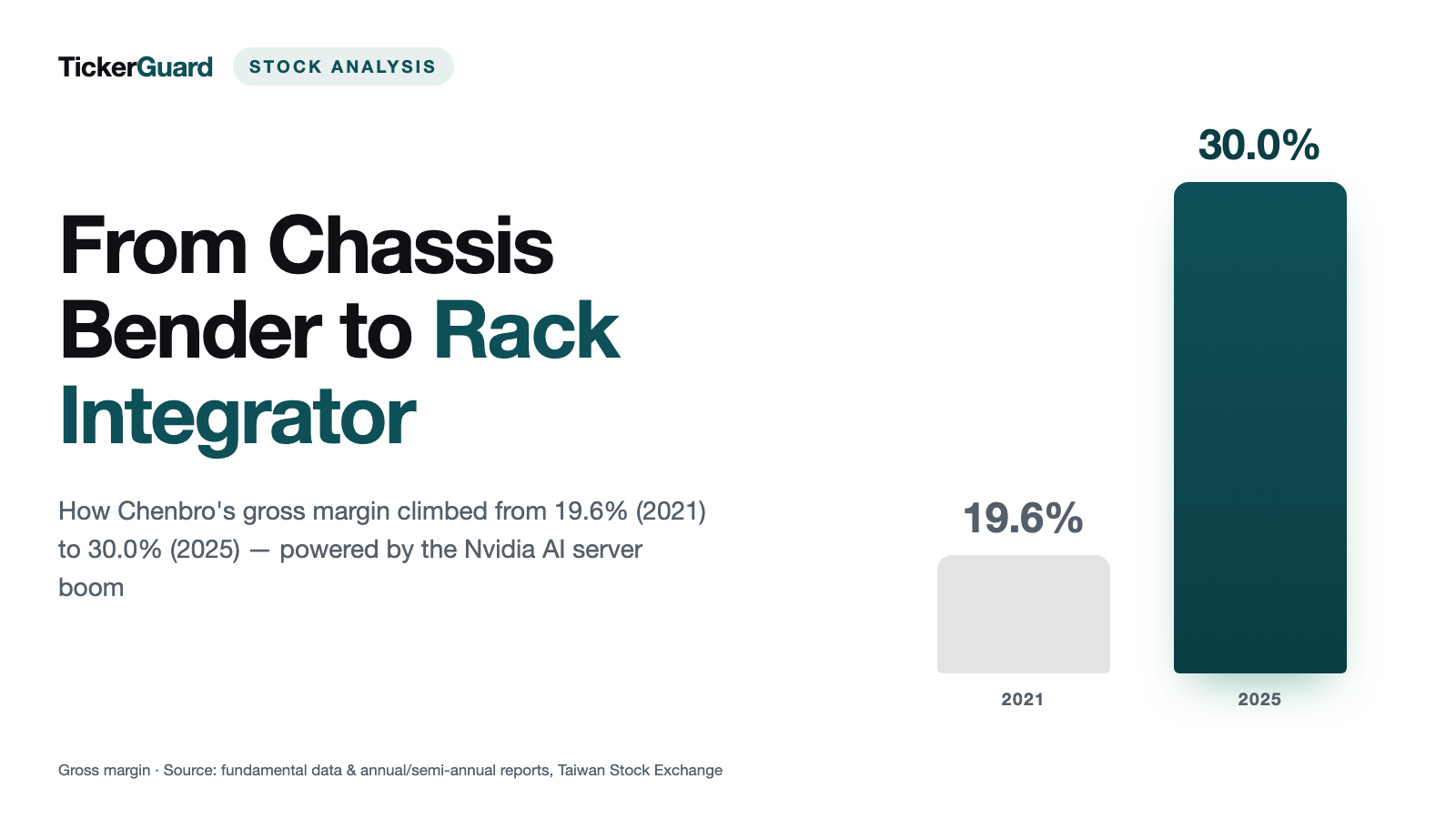
Reading the words "Nvidia" and "AI server" in the same sentence tends to switch off critical thinking — psychologists call it the halo effect: one famous name radiates credibility onto everything next to it. Chenbro Micom (TWSE: 8210), a Taiwanese chassis maker from New Taipei City, went from an interchangeable metal bender to a sought-after rack integrator for Nvidia's AI servers in just four years: revenue climbed from NT$9.42 billion to NT$22.00 billion (2021 through 2025, roughly $695 million or €600 million), and gross margin rose from 19.6% to 30.0%. What looks like a textbook growth story at first glance still deserves a look at the actual annual report: four customers accounted for 56 percent of revenue in 2024 — and Chenbro itself calls that "no sales concentration risk." We read the 2024 annual report, the press releases, and the available earnings-call coverage. What you make of the halo effect is your call — not the name on the press release.
 Thomas Mücke
Founder & Publisher
Thomas Mücke
Founder & Publisher
Psychologists call it the halo effect: one positive trait — a famous name, a shiny logo — radiates onto everything next to it, without us noticing. The word "Nvidia" in a press release makes everything that follows sound more credible. That is exactly the trap waiting at Chenbro Micom Co., Ltd. (TWSE: 8210), a maker of computer chassis based in New Taipei City, Taiwan. For decades, Chenbro was an unremarkable supplier of PC and server enclosures. Since the company started publicly working with Nvidia to build chassis for its AI servers, that has changed: revenue and gross margin have both moved at a remarkable pace since 2021, and the name "Nvidia" now shows up in nearly every press release the company puts out. So let's make a deal: before that name's shine spreads onto the entire balance sheet, let's read what Chenbro itself discloses in its 2024 annual report — including the sentence in which the company calls a 56 percent customer concentration "no risk." Not investment advice.
What Chenbro Micom Actually Does
Before a server can sit in a data center, it needs a chassis — a metal frame that holds boards, power supplies, fans, and drives together while protecting them from dust, vibration, and heat. That is what Chenbro Micom has built since 1983: server and storage chassis, barebone servers (pre-assembled frames without processor or memory), rackmount and tower enclosures, and storage expansion kits. By the company's own account, roughly 99 percent of revenue comes from this core business, with only about 1 percent from traditional PC cases. Products are sold under three models: OTS (off-the-shelf standard products), JDM (joint design manufacturing, developed together with the customer), and OEM Plus (contract manufacturing to customer specification). The company was founded by Mei-chi Chen together with her husband and brother; she remains chairperson today and, per a Forbes profile (April 16, 2026), is known in the industry as the "Queen of Chassis." Day-to-day operations are run by Ya-Nan Chen (known internally as "Corona Chen"), CEO since 2023 and, since December 1, 2024, also president again.
The decisive shift began once AI data centers stopped needing individual servers and started needing entire racks — cabinets holding multiple interconnected servers as a single unit. Chenbro positioned itself early as a partner for Nvidia's modular MGX architecture, a building-block standard for AI server chassis:
"Chenbro has collaborated with NVIDIA to offer a complete AI product line based on the NVIDIA MGX modular architecture."
— Chenbro Micom Co., Ltd., press release on NVIDIA GTC 2025, March 19, 2025

Per earnings-call coverage of the fourth-quarter-2025 call, AI-related projects already made up more than 50 percent of revenue; by the second quarter of 2026, that share had risen to 60 to 70 percent. Geographically, roughly half of 2024 revenue came from the Americas, 23 percent from China, 5 percent from Europe, and the rest from other regions (fourth-quarter-2024 investor presentation). One detail matters here: Chenbro does not sell AI software itself — it sells mechanical hardware for other companies' AI servers, not unlike Taiwanese cooling specialist Asia Vital Components, which supplies liquid cooling instead of chassis for the same AI racks. Internally, though, the 2024 annual report describes its own automation strategy:
"… while pushing forward with intelligent manufacturing and transforming into information- and automation-based factories."
— Chenbro Micom Co., Ltd., Annual Report 2024, page 6, "Production Strategy" section

That sets up this analysis's central tension: the revenue and margin growth is real and well documented — but how solid the story is underneath depends on customers nobody names, and on a sentence in the annual report that talks down a very concrete number.
Company history for investors
-
1983
Founded by Mei-chi Chen
Chenbro begins as a maker of computer chassis — the starting point of a business that, four decades later, becomes a rack integrator for AI servers.
-
2005
Listed on the Taiwan Stock Exchange
The stock starts regular trading on April 28, 2005 — the beginning of its public trading history.
-
2024
Zero-interest convertible bond raised, NT$1 billion
On January 19, 2024, Chenbro raises fresh capital via a convertible bond — conversion price NT$266.60, now deep in the money.
-
2025
Nvidia MGX collaboration confirmed publicly
At GTC 2025 (March 19, 2025), Chenbro publicly shows server chassis for Nvidia's GB200/GB300 platforms — the starting point of the current growth story.
-
2026
Record quarter, but rising uncertainty for the second half
On the second-quarter-2026 call (August 7, 2026), Chenbro reports record results but, for the first time, explicitly warns of "significantly higher" uncertainty ahead.
How Chenbro Micom Landed on Our Desk
Chenbro Micom made our research list not through a watchlist but through its revenue growth itself: up 51.6 percent in 2025, up 55.5 percent in the first half of 2026 — growth rates more typical of chip designers or cloud providers than their mechanical suppliers. A Taiwanese chassis maker keeping pace with the biggest names in the AI supply chain on revenue growth is unusual enough to warrant a closer look, especially since a metal enclosure does not, at first glance, look like a product with much room for differentiation.
The Numbers Over the Years — Honestly Assessed
First, what genuinely impresses: revenue rose from NT$9.42 billion (2021) through NT$10.56 billion (2022) and NT$11.25 billion (2023) to NT$14.52 billion (2024, up 29.1 percent) and finally NT$22.00 billion (2025, up 51.6 percent) — roughly $695 million or €600 million (FX rates as of August 29, 2026: $1 = NT$31.63, €1 = NT$36.68). Net income grew from NT$0.67 billion to NT$3.56 billion over the same period.
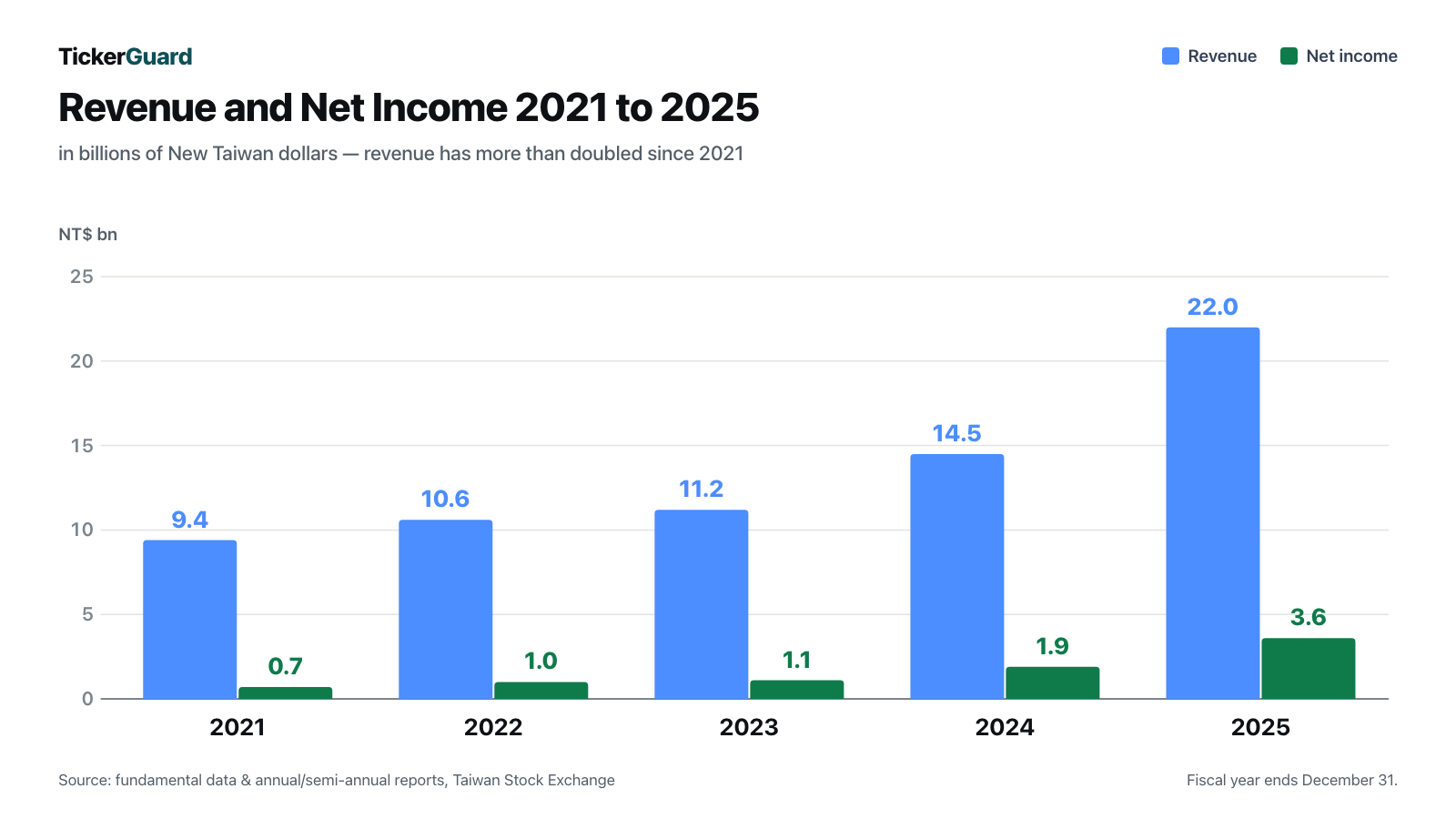
Gross margin tells an even more revealing story, because it shows Chenbro is not just selling more chassis but better ones: from 19.6 percent (2021) through 20.2 percent (2022) and 22.9 percent (2023) to 26.1 percent (2024) and 30.0 percent (2025) — a gain of more than ten percentage points in four years, not what you'd expect from a plain metal fabricator. Operating margin climbed from roughly 9 percent (2021) to 21.4 percent (2025) over the same period. The first half of 2026 kept the trend going: revenue of NT$14.93 billion (up 55.5 percent from NT$9.60 billion a year earlier), gross margin of 32.7 percent, and net income of NT$2.75 billion — more than one and a half times the year-earlier period's NT$1.50 billion. The second quarter of 2026 alone brought in NT$7.82 billion, after NT$7.11 billion in the first quarter.
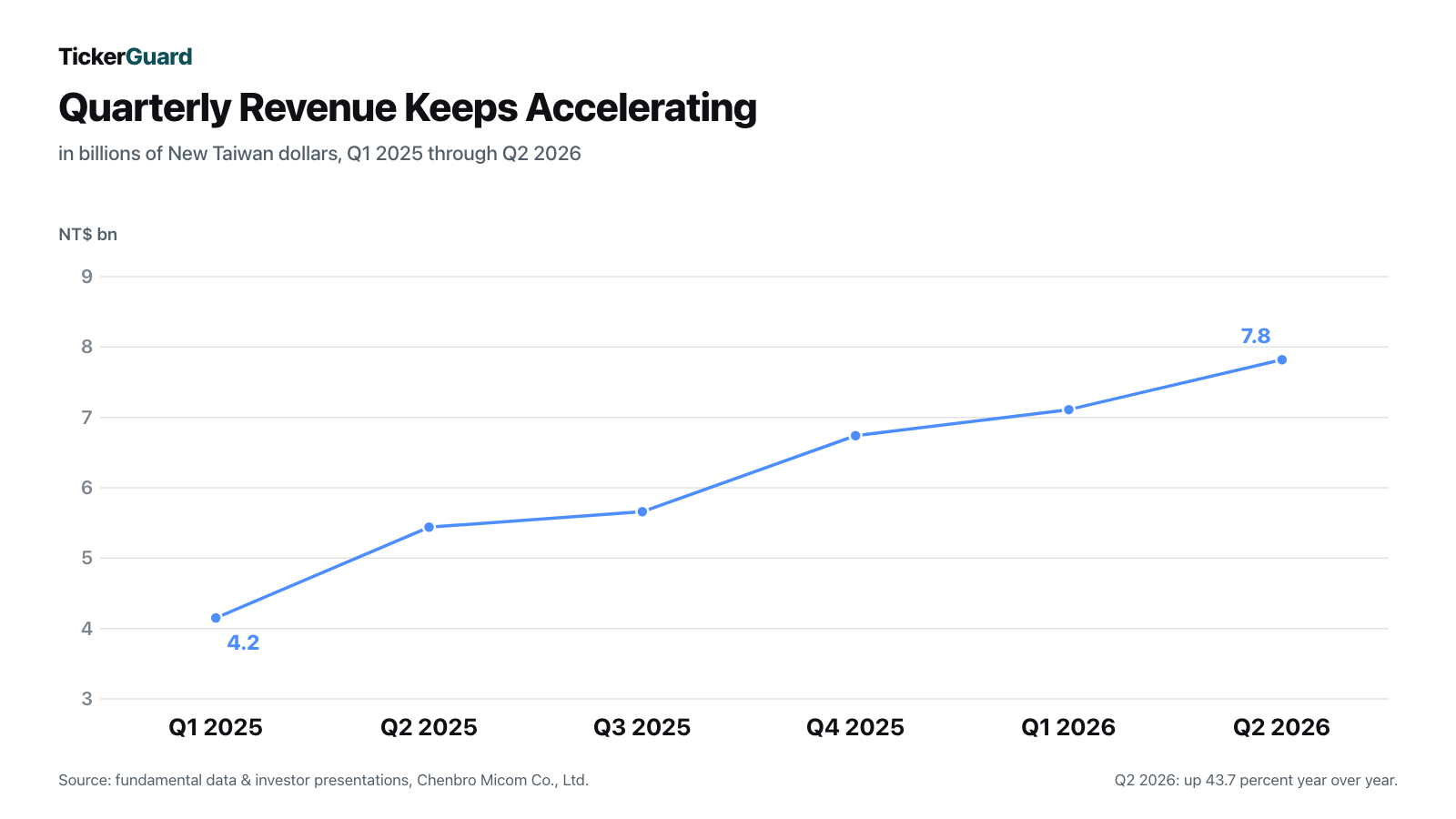
The balance sheet grew alongside it: equity rose from NT$10.88 billion (December 31, 2025) to NT$12.47 billion (June 30, 2026), and cash rose from NT$5.69 billion to NT$8.81 billion. Free cash flow came in at NT$2.11 billion in 2025 (operating cash flow of NT$3.09 billion minus capital expenditure of NT$0.98 billion) — a company financing most of its growth internally rather than piling on debt.
What the Earnings Calls Show — Without Official Transcripts
An honest disclosure upfront: no publicly available word-for-word transcripts of earnings calls exist for Chenbro Micom — a check against this publication's own database returned no matches, and the company's investor-relations page publishes only slide decks, not transcripts. This chapter is therefore based on investor presentations plus coverage from BigGo Finance (the August 7, 2026 call on second-quarter 2026 results) and TVBS World Taiwan (April 14, 2026, on fourth-quarter 2025 results) — a weaker evidentiary basis than a verbatim transcript, disclosed here deliberately.
Still, the shift in tone over eighteen months is instructive. Through early 2025, management sounded almost unreservedly optimistic: in spring 2024, per that period's investor presentation, Chenbro expressed confidence in revenue growth driven by customers' AI demand — and delivered: revenue grew 29.1 percent in 2024 and 51.6 percent in 2025. The same confidence carried into spring 2025 for continued growth — again borne out, with revenue up 55.5 percent in the first half of 2026. But a look at the announced plant expansions tells a different story: per coverage of the April 2026 call, mass production at the planned Dallas, Texas plant was expected to start in the third quarter of 2026. Per coverage of the August 2026 call, that slipped to the third quarter of 2027 — U.S. mass production has been pushed back roughly a year, even as the company announced a new "core rack production base" in Vietnam, expected to start operations as soon as August 2026 and reach mass production in early 2027.
Risk language has also sharpened. Per TVBS coverage, management first explicitly named tariff uncertainty, higher freight costs, and the possibility of an "AI investment bubble" as risks on the April 2026 call. By the August 2026 call, per BigGo coverage, the language had hardened further: second-half 2026 market uncertainty was "significantly higher" than in the first half, paired with a list of seven specifically named risk indicators (oil prices, U.S.-China trade policy, memory-chip prices, cloud-provider capital spending, AI financing and IPO activity, power supply, and geopolitics). At the same time, management reaffirmed its full-year revenue target of more than NT$22 billion — arithmetically achievable after NT$17.39 billion in cumulative revenue over the first seven months of 2026, but paired with acknowledged, growing uncertainty. Explaining the weak July results (see below), management stated, per coverage, that it had seen "no directional change in fundamentals" — customer demand remained intact.
What the Reports Show — the Uncomfortable Truths
Uncomfortable truth #1: 56 percent of revenue rides on four customers — the annual report calls that "no risk"
The 2024 annual report lists its four largest customers anonymously as "Customer A" through "Customer D": Customer B at 17 percent of revenue, Customer A at 15 percent, Customer C at 14 percent, and Customer D at 10 percent — a combined 56 percent of total net revenue of NT$14.52 billion in 2024 (in 2023, the same four customers made up 62 percent, led by a single customer at 25 percent). The report does not disclose who these customers are — standard practice in an industry where non-disclosure agreements with chip designers and cloud providers are the norm. What stands out is the company's own framing, in the risk section of the very same report:
"The Company's largest customer accounts for only 17% of total consolidated net sales revenue, and no single customer exceeds 50%, indicating no sales concentration risk."
— Chenbro Micom Co., Ltd., Annual Report 2024, page 133, "Risk from centralized purchasing or selling" section

That argument is technically correct — no single customer crosses the 50 percent threshold — but it shifts the yardstick: when four customers together make up more than half the business, an order slowdown at just one of them shows up immediately as a double-digit percentage hit to consolidated revenue. For readers, that means the company's impressive growth rates rest on a narrower base than the headline revenue figure suggests.
Uncomfortable truth #2: one single month showed how fast the supply chain can turn
In June 2026, Chenbro posted a record monthly revenue of roughly NT$3.25 billion, per coverage of the August call. In July 2026, monthly revenue dropped to roughly NT$2.46 billion — a decline of 23.9 percent from the prior month. Management attributed the drop to component shortages and shipping-schedule shifts rather than lost orders, per coverage. Whether that explanation holds up cannot be independently verified from public sources — but the magnitude of the swing itself is documented: a single month at Chenbro can lose nearly a quarter of revenue even in the middle of a record year with an intact order book. That is a direct consequence of production and shipments being tied to a handful of large projects and their component availability — the same structural feature already visible in the first uncomfortable truth.
Uncomfortable truth #3: a single family holds a substantial share of the stock through direct, marital, and nominee arrangements
The 2024 annual report lists, among shareholders holding more than 10 percent, both Chairperson Mei-chi Chen (8.00 percent directly, as of March 31, 2025) and the investment firm Peng Wei Investment, with 12,180,000 shares (10.07 percent). A footnote clarifies who actually owns those shares:
"Chairperson Mei-chi Chen held the shares by nominee arrangement."
— Chenbro Micom Co., Ltd., Annual Report 2024, page 89, footnote 1
That puts more than 18 percent of the shares under the chairperson's control across two disclosed positions. The same table lists director Tsun-yen Lee with 5,306,029 shares (4.39 percent directly) — recorded as a "relative-in-law" of the chairperson — married to Feng-ming Chen, who herself holds 13,191,433 shares (10.90 percent). Four named positions in the 2024 annual report — the chairperson directly, Peng Wei Investment as her nominee holding, Feng-ming Chen, and Tsun-yen Lee — add up to roughly 33 percent of the shares within a single family circle, a link the plain shareholder list does not make obvious at first glance. None of this is wrongdoing, and it is fully disclosed — but it means anyone investing in Chenbro is effectively investing in a family-controlled company, where one family can channel a very large share of the votes through multiple avenues.
How Expensive Is Chenbro Micom Stock, Really?
At a share price of NT$990 (August 28, 2026) and 125,619,146 shares outstanding, market capitalization comes to roughly NT$124.4 billion — about $3.93 billion or €3.39 billion. Based on the trailing four reported quarters, the price-to-earnings ratio (P/E) sits at roughly 26; using full-year 2025 earnings instead (roughly NT$28.3 earnings per share) puts the P/E at a higher 35 — the gap shows how much the current year has already shifted the picture upward. The price-to-sales ratio based on the trailing four quarters is roughly 4.55, and the analyst consensus price target per fundamental data is NT$1,431.54 (roughly 45 percent above the current price) — though without a breakdown of how widely that consensus is spread.
For comparison: Taiwan's two other publicly traded chassis makers are considerably smaller — AIC (TWSE: 3693) with a market cap of roughly NT$20.6 billion and InWin at roughly NT$6.6 billion (Forbes, April 16, 2026), versus Chenbro's roughly NT$124 billion. Chenbro itself, however, sees its real competition on the rack level not from these small chassis makers but from the large contract manufacturers that integrate entire racks themselves. Anyone buying the stock at this price is paying for a company whose valuation already assumes sustained high growth — and whose revenue base, as shown above, rests on a small number of customers.
Opportunities and Risks at a Glance
Opportunities: a structurally growing end market (AI data centers need increasingly dense, liquid-cooled rack solutions, and Chenbro has positioned itself as a partner to several chip makers — per company statements, including Nvidia, AMD, Intel, and Ampere); a gross margin that has risen every year for four straight years (19.6 to 30.0 percent), showing Chenbro has moved from an interchangeable supplier toward a higher-value integrator; a solid, growing balance sheet with far more cash than short-term debt; and a dividend that has risen continuously (from NT$2.50 per share in 2012 to NT$14.00 most recently in 2026). Risks: a 56 percent revenue concentration on four unnamed customers that the company itself calls unproblematic; a single month (July 2026) that showed a nearly one-quarter revenue drop; a U.S. plant expansion already delayed by roughly a year; family control of roughly one-third of the shares through direct, marital, and nominee arrangements; and a valuation that assumes sustained high growth in a market management itself now calls "significantly more uncertain" for the second half of 2026.
A Human Conclusion
Back to the halo effect from the opening. The Nvidia name on Chenbro's press releases is not false advertising — the collaboration is real, publicly documented, and has visibly reshaped the company's gross margin. But that very credibility is the trap: a famous partner's name does not answer how broad the actual customer base is, how resilient a single supply chain really is, or who ultimately controls the company. The annual report answers those questions itself — with a 56 percent customer concentration it calls "no risk," with a July that showed how quickly that can change, and with a family that holds a substantial share of the stock through multiple channels. None of that makes Chenbro a bad company — it makes it a company that rewards a closer read than a shiny partner name suggests at first glance. What you make of that reading is your call — not the name on the press release.
Sources
This analysis draws on: the 2024 annual report of Chenbro Micom Co., Ltd. (chenbro.com/en-US/shareholder-service, printed April 8, 2025); press releases on NVIDIA GTC 2025 (March 19, 2025), NVIDIA GTC 2026 (March 17, 2026), COMPUTEX 2026 (June 2, 2026), and the 2025 OCP Global Summit (October 15, 2025); earnings-call coverage from BigGo Finance on the August 7, 2026 call (finance.biggo.com/news/TW_8210.TW_2026-08-07) and TVBS World Taiwan on the April 14, 2026 call (news.tvbs.com.tw/english/3178003); a Forbes profile from April 16, 2026 (full text verified via VnExpress syndication after the Forbes original returned a block on direct access); and fundamental data (balance sheet, income statement, cash flow, price and valuation metrics, as of August 27–30, 2026). No publicly available word-for-word earnings-call transcripts exist for 8210.TW. Note: this analysis is journalistic interpretation of publicly available information. It is not investment advice and not a solicitation to buy or sell securities.
Our Bottom Line at a Glance
- Growth positive
- Revenue up 51.6 percent in 2025 to NT$22.00 billion, up 55.5 percent in the first half of 2026 to NT$14.93 billion — six straight quarters of rising revenue, driven by the Nvidia MGX collaboration and the shift from chassis maker to rack integrator.
- Margin trajectory positive
- Gross margin rose from 19.6 percent (2021) to 30.0 percent (2025) and 32.7 percent (H1 2026) — clear evidence Chenbro has moved from an interchangeable supplier toward a higher-value integrator, not just selling more units at lower prices.
- Customer concentration negative
- Four unnamed customers accounted for a combined 56 percent of 2024 revenue (62 percent in 2023) — the annual report itself calls that "no sales concentration risk" because no single customer exceeds 50 percent. The July 2026 monthly drop (down 23.9 percent) shows how quickly that concentration can hit the numbers.
- Balance sheet & liquidity positive
- Equity grew from NT$10.88bn to NT$12.47bn (2025-12-31 to 2026-06-30), cash from NT$5.69bn to NT$8.81bn; free cash flow of NT$2.11bn in 2025. Growth is being financed mostly out of internal cash flow.
- Valuation neutral
- P/E of roughly 26 (trailing four quarters) or roughly 35 (on full-year 2025 earnings), P/S of roughly 4.55 — not an extreme multiple given the growth rate, but it assumes the current pace continues even as management itself warns of "significantly higher" uncertainty for the second half of 2026.
- Governance & control negative
- Chairperson Mei-chi Chen controls more than 18 percent through a direct stake (8.00 percent) plus an investment firm disclosed as a nominee arrangement (10.07 percent); together with her sister and brother-in-law, four positions add up to roughly 33 percent — substantial, fully disclosed family control that a plain shareholder list would not reveal.
Chenbro Micom delivers operationally on what the Nvidia partnership implies: revenue and gross margin have both accelerated for four straight years, the balance sheet is solid, and the dividend keeps rising. But the annual report itself shows a 56 percent customer concentration on four unnamed customers that it calls "no risk," a single month (July 2026) demonstrated a nearly one-quarter revenue drop, and one family controls roughly a third of the shares through multiple channels. Not investment advice.
What Our Rating Means
Open questions
The business works in principle, but one material question is open. As long as it stays open, our findings do not carry a quality verdict.
Yellow is not about an existential question here — the balance sheet is solid and growing, margins at 30 percent gross are among the highest this company has ever posted, and the dividend has risen for years. Yellow reflects several open operating questions central to the growth story's durability. First, 56 percent of 2024 revenue rests on four customers the annual report itself does not treat as a risk, even though together they make up more than half the business. Second, July 2026 showed, with a 23.9 percent monthly revenue drop, how quickly supply-chain issues can hit the numbers. Third, the announced U.S. plant expansion has already slipped by roughly a year, even as management itself now warns of "significantly higher" uncertainty for the second half of 2026. The business model itself — the shift from chassis maker to rack integrator for AI data centers — clearly holds up; whether the customer base broadens and how the company weathers a genuine downturn in the cyclical AI-capex business will show up no earlier than the third-quarter-2026 report.
A journalistic assessment by our editorial team at the time of the deep dive, based on public sources — not investment advice and not a solicitation to buy or sell. Your personal circumstances (investment goals, risk capacity, taxes) cannot be taken into account. What our levels mean, how verdicts are formed, and what conflicts of interest exist →
Worth Noting
- This analysis first published on 2026-08-30. Annual figures for 2021 through 2025 and quarterly figures for 2025/2026 come from fundamental data (annual and quarterly statement series); customer-concentration and governance findings come from the 2024 annual report (the most recent complete annual report available at research time) — both sources are cited separately in the text and in the source list.
- No publicly available word-for-word earnings-call transcripts exist for 8210.TW (checked against this publication's own database on 2026-08-30: no matches). The earnings-call chapter therefore relies on investor presentations and press coverage (BigGo Finance, TVBS World Taiwan) rather than verbatim transcripts.
- Earnings per share and P/E were calculated using the current share count (125,619,146, as of 2026-08-30); officially reported earnings per share for individual prior periods may differ slightly due to share-count changes during the year.
The full analysis as a PDF for later
We will send you this analysis as a PDF — to print, file away, and read at your own pace.
Frequently Asked Questions
Chenbro Micom Co., Ltd. (TWSE: 8210), based in New Taipei City, Taiwan, builds server and storage chassis, barebone servers, and rackmount and tower enclosures — about 99 percent of revenue. Products are sold via three models: OTS (off-the-shelf), JDM (joint development with the customer), and OEM Plus (contract manufacturing). Since 2025 the company has also positioned itself as a rack integrator for Nvidia's AI servers based on the MGX architecture.
No. Chenbro builds chassis and rack mechanics for servers that customers fill with AI chips — the company itself does not sell AI software or hardware. Internally, its 2024 annual report does describe a strategy of "intelligent manufacturing" (factory automation) and staff training on the safe use of AI tools.
Heavily: four customers made up a combined 56 percent of 2024 revenue, per the annual report (Customer B 17 percent, A 15 percent, C 14 percent, D 10 percent); in 2023, the same four customers made up 62 percent. The report does not name them. Chenbro itself calls the concentration "no risk" because no single customer exceeds 50 percent.
Per coverage of the August 7, 2026 earnings call, monthly revenue fell 23.9 percent in July 2026 versus the record month of June (from roughly NT$3.25 billion to roughly NT$2.46 billion). Management cited component shortages and shipping-schedule shifts, not lost orders — a claim that cannot be independently verified from public sources.
Yes, continuously since at least 2011 and with a rising trend: from NT$2.50 per share (2012) through NT$4.00 (2019 and 2023) and NT$7.50 (2025) to NT$14.00 per share most recently (2026, out of fiscal-year-2025 profit) — roughly a 49 percent payout ratio on 2025 earnings.
At NT$990 (August 28, 2026) and a market cap of roughly NT$124.4 billion (about $3.93 billion), the price-to-earnings ratio based on the trailing four quarters is roughly 26, and roughly 35 based on full-year 2025 earnings. The price-to-sales ratio is roughly 4.55.
Founder and chairperson Mei-chi Chen directly holds 8.00 percent of the shares, per the 2024 annual report, plus another 10.07 percent through an investment firm (Peng Wei Investment) disclosed as a nominee arrangement. Together with her sister Feng-ming Chen (10.90 percent) and the sister's husband, director Tsun-yen Lee (4.39 percent), four named positions add up to roughly 33 percent of the shares within one family.
Found an error?
Did you spot a factual error, an outdated number, or a typo in this deep dive? Let us know briefly — your report goes straight to the editorial team.