Caledonia Mining: The Same 14 Cents Dividend, Quarter After Quarter — Even in the Loss Year. Now Comes the $150 Million Bet on Zimbabwe
When a stock pays the exact same dividend for 13 quarters in a row — even in the one year the group posted a loss — it feels like safety. Caledonia Mining (NYSE American: CMCL) mines gold in Zimbabwe, sits on $167.8 million in cash, and just raised $150 million via convertible notes to build a second, much larger mine. But its filings with the U.S. securities regulator, the SEC, also show: a third of its gold must be sold to a refinery owned by the Zimbabwean state, production costs have risen by half in a single year, and the same report names two different maturity years for the same bond in two different places. Not investment advice — just a look at what reliability actually means, and what it doesn't.
 Thomas Mücke
Founder & Publisher
Thomas Mücke
Founder & Publisher
As of Today
As of: October 9, 2026
- Closing price
- 23.80 $ -2.70%
- Market Capitalisation
- 0.5 $B
- P/E
- 7.7
- Growth Score
- 8/10
- AAQS
- 9/10
Price change since August 25, 2026: -5.9%
This analysis has a cut-off date. The Stock Guard tells you when something material changes in the numbers. Reserve your free spot
Chart
Interactive price chart (TradingView).
52-week range: 16.80 $ to 37.70 $ · Last price: 23.80 $ (As of: October 9, 2026)
Note: pure fact-based analysis, not investment advice and not a solicitation to buy or sell. All figures without guarantee.
There is a thinking trap that especially cautious investors fall into — because it feels like the opposite of recklessness: the reliability fallacy. It works like this: a company pays the same dividend, quarter after quarter, with the regularity of a clock. Your brain draws the automatic conclusion: "Whatever is this consistent must also be safe." That is an easy trap to fall into with Caledonia Mining Corporation Plc (NYSE American: CMCL). Since at least April 2023, the company has paid exactly $0.14 per share in dividends, quarter after quarter — even in the one year the group reported a net loss on the bottom line. That reliability is real. But it says nothing about how the money is earned: in a single gold mine in southwestern Zimbabwe, in a country whose own central bank replaced its currency yet again in 2024. Before you read that dividend as a promise of safety, it is worth looking at what Caledonia actually discloses to the U.S. securities regulator, the SEC — the annual report (Form 20-F) for 2025 and the interim report (Form 6-K) for the first half of 2026. An SEC filing is honest under penalty of law. And this one tells the story of a company rebuilding its future around a $150 million bet — while structurally required to sell part of its gold to the Zimbabwean state. In the end, you decide what "reliable" actually means here.
What Caledonia Actually Does — a Jersey Holding Company With a Single Real Operation: Zimbabwe
Caledonia Mining is legally a holding company headquartered in St Helier, Jersey (Channel Islands) — anchored in Europe for tax and regulatory purposes, but 100% operational in Zimbabwe. The stock trades under the symbol CMCL in three places at once: as common stock on NYSE American in the United States, via depositary interests on AIM of the London Stock Exchange, and via depositary receipts on the Victoria Falls Stock Exchange (VFEX) in Zimbabwe itself. The core business is the Blanket mine, a decades-old producing underground gold mine in which Caledonia holds a 64% stake — the remaining 36% belongs to Zimbabwean partners under the country's "indigenisation" policy (more on that below). Blanket produced 76,213 ounces of gold in 2025. Caledonia also owns 100% of the Bilboes project: a small oxide mine that has been on care and maintenance (heap leaching) since September 2023, plus the much larger Bilboes sulphide project, which a feasibility study published in November 2025 says holds 1.75 million ounces of proven and probable reserves across 24.1 million tonnes of ore — with first gold pour targeted for late 2028 and a 10.8-year mine life. Rounding out the portfolio are the Motapa and Maligreen exploration properties, for which a first Motapa mineral resource estimate is expected in 2026. Group-wide, Caledonia employed 2,357 people as of December 31, 2025, of whom 2,323 were in Zimbabwe. Mark Learmonth has been CEO since July 1, 2023 (with Caledonia since 2008, CFO from 2014 to 2023); as of May 2026, July Ndlovu serves as the new, independent Chairman (succeeding John Kelly). That frames the tension at the heart of this analysis: a company with a European holding-company facade whose entire value depends on how well it operates in one of the world's most difficult mining jurisdictions — and which is now building its largest-ever capital project in that same jurisdiction.
Company history for investors
-
2012
Indigenisation cuts Caledonia's Blanket stake to 49%
On September 5, 2012, Caledonia is required under Zimbabwean indigenisation law to hand 51% of Blanket to local partners — concrete proof of the political risk.
-
2020
Buyback to 64% of Blanket
On January 20, 2020, Caledonia buys back 15 percentage points from Fremiro Investments after the indigenisation requirement for gold mines was lifted in 2018 — the stake rises to 64%.
-
2023
Bilboes acquisition and a net loss
In January 2023, Caledonia acquires Bilboes from a group led by current Executive Director Victor Gapare; that same year the group reports a $7.9 million net loss while keeping the dividend unchanged.
-
2025
Bilboes feasibility study published
In November 2025, Caledonia publishes the final feasibility study for the Bilboes sulphide project: 1.75 million ounces of reserves, first gold pour targeted for late 2028.
-
2026
$150 million convertible note
In January 2026, Caledonia raises $150 million via convertible notes to fund Bilboes — for shareholders, the start of a new dilution mechanism above a $40.51 share price.
-
2026
July Ndlovu becomes new Chairman
Effective May 5, 2026, July Ndlovu takes over as Chairman from John Kelly after the annual meeting — a leadership change in the middle of the Bilboes build.
-
2026
Cost squeeze in the first half
The interim report dated August 10, 2026 shows production costs per ounce rising faster (+50.7%) than the gold price (+47.8%) year-on-year — an early warning sign for shareholders despite still-rising profit.
Where This Stock Landed on Our Desk
Caledonia caught our attention not through a dramatic price move but through a contrast: a quarterly dividend unchanged for more than three years on one side, a freshly raised $150 million convertible note for a growth project on the other. That combination — small-scale reliability, a large new bet — is worth a closer read of the SEC filings before assuming the two are the same thing.
The Numbers Over the Years
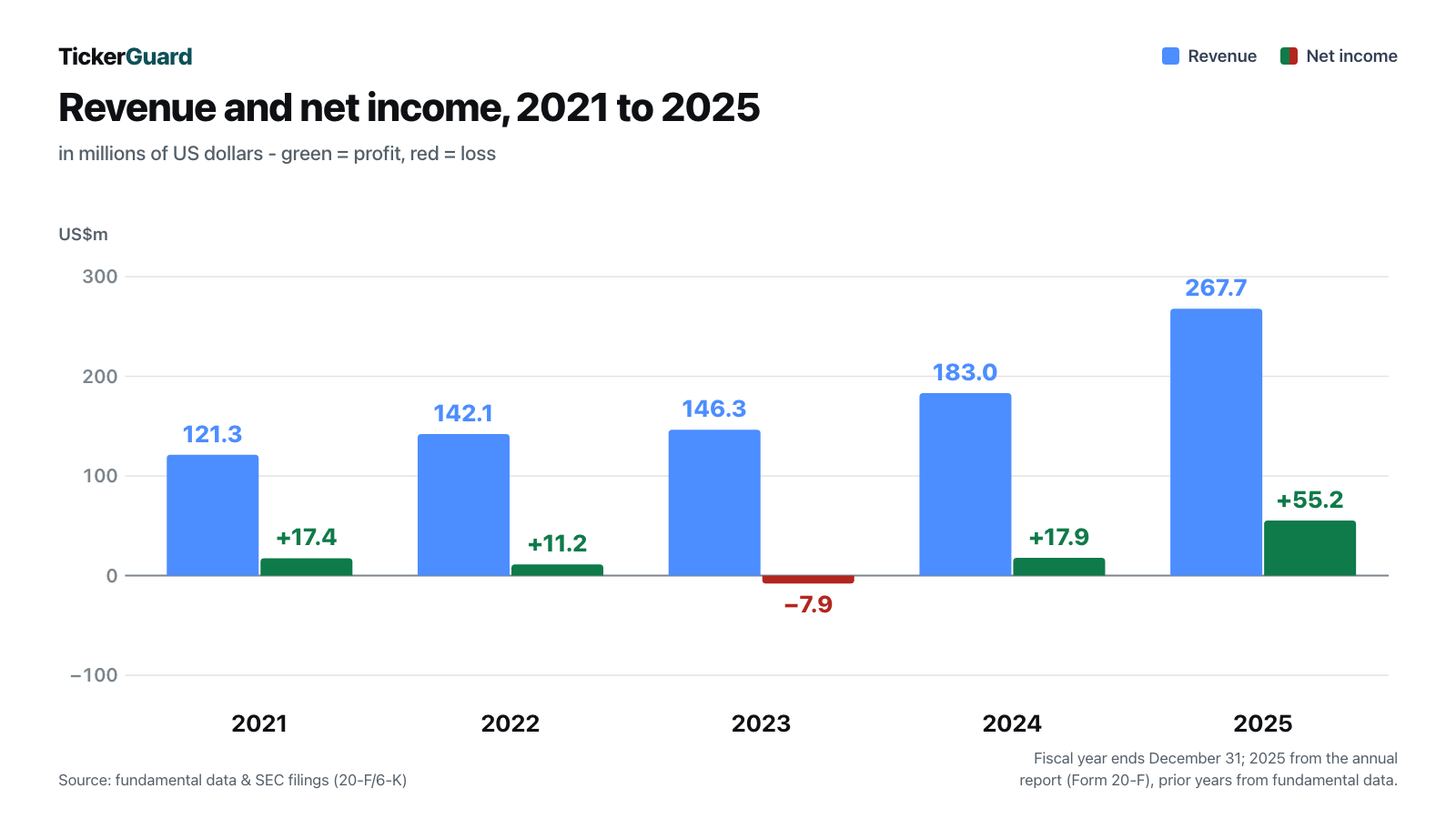
Caledonia's revenue more than doubled between 2021 and 2025 — driven by the gold price, not just output. Per the annual report (20-F) for 2025, revenue reached $267.7 million in 2025, up from $183.0 million in 2024. Net income swung far more sharply: 2023 showed a net loss of $7.9 million — a year in which the Bilboes oxide mine was still producing at high cost before it moved to care and maintenance at the end of September 2023. In 2024 and 2025 the group returned to solidly profitable territory: net income of $17.9 million and $55.2 million respectively, per the annual report driven by a realised gold price that rose from $2,347 per ounce (2024) to $3,383 (2025).
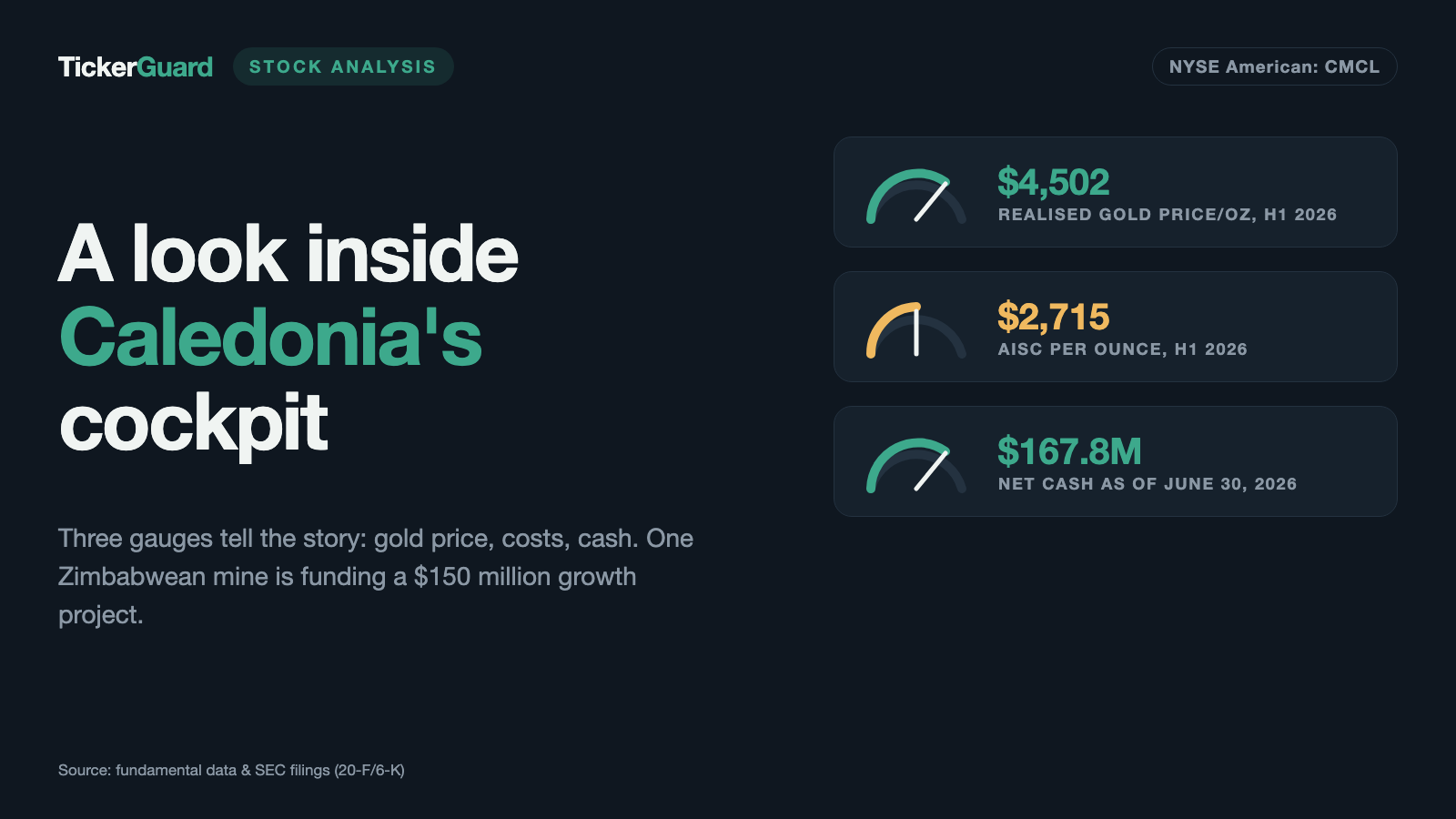
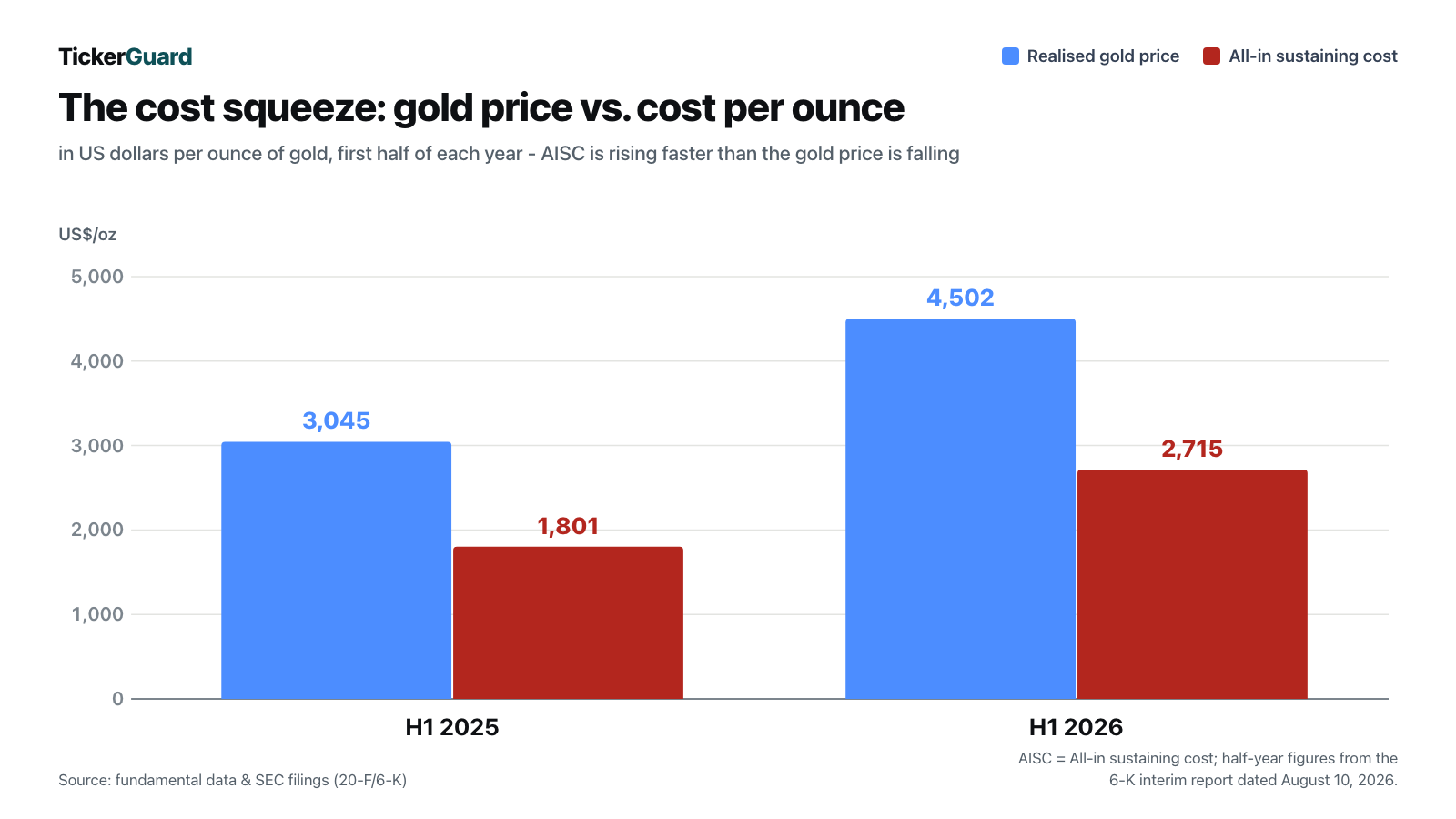
The first half of 2026 shows that this upward trend has two sides. The realised gold price kept climbing, from $3,045 per ounce (H1 2025) to $4,502 (H1 2026) — a 47.8% increase. But the all-in sustaining cost (AISC) — production costs including the capital needed to sustain output — rose almost as fast over the same period: from $1,801 to $2,715 per ounce, a 50.7% increase. The interim report cites higher wage costs (distributions to the BETS employee trust, booked as employee costs), higher royalties tied to the strong gold price, and advisory fees for the convertible notes.
The reason for the lower output is also in the interim report: in the second quarter of 2026, Blanket produced 17,360 ounces of gold, 17.6% less than the exceptionally strong comparative quarter in 2025 (21,070 ounces) — due to constrained access to higher-grade ore in the planned mining sequence. Management nonetheless reaffirmed its 2026 production guidance for Blanket of 72,000 to 76,500 ounces, while revising cost guidance upward: on-mine cost per ounce is now expected at $1,600 to $1,800 (previously lower), and AISC at $2,500 to $2,700.
What Management Promised — and What Actually Happened
Running a separate transcript archive for a Zimbabwe-focused name like Caledonia is rarely necessary — the company discloses its earnings calls thoroughly enough that five transcripts from the last five quarters (May 2025 through August 2026) could be reviewed in full. The most persistent thread runs through the cost story: as early as the fourth-quarter 2025 call (March 2026), CEO Mark Learmonth acknowledged that on-mine costs were "marginally above those cost guidance ranges that we had guided the market" — a consequence of the same constrained access to higher-grade ore that continued into the first half of 2026. Management did not hide this development; it named it consistently, quarter after quarter, and adjusted guidance accordingly rather than clinging to an overly optimistic number — a point in favor of the communication's credibility.
The Bilboes project shows a similar pattern of announcement followed by delivery: in the first-quarter 2025 call (May 2025), Executive Director Victor Gapare described an ongoing optimization of the feasibility study — a smaller upfront investment, an initial focus on the Isabella and McCays pits, with the Bubi deposit pushed to a later phase. That very same optimized concept became the final feasibility study Caledonia published in November 2025, with almost no further delay. In the Q&A portion of the second-quarter 2026 call (August 2026), an analyst pressed on the pace of execution: of the $48 million budgeted for 2026 Bilboes capital spending, only about $13 million had been invested by mid-year. Learmonth's answer was direct: "The spending isn't constrained by lack of funding. The spending has usually been constrained by slow delivery of materials … we're comfortable we can get there." He attributed the shortfall to supply-chain delays, not to a lack of capital or commitment — a testable but as-yet-unproven explanation: whether the remaining $35 million actually gets spent by year-end will only be clear from the next report. Overall, the communication pattern reads as unusually transparent — Learmonth answers uncomfortable Q&A questions directly rather than deflecting — but the Blanket cost trajectory shows that Caledonia's guidance has needed regular recalibration.
What the Filings Show — the Uncomfortable Truths
Uncomfortable truth #1: a third of the gold must be sold to the Zimbabwean state — paid in a currency that keeps depreciating
Hear "gold producer" and you think of a world-market price in US dollars. At Caledonia, that is only 70% true. The interim report for the first half of 2026 describes the mechanism:
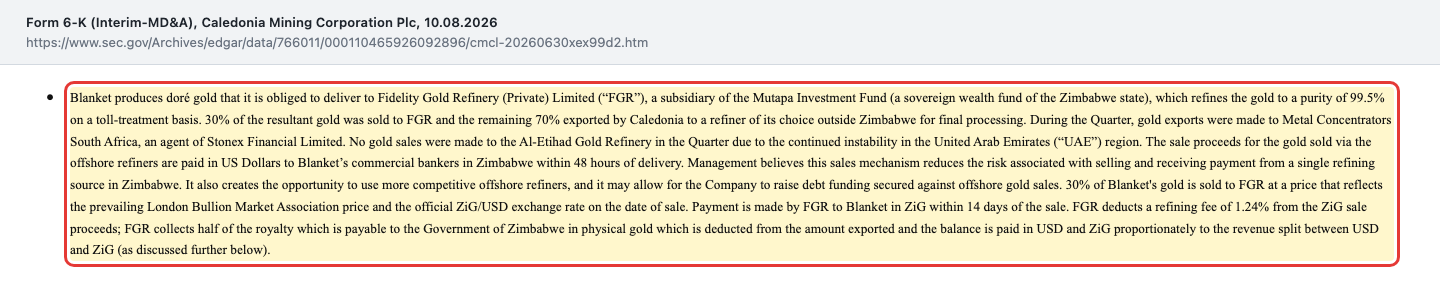
"Blanket produces doré gold that it is obliged to deliver to Fidelity Gold Refinery (Private) Limited ('FGR'), a subsidiary of the Mutapa Investment Fund (a sovereign wealth fund of the Zimbabwe state), which refines the gold to a purity of 99.5% on a toll-treatment basis."
— Caledonia Mining Corporation Plc, SEC interim report Form 6-K for the first half of 2026, "Zimbabwe Commercial Environment" section
So 30% of the gold produced must go to FGR and is paid at the official ZiG/USD exchange rate — minus a 1.24% refining fee and the royalty, part of which FGR withholds in physical gold. Only the remaining 70% can Caledonia sell freely to refiners outside Zimbabwe and be paid in US dollars, within 48 hours. The problem: Zimbabwe's local currency, the ZiG, keeps depreciating. In the second quarter of 2026, that depreciation cost Blanket $1.7 million in net realised foreign-exchange losses on ZiG holdings — money that has nothing to do with operations and everything to do with currency policy. Picture a small business forced to bill a third of its invoices in a currency the customer itself prints and regularly devalues. This dependency is not a new risk — it is the price of being allowed to mine gold in Zimbabwe at all.
Uncomfortable truth #2: the group's stake in its own flagship mine was already cut once before — by government policy, not by a business decision
How tightly this country risk is woven into ownership itself shows up in Blanket's history. On September 5, 2012, Caledonia had to hand 51% of Blanket to local partners under Zimbabwe's then-current "indigenisation" legislation — the group's stake fell from 100% to 49%. Only after President Mnangagwa's government lifted the indigenisation requirement for gold mines by a 2018 legislative change could Caledonia buy back part of that stake in January 2020 (15 percentage points from Fremiro Investments (Private) Limited, partly through the issuance of new Caledonia shares), restoring its stake to 64%, where it stands today.

That episode is history today, not an active threat — Zimbabwe's current government lifted the indigenisation requirement for gold mines in 2018, and nothing in recent filings suggests a return to that policy. But it is concrete proof that ownership rights in Zimbabwean mines have been altered by law before — a risk the annual report itself still lists under "expropriation and nationalization, or mandatory levels of Zimbabwean ownership beyond currently mandated levels."
Uncomfortable truth #3: $150 million in new debt for a project whose own maturity date the company can't state consistently
To finance the Bilboes sulphide project, Caledonia closed a $150 million convertible notes offering in January 2026 (5.875% coupon, including the initial purchasers' full exercise of a $25 million over-allotment option).
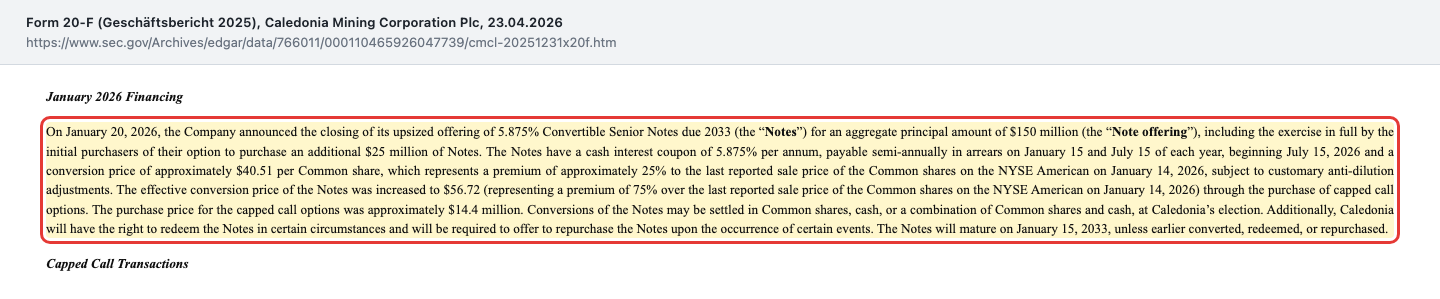
"The Notes will mature on January 15, 2033, unless earlier converted, redeemed, or repurchased."
— Caledonia Mining Corporation Plc, SEC annual report Form 20-F for 2025, "January 2026 Financing"
That much is clearly documented in the annual report. What is notable is what happens in the later interim report dated August 10, 2026: the section on liquidity suddenly refers to "Convertible Senior Notes due 2030" — while another section of the very same document, on financing activities, correctly says "due 2033." On its own, that is a small error. But for a bond that represents roughly 31% of the company's market capitalization (at a market value of about $489 million as of 08/25/2026), it shows how much organizational attention is currently flowing toward the large new project — and how little time apparently remains to proofread the company's own disclosures. For investors, what matters is the mechanism documented in the annual report: if the stock rises above the $40.51 conversion price, noteholders can convert; $14.4 million of purchased capped call options push that economic threshold to $56.72. Both marks sit well above the current share price of $25.29 (08/25/2026) — but they are the benchmark against which future dilution will be measured.
Valuation: Cheap on the P/E, But the Ratio Hides the Country Risk
At a share price of $25.29 (closing price 08/25/2026) and 19,335,079 shares outstanding (per the interim report dated 08/10/2026), Caledonia's market capitalization comes to roughly $489 million. On earnings, the stock looks cheap: the price-to-earnings ratio sits around 7 — well below what many gold producers with a comparable growth story command at more established mining jurisdictions. The price-to-book ratio of about 1.7 (book value roughly $15.20 per share) is likewise modest. The dividend yield is about 2.2%, underpinned by the $0.14 per share that has held steady for at least 13 quarters. These metrics are exactly why a careful look is warranted rather than mistaking the low valuation for a bargain: the market prices Caledonia more cheaply than comparable producers in politically more stable countries typically trade — a classic "country-risk discount." We have seen this discount before at other African gold producers: our analysis of Allied Gold shows a very similar pattern of operating substance paired with country-specific special factors. Whether Caledonia's discount is too large, too small, or fair depends on how you weigh the Zimbabwe risk described in this analysis — a judgment nobody else can make for you.
Opportunities and Risks at a Glance
What speaks for Caledonia Mining:
- Sharply rising revenue ($121.3 million to $267.7 million, 2021 to 2025) and a strong gold-price tailwind: realised price up from $2,347 to $3,383 per ounce (2024 to 2025), reaching $4,502 in the first half of 2026.
- A very strong balance sheet: $167.8 million in cash, net of overdrafts, as of 06/30/2026 (up from $8.2 million a year earlier, but before the new $150 million note), with an explicit going-concern affirmation for at least twelve months in the interim report.
- Reliable capital return: a $0.14 per share dividend unchanged for at least 13 quarters, maintained even through the 2023 loss year.
- A concrete, independently vetted growth project: the Bilboes feasibility study (November 2025) with 1.75 million ounces of reserves and a 10.8-year mine life, financed without immediate share dilution via a convertible note with dilution protection up to $56.72.
- Attractive relative valuation: a P/E around 7, price-to-book around 1.7 — room to re-rate upward if Bilboes delivers as planned, even after a country-risk discount.
What speaks against it:
- Structural dependence on the Zimbabwean state: 30% of the gold must be sold to the state-owned Fidelity Gold Refinery, paid in a depreciating local currency ($1.7 million in FX losses in the second quarter of 2026 alone).
- Historically documented political risk: the Blanket stake was cut to 49% by law in 2012 and only bought back to 64% in 2020 — country risk here is not theoretical; it has already happened once.
- Cost blowout at the core mine: AISC per ounce rose 50.7% from H1 2025 to H1 2026, faster than the 47.8% rise in the gold price — only the very high gold price has masked this so far.
- $150 million in new debt for a project that won't produce until 2028, carrying execution risk (per the earnings-call Q&A, only about $13 million of the $48 million annual Bilboes budget had been spent by mid-2026) and a documented self-contradiction about its own maturity date.
- Concentrated ownership: Executive Director Victor Gapare holds 12.66% through a family company while also running the very project he previously sold to Caledonia.
A Human Conclusion
Back to the reliability fallacy from the beginning. It has a kernel of truth at Caledonia: the dividend has flowed reliably for over three years, even when the group posted a loss in 2023. But past reliability is no guarantee of future reliability — especially not when the underlying business structurally depends on the decisions of a foreign government that has already cut the company's own ownership stake by law once before. Investing in Caledonia means buying not just a growing gold business at an attractive valuation — it means buying the Zimbabwe risk that underlies that attractive valuation in the first place. So the honest question isn't "Has the dividend been reliable so far?" but: Do you trust management to keep managing that risk well even as $150 million in new debt and a Bilboes project costing well over $100 million are added to the mix? If yes, you have a thesis that goes beyond the dividend track record. If no, you had a case of mistaking reliability for safety. What you do with that is your decision.
Sources
All primary documents used in this analysis — for your own reading:
- Caledonia Mining Corporation Plc — SEC annual report Form 20-F for 2025 (filed April 23, 2026)
- Caledonia Mining Corporation Plc — SEC interim report Form 6-K, interim MD&A for the first half of 2026 (filed August 10, 2026)
- Full SEC filing history for Caledonia Mining Corporation Plc: EDGAR overview (sec.gov)
- Five earnings-call transcripts (Q1 2025 through Q2 2026, May 12, 2025 to August 10, 2026), in-house transcript database.
- Fundamental data (metrics, valuation; data as of August 26, 2026), cross-checked against the SEC filings.
Transparency & disclaimer: This analysis is a journalistic assessment of publicly available information and does not constitute investment advice, a regulated financial analysis, or a solicitation to buy or sell any security. Equity investments carry significant risk, including total loss. All information is provided without warranty; data as-of dates are noted throughout the text. Positions held by the operator are disclosed daily; where one exists, it appears as a notice at the top of this deep dive.
Key figures at a glance
All monetary figures in millions of $; earnings per share as reported.
| Metric | 2021 | 2022 | 2023 | 2024 | 2025 |
|---|---|---|---|---|---|
| Revenue | 121.3 | 142.1 | 146.3 | 183.0 | 254.1 |
| Operating Income (EBIT) | 36.1 | 30.2 | 11.0 | 43.7 | 115.6 |
| Net Income | 17.4 | 11.2 | -7.9 | 17.9 | 55.2 |
| Net Margin | 14.3% | 7.9% | -5.4% | 9.8% | 21.7% |
| Earnings Per Share | 1.43 $ | 0.88 $ | -0.42 $ | 0.93 $ | 2.83 $ |
Source: fundamental data & SEC filings (annual and quarterly reports, 10-K/10-Q)
Our Bottom Line at a Glance
- Operating substance & growth positive
- Revenue more than doubled from $121.3 million (2021) to $267.7 million (2025), driven by a strong gold price ($3,383/oz in 2025, $4,502/oz in H1 2026). A concrete, independently vetted growth project (Bilboes, 1.75 million ounces of reserves) is financed and under construction.
- Cost trajectory negative
- AISC per ounce rose 50.7% from H1 2025 to H1 2026, reaching $2,715 — faster than the 47.8% rise in the gold price, whose sheer size has masked the effect so far. Blanket output fell 17.6% in the second quarter of 2026 due to constrained ore access.
- Zimbabwe country risk negative
- 30% of the gold must be sold to the state-owned Fidelity Gold Refinery, paid in the depreciating local currency ZiG ($1.7 million in FX losses in the second quarter of 2026 alone). Caledonia's Blanket stake was already cut to 49% by law once, in 2012.
- Balance sheet & liquidity positive
- Cash of $167.8 million (net of overdrafts) as of 06/30/2026 (up from $8.2 million a year earlier), before the $150 million convertible note, with going concern explicitly affirmed in the interim report. The note increases debt, but with no near-term maturity before 2033 (per the annual report).
- Communication quality neutral
- Five reviewed earnings calls show unusually candid management that names cost overruns rather than obscuring them. Counterpoint: a documented self-contradiction in the interim report over the maturity year of the company's own $150 million bond (2030 vs. 2033).
- Ownership & governance structure neutral
- Executive Director Victor Gapare holds 12.66% of the shares through a family company while also running the Bilboes project his former company sold to Caledonia — fully disclosed, but it creates a tight link between personal wealth and project responsibility.
Caledonia Mining is a growing, currently profitable gold producer with a strong cash position and a dividend unchanged for more than three years — but its entire business is structurally tied to Zimbabwe: a forced sale of a third of its gold to the state, a depreciating local currency, a mine stake already cut once by law, and now a $150 million bet on a major new project. Not investment advice.
What Our Rating Means
Open questions
The business works in principle, but one material question is open. As long as it stays open, our findings do not carry a quality verdict.
Yellow, because the core business holds up — Blanket has been producing for decades, the balance sheet is strong with $167.8 million in cash, and management explicitly affirms the going-concern basis — but a material operating question is open: whether the Bilboes project, financed with $150 million of fresh debt in a country that has already altered the group's mine ownership by law once before, comes into production on schedule by the end of 2028, while the existing mine's production costs are simultaneously rising faster than the gold price. Red would require evidence that isn't there — no going-concern qualification, no negative equity, no payment difficulties. Green is missing the country-level reliability: a state that has already altered ownership stakes by law and forces part of the proceeds into its own currency represents a structural, not merely temporary, uncertainty.
A journalistic assessment by our editorial team at the time of the deep dive, based on public sources — not investment advice and not a solicitation to buy or sell. Your personal circumstances (investment goals, risk capacity, taxes) cannot be taken into account. What our levels mean, how verdicts are formed, and what conflicts of interest exist →
Worth Noting
- Caledonia is a "Foreign Private Issuer" and reports to the SEC via Form 20-F (annual report) and Form 6-K (material events and interim reports during the year) instead of 10-K/10-Q — a routine, not a concerning, difference from US domestic filers.
- Data as of: balance sheet and earnings figures come from the annual report Form 20-F for 2025 (filed 04/23/2026) and the interim report Form 6-K for the first half of 2026 (filed 08/10/2026). Price and valuation data are as of August 25/26, 2026.
- The five reviewed earnings-call transcripts (Q1 2025 through Q2 2026) come from the in-house transcript database; supplemented by the last four interim MD&A reports and the Bilboes feasibility study published in November 2025.
Stock Watch
This analysis is as of August 26, 2026. Stock Watch will tell you what's changed at CMCL since then.
Later $1 a month per stock — signing up is free, and you'll be the first to know when it launches.
The full analysis as a PDF for later
We will send you this analysis as a PDF — to print, file away, and read at your own pace. And we will add you to the free Stock Watch list for Caledonia Mining Corporation (CMCL), so you hear about it when something material in this analysis changes.
Frequently Asked Questions
Caledonia Mining Corporation Plc (NYSE American: CMCL, headquartered in Jersey) is a gold producer whose entire operation sits in Zimbabwe. Its core asset is the 64%-owned Blanket mine (76,213 ounces of gold in 2025); it also owns 100% of the Bilboes oxide mine (on care and maintenance since September 2023), the Bilboes sulphide project under construction (first gold pour targeted for late 2028), and the Motapa and Maligreen exploration projects. The stock is also listed on AIM of the London Stock Exchange and on the Victoria Falls Stock Exchange.
Because Caledonia is registered with the SEC as a "Foreign Private Issuer." Such companies file their annual report as Form 20-F instead of Form 10-K and disclose material events during the year via Form 6-K instead of quarterly reports (10-Q). A missing 10-K is therefore not a red flag at Caledonia — it is the standard filing regime for companies headquartered outside the United States.
The all-in sustaining cost (AISC) per ounce rose from $1,801 (first half of 2025) to $2,715 (first half of 2026) — a 50.7% increase. Per the interim report, that reflects higher employee costs (distributions to the BETS employee trust), higher royalties tied to the strong gold price, advisory fees for the convertible notes, and 17.6% lower gold output in the second quarter of 2026 due to constrained access to higher-grade ore.
Bilboes is a 100%-owned Caledonia growth project in Zimbabwe. A feasibility study published in November 2025 shows 1.75 million ounces of proven and probable gold reserves across 24.1 million tonnes of ore, with first gold pour targeted for late 2028 and a 10.8-year mine life. Construction is financed in part through $150 million of convertible notes raised in January 2026; $48.0 million of 2026 capital spending alone is budgeted for Bilboes.
Under Zimbabwean law, Blanket must deliver 30% of the gold it produces to the state-owned Fidelity Gold Refinery (FGR), a subsidiary of the sovereign wealth fund Mutapa Investment Fund. FGR pays at the official ZiG/USD exchange rate in the local currency ZiG, minus a refining fee and the royalty. The remaining 70% Caledonia can sell freely to refiners outside Zimbabwe and is paid in US dollars.
Per the available SEC filings, Caledonia paid its $0.14 per share dividend unchanged for at least 13 consecutive quarters, from at least April 2023 through at least May 2026 — including 2023, when the group reported a net loss. That track record is not a guarantee, though: dividend capacity depends on cash on hand ($167.8 million as of 06/30/2026), which is also needed for the capital-intensive Bilboes project. The interim report itself states "no anticipated impact on the dividend" from Bilboes spending — a management statement, not a guarantee.
Per the annual report (20-F) for 2025, Toziyana Resources Limited is the largest single shareholder with 12.66% — the company is owned by a family trust of Executive Director Victor Gapare, who previously ran Bilboes Holdings (Private) Limited before Caledonia bought the Bilboes project in 2023. Other large shareholders include Shining Capital Holding II L.P. (9.96%) and BlackRock (5.54%, both as of April 2, 2026).
Measured by price-to-earnings (about 7) and price-to-book (about 1.7), the stock looks cheap compared with many other gold producers. Part of that discount likely reflects the Zimbabwe country risk described in this analysis — a forced 30% sale of gold to the state, a depreciating local currency, and a mine stake that has already been cut by law once before. Whether that discount is fair depends on your own assessment of that risk.
Found an error?
Did you spot a factual error, an outdated number, or a typo in this deep dive? Let us know briefly — your report goes straight to the editorial team.