Avnet Stock: 47.7 Percent Sales Jump — a Third of It Is the Memory Chip Price, the Rest the Road From 52-Week Low to Record High
Avnet, one of the world's largest electronic-component distributors, ranked first on our in-house stock scanner "revenue inflection": after two lackluster years, sales jumped 47.7 percent year over year in the fourth quarter of fiscal 2026, and the stock climbed more than 70 percent over twelve months to a record high. We read the annual report, four quarterly reports, and three earnings calls — and found two things that tend to get lost in the rally: roughly a third of the jump comes from memory chip prices, not volume, and operating cash flow turned negative for the first time in years. Not investment advice — just a look at what is left of the acceleration once you strip out the cycle.
 Thomas Mücke
Founder & Publisher
Thomas Mücke
Founder & Publisher
As of Today
As of: October 7, 2026
- Closing price
- 102.50 $ -3.60%
- Market Capitalisation
- 8.4 $B
- P/E
- 37.1
- Growth Score
- 3/10
- AAQS
- 6/10
Price change since August 21, 2026: +15.6%
This analysis has a cut-off date. The Stock Guard tells you when something material changes in the numbers. Reserve your free spot

Chart
Interactive price chart (TradingView).
52-week range: 44.40 $ to 106.90 $ · Last price: 102.50 $ (As of: October 7, 2026)
Note: pure fact-based analysis, not investment advice and not a solicitation to buy or sell. All figures without guarantee.
There is an investor trap that strikes exactly when a stock has just posted two really good quarters: the recency trap. Our brains take the last two or three data points, draw a line through them, and extend it into the future — as if the years before never happened. At Avnet, Inc. (Nasdaq: AVT), one of the world's largest electronic-component distributors, that trap is built into how the stock reached us: our in-house stock scanner deliberately looks for exactly this pattern — two strong quarters after four quiet ones. Avnet ranked first of 28 matches.
So let's make a deal. Before you turn two good quarters into a new era, let's read together what Avnet told the U.S. securities regulator, the SEC, under penalty of law: the annual report (10-K) for fiscal 2026, four quarterly reports (10-Q), and three earnings calls from the last thirteen months. By the end, you'll have an honest answer to the question that matters: how much of the acceleration is real growth — and how much is simply the cycle turning.
What Avnet actually does
Avnet was founded in 1921 and today, a good century later, is what is called an electronics distributor: the company buys semiconductors, connectors, and other electronic components from manufacturers — memory chip makers, processor makers, and more — in bulk, and resells them in smaller quantities to companies that build products from them, from startups to large enterprises, in more than 140 countries. Think of Avnet as a mix of wholesaler and technical advisor: beyond pure logistics, the company also helps customers with component design and manages their inventory.
Two segments carry the business. Electronic Components (EC) served large and mid-sized customers in fiscal 2026 with $25.85 billion in sales (93.6 percent of the company), selling semiconductors (roughly 83 percent of the EC segment), connectors, and similar components. Farnell ($1.78 billion, 6.4 percent) serves smaller customers — engineers and hobbyists who need a handful of parts quickly, mostly through an e-commerce channel.
The business model is deliberately low-margin: Avnet does not make money by selling expensive, but by moving enormous volumes at a thin markup. For comparison: of every $100 in sales in fiscal 2026, only $10.40 remained as gross profit, and of that, only $2.60 as operating profit. A software company would have a problem with numbers like that — for a distributor, it is business as usual, as long as the volume is large enough.
Company history for investors
-
2000
2-for-1 stock split
On 09/29/2000, Avnet split its stock 2-for-1 — the most recent split in the company's history. Existing shareholders saw their share count double at the same portfolio value.
-
2023
Revenue peak before the downturn
With $26.54 billion, Avnet posts a revenue record in fiscal 2023 — shortly before a worldwide slump in demand for electronic components pushes revenue down for two straight years.
-
2025
Cycle trough and Mexican tax dispute
Revenue and profit hit their cycle low in fiscal 2025 ($22.2 billion, $240.2 million profit); Avnet also estimates a $43.4 million loss from a Mexican tax audit for the first time.
-
2025
$650 million convertible note
In September 2025, Avnet issues convertible senior notes at 1.75 percent interest, due 2030. Shareholders have since carried a latent dilution risk of roughly 11 percent of the share count if the stock rallies hard.
-
2026
Record year and record stock price
Fiscal 2026 (reported 08/14/2026) brings a record $27.63 billion in revenue; the stock hits an all-time high of $100.00 on 08/06/2026, right after the earnings release.
-
2026
New $550 million bond
On 08/19/2026, Avnet prices new notes for $550 million at 5.65 percent to pay down its revolving credit facility and receivables purchase program — evidence of continued capital-market access despite rising debt.
Where the stock shows up in our scanner
Our in-house stock scanner "revenue inflection" (as of August 24, 2026, 28 matches) looks for a precise pattern: the most recent two-plus quarters each grow between 30 and 70 percent year over year, the four quarters before that each grew under 15 percent, the trailing four-quarter revenue base is at least $100 million, and no more than two quarters already show this acceleration — so only the early phase gets caught, not an already-mature trend. Our own backtest study of the scanner found that stocks showing this fresh-acceleration pattern historically returned 16.6 percent a year, well above the 9.9 percent posted by already-established growers.
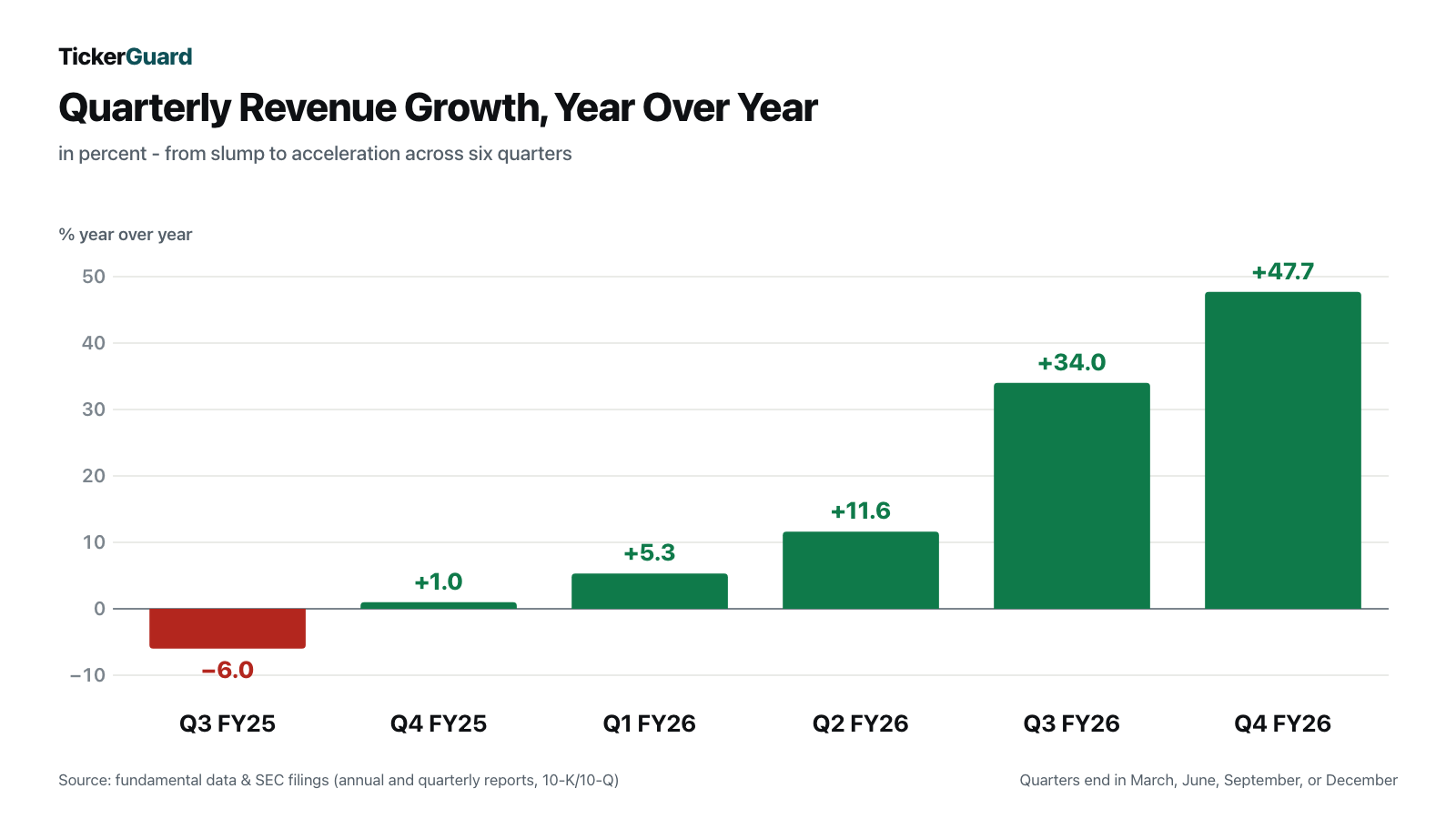
Avnet fits the pattern exactly: Q3 of fiscal 2026 (ended March 28, 2026) grew 34.0 percent, Q4 (ended June 27, 2026) grew 47.7 percent — both inside the 30-to-70-percent band. The four quarters before that came in at -6.0, +1.0, +5.3, and +11.6 percent, all under 15 percent. The trailing four-quarter revenue base was $27.63 billion, far above the minimum threshold. On the scanner page (as of 08/24/2026), Avnet ranked first of the 28 matches with these figures.
For context on the scanner's other columns, as of August 24, 2026: price $88.60, market capitalization roughly $7.3 billion, Piotroski F-Score 5 of 9 — a score that measures balance-sheet quality; 5 is middling, a genuinely healthy company sits at 8 or 9. The bankruptcy check (0 of 3 warning signs) and an Altman Z-Score of 7.8 (the "safe" threshold sits around 3) both point the other way, toward solid balance-sheet substance. Institutional investors held roughly 110 percent of shares outstanding per the scanner (double-counting through nested funds is common for this metric), and short sellers held roughly 9 percent of shares short.
The numbers over the years — honestly appraised
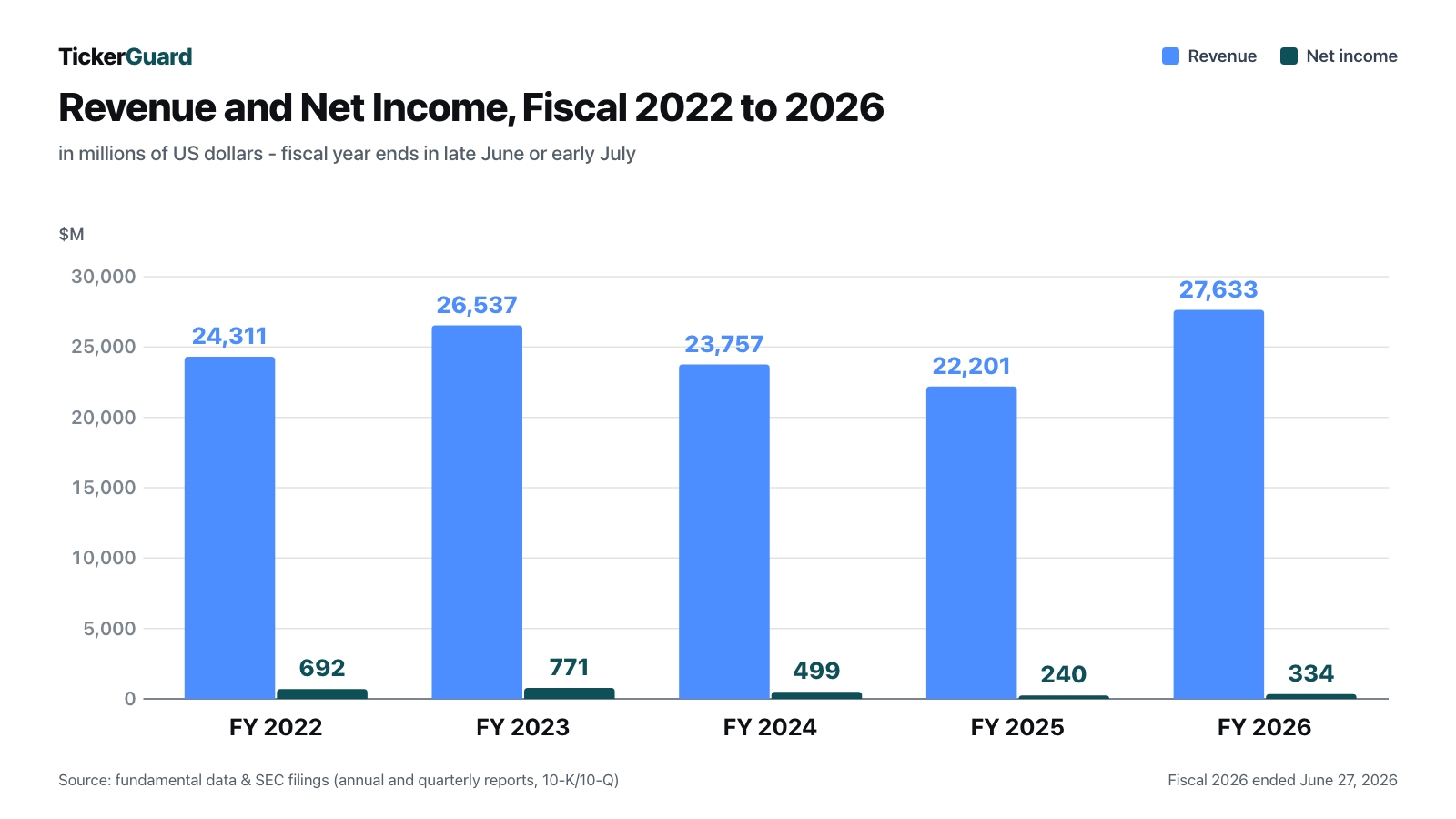
What genuinely impresses: Avnet hit $27.63 billion in fiscal 2026, the highest revenue year in its history — up 24.5 percent from fiscal 2025, driven, per the annual report, by "growth across all EC regions and Farnell." Adjusted diluted earnings per share rose 65 percent to $5.67, more than two and a half times faster than sales — a sign of genuine operating leverage: fixed costs such as IT and administration grow more slowly than sales, so every additional dollar of revenue brings disproportionately more profit.
The backstory tempers the applause considerably. Revenue was higher once before: $26.5 billion in fiscal 2023, the prior record year. It then fell for two straight years — to $23.8 billion in fiscal 2024 and $22.2 billion in fiscal 2025, the trough of a worldwide slump in demand for electronic components. Reported GAAP net income swung even harder over the same period: from $770.8 million (fiscal 2023) to $240.2 million (fiscal 2025) — a two-thirds drop on just a 16 percent revenue decline, because costs like rent or headcount do not shrink at the same pace as revenue. In fiscal 2026, profit climbed back to $334.4 million, but that remains well below the 2022 or 2023 level.
"During fiscal 2026, the Company's financial performance improved as demand for electronic components strengthened resulting in year-over-year sales growth across all regions and improved days of inventory on hand."
— Avnet, Inc., annual report 10-K for fiscal 2026, "Industry outlook" section

What the filings say: the uncomfortable truths
Uncomfortable truth No. 1: a third of the jump is the memory chip price, not volume. On the Q4 earnings call on August 5, 2026 (transcript), CFO Ken Jacobson quantified that roughly one-third of the fourth quarter's sequential and year-over-year sales growth came from higher memory chip prices (DRAM and NAND, among others) — a market that tightened globally in 2026, partly because of demand from the build-out of AI data centers. The annual report itself is more cautious, describing higher memory prices as a "lesser" contributor, with higher sales volumes and higher-priced components named as the main driver. The two are not mutually exclusive — but a pricing cycle can turn, while volume growth from genuinely new customers tends to stay. For you as a reader, that means: a meaningful chunk of the 47.7 percent headline number is a commodity price effect, not proof that Avnet is suddenly winning market share.
Uncomfortable truth No. 2: operating cash flow turned negative. Despite rising profit, cash flowed out of operations in fiscal 2026 for the first time in years, instead of in.
"Net cash used for operating activities was $280.9 million in fiscal 2026, compared with net cash provided by operating activities of $724.5 million in fiscal 2025."
— Avnet, Inc., annual report 10-K for fiscal 2026, "Liquidity and Capital Resources" section

The reason is actually ordinary for a distributor: growing faster means buying more inventory up front and waiting longer for customers to pay. Receivables rose from $4.33 billion to $6.88 billion, inventory from $5.24 billion to $6.07 billion. Still, it remains a fact that tends to get lost in the rally: a company reporting higher profit while simultaneously burning $1.01 billion more cash than the year before is financing its growth through the balance sheet — in this case, through new debt (more on that shortly) rather than its own cash generation.
Uncomfortable truth No. 3: a single, unnamed supplier accounts for more than 10 percent of sales.
"For fiscal 2026, one supplier accounted for over 10% of the Company's consolidated billings."
— Avnet, Inc., annual report 10-K for fiscal 2026, Item 1A "Risk Factors"
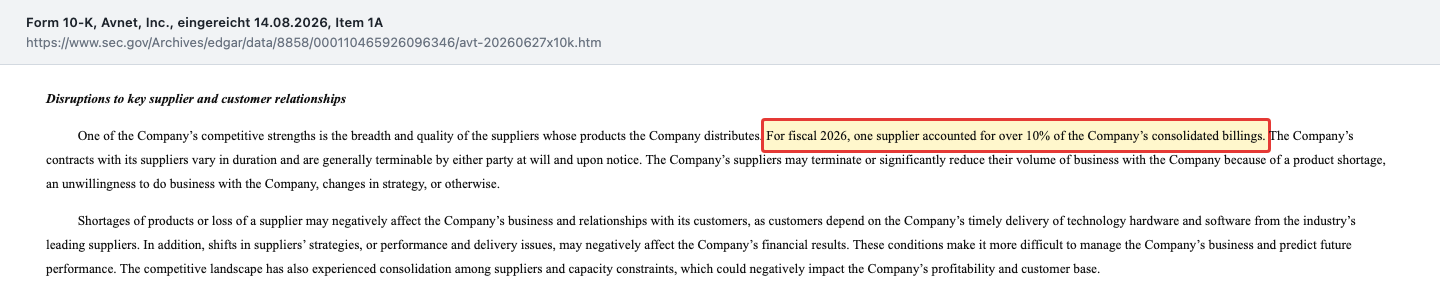
Avnet does not name the supplier — standard practice among distributors, since supplier contracts are sensitive. What is clear: semiconductors made up roughly 79 percent of consolidated sales in fiscal 2026 (78 percent in fiscal 2025, 80 percent in fiscal 2024), and Avnet's business "closely follows the strength or weakness of the semiconductor industry," as the annual report itself puts it. If the large supplier terminates the relationship, changes terms, or runs into trouble of its own, Avnet is hit disproportionately — supplier contracts, per the filing, are "generally terminable by either party at will and upon notice."
Uncomfortable truth No. 4: a Mexican tax dispute ultimately cost $35.1 million. Avnet's facilities in Mexico benefit from the IMMEX program (reduced tariffs, eased import rules). The Mexican tax authority SAT audited participation in the program for the period from January 2019 to January 2020 and settled with Avnet in fiscal 2026: the company paid $61.4 million, recording a $35.1 million loss net of an expected VAT recovery — more than the $43.4 million estimated a year earlier, but at least a closed chapter. The larger share of the $134.7 million in restructuring charges in fiscal 2026 was severance costs of $87.7 million — whose largest single item, in turn, was the announced closure of a distribution center in Germany, affecting roughly 350 employees and expected to be completed in the third quarter of fiscal 2027; the annual report does not break out a separate dollar figure for Germany.
Valuation: what the market pays for Avnet today
At the closing price of $88.64 on August 21, 2026, Avnet carried a market capitalization of roughly $7.3 billion (82,072,979 shares outstanding). Against reported diluted earnings per share of $4.01 (fiscal 2026), that works out to a price-to-earnings ratio (P/E) of roughly 22 — a middling multiple, neither cheap nor expensive, for a cyclical distribution stock. Measured against sales, the stock is very cheap at a price-to-sales ratio (P/S) of just roughly 0.26 — typical for a low-margin business model in which every sales dollar generates only a few cents of profit. Price-to-book sits at roughly 1.45 (book value per share $61.19 as of June 27, 2026).
For the current fiscal year 2027, the analyst consensus expects, on average, earnings per share of roughly $5.13 (data as of 08/24/2026) — that would put the P/E on that estimate at roughly 17, notably cheaper than the 22 based on reported earnings. Analysts themselves are far from unanimous, though: of five covering firms, one rates the stock "Strong Buy," two "Hold," one "Sell," and one "Strong Sell" — averaging out to a middling rating. At the same time, the mean price target sits at $106.25, nearly 20 percent above the August 21, 2026 close. That combination — subdued ratings alongside a notably higher price target — is unusual and shows that even the professionals disagree on whether there is still room to run after the record rally, or whether the market has already priced in the good news.
Opportunities and risks at a glance
What speaks for Avnet:
- Record revenue in fiscal 2026 ($27.63 billion), growth spread broadly across all regions and both segments, not concentrated in a single region or product per the annual report.
- Operating leverage is working: adjusted diluted EPS grew 65 percent in fiscal 2026, more than two and a half times faster than sales.
- Solid balance-sheet substance: equity ratio 32.6 percent, interest coverage (operating income to interest expense) roughly 2.9 times, no going-concern or governance-breach language in the filings.
- Consistent capital return: $138 million in share buybacks (3.2 percent of shares) and $114.4 million in dividends ($1.40 per share) in fiscal 2026, current dividend yield roughly 1.7 percent.
- Management guides, per the annual report, to roughly 10 percent further sales growth in the first quarter of fiscal 2027 versus the fourth quarter of fiscal 2026.
What speaks against it:
- Roughly a third of the latest growth surge came from higher memory chip prices per the CFO — a cycle that can turn as fast as it arrived.
- Operating cash flow negative in fiscal 2026 (-$280.9 million); growth is currently financed through debt rather than internally generated cash.
- Structurally thin margins (gross margin 10.4 percent, net margin roughly 1.2 percent) without a wide moat — Avnet competes with other large distributors for the same suppliers and customers.
- A single, unnamed supplier accounts for more than 10 percent of sales; roughly 79 percent of sales depend on the semiconductor industry and its cycles.
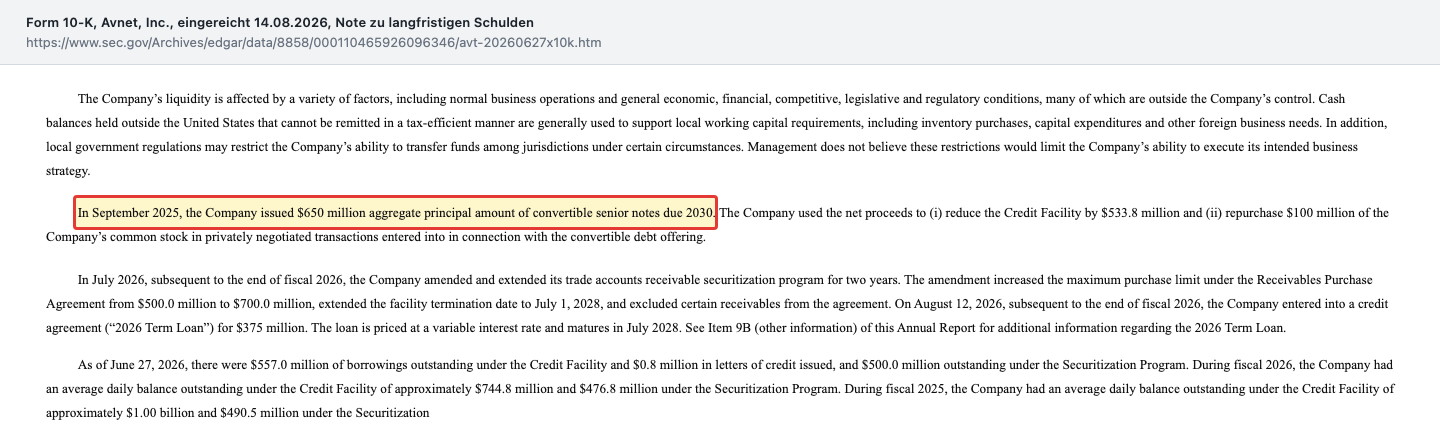
- A $650 million convertible note with a $70.27 conversion price is closing in on the roughly $91 early-conversion threshold — a level the stock briefly touched on August 6, 2026.
"In September 2025, the Company issued $650 million aggregate principal amount of convertible senior notes due 2030."
— Avnet, Inc., annual report 10-K for fiscal 2026, long-term debt note
A human conclusion
Was it the recency trap, or a genuine turn? After reading the filings, the honest answer is: a bit of both. Avnet's fiscal 2026 growth really is broad-based across all regions, cost discipline is working, and the operating leverage is real. At the same time, a solid third of the spectacular 47.7 percent fourth-quarter number is a memory-price effect that can vanish as quickly as it appeared, and operating cash flow shows that this growth is not yet self-financed. The scanner found its pattern reliably — whether the two strong quarters are the start of ten more, or just the peak of a pricing cycle, is a question it cannot answer, and nobody can responsibly promise you an answer either. What you make of it is your decision. And that is exactly as it should be.
Sources
- Annual report (10-K) for fiscal 2026, filed 08/14/2026
- Annual report (10-K) for fiscal 2025, filed 08/15/2025
- Quarterly report (10-Q) as of 03/28/2026, filed 05/01/2026
- Fourth-quarter fiscal 2026 earnings release (8-K dated 08/05/2026)
- Current report on the bond offering (8-K Item 8.01 dated 08/21/2026)
- Backtest study of the "revenue inflection" scanner
This analysis is a journalistic contextualization of publicly available information and is not investment advice, nor a solicitation to buy or sell securities. Stocks can lose their entire value; that is especially true for a low-margin, cyclical distributor like Avnet during phases when the industry cycle turns. Every figure comes from the sources named above and carries the date stated there. Positions held by the operator are disclosed daily; where one exists, it appears as a notice at the top of this deep dive. at the time of publication.
Key figures at a glance
All monetary figures in millions of $; earnings per share as reported.
| Metric | 2022 | 2023 | 2024 | 2025 | 2026 |
|---|---|---|---|---|---|
| Revenue | 24,310.7 | 26,536.9 | 23,757.1 | 22,200.8 | 27,632.7 |
| Operating Income (EBIT) | 939.0 | 1,186.8 | 844.4 | 622.6 | 859.5 |
| Net Income | 692.4 | 770.8 | 498.7 | 240.2 | 334.4 |
| Net Margin | 2.8% | 2.9% | 2.1% | 1.1% | 1.2% |
| Earnings Per Share | 6.94 $ | 8.26 $ | 5.43 $ | 2.75 $ | 4.01 $ |
Source: fundamental data & SEC filings (annual and quarterly reports, 10-K/10-Q)
Our Bottom Line at a Glance
- Growth positive
- Revenue hit a record $27.63 billion in fiscal 2026, up 24.5 percent from fiscal 2025, spread broadly across all regions and both segments. In the fourth quarter, growth accelerated to +47.7 percent year over year, driven by both volume and pricing per the annual report.
- Acceleration: cycle, not market share neutral
- CFO Ken Jacobson said on the 08/05/2026 earnings call that roughly one-third of the latest growth came from higher memory chip prices, not pure volume growth. That is not a fraud or accounting finding, but a signal that a meaningful portion of the 47.7 percent headline is cyclical, not permanent.
- Margins and profitability neutral
- Gross margin 10.4 percent, net margin roughly 1.2 percent (FY2026) — structurally thin, typical for a distributor without a wide moat. Adjusted EPS grew a disproportionate 65 percent in fiscal 2026, but reported net income of $334.4 million remains well below the 2022/2023 level ($692-771 million).
- Cash flow negative
- Operating cash flow turned to -$280.9 million in fiscal 2026 (FY2025: +$724.5 million), because inventory and receivables must be pre-financed for growth. That growth is currently being funded through additional debt rather than internally generated cash.
- Balance sheet and leverage positive
- Equity ratio 32.6 percent, interest coverage (operating income to interest expense) roughly 2.9 times, no going-concern language. Total debt rose from $2.66 billion to $3.21 billion, yet Avnet successfully refinanced in the bond market in August 2026 ($550 million at 5.65 percent) — a sign of continued market access.
- Concentration risk negative
- A single, unnamed supplier accounts for more than 10 percent of sales per the annual report; roughly 79 percent of sales depend on the cyclical semiconductor industry, and roughly 78 percent on business outside the U.S., with corresponding currency and trade risk.
Avnet delivered a record fiscal 2026 with $27.63 billion in revenue and an acceleration to +47.7 percent in the fourth quarter — after two soft years of declining revenue and profit. Roughly a third of the latest growth surge, per the CFO, comes from higher memory chip prices, a cyclical effect rather than a lasting market-share shift. Operating cash flow turned negative despite rising profit, as growth inflates inventory and receivables. The balance sheet remains solid, but a single supplier and the semiconductor industry as a whole remain concentration risks. Not investment advice.
What Our Rating Means
Open questions
The business works in principle, but one material question is open. As long as it stays open, our findings do not carry a quality verdict.
The yellow light here signals an open operational question, not a substance risk: Avnet's balance sheet is solid (equity ratio 32.6 percent, interest coverage roughly 2.9 times, no governance or accounting breach in the filings reviewed), and the company refinanced itself in the capital markets without difficulty in August 2026. What remains open is how much of the spectacular fourth-quarter fiscal 2026 acceleration (+47.7 percent) is durable: the CFO himself quantified roughly a third of it as coming from higher memory chip prices — a cycle that can turn as fast as it arrived. At the same time, operating cash flow is negative for the first time in years because growth must be pre-financed, and margins remain structurally thin (net margin roughly 1.2 percent) without a wide moat. That is the textbook case of erratic, cycle-dependent profitability without a documented substance risk — under the caution rule, the more conservative level applies, so yellow rather than green. The decision is yours.
A journalistic assessment by our editorial team at the time of the deep dive, based on public sources — not investment advice and not a solicitation to buy or sell. Your personal circumstances (investment goals, risk capacity, taxes) cannot be taken into account. What our levels mean, how verdicts are formed, and what conflicts of interest exist →
Worth Noting
- AVT reached our research list via our in-house stock scanner "revenue inflection" (rank 1 of 28 matches, as of August 24, 2026).
- Exchange history: Avnet, Inc. (Nasdaq: AVT) traded on the NYSE until May 2018; since then it trades exclusively on the Nasdaq Global Select Market.
- Filer status: as a U.S. domestic filer, Avnet files annual reports on Form 10-K and quarterly reports on Form 10-Q — unlike foreign private issuers (20-F/6-K), a detailed report exists for every quarter.
- Analyses are evergreen: every figure carries its own as-of date. Price, valuation, and analyst data are as of August 21-24, 2026 and are not a reason to buy.
Stock Watch
This analysis is as of August 26, 2026. Stock Watch will tell you what's changed at AVT since then.
Later $1 a month per stock — signing up is free, and you'll be the first to know when it launches.
The full analysis as a PDF for later
We will send you this analysis as a PDF — to print, file away, and read at your own pace. And we will add you to the free Stock Watch list for Avnet Inc (AVT), so you hear about it when something material in this analysis changes.
Frequently Asked Questions
Avnet, Inc. (Nasdaq: AVT) is an electronic-component distributor founded in 1921: the company buys semiconductors, connectors, and similar components from manufacturers in bulk and resells them to customers who build products from them. The Electronic Components segment contributed $25.85 billion, roughly 94 percent of fiscal 2026 sales; the Farnell segment contributed the remaining $1.78 billion.
On the Nasdaq. The company trades under the symbol AVT on the Nasdaq Global Select Market — but only since May 2018: before that, Avnet had been listed on the NYSE for decades, until the listing was transferred to the Nasdaq Global Select Market. Avnet itself states "Nasdaq: AVT" explicitly in every regulatory filing.
Because global demand for electronic components recovered sharply after two soft years — the annual report says sales grew "across all regions." CFO Ken Jacobson said on the August 5, 2026 earnings call that roughly one-third of that came from higher memory chip prices, not pure volume growth. The four quarters before that were far quieter, with growth rates between -6.0 and +11.6 percent.
Both, together. The annual report names higher sales volumes and higher-priced components as the main driver of the revenue increase, with higher memory chip prices contributing "to a lesser extent." On the earnings call, the CFO quantified the pricing effect more precisely at roughly one-third of the growth. No acquisition of another company is behind it — the acceleration is genuinely organic growth, but partly cycle-driven rather than market-share-driven.
Because Avnet, as a distributor, has to pre-finance what it sells: to keep up with growth, the company bought more inventory (up from $5.24 billion to $6.07 billion) and waited longer for customers to pay (receivables rose from $4.33 billion to $6.88 billion). That cost a net $280.9 million in cash in fiscal 2026, after generating $724.5 million a year earlier.
In September 2025, Avnet issued convertible senior notes for $650 million at a 1.75 percent coupon, due 2030, with a conversion price of roughly $70.27 per share. Noteholders may convert early if the stock closes above roughly $91 for 20 of 30 consecutive trading days — a level the stock briefly touched on August 6, 2026, when it hit an all-time high of $100.00, before pulling back. Full conversion would create roughly 9.25 million new shares, about 11 percent of the prior share count.
Yes. In fiscal 2026, Avnet paid out $1.40 per share in cash, $114.4 million in total (per the 10-K cash flow statement), plus $138 million in share buybacks (3.2 percent of shares outstanding). Following the August 20, 2026 increase, the quarterly dividend is $0.37, or $1.48 annualized — roughly a 1.7 percent yield at the August 21, 2026 closing price of $88.64, and a payout ratio of roughly 37 percent of reported earnings per share ($1.48 versus $4.01; the $114.4 million actually paid out in fiscal 2026 was roughly 34 percent of net income of $334.4 million), or roughly 26 percent of adjusted earnings per share of $5.67.
Solid, but with rising debt. As of June 27, 2026, the balance sheet showed $15.43 billion in total assets, $5.02 billion in equity (equity ratio 32.6 percent), and $3.21 billion in total debt (up from $2.66 billion a year earlier). Operating income covers interest expense roughly 2.9 times. None of the filings reviewed contain a going-concern warning or a balance-sheet or governance breach.
Found an error?
Did you spot a factual error, an outdated number, or a typo in this deep dive? Let us know briefly — your report goes straight to the editorial team.