The Side-Effect Romance at AN2 Therapeutics: A Failed Antibiotic, a Blood-Cancer Plan and a Stock That Nearly Quintupled in Four Days
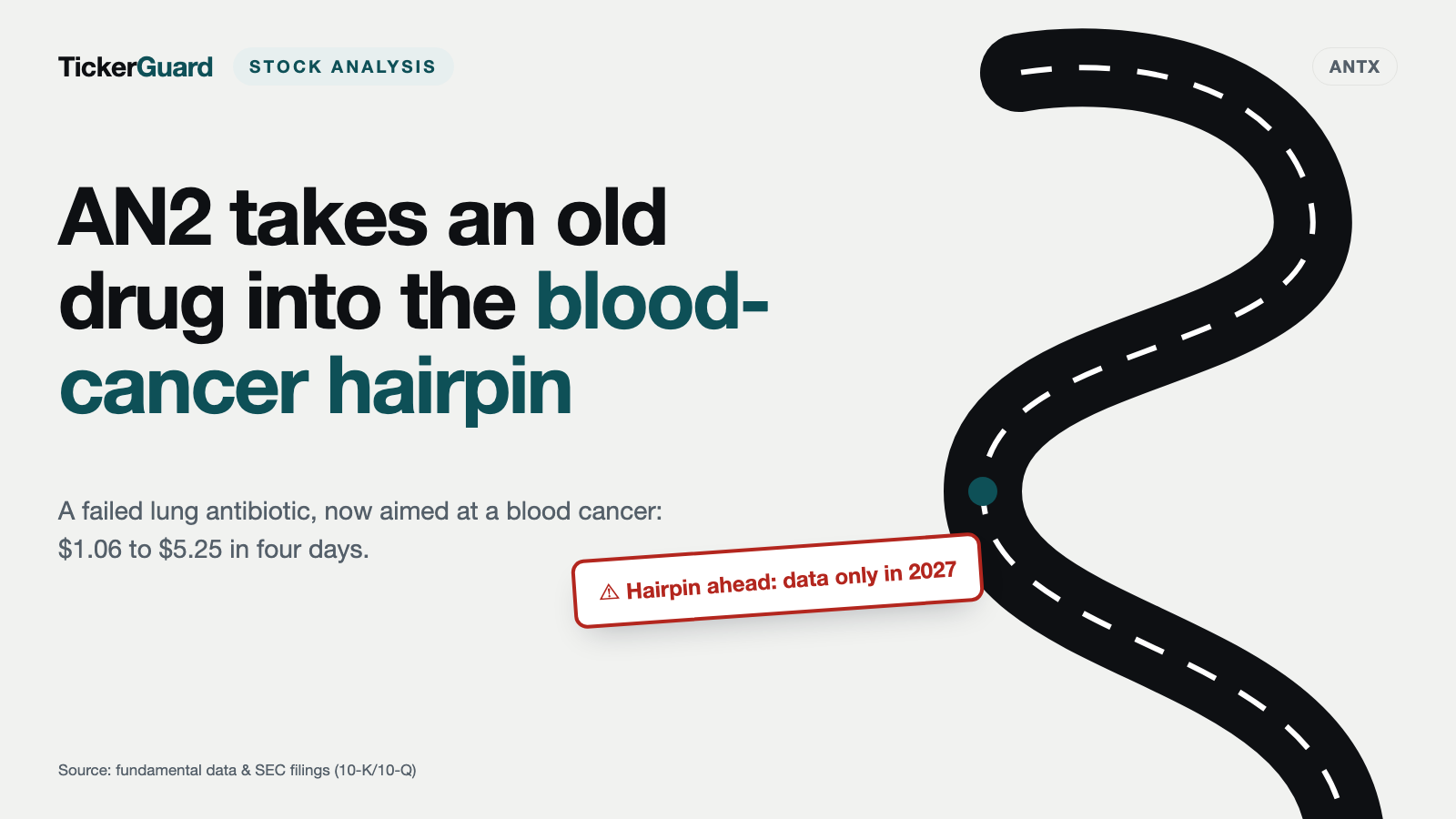
AN2 Therapeutics wants to turn a drug that failed as a lung antibiotic into a treatment for a blood cancer. In early March 2026, the stock went from $1.06 to $5.25 in four trading days — yet there is no patient data in the new disease, and the company expects the first in the course of 2027. What the SEC filings say about cash, new shares and control weaknesses before the story wins you over.
 Thomas Mücke
Founder & Publisher
As of Today
As of: October 30, 2026
- Closing price
- 4.50 $ -3.40%
- Market Capitalisation
- 0.2 $B
- Growth Score
- 3/10
- AAQS
- 0/10
Price change since October 30, 2026: -0.7%
This analysis has a cut-off date. The Stock Guard tells you when something material changes in the numbers. Reserve your free spot
Chart
Interactive price chart (TradingView).
52-week range: 1.00 $ to 6.30 $ · Last price: 4.50 $ (As of: October 30, 2026)
Note: pure fact-based analysis, not investment advice and not a solicitation to buy or sell. All figures without guarantee.
There is one story that almost always works on the stock market: a drug fails at the job it was built for — and then someone discovers that its side effect might treat a different disease. It sounds like fate, like a second chance the molecule has earned. Let’s call this reflex the side-effect romance: because the twist is told so well, it feels proven. At AN2 Therapeutics (Nasdaq: ANTX), a biotech from Menlo Park, California, that story moved the stock in early March 2026: from $1.06 on March 3 to $5.25 on March 9, nearly five times as much in four trading days (closing prices, fundamental data).
Let’s make a deal: before the story wins you over, let’s read together what AN2 itself has filed with the U.S. securities regulator, the SEC — the annual report (10-K) for 2025, the quarterly reports (10-Q) for the first and second quarters of 2026, the prospectus for new shares and every current report (8-K) through the end of October 2026. Anyone who files false statements with the SEC risks penalties, which is why these reports are among the most reliable sources there are. At the end, the decision is yours.
What AN2 Therapeutics Actually Does — Boron Chemistry, an Old Drug and Three New Targets
AN2 develops drugs but sells none. The quarterly report for June 30, 2026, puts it bluntly: “We do not have any products approved for sale and have not generated any revenue since inception.” The company is small: as of March 17, 2026, it had 21 full-time employees. It was incorporated in 2017 and began operations in November 2019; it licensed its compounds in November 2019 from the boron chemistry specialist Anacor, today a Pfizer subsidiary. Boron is an element rarely used in drug chemistry; AN2 builds an entire “platform” on it — picture a workshop that uses an unusual tool and hopes to open locks where others fail.
At the center is epetraborole, a pill. It was built as an antibiotic against a hard-to-treat lung infection caused by non-tuberculous mycobacteria (MAC). That did not work out: in May 2025, the truncated Phase 3 portion of the EBO-301 trial missed its primary endpoint, and AN2 stopped development for that disease. Since March 2026, epetraborole has mainly been aimed at polycythemia vera (PV), a slowly progressing blood cancer in which the bone marrow makes too many red blood cells. Two older programs continue alongside: an 84-patient investigator-initiated trial against a different lung infection (M. abscessus; cleared by the FDA in December 2025, results expected in late 2027) and the infectious disease melioidosis, which AN2 has worked on for years with funding from the U.S. National Institute of Allergy and Infectious Diseases (NIAID) and for whose next trial the company is in talks with the U.S. government about funding. AN2 is also working on early cancer projects from the same boron chemistry; it named a first development candidate for solid tumors in 2026 and expects a second by the end of 2026. A second clinical compound, AN2-502998, targets Chagas disease, a parasitic infection — in monkeys with naturally acquired infection, 28 days of treatment eliminated the parasite in all treated animals (8-K of June 4, 2026); a Phase 2 trial is planned for late 2026.
Why a blood cancer? In PV, the blood is too “thick”: the share of red blood cells, the hematocrit, rises, and with it the risk of clots. Many patients therefore need regular phlebotomy — blood draws. AN2 wants to position epetraborole as the “first oral, red-cell targeting therapy for hematocrit control” (10-K 2025). According to AN2, about 155,000 people in the U.S. live with PV. That names the central tension of this analysis, and it runs through every section: the story of a failed drug’s second life has already multiplied the stock price — the patient data that would have to prove it only arrives in 2027, and shareholders pay for the wait with new shares.
Company history for investors
-
2019
License from Anacor
AN2 licenses epetraborole and other boron compounds from Anacor, now a Pfizer subsidiary. For shareholders: the company holds its core compounds via a license, not outright.
-
2022
Nasdaq IPO
In March/April 2022, AN2 raises $79.4 million gross in its IPO; first close $15.40. Since then, the company has reported material weaknesses in its accounting controls.
-
2025
Phase 3 in MAC misses its primary endpoint
In May, AN2 stops development for the lung infection. As of June 30, the public float is worth only $23.1 million.
-
2026
PV plan, rally, placement
In March, AN2 announces the PV trial and the stock goes from $1.06 to $5.25; investors buy at $2.85, and options are repriced to $3.91.
-
2026
Timeline slips into 2027
After the FDA pre-IND meeting in July, PV enrollment is pushed to the fourth quarter and data to the course of 2027. For shareholders: a longer wait.
How the Stock Landed on Our Desk
No metrics screen flagged AN2 — other investors’ attention did. Our in-house Reddit hype scanner listed the ticker ANTX on October 31, 2026, with a single mention in 24 hours at rank 737, after rank 184 the day before (ApeWisdom). That is not a storm, just a flicker — but one with a remarkable price history behind it.
As of June 30, 2025, all shares not held by insiders or major holders were worth just $23.1 million in total (cover page of the 2025 annual report). On March 3, 2026, the stock closed at $1.06. In March 2026, AN2 announced the PV trial; by March 9, the closing price had risen to $5.25. The highest close of the past twelve months followed on August 12, 2026, at $6.28; on October 30, 2026, the stock closed at $4.53. According to fundamental data (as of October 30, 2026), 2.9 million shares were sold short, about 9 percent of the float — some investors are betting against the story. Price-to-sales and price-to-earnings ratios do not exist for lack of revenue and earnings. So keep this in mind from the start: at AN2, it is not a number that moves the stock but a narrative — and our job is to hold it up against the filings.
The Numbers Over the Years — Given Their Due
First, what genuinely impresses — and at AN2, that is spending discipline. After the failure in the lung infection, the company cut costs hard: net loss fell from $51.3 million (2024) to $35.2 million (2025), and cash used in operations from $49.3 million to $29.8 million. In the first half of 2026, AN2 lost $18.2 million and used $19.1 million in cash — about $9.5 million per quarter. For a company with three trials in preparation, that is lean. Fresh money came in, too: $37.2 million net from the March 2026 placement. As of June 30, 2026, AN2 held $79.9 million in cash and investments and has no borrowings; total liabilities were $5.8 million and stockholders’ equity $75.9 million.
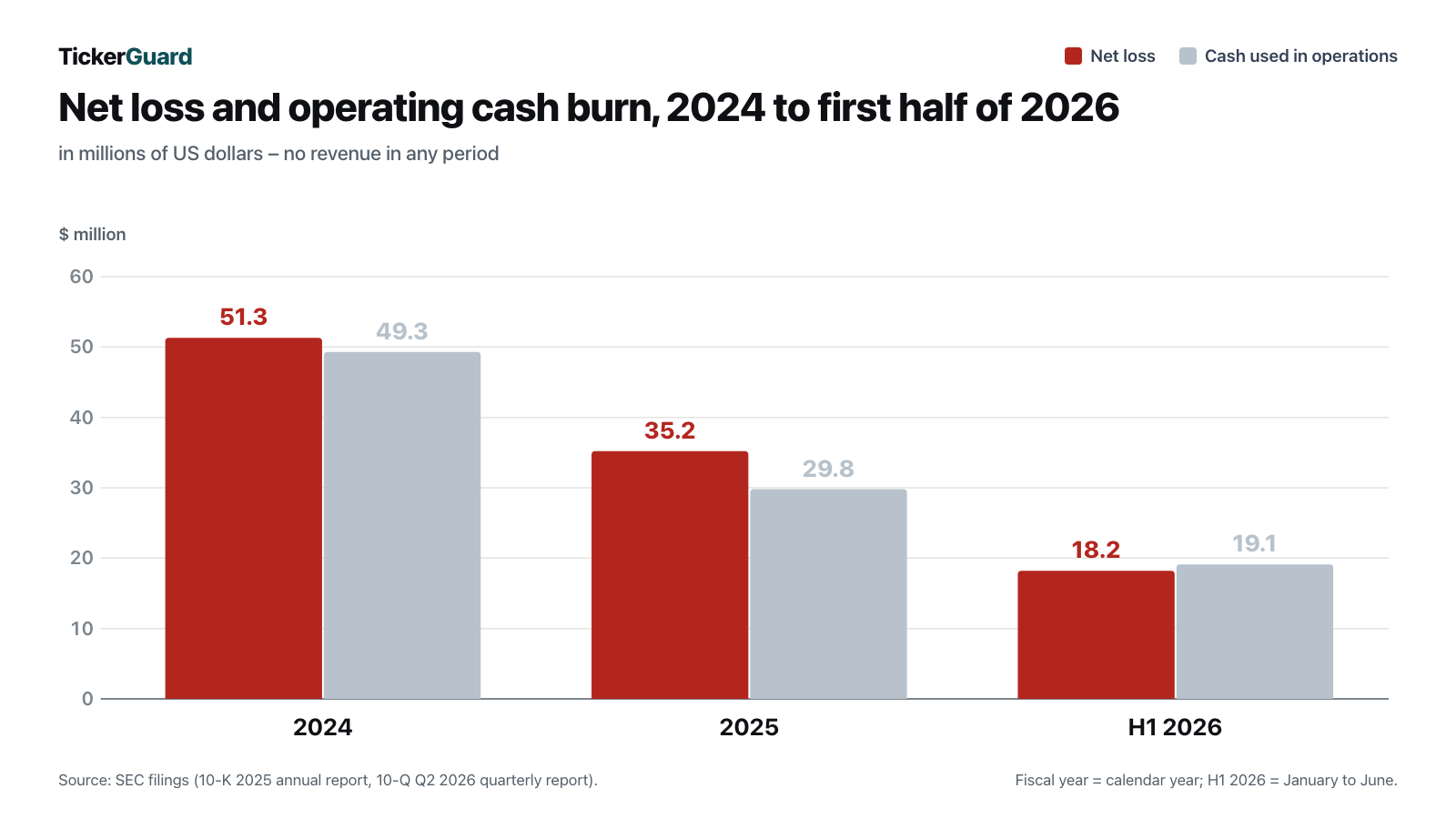
How long does that last? AN2 itself says cautiously: at least twelve months from the August 2026 quarterly report. Our own rough math — not a company figure — puts it at a little over eight quarters at the first-half 2026 pace. But AN2 itself writes that expenses are expected to increase “significantly” with the new trials. The accumulated deficit stood at $259.2 million as of June 30, 2026. In short: AN2 has become frugal and bought time — but the company has not earned a dollar yet, and the expensive trials are only starting.
What the Filings Say — the Uncomfortable Truths
Uncomfortable Truth No. 1: Not a Single Patient Data Point in Blood Cancer — and the Timeline Has Already Slipped
The March 2026 rally ran on an announcement, not on results. In its annual report of March 17, 2026, AN2 planned to start the PV trial in India in the third quarter of 2026 and wrote: “We expect to provide periodic data readouts beginning as early as the fourth quarter of 2026 and throughout 2027.” Five months later, after a pre-IND meeting with the U.S. Food and Drug Administration (FDA) in July, it reads differently:
“As a result of this expansion, Phase 2 enrollment is anticipated to commence in the fourth quarter of 2026, beginning with an open-label sentinel cohort at a sub-therapeutic dose aimed at assessing pharmacokinetics and safety in PV patients.”
— AN2 Therapeutics, Inc., SEC quarterly report 10-Q for June 30, 2026, Item 2 MD&A “Epetraborole – Polycythemia vera”
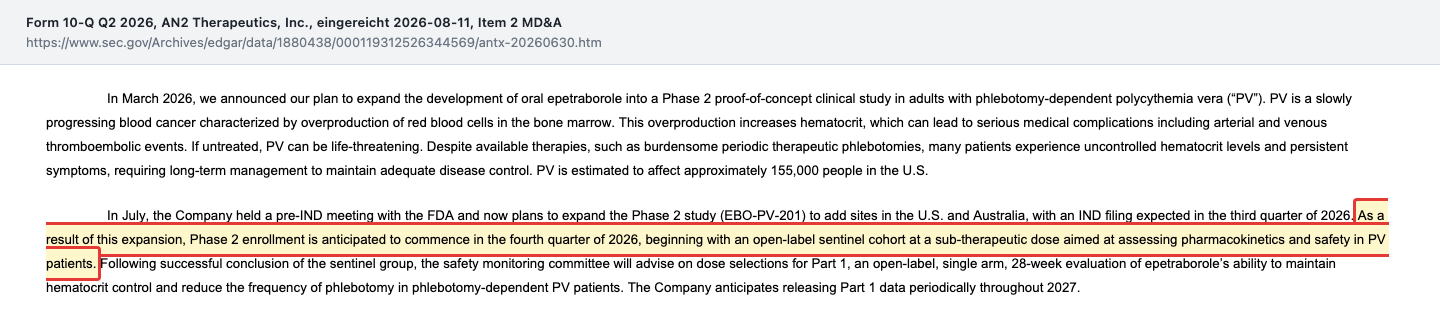
AN2 now expects data from Part 1 of the trial — 28 weeks of open-label treatment without a control group — “periodically throughout 2027.” AN2 planned to file the application to begin the trial with the FDA (IND) in the third quarter of 2026; no current report confirming that appears in the SEC filings through October 30, 2026. And this is not just about PV. In the summary of its risks, AN2 writes about its entire pipeline:
“We have a pipeline that is primarily composed of early-stage and mid-stage programs, and clinical proof of concept has not yet been established for any of our product candidates.”
— AN2 Therapeutics, Inc., SEC quarterly report 10-Q for June 30, 2026, Part II Item 1A “Risk Factors” (summary)
The lesson: what multiplied the stock in March was a trial plan — and by August, that plan had already slipped by several months.
Uncomfortable Truth No. 2: The Drug Has Disappointed Before — and Its Effect on the Blood Used to Sit in the Risk Factors
Epetraborole is not a blank slate. In MAC lung disease, the Phase 2 portion of EBO-301 showed no measurable advantage in clearing the bacteria in August 2024: after six months, sputum culture conversion was 13.2 percent on epetraborole versus 10.0 percent on placebo — no statistical difference. The truncated Phase 3 portion missed its primary endpoint in May 2025. And in those same years, the risk factors contained a sentence that reads differently today:
“For example, we have observed cases of anemia in patients receiving epetraborole, and though we believe these reported adverse events have not been serious in nature or otherwise suggestive of a material safety issue, consistent imbalances in observed adverse events between active and placebo arms could adversely affect the integrity of a study blind and subsequent trial data.”
— AN2 Therapeutics, Inc., SEC annual report 10-K for 2025, Item 1A “Risk Factors”
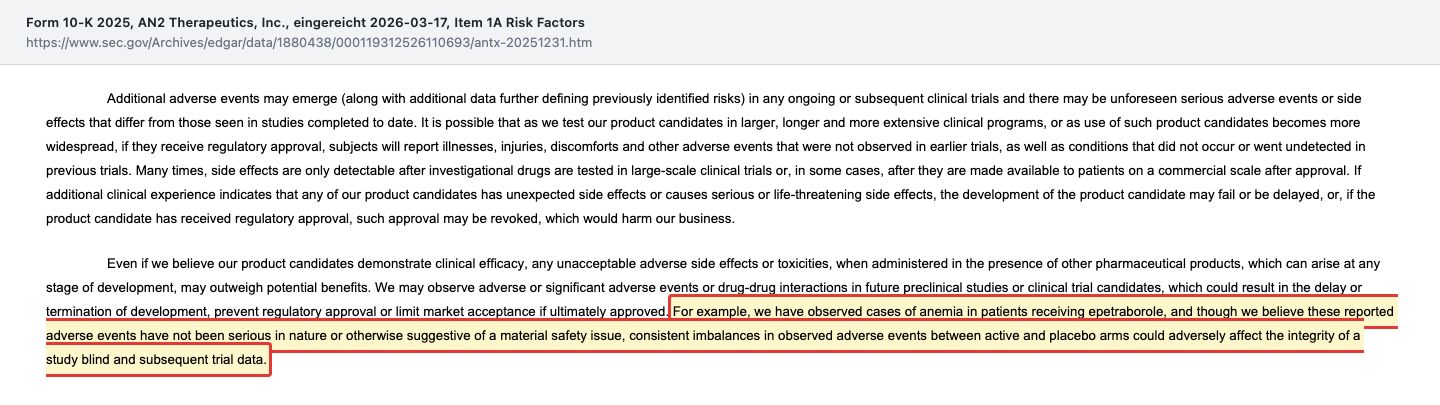
Put the two passages side by side and you understand the side-effect romance: what appeared as anemia in the risk factors for a lung infection is supposed to be exactly what is wanted in a disease with too many red blood cells. That is our reading of the two reports, not the company’s wording. AN2 itself presented analyses from earlier studies at a hematology meeting (SOHO 2026) in September 2026; per its press release of August 31, 2026, these included a poster titled “Epetraborole Demonstrates an Exposure-Dependent Effect on Erythropoiesis in Healthy Subjects” — an effect on red blood cell production that depends on drug levels in the blood — and analyses in patients without PV. That is a plausible starting point, but no proof that the pill spares PV patients their phlebotomies. Two drugs are already approved for PV: ruxolitinib and ropeginterferon alfa-2b (Besremi). The lesson: a side effect that is meant to become the main effect must first prove controllable in a new trial with new patients — otherwise it stays a side effect.
Uncomfortable Truth No. 3: Your Slice of the Pie Gets Smaller — and the Program for More Is Already in Place
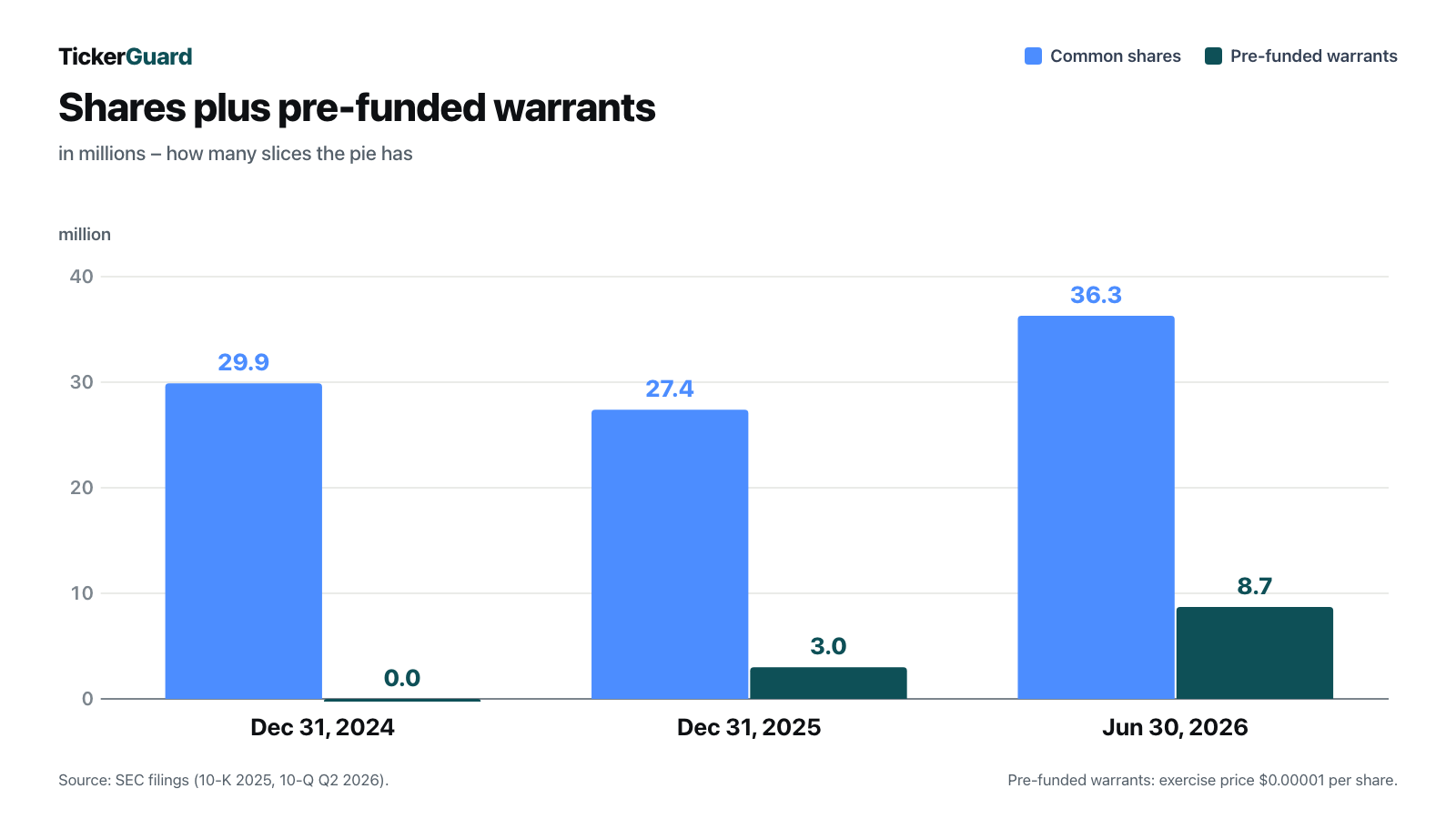
How AN2 pays for the wait shows in its share count. Every new share cuts one more slice from the same pie — that is dilution: your stake in the company shrinks even if you never sell a share. On Sunday, March 8, 2026, AN2 agreed to sell 8,245,611 shares at $2.85 and 5,789,493 pre-funded warrants at $2.84999 — instruments that can be exchanged for a share at any time for $0.00001, effectively shares. Investors included Coastlands Capital, Commodore Capital and Vivo Capital. $2.85 was the prior Friday’s close; on Monday, the stock closed at $5.25 — about 84 percent above the placement price (our own calculation).
A month later, on April 9, 2026, AN2 signed an at-the-market agreement with Jefferies: the company may sell new shares directly into the market from time to time, up to $80 million. The prospectus itself spells out what that means:
“Up to 49,573,835 shares (as more fully described in the notes following this table), assuming sales of 22,160,664 shares of our common stock in this offering at an offering price of $3.61 per share, which was the last reported sale price of our common stock on the Nasdaq Global Select Market on April 17, 2026.”
— AN2 Therapeutics, Inc., SEC prospectus supplement 424B5 of April 20, 2026, section “The Offering”

Measured against the 37.7 million shares outstanding on August 6, 2026, 22.2 million new shares would be just under 59 percent more (our own calculation). Through June 30, 2026, AN2 had sold only 286,498 shares under it for $1.4 million net; what happened since will only show in the third-quarter report. How a cash pile under dilution pressure plays out at a larger biotech, too, is covered in our Altimmune analysis. Remember: a higher stock price brings the company more money per new share — but as an existing shareholder, your slice of the pie still gets smaller.
Uncomfortable Truth No. 4: Control Weaknesses Since the IPO — and Options Reset After the Rally
An annual report is only as good as the controls that produce it. At AN2, so-called material weaknesses in internal control over financial reporting have existed since the company prepared for its 2022 IPO. In plain terms: by the company’s own account, duties in accounting are not sufficiently segregated because too few specialists are on board. Four years later, the quarterly report says:
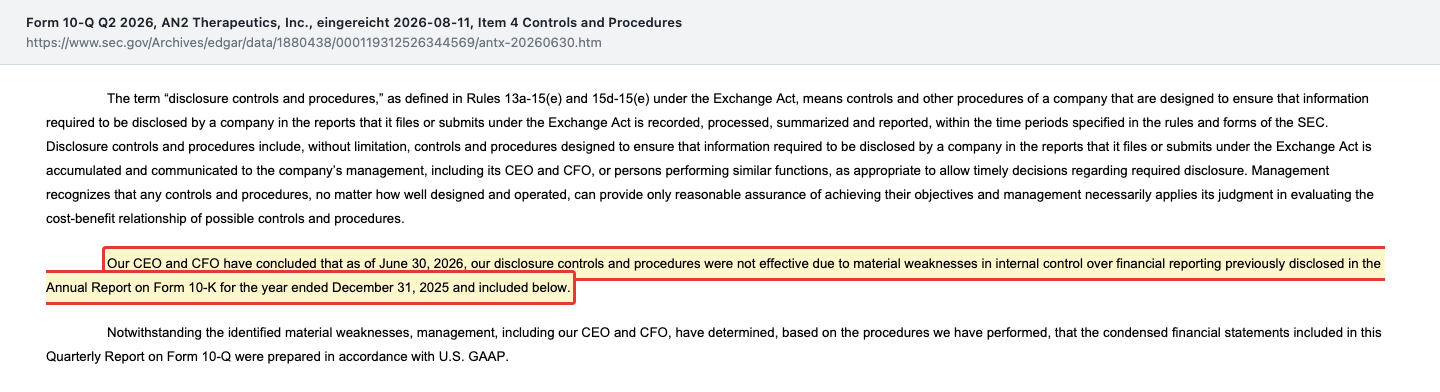
“Our CEO and CFO have concluded that as of June 30, 2026, our disclosure controls and procedures were not effective due to material weaknesses in internal control over financial reporting previously disclosed in the Annual Report on Form 10-K for the year ended December 31, 2025 and included below.”
— AN2 Therapeutics, Inc., SEC quarterly report 10-Q for June 30, 2026, Item 4 “Controls and Procedures”
For context: per AN2, the weaknesses led to adjustments to accrued expenses in the 2019 and 2020 financial statements, recorded before those statements were issued; management considers the current financial statements GAAP-compliant despite the weaknesses. The filings do not mention any restatement of previously issued financial statements. Then there is an event from March 2026. Ten days after the rally, on March 19, the board cut the exercise price of all employee, executive and director options that were above $3.91:
“Pursuant to the Option Repricing, the exercise price of each Eligible Option was reduced to $3.91 per share, the closing price of the Company’s common stock on the Repricing Date.”
— AN2 Therapeutics, Inc., SEC current report 8-K of March 20, 2026, Item 5.02
CEO Eric Easom alone held 742,649 of these options, with original exercise prices between $6.60 and $17.28. Anyone who exercises or leaves before September 19, 2027, pays the old price; after that, the new one applies. The board says the move retains employees without additional share grants or cash payments. For you as a shareholder, it means: ten days after the rally, the board cut the exercise price of all options, including those of executives and directors, to the then closing price of $3.91 — and the accounting control weaknesses have persisted since 2022.
Valuation: About $211 Million for $80 Million in Cash and a Story
Let’s do the math, our own and dated. On October 30, 2026, the stock closed at $4.53. With 37,736,237 shares (as of August 6, 2026), that is a market value of about $171 million, or about $211 million including the 8.7 million pre-funded warrants. Against that stand $79.9 million in cash and investments as of June 30, 2026, with no borrowings. For the pipeline — PV, Chagas, the lung infection and the early cancer projects combined — the market is paying about $131 million. For comparison: in the summer of 2025, the public float was worth just $23.1 million. The story has multiplied the price since; the body of evidence through October 30, 2026, is essentially the same, plus monkey and Phase 1 data in Chagas.
The view from the pros is friendly: according to fundamental data (as of October 30, 2026), both covering analysts rate the stock a buy, with an average price target of $9. Average means: all price targets added up and divided — with only two votes, that figure says little, and biotech price targets usually assume trial success. Insiders are mixed: director Robin Shane Readnour sold a total of 52,629 shares at around $6 for the funds of MGC Venture Partners between August 17 and September 9, 2026, under a trading plan adopted in April; director Margaret FitzPatrick bought 2,098 shares at $5.53 on September 1 (insider filings, Form 4). The next real test is the quarterly report for September 30, 2026 — last year, AN2 filed it on November 12. It will show whether the trial is enrolling patients, how many new shares were sold under the program and how fast the cash is shrinking. Remember: whoever holds AN2 shares owns not cash with a bonus, but a bet that is about two-thirds expectation.
Upside and Risks at a Glance
What speaks for AN2 Therapeutics:
- Solid cash for its size: $79.9 million in cash and investments as of June 30, 2026, no borrowings, $5.8 million in total liabilities.
- Frugality: net loss cut from $51.3 million (2024) to $35.2 million (2025); about $9.5 million in cash used per quarter in the first half of 2026.
- Several shots on goal: PV trial from the fourth quarter of 2026, a Chagas compound that eliminated the parasite in all treated monkeys with Phase 2 planned for late 2026, and an investigator-initiated trial in M. abscessus with results in late 2027.
- An approval in Chagas could earn AN2 a voucher for an expedited FDA review (priority review voucher).
- Specialist investors: Commodore Capital reported 9.9 percent after the placement, Vivo Opportunity Fund 8.0 percent (Schedule 13G, March 2026).
What speaks against it:
- No revenue and, by its own account, no clinical proof of concept for any product candidate; first PV data only in the course of 2027, and the timeline has already slipped.
- Epetraborole failed as an antibiotic for MAC (Phase 3 portion of EBO-301, May 2025).
- Dilution: shares plus pre-funded warrants rose from 30.4 million to 45.0 million in the first half of 2026, plus an at-the-market program of up to $80 million.
- Material weaknesses in financial reporting controls since 2022, not remediated as of June 30, 2026.
- Option repricing to $3.91 shortly after the rally; a director sold shares at around $6 in August and September 2026.
A Human Conclusion
Back to the side-effect romance from the beginning. The story is good, and it is not made up: according to the company, epetraborole affects red blood cell production, and for PV patients, a pill that replaces phlebotomy would be real progress. But a good story is not a trial result. According to the latest quarterly report, the first PV patients were to be enrolled in the trial no earlier than the fourth quarter of 2026; there are no results, the timeline has slipped, the company has diluted shareholders by roughly half in six months, reset options, including management’s, to $3.91 and set up a program for more new shares. So the honest question for you is not “Isn’t the twist wonderful?” but: would you still buy AN2 if you did not know the story and only saw the numbers? What you make of it is your decision. And that is how it should be.
Sources
All original documents used in this analysis — for you to read yourself:
- AN2 Therapeutics, Inc. — SEC quarterly report 10-Q for June 30, 2026 (filed August 11, 2026)
- AN2 Therapeutics, Inc. — SEC current report 8-K of August 11, 2026, Exhibit 99.1 (second-quarter 2026 results)
- AN2 Therapeutics, Inc. — SEC quarterly report 10-Q for March 31, 2026 (filed May 11, 2026)
- AN2 Therapeutics, Inc. — SEC annual report 10-K for 2025 (filed March 17, 2026)
- AN2 Therapeutics, Inc. — SEC current report 8-K of March 10, 2026 (private placement) and Exhibit 99.1 (press release of March 9, 2026)
- AN2 Therapeutics, Inc. — SEC current report 8-K of March 20, 2026 (option repricing)
- AN2 Therapeutics, Inc. — SEC current report 8-K of April 9, 2026 (sales agreement with Jefferies)
- AN2 Therapeutics, Inc. — SEC prospectus supplement 424B5 of April 20, 2026 and prospectus supplement 424B3 of April 20, 2026 (resale)
- AN2 Therapeutics, Inc. — SEC current report 8-K of June 4, 2026 (Chagas data)
- AN2 Therapeutics, Inc. — SEC registration statement S-8 of September 14, 2026 (inducement plan)
- Commodore Capital LP — Schedule 13G of March 16, 2026
- Robin Shane Readnour — insider filing (Form 4) of August 19, 2026; Margaret M. FitzPatrick — insider filing (Form 4) of September 2, 2026
- AN2 Therapeutics — press release of August 31, 2026, on the SOHO 2026 abstracts (Business Wire)
- Full SEC filing history: EDGAR overview AN2 Therapeutics (sec.gov)
- Fundamental data (prices, short interest, analyst ratings; as of October 30, 2026), cross-checked against the SEC filings; Reddit mentions: ApeWisdom, retrieved October 31, 2026.
Transparency & disclaimer: this analysis is journalistic commentary on publicly available information. It is not investment advice, not a regulated investment research product and not a solicitation to buy or sell securities. Equity investments carry substantial risk up to and including total loss. All information is provided without warranty; the as-of date for each figure is stated in the text. Positions held by the operator are disclosed daily; where one exists, it appears as a notice at the top of this analysis.
Key figures at a glance
All monetary figures in millions of $; earnings per share as reported.
| Metric | 2021 | 2022 | 2023 | 2024 | 2025 |
|---|---|---|---|---|---|
| Revenue | 0.0 | 0.0 | 0.0 | 0.0 | 0.0 |
| Operating Income (EBIT) | -21.6 | -42.3 | -69.6 | -54.6 | -38.1 |
| Net Income | -21.5 | -41.5 | -64.7 | -51.3 | -35.2 |
| Earnings Per Share | -1.15 $ | -2.70 $ | -2.74 $ | -1.72 $ | -1.16 $ |
Source: fundamental data & SEC filings (annual and quarterly reports, 10-K/10-Q)
Our Bottom Line at a Glance
- Cash & costs positive
- $79.9 million in cash and investments with no borrowings (6/30/2026); net loss cut from $51.3 million (2024) to $35.2 million (2025).
- Clinical evidence negative
- Per the 10-Q for 6/30/2026, no product candidate has clinical proof of concept; first PV data in the course of 2027, and epetraborole failed in MAC in 2025.
- Pipeline breadth neutral
- Three Phase 2 efforts (PV, M. abscessus, Chagas) plus early cancer projects; the Chagas compound has positive monkey and Phase 1 data (8-K of 6/4/2026).
- Dilution negative
- Shares plus pre-funded warrants up from 30.4 million to 45.0 million in the first half of 2026; at-the-market program of up to $80 million since April 2026.
- Governance & controls negative
- Material weaknesses since 2022, not remediated as of 6/30/2026; all options above $3.91 repriced to $3.91 on 3/19/2026.
AN2 Therapeutics is the side-effect romance in pure form: a drug that failed as an antibiotic is supposed to help against a blood cancer, and the stock went from $1.06 to $5.25 in four trading days in March 2026. The SEC filings show solid, frugally managed cash, but no clinical proof of concept, a slipped timeline, heavy dilution and control weaknesses since the IPO. Not investment advice.
What Our Rating Means
Open questions
The business works in principle, but one material question is open. As long as it stays open, our findings do not carry a quality verdict.
The balance sheet carries the next steps: about $80 million in cash, no borrowings, no going-concern doubt. Yellow because the entire company depends on trials whose first results arrive in 2027 at the earliest, and because the accounting control weaknesses have persisted since 2022 — with no restatement mentioned, but also not remediated. The decision is yours.
A journalistic assessment by our editorial team at the time of the deep dive, based on public sources — not investment advice and not a solicitation to buy or sell. Your personal circumstances (investment goals, risk capacity, taxes) cannot be taken into account. What our levels mean, how verdicts are formed, and what conflicts of interest exist →
Worth Noting
- Why we looked: in-house Reddit hype scanner, 10/31/2026 (1 mention in 24 hours, rank 737 after rank 184 the day before; ApeWisdom). Price references (closing prices, fundamental data): $1.06 (3/3/2026), $2.85 (3/6/2026), $5.25 (3/9/2026), $3.91 (3/19/2026), $3.61 (4/17/2026, 424B5), $6.28 (8/12/2026, twelve-month high), $4.53 (10/30/2026).
- Data as of: the latest periodic report is the 10-Q for 6/30/2026 (filed 8/11/2026); the 10-Q for 9/30/2026 had not been filed as of 10/31/2026. Market value and the “little over eight quarters” runway are our own calculations ($79.9 million ÷ about $9.5 million cash used per quarter in H1 2026), not company figures.
- The link between “anemia as an adverse event in MAC” and “lowering red blood cells in PV” is our reading of the 2025 10-K and the press release of 8/31/2026, not the company’s wording.
- Not to be confused: ticker ANTX belongs to AN2 Therapeutics, Inc. (CIK 0001880438), not to the former Anacor Pharmaceuticals (now a Pfizer subsidiary), from which AN2 licenses its compounds.
Stock Watch
This analysis is as of October 31, 2026. Stock Watch will tell you what's changed at ANTX since then.
Later $1 a month per stock — signing up is free, and you'll be the first to know when it launches.
The full analysis as a PDF for later
We will send you this analysis as a PDF — to print, file away, and read at your own pace. And we will add you to the free Stock Watch list for AN2 Therapeutics Inc (ANTX), so you hear about it when something material in this analysis changes.
Frequently Asked Questions
AN2 Therapeutics (Nasdaq: ANTX) is a Menlo Park, California, biotech with no revenue. It develops boron-based drugs: epetraborole for the blood cancer polycythemia vera and a lung infection, and AN2-502998 for Chagas disease. Its net loss was $35.2 million in 2025.
In March 2026, AN2 announced plans to test epetraborole in a Phase 2 trial in polycythemia vera. The closing price rose from $1.06 on March 3 to $5.25 on March 9, 2026. There was no patient data in this disease at the time; AN2 expects the first in the course of 2027.
Polycythemia vera (PV) is a slowly progressing blood cancer in which the bone marrow makes too many red blood cells. That raises the hematocrit and with it the risk of clots. Many patients need regular phlebotomy. According to AN2, about 155,000 people in the U.S. have PV.
As of June 30, 2026, AN2 had $79.9 million in cash and investments and no borrowings. Operations used $19.1 million in the first half of 2026. AN2 says the money will last at least twelve months; it expects expenses to rise significantly with the new trials.
Shares plus pre-funded warrants rose from 30.4 million at the end of 2025 to 45.0 million on June 30, 2026, mainly through a placement at $2.85 in March 2026. Since April 2026, AN2 may also sell up to $80 million of new shares into the market through Jefferies.
This analysis makes no buy recommendation. It shows solid cash and several trials, but no clinical proof of concept, a PV timeline that has already slipped, heavy dilution and control weaknesses since 2022. Whether the story justifies the price is your call.
Found an error?
Did you spot a factual error, an outdated number, or a typo in this deep dive? Let us know briefly — your report goes straight to the editorial team.