AIXTRON and the booking trap: best quarter of the year, stock 19 percent below its August price
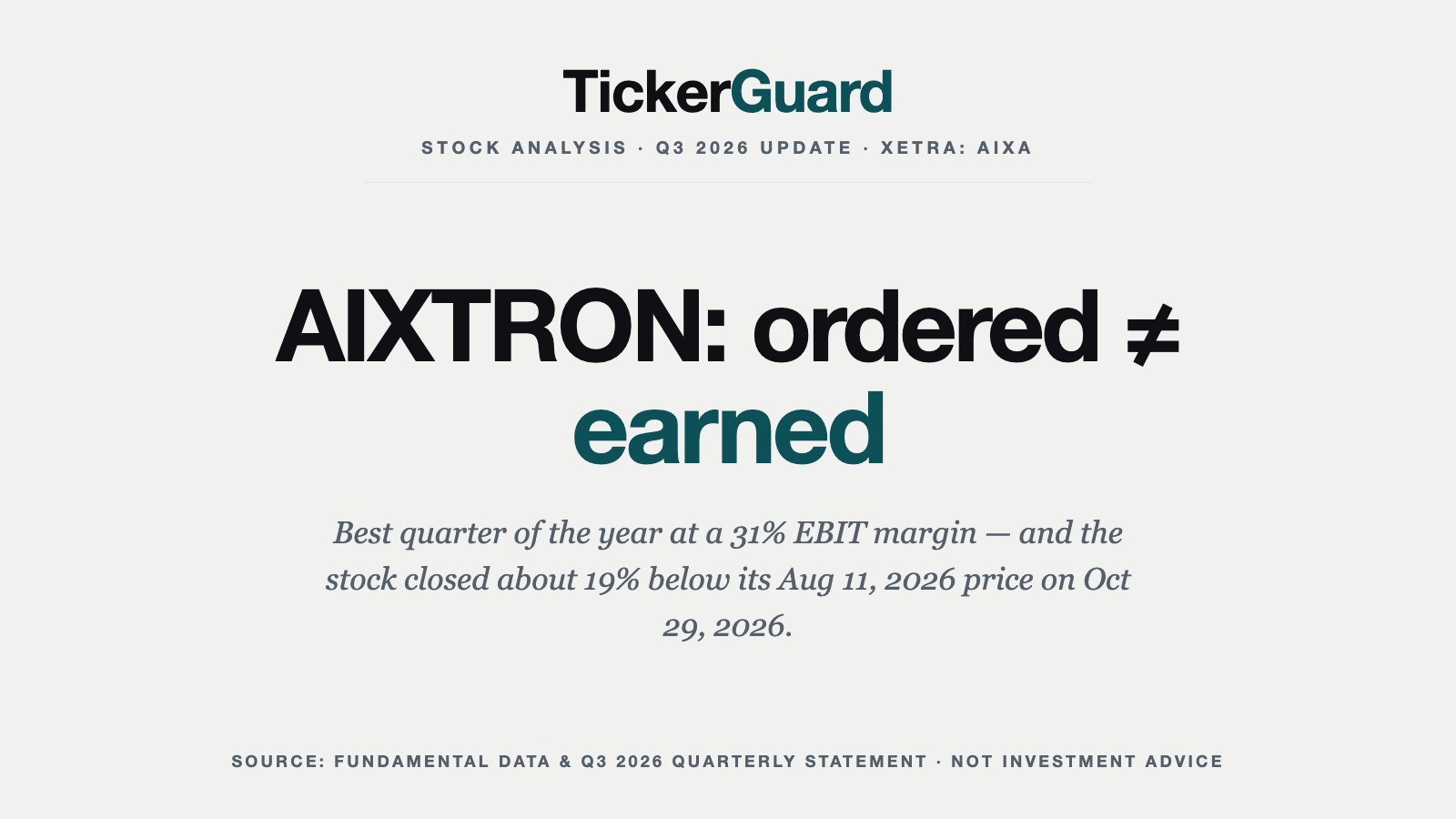
Order intake up 122 percent and a 31 percent operating margin in the third quarter of 2026 — and AIXTRON stock closed about 19 percent below its August 11 price on October 29, 2026. Against the booking trap (an order is not yet a profit) a sober calculation helps: the equipment order backlog stands at EUR 549.4 million, but for full-year guidance to work, the fourth quarter has to turn EUR 201.9 million of it into revenue. Not a buy or sell recommendation — just the arithmetic of how much of the full order book has to reach the profit line by New Year's Eve.
 Thomas Mücke
Founder & Publisher
Chart
Interactive price chart (TradingView).
Note: pure fact-based analysis, not investment advice and not a solicitation to buy or sell. All figures without guarantee.
Updated October 30, 2026 after the third-quarter 2026 results. The first edition of this analysis ran on August 12, 2026.
There is a mental move our brain makes so fast that we never notice it: it books an order as a profit. A headline says “order intake up 81 percent” (that was the second-quarter 2026 news) — and before we have finished reading, the picture in our head is of a company making money. Call it the booking trap: between an order and a profit there are, in reality, months, a factory, a delivery and an invoice that has to be paid. For an equipment maker that builds machines the size of a small car, those are not details. They are the actual test.
AIXTRON delivered exactly that headline in the second quarter of 2026. And the same report carried the other number: first-half revenue down 30 percent, operating result negative. This analysis first ran on August 12, 2026 and did the booking on paper back then. Since October 29, 2026 the first interim settlement is in — the third quarter. The tension is unchanged: the order book is fuller than it has been in years — the equipment backlog has more than doubled since the end of 2025 — and it gets paid for in a second half that, at the guidance midpoint, has to bring more than the second half of 2024 — and 2024 was the strongest revenue year since 2021. What is new is that the first half of that half-year has been delivered.
What changed with the third quarter of 2026
As of this update: October 30, 2026 (Quarterly Group Statement Q3/2026 of October 29, 2026, analyst call the same day). First the numbers, in the order the booking trap mixes them up. A lot was ordered: third-quarter 2026 order intake rose 122 percent to EUR 274.9 million (prior-year quarter EUR 124.0 million, second quarter EUR 214.5 million). More was shipped than at any point earlier this year: EUR 183.6 million of revenue, up 54 percent year on year and inside the EUR 180 million plus/minus EUR 20 million range management set itself in July. And this time money was made too: EUR 56.7 million of operating result at a 31 percent EBIT margin, after minus EUR 22.3 million in the first quarter and plus EUR 14.7 million in the second. Gross margin jumped to 48 percent (prior-year quarter 39 percent).
“Order intake increased by 122% to EUR 274.9 million in the third quarter of 2026 reflecting the continued strong demand for photonic applications in AI data centers (Q3/2025: EUR 124.0 million).”
— AIXTRON SE, Quarterly Group Statement Q3/2026, section “Business Development in the Group”, page 3
The market had expected less. On October 15, 2026 AIXTRON had already pre-released the headline figures by ad-hoc announcement — noting that order intake and operating result were “significantly” above current market expectations. The median of the analyst consensus compiled by AIXTRON stood at EUR 214.6 million for order intake. According to the EQS newswire the release went out at 6:00 p.m., after the close of a session in which the stock had lost 12.7 percent on XETRA (close EUR 30.98, after EUR 35.49 the day before).
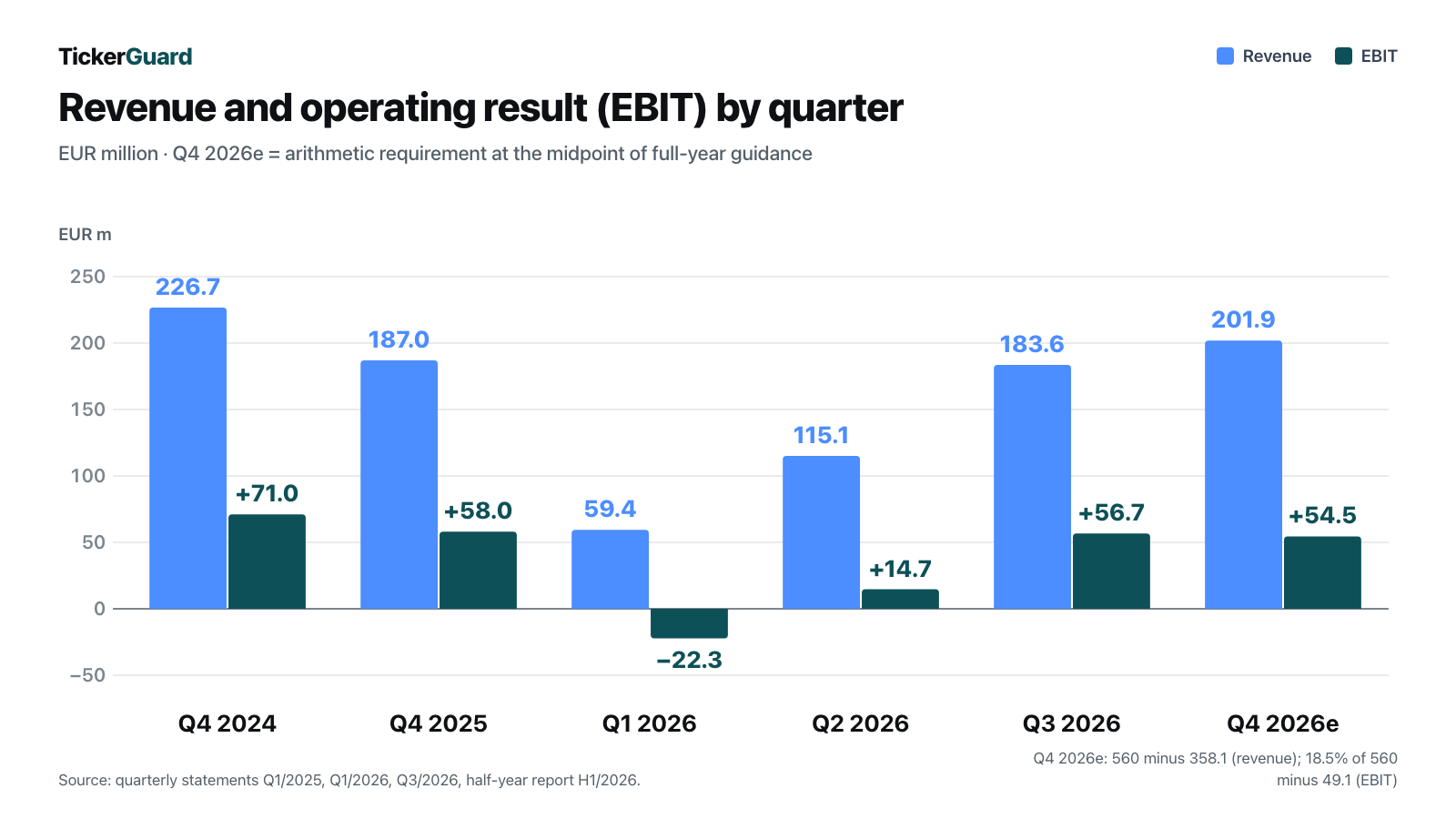
Now the arithmetic this case has been about since August. After nine months, EUR 358.1 million of revenue is on the books. That leaves EUR 201.9 million for the fourth quarter to reach the EUR 560 million guidance midpoint; the range runs from EUR 171.9 million (low end) to EUR 231.9 million (high end). That sounds like a lot, but it is no outlier: in the fourth quarters of 2024 and 2025 AIXTRON booked EUR 226.7 million and EUR 187.0 million of revenue, each at a 31 percent EBIT margin. On earnings, the midpoint requires EUR 46.1 million to EUR 62.9 million of fourth-quarter operating result — 17 to 20 percent of EUR 560 million, less the EUR 49.1 million from nine months. The call presentation backs the revenue math: roughly EUR 170 million (plus/minus EUR 30 million) of the fourth quarter is to come from the equipment order backlog, roughly EUR 30 million from service and spare parts.
One sentence from the call belongs to the full picture, because it puts the third quarter's 48 percent gross margin in context. CFO Christian Danninger said in his prepared remarks:
“We do not consider the Q3 margin level to be representative of Q4 and have therefore maintained our full-year gross margin outlook.”
— Dr. Christian Danninger, CFO, Q3/2026 analyst call of October 29, 2026, prepared remarks, page 4
In numbers: if full-year gross margin stays around 42 percent, the fourth quarter lands at roughly 45 percent — good, but below the third quarter's 48 percent. Per the statement, the third-quarter margin reflects a “favorable product and regional mix”, in other words the composition of the systems shipped that quarter and their destination regions. The CFO himself does not consider that level representative of the fourth quarter.
What changed in tone: in July, chief executive Felix Grawert said of power electronics that there was “not much new compared to the last quarter”. In October he spoke of first orders for capacity expansions in gallium nitride and silicon carbide and of a “beginning recovery”; roughly 24 percent of third-quarter equipment order intake came from that field. Also new is an outlook beyond the year — the presentation holds out “significant growth” for 2027, with formal guidance due only with the annual report on March 4, 2027. One caveat on sources: what has been published are management's prepared remarks and the presentation. The analyst Q&A was available only as an audio recording as of October 30, 2026 and is not reflected in this update.
Two numbers below the line deserve a second look. Third-quarter net income of EUR 35.4 million was well below the EUR 56.7 million operating result: the financial result cost EUR 4.5 million, and AIXTRON booked EUR 16.8 million of tax — about 32 percent of EUR 52.2 million of pre-tax profit. The statement explains part of it for the first nine months: EUR 4.5 million of the EUR 9.3 million tax expense is deferred tax, because tax loss carryforwards are being used up sooner than assumed thanks to the stronger business, so the deferred tax assets carried for them had to be reduced — good news in bad clothing. The statement gives no split for the third quarter alone. The negative financial result (nine months: minus EUR 7.2 million) stems mainly from the accretion of the interest-free convertible on the balance sheet — more on that in the fourth uncomfortable truth.
Company history for investors
-
2016
Takeover blocked, NASDAQ exit
The U.S. President blocked the takeover by Fujian Grand Chip; AIXTRON ended its U.S. listing. Since then the company reports only under European law.
-
2024
Revenue of EUR 633.2 million
The strongest revenue year since 2021; its second half, with EUR 383.1 million, became the yardstick against which 2026 guidance is measured.
-
2025
Revenue falls to EUR 556.6 million
Down 12 percent, yet still an 18.0 percent EBIT margin: the cycle hit revenue, not profitability.
-
2026
Guidance raised, EUR 450 million convertible
In April AIXTRON lifted its revenue target to EUR 560 million and issued an interest-free convertible — potentially 7.9 percent new shares.
-
2026
Third quarter hits its own range
EUR 183.6 million of revenue, a 31 percent EBIT margin, EUR 274.9 million of orders: the ramp shows up in the income statement for the first time.
What AIXTRON actually does — the machine behind the machine
AIXTRON SE, based in Herzogenrath near Aachen in western Germany, does not build chips. It builds the machines in which chips are grown — specifically, systems for metal-organic chemical vapor deposition, or MOCVD. Picture an extremely precise oven in which ultra-thin crystal layers grow onto a carrier wafer, layer by layer, accurate to the atomic level, out of gases that break down at several hundred degrees Celsius. What comes out is not a finished chip but the semiconductor layer from which a laser, an LED or a power transistor is made. AIXTRON sells the machine tool of the semiconductor industry — with a machine-tool business model: few, very expensive units, long lead times, revenue that arrives in jumps rather than in even monthly slices.
It serves three end markets, and their weighting shifted dramatically in 2026. In the first nine months of 2026, more than 61 percent of equipment revenue came from optoelectronics — lasers for optical data transmission and 3D sensing. 19 percent came from power electronics based on gallium nitride (GaN) and silicon carbide (SiC), and 18 percent from LED including micro-LED. Those power semiconductors are exactly the business of customers such as Infineon, whose end markets we have analysed separately. Regionally, Asia accounted for 54 percent of nine-month revenue (EUR 193.9 million), ahead of the Americas with 28 percent (EUR 98.5 million) and Europe with 18 percent (EUR 65.7 million).
AIXTRON was founded in 1983 and has been a European company (SE) since December 30, 2010, previously AIXTRON AG. It is run by Dr. Felix Grawert as chief executive and Dr. Christian Danninger as chief financial officer; both presented the third-quarter figures on October 29, 2026. As of June 30, 2026 the group employed 1,035 people — 871 in Europe, 122 in Asia, 42 in the United States; the quarterly statement as of September 30 gives no headcount. Under IFRS 8 AIXTRON reports a single segment. The fiscal year is the calendar year.
Why there is no 10-K here — and what the source is instead
One point up front, because it shapes the entire evidence base: AIXTRON files nothing with the U.S. securities regulator, the SEC, today. It once did. Until the end of 2016, AIXTRON depositary shares traded on NASDAQ under AIXG (SEC registrant CIK 0001089496). That listing ended in an episode still cited as a case study in semiconductor politics: Chinese investor Fujian Grand Chip wanted to acquire AIXTRON — and the U.S. President blocked the deal on December 2, 2016 on national-security grounds, because the company's U.S. operations were involved. AIXTRON pulled the plug shortly after: Form 25 to delist on December 30, 2016, Form 15F-12G to deregister fully on January 9, 2017. The SEC registrant record has shown no exchange and no ticker since.
That is neither a flaw nor a warning — it is simply a different legal regime. AIXTRON reports under European capital-markets law: audited IFRS consolidated statements (Annual Report 2025), a half-year financial report under IAS 34, quarterly statements and ad-hoc releases under Article 17 of the EU Market Abuse Regulation. Every figure in this analysis therefore carries “Source: fundamental data & company reports” rather than “SEC filings”. One detail belongs to full disclosure: by the company's own statement, the 2026 half-year report and quarterly statements have been neither audited under section 317 of the German Commercial Code nor subjected to an auditor's review. The 2025 full-year figures, by contrast, are audited. We saw the same constellation — German listing, no SEC filer — at SUESS MicroTec, the other German equipment maker in this industry.
How the stock landed on our desk
Through the chart. On October 17, 2025 AIXTRON shares dropped intraday to EUR 11.675 — the lowest price in the twelve months before the first edition of this analysis. Eight months later, on June 18, 2026, they reached EUR 62.66 intraday. That is more than a fivefold gain. Then it turned: on August 11, 2026, the data cutoff of the first edition, the shares closed at EUR 42.07; on October 29, 2026, results day, at EUR 34.14 — about 19 percent below the August level, even though the quarter hit its own range and beat expectations on order intake. Much of the decline came on a single day: on October 15, 2026, hours before the ad-hoc release, the stock lost 12.7 percent; on results day it then rose 8.5 percent (close EUR 34.14 after EUR 31.47). None of the sources reviewed here gives a documented reason for the decline since August.
A stock that quintuples while revenue drops, then falls while the numbers improve, is exactly the kind of contradiction this section exists for. The market prices not the quarter just reported but what comes after it — and how much of that was already in the price. The thematic trigger remains: the demand filling AIXTRON's order book comes from the rebuild of data centers for artificial intelligence — the same wave we examined from the chip side at Nvidia. AIXTRON sits at the other end of that chain, at the tooling.
The numbers over the years — credit where it is due
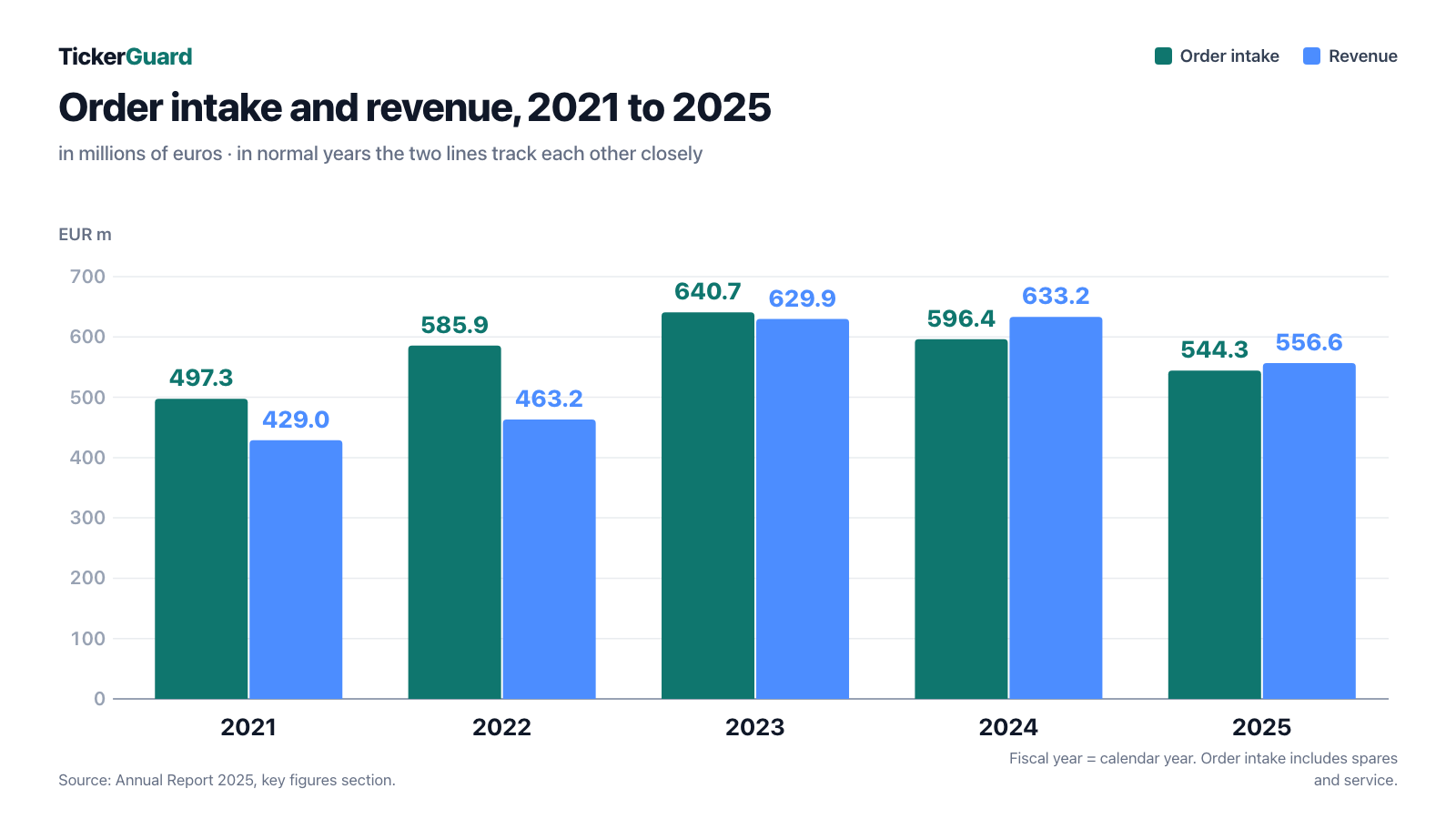
First the part that is good without qualification: AIXTRON makes money, and has for years. Revenue rose from EUR 429.0 million (2021) through EUR 463.2 million (2022) and EUR 629.9 million (2023) to EUR 633.2 million (2024), before falling back to EUR 556.6 million in 2025. The operating result was positive in every single one of those years: EUR 99.0m / 104.7m / 156.8m / 131.2m and 100.3 million (2025). Gross margin moved in a narrow band between 40 and 44 percent. Earnings per share: EUR 0.85 / 0.89 / 1.29 / 0.94 / 0.76. For a cyclical equipment maker that is a remarkably steady run — even the weakest year left an 18.0 percent EBIT margin standing.
Order intake tracked revenue closely throughout: EUR 497.3m / 585.9m / 640.7m / 596.4m and 544.3 million. That parallel is exactly what breaks in 2026: after nine months of 2026, order intake stands at EUR 660.9 million — more than in any of the five full years before — against EUR 358.1 million of revenue.
The balance sheet as of September 30, 2026 is strong too, and that should be said plainly before the uncomfortable chapters: EUR 944.8 million in cash and short-term financial assets, no bank debt, an undrawn credit facility of EUR 200 million, equity of EUR 1,030.8 million and — after deducting the liability component of the convertible bond — net financial assets of EUR 590.9 million. The half-year report showed no going-concern flag and no impairment on goodwill, which stood at EUR 72.2 million as of September 30, 2026. Anyone looking for a balance-sheet story at AIXTRON will not find one.
What the reports say — the uncomfortable truths
Uncomfortable truth no. 1: guidance demands a second half above the 2024 level — the first half of it is delivered
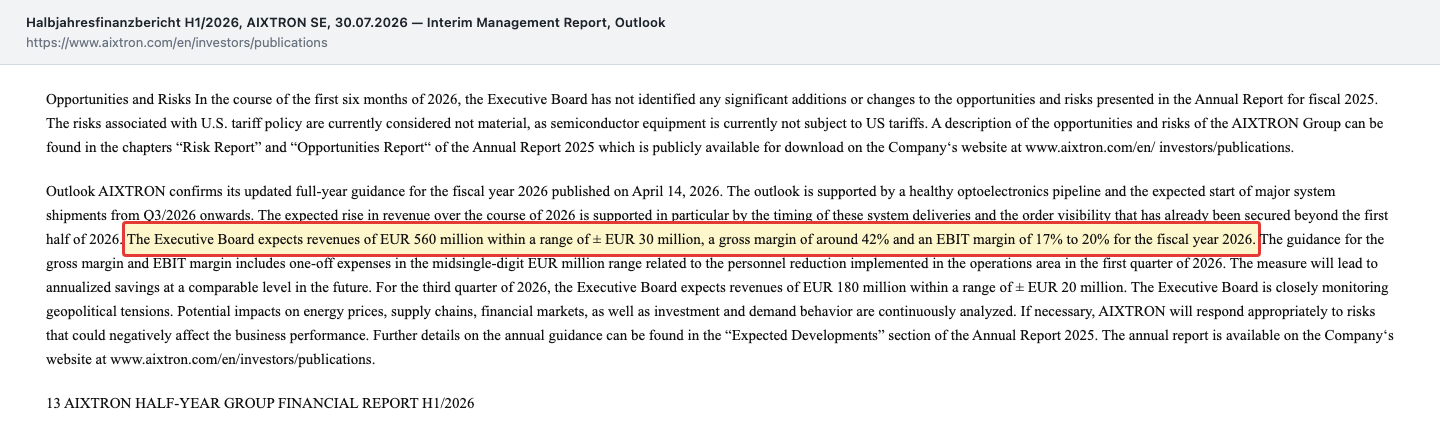
This is the core. On April 14, 2026 AIXTRON raised full-year guidance by ad-hoc release: revenue from around EUR 520 million to around EUR 560 million, the EBIT margin from 16 to 19 percent up to 17 to 20 percent. That guidance was confirmed in the half-year report on July 30, 2026 and again in the quarterly statement on October 29, 2026:
“The Executive Board expects revenues of EUR 560 million within a range of ± EUR 30 million, a gross margin of around 42% and an EBIT margin of 17% to 20% for the fiscal year 2026.”
— AIXTRON SE, Half-Year Group Financial Report H1/2026, interim management report, section “Outlook”, page 13; confirmed in substance in the Quarterly Group Statement Q3/2026, section “Outlook”, page 7
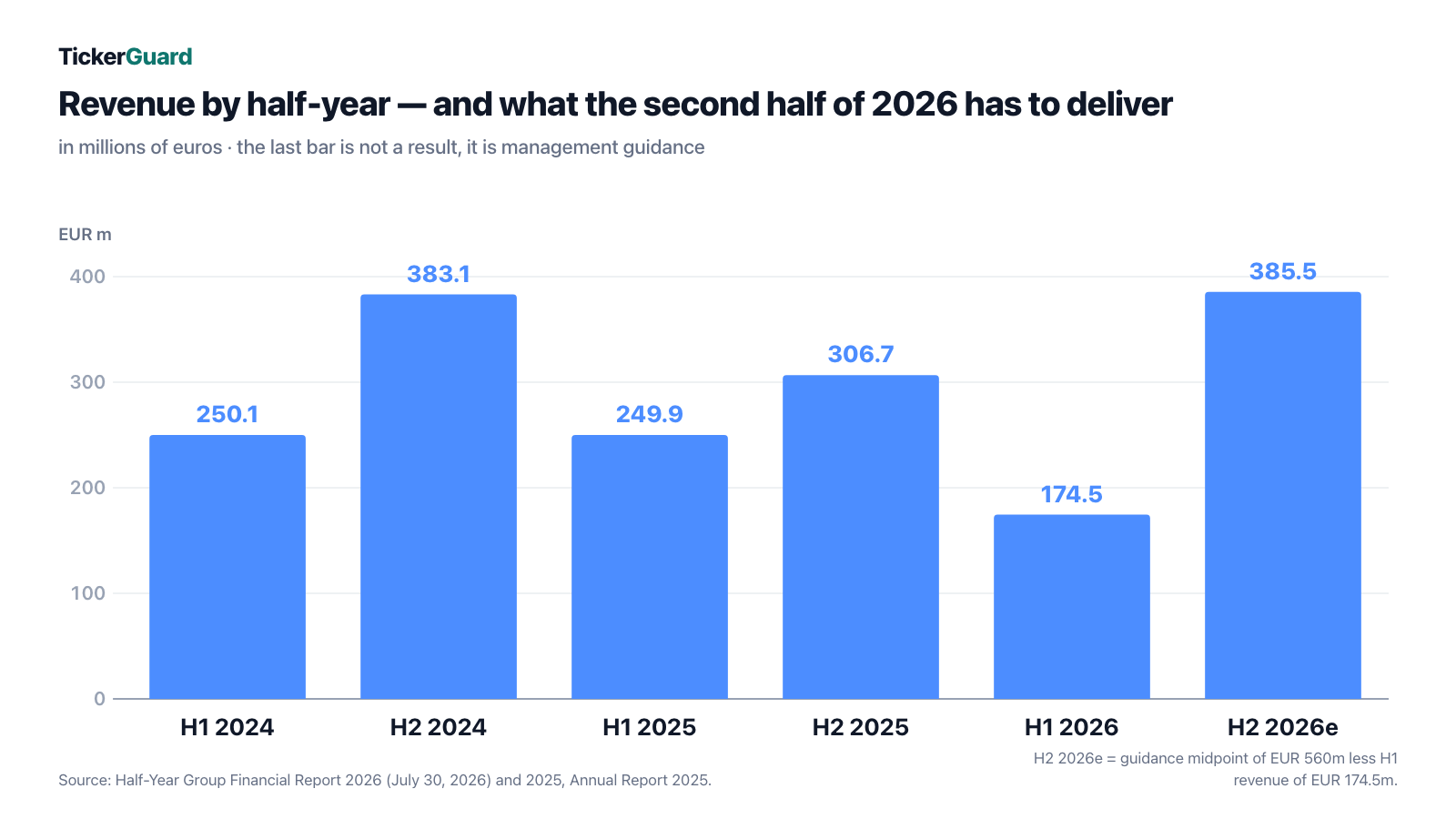
The arithmetic from the first edition: AIXTRON booked EUR 174.5 million of revenue in the first half of 2026. That left EUR 385.5 million to the EUR 560 million guidance midpoint for the six months from July to December. For comparison, the actual second halves: 2024 delivered EUR 383.1 million (full-year revenue of EUR 633.2 million less EUR 250.1 million in the first half), 2025 delivered EUR 306.7 million. At the midpoint, AIXTRON would therefore have to narrowly beat the second half of 2024, and 2024, at EUR 633.2 million, was the strongest revenue year since 2021 — at the low end of the range (EUR 530 million), EUR 355.5 million would do.
On the earnings side it looked tighter still in August. The operating result in the first half of 2026 was minus EUR 7.6 million. An EBIT margin of 17 to 20 percent on EUR 560 million of full-year revenue means full-year EBIT of EUR 95.2 million to EUR 112.0 million. The second half would therefore have to contribute EUR 102.8 million to EUR 119.6 million — on EUR 385.5 million of revenue an EBIT margin of 26.7 to 31.0 percent, against roughly 28.3 percent in the second half of 2024. The third quarter delivered EUR 56.7 million of that, at a 31 percent margin in line with the last two fourth quarters.
Remember: confirmed guidance is not a result. It is a calculation that still has to work out. After the third quarter, half of it has. The other half sits in the fourth quarter — with a revenue requirement of EUR 201.9 million at the midpoint, between the fourth-quarter figures of 2024 and 2025. That is far less daring than the half-year arithmetic looked in August. It is proven only with the annual report on March 4, 2027.
Uncomfortable truth no. 2: the order surge hangs on one end market — and on one material
The order boom is real and documented — but in the summer it was not broad. It came almost entirely from one application:
“Optoelectronics was the main driver of demand, accounting for approximately 75% of equipment order intake in the second quarter 2026.”
— AIXTRON SE, Half-Year Group Financial Report H1/2026, interim management report, section “Business Development in the Group”, page 3
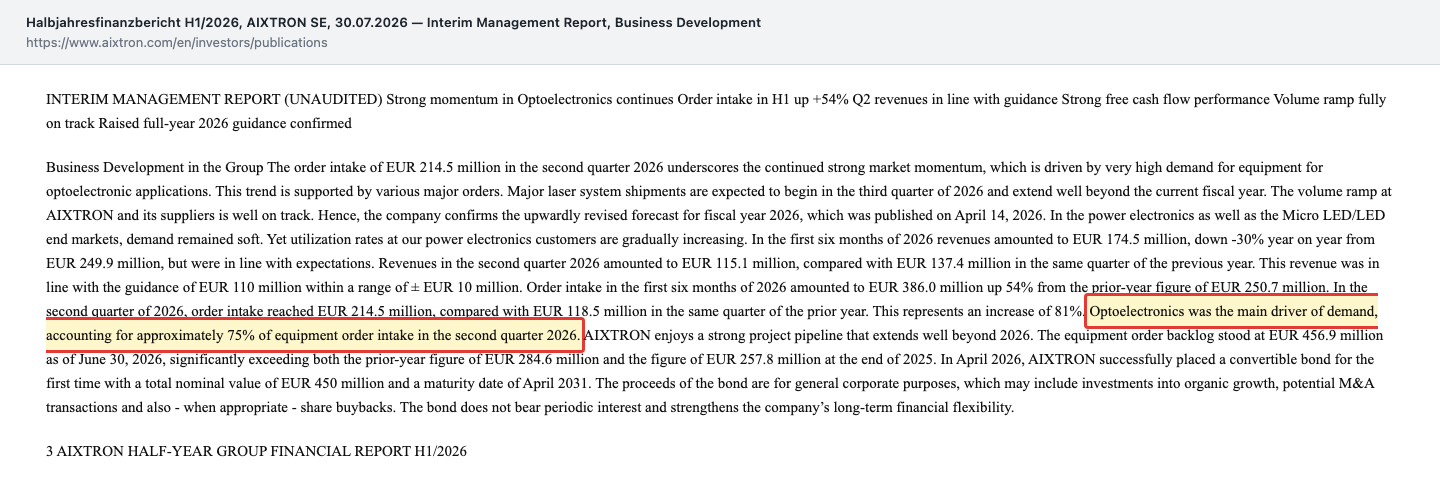
What is optoelectronics in this context? Above all, lasers for optical data transmission — the light sources that move data between servers and server racks in data centers. The half-year report is unambiguous: demand for these lasers is “largely driven by AI data centers”, and the market for AI-optimised optical transceivers is expected by market researcher TrendForce to grow more than 50 percent in 2026, propelled by the shift to 800G and 1.6T transmission rates.
In the third quarter the picture broadened somewhat: optoelectronics accounted for roughly 68 percent of equipment order intake, power electronics for roughly 24 percent. At the same time the concentration has become visible somewhere else — in the material. The quarterly statement says:
“Demand for Indium phosphide (InP)-based optical components continued to grow at a very strong pace in the third quarter of 2026 and now accounts for the majority of the order backlog, which provides revenue visibility well into 2027.”
— AIXTRON SE, Quarterly Group Statement Q3/2026, section “Business Development in the Group”, page 3
Put in everyday terms: a restaurant with three menus in which almost everyone suddenly orders the same dish may well post dazzling revenue — but it lives or dies by that dish. More than half of a EUR 549.4 million backlog rests on lasers made from a single semiconductor material for a single purpose. That the second menu is being read again is new: in gallium nitride, management sees utilization back to normal and first customer expansion plans; in silicon carbide, first new tool orders and a “gradual recovery of SIC throughout 2027”. Micro-LED remains “soft” by the company's own account. An expectation for 2027, though, is not yet an order for 2027.
Uncomfortable truth no. 3: the big cash inflow came out of customers' pockets
On its own, this number sounds spectacular: free cash flow reached EUR 289.9 million in the first nine months of 2026, after EUR 110.3 million a year earlier; the first half alone brought EUR 162.1 million, more than double the prior year (EUR 71.1 million) — alongside a half-year loss of EUR 2.8 million. How does that fit together?
The cash flow statement answers it in one line. Of the EUR 311.1 million operating cash inflow in the first nine months, EUR 261.7 million came from customer advance payments. On the balance sheet, contract liabilities for advance payments rose accordingly from EUR 44.5 million (December 31, 2025) through EUR 197.5 million (June 30, 2026) to EUR 309.0 million (September 30, 2026). That is money AIXTRON holds today and has to ship as machinery tomorrow — a liability, not income. To be fair: with a EUR 35.4 million result for the period, a solid part of the third-quarter inflow was earned.
Those advances are also the best available proof that the backlog is real. AIXTRON only books an order once four conditions are met — a firm written order, receipt or securing of the agreed advance payment, availability of all documents required for delivery, and a delivery date confirmed by the customer. On top of that, the Executive Board explicitly reserves the right to exclude orders whose execution it does not consider sufficiently probable. Even so: a full cash box built on advances is a prepayment for work still to be done. It shows up in inventories too, which climbed to EUR 323.3 million (December 31, 2025: EUR 283.6 million) — mostly work in progress for shipments in the coming quarters, according to the CFO.
Uncomfortable truth no. 4: a EUR 450 million convertible — with EUR 945 million in the bank
In April 2026 AIXTRON placed a convertible bond for the first time in its history: EUR 450 million nominal, maturing April 2031, redeemable at 101.26 percent of nominal. Proceeds were EUR 443.9 million per the nine-month cash flow statement (EUR 444.1 million in the half-year report). The decisive construction sits in the notes to the half-year report:
“The initial conversion price is EUR 50.375 per share.”
— AIXTRON SE, Half-Year Group Financial Report H1/2026, Condensed Additional Disclosures, section “Financial Instruments”, page 20
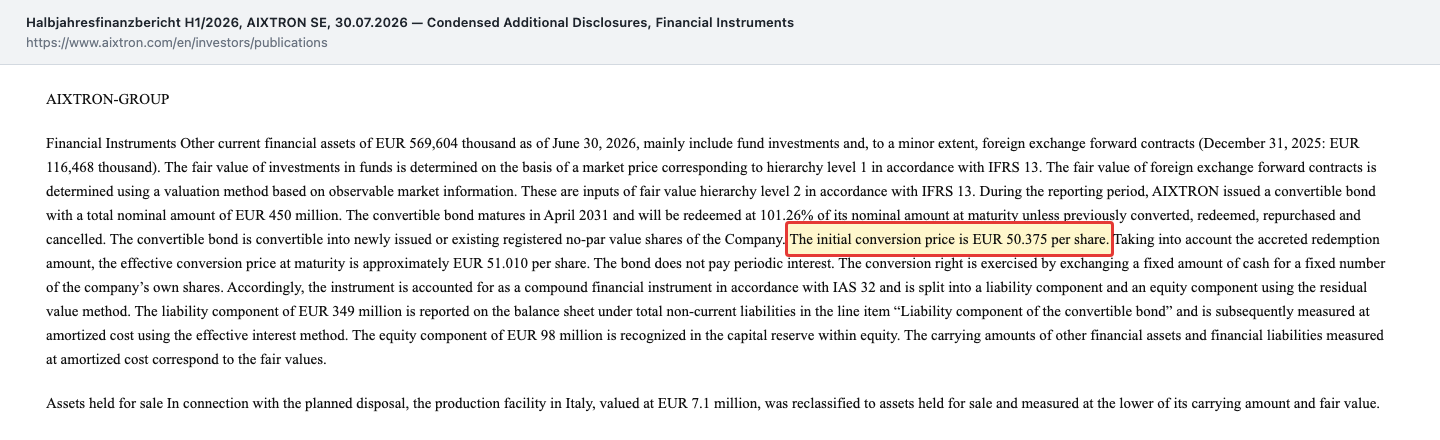
Translated: the bond pays no running interest. Investors give that up because they get the right to swap their money into shares later — at EUR 50.375 apiece, or roughly EUR 51.010 at maturity. Divide EUR 450 million by EUR 50.375 and you get about 8.9 million potential new shares, or 7.9 percent of the 112.851 million shares issued, unchanged as of September 30, 2026. That is the price, and it is not paid in interest but in ownership — your slice of the cake would get smaller. The bond does leave a trace in the income statement all the same: the liability component accretes until maturity, rising from EUR 349.2 million (June 30, 2026) to EUR 353.9 million (September 30, 2026), and that accretion is what pushed the nine-month financial result to minus EUR 7.2 million — a book charge, not a cash outflow.
The starting position is still what makes it notable. At the end of 2025 AIXTRON had no bank debt whatsoever, an undrawn credit facility of EUR 200 million and an equity ratio of 88 percent — as of September 30, 2026 it is 58 percent, because the bond and the advances swelled total assets to EUR 1,790.0 million. The company names general corporate purposes, investment in organic growth, possible M&A and, “when appropriate”, share buybacks as the use of proceeds; as of October 30, 2026 neither an acquisition nor a buyback had been announced. You can read that as confident: take money when it is essentially free. You can also read it as an open question: a company sitting on EUR 944.8 million of liquidity does not need the bond to run the business — and what it will ultimately fund, whether acquisitions, buybacks or growth, AIXTRON had not specified as of October 30, 2026. As long as the share trades below EUR 50.375, the dilution stays theoretical. On October 29, 2026 the close of EUR 34.14 was about 32 percent below it.
Uncomfortable truth no. 5: the factory was cut one quarter before the boom
This truth is not in the interim management report but at the back of the half-year report, under “Employees” — and it explains why the ramp is no formality:
“In the first quarter of 2026, a measure to reduce the number of employees in the operating division was implemented at the Herzogenrath site, which resulted in one-off expenses in the mid-single-digit EUR million range.”
— AIXTRON SE, Half-Year Group Financial Report H1/2026, Condensed Additional Disclosures, section “Employees”, page 22

The sequence of events is striking, and the report writes it down itself: the business outlook at the start of the year was “very weak”, hence the job cuts in the first quarter — and then, verbatim, “late in Q1, strong momentum in optoelectronics began to materialize”. The cut and the demand surge fell into the same quarter. Headcount dropped from 1,155 to 1,035 employees in twelve months (June 30, 2026), down 120 people or 10.4 percent, of which 100 in Europe.
The third quarter shows that the smaller operation can ship more than feared: revenue tripled versus the first quarter, and according to the quarterly statement production output rose in every quarter of the year. The new plant in Penang, Malaysia, contributes nothing yet: construction is under way, the building is expected to be usable from fall 2027, first system deliveries are planned by the end of 2027, and by 2028 it is to add roughly 25 to 30 percent of manufacturing capacity. Of the roughly EUR 40 million earmarked for Penang, the CFO says only about a third will be spent in 2026, with the rest shifting into next year. The fourth quarter therefore has to be carried by the existing factory and suppliers.
What the stock costs — the valuation
AIXTRON closed at EUR 34.14 on October 29, 2026 (XETRA). On 112.851 million shares issued that gives a market capitalisation of roughly EUR 3.85 billion. Against 2025 revenue of EUR 556.6 million and against the 2026 guidance midpoint of EUR 560 million, that is a price-to-sales ratio of roughly 6.9 either way. On 2025 earnings per share of EUR 0.76 the price-to-earnings ratio is roughly 45; on trailing four-quarter earnings (EUR 0.71: EUR 0.42 from the fourth quarter of 2025 plus EUR 0.29 from nine months of 2026) roughly 48. Book value per share was about EUR 9.13 as of September 30, 2026, so price-to-book is around 3.7. Strip out net financial assets of EUR 590.9 million and enterprise value is roughly EUR 3.26 billion — just under six times 2025 revenue.
That is cheaper than in August, when the same arithmetic at EUR 42.07 gave 8.5 times revenue — but it is still a price that discounts several very good years. Apply the company's own guidance — EUR 560 million of revenue at a 17 to 20 percent EBIT margin, so EUR 95 million to EUR 112 million of operating profit — and enterprise value to operating profit sits at roughly 29 to 34 times. On the dividend: EUR 0.15 per share was paid for 2025 (annual general meeting of May 13, 2026, EUR 16.9 million in total), which at the October 29, 2026 price is a yield of about 0.44 percent. This is not a stock held for income.
To frame the range: in the twelve months from October 30, 2025 to October 29, 2026 the lowest intraday price was EUR 12.97 (October 30, 2025; in the twelve-month window of the first edition it was EUR 11.675 on October 17, 2025), the highest EUR 62.66 (June 18, 2026). Between those two points sits a factor of almost 5 — at a company whose nine-month 2026 revenue was 3 percent below the prior year. The reported business itself changed less over that span than the share price did.
Opportunities and risks at a glance
What speaks for AIXTRON: the EUR 549.4 million order backlog as of September 30, 2026 is backed by advance payments and booked under strict internal criteria — it is real. The third quarter hit its own revenue range and reached a 31 percent EBIT margin. The balance sheet is solid: EUR 944.8 million of liquidity, no bank debt, EUR 1,030.8 million of equity, EUR 590.9 million of net financial assets. The company was operationally profitable in every year from 2021 to 2025. Research spending rose 17 percent to EUR 69.8 million in nine months — nobody is cutting the product here. And power electronics is showing first signs of recovery by the company's own account, with AI data centers as a new customer for GaN and SiC devices.
What speaks against it: full-year guidance hangs on a fourth quarter with EUR 201.9 million of revenue at the midpoint — achievable judging by prior years, but not yet delivered. The majority of the backlog rests on indium-phosphide lasers for AI data centers; if that one market cools, there is no equally strong second leg. The big cash inflow was largely advanced by customers. The convertible costs no running interest but potentially 7.9 percent in dilution. The factory was cut one quarter before the ramp, and the Malaysian plant only ships from the end of 2027. 54 percent of revenue comes from Asia — a market with tangible geopolitical and export-control uncertainty, as the blocked takeover of 2016 recalls. And the valuation still leaves little room for disappointment: roughly 6.9 times annual revenue.
Conclusion: the mind books faster than the factory ships
Back to the booking trap. The error it produces is not an arithmetic error — it is a timing error. In August a full order book sat next to a half-year with an operating loss, and the question was whether the factory could turn the orders into revenue in time. The third quarter has given part of the answer: EUR 183.6 million of revenue, EUR 56.7 million of operating result, the company's own range hit. The booking is happening — just quarter by quarter, not in the second the order is signed.
What this analysis does not say is that the fourth quarter is safe. At the midpoint it has to deliver EUR 201.9 million, with a factory that was cut back at the start of the year and a Malaysian plant that ships only from the end of 2027. And the booking trap works in the other direction too: anyone looking at a EUR 549.4 million backlog and the promise of “significant growth” in 2027 is already booking next year in their head. On October 29, 2026 the stock nonetheless stood about 19 percent below its August level although the quarter went better than expected.
The next honest checkpoint is in the calendar: March 4, 2027, the 2026 annual report with the fourth quarter and the first formal guidance for 2027. Until then, everything said about the final quarter is an expectation. Including what is written here. Not a buy or sell recommendation, not investment advice — just a request to let both numbers stand side by side: what has been ordered, and how much of it has already been shipped and earned. What you make of it is your decision.
Sources
- AIXTRON SE, Quarterly Group Statement Q3/2026 (IFRS, neither audited under section 317 of the German Commercial Code nor reviewed, published October 29, 2026) — key figures, business development, outlook, consolidated income statement, balance sheet as of September 30, 2026, cash flow statement; the most recent periodic report in this analysis.
- AIXTRON SE, ad-hoc release under Article 17 of the EU Market Abuse Regulation of October 15, 2026 (EQS, 6:00 p.m.): preliminary third-quarter 2026 figures, median analyst consensus for order intake EUR 214.6 million, 2026 guidance unchanged.
- AIXTRON SE, Q3/2026 analyst call of October 29, 2026 — prepared remarks by Dr. Felix Grawert and Dr. Christian Danninger; the Q&A was available only as an audio recording as of October 30, 2026 and was not evaluated. Plus the “Q3 2026 Results” presentation (slides 2, 12 and 13) and, for comparison, the prepared remarks for the Q2/2026 call.
- AIXTRON SE, Half-Year Group Financial Report H1/2026 (IFRS interim statements under IAS 34, unaudited and not reviewed, Herzogenrath, July 30, 2026) — interim management report, statement of financial position, cash flow statement, statement of changes in equity and notes.
- AIXTRON SE, Annual Report 2025 (audited IFRS consolidated financial statements) — key figures 2021 to 2025, group management report, market and outlook chapters, consolidated financial statements.
- AIXTRON SE, quarterly statements Q1/2026 and Q1/2025 — used solely for the Q4 2025 comparatives (revenue EUR 187.0 million, EBIT EUR 58.0 million) and Q4 2024 (revenue EUR 226.7 million, EBIT EUR 71.0 million); Half-Year Group Financial Report H1/2025 for the first-half 2024 comparatives (revenue EUR 250.1 million, operating result EUR 22.8 million).
- AIXTRON SE, ad-hoc release of April 14, 2026: guidance raised from around EUR 520 million to around EUR 560 million of revenue and the EBIT margin from 16–19 to 17–20 percent, together with preliminary first-quarter 2026 figures.
- AIXTRON SE, investor-relations news, directors' dealings and voting-rights notifications on aixtron.com (retrieved October 30, 2026) — after July 30, 2026 no dealings by board members, no capital measure and no share buyback reported.
- U.S. Securities and Exchange Commission, EDGAR registrant record for CIK 0001089496 (AIXTRON SE) — evidence for the terminated U.S. listing: Form 25 of December 30, 2016, Form 15F-12G of January 9, 2017, last periodic filing (6-K) of December 20, 2016, former name “AIXTRON AG” until December 30, 2010.
- Price, market-cap and range figures: fundamental data, XETRA close of October 29, 2026 (EUR 34.14), comparison prices of August 11, October 14 and October 15, 2026. Market cap cross-checked as share count times price, deviation 0.06 percent.
Transparency & disclaimer: this analysis is journalistic commentary on publicly available information. It is not investment advice, not a financial analysis in the regulatory sense and not a solicitation to buy or sell securities. Equity investments carry substantial risk up to total loss. All information without warranty; each figure carries its own date in the text. The first edition dates from August 12, 2026; the overall cutoff for this update is October 30, 2026. The next report (2026 annual report) is scheduled for March 4, 2027. Positions held by the operator are disclosed daily; where one exists, it appears as a notice at the top of this deep dive.
Our Bottom Line at a Glance
- Order situation positive
- Order intake rose 122 percent to EUR 274.9 million in the third quarter of 2026 and 76 percent to EUR 660.9 million over nine months. The order backlog climbed from EUR 257.8 million (December 31, 2025) to EUR 549.4 million as of September 30, 2026. AIXTRON only books orders after a firm order, a secured advance payment and a confirmed delivery date.
- Current trading positive
- After a first half of 2026 with minus EUR 7.6 million of operating result, the third quarter delivered EUR 183.6 million of revenue (inside the EUR 180 million plus/minus EUR 20 million range) and EUR 56.7 million of operating result at a 31 percent margin. Nine-month revenue of EUR 358.1 million is 3 percent below the prior year; operating result, at EUR 49.1 million, is above it.
- Balance sheet and liquidity positive
- As of September 30, 2026 the balance sheet carried EUR 944.8 million in cash and short-term financial assets, no bank debt, an undrawn credit facility of EUR 200 million and equity of EUR 1,030.8 million. After deducting the liability component of the convertible bond, net financial assets stand at EUR 590.9 million.
- Quality of cash inflow neutral
- Nine-month free cash flow reached EUR 289.9 million but came mostly from customer advances: EUR 261.7 million of the EUR 311.1 million operating cash inflow. Their balance rose from EUR 44.5 million to EUR 309.0 million. That evidences the reality of the orders but is a liability that unwinds on delivery.
- Guidance quality neutral
- Guidance raised on April 14, 2026 (revenue EUR 560 million plus/minus EUR 30 million, EBIT margin 17 to 20 percent) was confirmed on July 30 and October 29, 2026; the Q3 milestone was met. At the midpoint the fourth quarter requires EUR 201.9 million of revenue and EUR 46.1 million to EUR 62.9 million of operating result — between the fourth quarters of 2024 (EUR 226.7 million) and 2025 (EUR 187.0 million).
- Concentration and capital structure neutral
- Per the quarterly statement, the majority of the backlog is equipment for indium-phosphide components, driven by AI data centers. The EUR 450 million convertible converts at EUR 50.375 per share — arithmetically 7.9 percent of issued capital; on October 29, 2026 the stock closed at EUR 34.14, about 32 percent below. The equity ratio was 58 percent as of September 30, 2026.
With the third quarter of 2026 AIXTRON delivered the first half of its full-year arithmetic: EUR 274.9 million of order intake, EUR 183.6 million of revenue inside its own range and a 31 percent EBIT margin after a first half with an operating loss. The backlog stands at EUR 549.4 million, most of it equipment for indium-phosphide lasers in AI data centers. At the guidance midpoint the fourth quarter has to bring EUR 201.9 million of revenue. The balance sheet carries that comfortably; a valuation of roughly 6.9 times annual revenue leaves little room for disappointment. Not investment advice.
What Our Rating Means
Open questions
The business works in principle, but one material question is open. As long as it stays open, our findings do not carry a quality verdict.
Yellow here is explicitly not about a solvency risk — there is no sign of one. The balance sheet as of September 30, 2026 is solid: EUR 944.8 million in cash and short-term financial assets, not a single bank liability, an undrawn credit facility of EUR 200 million, EUR 1,030.8 million of equity, EUR 590.9 million of net financial assets. The earnings history is dependable too: every one of the five years from 2021 to 2025 showed a positive operating result, the weakest still an 18.0 percent EBIT margin. The traffic light was re-examined with the third-quarter figures and stays yellow, but the open question has narrowed. In August, guidance demanded a second half above the 2024 level after a loss-making half; since then the third quarter has delivered EUR 183.6 million of revenue at a 31 percent EBIT margin, and the fourth quarter has to bring EUR 201.9 million at the midpoint — a size AIXTRON already reached in the fourth quarters of 2024 and 2025. Two operational questions remain open. First, concentration: the majority of the EUR 549.4 million backlog rests on equipment for indium-phosphide lasers in AI data centers, while power electronics is only beginning to recover. Second, the quality of cash inflow: EUR 261.7 million of the EUR 311.1 million nine-month operating cash inflow came from customer advances that unwind with deliveries. Green would follow if the fourth quarter and the 2027 guidance show that the ramp holds and demand broadens. The EUR 34.14 price of October 29, 2026 equals roughly 6.9 times annual revenue and roughly 45 times 2025 earnings per share — that is a price argument and does not set the traffic light, but it does say how little room a disappointment would have. The next checkable milestone is the annual report on March 4, 2027. The decision is yours.
A journalistic assessment by our editorial team at the time of the deep dive, based on public sources — not investment advice and not a solicitation to buy or sell. Your personal circumstances (investment goals, risk capacity, taxes) cannot be taken into account. What our levels mean, how verdicts are formed, and what conflicts of interest exist →
Worth Noting
- Update of October 30, 2026: the first edition of August 12, 2026 was based on the H1/2026 half-year report. This update adds the Quarterly Group Statement Q3/2026 of October 29, 2026, the ad-hoc release of October 15, 2026 and management's prepared remarks for the analyst call of October 29, 2026. The call Q&A was available only as an audio recording as of October 30, 2026 and was not evaluated.
- The hook for this analysis is the contradiction between the share price and the business: the stock rose from a low of EUR 11.675 (October 17, 2025, intraday) to EUR 62.66 (June 18, 2026, intraday), stood at EUR 42.07 on August 11, 2026 and at EUR 34.14 on October 29, 2026. The thread running through it is the “booking trap”: the mind converts order intake straight into profit and skips manufacturing, delivery and payment terms.
- Our own calculations: H2 2024 (EUR 383.1 million of revenue) and H2 2025 (EUR 306.7 million) are full-year revenue less half-year revenue. The fourth-quarter 2026 requirement (EUR 201.9 million of revenue, EUR 46.1 million to EUR 62.9 million of operating result) is not a company number but the EUR 560 million midpoint less EUR 358.1 million after nine months, or 17 to 20 percent of EUR 560 million less EUR 49.1 million. The fourth-quarter gross margin of roughly 45 percent is likewise derived (around 42 percent of EUR 560 million less EUR 144.9 million of nine-month gross profit). The third-quarter share of advances (EUR 110.5 million) is the nine-month figure (EUR 261.7 million) less the half-year figure (EUR 151.2 million).
- On the evidence base: AIXTRON is not an active SEC filer. The NASDAQ listing ended after the takeover by Fujian Grand Chip was blocked by the U.S. President on December 2, 2016 (Form 25 of December 30, 2016, Form 15F-12G of January 9, 2017, CIK 0001089496). All company figures come from the reports on aixtron.com. By the company's own statement, the 2026 half-year report and quarterly statements have been neither audited under section 317 of the German Commercial Code nor subjected to an auditor's review; the 2025 annual accounts, by contrast, are audited.
- Price, market capitalisation and the twelve-month range come from fundamental data with a cutoff of October 29, 2026 (XETRA close EUR 34.14). Market capitalisation was cross-checked as share count times price: 112.851 million shares issued per the consolidated balance sheet as of September 30, 2026 give EUR 3,852.7 million against EUR 3,850.5 million from fundamental data — a deviation of 0.06 percent.
- Risk of confusion: the AIXA.DE symbol used here is shorthand for “AIXTRON, listed in Germany” and not an official exchange code. The shares trade as XETRA: AIXA as well as on Tradegate, Frankfurt and other regional exchanges. The former U.S. symbol AIXG refers to the NASDAQ listing terminated in 2016 and is meaningless today.
The full analysis as a PDF for later
We will send you this analysis as a PDF — to print, file away, and read at your own pace.
Frequently Asked Questions
AIXTRON SE, based in Herzogenrath near Aachen in Germany, builds metal-organic chemical vapor deposition (MOCVD) systems — machines in which ultra-thin crystal layers for semiconductors are grown. Those layers become lasers for optical data transmission, LEDs and micro-LEDs, and power transistors made of gallium nitride (GaN) and silicon carbide (SiC). Founded in 1983, the company employed 1,035 people as of June 30, 2026.
Much better than in the first half. Order intake rose 122 percent to EUR 274.9 million and revenue 54 percent to EUR 183.6 million — inside management's range of EUR 180 million plus/minus EUR 20 million. The operating result reached EUR 56.7 million (31 percent EBIT margin) and the result for the period EUR 35.4 million. The order backlog rose to EUR 549.4 million as of September 30, 2026.
At the midpoint of confirmed guidance of EUR 560 million of revenue, EUR 201.9 million is still missing after nine months (EUR 358.1 million); the range runs from EUR 171.9 million to EUR 231.9 million. On operating result it is EUR 46.1 million to EUR 62.9 million. For comparison: in the fourth quarters of 2024 and 2025 AIXTRON booked EUR 226.7 million and EUR 187.0 million of revenue, each at a 31 percent EBIT margin.
Mainly from optoelectronics: lasers for optical data transmission in AI data centers. In the third quarter of 2026 roughly 68 percent of equipment order intake came from that field, in the second quarter roughly 75 percent. According to the quarterly statement, equipment for indium-phosphide components now makes up the majority of the order backlog. Power electronics (GaN/SiC) reached roughly 24 percent in the third quarter.
AIXTRON names general corporate purposes, investment in organic growth, possible M&A and, where appropriate, share buybacks as the use of proceeds. The bond, placed in April 2026, runs to April 2031, pays no periodic interest and converts at an initial price of EUR 50.375 per share — arithmetically about 8.9 million new shares, or 7.9 percent of issued capital. As of October 30, 2026 neither an acquisition nor a buyback had been announced.
Because customers pay large advances. Of EUR 311.1 million in operating cash inflow in the first nine months of 2026, EUR 261.7 million came from customer advance payments; contract liabilities for advance payments rose from EUR 44.5 million to EUR 309.0 million. Advances are a liability that unwinds on delivery. Nine-month free cash flow was EUR 289.9 million.
AIXTRON was listed on NASDAQ until the end of 2016 but deregistered completely after the U.S. President blocked the takeover by Chinese investor Fujian Grand Chip on December 2, 2016: Form 25 on December 30, 2016 and Form 15F-12G on January 9, 2017. It has reported under European law ever since — audited IFRS annual report, half-year report, quarterly statements and ad-hoc releases. The shares trade on the Frankfurt Stock Exchange (XETRA: AIXA).
Yes, but a small one. For fiscal 2025 the annual general meeting of May 13, 2026 approved a dividend of EUR 0.15 per share — unchanged year on year; EUR 16.9 million was paid out in total. At the October 29, 2026 close of EUR 34.14 that is a yield of roughly 0.44 percent. This is not a stock held for income.
Found an error?
Did you spot a factual error, an outdated number, or a typo in this deep dive? Let us know briefly — your report goes straight to the editorial team.