AirSculpt: $12,707 for One Procedure — and $3,467 in Advertising to Find the Patient Who Pays It
There is an investor habit that feels like expertise: the price-tag trap. We see a high price, pair it with a high gross margin, and file it under "moat." AirSculpt Technologies, Inc. (Nasdaq: AIRS) runs 31 body contouring centers, takes payment in full before the procedure, accepts no insurance, and collected an average of $12,707 per case in the second quarter of 2026. It still finished 2023, 2024 and 2025 in the red — and in August 2026 it promised its lenders a conference call every two weeks. What counts in the end is not what a procedure costs, but what it costs to find the next person willing to pay for it.
 Thomas Mücke
Founder & Publisher
Thomas Mücke
Founder & Publisher
As of Today
As of: October 2, 2026
- Closing price
- 1.80 $ +4.10%
- Market Capitalisation
- 0.1 $B
- Growth Score
- 3/10
- AAQS
- 1/10
Price change since August 18, 2026: -33.2%
This analysis has a cut-off date. The Stock Guard tells you when something material changes in the numbers. Reserve your free spot
Chart
Interactive price chart (TradingView).
52-week range: 1.60 $ to 11.70 $ · Last price: 1.80 $ (As of: October 2, 2026)
Note: pure fact-based analysis, not investment advice and not a solicitation to buy or sell. All figures without guarantee.
There is an investor trap that feels like proof of good judgment: the price-tag trap. It works like this. You see a price only a few people can afford — $12,707 for a single procedure — pair it with a gross margin above 61 percent, and your brain finishes the investment thesis before the income statement is even open: "That is a luxury brand. Plenty must stick." AirSculpt Technologies, Inc. (Nasdaq Global Market: AIRS) is exactly that kind of company: 31 body contouring centers, a patented method, payment in full up front, no insurance billing, no bad debt. A business that looks like a money printer. And yet 2023, 2024 and 2025 each closed with a loss — $11.7 million in 2025 alone. So let us make a deal: before you trust the price tag, we read what AirSculpt itself told the U.S. securities regulator, the SEC — the quarterly report (10-Q) for June 30, 2026, the annual report (10-K) for 2025, and the late-filing notice of March 16, 2026. Those documents are honest under penalty of law. And they describe a company whose price holds steady while its customers get more expensive every year — and whose lenders have, since August 2026, been on a call every two weeks. The decision at the end is yours.
What AirSculpt actually does — cash in advance for the body you want
AirSculpt sells one thing: body contouring, the targeted removal of fat and tightening of skin. The in-house method is patented and, per the annual report, minimally invasive — no scalpel, no needle, no stitches, no general anesthesia. As of August 10, 2026 the company ran 31 centers across 20 U.S. states and Canada; as of June 30, 2026 they held 65 procedure rooms in total. Headcount as of December 31, 2025 was roughly 330 full-time and 33 part-time employees, plus contracts with about 90 surgeons.
The cash mechanics are unusually clean — and that is what feeds the price-tag trap. The quarterly report states it flatly: "We are 100% self-pay and do not accept payments from the U.S. federal government or payer organizations." Every patient pays personally; there is no insurer and no government payer in the chain. Company policy also requires payment in full before the procedure. In plain terms: AirSculpt is a restaurant where the bill is settled at the door. No receivables, no write-offs, no waiting on a claims department. That is why cash still came in during a weak first half of 2026: $4.0 million of operating cash flow.
Legally, AirSculpt is not a doctor but an administrator. The centers belong to professional associations — physician-owned entities — because many U.S. states allow only licensed physicians to practice medicine. Through management services agreements, AirSculpt runs everything non-clinical: premises, marketing, staffing, technology, accounting. For accounting purposes the physician entities are nevertheless fully consolidated. Keep that structure in mind, because it explains a lot later: the clinical judgment sits with the doctors, the business risk sits with the shareholder.
That also names the central tension of this analysis, and it runs through every chapter: AirSculpt can defend its price — but not the number of people willing to pay it. And every new patient costs more.
Company history for investors
-
2021
Nasdaq listing
AirSculpt was formed in Delaware on June 30, 2021 and went public on October 28, 2021. It has reported case volume and revenue per case every quarter since.
-
2023
Record year — and the last high-water mark
Revenue of $195.9 million on 14,932 cases with $43.5 million of adjusted EBITDA. None of those marks has been reached again since.
-
2025
Cases drop a fifth, London closes
Same-center case volume fell 22.1 percent and the London clinic closed on December 31, 2025. The year ended with an $11.7 million net loss.
-
2026
Late annual report — and the founder goes active, then passive again
On March 13, 2026 founder Aaron Rollins disclosed 23.6 percent of the shares and a review of strategic alternatives; the late-filing notice followed on March 16. On June 1, 2026 he returned to passive status with a Schedule 13G (20.9 percent).
-
2026
Fourth credit amendment with an investment bank deadline
On August 7, 2026 the lenders extended to November 15, 2027 — in exchange for mandatory payments, biweekly conference calls and an investment bank from October 31, 2026.
How the stock reached our desk
AirSculpt did not surface through one of our momentum or value screens. It surfaced through an event: the quarterly report for June 30, 2026, filed August 10, 2026 — and the fourth amendment to the credit agreement disclosed the same day. The price action tells you how the market read it. The stock closed at $5.01 on August 7, 2026 and at $2.75 on August 10. That is a 45 percent drop in a single session. By August 18, 2026 it had settled at $2.695 — roughly 78 percent below the twelve-month high of $12.00 set October 27, 2025, and roughly 78 percent above the twelve-month low of $1.51 set March 2, 2026.
The trigger was not the quarterly report alone. In the earnings release filed the same day — a current report on Form 8-K under Item 2.02 — AirSculpt reaffirmed full-year 2026 revenue only at the low end of its own range of approximately $151 to $157 million and cut its adjusted EBITDA outlook to approximately $12 to $14 million. At the low end of the revenue range that means roughly $151 million — essentially last year's figure. Translated: the company itself expects flat revenue in 2026 and less profit than it had signalled in the spring.
Prices like that invite the standard ratios, and here the standard ratios mislead. There is no price-to-earnings ratio, because there are no earnings. A price-to-book ratio around 1.8 sounds benign until you look at what the book value is made of (more on that shortly). And a price-to-sales ratio around 1.3 tells you nothing unless you know whether sales are growing or shrinking. So fix this in your mind at the outset: with AirSculpt, the question is not valuation but whether the patient count has found a floor. Which brings us to the numbers.
The numbers over the years — credit where credit is due
First, what genuinely works. The price holds. Across five years, revenue per case moved in a remarkably tight band: $13,121 in 2023, $12,849 in 2024, $12,809 in 2025 and $12,707 in the second quarter of 2026. In a field where, per the annual report, university hospitals, medspas and rejuvenation centers all compete for the same customer, that is not a given. The gross margin is likewise stable and high: direct cost of service ran at 38.6 percent of revenue in the second quarter of 2026 (year-earlier quarter: 39.1 percent), leaving a good 61 cents of every dollar before administration and advertising begin. And the company still generates an adjusted operating profit: adjusted EBITDA — earnings before interest, taxes, depreciation and amortization, as defined by the company — was $4.9 million in the second quarter of 2026, or 11.5 percent of revenue.
Now the line that shows the problem — revenue across five years:
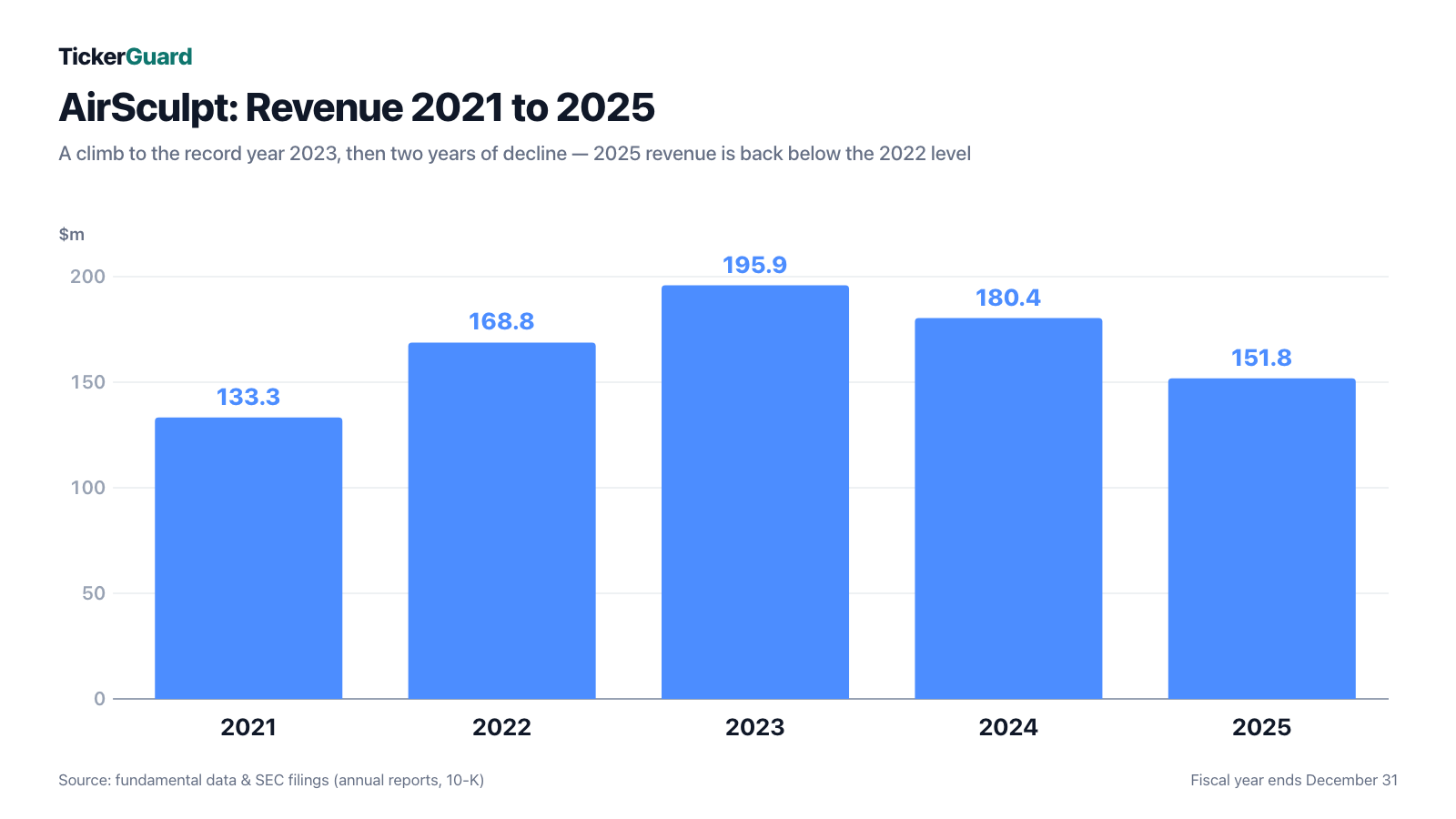
The decline comes from volume, not price. Cases performed fell from 14,932 in 2023 to 14,036 in 2024 and 11,852 in 2025 — down 15.6 percent in that final year alone. On a same-center basis, meaning only locations open in both periods, the drop was steeper still: 22.1 percent in 2025, after minus 13.7 percent in 2024. The company attributes it to "weaker than expected performance across the broader aesthetics industry." On the bottom line that produced net losses of $4.2 million in 2023, $8.0 million in 2024 and $11.7 million in 2025, while adjusted EBITDA halved twice over — from $43.5 million in 2023 to $21.0 million in 2024 and $15.1 million in 2025.
And 2026? Here there is a genuine bright spot. In the first half of 2026, same-center case volume turned positive for the first time in years — 6,458 versus 6,389 cases, up 1.1 percent; for the second quarter alone the report shows a gain of 1.0 percent. Revenue still slipped to $82.3 million, down 1.3 percent, because the average price across all centers slipped from $12,892 to $12,742, down 1.2 percent, and the London clinic closed in December 2025 still counted in the prior-year figures. So the floor in case volume appears to be in. It is simply an expensive floor. Which brings us to the uncomfortable truths.
What the filings say — the uncomfortable truths
Uncomfortable truth no. 1: Every new customer costs a fifth more than last year
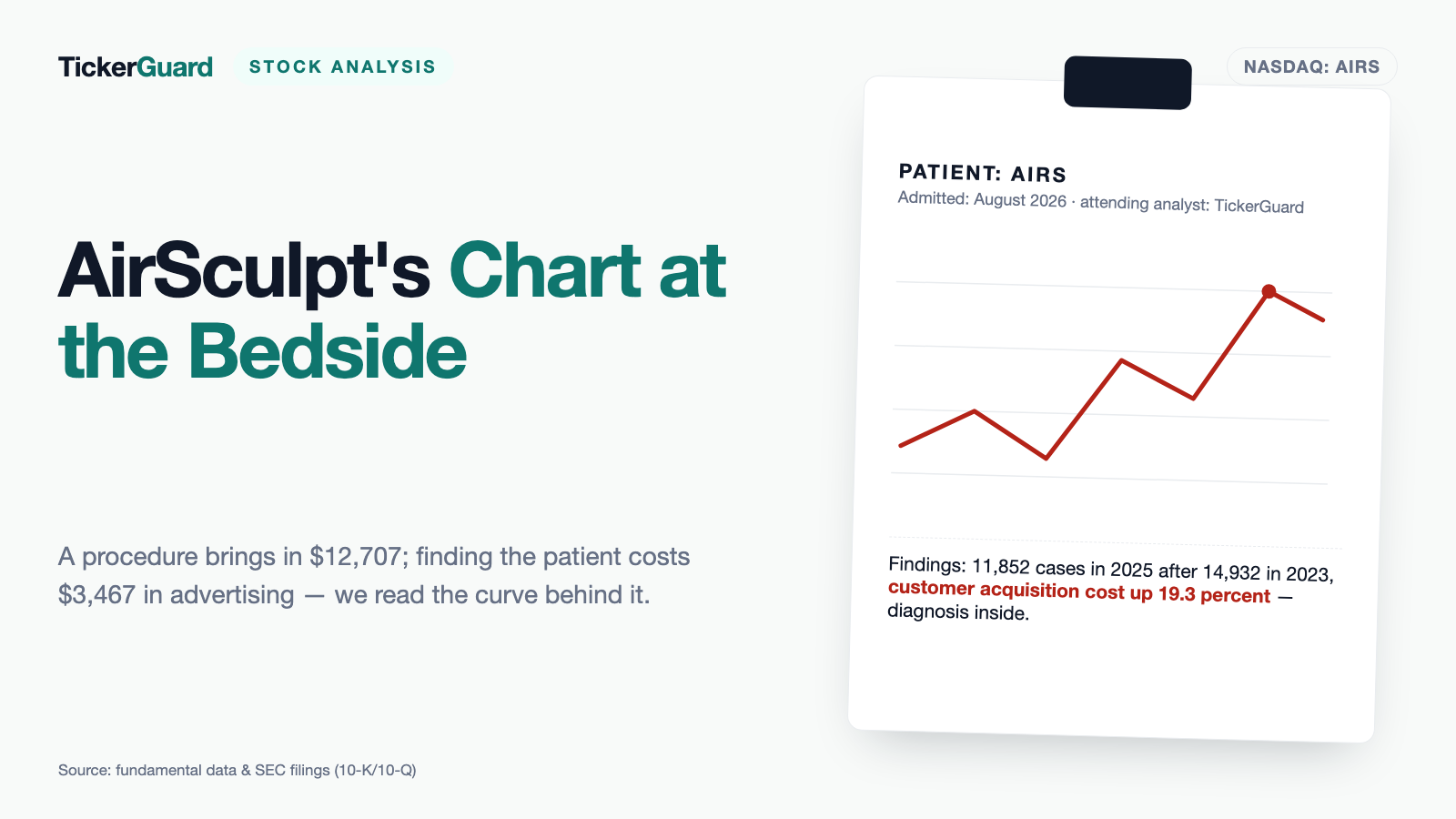
This is where the price-tag trap breaks. AirSculpt discloses what it costs to get one patient into a procedure room — customer acquisition cost, meaning total selling and advertising expense divided by cases performed. In the second quarter of 2026 that was roughly $3,467 per customer, against $2,905 a year earlier. An increase of 19.3 percent, in a quarter when the price fell 2.1 percent.
"Total selling expenses were approximately $11.7 million and $9.9 million for the three months ended June 30, 2026 and 2025, respectively. Our customer acquisition costs were approximately $3,467 and $2,905 per customer in the three months ended June 30, 2026 and 2025, respectively."
— AirSculpt Technologies, Inc., SEC quarterly report 10-Q for June 30, 2026, Item 2 (Results of Operations)

The chart shows how narrow the gap has become:
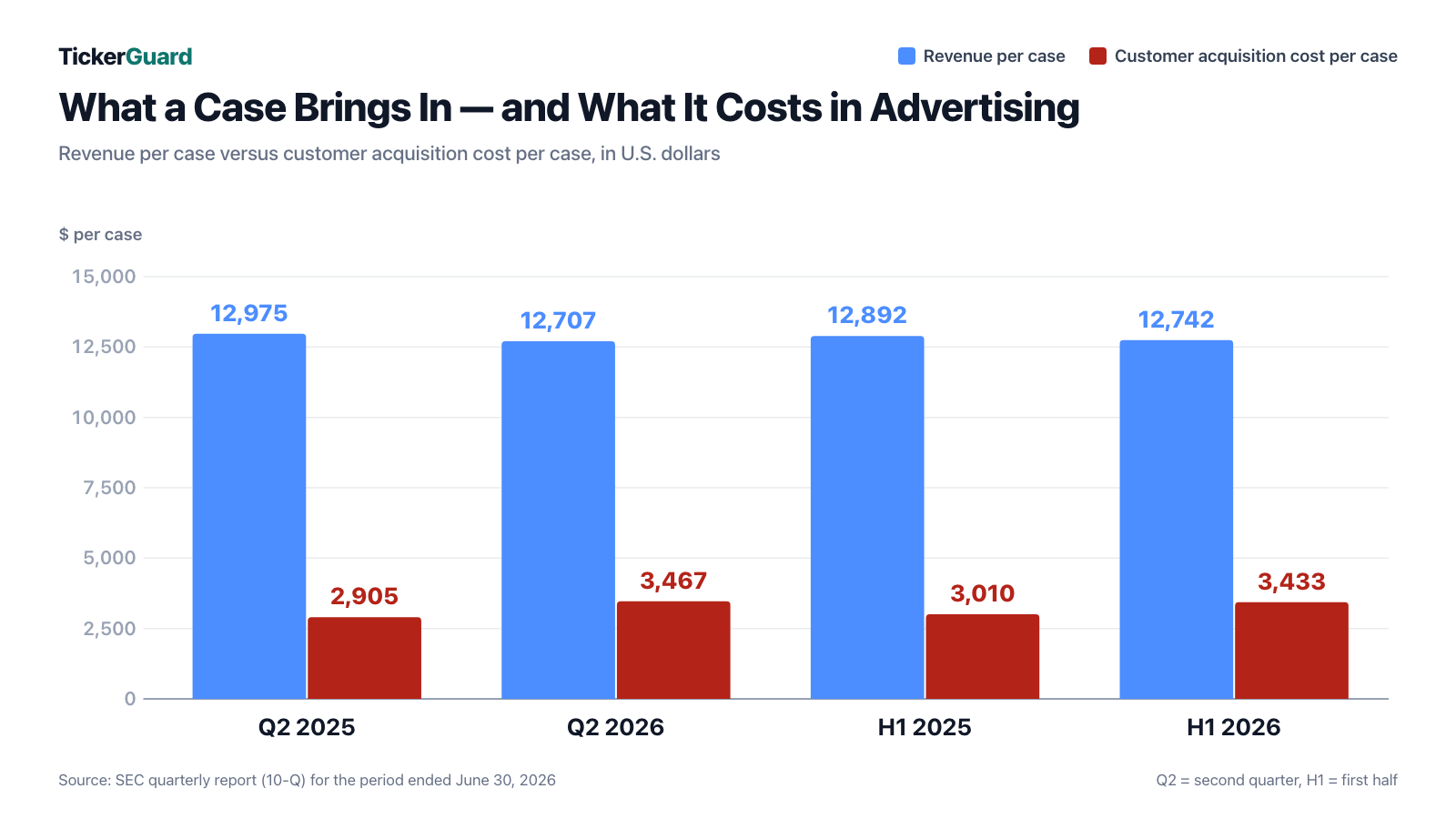
Put it in everyday terms. Picture a baker selling an excellent cake for $100. He used to spend $22 on advertising to find each buyer; now he spends $27, and the cake still sells for $100. As long as ingredients and rent stay put, that difference eats precisely the profit. At AirSculpt you can see it in operating income: negative $29 thousand in the second quarter of 2026, down from positive $786 thousand a year earlier. Selling, general and administrative expense consumed 54.6 percent of revenue, versus 51.5 percent a year before. Remember the line: the problem is not the price, it is the price of attention.
Uncomfortable truth no. 2: Since August 2026 the lenders join a call every two weeks
AirSculpt carries debt from a 2022 credit agreement, originally $85.0 million of term loans. As of June 30, 2026, roughly $43.6 million remained on the balance sheet ($10.5 million current, $33.1 million long-term), bearing interest at 8.39 percent. The company has paid down aggressively: $10.0 million in 2023, $10.0 million on June 13, 2025 and another $10.0 million in the first quarter of 2026, plus scheduled amortization. All covenants were in compliance as of June 30, 2026.
Even so, the relationship with the lenders has fundamentally changed. The fourth amendment to the credit agreement, dated August 7, 2026, does extend maturity from May 2027 to November 15, 2027 — but at a price you only grasp on the second reading: $2.5 million payable on signing, another $2.5 million on or before September 30, 2026, 50 percent of the net proceeds of future equity issuances (outside the equity incentive plans) applied straight to the term loans, a requirement to brief the lenders on a conference call every two weeks — and then clause (vi):
"require the Company, if the Discharge of Obligations has not occurred by October 31, 2026, to retain one or more investment banks reasonably satisfactory to the Administrative Agent (as defined in the Credit Agreement) to cause the Discharge of Obligations to occur, whether by obtaining replacement debt financing or otherwise."
— AirSculpt Technologies, Inc., SEC quarterly report 10-Q for June 30, 2026, notes on long-term debt
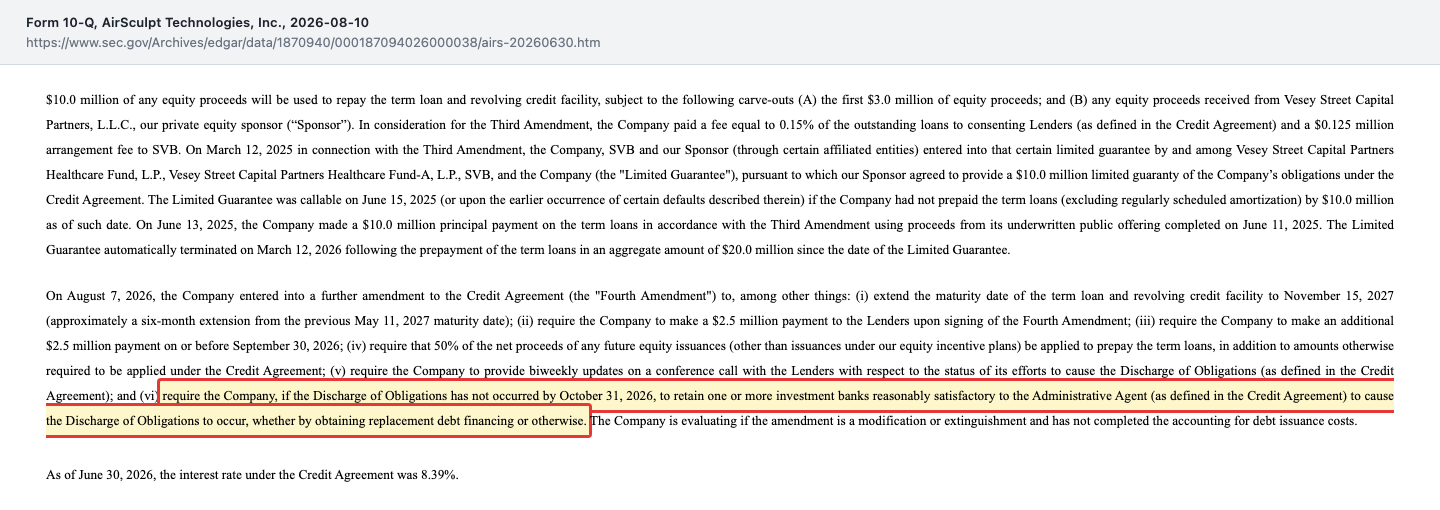
What does that mean in plain English? A lender giving a healthy borrower more time simply extends. A lender that writes biweekly reporting, mandatory prepayments and the pre-emptive hiring of an investment bank into the contract is saying, in effect: we will stay aboard another year, but we want to see you actively shopping for a different financier. To be fair: this is not a default, not an acceleration, and not a going-concern warning. AirSculpt is in compliance with every covenant and states that expected cash from operations will suffice for at least the next twelve months; its auditor, Grant Thornton, raised no substantial doubt about the company's ability to continue as a going concern. But the queue has been reordered: the next $5.0 million of cash in 2026 belongs to the lenders, not to growth. And there is a date on the calendar.
Uncomfortable truth no. 3: The books were not in order — and as of June 30, 2026 they still are not
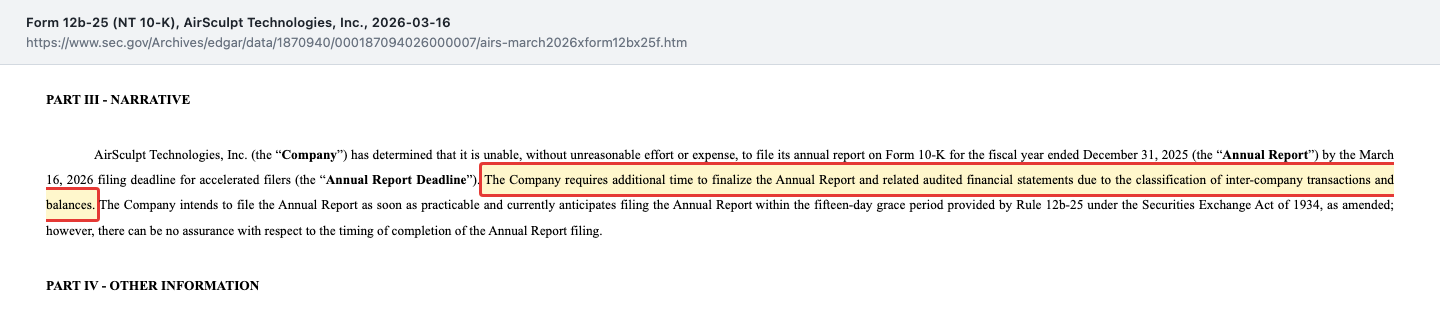
On March 16, 2026, the day the filing was due, AirSculpt notified the SEC that its 2025 annual report would be late. The stated reason appears verbatim in the notification (Form 12b-25, known in SEC shorthand as an NT 10-K):
"The Company requires additional time to finalize the Annual Report and related audited financial statements due to the classification of inter-company transactions and balances."
— AirSculpt Technologies, Inc., SEC late filing notification NT 10-K (Form 12b-25) of March 16, 2026, Part III
The report arrived on March 31, 2026, followed by an amendment (10-K/A) on April 6, 2026. What mattered more than the delay was its content: two material weaknesses in internal control. A material weakness is the most serious finding of its kind — it means a significant misstatement in the financial statements could have occurred without being caught in time. The first concerns general accounting and financial reporting, specifically the preparation and review of account reconciliations. The second concerns lease accounting under ASC 842 — and it already had consequences: per the report, the deficiency produced errors in the measurement and presentation of right-of-use assets and lease liabilities and required a revision of previously issued financial statements. The company cites as the cause that it did not maintain a sufficient complement of personnel with the appropriate technical accounting competency.
And the position six months later? Unchanged:
"Based on this evaluation, our principal executive officer and principal financial officer concluded that our disclosure controls and procedures were not effective as of June 30, 2026 due to the material weaknesses in our internal control over financial reporting described below, which were previously identified in our Annual Report on Form 10-K for the year ended December 31, 2025 and have not yet been remediated."
— AirSculpt Technologies, Inc., SEC quarterly report 10-Q for June 30, 2026, Item 4 (Controls and Procedures)

Fairness demands the other half: AirSculpt discloses all of this voluntarily and in detail, has brought in outside advisers, is working through remediation, and states that after additional procedures the financial statements themselves fairly present its position. Still, it carries a price that shows up in the same income statement. "One-time SOX compliance and other related costs" ran to $465 thousand in the second quarter of 2026 and $1.046 million in the first half. That is roughly the amount by which operating income slipped below zero. Remember this: orderly books are not an overhead footnote — at AirSculpt they currently cost about as much as the profit.
Uncomfortable truth no. 4: The book value is almost entirely goodwill
As of June 30, 2026, AirSculpt reported stockholders' equity of $104.8 million on total assets of $193.3 million. That sounds comfortable. Now look at what the asset side contains: $81.7 million of goodwill and $34.5 million of other intangible assets — together $116.2 million, or 60 percent of all assets. Strip those two out and nothing is left of the equity: tangible book value is negative, at roughly minus $11.4 million.
What is goodwill? In everyday terms: if you buy a bakery for $500,000 whose ovens, register and inventory are together worth only $300,000, the remaining $200,000 sits on your balance sheet as goodwill — you paid it for the reputation and the regulars. As long as the regulars keep coming, that is fine. When they stop, the item has to be written down, and equity shrinks without a single dollar leaving the bank. At AirSculpt, case volume has fallen more than a fifth since 2023 — exactly the development that puts goodwill under pressure. No impairment stood on the books as of June 30, 2026, and none should be talked into existence. But a price-to-book ratio of roughly 1.8 looks different once you know how little tangible substance sits behind that book value.
Uncomfortable truth no. 5: The share count grew almost a quarter in eighteen months
When the business does not throw off enough to retire debt, the money has to come from somewhere — at AirSculpt it comes from shareholders themselves. Through an at-the-market program the company sells new shares into the open market on a rolling basis. You can see the effect in the share count: 58,369,138 on December 31, 2024, 64,542,461 on December 31, 2025, 71,518,820 on June 30, 2026 and 72,095,209 on August 7, 2026. That is up 23.5 percent in about eighteen months. In the first half of 2026 alone those sales raised $19.6 million net; by August 10, 2026 a further 576,000 shares had been issued for roughly $2.4 million.
Dilution, in everyday terms, means your slice of the cake gets smaller even though you sold nothing — the cake is simply cut into more pieces. And since August 7, 2026 there is a twist that is easy to miss: of every dollar AirSculpt raises with new shares in future, 50 cents go straight to the lenders. The company writes that as a result only "approximately half" of the proceeds will be available to fund operations, which increases its reliance on cash generated from operations. Remember the pattern: the shareholder pays for the dilution in full but keeps only half of it.
The other side: the weight-loss drug is not only an enemy
One uncomfortable truth points the other way — namely that the most obvious bear case may be wrong. Almost everyone looking at a liposuction chain thinks immediately of GLP-1 drugs, the weight-loss injections from makers such as Novo Nordisk and Eli Lilly, and concludes: people who slim down do not need fat removal. The annual report takes a more nuanced view, and it cuts both ways:
"The increased market acceptance, availability and customer awareness of weight-loss drugs has changed the market for body fat reduction procedures. The increasing use of weight loss drugs may lead to increased demand for body contouring and skin tightening procedures."
— AirSculpt Technologies, Inc., SEC annual report 10-K for 2025, Item 1 (Business)
The medical logic holds up: people who lose a lot of weight are often left with excess skin and uneven fat distribution — both reasons to book precisely the procedures AirSculpt sells. How much of the weight-loss-drug wave is threat and how much is feedstock, nobody currently knows; the company itself says it cannot predict the long-term impact. If that link interests you, the other side of the trade is worth a look: we broke down one of the two dominant makers of these drugs in a separate Eli Lilly analysis, including how much of that company's revenue now rides on a single compound.
Valuation: what the market pays for a shrinking premium provider
Let us work in orders of magnitude, not daily prices. At $2.695 on August 18, 2026 and 72,095,209 shares outstanding (as of August 7, 2026, per the quarterly report cover page), the market value was roughly $194 million. Revenue over the trailing twelve months was about $150.7 million, giving a price-to-sales ratio near 1.3. Add net debt of roughly $24.7 million ($43.6 million of debt less $18.8 million of cash) and enterprise value lands near $219 million, or about 1.5 times annual revenue.
A price-to-earnings ratio cannot be formed — there has been no annual profit since 2023. Using adjusted EBITDA instead gives roughly $13.8 million for the trailing twelve months, putting enterprise value at about 16 times that figure. The forward picture is no better: the company's own full-year 2026 expectation stands at roughly $12 to $14 million (as of August 10, 2026), which is not above the trailing figure. For a business whose revenue has shrunk two years running, that is not a liquidation price. For context on market sentiment: the average analyst price target stood at $4.50 per fundamental data (as of August 18, 2026), above the price at the time — though all four recorded ratings read "hold," and the same houses accompanied a $12 share price in October 2025. At the same time 2,761,856 shares were sold short, roughly 3.8 percent of all shares outstanding (as of August 18, 2026). We deliberately do not quote a ratio against the tradable float: the figures for it contradict each other — a reported float of roughly 16.8 million shares does not square with an insider stake of 42.1 percent, which on 72,095,209 shares outstanding would leave about 41.7 million shares in public hands. What is solid is the high insider stake — a setup that amplifies moves in both directions. We have seen how heavily such valuations hinge on a single question in other deep dives; here the question is simply this: do the patients come back, and at what advertising price?
Opportunities and risks at a glance
What speaks for AirSculpt:
- An unusually clean cash model: 100 percent self-pay, payment in full before the procedure, no insurance billing, no bad debt — producing $4.0 million of operating cash flow in the first half of 2026.
- Price stability across five years: $13,121 per case in 2023, $12,849 in 2024, $12,809 in 2025 and $12,707 in the second quarter of 2026 — no price war despite falling revenue.
- Case volume has found a floor: up 1.0 percent on a same-center basis in the second quarter of 2026 and up 1.1 percent in the first half, after minus 22.1 percent in 2025.
- The deleveraging is real: $20.0 million of voluntary prepayments since March 2025, cash up from $8.4 million to $18.8 million (December 31, 2025 to June 30, 2026), all covenants in compliance at June 30, 2026, and no going-concern warning.
- Weight-loss drugs may create demand rather than destroy it: the company itself names the possibility of higher demand for body contouring and skin tightening as those drugs spread.
What speaks against it:
- Customer acquisition cost is rising faster than anything else: $3,467 per case in the second quarter of 2026 versus $2,905 a year earlier, up 19.3 percent, while price per case fell 2.1 percent — operating income landed at negative $29 thousand.
- Three consecutive loss years ($4.2 million, $8.0 million and $11.7 million in 2023, 2024 and 2025) and adjusted EBITDA cut to a third, from $43.5 million to $15.1 million.
- Two material weaknesses in internal control persisted as of June 30, 2026, one of which forced a revision of previously issued financial statements; the 2025 annual report was filed late.
- Refinancing pressure with a date attached: $5.0 million of mandatory term-loan payments in 2026, biweekly reporting to lenders, a requirement to retain an investment bank from October 31, 2026, maturity on November 15, 2027, and an 8.39 percent interest rate.
- Dilution and thin substance: share count up 23.5 percent since December 31, 2024, with half of every future equity dollar now going to the lenders; of $104.8 million of equity, $116.2 million sits in goodwill and intangibles, leaving tangible book value at roughly minus $11.4 million.
A human conclusion
Back to the price-tag trap. Its core is not that the price is a lie — $12,707 per procedure is real, the gross margin above 61 percent is real, and payment in advance is a better cash model than most companies will ever have. Its core is that a high price says nothing about how expensive it is to find someone willing to pay it. That is exactly where AirSculpt tipped over these past two years: the price stayed, the pipeline of interested patients did not — and pulling them back consumes more and more advertising money, until operating income is precisely nothing. Add two things that cannot be talked away: books whose controls the company's own executives called "not effective" as of June 30, 2026, and lenders who had biweekly conference calls and an investment bank written into the contract.
So the honest question is not "is the stock cheap after a 78 percent decline?" It is this: do you believe people will again spend $12,000 on a procedure in 2027 — and that AirSculpt can find them without paying $3,500 a head in advertising? If yes, you have a thesis, and October 31, 2026 is the date on which you test whether it holds. If no, you had a price tag. What you make of that is your decision. And that is exactly as it should be.
Sources
Every primary document used in this analysis — for you to read yourself:
- AirSculpt Technologies, Inc. — SEC quarterly report 10-Q for June 30, 2026 (filed August 10, 2026)
- AirSculpt Technologies, Inc. — SEC current report 8-K of August 10, 2026 (Item 2.02), Exhibit 99.1: second-quarter 2026 earnings release including the full-year outlook
- AirSculpt Technologies, Inc. — SEC annual report 10-K for 2025 (filed March 31, 2026)
- AirSculpt Technologies, Inc. — SEC annual report amendment 10-K/A for 2025 (filed April 6, 2026)
- AirSculpt Technologies, Inc. — SEC late filing notification NT 10-K (Form 12b-25) of March 16, 2026
- Aaron Rollins — SEC Schedule 13D on AirSculpt filed March 13, 2026 and Schedule 13G filed June 1, 2026
- AirSculpt Technologies, Inc. — SEC current report 8-K of August 12, 2026 (headquarters relocation to Tampa)
- Complete SEC filing history for AirSculpt Technologies, Inc.: EDGAR overview (sec.gov)
- Fundamental data (price, market capitalization, valuation, analyst target, short interest; as of August 18/19, 2026), reconciled against the SEC filings.
Transparency & disclaimer: this analysis is journalistic commentary on publicly available information. It is not investment advice, not a regulated financial analysis, and not a solicitation to buy or sell securities. Equity investments carry substantial risk up to and including total loss. All information is provided without warranty; the as-of date for each figure is noted in the text. Positions held by the operator are disclosed daily; where one exists, it appears as a notice at the top of this deep dive.
Key figures at a glance
All monetary figures in millions of $; earnings per share as reported.
| Metric | 2021 | 2022 | 2023 | 2024 | 2025 |
|---|---|---|---|---|---|
| Revenue | 133.3 | 168.8 | 195.9 | 180.4 | 151.8 |
| Operating Income (EBIT) | 15.8 | -4.5 | 9.5 | -1.8 | -4.8 |
| Net Income | 10.6 | -14.7 | -4.5 | -8.3 | -11.7 |
| Net Margin | 7.9% | -8.7% | -2.3% | -4.6% | -7.7% |
| Earnings Per Share | 0.19 $ | -0.26 $ | -0.08 $ | -0.14 $ | -0.19 $ |
Source: fundamental data & SEC filings (annual and quarterly reports, 10-K/10-Q)
Our Bottom Line at a Glance
- Pricing and cash model positive
- Revenue per case held in a tight band across five years ($13,121 in 2023, $12,849 in 2024, $12,809 in 2025 and $12,707 in the second quarter of 2026), and direct cost of service ran at 38.6 percent of revenue in the second quarter of 2026. On top of that sits a 100 percent self-pay model with payment in advance: no insurance billing, no bad debt, and $4.0 million of operating cash flow in the first half of 2026.
- Demand and case volume negative
- Cases performed fell from 14,932 in 2023 to 14,036 in 2024 and 11,852 in 2025, a same-center decline of 22.1 percent in 2025 alone. The first half of 2026 brought a small gain for the first time in years (6,458 versus 6,389 cases), but revenue still slipped to $82.3 million, down 1.3 percent.
- Customer acquisition cost negative
- Cost per acquired patient rose to roughly $3,467 in the second quarter of 2026 from $2,905 a year earlier, up 19.3 percent, while price per case fell 2.1 percent. Selling expense climbed from $9.9 million to $11.7 million, and operating income dropped to negative $29 thousand from positive $786 thousand a year earlier.
- Balance sheet and financing negative
- Of $104.8 million of equity at June 30, 2026, $81.7 million is goodwill and $34.5 million other intangibles — leaving tangible book value at roughly minus $11.4 million. First-half 2026 operating income of minus $1.8 million did not cover $2.2 million of interest expense. The fourth credit amendment of August 7, 2026 requires $5.0 million of mandatory payments in 2026, biweekly conference calls, and an investment bank from October 31, 2026.
- Accounting and controls negative
- The 2025 annual report was filed late (notification of March 16, 2026 citing the classification of inter-company transactions). Two material weaknesses in internal control — general accounting and lease accounting under ASC 842, the latter forcing a revision of previously issued financial statements — persisted unchanged at June 30, 2026, and the chief executive and chief financial officer themselves call disclosure controls not effective.
- Dilution negative
- The share count rose from 58,369,138 on December 31, 2024 to 72,095,209 on August 7, 2026 — up 23.5 percent. At-the-market sales alone raised $19.6 million net in the first half of 2026. Since August 7, 2026, 50 percent of future equity proceeds go straight to the lenders; the company itself writes that only about half remains available to fund operations.
AirSculpt can defend its price — $12,707 per case in the second quarter of 2026 — but not the number of people paying it: cases fell from 14,932 in 2023 to 11,852 in 2025, and each new patient recently cost roughly $3,467 in advertising instead of $2,905. What is left is operating income of negative $29 thousand, a book value made almost entirely of goodwill, two unresolved weaknesses in internal control, and a credit agreement that requires an investment bank to be retained from October 31, 2026. Not investment advice.
What Our Rating Means
Substance risk
We found at least one documented issue that threatens the company itself — regardless of how the stock is currently valued.
Two documented substance findings drive the red rating. First, operating income does not cover interest: the first half of 2026 showed an operating loss of $1.8 million against $2.2 million of interest expense, and the fourth credit amendment of August 7, 2026 requires biweekly reporting plus the retention of an investment bank from October 31, 2026. Second, two material weaknesses in internal control remained unremediated at June 30, 2026, one of which forced a revision of previously issued financial statements. This is a judgment on the substance of the company, not on the share price: there is no going-concern warning and no covenant breach, and the self-pay model with payment in advance still produces operating cash flow. The decision is yours.
A journalistic assessment by our editorial team at the time of the deep dive, based on public sources — not investment advice and not a solicitation to buy or sell. Your personal circumstances (investment goals, risk capacity, taxes) cannot be taken into account. What our levels mean, how verdicts are formed, and what conflicts of interest exist →
Worth Noting
- The trigger for this analysis was the quarterly report for June 30, 2026, filed August 10, 2026, together with the fourth credit amendment disclosed the same day — not a hit in our in-house stock scanner. The stock fell from $5.01 to $2.75 on the day of publication.
- Easy to confuse: the ticker AIRS belongs to AirSculpt Technologies, Inc. (CIK 0001870940, Nasdaq Global Market) — not to the similarly named Airship AI Holdings, which trades under AISP. The mapping was verified against the SEC ticker registry.
- Business figures carry their own balance sheet or reporting date (December 31, 2025 and June 30, 2026); price, market value, analyst target and short interest are as of August 18/19, 2026. Analyses are evergreen — a daily price is not a reason to buy.
Stock Watch
This analysis is as of August 26, 2026. Stock Watch will tell you what's changed at AIRS since then.
Later $1 a month per stock — signing up is free, and you'll be the first to know when it launches.
The full analysis as a PDF for later
We will send you this analysis as a PDF — to print, file away, and read at your own pace. And we will add you to the free Stock Watch list for Airsculpt Technologies Inc (AIRS), so you hear about it when something material in this analysis changes.
Frequently Asked Questions
AirSculpt Technologies, Inc. (Nasdaq: AIRS) operates centers for minimally invasive body contouring — targeted fat removal and skin tightening using its patented AirSculpt method. As of August 10, 2026 it ran 31 centers across 20 U.S. states and Canada, holding 65 procedure rooms as of June 30, 2026. The business is 100 percent self-pay: no insurers and no government payers are accepted, and the procedure must be paid in full in advance.
Because the cost of winning a customer rises faster than the price. In the second quarter of 2026 each patient cost roughly $3,467 in selling and advertising expense, against $2,905 a year earlier — up 19.3 percent. Revenue per case fell from $12,975 to $12,707 over the same period. Selling, general and administrative expense consumed 54.6 percent of revenue, and operating income landed at negative $29 thousand.
As of June 30, 2026 the balance sheet showed roughly $43.6 million of debt ($10.5 million current, $33.1 million long-term) bearing interest at 8.39 percent. The fourth amendment to the credit agreement, dated August 7, 2026, extended maturity to November 15, 2027 but requires $5.0 million of mandatory term-loan payments in 2026, redirects 50 percent of future equity proceeds to the lenders, and mandates biweekly conference calls.
If AirSculpt has not discharged its credit obligations by October 31, 2026, the quarterly report states the company must retain one or more investment banks acceptable to the administrative agent to bring that discharge about, for instance through replacement financing. This is not a default and not a going-concern warning; all covenants were in compliance as of June 30, 2026. It is, however, a clear signal that the lenders want to be taken out.
Yes, and they are disclosed. The 2025 annual report was filed late (notification of March 16, 2026 citing the classification of inter-company transactions and balances), and the report itself identifies two material weaknesses in internal control: general accounting and financial reporting, and lease accounting under ASC 842, the latter having required a revision of previously issued financial statements. As of June 30, 2026 the chief executive and chief financial officer still called disclosure controls not effective.
That is genuinely open, and the company sees both directions. The 2025 annual report names weight-loss drugs as competition in the weight loss and obesity solutions market, but also states verbatim that their increasing use may lead to higher demand for body contouring and skin tightening. Significant weight loss often leaves excess skin and uneven fat distribution. The company says it cannot predict the long-term impact.
Substantially. The share count rose from 58,369,138 on December 31, 2024 to 64,542,461 on December 31, 2025, 71,518,820 on June 30, 2026 and 72,095,209 on August 7, 2026 — up 23.5 percent in about eighteen months. In the first half of 2026 alone, at-the-market sales raised $19.6 million net. Since August 7, 2026, 50 percent of such proceeds go straight to the lenders.
At the August 18, 2026 price of $2.695 and 72,095,209 shares outstanding, the market value was roughly $194 million. Against trailing twelve-month revenue of about $150.7 million that is a price-to-sales ratio near 1.3; including net debt, enterprise value sits at roughly 1.5 times revenue. A price-to-earnings ratio cannot be formed, because no annual profit has been reported since 2023.
Found an error?
Did you spot a factual error, an outdated number, or a typo in this deep dive? Let us know briefly — your report goes straight to the editorial team.