AES-KY: Whoever bought at the yearly high missed the actual record
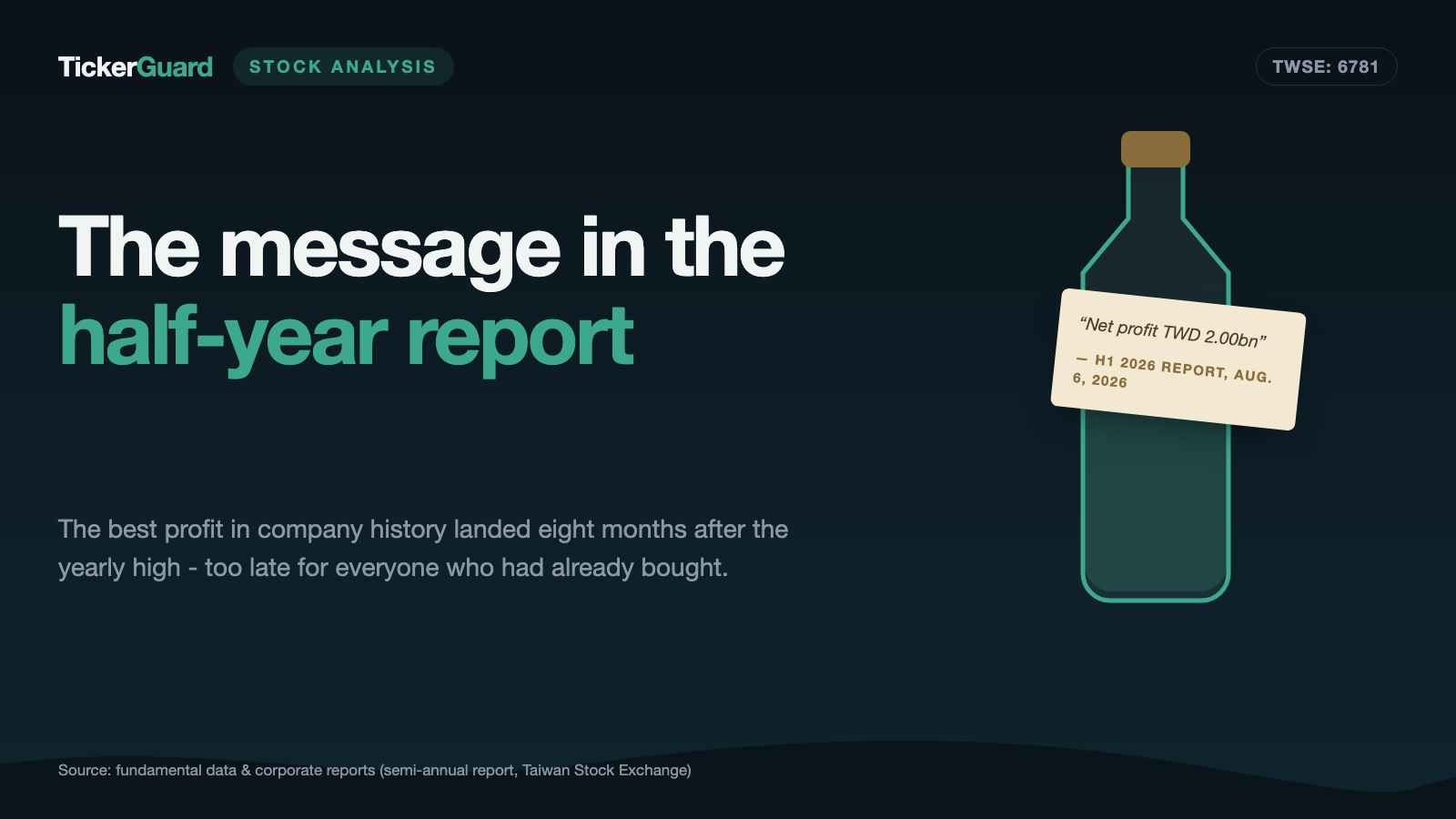
On December 1, 2025, shares of Taiwanese battery-module maker AES-KY (TWSE: 6781) hit their 52-week high of TWD 1,500 — carried by the promise of backup batteries for AI data centers. Eight months later, on August 6, 2026, the company reported its best-ever six-month profit for the first half of 2026, roughly TWD 2.00 billion — more than it earned in the entire year 2023. But by then the stock had long since fallen, briefly touching TWD 842. We read the annual report, the interim figures and the mandatory disclosures to understand how both things can be true at once — the story held up, but entry timing still decided profit and loss. Not investment advice.
 Thomas Mücke
Founder & Publisher
Thomas Mücke
Founder & Publisher
Every investor knows the moment: a stock shows up everywhere — in a forum, in a friend's tip, in the ticker of an app —, and the price is climbing at exactly the pace that seems to confirm the story behind it. That is what happened in late 2025 with AES-KY, a Taiwanese maker of lithium battery modules. The narrative was simple and compelling: AI data centers need power, and when the power fails, they need batteries to bridge the gap until generators kick in. AES-KY builds those batteries. On December 1, 2025, the stock hit its 52-week high of TWD 1,500. Anyone who bought then was buying into a story that would turn out to be largely correct eight months later — just at a price that proved far too high. On July 30, 2026, the stock fell to a 52-week low of TWD 842, one week before the company reported the best half-year profit in its history. We read the annual report, the interim figures and the mandatory disclosures to understand how both can be true at once. Every figure in this analysis is evergreen and carries its own as-of date; the price of TWD 1,130 (August 28, 2026) is only a valuation anchor.
What AES-KY actually does
Advanced Energy Solution Holding Co., Ltd. — traded under the ticker "AES-KY," where the "-KY" suffix is Taiwan's standard marker for holding companies incorporated in the Cayman Islands — was founded on January 9, 2020, and primarily makes lithium battery modules. The company's own website describes the business this way:
"AES is registered in the British Cayman Islands and was established on January 9, 2020. The main products are lithium battery modules, and its main production sites are Changshu, China, and Hsinchu, Taiwan. AES has been committed to the R&D of professional lithium battery module technology for many years."
— Advanced Energy Solution Holding Co., Ltd., company profile, advancedenergysolution.com.tw/en/about (accessed Aug. 29, 2026)
Its own product page splits the business into three categories: Light Electric Vehicle (lithium battery packs for e-bikes and e-scooters, sold mostly to Europe and Japan, with Bosch, BMZ and Panasonic named as competitors in the annual report), Industrial Energy Solution (energy storage and "battery backup solution" for industrial use), and a still-small Automotive segment (battery packs for EVs, e-buses and battery management systems). Notably, neither this official product categorization nor the "Company Profile" mentions "data center" or "artificial intelligence" — striking, given that this exact link has driven revenue growth for roughly a year and a half. The 2024 annual report's MD&A section is considerably more explicit:
"The deployment of 5G base stations and the rapid advancements in artificial intelligence have led to ongoing construction of base stations and data center infrastructure, thereby fueling the demand for battery modules for medium and large industrial energy storage systems."
— Advanced Energy Solution Holding Co., Ltd., 2024 Annual Report, page 4
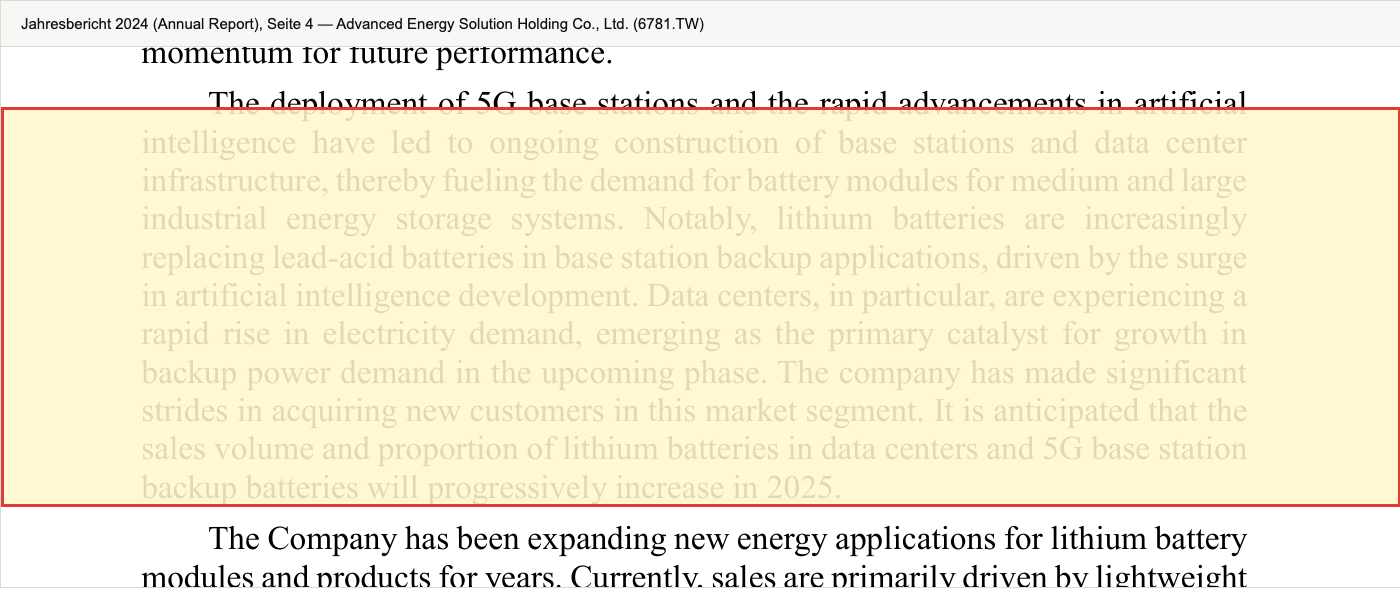
The gap between the reserved self-description on the product page and the more explicit language in the annual report is not a contradiction so much as a sign of how new this business line still is for the company: the product page evidently has not been updated since data centers became the most important growth driver.
Company history for investors
-
2020
Founded as a spin-off from Simplo Technology
Advanced Energy Solution Holding Co., Ltd. is incorporated in the Cayman Islands on January 9, 2020, as an independent company under parent Simplo Technology.
-
2021
IPO on the Taiwan Stock Exchange
The stock first trades under the ticker AES-KY on March 22, 2021, at an issue price of TWD 168 — per press coverage, with a price surge that briefly lifted the company above the market value of its own parent.
-
2023
Revenue collapses by a third
Global purchasing-power weakness and e-bike maker inventory destocking drag revenue down to TWD 10.03 billion; operating cash flow turns negative.
-
2025
Revenue jumps on data-center demand, yearly high in December
Revenue jumps 59.4% to TWD 16.00 billion, driven by backup batteries for data centers and 5G base stations. On December 1, 2025, the stock hits its 52-week high of TWD 1,500.
-
2026
Yearly low in July, record half-year profit in August
The stock falls to a 52-week low of TWD 842 on July 30, 2026. One week later, on August 6, 2026, the company discloses preliminary net profit of TWD 2.00 billion for the first half of 2026 — more than the entire year 2023.
Where this stock landed on our desk
The trigger for this analysis is unremarkable, and worth stating honestly: a share price that swung between a 52-week high and a 52-week low within eight months, while the underlying business figures kept improving over the same period, is a pattern that inevitably confuses investors — either they bought too high and wonder whether to hold on, or they sold and then watched the stock report record numbers. That exact mismatch between the price chart and the fundamentals is what led us to read the original filings instead of relying on the chart. What became of the December 2025 high and the August 2026 record half-year is the subject of the rest of this analysis.
The numbers over the years — an honest look
Looking only at the trailing twelve months misses the backstory. AES-KY's revenue was anything but a straight line up: TWD 11.55 billion (2021), a rise to TWD 15.05 billion (2022), then a drop to TWD 10.03 billion (2023, -33.4%), near-stagnation at TWD 10.04 billion (2024), and finally the jump to TWD 16.00 billion in 2025 (+59.4%) — roughly USD 506 million or EUR 436 million (exchange rates as of Aug. 29, 2026: $1 = TWD 31.63, €1 = TWD 36.68). The 2024 annual report offers only a brief line for the decline: "The decrease in annual revenue was mainly due to reduced customer demand and changes in product mix" — elaborated elsewhere as e-bike battery demand suffering in 2023 and 2024 from "global political and economic instability, declining purchasing power due to high inflation, and the ongoing destocking efforts of brand suppliers" — the same inventory-drawdown and purchasing-power pressures that hit other consumer-goods and bicycle makers worldwide in 2023.
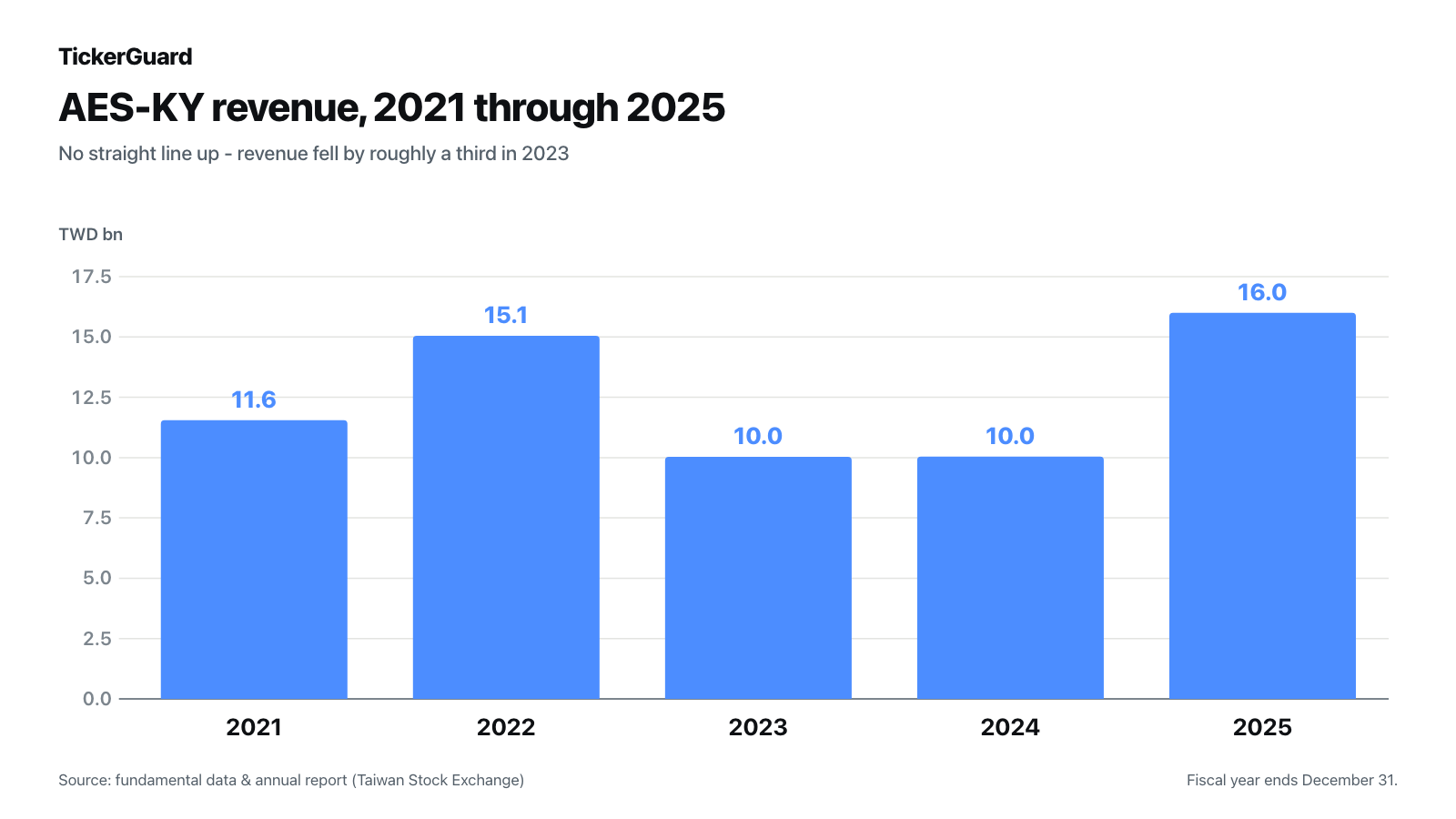
Net profit followed the same pattern: TWD 2.43 billion (2021), TWD 3.22 billion (2022), a decline to TWD 1.97 billion (2023), a recovery to TWD 2.17 billion (2024), and finally TWD 3.26 billion in 2025 (earnings per share of roughly TWD 38.2). Headcount grew sharply over the same period: from 878 employees (2023) to 1,022 (2024) to 1,292 as of May 9, 2025 — a 47% increase in eighteen months, with the strongest growth among direct manufacturing staff (from 310 to 660). That is a sign the 2025 revenue recovery was not just an accounting artifact, but came with real capacity expansion.
What the mandatory disclosures show — without earnings-call transcripts
An honest note upfront: no publicly available analyst-call transcripts exist for AES-KY — a check of the earnings-call transcript table on August 29, 2026, returned "0 fetched, 0 candidates." Instead, we reviewed three types of mandatory disclosures that Taiwanese listed companies must publish through the market observation system: monthly revenue announcements, board-approved preliminary financial figures, and ad-hoc clarifications of press reports.
The most informative of these is dated August 6, 2026: the board and audit committee approved preliminary ("self-compiled") financial figures for the first half of 2026. AES-KY reported revenue of TWD 9,337.9 million for the first six months of 2026, gross profit of TWD 3,513.5 million (37.6% gross margin), operating income of TWD 2,405.4 million (25.8% margin), pre-tax profit of TWD 2,541.5 million, and net profit of TWD 2,002.9 million (21.4% net margin) — basic earnings per share of TWD 23.45. As of June 30, 2026, total assets stood at TWD 27,284.0 million, liabilities at TWD 9,585.3 million, and equity at TWD 17,697.9 million. An explicit caveat: these are preliminary, board-approved figures — an auditor-reviewed semi-annual report was not separately available as of this analysis's cutoff.
For context: net profit for these six months alone already exceeds the entire net profit of 2023 (TWD 1.97 billion) — a comparison that shows how much earnings power has shifted since the low point. Monthly revenue disclosures confirm the trend: July revenue hit a record TWD 1,723 million (up 28.24% year-on-year), and cumulative revenue for the first seven months of 2026 reached TWD 11,061 million (up 26.35%) — a figure that matches exactly the sum of the disclosed half-year figure and the July figure, confirming the internal consistency of the numbers.
A third disclosure shows how cautious AES-KY is about its own forecasts: on December 16, 2025, press reports circulated claiming the company was targeting earnings per share of "at least TWD 48" for fiscal year 2027. AES-KY promptly issued a denial via the market observation system: the cited figure was an "analyst's own forecast," not a company statement — only the company's official announcements should be treated as binding. Eight months later, the fundamental-data analyst consensus (3 analysts) for the current fiscal year 2026 already sits at TWD 48.35 per share — almost exactly the once-disowned number, just arriving a year sooner than originally floated.
What the filings reveal — the uncomfortable truths
Uncomfortable truth #1: the record is young — two lost years came before it
AES-KY's current growth story is not yet 18 months old. 2023 and 2024 combined brought essentially no revenue growth versus 2022 — the jump to TWD 16.00 billion came only in 2025, driven by the new data-center and 5G business. Anyone who bought the stock in December 2025 was not buying into a multi-year proven growth trajectory, but into a single strong year preceded by two weak ones. Whether the AI-driven growth holds up, or whether — like e-bike demand in 2023 — it slows again through a demand or inventory cycle, cannot be read from the history alone.
Uncomfortable truth #2: the largest supplier vanished within a single quarter
The 2024 annual report discloses the largest suppliers for the last two years plus the first quarter of 2025. A single supplier, not named in the report ("Company A"), accounted for 66.8% of all purchases in 2023, only 46.6% in 2024 — and its share collapsed to 0.4% in the first quarter of 2025.
"In 2024, the Group's purchase amount from Company A was NT$2,321,179 thousand, accounting for 46.6% of the overall purchase amount. The purchase amount decreased compared with the previous year, mainly due to the reduction in production demand.."
— Advanced Energy Solution Holding Co., Ltd., 2024 Annual Report, page 69
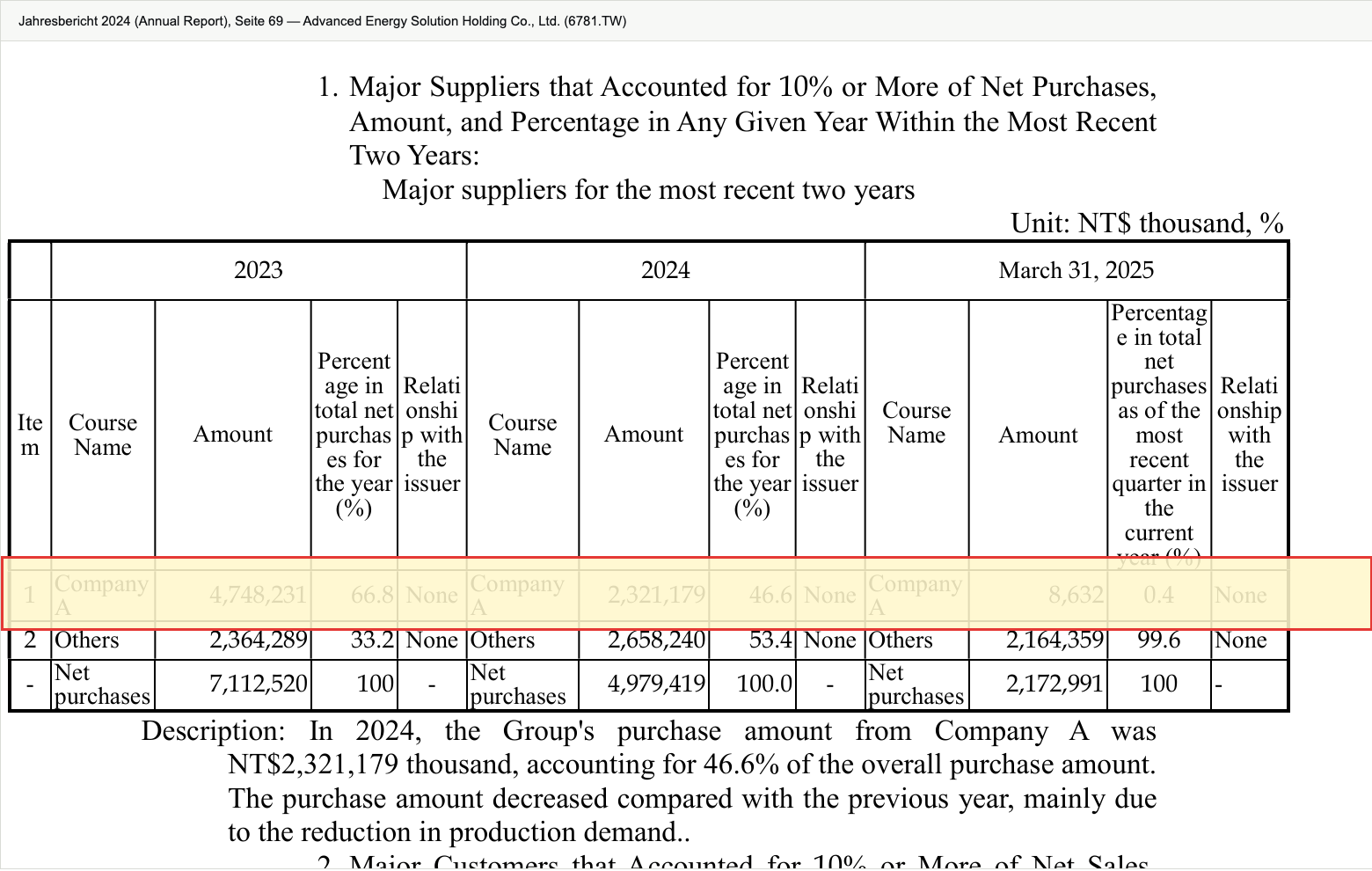
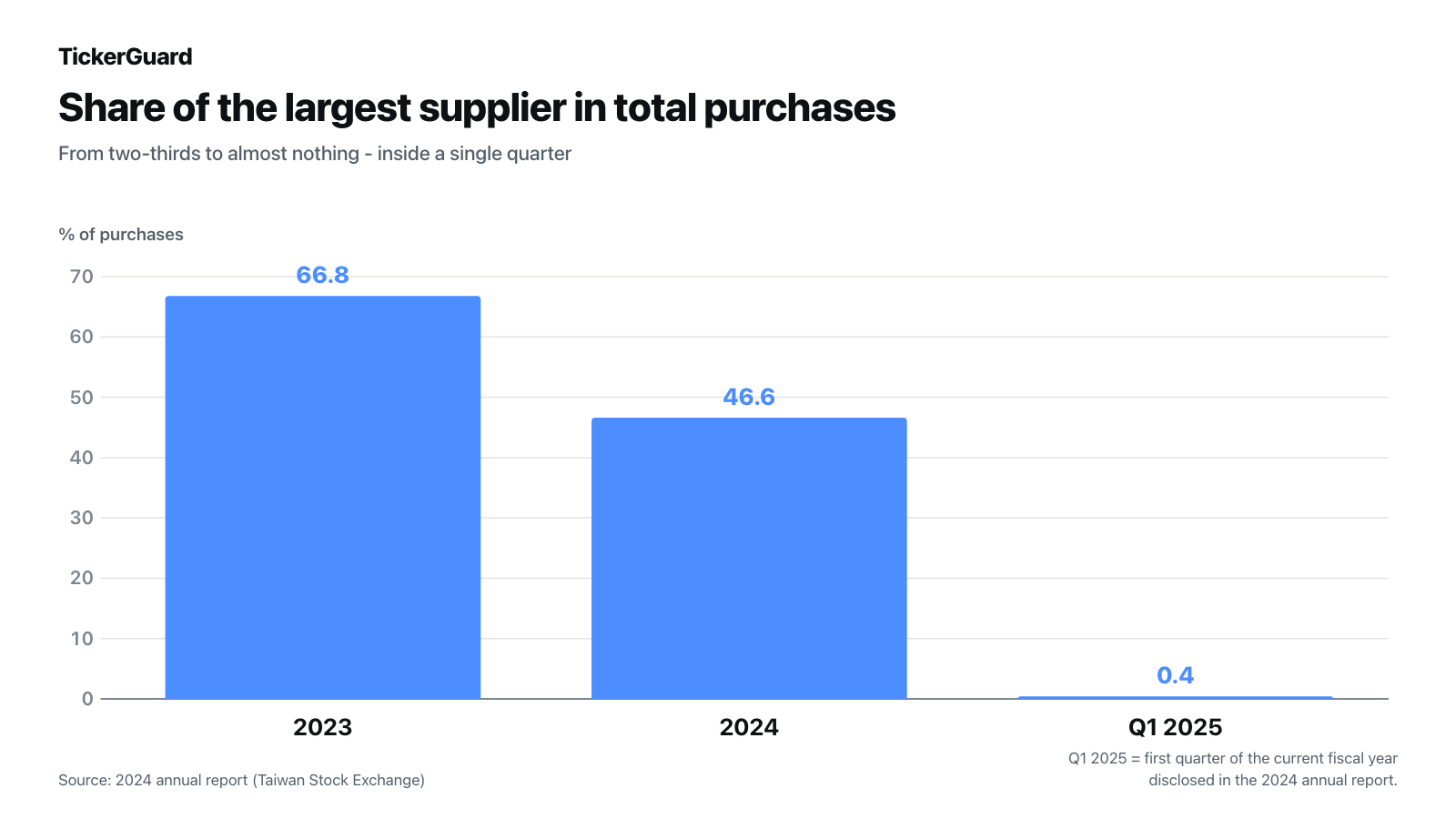
A supplier switch of this magnitude — from two-thirds to a twentieth of a percent — is unusually abrupt for a manufacturer that depends on continuous material availability. The report does not explain who absorbed the freed-up share, or whether this reflects deliberate diversification, a supplier failure, or a pricing dispute. The customer side looks considerably calmer: the largest customer ("Company A" on the sales side, again unrelated to the company) accounted for 22% (2023), 29% (2024) and 25% (Q1 2025) of sales, the second-largest for 13%, 7% and 12% — noticeable but not extreme concentration, and in neither case is it the parent company Simplo according to the report.
Uncomfortable truth #3: in 2023 the company earned money on paper — while cash flowed out
In 2023, the same year revenue fell by a third, AES-KY reported a positive net profit of TWD 1.97 billion — yet operating cash flow was negative, at −TWD 265.8 million. In every other year reviewed (2021, 2022, 2024, 2025), operating cash flow was clearly positive, ranging between TWD 1.47 billion and TWD 2.69 billion. A plausible explanation suggests itself: during an abrupt demand slowdown, inventory and receivables often sit on the books longer than the reported book profit suggests — cash flow reflects that effect immediately, while the income statement only catches up later. The 2024 annual report reviewed does not explicitly address this connection; the observation is based on comparing fundamental data across five fiscal years.
Valuation — a solid balance sheet, but no longer a bargain
With 85,419,000 shares outstanding and a price of TWD 1,130 (August 28, 2026), market capitalization comes to roughly TWD 96.52 billion — about USD 3.05 billion or EUR 2.63 billion. Because the underlying fundamental-data feed does not yet include the preliminary half-year figures from August 6, 2026 (its most recent quarterly cell is March 31, 2026), we added up trailing-twelve-month earnings per share ourselves: TWD 18.84 from the second half of 2025 plus TWD 23.45 from the first half of 2026 comes to roughly TWD 42.3 — implying a price-to-earnings ratio of roughly 26.7. Based on equity per share as reported on June 30, 2026 (roughly TWD 207.2), the price-to-book ratio is roughly 5.5; based on self-calculated trailing-twelve-month revenue (roughly TWD 17.93 billion), the price-to-sales ratio is roughly 5.4.
The balance sheet itself is solid: as of June 30, 2026, equity of TWD 17.70 billion stood against liabilities of TWD 9.59 billion, an equity ratio of nearly 65%. Financial debt was low at TWD 821.9 million as of March 31, 2026, with cash of TWD 9.02 billion on the same date — cash alone equaled roughly 9% of today's market capitalization. AES-KY has also paid a dividend every year since its 2021 listing; the most recently declared dividend went ex on July 9, 2026, with a payout ratio of roughly 66% of profit.
Opportunities and risks at a glance
Opportunities: a structurally growing end market (data centers and 5G base stations are increasingly switching from lead-acid to lithium backup batteries, which the annual report says last longer and deliver higher currents); a solid, barely leveraged balance sheet with an equity ratio around 65%; a dividend paid every year since the IPO; real, headcount-backed capacity growth; and an already-achieved record first-half 2026 profit that catches up to the analyst estimates the company itself once disowned. Risks: a growth story that is barely a year old, preceded by two weak years; an abrupt, unexplained supplier switch with unclear margin implications; a year (2023) with negative operating cash flow despite a book profit; majority control by parent company Simplo Technology, which does not rule out conflicts of interest in intercompany dealings even though the reports reviewed show no such dealings among the largest customers or suppliers; a free float of only around 36% of shares, which can limit liquidity; and a valuation (P/E around 27) that leaves little room for disappointment in the further build-out of the data-center business.
A human conclusion
The story that put AES-KY on the board in December 2025 was not wrong. Data centers really do need more backup batteries, the company really is shipping more of them, and profit really did rise — to a level that, by the first half of 2026, already exceeded the entire net profit of 2023. Anyone who bought at TWD 1,500 in December 2025 had the story essentially right — and yet, measured against the TWD 1,130 price eight months later, was sitting on a loss. That is the uncomfortable lesson this stock offers: a correct story does not protect against a wrong entry price. Anyone who instead bought in the very week before the record announcement, at TWD 842 on July 30, 2026, would today be sitting on a gain of more than 34% — not because the story changed that week, but because the price did. Not investment advice.
Sources
This analysis draws on: the 2024 Annual Report (published May 28, 2025) of Advanced Energy Solution Holding Co., Ltd.; the company's own corporate and product pages (advancedenergysolution.com.tw/en/); the 2025 monthly revenue table from its investor relations site; the mandatory disclosures of December 16, 2025 and August 6, 2026, plus the June/July 2026 monthly revenue announcements, as reported by moneydj.com, cmoney.tw, udn.com, statementdog.com and winvest.tw (all accessed August 29, 2026); press coverage of the 2021 IPO (ctee.com.tw, cnyes.com); and fundamental data (balance sheet, income statement, cash flow, price and valuation metrics, as of August 27-29, 2026). No publicly available analyst-call transcripts exist for 6781.TW; the most recent half-year figures cited are preliminary (board-approved, "self-compiled"), not yet confirmed by an auditor-reviewed semi-annual report. As with other Taiwanese issuers outside SEC reporting — see for instance our analysis of Hon Precision — the same rule applies: filings beat the feed, and every core claim needs a named, dated source. Note: this analysis is journalistic interpretation of publicly available information, not investment advice and not a recommendation to buy or sell.
Our Bottom Line at a Glance
- Growth positive
- Revenue rose 59.4% in 2025 to TWD 16.00 billion; the first half of 2026 already added TWD 9.34 billion per the preliminary disclosure, with net profit (TWD 2.00 billion) already exceeding the entire 2023 net profit. Growth is driven by the build-out of backup batteries for data centers and 5G base stations.
- Track record and growth duration negative
- The current growth story is not yet 18 months old. Revenue fell a third in 2023 and stagnated in 2024 — the jump came only in 2025. Whether the AI-driven growth is structural, or will slow again like e-bike demand did in 2023, cannot be read from the track record alone.
- Supplier and customer concentration negative
- The former primary supplier fell from 66.8% to 0.4% of purchases within a single quarter — an unusually abrupt, unexplained switch. Customer concentration is more moderate (largest customer roughly a quarter of sales), but still notable.
- Balance sheet and liquidity positive
- An equity ratio of roughly 65% (June 30, 2026), low financial debt (TWD 821.9 million as of March 31, 2026) and cash of TWD 9.02 billion on the same date — an unusually solid balance sheet for a manufacturer, reinforced by a dividend paid every year since the IPO.
- Valuation and price history neutral
- At TWD 1,130 (Aug. 28, 2026) and a self-added P/E of roughly 26.7, the stock is no longer cheap but not extreme either. What stands out is the price range: a 52-week high of TWD 1,500 (Dec. 1, 2025) ahead of the strong numbers, a 52-week low of TWD 842 (Jul. 30, 2026) right before the record announcement — a textbook case of timing risk around a fundamentally correct growth story.
- Ownership structure and governance neutral
- Parent company Simplo Technology still controls roughly 55% of shares through a holding vehicle (down from roughly 73% at the 2021 IPO); free float is only around 36%. The reports reviewed show no dealings with Simplo among the largest customers or suppliers, but the close corporate tie — the 2025 shareholder meeting was held in the parent company's own building — remains a structural point.
AES-KY is delivering operationally what the data-center narrative promised: a 59.4% revenue jump in 2025, a record first-half 2026 profit that already exceeds the entire 2023 net profit, and a solid, barely leveraged balance sheet. But the growth story is young, an abrupt, unexplained supplier switch raises questions, and anyone who bought at the December 2025 high is sitting on a loss despite better numbers. Not investment advice.
What Our Rating Means
Open questions
The business works in principle, but one material question is open. As long as it stays open, our findings do not carry a quality verdict.
Yellow here is not about an existential question — the balance sheet is solid, with an equity ratio of roughly 65%, low financial debt, and a dividend paid every year since the IPO, and the company has posted a profit every fiscal year for five years running. Yellow reflects two open operational questions instead: first, the current growth story — carried by the data-center and 5G backup business — is not yet 18 months old, while the two years before it (2023/2024) essentially stagnated or fell; whether the new growth is structural, or will fade again like e-bike demand once did, cannot be reliably inferred from the track record so far. Second, per the 2024 annual report, the former primary supplier fell from 66.8% to 0.4% of purchases within a single quarter, without the report explaining the circumstances or the consequences for margin and material availability. Both are operational, not solvency questions — the business model itself (lithium battery modules for a structurally growing backup-power market) clearly holds up, and the close tie to parent Simplo Technology shows no evident conflicts of interest in the largest business relationships reviewed.
A journalistic assessment by our editorial team at the time of the deep dive, based on public sources — not investment advice and not a solicitation to buy or sell. Your personal circumstances (investment goals, risk capacity, taxes) cannot be taken into account. What our levels mean, how verdicts are formed, and what conflicts of interest exist →
Worth Noting
- This analysis was first published on August 29, 2026. The first-half-2026 figures come from a board-approved, preliminary ("self-compiled") mandatory disclosure dated August 6, 2026 — an auditor-reviewed semi-annual report was not separately available as of this analysis's cutoff. Price, share count and valuation metrics are as of August 27-29, 2026; trailing-twelve-month earnings per share was added up by us from the second half of 2025 and the first half of 2026, not taken unchecked from a data feed, since the underlying raw dataset did not yet include the preliminary half-year figures.
- No publicly available analyst-call transcripts exist for 6781.TW (checked Aug. 29, 2026). The chapter on investor communication therefore relies on mandatory disclosures and monthly revenue announcements rather than verbatim transcripts.
- Press coverage of the 2021 IPO (ctee.com.tw, cnyes.com), and the reporting of the mandatory disclosures by moneydj.com, cmoney.tw and udn.com, are external, named, dated sources — not AES-KY's own corporate reports — and are labeled accordingly. A direct fetch of ctee.com.tw was blocked with HTTP 403 on August 29, 2026; the facts reported there (IPO price, market-cap comparison with the parent company) were cross-checked via Google's search index and additional sources.
The full analysis as a PDF for later
We will send you this analysis as a PDF — to print, file away, and read at your own pace.
Frequently Asked Questions
Advanced Energy Solution Holding Co., Ltd. ("AES-KY", TWSE: 6781), based in Hukou Township, Hsinchu County, Taiwan, makes lithium battery modules. Originally focused on lightweight electric vehicles such as e-bikes and e-scooters, the company increasingly sells backup batteries for data centers and 5G base stations, plus an early automotive battery-pack business.
Parent company Simplo Technology (TWSE: 6121), a large Taiwanese battery-module maker, spun AES-KY off as an independent company in 2020. Market reports say Simplo, through its holding vehicle Trend Power, held roughly 73% of shares at the 2021 IPO; current reports put the stake at roughly 55%.
AES-KY trades on the Taiwan Stock Exchange, not in the U.S. — there is no SEC registration, no 10-K, no 10-Q. Instead, it must publish annual and quarterly reports, monthly revenue disclosures and ad-hoc mandatory announcements through Taiwan's market observation system. This analysis draws on the 2024 annual report and the August 6, 2026 disclosure of preliminary first-half 2026 figures.
Revenue fell roughly 33% to TWD 10.03 billion in 2023. Per the 2024 annual report, the e-bike battery business in particular suffered from global political and economic instability, high inflation eroding purchasing power, and ongoing inventory destocking by brand customers — effects that hit other consumer-goods makers worldwide in 2023 as well.
Heavily on the supplier side, with a striking break: a single supplier accounted for 66.8% of purchases in 2023, only 46.6% in 2024, and just 0.4% in the first quarter of 2025 — without the report explaining the circumstances. Customer concentration is more moderate: the largest customer most recently accounted for roughly a quarter of sales.
Yes, every year since its 2021 IPO. The most recently declared dividend went ex on July 9, 2026, with a payout ratio of roughly 66% of profit and a yield of roughly 1.7% at the current price.
At a price of TWD 1,130 (August 28, 2026) and a self-calculated trailing-twelve-month earnings per share of roughly TWD 42.3 (adding the last two half-years), the price-to-earnings ratio is roughly 26.7. Price-to-book is roughly 5.5, price-to-sales roughly 5.4 — not a bargain, but backed by a solid, barely leveraged balance sheet.
No. A check on August 29, 2026, found no publicly available transcripts. This analysis instead relies on board-approved mandatory disclosures, monthly revenue announcements, and a public clarification the company issued on December 16, 2025.
Found an error?
Did you spot a factual error, an outdated number, or a typo in this deep dive? Let us know briefly — your report goes straight to the editorial team.