UP Fintech: 56 Percent Growth — and a RMB 411 Million Penalty for the Business That Built the Broker
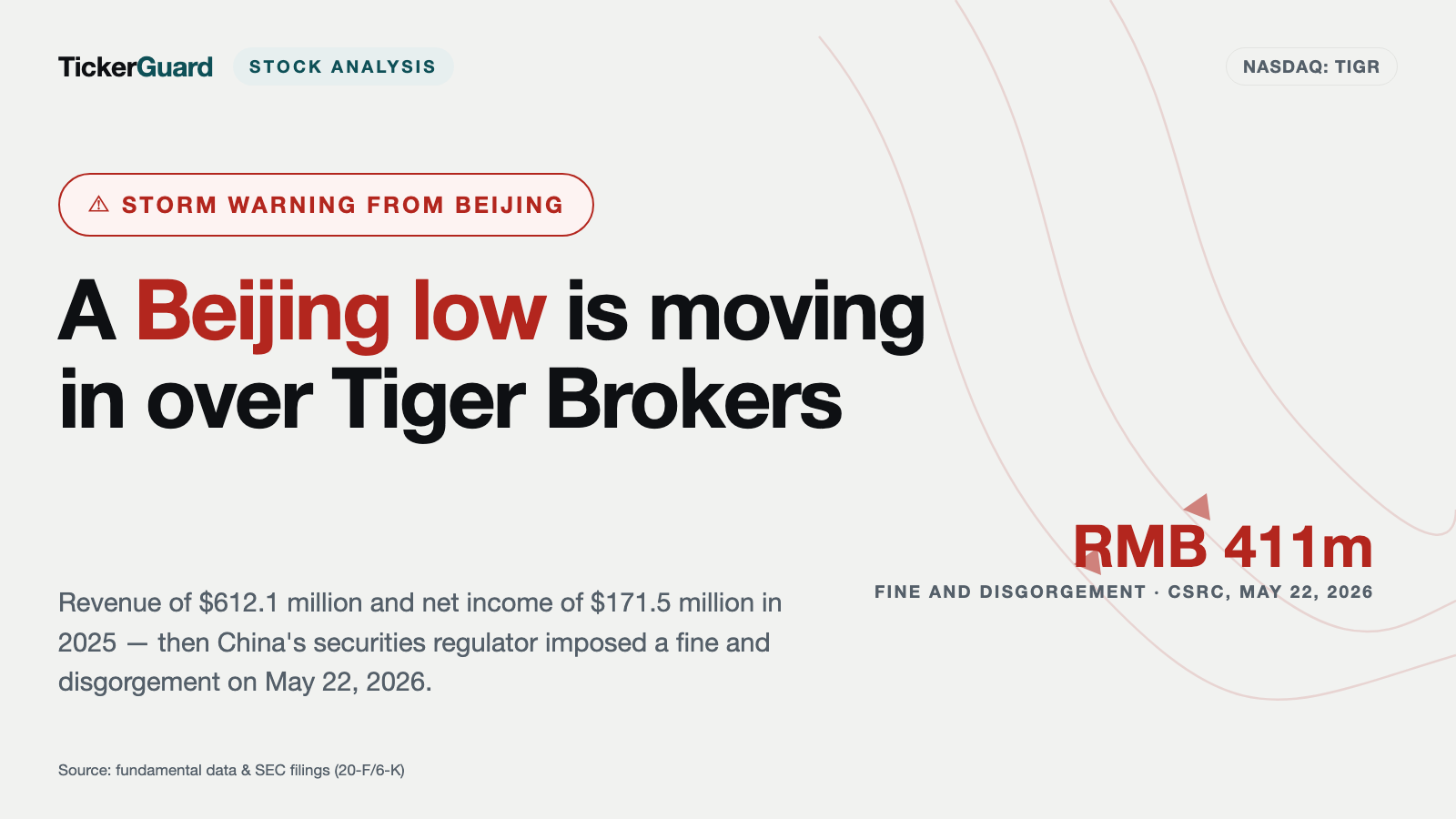
On paper UP Fintech, the company behind Tiger Brokers, looks like a dream: revenue of $612.1 million in 2025, up 56.3 percent, net income of $171.5 million, $60.8 billion of client assets. Then came May 22, 2026. The Beijing Bureau of the China Securities Regulatory Commission imposed fines and disgorgement totaling roughly RMB 411 million — close to $60 million — on subsidiaries for unlicensed cross-border securities business in mainland China. The chief executive received a personal warning. A quarterly profit turned into a $26.9 million loss. The same regulator had already put the company on notice back in 2022. We read what actually grew — and who decides whether it keeps growing.
 Thomas Mücke
Founder & Publisher
Thomas Mücke
Founder & Publisher
As of Today
As of: October 7, 2026
- Closing price
- 4.40 $ -1.80%
- Market Capitalisation
- 0.8 $B
- P/E
- 7.3
- Growth Score
- 7/10
- AAQS
- 6/10
Price change since August 21, 2026: -17.4%
This analysis has a cut-off date. The Stock Guard tells you when something material changes in the numbers. Reserve your free spot
Chart
Interactive price chart (TradingView).
52-week range: 4.20 $ to 11.10 $ · Last price: 4.40 $ (As of: October 7, 2026)
Note: pure fact-based analysis, not investment advice and not a solicitation to buy or sell. All figures without guarantee.
There is an investor trap that does not catch you the first time, but the second — call it the second-chance trap. It works like this. You missed a big move. The broker stocks ran without you. Then a name shows up that looks like a twin of the story you missed, only cheaper. Your brain does not read "different company," it reads "discount." UP Fintech Holding Limited (Nasdaq: TIGR), the company behind the online broker Tiger Brokers, puts exactly that price tag on the table: in 2025 revenue grew 56.3 percent to $612.1 million, net income climbed to $171.5 million, and the price-to-earnings ratio has recently sat in single digits.
So let us make a deal. Before you confuse a price with a discount, we read together what the company itself reported to the U.S. securities regulator, the SEC: the annual report on Form 20-F for 2025 and the interim reports on Form 6-K that followed. A foreign private issuer such as UP Fintech does not file a 10-K or a 10-Q; it files Form 20-F once a year and furnishes Form 6-K in between. Those filings describe a securities regulator that imposed almost $60 million of penalties four weeks after the annual report; a chief executive who was personally warned; and a quarterly profit that became a loss because of it. What you make of that is up to you.
What UP Fintech actually does
UP Fintech is, at its core, an online broker: an app through which retail investors buy and sell stocks, options, futures, funds and bonds on exchanges in the United States, Hong Kong, Singapore, Australia and elsewhere. The brand is Tiger Brokers, the trading application is Tiger Trade. The target audience is stated plainly in the annual report: Chinese-speaking investors around the world, plus a growing local client base in Singapore, Hong Kong, Australia, New Zealand and the United States.
The money comes from four places. First, commissions per trade — $266.8 million in 2025, or 43.6 percent of revenue. Second, interest: clients who trade on margin pay interest to the broker, which brought in another $257.0 million, or 42.0 percent. Third, financing service fees ($10.7 million) and fourth, other revenues ($77.5 million) from fund management in Singapore, underwriting initial public offerings in Hong Kong and the United States, currency exchange and employee share plan administration.
Two account models sit side by side, and the difference matters more to the numbers than it sounds. Under consolidated accounts everything runs through the company itself, and revenue is recognized gross, including execution and clearing costs. Under fully disclosed accounts, the U.S. broker Interactive Brokers handles execution, clearing and settlement, and UP Fintech keeps only the remainder of the commission — net. That outsourced share has been shrinking for years: 16.6 percent of net revenues in 2023, 10.6 percent in 2024, 6.6 percent in 2025.
And then there is the part the company likes to talk about most: Tiger AI, an artificial-intelligence assistant for investment decisions. It launched as "TigerGPT" in 2023, became TigerAI in 2024, and in 2025 user numbers grew nearly fivefold while conversations rose tenfold, according to the annual report. In the first quarter of 2026 the company rebuilt it into a multi-agent structure, added a dedicated futures agent and integrated a third large language model.
One point belongs right at the start because it colors everything else: the security traded on Nasdaq is not an ordinary share but an ADS — a depositary receipt representing 15 Class A ordinary shares of the Cayman holding company. Alongside them sit Class B shares carrying 20 votes each, held entirely by the family of founder and chief executive Wu Tianhua. As of March 31, 2026 those Class B shares represented 3.43 percent of the share capital but 43.18 percent of the votes. Translated: buying here buys an economic stake, not a say.
Company history for investors
-
2019
Nasdaq listing
In March 2019 UP Fintech sells 14,950,000 ADSs; alongside, IB Global Investments of the Interactive Brokers group buys 13,125,000 Class A shares privately. The clearing partner thereby becomes a shareholder.
-
2022
The CSRC bars new business in mainland China
The notice of December 30, 2022 classifies the cross-border business as unlicensed: no new customers, no new accounts in mainland China. For shareholders it was the first warning aimed at the growth engine.
-
2023
The app leaves China
On May 18, 2023 the company pulls "Tiger International" from the PRC application market. New client acquisition shifts decisively to Singapore, Hong Kong, Australia and the United States.
-
2024
Follow-on offering at $6.25 per ADS
The offering of 17,250,000 ADSs brings fresh capital for growth — and dilutes existing holders at the same time. The issue price sat well below the later 2025 high.
-
2025
Record year: $612 million of revenue, $171 million of net income
Revenue up 56.3 percent, net income almost tripled, client assets up from $41.7 billion to $60.8 billion. For shareholders, the year the business model first showed visible operating leverage.
-
2026
RMB 411 million of penalties — and a buyback
On May 22, 2026 the CSRC imposes fines and disgorgement, and the quarter swings to a loss. Ten days later the board approves a repurchase program of up to $50 million running to June 1, 2027.
How this stock landed on our desk
Not through a screening filter, but through the Reddit mention list of our in-house stock scanner (as of August 24, 2026). Such lists are not buy signals; they are an early warning that a stock is being talked about. And when a stock is being talked about, reading the mandatory filings matters more, not less.
The second reason was what the scanner showed next. The Piotroski F-Score — a nine-point system that tests profitability, leverage and efficiency against the prior year — stood at 8 out of 9. That is rare for a name being traded on message boards. At the same time the price-to-earnings ratio was around 8.6 and the price-to-book ratio around 1.1 (fundamental data, as of August 24, 2026). For a financial firm, though, the F-Score deserves caution: balance sheet ratios mean something different at a broker passing billions of client money through its books than at an industrial company.
The third reason was the share price itself. On August 21, 2026 the ADS closed at $5.33; the preceding 52-week range ran from $4.00 to $13.42, the 50-day average sat at $4.74 and the 200-day average at $7.01 (fundamental data, as of August 24, 2026). A stock that has more than halved within a year while the company\'s profit hit a record — that is either an opportunity or a signal. Which one, the filings decide.
We have opened a Chinese success story whose structure raises more questions than its numbers once before: our analysis of Haier Smart Home looked at a group with a record year whose cash largely sits at a bank owned by its own controlling shareholder. At UP Fintech the issue is not the cash but the license. What that means comes two chapters down.
The numbers over the years — honestly credited
Start with what genuinely impresses: this company grows fast and makes money doing it. Revenue rose from $272.5 million in 2023 through $391.5 million in 2024 to $612.1 million in 2025 — up 125 percent in two years, 56.3 percent of that in 2025 alone. Net income climbed over the same period from $33.0 million through $61.4 million to $171.5 million. Income before income taxes reached $207.4 million in 2025, against $81.8 million a year earlier.
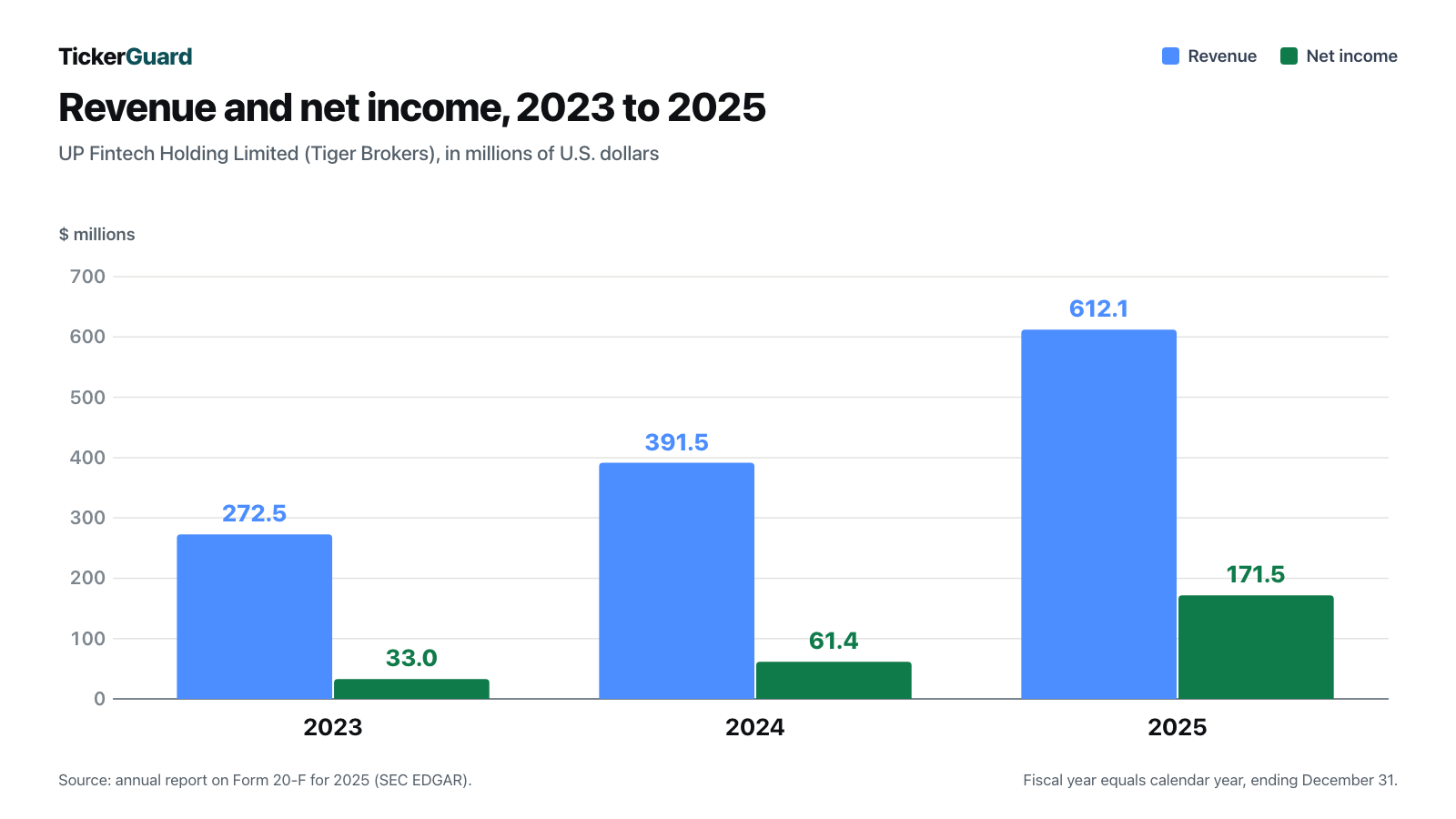
Behind that sits real operating growth, not just a friendly market. Customer accounts rose from 2,195,705 at the end of 2023 through 2,499,304 to 2,657,544 at the end of 2025. Client assets held on the platform grew from $30.6 billion through $41.7 billion to $60.8 billion. And in the first quarter of 2026 the company added 28,900 newly funded clients, mostly from Singapore and Hong Kong; net asset inflows reached $2.9 billion — the first quarter above two billion in company history, according to management.
The balance sheet is solid for this kind of business, too. As of March 31, 2026, total assets of $8.86 billion stood against $842.8 million of equity attributable to UP Fintech shareholders; unrestricted cash and term deposits came to $598.1 million. Most of the balance sheet is pass-through: $3.90 billion of cash segregated for regulatory purposes and $5.99 billion of payables to customers. The convertible notes issued in 2021 were repaid in March and April 2026 at a principal amount of $100.0 million, leaving $57.0 million at quarter end. And on June 1, 2026 the board approved a share repurchase program of up to $50 million, running to June 1, 2027.
And then comes the quarter that puts all of it in context.
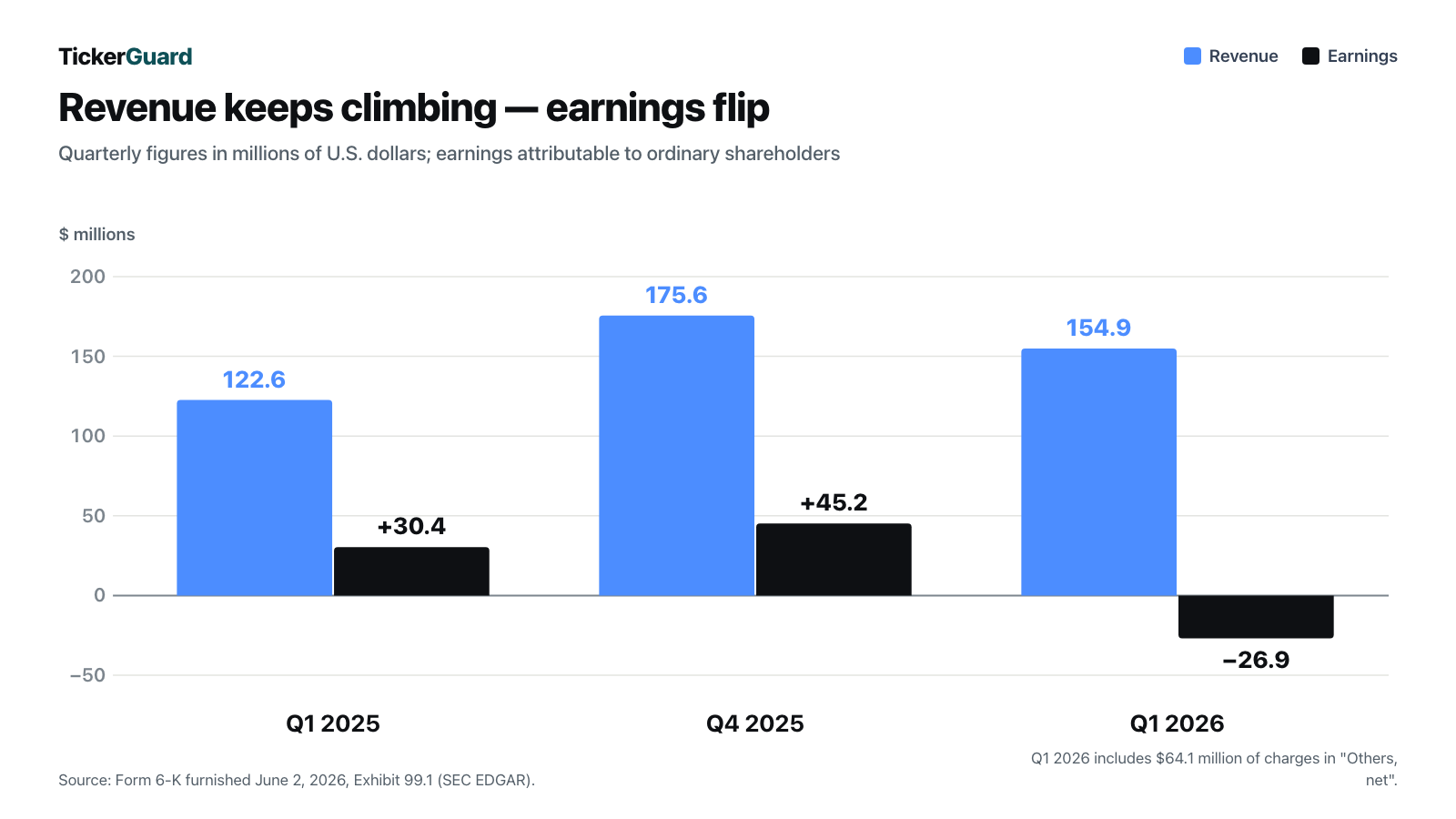
The middle pair of bars shows that the quarter would not have been a record even without the penalty: in the fourth quarter of 2025 revenue and earnings stood higher, at $175.6 million and $45.2 million respectively. Against that immediately preceding quarter, first-quarter 2026 revenue fell 11.8 percent.
One note on the basis: the annual figures in the first chart are consolidated net income, while the quarterly figures in the second are earnings attributable to ordinary shareholders. The two differ only by small non-controlling interests, but they are not the same measure — which is why they sit in two separate charts rather than one.
What the filings say — the uncomfortable truths
Uncomfortable truth No. 1: the regulator in Beijing has declared part of the business unlicensed — and fined it
On May 22, 2026 UP Fintech furnished a Form 6-K to the SEC. The heading of the exhibit is plain: "Administrative Penalty by the CSRC." The content is not.
"Based on its findings, the CSRC Beijing Bureau has imposed administrative penalties in the aggregate amount of approximately RMB308.1 million and confiscation of illegal income in the aggregate amount of approximately RMB103.1 million. Mr. Tianhua Wu, a director and the CEO and controlling person of the Company, has also received a warning and penalty of RMB1.25 million."
— UP Fintech Holding Limited, Form 6-K furnished May 22, 2026, Exhibit 99.1
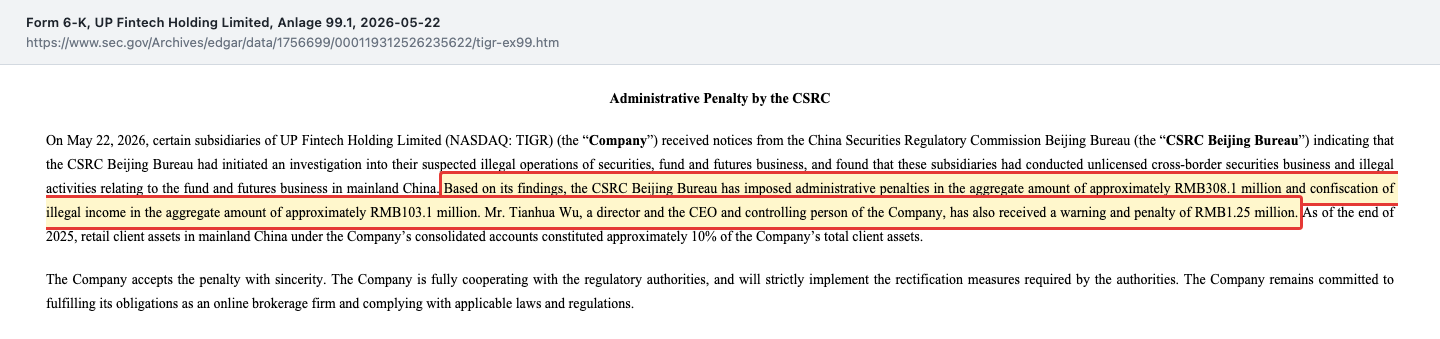
The finding recorded there: subsidiaries had conducted "unlicensed cross-border securities business" as well as illegal activities relating to the fund and futures business in mainland China. Add the fine and the disgorgement together and you get roughly RMB 411 million, which the company itself puts at about $59.7 million. For scale, that is roughly one third of the entire 2025 net income and about 7 percent of shareholders\' equity.
The response is telling. The company says it accepts the penalty "with sincerity," is fully cooperating and will strictly implement the required rectification measures. No objection, no appeal, no qualification. Anyone holding the stock should take that seriously: a company that accepts a penalty of this size without contest does not expect to overturn it.
Uncomfortable truth No. 2: the warning has been in the company\'s own filings since late 2022
What makes this uncomfortable is not the penalty alone but its prehistory, which has been reprinted in the risk factors of every annual report for years.
"On December 30, 2022, the CSRC issued the CSRC 1230 Notice, stating that we had carried out cross-border securities business for Chinese mainland investors without approval of the CSRC, constituting illegal operation of securities business under the Securities Law of the PRC."
— UP Fintech Holding Limited, annual report on Form 20-F for 2025, Item 3.D Risk Factors
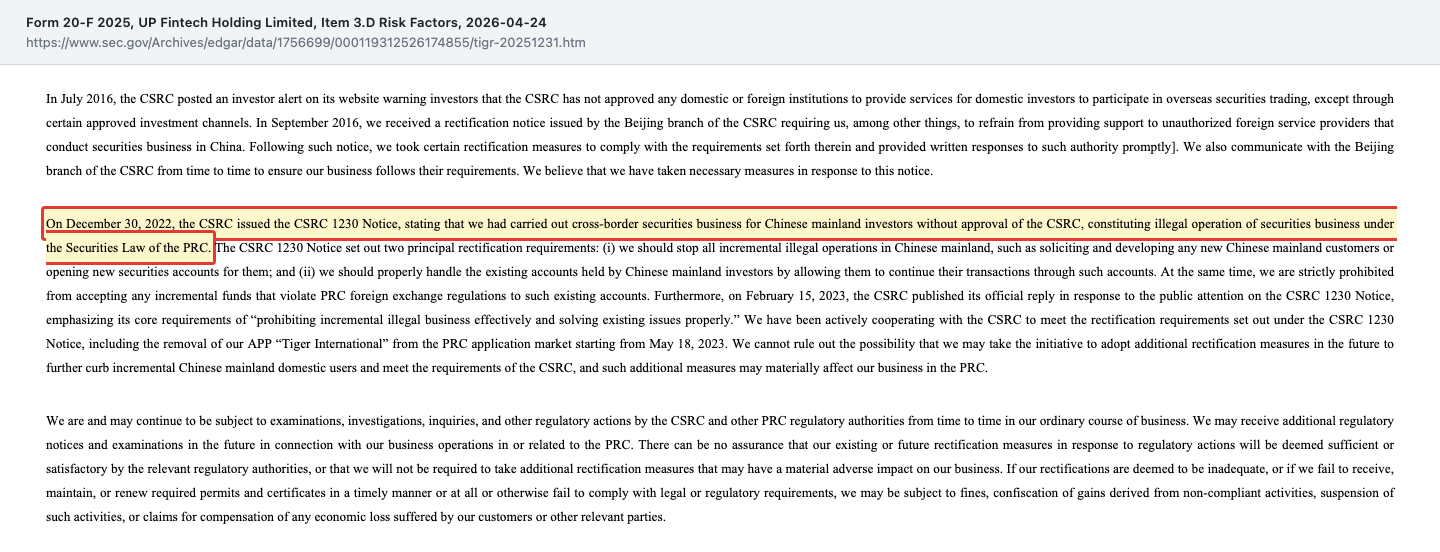
That notice carried two requirements: no new business in mainland China — no new customers, no new accounts — and an orderly continuation of existing accounts. The company did what was visible: the "Tiger International" app left the Chinese app market on May 18, 2023. Three and a half years later the penalty arrived anyway, together with the finding that unlicensed business had taken place.
One more piece of the chronology belongs here. The annual report on Form 20-F for 2025 was filed on April 24, 2026. Its subsequent-events note states that no event with a material impact on the group was identified. Four weeks later the penalty landed. Both statements are formally correct — the evaluation ran through the date the financial statements were issued. For a reader it means something else: at this company an annual report has a short half-life. Whoever reads it has to read the Form 6-K filings that follow.
Uncomfortable truth No. 3: the "global" broker is a Chinese company by headcount
Every press release calls it "a leading online brokerage firm focusing on global investors." The seat is Singapore, the holding company is registered in the Cayman Islands, and revenue is booked mostly in New Zealand, Singapore and the United States: in 2025, $219.6 million came from New Zealand, $163.3 million from Singapore, $156.9 million from the United States and only $2.3 million from the Cayman Islands. The people who build the company sit somewhere else.
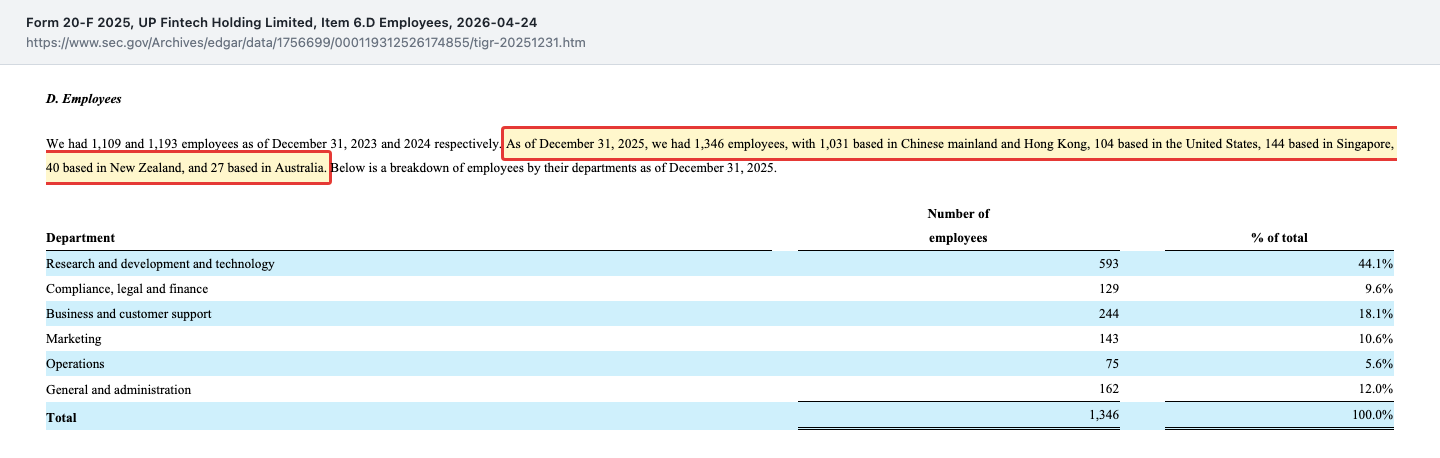
The annual report spells out the consequence itself: a significant portion of technology research and development, management and supporting teams is based in China, a significant portion of clients are Chinese speakers, and therefore compliance with PRC securities laws is "of particular significance" to the business. On top of that sits the structure. Two Chinese companies — named in the filing as Beijing Rongke and Beijing Yiyi — are not owned by the group but tied to it by contract, an arrangement known as a variable interest entity, or VIE. On access to their revenues the report states verbatim: "We do not have unfettered access to Beijing Bohu’s, Beijing Yixin’s and the respective VIEs’ revenues due to PRC legal restrictions on the payment of dividends by PRC companies, foreign exchange control restrictions, and the restrictions on foreign investment, among others."
A second strand of the same story is quiet right now but not closed. Under the U.S. Holding Foreign Companies Accountable Act, the SEC added the company to its conclusive list of identified issuers on May 26, 2022, because its auditor could not be inspected by the U.S. audit regulator, the PCAOB. On December 15, 2022 the PCAOB vacated that determination; since then, according to the filing, there is no immediate trading-prohibition risk. It revives the moment the PCAOB issues a new adverse determination.
Uncomfortable truth No. 4: the price per trade has been falling for years
The growth comes from volume, not from price. The annual report discloses the average commission rate — commissions divided by trading volume — openly: 0.0315 percent in 2023, 0.0288 percent in 2024, 0.0260 percent in 2025. The company itself blames industry competition. In two years, the price per dollar traded has fallen roughly 17 percent.
The second earnings pillar looks similar. The average annualized rate on margin financing provided by the company fell from 8.16 percent in 2023 through 5.69 percent to 5.33 percent in 2025; the average rate on financing service fees dropped from 3.18 percent through 2.74 percent to 1.57 percent. Interest income still rose, purely because more clients borrowed more: the margin financing and securities lending balance reached $6.2 billion as of March 31, 2026, a fifth more than a year earlier.
That is not a disaster, but it is an equation with a condition attached. Two of this broker\'s three earnings streams depend on things it does not control — how much its clients trade, and where interest rates sit. If either goes away, revenue falls faster than the cost base can follow. And the cost base is currently growing: in the first quarter of 2026 operating costs and expenses rose 32.9 percent to $89.2 million, employee compensation alone 38.5 percent to $46.8 million.
Uncomfortable truth No. 5: three percent of the capital carries 43 percent of the votes
That leaves the question of who decides all of this. The answer sits in the risk factors of the annual report.
"As of March 31, 2026, these Class B ordinary shares constitute 3.43% of our total issued and outstanding share capital and 43.18% of the aggregate voting power of our total issued and outstanding share capital due to the disparate voting powers associated with our dual-class share structure."
— UP Fintech Holding Limited, annual report on Form 20-F for 2025, Item 3.D Risk Factors
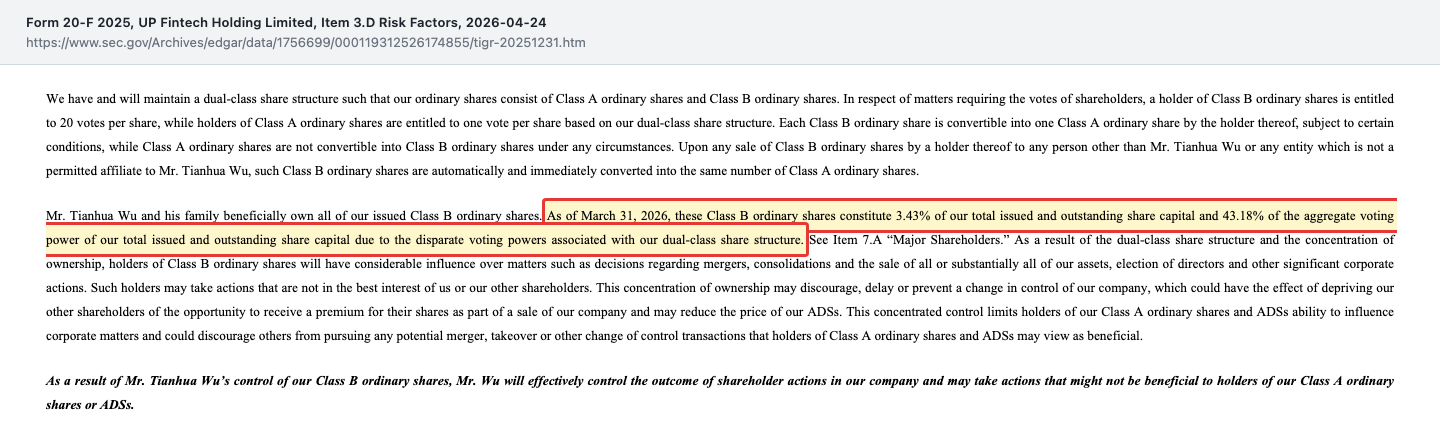
Counting the voting rights irrevocably entrusted to him under the employee share incentive plans, Wu Tianhua reaches 48.58 percent — effectively a majority in any vote. The filing says so itself: he will "effectively control the outcome of shareholder actions."
Then there is dilution — the picture for it: your slice of the cake gets smaller because new slices are handed out, not because the cake shrinks. The 2019 share incentive plan contains an evergreen clause that automatically tops up the pool each year by 1.5 percent of the shares outstanding, as long as the unissued plan shares stay below 10 percent of the total. How much that costs in practice shows in the first quarter of 2025, the last profitable one and therefore the last with a full dilution calculation: the diluted share count of 2,767,093,920 exceeded the basic count by 132.1 million shares, or 5.0 percent. In the loss-making quarter of 2026 that add-on drops out of the arithmetic — the claims themselves have not gone anywhere.
Valuation: what the market pays for UP Fintech today
Let us do this in orders of magnitude, not to the decimal. As of March 31, 2026, 2,680,509,912 Class A and Class B ordinary shares were outstanding, equal to 178,700,661 ADSs. Multiplied by the closing price of $5.33 on August 21, 2026, that gives a market value of roughly $952 million. As a cross-check: the most recent price documented in a filing comes from a Form 4 filed June 29, 2026 — director Liu Jian sold 9,333 ADSs at $4.60 on June 25. On that price the market value works out at roughly $822 million; the gap stays within a reasonable band.
What does that buy? Against 2025 revenue of $612.1 million the market pays about one and a half times one year of sales. The trailing price-to-earnings ratio stood at roughly 8.6 and the price-to-book ratio at roughly 1.1 — the market value sits only about an eighth above the $842.8 million of shareholders\' equity reported as of March 31, 2026 (fundamental data, as of August 24, 2026). There is no dividend; the annual report notes that the company "has not yet implemented a formal policy on dividend distributions."
For a broker that just grew 56 percent, those multiples are conspicuously low — and that is the point. A single-digit price-to-earnings ratio at this growth rate is not an arithmetic error by the market; it is a price tag on risk. The market here is paying for the earnings, not for the expectation. And it appears to be discounting the question of what license those earnings will be produced under.
What about the professionals? The average analyst target price was $7.69, from four strong buy ratings, one further buy, one hold and one sell. Short interest stood at 8.46 million ADSs, roughly 5.5 percent of the free float (fundamental data, as of August 24, 2026). Translated: most analysts see room above, and the bets against the stock are within normal range — this is not the torn opinion picture of a typical hype name.
Upside and risks at a glance
What speaks for UP Fintech:
- The growth is real and profitable: revenue of $272.5 million (2023), $391.5 million (2024) and $612.1 million (2025); net income of $33.0 million, $61.4 million and $171.5 million. In the first quarter of 2026 revenue rose another 26.3 percent to $154.9 million.
- The client base keeps growing, and it grows outside China: 28,900 newly funded clients in the first quarter of 2026, mostly from Singapore and Hong Kong; 1,282,800 funded clients in total, up 11.3 percent year over year.
- Inflows continue: $2.9 billion net in the first quarter of 2026 — the first quarter above two billion, per management; client assets of $58.9 billion stood 28.4 percent above the prior-year date.
- The balance sheet absorbs the penalty: $598.1 million of cash and term deposits and $842.8 million of shareholders\' equity as of March 31, 2026, plus full repayment of $100.0 million of convertible notes in March and April 2026.
- The side businesses grow fastest: other revenues rose to $77.5 million in 2025 and, in the first quarter of 2026, by 161.4 percent to $20.7 million — driven by wealth management, ten Hong Kong IPOs underwritten in the quarter and 790 corporate clients in the employee share plan business.
- On June 1, 2026 the board approved a share repurchase program of up to $50 million running to June 1, 2027, funded from existing cash.
What speaks against it:
- China\'s securities regulator has classified the cross-border business in mainland China as unlicensed and, on May 22, 2026, imposed roughly RMB 411 million of fines and disgorgement; the chief executive was personally warned and fined RMB 1.25 million.
- The first quarter of 2026 therefore ended with a $26.9 million loss attributable to ordinary shareholders, against a $30.4 million profit in the prior-year quarter.
- About 10 percent of total client assets came from retail accounts in mainland China at the end of 2025 — precisely the business the regulator objected to.
- 1,031 of 1,346 employees were based in mainland China and Hong Kong as of December 31, 2025; the group controls two Chinese entities only by contract and, per the annual report, has no unfettered access to their revenues.
- The price per trade keeps falling: average commission rate of 0.0315 percent (2023), 0.0288 percent (2024) and 0.0260 percent (2025); the average rate on the company\'s own margin financing fell from 8.16 percent to 5.33 percent.
- Costs grow faster than revenue: in the first quarter of 2026 operating costs and expenses rose 32.9 percent while revenue rose 26.3 percent.
- Through dual-class voting rights the chief executive controls 48.58 percent of the votes on a 3.43 percent Class B capital stake; the share plan grows automatically each year by 1.5 percent of the shares outstanding under an evergreen clause.
- There is no dividend; the annual report states that no formal distribution policy exists yet.
A human conclusion
Back to the second-chance trap from the opening. Its core is not that UP Fintech is a bad company. It is a growing, profitable, evidently very capable broker with a client base that has expanded every year for years, and a balance sheet that absorbs a $60 million penalty without wobbling. Its core is that a low price is not a statement about risk. Anyone buying the stock because the price-to-earnings ratio reads 8.6 is not buying the broker rally they missed at a discount. They are buying a company whose regulator in Beijing has just found that part of its business was not permitted — and whose chief executive decides alone, with nearly half of all votes, what happens next.
Two entirely opposite stories can be read from this, and both are supported by the filings. One: a company settled a legacy problem in a market that now accounts for only about ten percent of its client assets, paid for it once, keeps growing at double-digit rates on new clients from Singapore and Hong Kong, and is now buying back its own shares. The other: a company is far more tightly bound to mainland China — in people, technology and law — than its Singapore letterhead suggests, did not implement a 2022 warning thoroughly enough, and does not know whether the rectification measures will be enough this time. Its own report says exactly that.
So the honest question is not "Is UP Fintech cheap?" but: are you willing to trust a broker whose permission to operate in its most important home market depends on an authority that has just penalized it — and whose share price offers you a discount for that risk that you cannot calculate yourself? If yes, you get a growing, profitable business at roughly book value. If no, you have understood why that discount exists. What you make of it is your decision. And that is exactly as it should be.
Sources
- Annual report on Form 20-F for 2025, UP Fintech Holding Limited, filed April 24, 2026 (CIK 0001756699)
- Form 6-K furnished May 22, 2026, Exhibit 99.1 — "Administrative Penalty by the CSRC"
- Form 6-K furnished June 2, 2026, Exhibit 99.1 — first-quarter 2026 results and share repurchase program
- Schedule 13G/A filed June 16, 2026 (Avenir Tech Limited, 19,487,703 ADSs, or 10.9 percent)
- Form 4 filed June 29, 2026 (director Liu Jian, sale of 9,333 ADSs at $4.60 on June 25, 2026)
- Source: fundamental data and SEC filings (annual and interim reports, 20-F/6-K) — price, valuation and short-interest data as of August 24, 2026
Journalistic analysis, not investment advice and not a solicitation to buy or sell securities. Stocks can lose their entire value; that applies with particular force to a Cayman Islands holding company whose operations centre on China and whose shares trade as depositary receipts. All figures come from the primary sources named above and carry the as-of dates stated there. Positions held by the operator are disclosed daily; where one exists, it appears as a notice at the top of this deep dive.
Key figures at a glance
All monetary figures in millions of $; earnings per share as reported.
| Metric | 2021 | 2022 | 2023 | 2024 | 2025 |
|---|---|---|---|---|---|
| Revenue | 264.5 | 225.4 | 272.5 | 391.5 | 613.7 |
| Operating Income (EBIT) | 17.7 | 20.4 | 79.8 | 139.3 | 282.5 |
| Net Income | 14.7 | -2.2 | 32.6 | 60.7 | 171.4 |
| Net Margin | 5.6% | -1.0% | 11.9% | 15.5% | 27.9% |
| Earnings Per Share | 0.09 $ | -0.01 $ | 0.20 $ | 0.36 $ | 0.92 $ |
Source: fundamental data & SEC filings (annual and quarterly reports, 10-K/10-Q)
Our Bottom Line at a Glance
- Growth positive
- Revenue rose from $272.5 million (2023) through $391.5 million (2024) to $612.1 million (2025), up 56.3 percent in the last year alone, and another 26.3 percent to $154.9 million in the quarter ended March 31, 2026. Client assets held grew from $30.6 billion to $60.8 billion between the end of 2023 and the end of 2025.
- Earnings power and balance sheet positive
- Net income climbed from $33.0 million (2023) through $61.4 million (2024) to $171.5 million (2025). As of March 31, 2026 the books carried $598.1 million of cash and term deposits and $842.8 million of shareholders' equity; $100.0 million of convertible notes were repaid in March and April 2026.
- Regulatory and legal position negative
- On May 22, 2026 the Beijing Bureau of the CSRC imposed roughly RMB 308.1 million of fines and RMB 103.1 million of disgorgement on subsidiaries for unlicensed cross-border securities business; the chief executive was personally warned and fined RMB 1.25 million. The same authority had issued a warning on December 30, 2022.
- Location and structure negative
- 1,031 of 1,346 employees were based in mainland China and Hong Kong as of December 31, 2025, while 2025 revenue was booked mostly in New Zealand ($219.6 million), Singapore ($163.3 million) and the United States ($156.9 million). Two Chinese entities are tied to the group only by contract, and per the Form 20-F for 2025 there is no unfettered access to their revenues.
- Pricing pressure in the core business neutral
- The average commission rate fell from 0.0315 percent (2023) through 0.0288 percent to 0.0260 percent (2025), and the average rate on the company's own margin financing from 8.16 percent to 5.33 percent. Revenue grows on volume, not on price; in the quarter ended March 31, 2026 costs rose 32.9 percent against revenue growth of 26.3 percent.
- Ownership and dilution negative
- The founding family's Class B shares represented 3.43 percent of the capital and 43.18 percent of the votes as of March 31, 2026; including entrusted plan votes the chief executive reaches 48.58 percent. The share plan grows each year by 1.5 percent of shares outstanding under an evergreen clause; in the profitable first quarter of 2025 the diluted share count exceeded the basic count by 132.1 million shares.
UP Fintech runs a fast-growing and profitable online broker under the Tiger Brokers brand: $612.1 million of revenue and $171.5 million of net income in 2025, $60.8 billion of client assets, and client numbers still rising out of Singapore and Hong Kong. On May 22, 2026 the Beijing Bureau of the China Securities Regulatory Commission imposed roughly RMB 411 million of fines and disgorgement on subsidiaries for unlicensed cross-border securities business in mainland China, and personally warned the chief executive. A quarterly profit turned into a $26.9 million loss. 1,031 of 1,346 employees sit in mainland China and Hong Kong, two Chinese entities are tied to the group only by contract, and through dual-class voting rights the chief executive decides with 48.58 percent of the votes. Not investment advice.
What Our Rating Means
Substance risk
We found at least one documented issue that threatens the company itself — regardless of how the stock is currently valued.
The red rating here is explicitly not about the price or the valuation — at a price-to-earnings ratio around 8.6 and a price-to-book ratio around 1.1 this stock is anything but expensive. It reflects a documented finding about the substance of the business: a state securities regulator has determined that subsidiaries of the group conducted unlicensed securities business, imposed roughly RMB 411 million of fines and disgorgement on May 22, 2026, and personally warned the chairman and chief executive — after a warning from the same authority on December 30, 2022. That is not an operating setback; it is a compliance and governance finding. It weighs heavier because 1,031 of 1,346 employees and the entire engineering core sit in exactly that jurisdiction, and because the group states in its own annual report that it has no unfettered access to the revenues of its two Chinese contractual entities. Plenty speaks against the rating, and it deserves saying: the company is profitable, growing at double-digit rates, holds $842.8 million of equity and $598.1 million of cash, carries no going-concern qualification, reported effective internal controls as of December 31, 2025, and has already booked the penalty. Where the evidence sits between two levels, the more cautious one applies — and here a legal finding is aimed at the business model itself, not at a single quarter. The decision is yours.
A journalistic assessment by our editorial team at the time of the deep dive, based on public sources — not investment advice and not a solicitation to buy or sell. Your personal circumstances (investment goals, risk capacity, taxes) cannot be taken into account. What our levels mean, how verdicts are formed, and what conflicts of interest exist →
Worth Noting
- TIGR reached our research list through the Reddit mention list of our in-house stock scanner (as of August 24, 2026). The Piotroski F-Score stood at 8 out of 9 — a figure to read with caution at a broker passing billions of client money through its books, because balance sheet ratios behave differently there than in industry.
- Easily confused: the company is UP Fintech Holding Limited, the brand is Tiger Brokers and the app is Tiger Trade. It has nothing to do with Asian rival Futu Holdings or with the investment firm Tiger Global Management.
- Reporting regime: as a foreign private issuer the company files annual reports on Form 20-F and furnishes interim reports on Form 6-K. There is no Form 10-K or Form 10-Q for this company — searching for one turns up nothing and can be misread as missing disclosure.
- Depositary receipts: the market value of roughly $952 million refers to all 178,700,661 ADSs at the August 21, 2026 closing price. One ADS represents 15 Class A ordinary shares; multiplying the price by the 2.68 billion ordinary share count gives a figure fifteen times too large.
- Analyses are evergreen: every figure carries its own as-of date. Price, valuation and short-interest data are as of August 24, 2026 and are not a reason to buy.
Stock Watch
This analysis is as of August 26, 2026. Stock Watch will tell you what's changed at TIGR since then.
Later $1 a month per stock — signing up is free, and you'll be the first to know when it launches.
The full analysis as a PDF for later
We will send you this analysis as a PDF — to print, file away, and read at your own pace. And we will add you to the free Stock Watch list for Up Fintech Holding Ltd (TIGR), so you hear about it when something material in this analysis changes.
Frequently Asked Questions
UP Fintech Holding Limited (Nasdaq: TIGR) runs the online broker Tiger Brokers for retail investors, focused on Chinese-speaking clients worldwide as well as Singapore, Hong Kong, Australia, New Zealand and the United States. It earns commissions ($266.8 million in 2025), interest on margin lending ($257.0 million), financing service fees ($10.7 million) and other revenues from fund management, IPO underwriting and employee share plans ($77.5 million).
On May 22, 2026 the Beijing Bureau of the China Securities Regulatory Commission found that subsidiaries had conducted unlicensed cross-border securities business as well as illegal fund and futures activities in mainland China. It imposed fines of roughly RMB 308.1 million and ordered disgorgement of RMB 103.1 million, together about RMB 411 million, or $59.7 million. Chairman and CEO Wu Tianhua personally received a warning and an RMB 1.25 million penalty.
The company recorded it as a subsequent event in the first quarter of 2026, inside the "Others, net" line. That line carried a $64.1 million charge for the quarter. As a result, despite revenue rising 26.3 percent to $154.9 million, the company posted a $26.9 million loss attributable to ordinary shareholders — against a $30.4 million profit in the prior-year quarter.
Because the U.S. securities regulator, the SEC, treats it as a foreign private issuer. Such companies file an annual report on Form 20-F once a year and furnish interim events and quarterly results on Form 6-K. The annual report for 2025 was filed on April 24, 2026 and the first-quarter 2026 results were furnished on June 2, 2026. There is no quarterly report on Form 10-Q for this company.
An American Depositary Share is a receipt that lets shares of a foreign company trade on a U.S. exchange. At UP Fintech one ADS represents 15 Class A ordinary shares of the Cayman Islands holding company. As of March 31, 2026, 2,680,509,912 Class A and Class B ordinary shares were outstanding, equal to 178,700,661 ADSs. Market value is calculated from that ADS count and the ADS price.
There are two share classes: Class A with one vote, Class B with twenty. The Class B shares are held entirely by the family of founder and CEO Wu Tianhua. As of March 31, 2026 they represented 3.43 percent of the share capital but 43.18 percent of the votes; including voting rights entrusted to him under the employee plans, Wu reaches 48.58 percent. The largest outside holder is the Avenir group at 10.9 percent, per a filing dated June 16, 2026.
No. The annual report on Form 20-F for 2025 states that the company has not yet implemented a formal policy on dividend distributions. Instead, on June 1, 2026 the board approved a share repurchase program of up to $50 million running to June 1, 2027, to be funded from the existing cash balance of $598.1 million as of March 31, 2026.
Through its workforce and its structure. Of 1,346 employees as of December 31, 2025, 1,031 were based in mainland China and Hong Kong, 593 of them in research and technology. Two Chinese entities are not owned by the group but tied to it by contract, and the annual report states the company has no unfettered access to their revenues. About 10 percent of client assets came from retail accounts in mainland China at the end of 2025.
Found an error?
Did you spot a factual error, an outdated number, or a typo in this deep dive? Let us know briefly — your report goes straight to the editorial team.