United Integrated Services: The Shovel That Looks Like It Can't Break
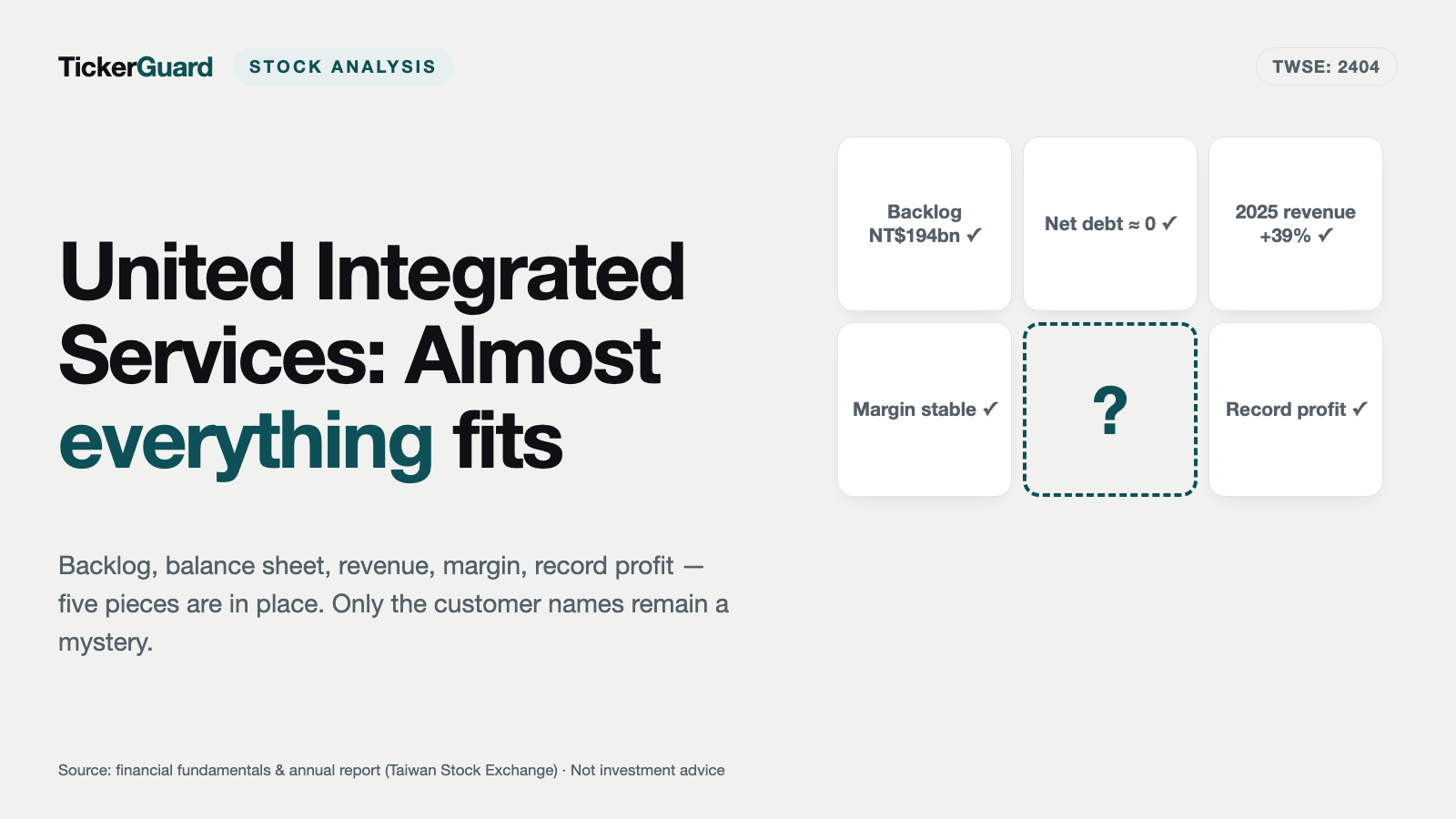
If you can't tell whether TSMC or Micron will still be printing money in 2029, you could always invest in the company that builds the cleanrooms for both — or so the quiet logic behind many "picks-and-shovels" bets on the chip boom goes. United Integrated Services (TWSE: 2404) from New Taipei City is exactly that kind of supplier: revenue grew 39 percent in 2025 to TWD 66.09 billion (roughly €1.80 billion), the order backlog stands at about TWD 194 billion, and the balance sheet is essentially debt-free. The catch: more than 90 percent of that revenue comes from the semiconductor industry, and more than 90 percent of that in turn from just three customers. We read the annual reports to see how safe this "shovel" really is. No buy or sell recommendation.
 Thomas Mücke
Founder & Publisher
Thomas Mücke
Founder & Publisher
There is a favorite piece of wisdom among stock pickers that traces back to the California gold rush: if you cannot tell which prospector will strike it rich, you can still make money reliably by selling shovels to all of them. That "picks-and-shovels" logic has a catch many investors overlook: a shovel factory with only three prospectors as customers is not automatically safer than the goldfield itself — it just carries its own concentration risk, hidden behind an apparently neutral infrastructure role. That is exactly the case with United Integrated Services from Taiwan: the company builds the cleanrooms and building systems in which TSMC and other chipmakers manufacture their chips — it never acts as a chipmaker itself, which makes it look "neutral" toward the ups and downs of any single chip cycle. Read the annual reports, though, and you find a customer concentration as high as at some chipmakers themselves — it just gets far less public attention, because "construction company for the chip industry" sounds like a diversified, boring old-economy stock.
This analysis is journalistic interpretation of publicly available information from United Integrated Services' annual reports, conference summaries and fundamental data — not investment advice. All figures are evergreen and carry their own as-of date; the TWD 1,060 price serves only as a valuation anchor from August 31, 2026.
What United Integrated Services Actually Does
Before a chip fab can produce its first wafer, someone has to build a room that is practically free of dust — ISO Class 1 cleanroom or better, where a single speck of dust can ruin an entire chip. On top of that come piping systems for ultrapure water, specialty gases, chemicals and exhaust; climate control that holds temperature and humidity constant to a fraction of a degree; and power systems that can never fail. That is exactly what United Integrated Services (漢唐集成股份有限公司, TWSE: 2404), headquartered in Zhonghe, New Taipei City, builds: cleanrooms, electrical and HVAC systems, water and gas supply, and monitoring systems for semiconductor and optoelectronics fabs — as a general contractor delivering the complete building-systems package, not just a single trade. The company was founded in September 1982 with initial capital of TWD 5.1 million, as its own capital-stock table in the 2025 annual report shows — today paid-in capital stands at TWD 1.91 billion.
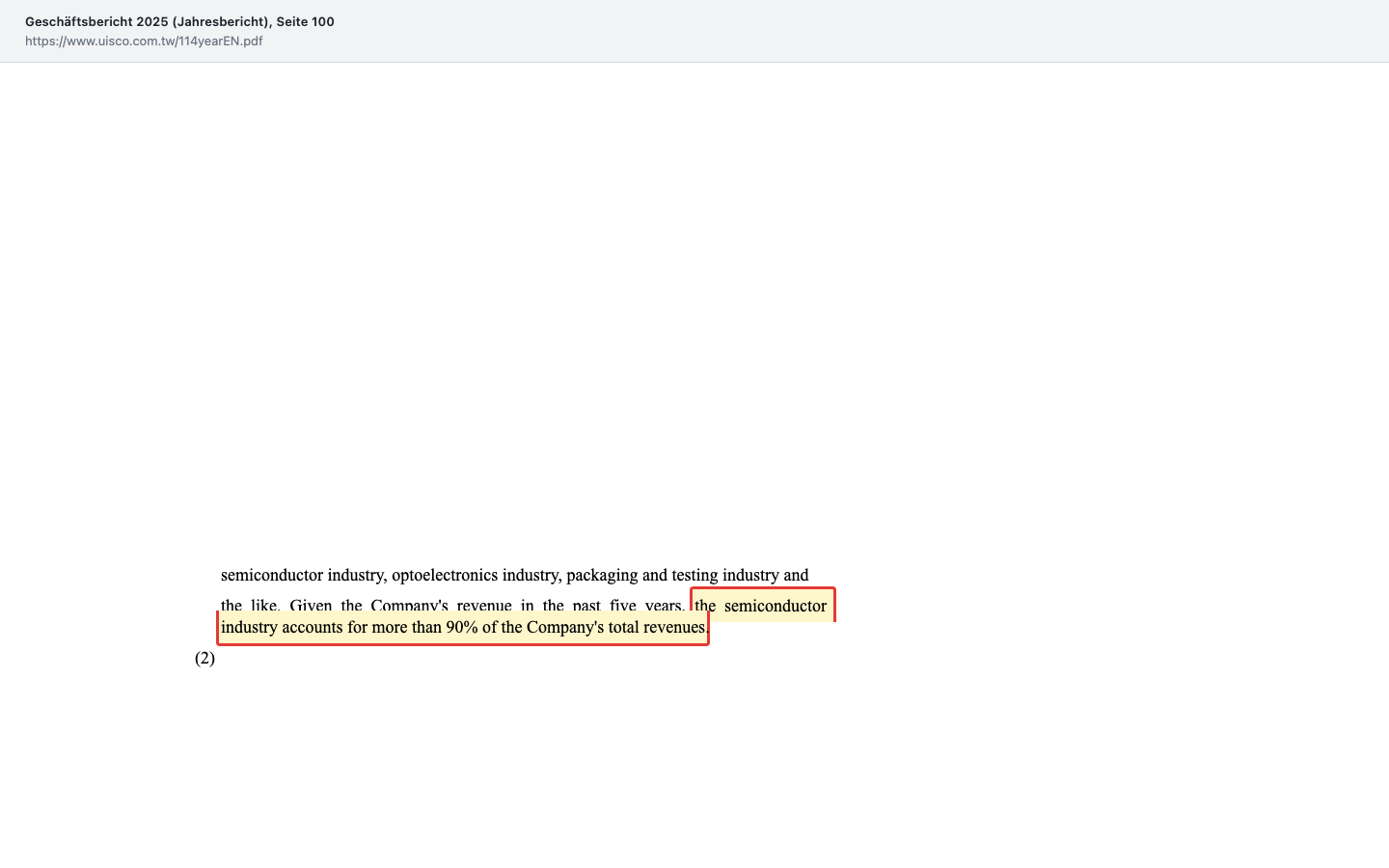
Just how concentrated the business has become on a single industry is stated plainly in the company's own annual report:
"Given the Company's revenue in the past five years, the semiconductor industry accounts for more than 90% of the Company's total revenues."
— United Integrated Services Co., Ltd., 2025 Annual Report, page 100
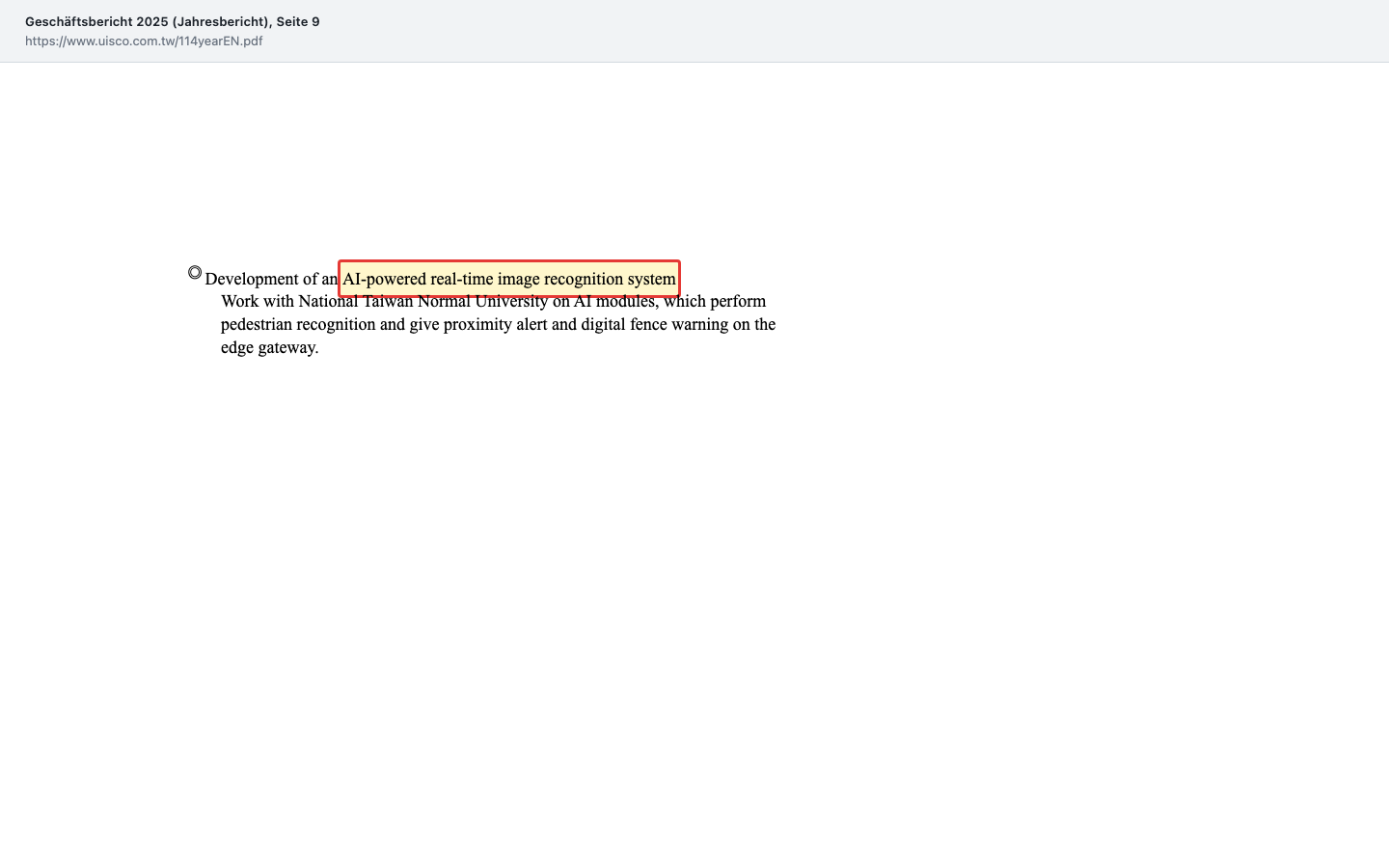
One side note before the numbers: United Integrated Services is not itself an artificial-intelligence vendor — the company benefits from its customers building AI chips, but it does not sell AI software or hardware. One exception appears word-for-word in two consecutive annual reports: as part of a minor wireless home-security side business, the company is developing an AI-powered image recognition module together with National Taiwan Normal University.
Company history for investors
-
1982
Founded in Taiwan
United Integrated Services is founded in September 1982 with initial capital of TWD 5.1 million — the starting point of today's cleanroom and building-systems business for semiconductor fabs.
-
2023
First record year of the current boom
Revenue reaches a then-record TWD 68.89 billion, driven by expansion of Taiwanese semiconductor fabs.
-
2024
Revenue dip despite profit growth
Revenue falls 31.2 percent to TWD 47.42 billion as a large project winds down — net profit rises 33 percent that same year.
-
2025
Recovery and record customer concentration
Revenue recovers 39.4 percent to TWD 66.09 billion; three unnamed customers together account for 91.82 percent of it.
-
2026
US share overtakes Taiwan, order backlog hits a record
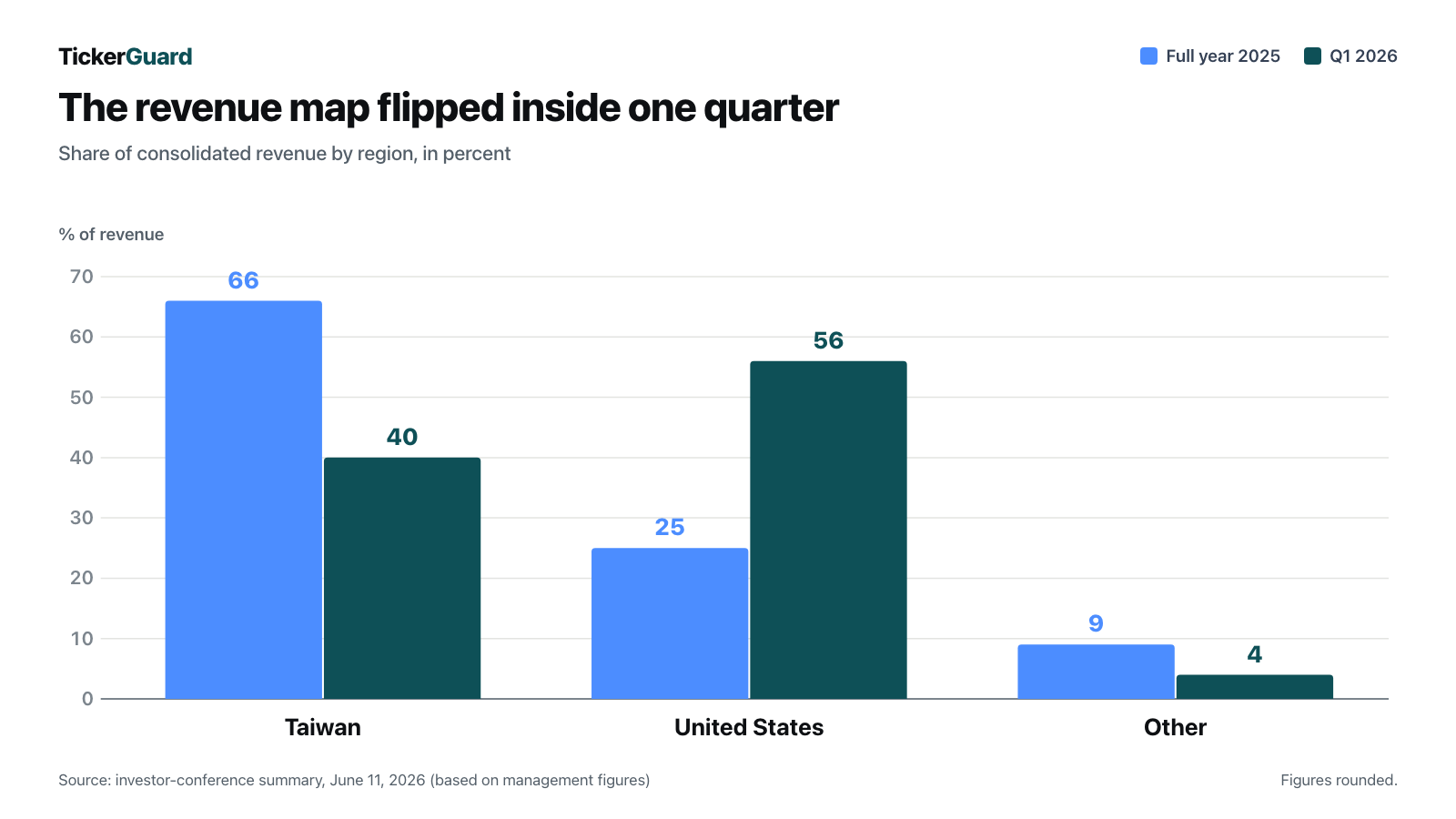
In the first quarter of 2026, the US revenue share (56 percent) overtakes Taiwan's (40 percent) for the first time; the order backlog reaches a record TWD 193.94 billion by the end of May.
Why This Stock Landed on Our Desk
The reason for this analysis is the construction story behind the construction story: while headlines about AI capacity expansion usually start with TSMC, Nvidia or the cloud giants themselves, the supplier that physically builds the buildings for it all remains almost invisible to the public — even though its numbers swing just as dramatically as the more famous names. That gap between media attention and the actual numbers is what led us to read United Integrated Services' annual reports rather than rely on a stock chart or forum chatter.
The Numbers Over the Years — Not a Straight Line
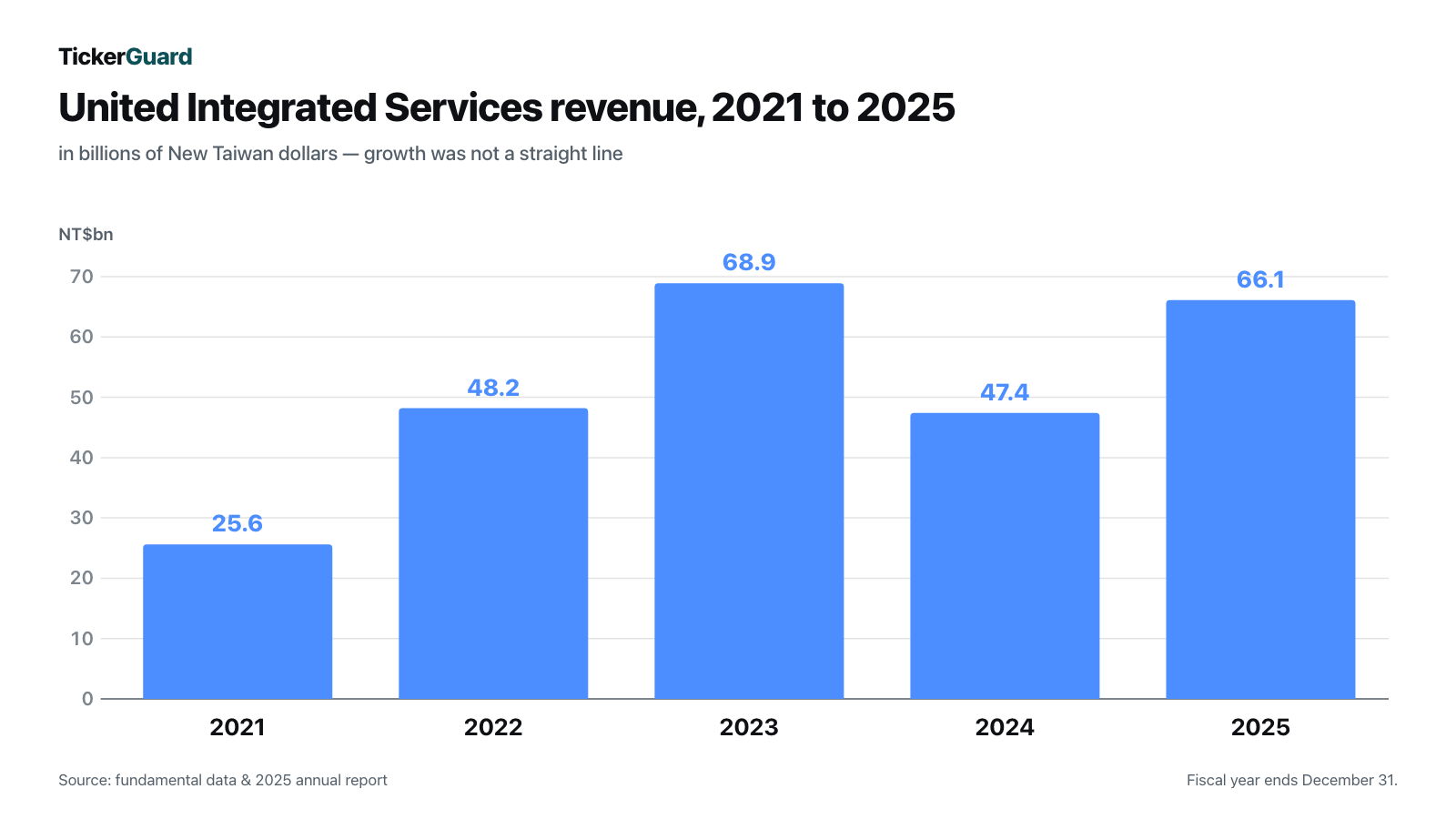
Anyone looking only at the last twelve months might assume United Integrated Services' revenue climbs steadily in lockstep with the chip boom. In reality it has been anything but linear: TWD 25.61 billion (2021), TWD 48.20 billion (2022), TWD 68.89 billion (2023), a drop to TWD 47.42 billion (2024, -31.2 percent), and finally a recovery to TWD 66.09 billion (2025, +39.4 percent) — roughly €1.80 billion or US$2.09 billion (exchange rates 2026-08-31/09-01: €1 ≈ TWD 36.76, US$1 ≈ TWD 31.65). The reason for this zigzag lies in the accounting method: as a general contractor, United Integrated Services recognizes revenue on a percentage-of-completion basis for individual large projects — when one project wraps up before the next has fully ramped up, a visible dent appears in annual revenue even though the underlying business has not actually shrunk.
Net profit tells an entirely different story: TWD 2.77 billion (2021), TWD 4.00 billion (2022), TWD 4.66 billion (2023), TWD 6.19 billion (2024) and TWD 9.07 billion (2025, +46.5 percent) — a new record every single year, including the year revenue fell. Operating margin (operating income as a share of revenue) reached 16.6 percent in 2025, up from 14.5 percent in 2024 — evidence that profitability tracks project utilization and the mix of active job sites more closely than raw revenue volume. The first half of 2026 kept up the record pace: TWD 46.37 billion in revenue (TWD 20.29 billion in Q1 plus TWD 26.08 billion in Q2) and earnings per share of TWD 36.23 for the half — a record for a six-month period by the company's own account, up 102 percent from the prior-year half. July 2026 continued the trend: TWD 9.945 billion in monthly revenue (+63.8 percent versus July 2025), bringing the first seven months of 2026 to a cumulative TWD 56.30 billion (+73.9 percent).
What the Analyst Conference Shows — No Transcript, But Substance
An honest note upfront: our own database holds no verbatim transcripts of analyst conferences for United Integrated Services — a check as of 2026-09-01 found no entry. Instead, we reviewed two independent written summaries of the June 11, 2026 analyst conference (financial media outlets Fugle and BigGo Finance) plus a Taipei Times article from June 11, 2025 as a year-over-year comparison. That is weaker evidence than a verbatim transcript — we flag that deliberately rather than gloss over it.
The year-over-year comparison first shows that management delivers on what it promises: in June 2025, Chairwoman Belle Lee (李惠文) struck an optimistic tone for the second half of 2025, backed by already-confirmed orders; President Lai Chih-ming (賴志明) spoke of an accelerated Phase 2 expansion for a US customer and a doubling of the local workforce from 100 to 200 employees. The company delivered: 2025 revenue beat 2024 by 39.4 percent, and the dividend for fiscal 2025 rose to TWD 40 per share (from TWD 28 for fiscal 2024, when the payout ratio was around 85 percent).
A year later, at the June 11, 2026 conference, the tone had noticeably shifted — not negatively, but from pure growth optimism toward a more sober assessment of the company's own limits. Asked whether the 23.32 percent gross margin achieved in the first quarter of 2026 could be extrapolated, management explicitly said no: a "one-time cost adjustment on a US project" had flattered the first-quarter margin, and it should normalize going forward. Asked about the biggest constraint on growth, management pointed not to a lack of orders but to its own organizational capacity — specifically the labor shortage in Taiwan, which conference notes describe as now more severe than in the US. And asked how long the demand overhang would last, President Lai reportedly offered a "personal view": at least through 2029, citing plant operators' power-supply plans that, per later press reports, already extend to 2032. On the ongoing US expansion (project "P2"), management said construction progress stood above 50 percent, with a target of 80 to 90 percent by year-end 2026; a follow-on project ("P3") had not yet been formally awarded at the time of the conference but was expected as a repeat order from the same customer — later press reports indicate a decision could come before the end of 2026, at a scale comparable to P2. In short: for 2026, management no longer promises unbroken margin expansion, pointing instead to efficiency gains rather than price increases as its answer to pricing pressure from its own major customers — a noticeably more cautious tone than a year earlier, even as order volume remains high.
What the Filings Show — the Uncomfortable Truths
Uncomfortable Truth No. 1: 92 Percent of Revenue Rests on Three Customers Nobody Names
The 2025 annual report's "Major customers" section lists three customers that together accounted for 91.82 percent of consolidated revenue: "Customer A" at 40.96 percent (TWD 27.07 billion), "Customer B" at 25.44 percent and "Customer C" at 25.42 percent — each listed as an unrelated party.
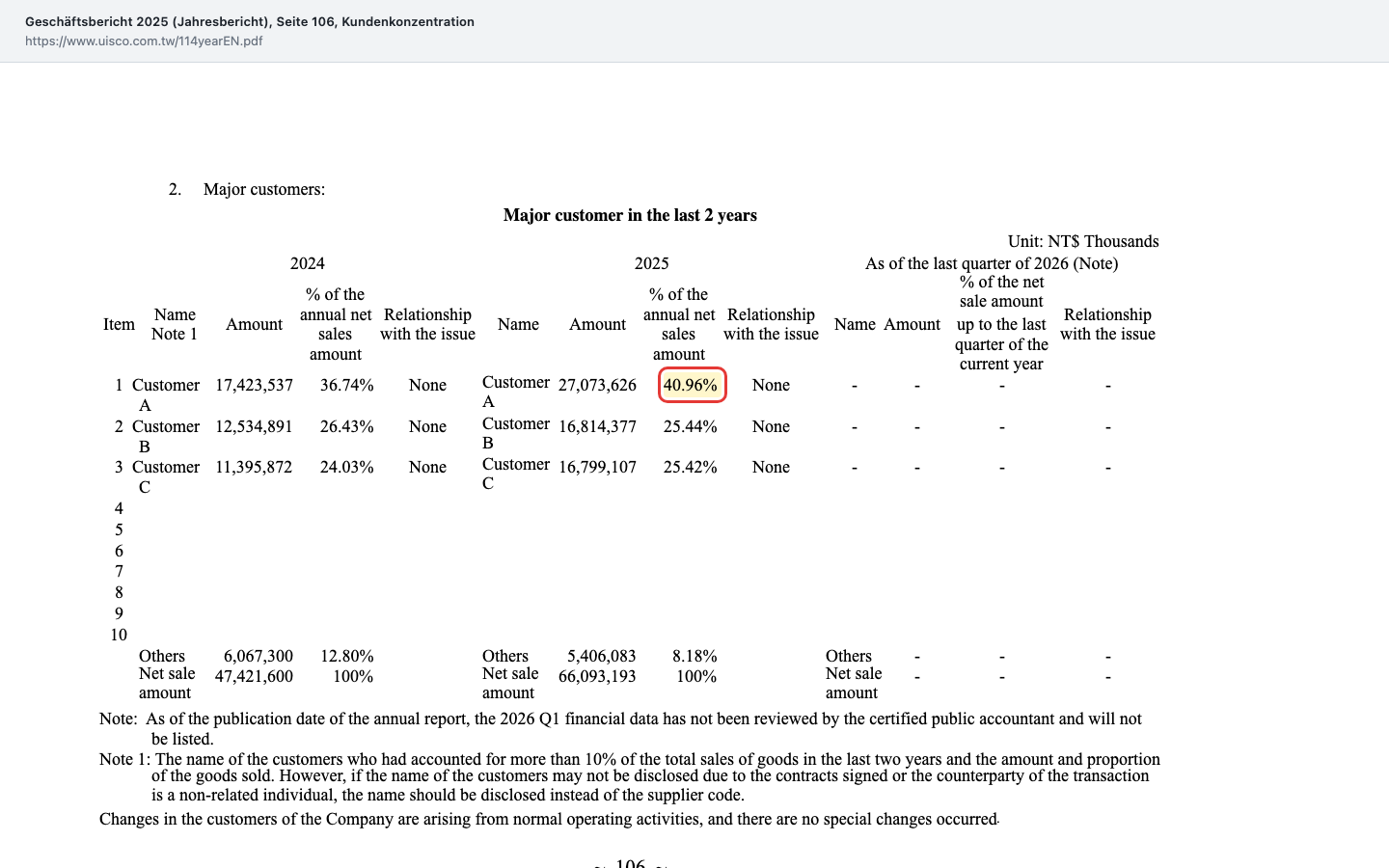
The company itself attributes the missing names to a contractual confidentiality exception — not unusual in Taiwan's construction supply chain for semiconductor customers. Independent press reports and investor-conference summaries identify TSMC and Micron Technology as major customers of United Integrated Services, but that does not let a reader map either name onto "A," "B," or "C." For readers, that means: should any one of these three unnamed major customers delay or cut its fab investments, it would show up immediately in United Integrated Services' order intake — without the public knowing in advance which customer was involved. That is the core of the "shovel-seller" illusion from the introduction: the construction supplier looks more neutral than the chipmaker itself, yet carries at least as much concentration risk.
Uncomfortable Truth No. 2: A 31 Percent Revenue Drop in 2024 Was Not a Crisis — But the Headline Number Alone Would Not Have Told You That
Anyone looking only at the 2024 revenue drop from TWD 68.89 billion to TWD 47.42 billion might have assumed a downturn. In fact, net profit rose 33 percent that very year, to TWD 6.19 billion. The reason lies in percentage-of-completion accounting: large projects are recognized over their construction period, and when one project winds down before a comparably sized new one ramps up at full speed, a visible dent appears in reported annual revenue — without the order base or profitability actually suffering. This quirk makes it risky to extrapolate a linear full-year forecast from any single strong or weak quarter — a warning management itself issued at the June 11, 2026 analyst conference, when it cautioned against extrapolating the first-quarter 2026 margin.
Uncomfortable Truth No. 3: Revenue Flipped From Taiwan to the US Within a Single Quarter — With All the Side Effects
For full-year 2025, 66 percent of revenue came from Taiwan and 25 percent from the US. By the first quarter of 2026, that ratio had reversed: 40 percent Taiwan, 56 percent US. Per management commentary at the June 11, 2026 conference, the US share could reach roughly half of consolidated revenue for full-year 2026 — driven by construction progress on a US customer's second expansion phase in Arizona.
Operationally, this is good news at first glance: more orders, higher utilization, a growth engine alongside a Taiwan business constrained by the labor shortage. For risk assessment, though, it also means US-dollar revenue instead of Taiwan-dollar revenue at a company that still reports in Taiwan dollars; US wage and construction-cost structures instead of Taiwanese ones; and growing exposure to US permitting processes, tariffs on imported construction materials and equipment, and the political durability of US semiconductor incentive programs. Management itself named inflation, rising wage costs and longer overseas construction timelines as risk factors at the June 11, 2026 conference — without quantifying them in detail.
Valuation — Moderate for a Company With a Record Backlog
With 188,886,700 shares outstanding and a price of TWD 1,060 (August 31, 2026), market capitalization works out to roughly TWD 200.2 billion — about US$6.33 billion or €5.45 billion (exchange rates 2026-08-31/09-01). Based on the last four reported quarters (Q3 2025 through Q2 2026), earnings per share come to roughly TWD 66.3, putting the P/E ratio at about 16.0. Revenue for the same four quarters totals TWD 86.16 billion, putting the price-to-sales ratio at roughly 2.3. Book value per share stood at roughly TWD 94.8 as of June 30, 2026, putting the price-to-book ratio at about 11.2. Per fundamental data (as of 2026-08-29), enterprise value is about TWD 161.9 billion (below market cap, because the net cash position comfortably exceeds the small amount of debt) and enterprise value to EBITDA is roughly 9.3.
For a company posting 39 percent revenue growth, a record order backlog of TWD 194 billion and an essentially debt-free balance sheet, these multiples look moderate rather than expensive — unlike some direct AI beneficiaries elsewhere in the same Taiwanese supply chain, such as test-handler maker Hon Precision, which we found trading at a P/E of roughly 64 in a separate analysis. Part of that comparatively modest valuation likely reflects the customer concentration and the volatile annual revenue recognition described above: the market is not pricing United Integrated Services like a pure AI growth stock, but like a cyclical construction group with an unusually strong, if concentrated, order book.
Opportunities and Risks at a Glance
Opportunities: An order backlog of roughly TWD 194 billion with visibility through at least 2028, per management backed by plant operators' power-supply plans extending to 2032; an essentially debt-free balance sheet with high net liquidity; a follow-on project ("P3") for the same major US customer expected to be decided in 2026, at a scale comparable to the current expansion; a moderate valuation compared with direct AI growth stocks; and a business model built over four decades that has already absorbed a 31 percent revenue decline (2024) without hurting profit or the dividend. Risks: Extreme, unverifiable customer concentration (three customers = 92 percent of 2025 revenue, largest single customer 41 percent); a self-acknowledged labor shortage that management itself calls the real constraint on growth, not a lack of orders; a margin that management itself has called "not extrapolatable" at the first-quarter 2026 level; a rapidly rising US revenue share carrying corresponding currency, tariff and permitting risk; and a fundamentally cyclical business whose annual revenue recognition can swing sharply depending on project timing.
A Human Conclusion
The "shovel-seller" bet sounds reassuring because it implies a comfortable distance from the actual risk: you do not need to know whether TSMC or Micron will still be ahead in five years, only that someone keeps building factories. United Integrated Services shows why that distance is smaller than it looks: the company has its own version of customer concentration, its own version of cycle risk, and now its own version of geopolitical risk, since more than half of quarterly revenue comes from the US. None of that makes the numbers automatically bad — quite the opposite: a record order backlog, a debt-free balance sheet and 39 percent revenue growth are real, documented facts. It just narrows the gap between "I'm out of the wind because I sell shovels instead of gold" and "I'm standing in the same wind, just wearing a different name tag" — a gap that looks wider at first glance at a construction company than it actually is. No buy or sell recommendation.
Sources
This analysis draws on: the 2025 annual report (dated 2026-03-31) and 2024 annual report (dated 2025-04-12) of United Integrated Services Co., Ltd.; the Q1 2026 consolidated financial statements; written summaries of the June 11, 2026 analyst conference (Fugle, BigGo Finance); a Taipei Times article from June 11, 2025; a press release on July 2026 monthly revenue; and fundamental data (balance sheet, income statement, cash flow, price and valuation metrics, as of 2026-08-29/09-01). No publicly available verbatim analyst-conference transcripts exist for 2404.TW. Note: this analysis is journalistic interpretation of publicly available information, not investment advice and not a buy or sell recommendation.
Our Bottom Line at a Glance
- Growth positive
- Revenue rose 39.4 percent in 2025 to TWD 66.09 billion, net profit 46.5 percent to TWD 9.07 billion — the fifth straight year of profit growth, including the year revenue fell. The first half of 2026 kept up the pace with EPS up 102 percent.
- Customer concentration negative
- Three unnamed customers accounted for a combined 91.82 percent of 2025 consolidated revenue, the largest alone for 40.96 percent. A demand shock at just one of them would show up immediately in order intake, without the public knowing which customer was involved.
- Balance sheet and liquidity positive
- Essentially debt-free: financial debt of just TWD 257.7 million against TWD 78.82 billion in total assets (2025-12-31). Cash and short-term investments of about TWD 53.55 billion exceed total financial debt more than two-hundredfold.
- Valuation positive
- At TWD 1,060 (2026-08-31) and trailing-four-quarter EPS of about TWD 66.3, the stock trades at a P/E of roughly 16.0 — moderate for a company with a record order backlog and 39 percent revenue growth, compared with direct AI growth stocks trading at high double- or triple-digit P/E ratios.
- Geographic and operational shift negative
- The US revenue share jumped from 25 percent (full-year 2025) to 56 percent (Q1 2026) — with corresponding currency, tariff and permitting risk. Management itself names the Taiwan labor shortage as the biggest constraint on growth and warns against extrapolating the Q1 2026 margin.
- Order backlog and visibility positive
- About TWD 193.94 billion in order backlog as of 2026-05-31 (record), with management-cited visibility through at least 2028, backed by plant operators' power-supply plans extending to 2032.
United Integrated Services delivers what a supplier to the semiconductor construction boom promises: 39 percent revenue growth in 2025, a record order backlog of roughly TWD 194 billion, and an essentially debt-free balance sheet — at a valuation that looks moderate for those growth rates (P/E around 16). But the apparent "safety" of a construction supplier is deceptive: 92 percent of 2025 revenue rests on three never-named major customers, management itself says the operating margin cannot be extrapolated, and the revenue base has shifted radically toward the US within a single quarter. Not investment advice.
What Our Rating Means
Open questions
The business works in principle, but one material question is open. As long as it stays open, our findings do not carry a quality verdict.
Yellow here is not about an existential question — the balance sheet is essentially debt-free, the order backlog stands at a record roughly TWD 194 billion, and the company has already absorbed a 31 percent revenue decline (2024) without profit or the dividend suffering. Yellow applies because two operational questions remain open that are central to whether the growth story holds up: first, 92 percent of 2025 revenue rests on three customers that no reviewed source names — a concentration that does not threaten the company's existence and is not a pricing argument, but ties the growth story to a small, unverifiable customer group. Second, management itself acknowledged at the June 11, 2026 analyst conference that the first-quarter 2026 margin was flattered by a one-time cost effect and should normalize, while at the same time naming its own labor shortage as a constraint on growth. The business model itself — cleanroom and building-systems engineering with documented order visibility through at least 2028 — clearly holds up; whether the customer base broadens and how the margin settles after normalization will show, at the earliest, in the Q3 2026 report.
A journalistic assessment by our editorial team at the time of the deep dive, based on public sources — not investment advice and not a solicitation to buy or sell. Your personal circumstances (investment goals, risk capacity, taxes) cannot be taken into account. What our levels mean, how verdicts are formed, and what conflicts of interest exist →
Worth Noting
- This analysis first appeared on 2026-09-01. All company figures come from the 2025 (2026-03-31) and 2024 (2025-04-12) annual reports and the Q1 2026 consolidated financial statements — not from press reports. Price, share count and valuation metrics are as of 2026-08-29 through 09-01; trailing-twelve-month EPS was summed by us from the four most recently reported quarters.
- No publicly available verbatim analyst-conference transcripts exist for 2404.TW (checked 2026-09-01: transcripts:sync returned 0 hits). The analyst-conference chapter therefore relies on two independent written summaries (Fugle, BigGo Finance) rather than a verbatim transcript.
- The Q2 2026 consolidated financial statements were not yet available as a PDF on uisco.com.tw as of 2026-09-01; the H1 2026 figures are independently confirmed by the board's 2026-08-12 announcement and by fundamental data.
The full analysis as a PDF for later
We will send you this analysis as a PDF — to print, file away, and read at your own pace.
Frequently Asked Questions
United Integrated Services (TWSE: 2404, 漢唐集成), headquartered in New Taipei City, Taiwan, builds cleanrooms and building systems — electrical, HVAC, water and gas supply, and monitoring systems — for semiconductor and optoelectronics fabs. The company is a general contractor, not a chipmaker itself, and was founded in September 1982.
Very: per the 2025 annual report, three anonymized customers "Customer A/B/C" together accounted for 91.82 percent of consolidated revenue in 2025, the largest alone for 40.96 percent. The report does not name any of the three; press reports identify TSMC and Micron Technology as major customers.
United Integrated Services is listed on the Taiwan Stock Exchange, not in the US — there is no SEC registration, no 10-K, no 10-Q. Instead it must file annual reports and quarterly financial statements, published on its own investor-relations site uisco.com.tw. This analysis relies on the 2025 and 2024 annual reports plus the Q1 2026 consolidated financial statements.
Not as a core business. The company benefits from its customers building semiconductor fabs for AI chips — it does not sell AI software or hardware itself. One exception: per the 2024 and 2025 annual reports, a minor wireless home-security side business includes development of an AI-powered image-recognition module with National Taiwan Normal University.
As a general contractor, the company recognizes revenue on a percentage-of-completion basis for individual large projects. Revenue fell 31.2 percent to TWD 47.42 billion in 2024 because one large project wound down before the next ramped up at full speed — net profit rose 33 percent that same year.
Per summaries of the June 11, 2026 analyst conference, the order backlog hit a record TWD 193.94 billion at the end of May 2026, with visibility through at least 2028. New contracts signed from January through May 2026 totaled about TWD 67.41 billion.
At a price of TWD 1,060 (August 31, 2026) and trailing-four-quarter earnings per share of roughly TWD 66.3, the stock trades at a P/E ratio of about 16.0 — moderate for a company with 39 percent revenue growth and a record order backlog.
Yes: for fiscal 2025, TWD 40 per share was distributed (ex-dividend date 2026-07-16), up from TWD 28 per share for fiscal 2024, when the payout ratio was around 85 percent.
Found an error?
Did you spot a factual error, an outdated number, or a typo in this deep dive? Let us know briefly — your report goes straight to the editorial team.