TSS, Inc.: The Shovel Seller in the AI Gold Rush Has Exactly One Prospector
In Georgetown, Texas, TSS assembles the server racks that carry the AI boom. Revenue climbed from $27.4 million in 2021 to $245.7 million in 2025 — one of the prettier growth curves a small Nasdaq company can put on a slide. The filings with the U.S. securities regulator, the SEC, carry the other half of the story: one U.S.-based IT OEM supplied 99 percent of revenue in the first half of 2026 and a full 100 percent of accounts receivable as of June 30, 2026. Operating income has barely moved since 2024, from $5.8 million to $6.3 million; the 2025 profit of $15.1 million includes $7.6 million of tax benefit; and the first half of 2026 burned cash while the income statement showed $3.7 million of profit. Not investment advice — just the question of what is left of a growth story when a single customer can pull the plug.
 Thomas Mücke
Founder & Publisher
Thomas Mücke
Founder & Publisher
As of Today
As of: October 6, 2026
- Closing price
- 10.40 $ +3.40%
- Market Capitalisation
- 0.3 $B
- P/E
- 20.5
- Growth Score
- 5/10
- AAQS
- 3/10
Price change since August 21, 2026: +18.9%
This analysis has a cut-off date. The Stock Guard tells you when something material changes in the numbers. Reserve your free spot
Chart
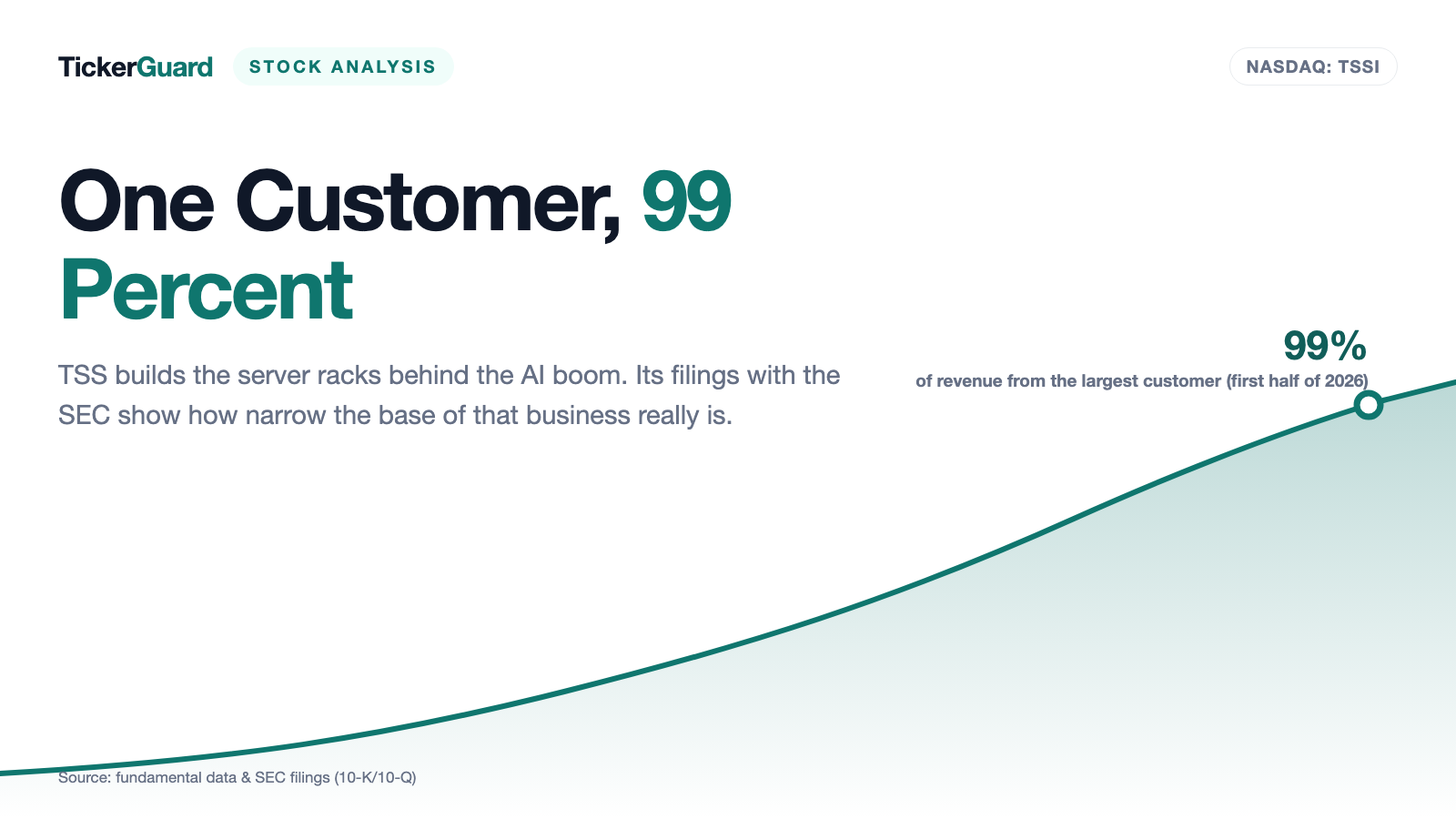
Interactive price chart (TradingView).
52-week range: 6.90 $ to 20.40 $ · Last price: 10.40 $ (As of: October 6, 2026)
Note: pure fact-based analysis, not investment advice and not a solicitation to buy or sell. All figures without guarantee.
The shovel-seller trap
There is a line that shows up in every investing forum the moment a boom breaks out somewhere: in a gold rush, it was not the prospectors who got rich, it was the people selling shovels. The line feels shrewd. It lets us ride the trend without taking the bet. We are not buying the risk — we are buying the tools.
The line has a blind spot. A shovel seller does well because many prospectors buy from him. Sell to exactly one prospector and you are no longer a merchant. You are an employee holding a stock certificate, and your boss can let you go without you ever resigning.
That is the question at TSS, Inc. of Georgetown, Texas. The company assembles the server racks that run the world's AI data centers. Its revenue has grown almost ninefold since 2021. And in the first half of 2026, 99 percent of that revenue came from a single customer. Let us read the filings with the U.S. securities regulator, the SEC, together — not to talk the stock down, but to see what is actually written there.
Company history for investors
-
2005
Public listing as an acquisition shell
On July 15, 2005 Fortress America Acquisition Corp. went public — a shell hunting for a business. Anyone buying TSSI today buys a company that has changed its name twice.
-
2024
Long-term agreement on AI racks
In October 2024 TSS signed a multi-year agreement with minimum volumes with its largest customer. That was the starting gun for the revenue doubling — and for the dependency.
-
2025
Move into the fitted-out Georgetown hall
Production moved to Georgetown, Texas in May 2025. Through mid-2026 roughly $48 million went into power and cooling — inside a building TSS only leases.
-
2025
Share sale raises $55.3 million net
In August 2025 TSS placed 3,450,000 new shares. For existing holders that meant dilution; for the company it meant a cash balance that reached $85.5 million by year end.
-
2025
Contract extension and tax entry
The master agreement was extended by two years in December 2025. TSS then released its valuation allowance on deferred taxes — $7.6 million of benefit, without a dollar of cash.
-
2026
Warehouse operation for the same customer
Since May 1, 2026 TSS has run the previously idle Round Rock hall as a warehouse for its largest customer, contracted through March 31, 2029. A second leg — with the same client.
-
2026
Half-year figures: revenue down 37 percent
On August 13, 2026 TSS reported $90.5 million of first-half revenue and $3.7 million of profit — with $7.3 million of operating cash outflow. Cash fell $17.8 million in six months.
What TSS actually does — the workbench behind the AI racks
TSS earns money in three business lines, and they differ more than the shared company name suggests.
Systems integration is the heart of the business and the reason for the market's interest. An AI server rack is not furniture you unbox and switch on. It weighs as much as a small car, draws as much power as a city block and often has to be liquid cooled. Someone has to build the components into the cabinet, cable it, test it and prepare it for shipment before it rolls into a data center. That is the work TSS does, in a hall purpose-built for it. In 2025 the line brought in $40.4 million of revenue, up 78 percent.
Procurement is the largest and least glamorous line. TSS buys hardware, software and third-party services on behalf of its customers and passes them through. In 2025 that meant $197.5 million of revenue, 80 percent of the company total. The catch sits in the annual report on Form 10-K: because most of it is pass-through, very little sticks. A good share of the business ultimately traces to U.S. federal government buying, whose fiscal year ends September 30 — which makes quarters lumpy.
Facilities management is the small, high-margin remainder: maintaining and operating data center infrastructure, roughly $7.8 million of revenue in 2025. Gross margin here ran at 60 percent in 2025, against 31 percent in systems integration.
One detail is necessary to read the revenue figures correctly. The expensive components TSS installs in the AI racks do not belong to TSS. The annual report says they are consigned. They appear neither in revenue nor on the balance sheet. TSS sells only the labor. That is honest accounting, and it explains why a company with $245.7 million of revenue needs just 286 permanent employees (as of December 31, 2025, plus roughly 64 temporary workers).
How this stock reached our desk
TSSI landed on the research list through our in-house Reddit hype scanner, flagged on August 22, 2026. Forum attention is not an argument for or against a stock. It is a reason to go and read, and we claim nothing more for it here.
What the market data shows: market value stood at roughly $248 million as of August 22, 2026, with a 52-week range between $6.87 and $21.77. High to low across those twelve months is therefore a factor of three — the kind of swing you would expect from a name with 28.2 million shares outstanding. One figure stands out: 3,962,476 shares were sold short, roughly 14 percent of all 28.2 million shares outstanding (as of August 22, 2026). So there is a group betting on a decline and a group in the forum betting the other way. Neither tells us anything about the business. Which is why we now read the filings.
The numbers over the years — honestly credited
Start with what genuinely impresses, and that is not a small thing.
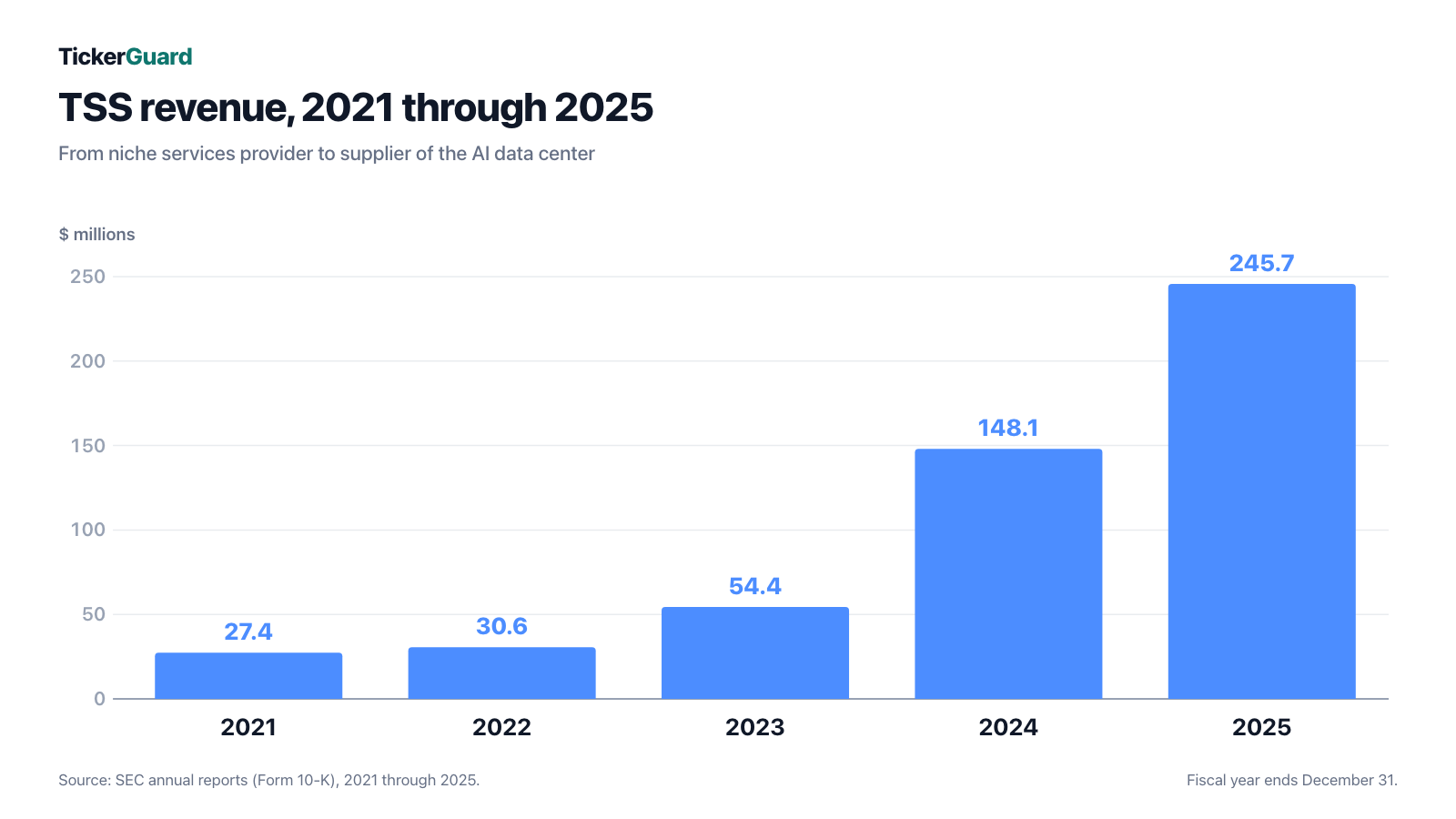
That curve is real and it is earned. In 2021 TSS was a niche services provider with $27.4 million of revenue that had barely grown for years. Then the AI wave arrived, and the niche provider became a supplier to what may be the largest capital investment cycle in the history of computing. Revenue doubled to $148.1 million in 2024 and added another 66 percent to reach $245.7 million in 2025.
The balance sheet improved noticeably over the same stretch. At June 30, 2026 total assets of $175.3 million stood against $95.0 million of liabilities, leaving $80.3 million of stockholders' equity. Interest-bearing bank debt is only $16.1 million — $4.2 million current and $11.9 million non-current. Cash held $67.7 million, plus $1.8 million of restricted cash pledged as collateral for a letter of credit with the electric utility. That is not a fragile balance sheet. The accumulated deficit from earlier years shrank from $45.2 million to $41.5 million.
And now the second curve, the one that has to be laid beside it.
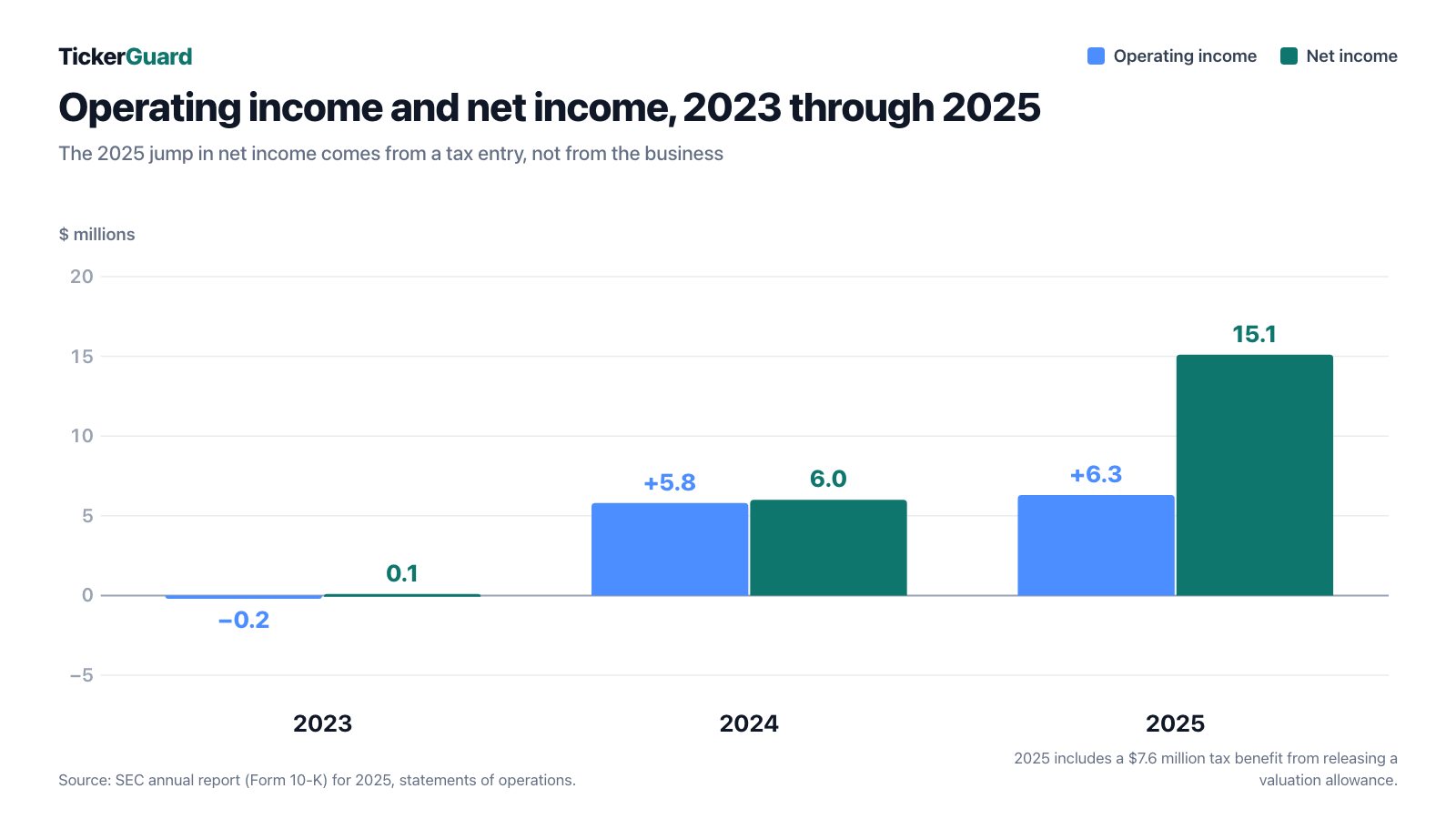
Revenue in 2025 rose by $97.6 million. Operating income rose by $0.556 million. Of every additional dollar of revenue, roughly half a cent survived as operating profit. That is not an accounting quibble; it is the core of the business model. The increase came mostly from procurement, where TSS passes goods through and collects a thin trading spread.
What the filings say — the uncomfortable truths
Four findings are written into the filings verbatim. We take them in order.
Uncomfortable truth no. 1: one customer, 99 percent — and 100 percent of receivables
The Form 10-Q for the quarter ended June 30, 2026 does not name the customer. It calls it a US-based IT OEM, an American maker of IT equipment. What it says about that customer is clear enough.
"No other customer represented more than 10% of our revenues for any period presented. Our US-based IT OEM customer represented 100% of our accounts receivable at June 30, 2026 and 98% at December 31, 2025."
— TSS, Inc., Form 10-Q for the quarter ended June 30, 2026, note "Concentrations"

Elsewhere the report is blunter still: "We are economically dependent upon our relationship with a large US-based IT OEM." That is not boilerplate from a risk-factor list. It is a statement in the notes to the financial statements.
What does concentration mean in practice? All the eggs sit in one basket. As long as the basket is carried, everything is fine — and the numbers show it is being carried. But there is no second basket. No other customer reaches even 10 percent.
Uncomfortable truth no. 2: the 2025 profit jump came from the tax line
In 2025 TSS more than doubled net income from $6.0 million to $15.1 million. Read that line alone and you see a company that transformed its profitability. The annual report on Form 10-K explains where the jump came from.
"Our current year income tax benefit of $7.6 million is comprised of a $7.9 million increase in the net recorded deferred tax asset driven by the release of the valuation allowance, partially offset by $0.3 million of income tax expense related to the current period operations."
— TSS, Inc., Form 10-K for 2025, "Income tax expense"

In plain terms: TSS carried loss carryforwards from earlier years that can offset future taxes. As long as it was unclear whether profits would ever return, that benefit could not be carried on the balance sheet — it was written down through a valuation allowance. Once the profits arrived and the long-term agreement was extended in December 2025, management and auditors concluded it could be recognized. The entry lifts profit once by $7.6 million. Not a single dollar changes hands. The auditor flagged the judgment as a critical audit matter.
None of this is sleight of hand; it is standard practice under U.S. accounting rules. But it means the 2025 profit cannot be extrapolated. The comparable line is one level up — pre-tax income: $6.134 million in 2024 against $7.533 million in 2025, up 23 percent while revenue grew 66 percent.
Uncomfortable truth no. 3: the factory is leased, the risk belongs to TSS
To build the AI racks, TSS fitted out a hall in Georgetown, Texas with power and cooling that no ordinary industrial building carries. Through June 30, 2026 that cost roughly $48 million. TSS does not own the hall; it leases it. The quarterly report describes what happens if the customer relationship ends.
"Our customer could terminate the agreement if we were to materially breach the agreement, leaving us with the financial obligations of the lease and debt service regardless of whether we had revenues sufficient to cover those costs."
— TSS, Inc., Form 10-Q for the quarter ended June 30, 2026, management's discussion
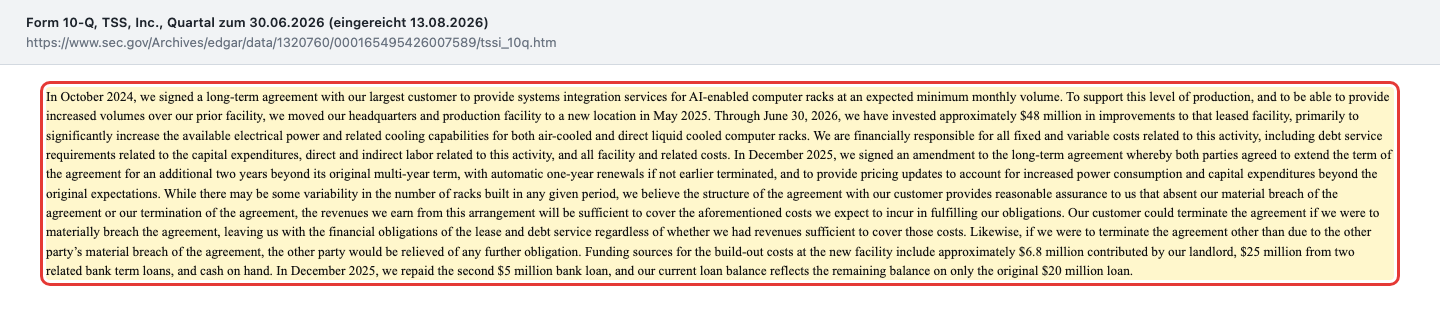
The other side of the ledger deserves equal weight. The agreement was extended by two years in December 2025, with automatic one-year renewals, and it provides for fixed monthly payments that TSS believes cover the majority of facility and debt service costs. If the customer terminates for convenience, the 2025 annual report states it remains obligated to pay the fixed monthly charge and only the minimum volume commitments fall away. That is materially better protection than the sentence above suggests on its own.
What remains is the structure. TSS carries $22.7 million of lease liabilities (June 30, 2026), $16.1 million of bank debt and $45.9 million of property and equipment — assets worth considerably less outside this one customer relationship. On top come fixed power charges of roughly $192,000 per month (per the 2025 annual report), incurred whatever the rack volume.
Uncomfortable truth no. 4: profit booked, cash gone
In the first half of 2026 TSS reported $3.7 million of net income. Over the same period, operating activities consumed cash.
"The $16.0 million year-to-date net decrease in cash and cash equivalents was primarily attributable to a net use of $7.3 million in operating activities, reflecting largely the $3.7 million net income, net of $11.0 million of cash related to paydowns of our accounts payable, increased inventory purchases, and the reduction of our deferred revenues period-over-period."
— TSS, Inc., Form 10-Q for the quarter ended June 30, 2026, "Liquidity and Capital Resources"

A half year of negative operating cash flow is no alarm bell in a project business — 2023 already showed minus $8.3 million, and 2025 then delivered plus $34.9 million. But the direction is unmistakable: cash fell from $85.5 million to $67.7 million. The $17.8 million gap is $1.8 million wider than the $16.0 million quoted above — exactly the amount set aside as restricted cash for the letter of credit, which therefore no longer counts as free cash. To understand the mechanism, look at deferred revenues, which dropped from $13.9 million to $2.8 million. Advances that filled the till a year ago have now been worked off.
The revenue side belongs to the same half year: $90.5 million against $142.9 million a year earlier, down 37 percent. The reason is explainable and partly deliberate. Low-margin procurement fell 53 percent to $58.2 million, while systems integration grew 65 percent to $28.0 million and facilities management 44 percent to $4.0 million. Gross profit therefore held at $16.8 million, up 2 percent. Still, a 37 percent revenue decline is a 37 percent revenue decline, and anyone buying the stock as a pure AI growth story should know about it. For 2026 the company reaffirmed, in its press release of August 13, 2026, adjusted EBITDA at the upper end of a $20 million to $22 million range.
Valuation: a little over one year of sales
Let us set the orders of magnitude — without a daily price, which will be a different number the day after publication anyway.
At roughly $248 million of market value (as of August 22, 2026) and $193.3 million of trailing twelve-month revenue, the price-to-sales ratio is about 1.3. For a services business with a single-digit operating margin that is not a demanding number, and it sits well below what the large names of AI infrastructure cost. Strip out net cash ($67.7 million against $16.1 million of bank debt at June 30, 2026) and enterprise value comes to roughly $196 million, a little over one year of sales.
The price-to-earnings ratio is trickier. Arithmetically it stands just under 17, based on trailing twelve-month earnings of $0.52 per share. That figure still contains the fourth quarter of 2025 with its tax benefit. Take the first half of 2026 instead ($0.13 per diluted share) and annualize it, and you arrive at roughly $0.26 of annual earnings and a multiple near 34. Both numbers are correct; they simply answer different questions. Price to book stands at roughly 3.1, on a book value of $2.80 per share.
The professional view is thin and bullish: two analysts cover the name, both with buy recommendations and an average price target of $16.50 (as of August 22, 2026). With two voices, a consensus is above all one thing — a small sample. Readers who want a broadly covered company from the same AI supply chain as a yardstick will find one in our Nvidia stock analysis; that is the other side of the same arithmetic.
Upside and risks at a glance
What speaks for TSS:
- Revenue grew from $27.4 million in 2021 to $245.7 million in 2025 — the company sits at a point in the AI supply chain where real building happens.
- The shift toward higher-margin work is measurable: systems integration grew 65 percent to $28.0 million in the first half of 2026 and facilities management 44 percent to $4.0 million, holding gross profit flat despite a 37 percent revenue decline.
- The balance sheet carries: $80.3 million of equity, $67.7 million of cash and only $16.1 million of bank debt at June 30, 2026, with all credit covenants met at the balance sheet date.
- The long-term agreement was extended by two years in December 2025 and repriced for higher power consumption; it provides for fixed monthly payments and minimum volumes.
- A second leg with the same customer is forming: since May 1, 2026 TSS has been running a warehouse for it in the previously idle Round Rock hall, contracted through March 31, 2029.
What speaks against it:
- 99 percent of revenue and 100 percent of accounts receivable come from one customer (Form 10-Q for the quarter ended June 30, 2026). The filing itself uses the words economically dependent.
- Operating income is flat: $5.766 million in 2024 against $6.322 million in 2025, on $97.6 million more revenue.
- The 2025 net income contains $7.6 million of tax benefit that will not repeat.
- The first half of 2026 consumed $7.3 million of operating cash; cash fell $17.8 million and deferred revenues by 80 percent.
- Roughly $48 million is sunk into a leased hall, alongside $22.7 million of lease liabilities and fixed power charges of about $192,000 per month — costs that accrue with or without orders.
- Under the existing shelf registration TSS could raise a further $94.3 million without a new authorization — roughly 38 percent of market value.
- A good share of the procurement business depends on U.S. federal budgets; shutdowns push orders around.
A human conclusion
Back to where we started. The shovel seller in the gold rush is a good image precisely because he does not need to know who finds the gold. He sells to everyone. His risk is spread without him having to do anything about it.
TSS is that shovel seller — with exactly one customer. The workshop is good, the work is in demand, the client is solvent and contractually committed. But the $48 million sitting in that leased hall was spent for this client and no other. That is not diversification. It is a marriage without a prenuptial agreement, in which one partner built the house and the other pays the rent.
Then comes the second trap this kind of story sets. You look at the revenue curve and infer the profit curve. At TSS the two diverge. An extra $97.6 million of revenue produced an extra $0.556 million of operating income. The handsome 2025 net income owes half of itself to a tax entry that will not repeat. And in the first half of 2026, a booked profit of $3.7 million came with $7.3 million of cash going out the door.
None of this makes TSS a bad company. The balance sheet is healthy, the business is profitable, the shift toward higher-margin work is visible in the numbers. It simply makes the stock something other than the label "AI infrastructure" promises: a bet on a single business relationship, wrapped in a growth story.
Anyone willing to take that bet should see it for what it is — and keep an eye on the one number everything hangs on: the largest customer's share in the next quarterly report. What you make of that is your decision. And that is exactly as it should be.
Sources
- TSS, Inc., Form 10-Q for the quarter ended June 30, 2026 (filed August 13, 2026) — balance sheet, statements of operations, notes "Concentrations" and "Non-recourse factoring", management's discussion
- TSS, Inc., Form 10-Q/A for the quarter ended June 30, 2026 (filed August 14, 2026) — amendment solely to complete the iXBRL tagging, with no change to substantive content
- TSS, Inc., Form 10-K for 2025 (filed March 18, 2026) — business description, segments, income tax note, report of the independent auditor
- TSS, Inc., Form 8-K of August 13, 2026 with the second-quarter 2026 press release (Exhibit 99.1) — segment figures, adjusted EBITDA, 2026 outlook
- SEC submissions file for CIK 0001320760 — listing venue, former names, complete filing history
- Price, valuation and market data: source: fundamental data & SEC filings (annual and quarterly reports, 10-K/10-Q), as of August 22, 2026
Disclosure: This article is journalistic analysis of publicly available company filings. It is expressly not investment advice and not a solicitation to buy or sell securities. Shares of small companies can move sharply; a total loss of invested capital is possible. Positions held by the operator are disclosed daily; where one exists, it appears as a notice at the top of this deep dive. at the time of publication. All figures come from the sources named above and carry the as-of date stated there.
Key figures at a glance
All monetary figures in millions of $; earnings per share as reported.
| Metric | 2021 | 2022 | 2023 | 2024 | 2025 |
|---|---|---|---|---|---|
| Revenue | 27.4 | 30.6 | 54.4 | 148.1 | 245.7 |
| Operating Income (EBIT) | -0.8 | 0.9 | 1.8 | 8.5 | 10.6 |
| Net Income | -1.3 | -0.1 | 0.1 | 6.0 | 15.1 |
| Net Margin | -4.7% | -0.2% | 0.1% | 4.0% | 6.2% |
| Earnings Per Share | -0.07 $ | 0.00 $ | 0.00 $ | 0.24 $ | 0.61 $ |
Source: fundamental data & SEC filings (annual and quarterly reports, 10-K/10-Q)
Our Bottom Line at a Glance
- Growth positive
- Revenue rose from $27.4 million in 2021 through $54.4 million (2023) and $148.1 million (2024) to $245.7 million in 2025, up 66 percent in 2025 alone. In the first half of 2026 the higher-margin systems integration line grew 65 percent to $28.0 million and facilities management 44 percent to $4.0 million, while total revenue fell 37 percent to $90.5 million on the procurement decline.
- Earnings power negative
- Operating income in 2025 moved only from $5.766 million to $6.322 million even though revenue added $97.6 million. The reported net income of $15.125 million contains $7.6 million of tax benefit from releasing a valuation allowance — per the Form 10-K for 2025 a non-cash entry that the independent auditor treated as a critical audit matter.
- Customer base negative
- A single U.S.-based IT OEM supplied 99 percent of quarterly revenue and 100 percent of accounts receivable per the Form 10-Q for the quarter ended June 30, 2026 (December 31, 2025: 98 percent). No other customer reached 10 percent. The filing expressly calls TSS economically dependent on that relationship, and roughly $48 million of build-out cost plus $22.7 million of lease liabilities are tailored to it.
- Balance sheet positive
- At June 30, 2026 total assets of $175.3 million stood against $95.0 million of liabilities, leaving equity of $80.3 million. Interest-bearing bank debt was only $16.1 million against $67.7 million of cash and $1.8 million of restricted cash. All credit covenants were met at the balance sheet date, and the filings contain no going-concern qualification.
- Cash flow neutral
- The first half of 2026 consumed $7.3 million of operating cash while reporting $3.7 million of net income; cash fell from $85.5 million to $67.7 million. The Form 10-Q attributes this to paying down accounts payable, higher inventory purchases and a drop in deferred revenues from $13.9 million to $2.8 million. In 2025 that same line helped deliver an inflow of $34.9 million — the pattern swings with the project business.
- Capital structure neutral
- Shares outstanding rose from 27,593,000 at December 31, 2025 to 28,219,070 at August 7, 2026, against 49,000,000 authorized. Under its effective shelf registration TSS could raise a further $94.3 million without new authorization — roughly 38 percent of market value as of August 22, 2026. The instrument was last used in August 2025 for $55.3 million net. There is no dividend.
TSS occupies a genuine position in the AI supply chain and lifted revenue from $27.4 million in 2021 to $245.7 million in 2025. The balance sheet is sound, the company is profitable, and the shift toward higher-margin work is measurable in the first-half 2026 numbers. Against that stand three documented findings: 99 percent of revenue and 100 percent of receivables come from one customer, operating income stalled in 2025 despite $97.6 million more revenue, and that year's net income contains $7.6 million of one-time tax benefit. Not investment advice.
What Our Rating Means
Substance risk
We found at least one documented issue that threatens the company itself — regardless of how the stock is currently valued.
The red light here does not stand for a shaky balance sheet — that one is healthy — but for a single documented dependency: 99 percent of revenue and, as of June 30, 2026, a full 100 percent of accounts receivable come from one customer, and the quarterly report itself calls TSS economically dependent on that relationship. Roughly $48 million sits in a leased hall fitted out for that one client, alongside $22.7 million of lease liabilities and fixed power charges of about $192,000 per month. If the relationship ends, those obligations remain — and there is no second customer above the 10 percent threshold to absorb them. That is an existential dependency on one counterparty, and our rules take the more cautious level in case of doubt. The verdict judges the company, not the share price: at a price-to-sales ratio near 1.3 the stock is not expensive, and an extended master agreement with minimum volumes is meaningful protection. The decision is yours.
A journalistic assessment by our editorial team at the time of the deep dive, based on public sources — not investment advice and not a solicitation to buy or sell. Your personal circumstances (investment goals, risk capacity, taxes) cannot be taken into account. What our levels mean, how verdicts are formed, and what conflicts of interest exist →
Worth Noting
- TSSI reached the research list through our in-house Reddit hype scanner, flagged on August 22, 2026. Forum attention is a reason to go and read, not an argument; this analysis rests solely on the filings with the U.S. securities regulator, the SEC.
- As-of dates: annual figures from the Form 10-K for 2025 (filed March 18, 2026), interim figures from the Form 10-Q for the quarter ended June 30, 2026 (filed August 13, 2026), share count from that filing's cover page (August 7, 2026), price and market data as of August 22, 2026. The Form 10-Q/A of August 14, 2026 concerns only the iXBRL tagging and changes no figure.
- Do not confuse the company: today's TSS, Inc. was named Fortress America Acquisition Corp. until 2007 and Fortress International Group, Inc. until 2013. It is unrelated to similarly named investment firms or to software companies trading as TSS in other markets. CIK 0001320760 is the identifier that governs.
- The adjusted EBITDA the company reports is not a measure defined under U.S. GAAP. It excludes, among other items, interest, taxes, depreciation, stock-based compensation and bank factoring fees, and is therefore not comparable to operating income.
Stock Watch
This analysis is as of August 26, 2026. Stock Watch will tell you what's changed at TSSI since then.
Later $1 a month per stock — signing up is free, and you'll be the first to know when it launches.
The full analysis as a PDF for later
We will send you this analysis as a PDF — to print, file away, and read at your own pace. And we will add you to the free Stock Watch list for TSS, Inc. (TSSI), so you hear about it when something material in this analysis changes.
Frequently Asked Questions
TSS is a data center services company based in Georgetown, Texas. It assembles complete server racks, tests them and prepares them for shipment — since 2024 mostly AI racks with air and liquid cooling. It also procures hardware and software on behalf of customers ($197.5 million of revenue in 2025) and operates data center infrastructure. As of December 31, 2025 the company had 286 full-time employees.
The Form 10-Q for the quarter ended June 30, 2026 reports that a single U.S.-based IT OEM supplied 99 percent of quarterly revenue and 100 percent of accounts receivable, up from 98 percent of receivables at December 31, 2025. No other customer reached 10 percent. The filing itself describes TSS as economically dependent on that relationship. If it ends, the rent, bank debt and fixed power costs of the purpose-built hall remain with TSS.
Revenue dropped from $142.9 million to $90.5 million, or 37 percent. Almost all of the decline came from low-margin procurement, down 53 percent to $58.2 million, which depends heavily on U.S. federal government buying. Systems integration grew 65 percent to $28.0 million over the same period and facilities management 44 percent to $4.0 million, so gross profit held nearly unchanged at $16.8 million.
Reported net income was $15.1 million. It contains a $7.6 million income tax benefit from releasing a valuation allowance on deferred tax assets — a one-time, non-cash entry. The comparable line is pre-tax income: $7.533 million in 2025 against $6.134 million in 2024. Operating income rose from $5.766 million to $6.322 million even though revenue added $97.6 million.
At June 30, 2026 total assets of $175.3 million stood against $95.0 million of liabilities, leaving $80.3 million of stockholders' equity. Cash held $67.7 million after $85.5 million six months earlier, plus $1.8 million of restricted cash. Interest-bearing bank debt is $16.1 million and lease liabilities $22.7 million. All debt covenants were met at the balance sheet date.
Yes. The Form 10-Q for the quarter ended June 30, 2026 cites remaining capacity of $94.3 million under its currently effective shelf registration statement — roughly 38 percent of market value as of August 22, 2026. The company last used the instrument in August 2025, selling 3,450,000 shares for $55.3 million net. Shares outstanding were 28,219,070 on August 7, 2026 against 49,000,000 authorized.
The SEC filings do not name it, describing it only as a US-based IT OEM, an American maker of IT equipment. TSS has integrated AI server racks for that customer since October 2024 under a master agreement with minimum volumes, and since May 2026 also provides warehousing and logistics through March 31, 2029. Who stands behind the label cannot be established from the filings, and we deliberately do not speculate.
No. The company was incorporated in Delaware in December 2004 and went public on July 15, 2005 as Fortress America Acquisition Corp., a shell formed to acquire a business. It was renamed Fortress International Group in 2007 and TSS, Inc. in 2013. The shares now trade on the Nasdaq Capital Market under the symbol TSSI (ISIN US87288V1017).
Found an error?
Did you spot a factual error, an outdated number, or a typo in this deep dive? Let us know briefly — your report goes straight to the editorial team.