TeamViewer Stock: €625 Million for an Acquisition That Delivered €45 Million in Revenue
TeamViewer sells software that lets companies operate and repair other people's computers from a distance. Revenue rose 49 percent between 2021 and 2025 to €746.8 million — while the customer count fell from 669,000 to 611,900. One acquisition cost €625.4 million and delivered exactly €44.8 million in revenue and a €21.6 million loss in 2025; goodwill on the balance sheet stands at €1,128.4 million against equity of €249.7 million. Not a buy or sell recommendation — just the question of who the June 30, 2026 balance sheet belongs to: the customers or the lenders.
 Thomas Mücke
Founder & Publisher
Thomas Mücke
Founder & Publisher
Chart
Interactive price chart (TradingView).
Note: pure fact-based analysis, not investment advice and not a solicitation to buy or sell. All figures without guarantee.
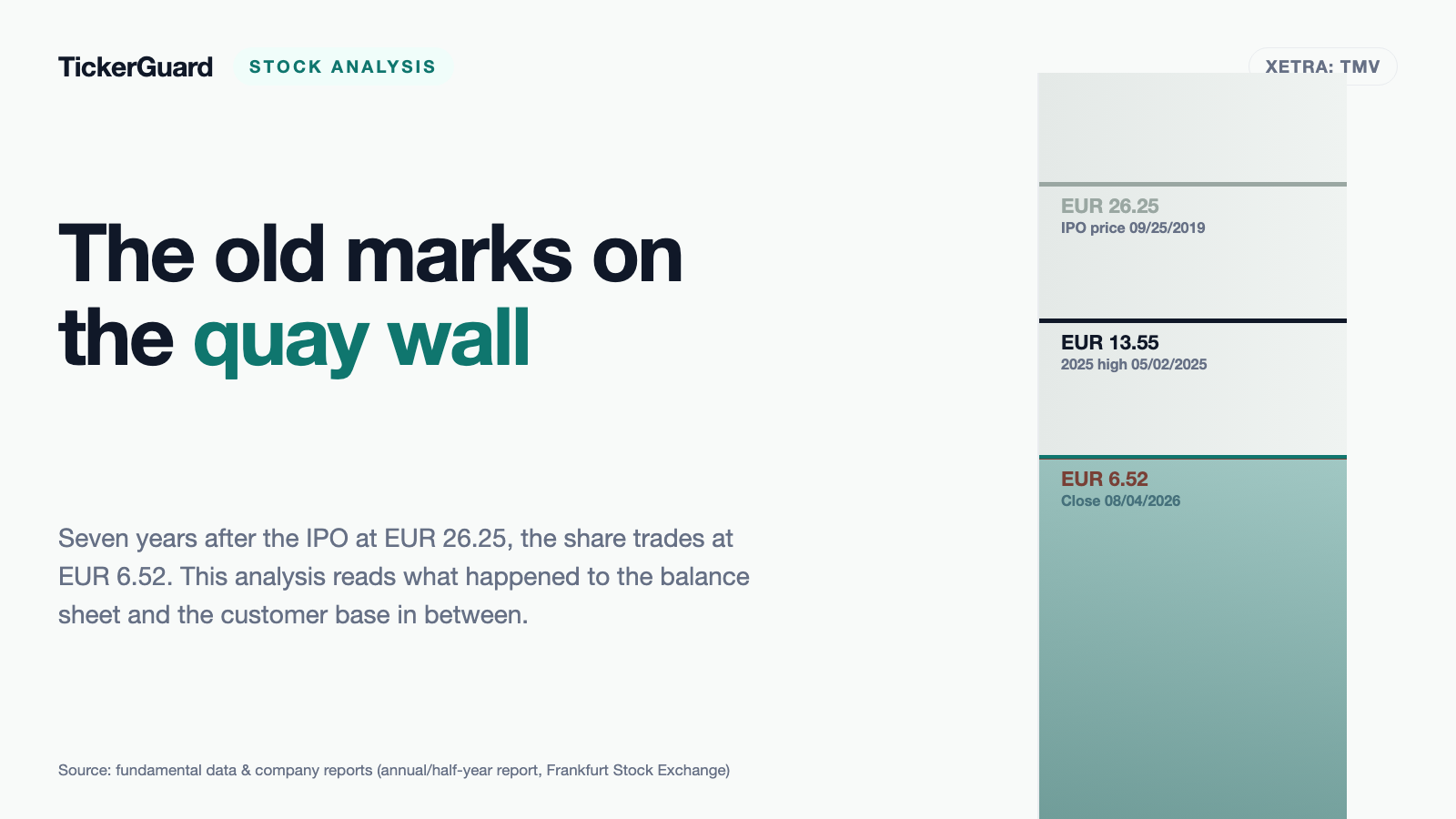
There is an investor trap that catches good observers in particular: the anchor. We fix on one number — the price we paid, or the price at which a stock first came to market — and measure everything against it from then on. TeamViewer listed in Frankfurt on September 25, 2019, at €26.25 a share. On August 4, 2026, the same share closed on Xetra at €6.52. The anchor says: €20 are missing. It does not say why. And above all it does not say whether the company of 2026 is still the company of 2019.
That is what this analysis is about. We leave the old price where it belongs — in the past — and read the reports instead: the 2025 annual report, the H1 2026 half-year report (signed by the Management Board on July 24, 2026) and the Q2 statement of July 28, 2026. Out of those comes the tension that carries this piece: revenue grows because the company bought growth. The customer base shrinks. And two-thirds of the balance sheet consists of a number nobody can touch.
What TeamViewer actually does
TeamViewer SE of Göppingen, Germany, sells software that lets you operate someone else's computer without sitting in front of it. In everyday terms: when the IT technician asks "may I take over your screen for a second?" and the mouse pointer starts moving on its own, that is the category of software TeamViewer sells. Roughly 611,900 paying customers used it as of June 30, 2026 — from one-person trades to global corporations.
The offering is broader than plain remote support now. It splits into four building blocks: Remote (classic remote access), Tensor (the same idea for large corporate IT, with rights management and audit logs), DEX — Digital Employee Experience, software that continuously monitors the workforce's machines and spots problems before anyone calls — and Frontline, an augmented-reality application for warehouses and workshops. Since 2025 TeamViewer has bundled all of it under the name TeamViewer ONE and describes the goal as "autonomous endpoint management": devices that repair themselves.
Customers pay by subscription, mostly annually and in advance. That is economically pleasant, because the money arrives before the service does: as of June 30, 2026, €376.0 million sat on the balance sheet as deferred revenue — cash already collected for work still to be delivered. The matching steering metric is ARR, annual recurring revenue: the annualised value of all active subscriptions at the reporting date. That number is about to matter a great deal.
As of June 30, 2026, 1,967 full-time equivalents worked for the company. The Management Board consists of Oliver Steil (CEO), Michael Wilkens (CFO), Mei Dent (products and technology) and Mark Banfield (revenue).
Why there is no SEC filing here — and where the numbers come from instead
One point up front, because it shapes the whole evidence chain: there is no 10-K and no 10-Q for TeamViewer. The company is not a U.S. reporting issuer. The only SEC identifier associated with the name (CIK 0001800573, filed as "TeamViewer AG/ADR") holds eight filings from 2020 and 2023 — depositary-bank registration forms for an American Depositary Receipt. The ticker and exchange fields there are empty; periodic reporting does not exist.
TeamViewer's mandatory reporting runs instead through the regulated market (Prime Standard) of the Frankfurt Stock Exchange: audited IFRS consolidated statements in the annual report, a half-year report and short quarterly statements. Every figure in this analysis therefore carries "Source: fundamental data & company reports (annual/half-year report, Frankfurt Stock Exchange)". We had the same constellation — a listed German software house with no SEC filings — in our analysis of Serviceware.
And one naming point, because the market-data feed gets it wrong: the company trades as TeamViewer SE, no longer as "TeamViewer AG". The 2025 annual report uses "TeamViewer SE" 346 times and the old name exactly once, in a historical aside. The half-year report and the Q2 statement know only the SE.
How this stock landed on our desk
No scanner hook this time, but other people's attention: on August 5, 2026, TeamViewer appeared on the wallstreet-online forum hot list among the most-discussed stocks held by German retail investors. That is not a buy signal — it is a sign that a lot of people have the same question at the same time. For a stock that reported quarterly numbers a week earlier and fell from €6.77 to €5.96 between July 29 and July 30, 2026, only to recover to €6.52 by August 4, the question is obvious: what exactly was in those numbers?
The timing is helpful, and that belongs up front rather than in a footnote: the half-year report has been available since July 24, 2026, and the quarterly statement since July 28, 2026. There is no newer mandatory disclosure as of the data date of this analysis — the investor-relations newsroom lists the Q2 numbers (July 28, 2026) and the ServiceNow partnership (July 23, 2026) as the most recent items. This analysis therefore stands on the most current basis available.
The numbers over the years — given their due
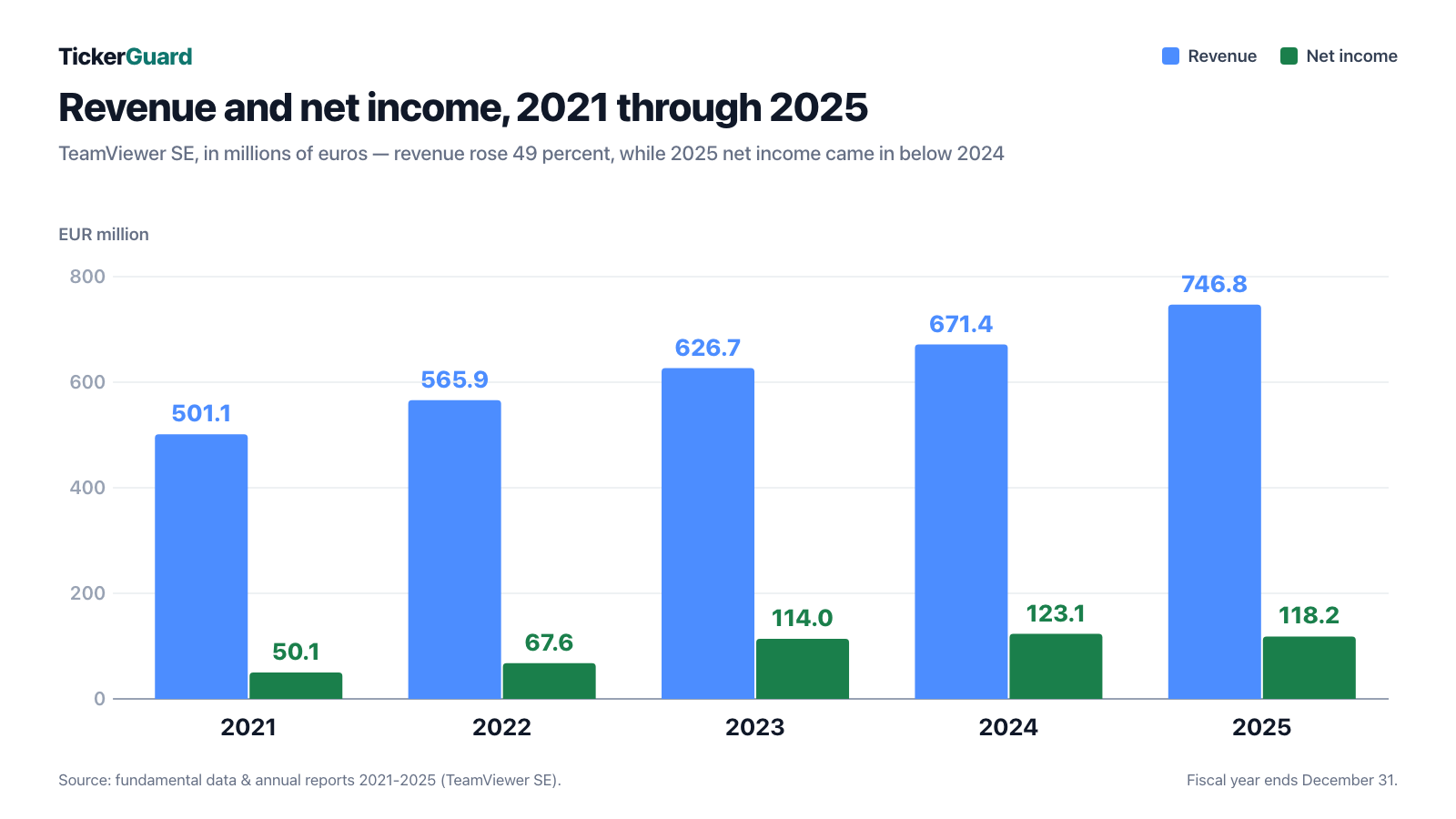
Start with what is genuinely strong, because there is plenty of it. Revenue rose over five years from €501.1 million (2021) through €565.9 million, €626.7 million and €671.4 million to €746.8 million (2025) — a gain of 49 percent. The adjusted EBITDA margin, meaning operating profit before interest, taxes, depreciation and amortisation relative to revenue, came in at 44 percent in 2025 and again at 44 percent in the first half of 2026. Most listed companies can only dream of that. If you are looking for a business that converts roughly 44 cents of every euro of revenue into operating gross profit, this is one.
The earnings statement looks tidy at first glance too: net income climbed from €50.1 million (2021) through €67.6 million (2022) and €114.0 million (2023) to €123.1 million (2024) — and then fell. 2025 left €118.2 million, down 4 percent. Earnings per share slipped from €0.77 to €0.75.
And now the question that changes the whole picture: where did that revenue growth come from?
Uncomfortable truth no. 1: the customer base has been shrinking for years
The customer count is one of the few numbers you cannot dress up. It stood at 669,000 on December 31, 2024, at 637,000 on December 31, 2025 and at 611,900 on June 30, 2026. Against the prior-year date (656,400) that is down 7 percent. In absolute terms: roughly 57,000 paying customers left the product in eighteen months.
ARR — the annualised value of all active subscriptions — follows that movement with a lag, because larger customers pay more than small ones. It stood at €736.8 million on June 30, 2026, against €759.1 million a year earlier: down 3 percent. Split by customer group, the real movement shows:
"Enterprise ARR was up 4% year-over-year, while SMB ARR declined 6% year-over-year."
— TeamViewer SE, Half-Year Report H1 2026, interim management report section 2.3 "Earnings position", page 10

The SMB business carries 68 percent of revenue (€250.3 million of €365.9 million in the first half of 2026) and 607,000 of the 611,900 customers. That is precisely the part that is shrinking. The enterprise business is growing — but it consists of 5,311 customers and accounts for 32 percent of revenue.
More telling still is net retention. It measures how much a cohort of customers pays today compared with what the same cohort paid a year ago — cancellations deducted, upsells included. Above 100 percent means the base grows on its own. At TeamViewer enterprise net retention ran at 100 percent (2024), 96 percent (2025) and 94 percent (June 30, 2026). Translated: even in the growing part of the business, existing customers now spend less than a year earlier; the reported growth comes from new customers and from customers reclassified upward out of the SMB segment.
Uncomfortable truth no. 2: two-thirds of the balance sheet is goodwill
When one company buys another and pays more than the individual assets are worth, the difference lands on the balance sheet as goodwill. That is not fraud and not a trick — it is prescribed accounting. But it is also nothing you can sell, pledge or touch. Goodwill is the accounting claim that the purchase price will one day be earned back.
At TeamViewer that line stood at €1,128.4 million on June 30, 2026. Total assets were €1,670.7 million. Equity: €249.7 million. Strip out goodwill and other intangibles (€331.2 million) and €211.1 million of tangible assets remain — receivables, cash, equipment, associates.
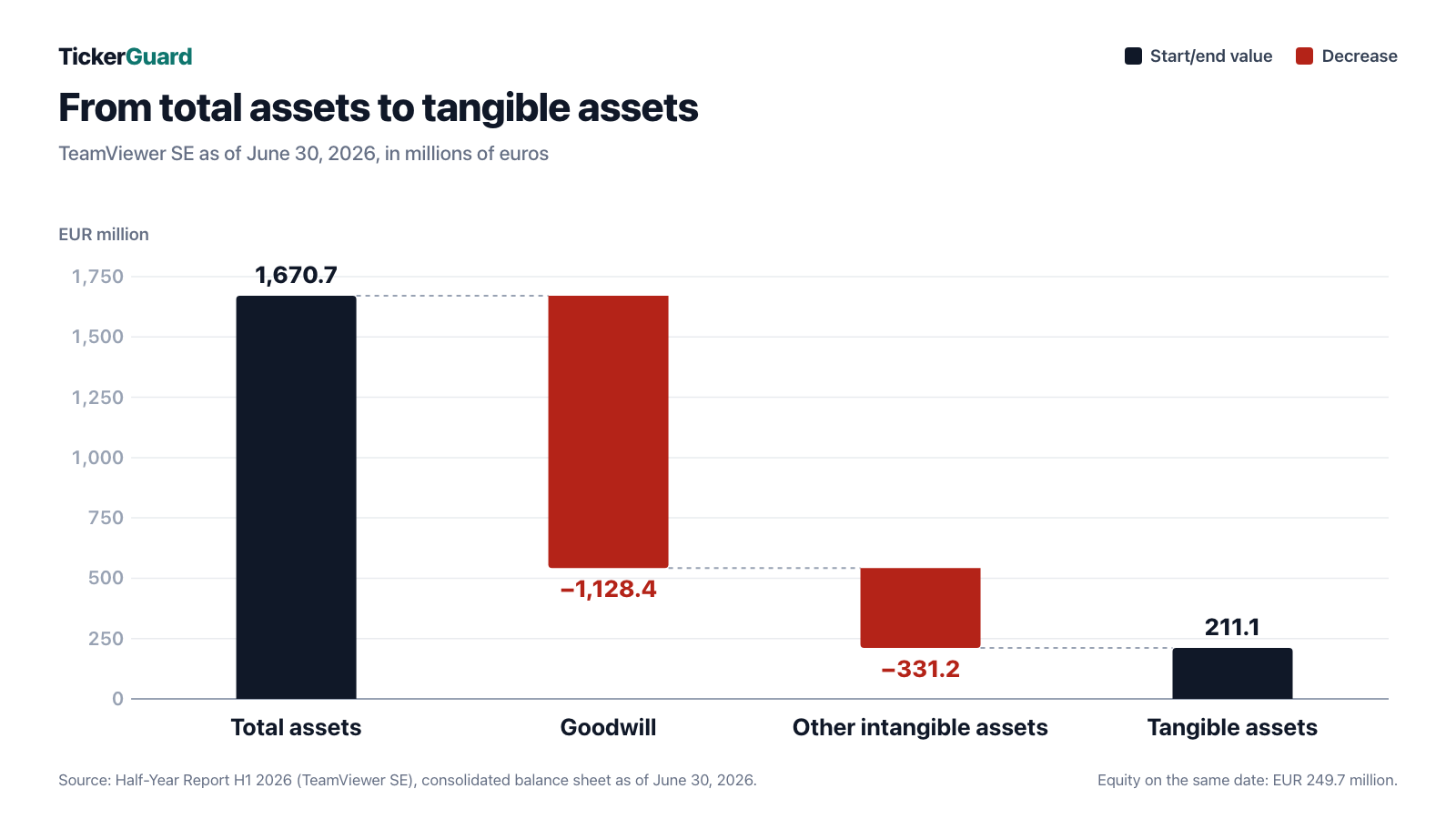
The auditor considers this just as important as we do. In the audit opinion on the 2025 annual report, the recoverability of goodwill is listed as a key audit matter — the section where an auditor names what caused the most work and the greatest judgement risk:
"In the Company's consolidated financial statements goodwill amounting in total to EUR 1,115.5 million (67% of total assets) is reported under the 'Goodwill' item in the consolidated statement of financial position."
— Independent auditor, Annual Report 2025 (TeamViewer SE), auditor's report, key audit matter no. 2, page 199

Whether that goodwill survives is decided by a model the company builds once a year and the auditor reviews. The assumptions as of December 31, 2025 are in the notes: 5.7 percent annual revenue growth across four planning years, 2.3 percent terminal growth thereafter, a 9.7 percent pre-tax discount rate and a terminal adjusted EBITDA margin of 43.6 percent. The notes record that the recoverable amount exceeded the carrying amount and that, in management's view, changes in the assumptions considered possible would not trigger an impairment.
Now hold that planning assumption next to reality: the model assumes 5.7 percent revenue growth. In the first half of 2026 TeamViewer delivered 0 percent (€365.9 million versus €364.4 million), and its own full-year guidance is 0 to 3 percent in constant currency. That is not proof that a write-down is coming — a four-year plan is allowed to contain a weak year and catch up later. But it is the number to watch: every year without growth burns cushion in a model that carries €1,128.4 million while equity sits at €249.7 million. What that can look like when a serial acquirer fails to turn the corner, we worked through step by step in our analysis of Upland Software.
Uncomfortable truth no. 3: €625.4 million for €44.8 million of revenue
Where the goodwill came from can be dated precisely. On January 31, 2025, TeamViewer acquired all shares in the British Chamber Topco Limited, which in turn holds the 1E group — a provider of software for monitoring and remotely managing workplace computers. The auditor names the purchase price and the arithmetic behind it:
"The purchase price for the business combination was EUR 625.4 million."
— Independent auditor, Annual Report 2025 (TeamViewer SE), auditor's report, key audit matter no. 1, page 199
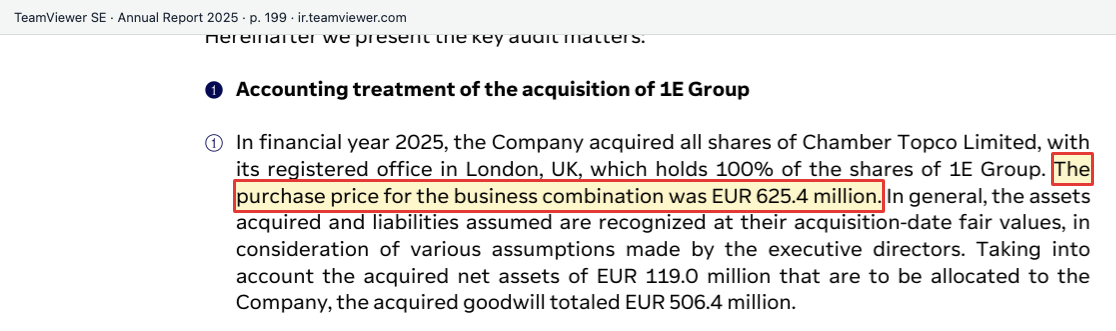
So of the €625.4 million, only €119.0 million was identifiable net assets; €506.4 million went onto the balance sheet as new goodwill. That is the cost side. Now the return — the notes quantify it for the eleven months from February to December 2025 without ambiguity:
"In the 2025 fiscal year, 1E contributed EUR 44,841 thousand to the Group's revenue and a net loss of approximately EUR 21,631 thousand to the Group's net income/loss."
— TeamViewer SE, Annual Report 2025, note 4 "Business combinations", page 155

Be fair about it: the €21.6 million loss includes €23.3 million of amortisation on the intangibles capitalised with the purchase — strip out that purely accounting charge and 1E was marginally positive. And the deal brought more than revenue: it is the foundation of the DEX business, which according to the company picked up again in the second quarter of 2026. Still, the order of magnitude stands: €625.4 million purchase price, €44.8 million of annual revenue. That is nearly fourteen times revenue — for a business that lifted TeamViewer's own 2025 revenue by 11 percent while the customer count fell 5 percent.
Because this is where the first two uncomfortable truths meet: of the €75.4 million revenue increase in 2025, €44.8 million came from the acquisition. Organic growth was therefore about €30.6 million, or 4.6 percent — with a customer count that dropped by 32,000 in the same year.
Uncomfortable truth no. 4: the cash is thin, the debt is not
The acquisition was paid for with borrowed money. The first-half 2025 cash flow statement shows €682.5 million paid for acquisitions and €720.0 million of proceeds from new borrowings. The result sits on today's balance sheet: €872.4 million of financial liabilities as of June 30, 2026 (€231.5 million current, €640.9 million non-current) against €39.6 million of cash. Net debt as TeamViewer itself reports it stood at €832.8 million at quarter-end — 2.5 times adjusted EBITDA over the last twelve months. The company's own target: about 2.3 by the end of 2026.
€39.6 million of cash is little for a company of this size, and the figure has sat at that level for eighteen months (December 31, 2024: €55.3 million; December 31, 2025: €41.6 million). At TeamViewer that is not an alarm signal but a choice: a business that bills in advance and earns money consistently does not need a cushion — surplus funds go into repayment. Operations threw off €99.3 million in the first half of 2026 against an interest burden of €19.5 million, so interest is covered better than fivefold.
There is still one line to keep an eye on. Levered free cash flow fell in the first half of 2026 from €104.0 million to €64.6 million, down 38 percent. Cash conversion — the share of adjusted EBITDA that actually arrives as cash — dropped from 67 to 40 percent. The company attributes this to fewer multi-year contracts with upfront payment, a plausible and reversible explanation. But it is also the flip side of the subscription model: prepayments make one year better and the next one harder.
The first half of 2026 and the outlook — what the company itself expects
The half-year report shows two faces. On one side: revenue of €365.9 million, level with the prior year; adjusted EBITDA up 4 percent to €161.9 million (margin 44 percent); net income up 23 percent to €64.3 million; earnings per share up from €0.33 to €0.41. In the second quarter of 2026 net income even rose 33 percent to €30.1 million. That is real money, not a booking trick — it comes mainly from a much better foreign-exchange result and lower marketing spend.
On the other side: second-quarter revenue fell 1.4 percent in constant currency to €182.7 million and adjusted EBITDA fell 6.0 percent to €78.9 million. Management frames this as a transition phase and confirms full-year guidance without qualification:
"Revenue growth in constant currency between 0% and 3% yoy"
— TeamViewer SE, Half-Year Report H1 2026, interim management report section 5 "Outlook", page 17

What stands out in that line is the yardstick. Growth is measured not against the €746.8 million that actually appeared in the 2025 income statement, but against a comparison base of €767.5 million — the revenue the group would have had if 1E had belonged to it from January 1, 2025. The change is justified on the merits and disclosed in the footnote; but it raises the bar by €20.7 million and makes the comparison with the reported prior year unusable. Anyone checking the guidance has to read the footnote.
The good news of the quarter is documented too and belongs here: enterprise ARR grew 8.3 percent in constant currency, and 11 percent in the highest customer bracket (above €200,000 of ARR). About 49,000 customers had used at least one AI feature by July 25, 2026, up from 26,000 in the first quarter. And on July 23, 2026, TeamViewer and ServiceNow announced a multi-year partnership under which TeamViewer's remote-access and DEX solutions are to be integrated into the ServiceNow platform and offered to its customers as an add-on package. Whether that turns into revenue will be decided in the coming quarters — announced, it is.
What the stock costs
At the Xetra closing price of €6.52 on August 4, 2026, and with 157.8 million shares outstanding, the market capitalisation was about €1,028 million. Against 2025 net income of €118.2 million that is a price-earnings ratio of roughly 8.7. Measured against 2025 revenue, the company costs 1.4 times sales. Both are conspicuously low for a software house with a 44 percent adjusted margin.
The second look qualifies that. Add net debt of €832.8 million and the whole enterprise costs about €1,861 million — 5.7 times 2025 adjusted EBITDA (€325.6 million) and 2.5 times annual revenue. Of every euro of enterprise value, 45 cents is debt. That is why the price-earnings ratio looks so low: equity is the smaller part of the funding, and whatever return lands in it is geared accordingly — up and down alike.
Against book value it runs the other way: €1,028 million of market value against €249.7 million of equity is 4.1 times. And once goodwill and other intangibles are removed, tangible equity is deeply negative at roughly minus €1,210 million. For a software company that is not unusual — the value sits in code, brand and customer relationships, not in machinery. But it means this: whoever buys this stock buys an earnings expectation, not assets.
There is no dividend; the notes state explicitly that no distribution is expected. Shareholder returns have so far come through buybacks — in December 2025 TeamViewer cancelled 6.5 million treasury shares and cut share capital from €170.0 million to €163.5 million. Free float is 100 percent, since the private-equity firm Permira placed its remaining 12.46 million shares on September 4, 2025.
Opportunities and risks — set side by side
What speaks for the company. The margin is exceptional and stable: 44 percent adjusted EBITDA in 2025 as in the first half of 2026. The prepaid subscription model delivers predictable income and €376.0 million of cash already collected but not yet earned. The enterprise business grows 8.3 percent in constant currency, the most expensive customer bracket 11 percent. Debt is falling: from €870.0 million (March 31, 2026) to €832.8 million (June 30, 2026). The AI features are finding users — 49,000 customers by July 25, 2026 — and the ServiceNow partnership opens a distribution channel TeamViewer would not have on its own.
What speaks against it. The customer base is shrinking for the fourth year running, and it is shrinking exactly where two-thirds of revenue comes from. Enterprise net retention sits at 94 percent — even the growing part is not growing on its own. Goodwill of €1,128.4 million stands against €249.7 million of equity, and its impairment test assumes 5.7 percent growth while 0 percent was delivered. Levered free cash flow fell 38 percent and cash conversion from 67 to 40 percent. And the largest acquisition in the company's history delivered €44.8 million of revenue in its first year on a purchase price of €625.4 million.
The structural risk in the background. The 2025 annual report names it itself: AI agents could significantly reduce the relevance of many traditional software applications over time. TeamViewer answers with an AI push of its own — the "Tia" agent, AI features across the core packages and the story of the self-healing endpoint. That is the right answer to the right question. Whether it holds will be readable in exactly one number: the customer count.
Conclusion — what the anchor leaves out
Back to the beginning. The anchor says: €26.25 at the IPO, €6.52 on August 4, 2026, so a 75 percent loss and therefore "cheap". The anchor is a poor adviser because it compares the wrong things. Between 2019 and 2026 it is not only the price that changed but the company: back then TeamViewer was a low-debt remote-support vendor with a growing customer count. Today it is a platform vendor with €832.8 million of net debt, €1,128.4 million of goodwill and a customer count that has been falling for four years.
This is expressly not a disaster story. TeamViewer earns money — €118.2 million in 2025, €64.3 million in the first half of 2026 — covers its interest more than fivefold, repays its debt and has two areas, enterprise and AI features, that are measurably gaining. Anyone who thinks the company is undervalued holds a strong argument with a price-earnings ratio of 8.7 and a 44 percent margin.
But the arithmetic only works if the customer count eventually stops falling. Everything else — the goodwill, the deleveraging, the guidance, the impairment model — hangs on that single movement. The next report will show it, and we will read it. Until then: the old share price is not the yardstick. The 611,900 is. This analysis is not a buy or sell recommendation — it is only meant to show you where to look for yourself.
Sources
- TeamViewer SE — Half-Year Report H1 2026 (IFRS interim statements, signed by the Management Board in Göppingen on July 24, 2026): interim management report, balance sheet as of June 30, 2026, income statement, cash flow statement, notes
- TeamViewer SE — Q2 2026 press release and quarterly statement, July 28, 2026: quarterly figures, ARR by customer group, net debt, AI metrics, ServiceNow partnership
- TeamViewer SE — Annual Report 2025 (audited IFRS consolidated financial statements): group management report, capital-market chapter, note 4 (business combinations), note 9 (goodwill and impairment test), note 25 (contractual obligations), auditor's report with the key audit matters
- wallstreet-online forum hot list, as of August 5, 2026 — the hook for this analysis, not a data source
- Source: fundamental data & company reports (annual/half-year report, Frankfurt Stock Exchange) — prices, market capitalisation and multi-year series; reporting dates named in the text
Note: this analysis is not investment advice and not a buy or sell recommendation. All figures come from the primary reports named above and carry their respective reporting dates. Data as of August 5, 2026.
Our Bottom Line at a Glance
- Profitability positive
- The adjusted EBITDA margin came in at 44 percent in fiscal 2025 and again in the first half of 2026, and at 43.2 percent in the second quarter of 2026. Net income rose 23 percent to €64.3 million in the first half and 33 percent to €30.1 million in the second quarter. The €19.5 million interest burden was covered better than fivefold by €99.3 million of operating cash flow.
- Customer base negative
- The customer count fell from 669,000 (December 31, 2024) through 637,000 (December 31, 2025) to 611,900 (June 30, 2026), down 7 percent year over year. ARR in the small and medium-sized business segment — 68 percent of revenue — fell 6 percent, and enterprise net retention went from 100 percent (2024) through 96 percent (2025) to 94 percent (June 30, 2026).
- Balance-sheet quality negative
- Goodwill of €1,128.4 million equals 67.5 percent of total assets as of June 30, 2026 and more than four times the equity of €249.7 million; the auditor lists its recoverability as a key audit matter. After deducting all intangibles, €211.1 million of tangible assets remain.
- Acquisition and capital allocation negative
- For the 1E group TeamViewer paid €625.4 million on January 31, 2025 against €119.0 million of acquired net assets. In fiscal 2025 the acquisition contributed €44.8 million of revenue and a €21.6 million loss — including €23.3 million of amortisation on the acquired intangibles.
- Debt and cash generation neutral
- Net debt fell from €870.0 million (March 31, 2026) to €832.8 million (June 30, 2026), or 2.5 times adjusted EBITDA; the company's own target is about 2.3 by year-end. At the same time levered free cash flow fell 38 percent to €64.6 million in the first half of 2026 and cash conversion dropped from 67 to 40 percent.
- Outlook and guidance quality neutral
- Guidance for 2026 was reaffirmed unchanged on July 28, 2026: 0 to 3 percent constant-currency revenue growth and an adjusted EBITDA margin of around 43 percent. It is measured, however, against a comparison base of €767.5 million rather than the reported €746.8 million — the change is disclosed, but the year-on-year comparison only works if you read the footnote.
TeamViewer earns money reliably: a 44 percent adjusted EBITDA margin, €118.2 million of net income in 2025 and a first-half 2026 profit up 23 percent. The price for that sits on the other side of the balance sheet: €832.8 million of net debt, €1,128.4 million of goodwill against €249.7 million of equity, and an acquisition costing €625.4 million that delivered €44.8 million of revenue in its first year. The customer count has been falling for four years — everything else hangs on it. Not investment advice.
What Our Rating Means
Open questions
The business works in principle, but one material question is open. As long as it stays open, our findings do not carry a quality verdict.
Yellow, not red — and the difference matters. A substance risk in the narrow sense is not documented: equity is positive at €249.7 million, there is no going-concern indication and no visible covenant breach; the half-year report records that the leverage covenants were complied with at all times. Operating cash flow of €99.3 million covers the €19.5 million interest burden better than fivefold, net debt has been falling since the first quarter, and with €376.0 million of cash already collected but not yet earned, the business model runs on customers' money rather than the bank's. The thin €39.6 million cash balance is not an alarm signal at a subscription vendor that bills in advance — it is repayment discipline. Yellow stands because one material operating question is open, and it is the central one: the customer base has shrunk for four years running — 669,000, 637,000, 611,900 — and even in the growing enterprise business net retention sits at 94 percent. The 11 percent revenue growth of 2025 came 59 percent from an acquisition that cost €625.4 million and delivered €44.8 million of revenue. And goodwill of €1,128.4 million rests on a model that assumes 5.7 percent revenue growth while the company delivers 0 percent and promises 0 to 3 percent. None of these figures threatens the company's existence. Taken together they describe a business whose valuation depends on a turn that has not yet happened. At the August 4, 2026 price the stock is not expensive at a price-earnings ratio of 8.7 — that changes nothing about this rating, because price is not a quality metric. The decision is yours.
A journalistic assessment by our editorial team at the time of the deep dive, based on public sources — not investment advice and not a solicitation to buy or sell. Your personal circumstances (investment goals, risk capacity, taxes) cannot be taken into account. What our levels mean, how verdicts are formed, and what conflicts of interest exist →
Worth Noting
- Hook: the wallstreet-online forum hot list, as of August 5, 2026 — not a data source, only the reason for the research.
- Data as of August 5, 2026. The latest mandatory disclosure is the Q2 statement of July 28, 2026, preceded by the H1 2026 half-year report (signed July 24, 2026) and the ServiceNow partnership of July 23, 2026. After June 30, 2026, TeamViewer reported additional loan facilities of €15 million and a €25 million partial repayment on the bridge facility in July 2026.
- Possible confusion: the company has been called TeamViewer SE since its conversion into a Societas Europaea, no longer TeamViewer AG — several market-data feeds still carry the old name. There is no 10-K and no 10-Q; SEC identifier 0001800573 belongs to a depositary bank's ADR program, not to the company's own reporting.
- On the guidance: the €767.5 million comparison base for 2026 is not reported 2025 revenue (€746.8 million) but a pro forma figure including 1E from January 1, 2025. Checking the guidance against the income statement without that adjustment produces the wrong answer.
The full analysis as a PDF for later
We will send you this analysis as a PDF — to print, file away, and read at your own pace.
Frequently Asked Questions
TeamViewer SE of Göppingen, Germany, sells software for remote access to other people's computers and devices. The offering ranges from the classic remote-support program (Remote) through the corporate variant (Tensor) and the monitoring of workplace computers (DEX) to an augmented-reality application for warehouses and workshops (Frontline). Since 2025 the company has bundled everything under the TeamViewer ONE platform. As of June 30, 2026, TeamViewer had 611,900 paying customers and 1,967 full-time equivalents.
Revenue in the first half of 2026 was level with the prior year at €365.9 million (€364.4 million). Adjusted EBITDA rose 4 percent to €161.9 million (margin 44 percent), net income 23 percent to €64.3 million, and earnings per share from €0.33 to €0.41. ARR — the annualised value of all active subscriptions — fell 3 percent to €736.8 million and the customer count 7 percent to 611,900. Levered free cash flow dropped 38 percent to €64.6 million.
Because TeamViewer bought growth. Anyone who buys a company for more than its individual assets are worth has to capitalise the difference as goodwill. For the 1E group alone TeamViewer paid €625.4 million on January 31, 2025, against €119.0 million of acquired net assets — €506.4 million went onto the balance sheet as new goodwill. As of June 30, 2026, total goodwill stood at €1,128.4 million, or 67.5 percent of total assets, against equity of €249.7 million.
Not as of December 31, 2025: the notes record that the recoverable amount exceeded the carrying amount and that changes in the assumptions considered possible would not trigger an impairment. The model does, however, assume 5.7 percent annual revenue growth over four planning years, 2.3 percent terminal growth thereafter and a terminal adjusted EBITDA margin of 43.6 percent. What was delivered in the first half of 2026 was 0 percent revenue growth; full-year guidance is 0 to 3 percent in constant currency. Every year without growth burns cushion in that model.
The decline comes almost entirely from the small and medium-sized business segment: its ARR fell 6 percent year over year, and among the smallest customers (below €1,500 of ARR) by 7.0 percent in constant currency. TeamViewer attributes this to its own course corrections in sales, which weigh on the short term. The count fell from 669,000 (December 31, 2024) through 637,000 (December 31, 2025) to 611,900 (June 30, 2026). The enterprise business grew to 5,311 customers over the same period but covers only 32 percent of revenue.
As of June 30, 2026, the balance sheet showed €872.4 million of financial liabilities (€231.5 million current, €640.9 million non-current) against €39.6 million of cash. Net debt as reported by the company was €832.8 million, or 2.5 times adjusted EBITDA over the last twelve months; the company's own target is about 2.3 by the end of 2026. The interest burden of €19.5 million in the first half was covered better than fivefold by operating cash flow of €99.3 million.
No. In valuing its share-based compensation, the notes to the 2025 annual report state explicitly that no dividend payment is expected. Shareholder returns have so far come through buybacks: in December 2025 TeamViewer cancelled 6.5 million treasury shares and cut share capital from €170.0 million to €163.5 million. As of June 30, 2026 the company still held 5,705,406 treasury shares.
Because TeamViewer is not a U.S. reporting issuer. The stock trades in the Prime Standard of the Frankfurt Stock Exchange; its mandatory reports are the audited IFRS annual accounts, a half-year report and quarterly statements. The only SEC identifier associated with the name (CIK 0001800573) contains eight depositary-bank registration forms for an American Depositary Receipt from 2020 and 2023 — no annual or quarterly reports. Every figure in this analysis therefore comes from the primary reports on the company's investor-relations site.
Found an error?
Did you spot a factual error, an outdated number, or a typo in this deep dive? Let us know briefly — your report goes straight to the editorial team.