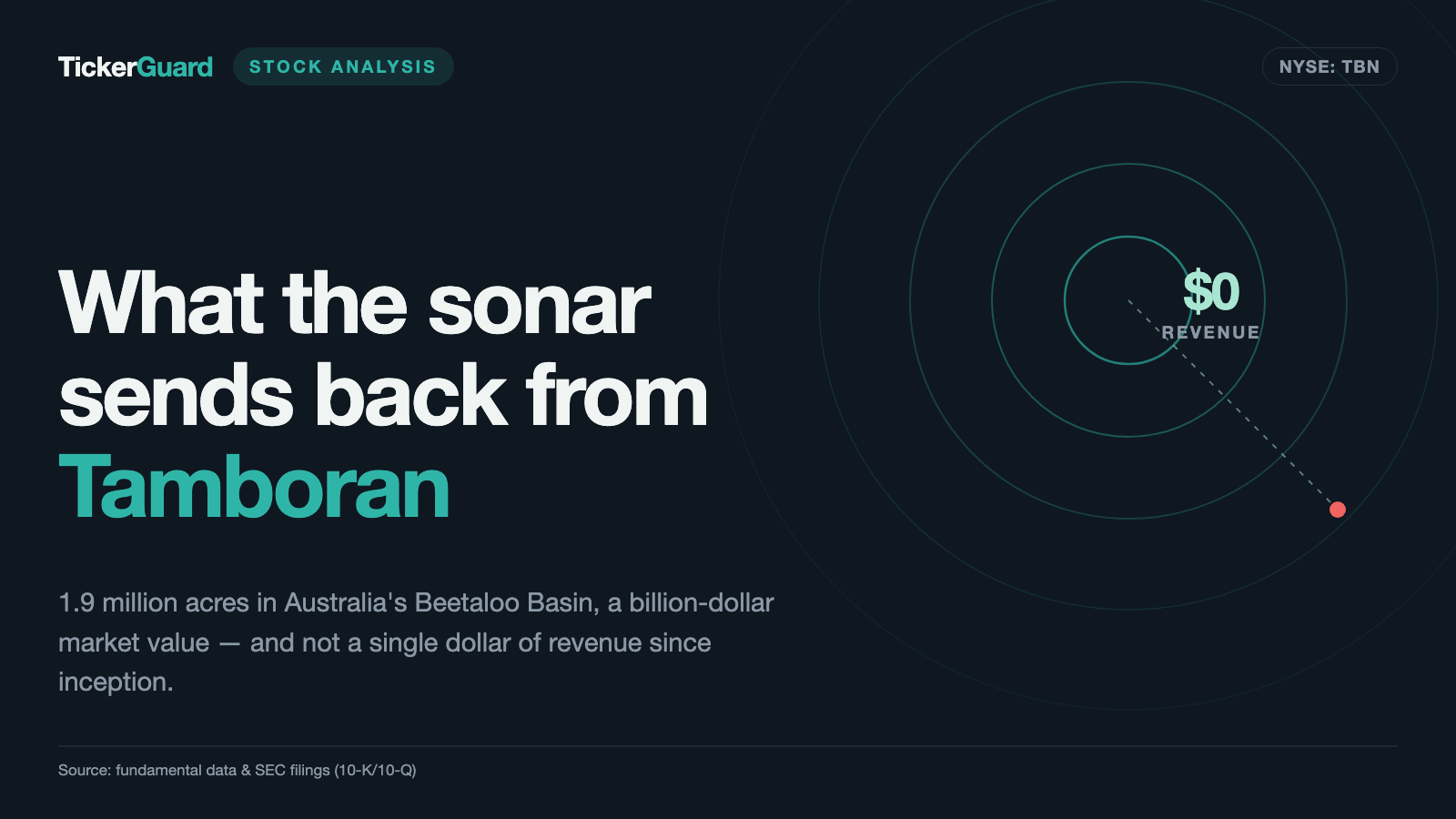
Tamboran Resources: 1.9 million acres of gas country – and a zero on the revenue line in every report since inception
About 1.9 million net acres in Australia's Beetaloo Basin, a market value of roughly $1.30 billion on August 18, 2026 – and a zero on the revenue line of the latest quarterly report, for the period ended March 31, 2026. Tamboran Resources Corporation (NYSE: TBN) is the largest acreage holder there and has not booked a dollar of revenue since inception; the same report shows an accumulated deficit of $191.5 million and an explicit statement of substantial doubt about the company's ability to continue as a going concern. Let's make a deal: we read the Form 10-K for the year ended June 30, 2025, the Form 10-Q for the quarter ended March 31, 2026 and the Form 8-K filings from May and August 2026 together. In the end what counts is not how big the site is, but how much gas actually moves through the pipe.
 Thomas Mücke
Founder & Publisher
Thomas Mücke
Founder & Publisher
As of Today
As of: October 2, 2026
- Closing price
- 33.70 $ +1.40%
- Market Capitalisation
- 1.2 $B
- AAQS
- 1/10
Price change since August 18, 2026: -9.8%
This analysis has a cut-off date. The Stock Guard tells you when something material changes in the numbers. Reserve your free spot
Chart
Interactive price chart (TradingView).
52-week range: 22.60 $ to 50.00 $ · Last price: 33.70 $ (As of: October 2, 2026)
Note: pure fact-based analysis, not investment advice and not a solicitation to buy or sell. All figures without guarantee.
There is an investor weakness familiar to anyone who has ever stopped at a construction fence: the site-fence trap. We see cranes, a board with the name of the future building, maybe even a rendering bathed in evening light – and we start calculating the rent in our heads. What we do not see is whether the developer can pay the final installment and when the first tenant moves in. Tamboran Resources Corporation (NYSE: TBN) has a very large construction site: roughly 1.9 million net acres in the Beetaloo Basin in northern Australia, more than any other operator there. On August 18, 2026 the market valued the company at about $1.30 billion. The filed reports say something else. In fiscal 2023, 2024 and 2025 and in the nine months ended March 31, 2026 the revenue line read zero every single time. Let's make a deal: we read the Form 10-K for the year ended June 30, 2025, the Form 10-Q for the quarter ended March 31, 2026 and the Form 8-K filings from May and August 2026 together – and separate the blueprint from what is already standing.
What Tamboran Resources actually does
The Beetaloo Basin lies inland in Australia's Northern Territory, southeast of Darwin – cattle country, bush and very few people. Several kilometers below that surface sits a rock formation called the Velkerri shale, with natural gas trapped inside it. Trapped is meant literally: the gas sits in a tight rock and will not flow to a wellbore on its own. The rock has to be fractured under high pressure – the same technique that built the U.S. shale gas industry. In its annual report Tamboran explicitly compares the Velkerri to the Marcellus in Pennsylvania, one of the most productive gas fields in the world.
Tamboran holds interests in six exploration permits (EPs) and one permit application. The split matters, because it shows how much of the acreage the company really owns. In the three core permits EP 76, EP 98 and EP 117 it holds a 38.75 percent working interest and acts as operator – those permits sit inside TB1, a 50/50 joint venture between Tamboran and partner Daly Waters Energy. In EP 161 it holds 25 percent and does not operate. Only EP 136, EP 143 and the application EP(A) 197 are wholly owned. In acres: EP 98 is the largest at 2,312,262 gross acres, of which 896,000 are net to Tamboran; EP 143 adds 512,000 acres, all of them net. Together that produces the roughly 1.9 million net acres quoted in every presentation.
That largest wholly owned block carries a caveat that is easy to miss. The subsequent-events note of the Form 10-Q for the quarter ended March 31, 2026 records that on April 27, 2026 the Northern Territory regulator denied Tamboran's application to extend EP 143; the same report says the group may reapply closer to the end of the calendar year, and the permit itself runs to March 4, 2028. Until that is resolved, 512,000 of the roughly 1.9 million net acres – a good quarter of the position – sit behind an application that has already been turned down once. It is not a write-off, but it belongs next to every dollar-per-acre figure further down this page: part of that acreage is not yet permanently secured.
The business plan has three phases. Phase one is the Shenandoah South Pilot Project: five wells plus a processing plant called the Sturt Plateau Compression Facility (SPCF), which turns raw gas into sales gas – capacity 40 terajoules a day, or about 39 million cubic feet. From there the gas travels through a 35-kilometer pipeline built and operated by Australian infrastructure group APA Group into the existing Amadeus Gas Pipeline. Phase two is an approximately 1,000-mile pipeline to Australia's East Coast market, also planned with APA Group; six of Australia's largest energy retailers have signed non-binding letters of intent for an aggregate 875 million cubic feet a day over 10 to 15 years. Phase three would be a dedicated LNG export facility near Darwin, for which pre-FEED work has been completed with engineering contractor Bechtel. As of June 30, 2025 Tamboran employed 46 people full time and one part time.
Remember that sequence: acreage, well, processing, pipeline, customer. Revenue appears only at the end of that chain – and Tamboran's own quarterly report places the company before the second-to-last link.
Company history for investors
-
2022
Joint venture TB1 acquires the core permits
On November 9, 2022 TB1, the 50/50 joint venture with Daly Waters, acquired a 77.5 percent share of EP 76, 98 and 117 – half of the core acreage has belonged to a partner ever since.
-
2024
Listing on the New York Stock Exchange
Trading under TBN began on June 27, 2024, with the IPO shares issued the following day. For investors that brought quarterly disclosure under U.S. rules – and the first revenue line showing a zero.
-
2025
Two more wells and construction of the processing plant
In fiscal 2025 SS-2H ST1 (August 2024) and SS-3H (November 2024) were drilled and construction of the Sturt Plateau Compression Facility began – funded by equity raises, not by sales.
-
2026
Roughly $198 million raised in equity
In April and May 2026 Tamboran raised about $198 million at $35.00 per share. The price was strong; the share count rose by roughly a quarter as a result.
-
2026
Falcon Oil & Gas acquisition completed
On May 28, 2026 Tamboran bought partner Falcon for 6,537,503 of its own shares plus $23.7 million in cash. Existing holders have owned about 81.2 percent of the company since.
-
2026
Amendment with Falcon accounts and pro forma figures
The Form 8-K/A of August 7, 2026 supplied the audited Falcon statements and the pro forma numbers – the basis for judging the acquisition from the annual report onward.
How the stock landed on our desk
This time the prompt did not come from a balance sheet ratio but from the internet. Our in-house stock scanner tracks, among other things, which smaller U.S. names get mentioned unusually often in retail investor forums. On August 12, 2026 that filter flagged Tamboran Resources with 10 mentions and a reported market value of about $1.26 billion. That is expressly not a quality signal: a stock shows up there because people are talking about it, not because its numbers hold up. For us such an alert is an invitation to open the original filings – nothing more.
And here it is worth doing, because the share price behaves in a way that has little to do with the numbers: the 52-week range ran from $19.55 to $52.21 as of August 18, 2026. A stock that can more than double and halve again within a year while nothing changes on the revenue line is being moved by expectations, not results. If you want to see what a gas business that actually issues invoices looks like, read our analysis of Natural Gas Services, a lessor of gas compression equipment – precisely the technology Tamboran is only now installing. And for how hard the path from wellbore to income statement can be, see our analysis of Battalion Oil, a small U.S. producer with real output and chronic problems all the same.
The numbers over the years — given their due
First the part that genuinely impresses, because it is real: Tamboran has financed a project of this scale without earning a cent. At March 31, 2026 the balance sheet showed equity of $546.578 million, of which $151.024 million belonged to noncontrolling interests. On the asset side sat $465.020 million of unproved gas properties and a further $61.200 million of gas equipment under construction – that is the SPCF taking shape. Total assets grew from $446.462 million to $672.062 million in nine months. Operationally, three more wells were drilled, approval to sell gas during the appraisal period is in hand, and binding construction and transportation agreements with APA Group are signed.
And yet: open the income statement and you find the same character in the same place across four consecutive reporting periods.
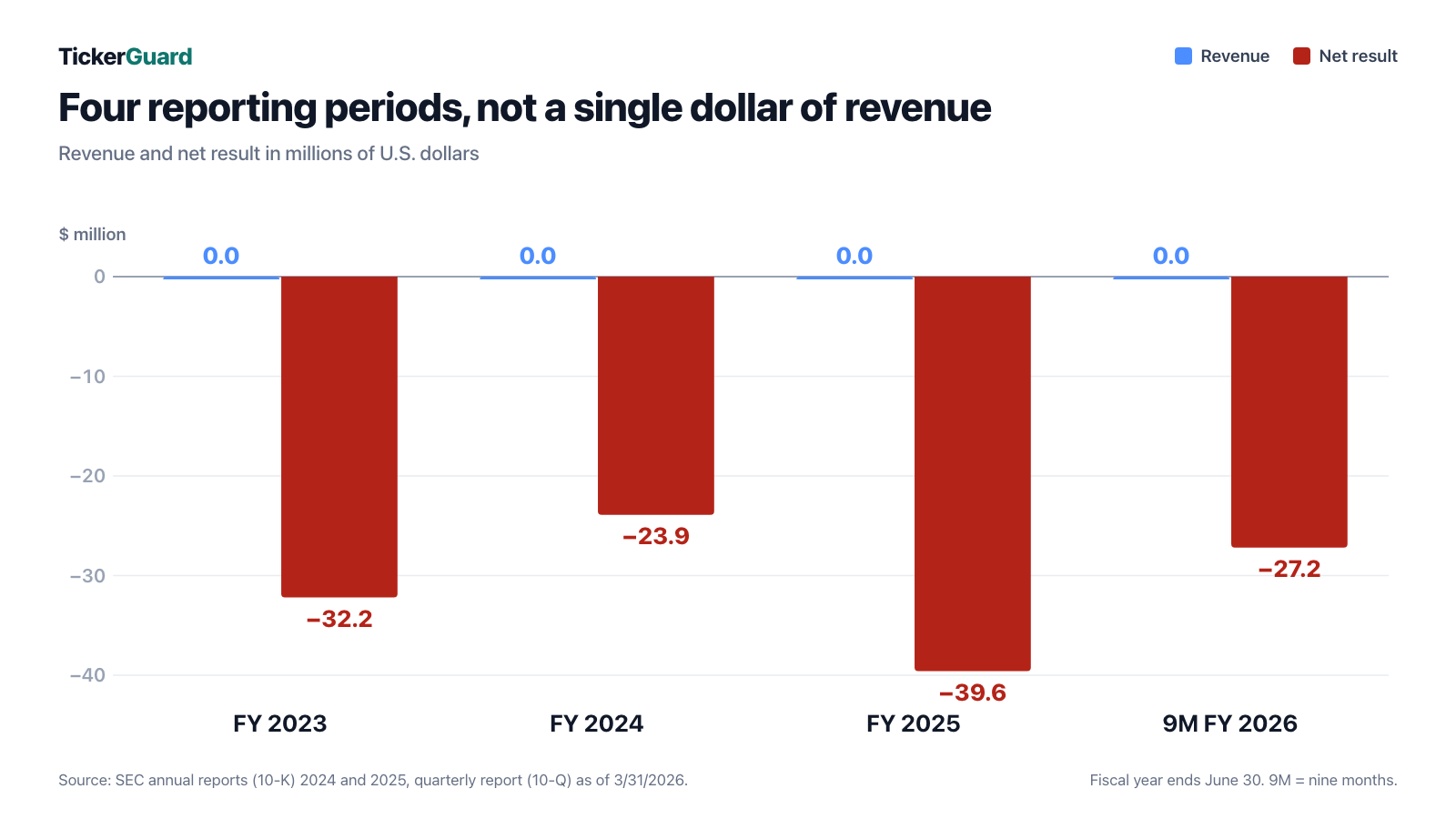
Across those four periods the net losses add up to about $123 million. Since inception the figure is $191.5 million, per the quarterly report. For an exploration company that is not a scandal in itself – nobody expects profits before the first plant is running. But it changes the question you have to ask about the stock. It is not “how much does the company earn?” It is “does the money last until the first sale – and how many new shares does that road cost?”
What the filings say — the uncomfortable truths
Uncomfortable truth no. 1: the company doubts its own continuation
There is a paragraph in financial statements that no management writes voluntarily. It is called going concern. When it carries a reference to substantial doubt, it means that under the applicable accounting rules there is no assurance the company survives the next twelve months without something additional happening. The quarterly report for the period ended March 31, 2026 contains exactly that paragraph, and it names the reasons: no revenue since inception, an accumulated deficit of $191.5 million and substantial planned expenditures over the next twelve months.
“While these factors raise substantial doubt regarding the Group's ability to continue as a going concern for the 12 months following the date these condensed consolidated financial statements were available for issuance, the Company has achieved several milestones subsequent to the end of the quarter that indicate positive progress toward addressing this substantial doubt in future periods.”
— Tamboran Resources Corporation, Form 10-Q for the quarter ended March 31, 2026, Note 1 “Going Concern and Management's Liquidity Plan,” filed with the U.S. securities regulator, the SEC
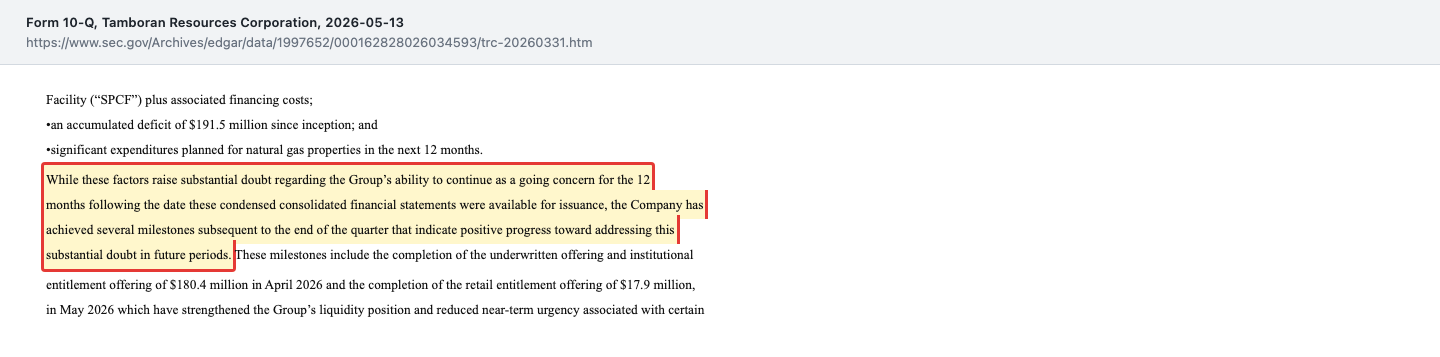
The context cuts both ways. The warning is serious – but at a company with no revenue it is hardly surprising, and Tamboran acted immediately: an April 2026 offering brought in roughly $180.4 million, and a May follow-on for retail holders added $17.9 million. At March 31, 2026 there was $88.151 million of unrestricted cash on hand, plus $13.766 million restricted and a working capital surplus of $45.2 million. The company writes that it expects to reassess the doubt only with the annual financial statements, and only if the three wells already drilled on the SS2 pad are stimulated, tied into the plant and the plant is commissioned. Until then the sentence stands.
Uncomfortable truth no. 2: no proved reserves – and no gas ever sold
In the resources business two words that sound similar in everyday speech mean very different things: resource and reserve. A resource is the geological estimate of how much gas sits in the rock. A reserve is the audited proof that a portion of it can be produced economically with today's technology at today's prices. Only the reserve is a number a bank will lend against. Tamboran states its own position in one very clear sentence:
“We presently have no proved reserves and have not sold any natural gas produced.”
— Tamboran Resources Corporation, Form 10-K for the year ended June 30, 2025, Risk Factors
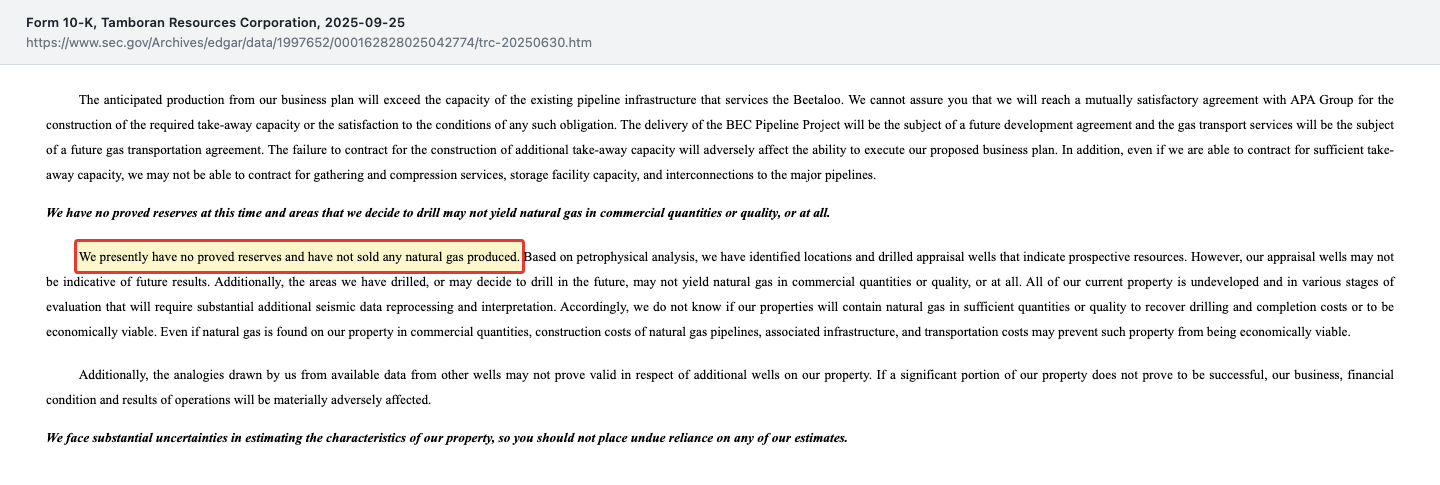
There is also a slippage you only notice when you lay two filings side by side. The annual report for the year ended June 30, 2025 said no material revenue from production “until at least mid-calendar year 2026.” The quarterly report for the period ended March 31, 2026 says, in the same place, no material revenue “until late 2026.” Between the two filings lie about eight months of reporting time – and half a year of schedule. At a company burning cash every month that is not a detail: it lengthens the stretch that has to be bridged with other people's money.
Uncomfortable truth no. 3: the share count has more than doubled in two years
Dilution is the quietest risk in a stock because it breaks nothing – it only divides. Picture owning one eighth of a pizza. Guests arrive, the pizza is cut into more slices, and your slice shrinks without anyone taking anything from you. At Tamboran the pizza has been cut into more than twice as many slices in under two years.
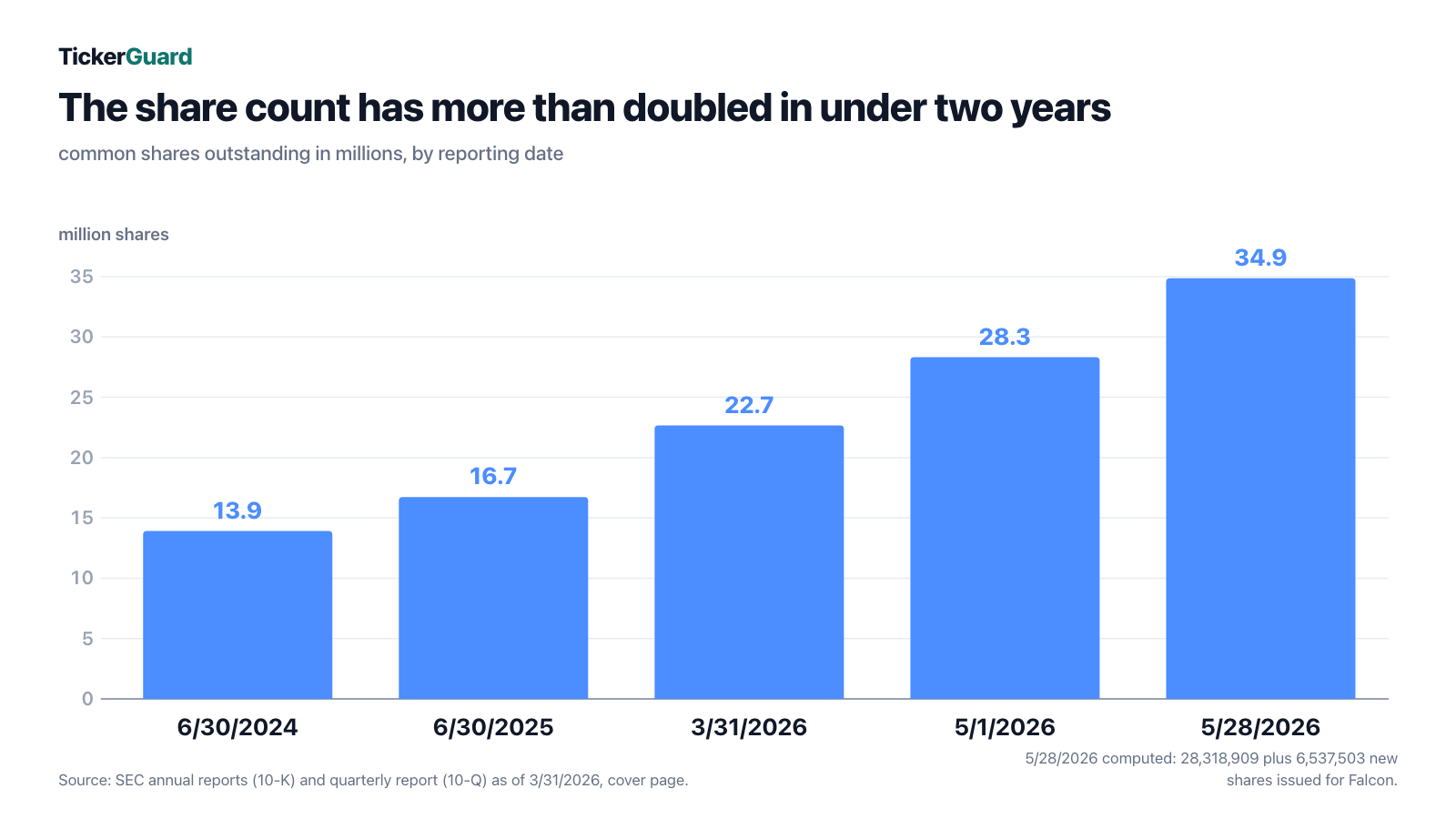
The steps, all from the filings: 13,915,524 shares at June 30, 2024, 16,717,289 at June 30, 2025, 22,667,289 at March 31, 2026 and 28,318,909 at May 1, 2026. April 2026 alone added roughly 5.15 million new shares – 3,400,093 from an underwritten offering and 1,013,110 from an institutional entitlement offer, both at $35.00, plus 741,542 shares for holders outside the United States; 496,875 more followed on May 1 from the retail entitlement offer. Together those raised about $198 million.
Then came the acquisition. On May 28, 2026 Tamboran completed the purchase of all subsidiaries of Canadian partner Falcon Oil & Gas Ltd. – including roughly 98.1 percent of Falcon Oil & Gas Australia, a co-owner of the Beetaloo permits. The consideration was 6,537,503 new shares plus $23,663,080 in cash. The quarterly report does the math itself:
“Based on 28,318,909 shares of common stock issued and outstanding as of May 1, 2026, following the completion of the Falcon Acquisition, it is anticipated that persons who were stockholders and shareholders of Tamboran and Falcon, respectively, immediately prior to the Falcon Acquisition will own approximately 81.2% and 18.8% of the combined company, respectively, with Tamboran maintaining control over the combined company.”
— Tamboran Resources Corporation, Form 10-Q for the quarter ended March 31, 2026, Risk Factors
Commercially the deal makes sense: buying out a co-owner of your own acreage simplifies the structure and raises your share of the same ground. For existing holders it still means their claim on that ground shrinks by roughly a fifth. And the count is not finished: on June 8, 2026 Tamboran registered a new employee share plan, and in connection with the Falcon deal options over a further 369,084 shares at $21.94 were issued.
That the roughly 34.9 million share count holds up is confirmed by two ownership filings dated August 13, 2026 – the company's most recent filings of any kind. Energy-focused fund HITE Hedge Asset Management reported 2,881,804 shares, or 8.27 percent, as of June 30, 2026; U.S. oilfield services provider Liberty Energy Services reported 1,336,127 shares, or 3.8 percent, as of May 28, 2026. Grossing either stake up to the full class puts the total at roughly 34.8 million and 35.2 million shares respectively. Both were filed expressly as passive positions – not activist stakes, but an independent cross-check on the share count.
Uncomfortable truth no. 4: management rates its own financial controls as not effective
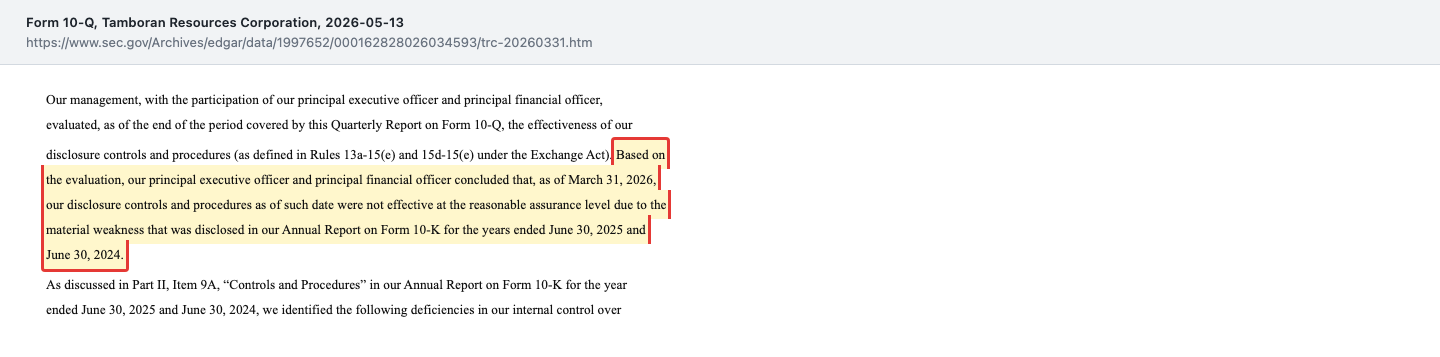
U.S.-listed companies must confirm in every report that their internal controls work – that figures are captured, checked and passed on reliably. When the chief executive and chief financial officer cannot confirm it, that appears in black and white. At Tamboran it has appeared for three reporting years running:
“Based on the evaluation, our principal executive officer and principal financial officer concluded that, as of March 31, 2026, our disclosure controls and procedures as of such date were not effective at the reasonable assurance level due to the material weakness that was disclosed in our Annual Report on Form 10-K for the years ended June 30, 2025 and June 30, 2024.”
— Tamboran Resources Corporation, Form 10-Q for the quarter ended March 31, 2026, Part I, Item 4 “Controls and Procedures”
The filing lists four individual deficiencies: insufficient evidence retained that controls were actually performed; thin staffing in key accounting and finance roles and therefore inadequate segregation of duties; missing access and change controls over the cloud-based enterprise resource planning system; and accounting for complex transactions under U.S. GAAP. Tamboran has engaged an outside consulting firm and implemented a new ERP system to remediate; the assessment of whether the controls now work was still in progress at the reporting date. This is no accusation of manipulation – but it means that at a company currently booking a cross-border acquisition spanning four jurisdictions, the accounting function is the acknowledged weak spot.
Uncomfortable truth no. 5: a meaningful slice of the gas belongs to others before it is produced
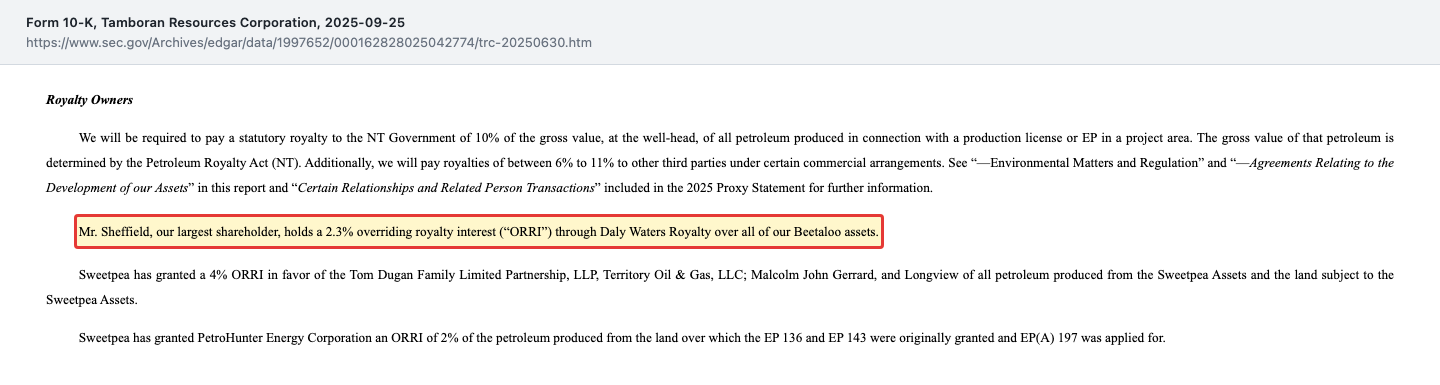
The resources industry uses a contract type that rarely appears on investor slides: the overriding royalty interest, or ORRI. It works like rent on every unit produced: the holder receives a percentage of the gross value of production regardless of whether the company makes a profit, and before costs are deducted. The annual report for the year ended June 30, 2025 lists several such royalties. One of them goes to the largest shareholder himself:
“Mr. Sheffield, our largest shareholder, holds a 2.3% overriding royalty interest (“ORRI”) through Daly Waters Royalty over all of our Beetaloo assets.”
— Tamboran Resources Corporation, Form 10-K for the year ended June 30, 2025, “Royalty Owners” section
Bryan Sheffield is, per the quarterly report, managing partner of the private equity firm Formentera Partners, whose fund also owns joint venture partner Daly Waters Energy; he has been a Tamboran shareholder since November 2021. That makes him involved three times over – as largest shareholder, as half-owner of the TB1 joint venture and as recipient of the royalty. On the EP 136 and EP 143 permits the filing adds 4 percent to a group around the Tom Dugan Family Limited Partnership, 2 percent to PetroHunter Energy and 1 percent to a family trust whose beneficiaries are the children of a company director. For an investor the message is simple: when gas eventually flows, a double-digit percentage of gross value is already committed before Tamboran books its first cost.
Valuation: what the market pays for 1.9 million acres
The usual ratios do not help here, and that is not an excuse but the finding: a price-to-earnings ratio needs earnings, a price-to-sales ratio needs sales. Tamboran has neither. Two more honest measures remain.
The first is price per acre. At $37.35 on August 18, 2026 and a computed 34,856,412 shares, the market value was about $1.30 billion. Spread across the roughly 1.9 million net acres that is about $685 per acre – for ground that the annual report says carries no proved reserves. For contrast from the same filing: partner Daly Waters is to pay $15.0 million for a non-operating, noncontrolling interest in 100,000 acres, a transaction still subject to regulatory approval – equal to $150 per acre. The two numbers do not measure the same thing, and the comparison limps in several places, but the order of magnitude shows how much expectation sits inside the share price.
The second measure is book value. At March 31, 2026, $395.554 million of equity was attributable to Tamboran shareholders; spread across the 22,667,289 shares outstanding at that date, roughly $17.45 per share. The August 18, 2026 price of $37.35 was about twice that. At a company with running revenue a price-to-book ratio around 2 would be unremarkable; here the book value consists essentially of capitalized exploration costs – what the drilling has cost so far, not what it is worth. As for the professional view: the mean analyst target from fundamental data stood at roughly $55 as of August 18, 2026, well above the price, while 1,064,793 shares were sold short – about 4.5 percent of the 23,780,804-share float. The professionals visibly disagree.
Upside and risks at a glance
What speaks for Tamboran Resources:
- Roughly 1.9 million net acres and the position as the largest acreage holder in the Beetaloo Basin (as of June 30, 2025).
- Binding agreements with Australian infrastructure group APA Group covering construction and operation of the 35-kilometer tie-in pipeline and the gas transportation itself.
- Non-binding letters of intent from six of Australia's largest energy retailers for an aggregate 875 million cubic feet a day over 10 to 15 years.
- Regulatory permission to sell gas already during the appraisal period, plus Native Title Holder consent.
- Roughly $198 million of equity raised in April and May 2026 at $35.00 per share – a price institutional investors were willing to pay.
- The Falcon Oil & Gas acquisition on May 28, 2026 simplifies the ownership structure of the company's own permits.
- A forecast supply shortfall on Australia's East Coast in the late 2020s that Beetaloo gas could help fill.
What speaks against it:
- No revenue since inception; net losses of $32.196 million (fiscal 2023), $23.851 million (2024), $39.624 million (2025) and $27.232 million (nine months ended March 31, 2026).
- Going-concern warning in the quarterly report for the period ended March 31, 2026; accumulated deficit since inception of $191.5 million.
- No proved reserves; all property is classified as undeveloped.
- Share count up from 13,915,524 (June 30, 2024) to a computed 34,856,412 (after May 28, 2026), with further issuance programs in place.
- Disclosure controls rated not effective as of March 31, 2026; the material weakness has persisted since fiscal 2024.
- A royalty stack on gross value: 10 percent statutory to the Northern Territory, 2.3 percent to the largest shareholder and a further 6 to 11 percent to third parties.
- The timeline for first material revenue moved from “mid-2026” in the fiscal 2025 annual report to “late 2026” in the quarterly report for the period ended March 31, 2026.
- All assets sit in a single region of a single country – one regulatory or political intervention would hit the entire company.
- The Northern Territory regulator denied the extension for EP 143, the largest wholly owned permit, on April 27, 2026.
A human bottom line
Back to the site-fence trap. Tamboran Resources has an unusually large construction site, and it is real: 1.9 million net acres, eleven appraisal wells since fiscal 2022, a processing plant under construction, a named infrastructure partner and letters of intent for substantial gas volumes. None of it is fantasy; all of it sits in filed reports. The mistake would be to treat the blueprint as the finished building.
Because the same reports say just as plainly: no proved reserves, no gas sold, no revenue since inception, $191.5 million of accumulated deficit, a going-concern warning, a control weakness unresolved for three years and a share count that has more than doubled in under two years. Anyone investing here is not buying a company with a weak business – they are buying the probability that acreage eventually becomes a business, and paying about $685 per acre today for that chance. It can work; U.S. shale built billion-dollar companies from the same starting point. It can also fail, and then the balance sheet will end up saying exactly what it says today. What you make of that is your decision. And that is exactly as it should be.
Sources
- Form 10-Q for the quarter ended March 31, 2026, filed May 13, 2026
- Form 10-K for the year ended June 30, 2025, filed September 25, 2025
- Form 10-K for the year ended June 30, 2024, filed September 23, 2024
- Form 8-K dated May 28, 2026 on the closing of the Falcon acquisition, Items 2.01/3.02/7.01/8.01
- Form 8-K/A dated August 7, 2026 with Falcon's financial statements and pro forma information
- Form 8-K dated May 13, 2026 with the quarterly release, Item 2.02
- Schedule 13G filed August 13, 2026 by HITE Hedge Asset Management, as of June 30, 2026
- Schedule 13G/A filed August 13, 2026 by Liberty Energy Services, as of May 28, 2026
- SEC EDGAR filing history of the issuer (CIK 0001997652)
This analysis is journalistic commentary on publicly available information and not investment advice. It is not a solicitation to buy or sell securities. Buying shares carries the risk of loss up to and including total loss. Positions held by the operator are disclosed daily; where one exists, it appears as a notice at the top of this deep dive.
Key figures at a glance
All monetary figures in millions of $; earnings per share as reported.
| Metric | 2022 | 2023 | 2024 | 2025 | 2026 |
|---|---|---|---|---|---|
| Revenue | 0.0 | 0.0 | 0.0 | -3,254.5 | -1.1 |
| Operating Income (EBIT) | -8.2 | -19.4 | -20.5 | -39.3 | -32.7 |
| Net Income | -7.8 | -32.0 | -21.9 | -36.9 | -26.1 |
| Net Margin | – | – | – | 1.1% | 2,285.1% |
| Earnings Per Share | -2.21 $ | -5.29 $ | -2.32 $ | -2.52 $ | -1.16 $ |
Source: fundamental data & SEC filings (annual and quarterly reports, 10-K/10-Q)
Our Bottom Line at a Glance
- Acreage and partners positive
- About 1.9 million net acres and the position as the largest holder in the Beetaloo (as of 6/30/2025), plus binding agreements with APA Group for the pipeline and gas transportation and six non-binding letters of intent from Australian energy retailers for an aggregate 875 MMcf/d over 10 to 15 years.
- Earnings negative
- No revenue in fiscal 2023, 2024 and 2025 or in the nine months ended 3/31/2026; net losses of $32.196 million, $23.851 million, $39.624 million and $27.232 million; accumulated deficit of $191.5 million at 3/31/2026.
- Going concern negative
- The quarterly report for the period ended 3/31/2026 explicitly cites substantial doubt about the ability to continue as a going concern; management sees the April and May 2026 capital raises as progress but expects to reassess only with the annual financial statements.
- Dilution negative
- Share count from 13,915,524 (6/30/2024) through 16,717,289 (6/30/2025) and 28,318,909 (5/1/2026) to a computed 34,856,412 after the Falcon closing on 5/28/2026 – more than a doubling in under two years.
- Internal controls negative
- Disclosure controls and procedures were rated not effective as of 3/31/2026; the underlying material weakness was already disclosed in the annual reports for the years ended 6/30/2024 and 6/30/2025 and has not been remediated.
- Liquidity neutral
- At 3/31/2026 the company held $88.151 million of cash plus $13.766 million restricted and a working capital surplus of $45.2 million – funded by roughly $198 million of equity raised in April and May 2026, not by the business itself.
Tamboran Resources controls one of the largest contiguous natural gas acreage positions in Australia and has serious partners in APA Group and six energy retailers. Against that stands a balance sheet with no revenue since inception, an accumulated deficit of $191.5 million, a going-concern warning in the latest quarterly report and a share count that has more than doubled in under two years. Not investment advice.
What Our Rating Means
Substance risk
We found at least one documented issue that threatens the company itself — regardless of how the stock is currently valued.
There is documented risk to the substance of the business: the quarterly report for the period ended March 31, 2026 itself cites substantial doubt about the going concern, the company has earned no revenue since inception, there are no proved reserves, and funding comes entirely from equity raises and debt. On top of that, management rates its own disclosure controls as not effective. This is a judgment about the company as it stands today, not about the share price and not a forecast on whether the Beetaloo project will ultimately succeed. The decision is yours.
A journalistic assessment by our editorial team at the time of the deep dive, based on public sources — not investment advice and not a solicitation to buy or sell. Your personal circumstances (investment goals, risk capacity, taxes) cannot be taken into account. What our levels mean, how verdicts are formed, and what conflicts of interest exist →
Worth Noting
- This analysis was triggered by an August 12, 2026 alert from our in-house stock scanner, which flagged 10 mentions of the ticker in retail investor forums at a reported market value of about $1.26 billion.
- Valuation figures as of August 18, 2026; business figures are labeled with their own balance sheet or reporting dates. The fiscal year ends June 30.
- The market value was cross-checked: 34,856,412 shares times $35.00 (the April 2026 offering price disclosed in the quarterly report) equals about $1.22 billion against roughly $1.30 billion from fundamental data.
- A note on the tickers: today's Tamboran Resources Corporation is a Delaware company; the former Australian Tamboran Resources Limited has traded as Tamboran Resources Pty Ltd since the corporate reorganization and is a wholly owned subsidiary. Besides the NYSE ticker TBN, the U.S. securities regulator, the SEC, lists a second ticker for the same issuer, TBNRL, in the over-the-counter market; on the Australian Securities Exchange the company also maintains a listing of CHESS Depository Interests, 200 of which represent one share.
Stock Watch
This analysis is as of August 26, 2026. Stock Watch will tell you what's changed at TBN since then.
Later $1 a month per stock — signing up is free, and you'll be the first to know when it launches.
The full analysis as a PDF for later
We will send you this analysis as a PDF — to print, file away, and read at your own pace. And we will add you to the free Stock Watch list for Tamboran Resources Corporation (TBN), so you hear about it when something material in this analysis changes.
Frequently Asked Questions
Tamboran Resources Corporation (NYSE: TBN) wants to produce natural gas from the Beetaloo Basin in Australia's Northern Territory. According to the annual report for the year ended June 30, 2025 it holds about 1.9 million net acres there and is the largest acreage holder. As of March 31, 2026 it had not sold any gas – the business so far consists of drilling, testing and building.
Because production has not started. The company is in the exploration and appraisal stage: it has participated in eleven appraisal wells since fiscal 2022, is building the Sturt Plateau Compression Facility and is waiting for the tie-in to the pipeline network. The quarterly report for the period ended March 31, 2026 expects no material revenue until late 2026.
It is the formal signal that the company's continuation is not assured. The quarterly report for the period ended March 31, 2026 lists the reasons: no revenue since inception, an accumulated deficit of $191.5 million and substantial planned expenditures. Management points to the April and May 2026 capital raises as progress but does not lift the warning.
On June 30. Fiscal 2025 therefore covered July 1, 2024 through June 30, 2025. Anyone comparing figures needs to keep that in mind: the “nine months ended March 31, 2026” are the first three quarters of fiscal 2026, not three quarters of calendar 2026.
All of the subsidiaries of Canadian partner Falcon Oil & Gas Ltd., including roughly 98.1 percent of Falcon Oil & Gas Australia, a co-owner of the Beetaloo permits. The consideration paid on May 28, 2026 was 6,537,503 new Tamboran shares plus $23,663,080 in cash. Former Tamboran shareholders have held about 81.2 percent of the combined company since then.
Substantially. There were 13,915,524 shares outstanding on June 30, 2024, 16,717,289 on June 30, 2025 and 28,318,909 on May 1, 2026. After 6,537,503 shares were issued for Falcon on May 28, 2026 the computed total is 34,856,412 – roughly two and a half times the count of two years earlier.
No. The annual report for the year ended June 30, 2025 states in plain words that the company presently has no proved reserves and has not sold any natural gas produced. There are drilling results and geological estimates, but the audited and regulatory proof of economically recoverable volumes is missing – the 1.9 million acres are acreage, not reserves.
Found an error?
Did you spot a factual error, an outdated number, or a typo in this deep dive? Let us know briefly — your report goes straight to the editorial team.