STIF: Explosion Protection Without Price Protection
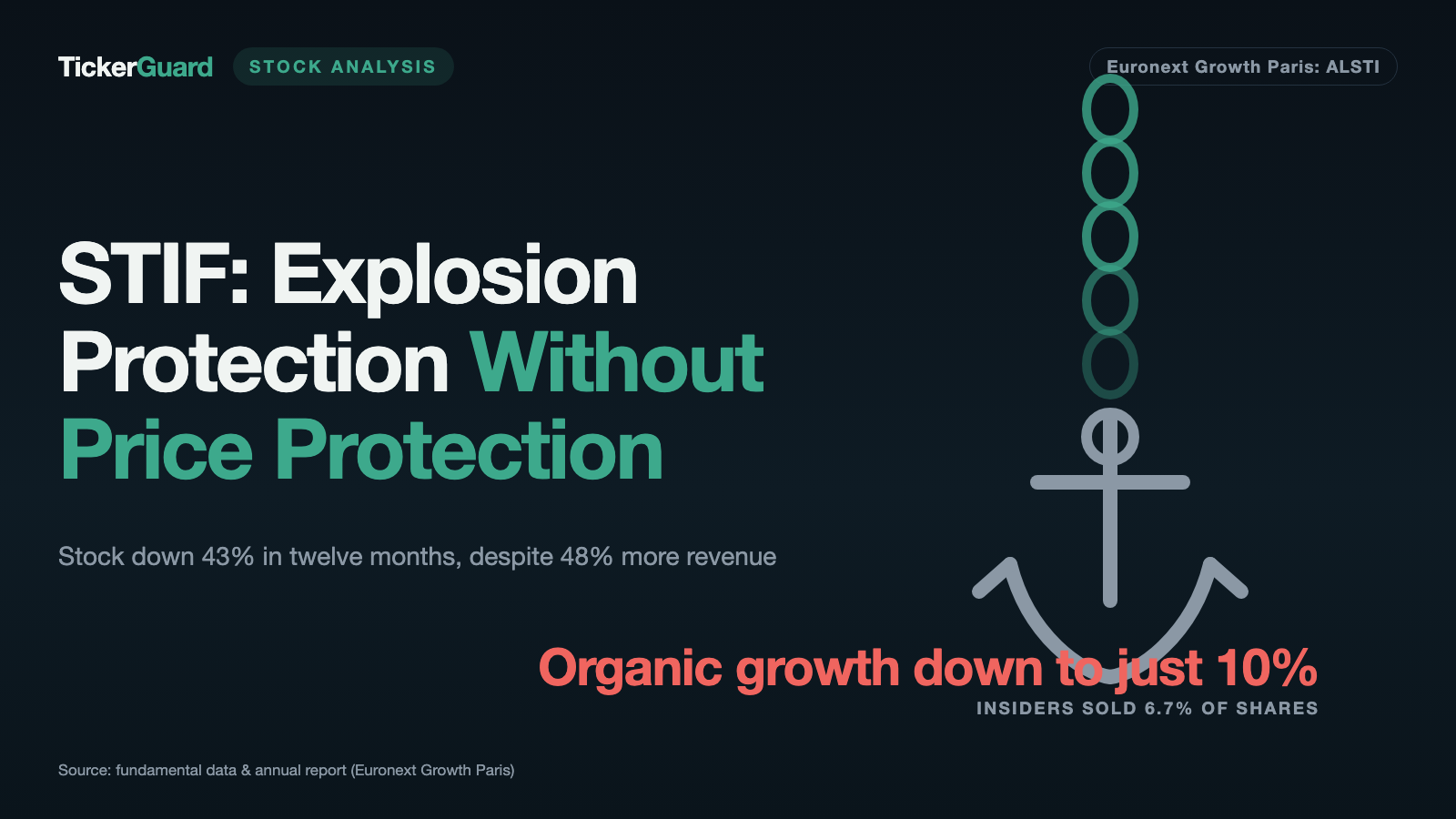
A French company builds valves and panels meant to stop a battery storage container from going up in flames — and the market has been treating it like a pure clean-energy growth stock. STIF Société anonyme (Euronext Growth Paris: ALSTI) reported 47.8 percent revenue growth for 2025 and 50.7 percent for the first half of 2026. Look closer, and only about a fifth of that recent growth was organic — the rest came from acquisitions. Months earlier, in the second half of 2025, the founding family and its holding company had already sold shares worth several million euros; the stock went on to fall more than 50 percent from its twelve-month high. We read the annual report. Not investment advice.
 Thomas Mücke
Founder & Publisher
Thomas Mücke
Founder & Publisher
There is a trap that catches green-growth stories more than most: a company delivers a headline number that fits perfectly into a big megatrend — here, battery storage, the energy transition, explosion protection for millions of new lithium-ion cells — and the brain jumps straight to a conclusion: if the trend is real and the number is real, the stock must be a good bet too. That shortcut skips a question that a little patience can answer: how much of that number is actually organic growth, and how much was simply purchased? STIF Société anonyme, a family-owned French industrial company from the Anjou region, is a textbook case for exactly that question.
This analysis is a journalistic assessment of publicly available information from STIF's 2025 annual report, its result releases, and fundamental data — not investment advice. All figures are evergreen and carry their own reference date; the €46.80 price is only a valuation anchor as of August 31, 2026.
What STIF actually does
When a dust cloud in a factory or thermal runaway inside a battery storage container turns into an explosion, split seconds decide whether a single component is damaged or an entire facility is lost. That is exactly what STIF (based in Saint-Georges-sur-Loire, near Angers, France) builds equipment for: vent panels, isolation flaps and pressure-relief valves that release explosion pressure in a controlled way or smother an explosion before it can spread, sold under brand names including VIGIFLAP, VIGIFLAM, VIGILEX, DUAL-VENT and VIGISPACE. Alongside that, STIF runs a second, much older business line: components for bulk-material handling — elevator buckets, conveyor belts and couplings for the pneumatic transport of powders and granules, a niche in which the company says it ranks among the world's three largest suppliers.
STIF was founded in 1984 by Manuel Burgos, who remains involved today as Deputy CEO; day-to-day leadership has since passed to his son José Burgos as chairman and CEO. On December 20, 2023, the family took the company public on Euronext Growth Paris — the exchange's smaller, less strictly regulated segment for mid-sized companies, not the main regulated market. About 400 employees (as of December 31, 2025) work across production sites in France, China (Suzhou) and the United States (San Antonio, Texas); more than 91 percent of 2025 revenue was generated outside France, across more than 80 countries.
The real stock-price driver of recent years is a third, newer business line: explosion protection for stationary battery energy storage systems (BESS) — the container-sized battery installations that stabilize power grids and solar or wind farms. STIF says it supplies industry names including U.S. storage maker Fluence, Finnish energy group Wärtsilä and — a customer with its own currency exposure, more on that below — Tesla. This BESS business grew 41.4 percent to €41.4 million in 2025 and now accounts for nearly half of group revenue.
Company history for investors
-
1984
Founded in Saint-Georges-sur-Loire
Manuel Burgos founds STIF as a maker of material-handling components and explosion-protection systems — the foundation of what remains a family-run company today.
-
2023
IPO on Euronext Growth Paris
STIF goes public on December 20, 2023 (ALSTI, ISIN FR001400MDW2) — opening the previously family-owned company to outside investors for the first time.
-
2025
Two acquisitions drive revenue, insiders sell shares
The Stuvex and BOSS Products acquisitions lift revenue growth to 47.8 percent — in the same half-year, the founding family sells 345,000 shares (6.72 percent of capital).
-
2026
More acquisitions, organic growth cut in half
STIF acquires Denmark's SAFEVENT and raises its BOSS Products UK stake to 100 percent; the July 22, 2026 revenue release shows organic growth of just 10 percent, with the stock 43 percent below its twelve-month high.
How this stock landed on our desk
The trigger for this analysis is a discrepancy visible in two of STIF's own mandatory disclosures. First, the share price: the stock hit its twelve-month high of €82.70 on September 1, 2025, then fell to a low of €40.30 by March 30, 2026 — a drop of roughly 51 percent. By August 31, 2026 it had recovered slightly to €46.80, still 43.4 percent below the twelve-month high, during a period in which the company kept reporting double-digit revenue growth. Second, two mandatory disclosures about founder share sales: on July 31, 2025 and again on October 22, 2025, STIF informed the market of block sales by family members and holding company JB Participations — 345,000 shares combined, 6.72 percent of capital. A stock that falls this hard despite strong headline numbers, while insiders sell at the same time, is a pattern worth reading the annual report for, rather than trusting the price chart alone.
The numbers over the years — growth at two different speeds
At first glance, the STIF story reads like a textbook energy-transition growth case: revenue rose from €35.0 million (2023, about $40.6 million) to €61.2 million (2024, about $71.0 million) to €90.5 million (2025, about $105.0 million) — nearly tripling in two years. A closer look shows where that growth actually came from.
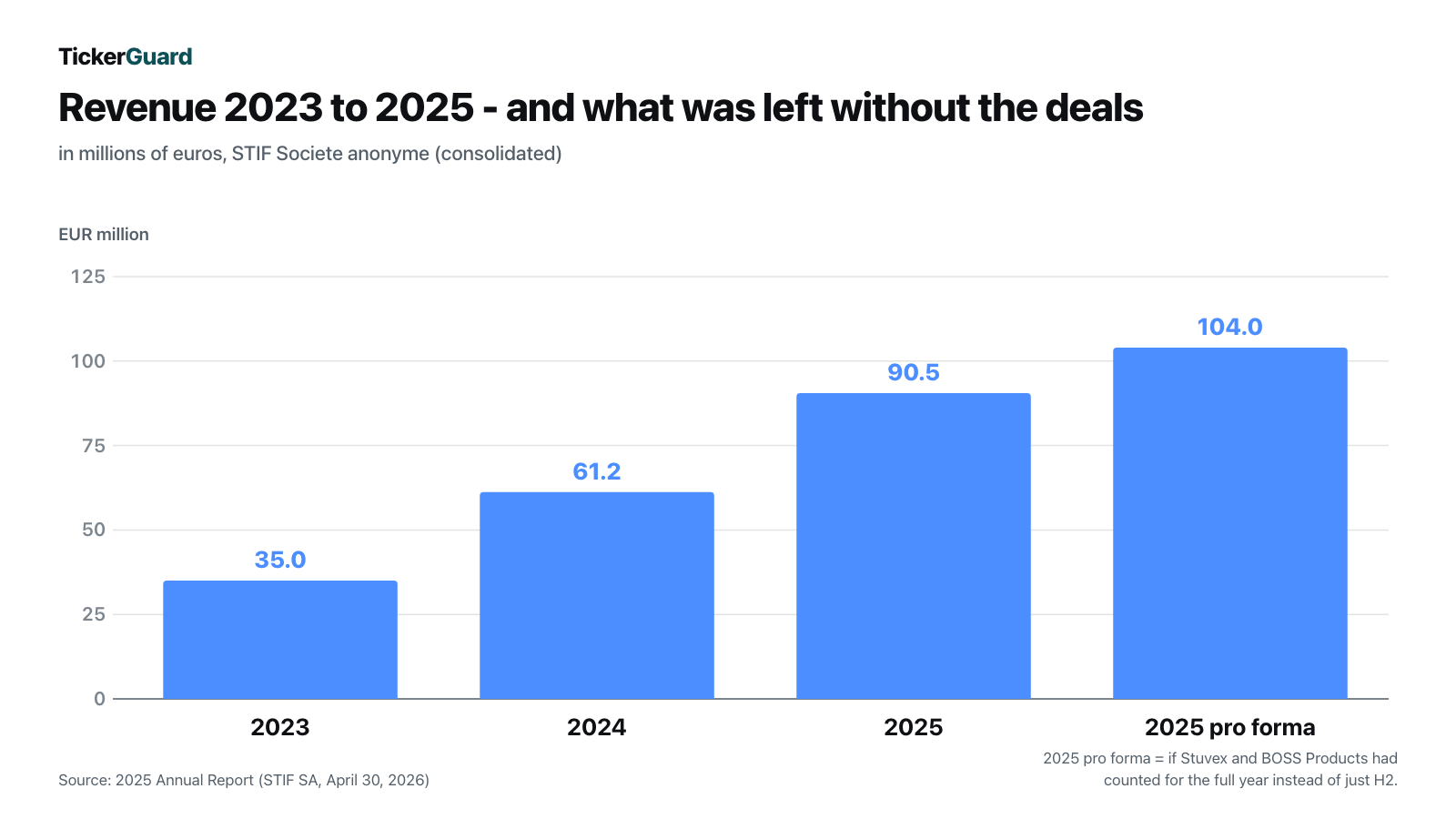
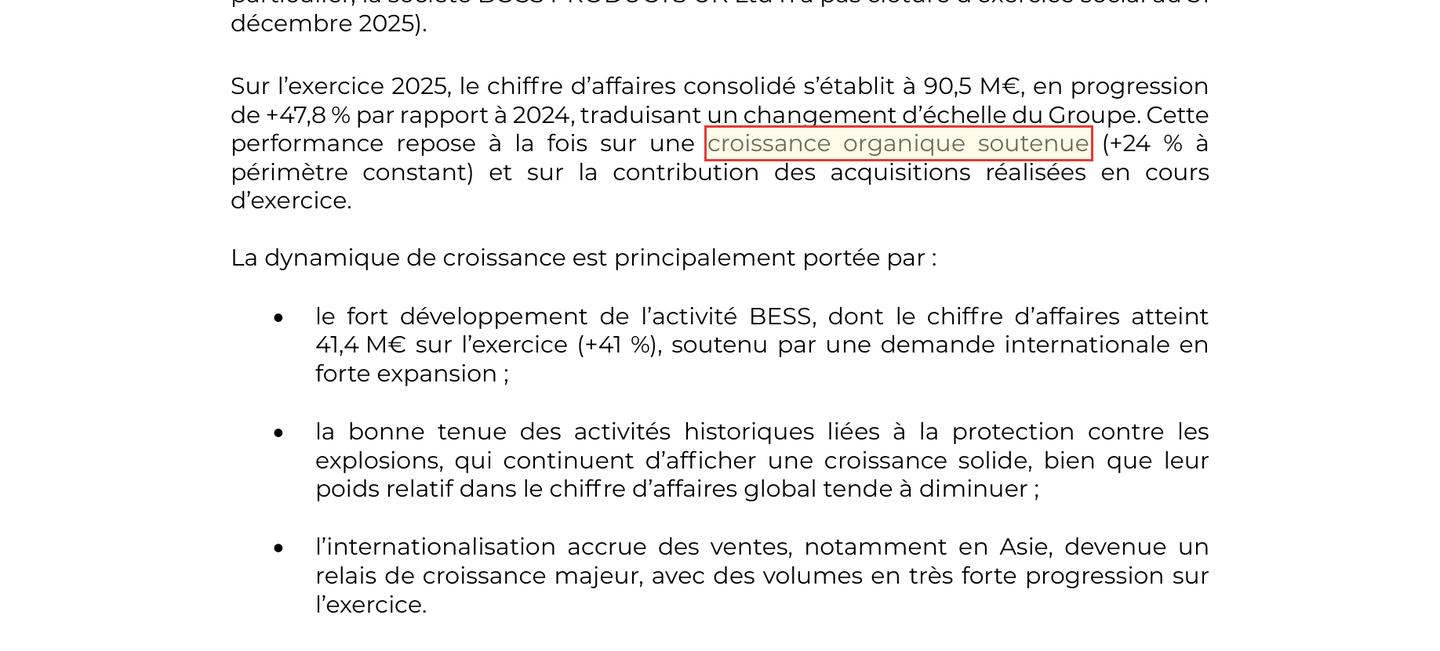
Of the 47.8 percent revenue growth reported for 2025, only 24 percentage points were organic — "à périmètre constant" ("on a constant scope basis"), as the annual report puts it, meaning excluding the revenue contributed by Stuvex (active explosion protection, consolidated since summer 2025) and BOSS Products (control acquired September 26, 2025). The company states it plainly:
« Sur l'exercice 2025, le chiffre d'affaires consolidé s'établit à 90,5 M€, en progression de +47,8 % par rapport à 2024 [...]. Cette performance repose à la fois sur une croissance organique soutenue (+24 % à périmètre constant) et sur la contribution des acquisitions réalisées en cours d'exercice. »
— STIF Société anonyme, 2025 Annual Financial Report (Rapport Financier Annuel), page 42
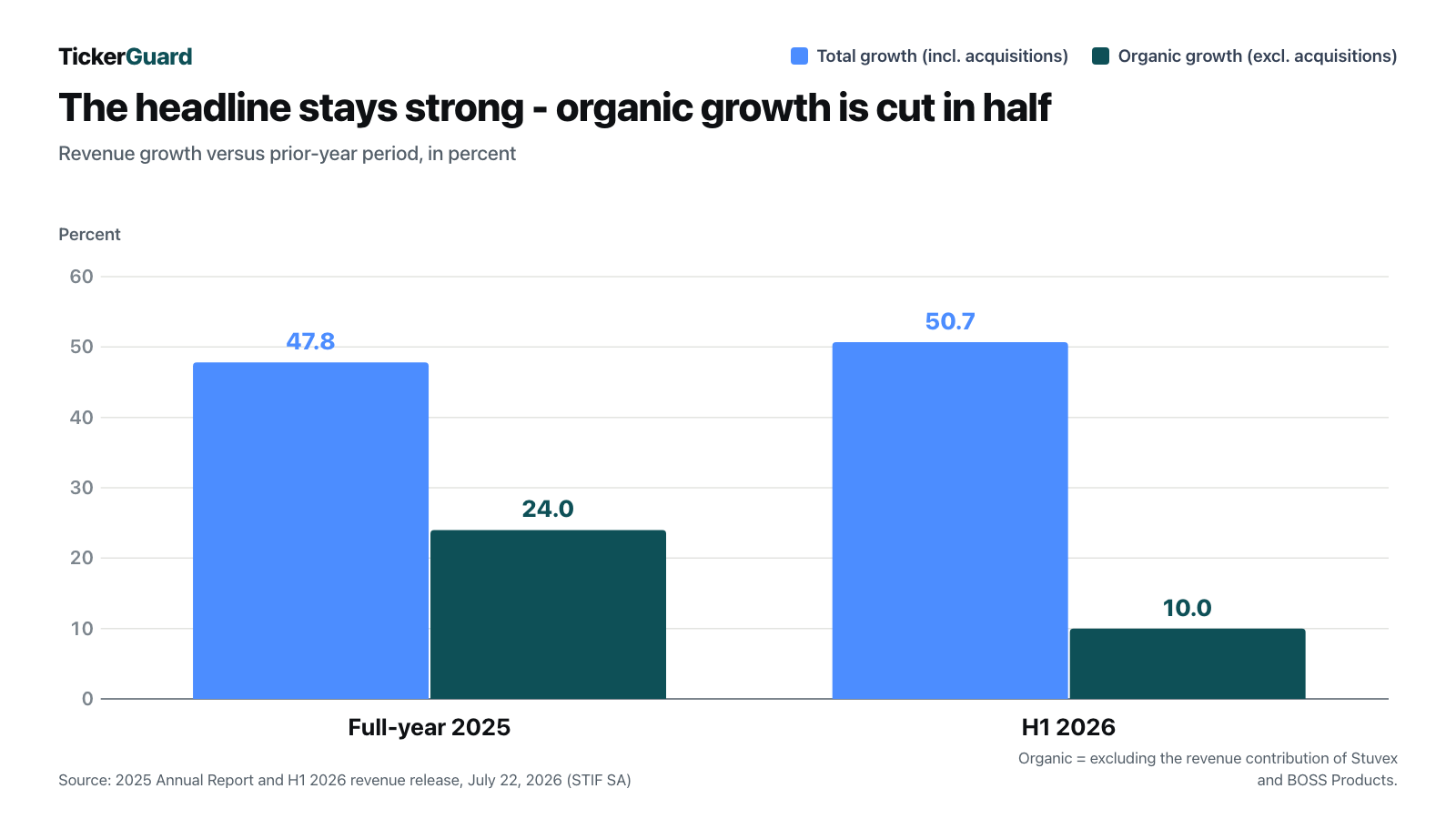
That is not a red flag on its own — 24 percent organic growth is strong for an industrial company, and acquired growth is not inherently worse growth. What matters is how the gap between organic and total growth evolves once the deals have been in the accounts for a full year — and the most recent available figure tells a different story than the headline. Per the July 22, 2026 revenue release, group revenue rose 50.7 percent to €55.3 million (about $64.1 million) in the first half of 2026 — a higher rate than the full year 2025. But with the acquisitions now counted for a full comparable period, only 10 percent organic growth was left, as the release itself admits: "Hors acquisitions, la croissance aurait été de +10%" ("excluding acquisitions, growth would have been +10%").
Profitability tells a similar story behind the absolute numbers: the EBITDA margin (operating profit before interest, taxes, depreciation and amortization, as a share of revenue) slipped to 22.7 percent in 2025, from 25.6 percent in 2024 — net income attributable to the group still rose 22 percent to €11.8 million (about $13.7 million), but slower than revenue. Gross margin fell from 64.0 to 63.0 percent. Both fit the same pattern: the newly integrated businesses — particularly the pure-distribution BOSS Products unit in the U.S. — add revenue, but at thinner margins than STIF's core explosion-protection business.
What the investor presentations show — without a call transcript
An honest note upfront: no publicly available earnings call transcripts exist for STIF (checked September 1, 2026). Unlike some other internationally listed names in our archive, an independent search also turned up no third-party written summaries of an analyst conference. STIF is a small Euronext Growth issuer and appears to communicate results primarily through PDF presentations and written press releases (Actusnews wire), not through a publicly documented, live analyst call. As a substitute, we instead assess the "H1 2025 Results & 2030 Ambitions" presentation from October 22, 2025 — where management laid out its 2030 target framework — against what has actually happened since.
On October 22, 2025, STIF unveiled its "Horizon 2030" ambition: a global footprint across more than three continents, a doubling of group revenue from the then-current level, leadership in integrated industrial safety solutions, and — quantified in the April 1, 2026 results presentation — €200 million in revenue by 2030. The company's own documents are not fully consistent on the margin target: the 2025 annual report states the goal as "devrait être supérieur à 20%" (should exceed 20 percent), the body text of the results presentation speaks of a margin "exceeding 20%" — only the graphic label on that same slide rounds down to "20%." Stated priorities included accelerating sales growth, growing Stuvex sales in Europe, expanding the BESS product range, and rolling out new product lines internationally.
Nine months later, the July 22, 2026 revenue release shows a mixed picture against those commitments. International expansion is genuinely delivering — North American revenue more than doubled in H1 2026 (up 117 percent to €20.3 million, about $23.5 million), and Europe outside France grew 58 percent. The BESS business kept growing at a strong pace (up 41.4 percent to €25.6 million). But the "accelerate growth" priority named first in October 2025 shows up only in the headline number: organically, growth has more than halved, as shown in the previous section. The 22.7 percent EBITDA margin already achieved in 2025 technically still sits above the company's own 2030 target of "above 20 percent" — but with far less room than the round target number suggests, and the margin has already fallen from 25.6 percent in 2024. Whether management expects a further slide toward that 20 percent line, or simply phrased the target conservatively, cannot be answered from the available documents.
What's in the annual report — the uncomfortable truths
Uncomfortable truth No. 1: nearly half of reported growth was purchased — and the buying pace hasn't slowed
As shown above, only 24 percentage points of the 47.8 percent revenue growth reported for 2025 were organic. STIF's annual report lists two further acquisitions in its "events after the balance sheet date" section: the majority takeover of Danish firm SAFEVENT (also explosion protection, via Belgian subsidiary Torino Holding BV) and raising the stake in BOSS Products UK from 70 to 100 percent on April 8, 2026. In just over a year, STIF has completed or expanded four acquisitions: Stuvex and BOSS Products (2025), SAFEVENT and BOSS Products UK (2026). On its own, that is a plausible consolidation strategy in a fragmented niche market — it only becomes a problem if the market mistakes the headline growth rate for organic momentum, when the company's own fine print says the opposite.
Uncomfortable truth No. 2: the founding family sold 6.7 percent of shares while publicly promising to double the business by 2030
Two mandatory disclosures in the 2025 annual report document share sales by the Burgos founding family: on July 31, 2025, Manuel Burgos (70,000 shares) and Valérie Burgos (25,000 shares) sold a combined 95,000 shares (1.85 percent of capital) through an off-market block placement. Barely three months later, on October 22, 2025, holding company JB Participations — controlled by chairman and CEO José Burgos — sold a further 250,000 shares (4.9 percent of capital).
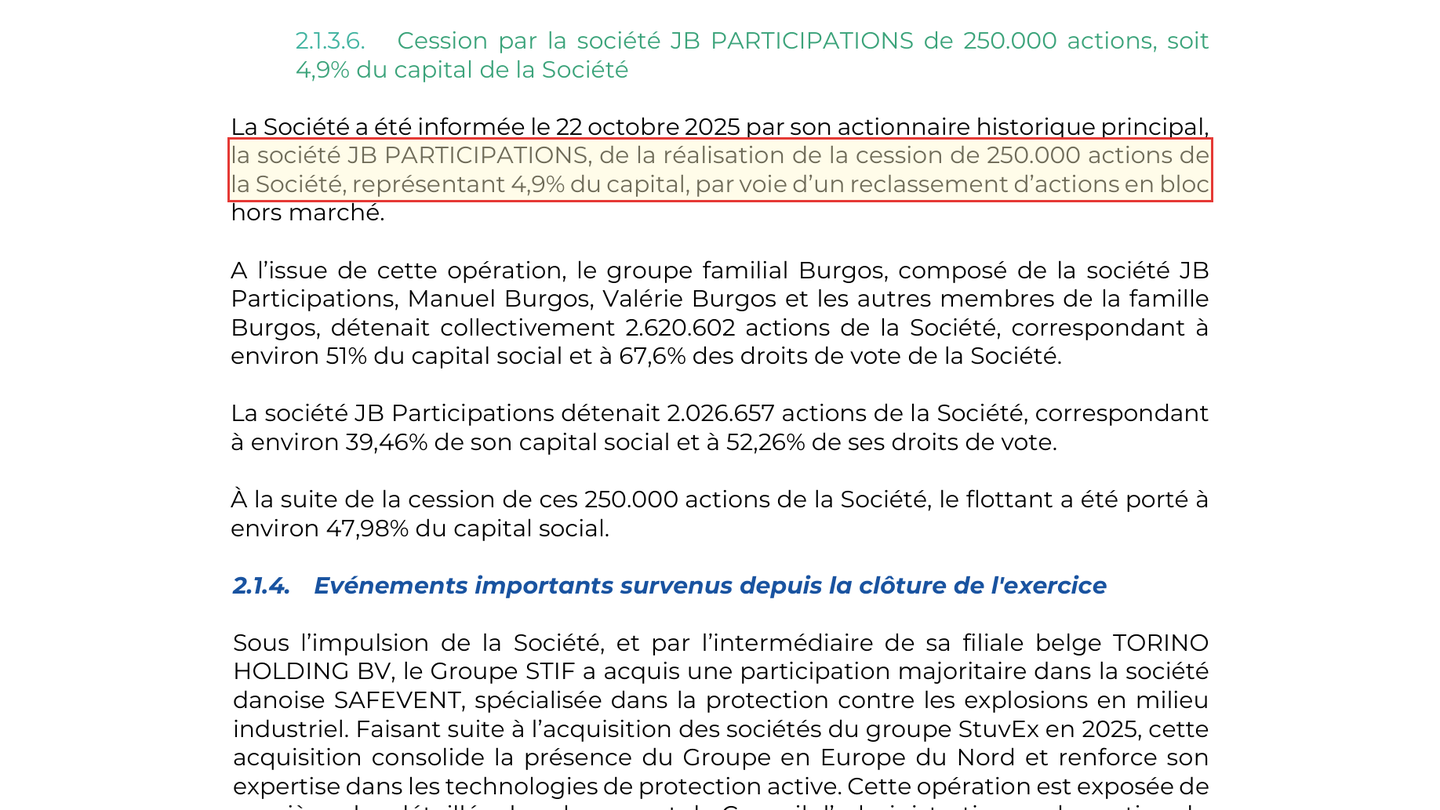
In total, 345,000 shares (6.72 percent of capital) changed hands — at share prices between roughly €50 and €90 during that period, an estimated value of several million euros. The annual report discloses neither a sale price nor a buyer for either transaction; the Burgos family retained control after both sales (about 51 percent of capital, 67.6 percent of voting rights) — so these were partial disposals from a highly concentrated position, not a change of control. That does not automatically make the sales a warning sign — founding families diversify their wealth for understandable reasons, especially after a run-up in the share price since the IPO. What stands out is the timing: both sales took place months before the July 22, 2026 revenue release made the organic slowdown public.
Uncomfortable truth No. 3: a major customer is Tesla — and it brings a currency risk the report itself rates as "low"
In its risk section, STIF's annual report names its main foreign-currency customer directly:
« Le Groupe est aujourd'hui exposé à un risque de change sur les ventes réalisées dans une devise qui n'est pas celle de l'entreprise qui a manufacturé les produits. Ceci concerne avant tout les ventes réalisées avec le client Tesla (facturées en USD) ; le changement à terme de lieu de fabrication (passage de St Georges sur Loire à San Antonio) mettrait un terme à ce risque. »
— STIF Société anonyme, 2025 Annual Financial Report (Rapport Financier Annuel), page 65
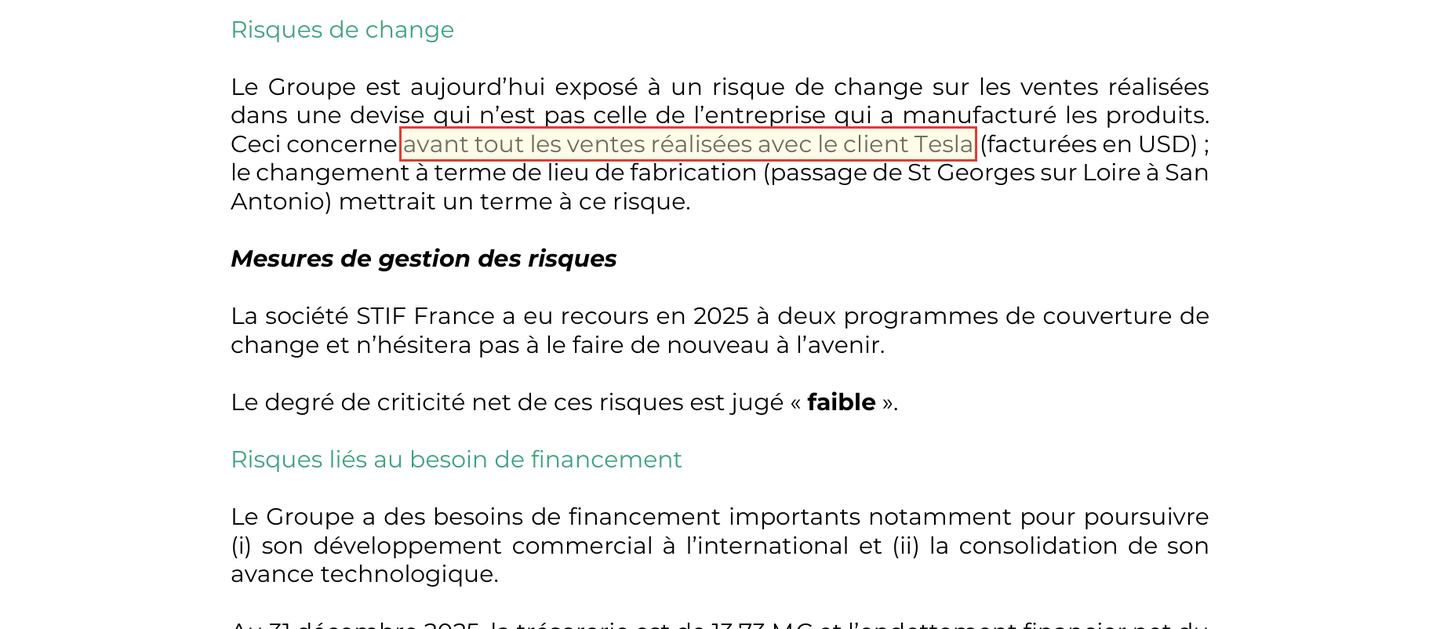
What the report does not quantify is notable: how large Tesla's — or any single customer's — share of revenue actually is is never disclosed anywhere in the annual report, unlike some Taiwanese or South Korean suppliers in our archive, which often disclose concrete percentages for their largest customers (even if anonymized). STIF's North American business grew 117 percent in H1 2026 — a pace that is hard to assess without concrete customer figures: it could reflect broad demand from many customers, or growing dependence on a few. The company itself rates the currency risk as "low," pointing to two hedging programs used in 2025 and its longer-term plan to move production for the U.S. market closer to U.S. customers (from Saint-Georges-sur-Loire to San Antonio, Texas) — a structural fix that has not yet been implemented.
Valuation — expensive for a company with organic growth cut in half
With 5,135,455 shares outstanding and a price of €46.80 (about $54.30, August 31, 2026), market capitalization works out to roughly €240 million (fundamental data shows about €239 million, a reference-date difference) — about $277 million, using a rate of 1 EUR = 1.16 USD. Based on trailing earnings, the price-to-earnings ratio is roughly 20, the price-to-sales ratio roughly 2.6, and the enterprise-value-to-EBITDA ratio roughly 15 (fundamental data, as of August 2026). The price-to-book ratio is roughly 8 — high, but not unusual for a company that has grown sharply through acquisitions over two years and roughly doubled its balance sheet (€93.1 million versus €51.3 million in total assets).
For a sense of how a market can price a similar pattern: in our Amphenol analysis, we showed how a celebrated "record margin" actually contained a one-time effect (a tariff refund) that management itself declined to extrapolate — there at an established global company with broad analyst coverage. STIF's situation is structurally similar, only smaller and with far thinner coverage: five brokers (Portzamparc, Gilbert Dupont, Euroland, GreenSome Finance, Kepler Cheuvreux) put the consensus price target at €83.79 (about $97.20) per fundamental data — roughly 79 percent above this analysis's €46.80 price anchor (the data provider itself lists a different, roughly 63 percent upside, based on another, unstated reference date). Whether that target already reflects the organic-growth slowdown reported in July 2026 cannot be checked from the outside; the underlying analyst research itself is not available to us.
The dividend of €0.68 per share (about $0.79) most recently proposed — for fiscal year 2025, shareholder meeting May 22, 2026, a total payout of roughly €3.49 million — equals a payout ratio of roughly 30 percent of group net income and, at the current price, a yield of roughly 1.5 percent — a side note for a growth company, not a reason to buy.
Opportunities and risks at a glance
Opportunities: a structurally growing market for explosion protection at battery storage sites, with named reference customers including Fluence, Wärtsilä and Tesla; four decades of accumulated technical expertise, with its own production sites on three continents; moderate leverage (net debt of €24.3 million, leverage ratio 1.2 as of December 31, 2025) despite several acquisitions; a concrete "Horizon 2030" ambition targeting €200 million in revenue; and a share price that, after falling 43 percent, may already reflect part of the previously very optimistic expectations. Risks: organic growth that, per the company's own disclosure, more than halved from 24 to 10 percent while the headline number stayed in double digits; a declining EBITDA margin (22.7 versus 25.6 percent the year before) that still clears the company's own 2030 target ("above 20 percent") but with a shrinking cushion; two documented insider sales by the founding family totaling 6.7 percent of capital within three months; undisclosed customer concentration with at least one large U.S. customer (Tesla) carrying foreign-currency exposure; a balance sheet reshaped by four acquisitions in just over a year, before the integration track record is proven; and overall thin trading liquidity given a market capitalization of only about €240 million.
A human conclusion
The temptation with a stock like STIF is the shortcut: battery storage is the future, STIF protects battery storage from explosions, therefore STIF is a buy. Each step in that chain sounds almost right on its own — which is exactly what makes the shortcut so tempting. What it skips is the question that only the annual report, read closely, can answer: is the underlying business actually growing, or is the balance sheet simply growing because the company keeps buying new firms every half-year? For STIF, the honest answer as of today is: a bit of both, with a visible shift toward the latter. That alone doesn't make the stock a bad investment — a family business that has survived four decades in a niche market and now serves a genuine growth market has real strengths. It just means the headline number alone is the wrong basis for a decision — and a 43 percent price decline alongside continued double-digit reported growth deserves a question, not reassurance. What you do with that is your decision. And that's how it should be.
Sources
This analysis draws on: the 2025 Annual Financial Report (Rapport Financier Annuel, dated April 30, 2026) of STIF Société anonyme; the "2025 Full-year results" presentation (April 1, 2026); the "H1 2025 Results & 2030 Ambitions" presentation (October 22, 2025); the H1 2026 revenue release (Actusnews/Boursorama wire, July 22, 2026); and fundamental data (balance sheet, income statement, price and valuation metrics, analyst consensus, as of August 4-31, 2026). No publicly available earnings call transcripts exist for ALSTI.PA. Note: this analysis is a journalistic assessment of publicly available information, not investment advice and not a solicitation to buy or sell securities.
Our Bottom Line at a Glance
- Growth neutral
- Reported revenue rose 47.8 percent in 2025 and 50.7 percent in H1 2026 — but only 10 percentage points of the latter were organic (July 22, 2026 revenue release), down from 24 points for full-year 2025. The core business is growing solidly, but noticeably slower than the headline number suggests.
- Profitability and margin negative
- EBITDA margin fell to 22.7 percent in 2025 (2024: 25.6 percent), gross margin to 63.0 percent (2024: 64.0 percent). The 2025 margin still clears the company's own 2030 floor ("above 20 percent"), but the cushion is shrinking fast given the margin already fell year over year.
- Balance sheet and leverage neutral
- Net financial debt of €24.3 million at a leverage ratio of 1.2 and gearing below 0.8 (December 31, 2025) — moderate for a company that has roughly doubled its balance sheet through acquisitions in two years (€93.1 million versus €51.3 million in total assets). On liquidity risk, the annual report contradicts itself: the body text calls the risk "faible" (low) and the situation "saine" (healthy), while the formal rating at the end of the same section reads "élevé" (high).
- Ownership structure and insider behavior negative
- The Burgos founding family sold a combined 345,000 shares (6.72 percent of capital) across two block placements in the second half of 2025 — months before the organic growth slowdown became public. The family retains control (roughly 51 percent of capital, 67.6 percent of voting rights); the roughly €240 million market capitalization keeps overall trading liquidity thin.
- Customer dependency and disclosure negative
- The annual report names Tesla as a central foreign-currency customer but never discloses what share of revenue any single customer actually represents — unlike comparable Asian suppliers in our archive. That limits how precisely the concentration risk can be assessed from the outside.
- Market position and valuation positive
- STIF serves a structurally growing niche market — explosion protection for battery storage — with named reference customers including Fluence and Wärtsilä. After the 43 percent price decline from its twelve-month high, the P/E ratio is roughly 20 — no longer at peak-era valuation levels, but still demanding for a company whose most recent organic growth was just 10 percent.
STIF looks, at first glance, like a classic clean-energy growth story: revenue up 47.8 percent in 2025, up 50.7 percent in the first half of 2026, a concrete €200 million revenue ambition for 2030. Look closer, and only about a fifth of the most recent growth was organic, with the rest coming from a steady stream of acquisitions; margin is shrinking despite growth; and the founding family sold shares worth several million euros months before the stock fell more than 50 percent from its twelve-month high. Not investment advice.
What Our Rating Means
Open questions
The business works in principle, but one material question is open. As long as it stays open, our findings do not carry a quality verdict.
Yellow here does not reflect a question about the company's survival — the balance sheet is solidly financed at a leverage ratio of 1.2, the core business keeps growing organically, and the company has operated in its home niche for four decades. Yellow reflects several open operational questions that matter for how durable the growth story is: first, organic growth fell from 24 to 10 percent per the company's own disclosure, while the headline figure stays in double digits thanks to a steady stream of acquisitions — whether the organic pace stabilizes or keeps falling will not be clear until the full H1 2026 report, scheduled for October 1, 2026. Second, margin is falling despite growth — the 2025 level still clears the company's own 2030 target ("above 20 percent"), but with a shrinking cushion. Third, the founding family sold 6.7 percent of capital within three months — a legitimate move, but one that took place months before the growth slowdown became public. None of this threatens the company itself; taken together, though, it meaningfully tempers what looks, at first glance, like an impressive growth headline. The decision is yours.
A journalistic assessment by our editorial team at the time of the deep dive, based on public sources — not investment advice and not a solicitation to buy or sell. Your personal circumstances (investment goals, risk capacity, taxes) cannot be taken into account. What our levels mean, how verdicts are formed, and what conflicts of interest exist →
Worth Noting
- This analysis was first published on September 1, 2026. All company figures come from the 2025 Annual Financial Report (April 30, 2026) and the July 22, 2026 revenue release — not from press coverage. Price, share count and valuation metrics are as of August 4-31, 2026.
- No publicly available earnings call transcripts exist for ALSTI.PA (checked September 1, 2026; independent written summaries could not be found either). The investor-communication chapter therefore relies on the company's PDF presentations instead of a call transcript.
- The full H1 2026 report (with balance sheet and income figures as of June 30, 2026) had not yet been published as of September 1, 2026, per STIF's financial calendar (scheduled for October 1, 2026); the already-available July 22, 2026 revenue release was used instead.
- Price and valuation metrics carry a reference date of August 31, 2026 — the most recent fundamental data on file at the time of publication.
The full analysis as a PDF for later
We will send you this analysis as a PDF — to print, file away, and read at your own pace.
Frequently Asked Questions
STIF Société anonyme (Euronext Growth Paris: ALSTI), based in Saint-Georges-sur-Loire, France, builds explosion-protection systems — vent panels, isolation flaps, pressure-relief valves — mainly for battery energy storage systems (BESS), plus bulk-material handling components such as elevator buckets and conveyor belts. Founded 1984 by Manuel Burgos, publicly listed since December 20, 2023.
Of the 47.8 percent revenue growth reported for 2025, only 24 percentage points were organic per the annual report — the rest came from the 2025 acquisitions of Stuvex and BOSS Products. In the first half of 2026, per the July 22, 2026 revenue release, organic growth was just 10 percent, even as the total figure rose to 50.7 percent.
Yes: on July 31, 2025, Manuel and Valérie Burgos sold a combined 95,000 shares (1.85 percent of capital); on October 22, 2025, holding company JB Participations (controlled by chairman and CEO José Burgos) sold a further 250,000 shares (4.9 percent). In total, 345,000 shares (6.72 percent) changed hands; the Burgos family still holds about 51 percent of capital and 67.6 percent of voting rights afterward.
STIF is listed on Euronext Growth Paris, not in the United States — there is no SEC registration, no 10-K, no 10-Q. Instead, French rules require an annual Rapport Financier Annuel and half-year reports, published on the company's own investor relations site, investir.stif.fr. This analysis relies on the 2025 annual report and the July 22, 2026 revenue release.
No. STIF builds mechanical and electronic explosion-protection hardware and bulk-material handling components — no AI software or hardware. The company benefits indirectly from the buildout of battery storage infrastructure, some of which powers data centers and AI workloads, but it does not sell AI products itself.
The 2025 annual report does not disclose a quantified customer concentration, but names Tesla as the central USD-invoiced customer in its currency-risk discussion. Fluence, Wärtsilä, BYD and Trina Solar are named as further BESS customers, without disclosed revenue shares.
At €46.80 (about $54.30, August 31, 2026) and 5,135,455 shares outstanding, market capitalization is roughly €240 million (about $278 million; fundamental data puts it at roughly €239 million on a different reference date). The price-to-earnings ratio is roughly 20 and the price-to-sales ratio roughly 2.6 (fundamental data, as of August 2026) — not cheap for a company whose organic growth was just 10 percent in its most recent reported period.
For fiscal year 2025, the board proposed a dividend of €0.68 per share (about $0.79), voted on at the May 22, 2026 shareholder meeting — equal to a payout ratio of roughly 30 percent of group net income and, at the August 31, 2026 price, a yield of roughly 1.5 percent.
Found an error?
Did you spot a factual error, an outdated number, or a typo in this deep dive? Let us know briefly — your report goes straight to the editorial team.