Stewart Information Services: $54 of Book Value per Share — $1.58 of It You Can Touch
Stewart is the fourth-largest title insurer in the United States, in business since 1893, and the stock looks grounded: price-to-book of roughly 1.26, a price-to-earnings ratio near 15, and a dividend yield just above 3 percent (data as of August 20, 2026). The filings with the U.S. securities regulator, the SEC, show a second layer. Revenue has almost fully recovered from the rate shock — $2,921.6 million in 2025 against $3,305.8 million in the record year 2021. Earnings per share have not: $4.05 against $11.90. And of the $54.63 book value per share as of June 30, 2026, roughly $1.58 is tangible, because goodwill and intangibles absorb 97 percent of equity. What counts in the end is not what the balance sheet says, but what survives once you subtract the goodwill.
 Thomas Mücke
Founder & Publisher
Thomas Mücke
Founder & Publisher
As of Today
As of: October 5, 2026
- Closing price
- 50.80 $ -1.40%
- Market Capitalisation
- 1.5 $B
- Growth Score
- 4/10
- AAQS
- 7/10
Price change since August 20, 2026: -26.3%
This analysis has a cut-off date. The Stock Guard tells you when something material changes in the numbers. Reserve your free spot
Chart
Interactive price chart (TradingView).
52-week range: 49.70 $ to 77.20 $ · Last price: 50.80 $ (As of: October 5, 2026)
Note: pure fact-based analysis, not investment advice and not a solicitation to buy or sell. All figures without guarantee.
There is an investor trap that catches careful people in particular — because it feels like prudence: the book value illusion. It goes like this. You are not chasing the hot growth story; you want something solid. You find a company trading at roughly 1.26 times book value and you think: “For every dollar I pay, there is a dollar of substance sitting on the balance sheet. How wrong can this go?” The instinct is honorable. It just assumes one thing nobody has checked — that the book value consists of things that actually exist. Stewart Information Services Corporation (NYSE: STC) of Houston, Texas, has been insuring ownership rights to real estate since 1893 and is today the fourth-largest U.S. title insurer. Reported book value stood at $54.63 per share on June 30, 2026. Tangible book value — after deducting goodwill and intangibles — works out to roughly $1.58. So let us make a deal: before you write “cheaply valued” in your notebook, we read together what Stewart itself reported to the U.S. securities regulator, the SEC — the annual report on Form 10-K for 2025, the quarterly report on Form 10-Q for the period ended June 30, 2026, and the 2022 annual report that documents the boom years. An SEC filing is honest under penalty of law. And this one tells of revenue that has almost returned, earnings per share that have not, and $332.7 million that landed on the balance sheet almost entirely as goodwill. In the end, the decision is yours.
What Stewart Actually Does — the Insurance You Buy Only Once
Title insurance is an American product with no direct European equivalent, so it is worth an everyday picture. Imagine buying a house. In much of Europe, a public land register carries a state guarantee: what it says, counts. The United States has no such register. Instead, ownership records sit scattered across county archives — old deeds, probate records, tax liens, mechanic's liens, divorce decrees. Somebody has to search that paper mountain and guarantee that the seller really owns the property and that no one else has a claim. That is exactly what Stewart does: search, examine, insure. And then the unusual part — the premium is paid once, at closing, and covers losses arising from events that occurred before the purchase, for as long as the owner holds the property. No annual premium, no renewal. A business that earns money only when real estate changes hands or mortgages are written.
Stewart sells this through three channels, and the differences between them are the key to everything that follows. First, direct operations: company-owned offices, company employees, and all of the revenue stays in house — $1,157.5 million in 2025. Second, agency operations: independent title agencies sell policies under Stewart's underwriting, Stewart carries the risk and keeps a share of the premium — $1,262.6 million of gross revenue in 2025, of which roughly 83 percent flows straight back to the agencies. Third, real estate solutions: credit reporting, valuations, online notarization, property preservation for mortgage servicers — $438.3 million in 2025, and the only area Stewart actively buys into. As of December 31, 2025 the group employed roughly 7,800 people, about 6,000 of them in the United States and 1,800 at locations outside it, mainly in Canada.
That frames the central tension of this analysis, and it runs through every chapter that follows: Stewart is growing strongly again — but the growth comes from the two channels where the least of it sticks, and a substantial part of it was bought rather than earned. What looks like substance on the balance sheet is 97 percent goodwill and intangibles.
Company history for investors
-
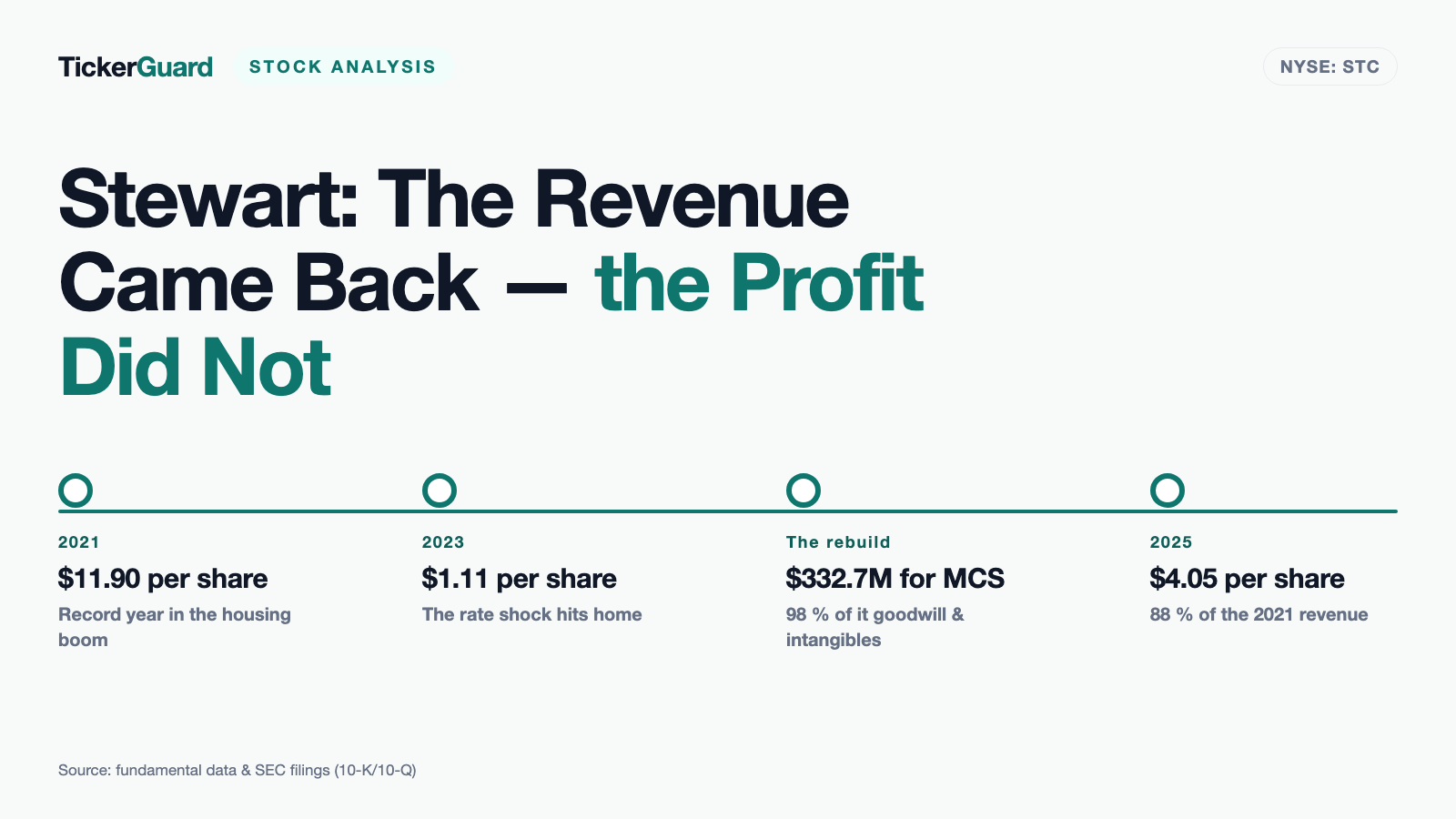
2021
Record year in the housing boom
$3,305.8 million of revenue and $11.90 of earnings per share — the best result in recent company history. In November 2021 Stewart locked in $450 million at 3.6 percent until 2031.
-
2023
The rate shock lands
Revenue fell to $2,257.3 million and earnings per share to $1.11. The $50.5 million dividend was not covered that year by $45.2 million of free cash flow.
-
2025
Equity offering and the purchase of MCS
The fourth quarter added 2,185,000 new shares for $140.8 million net; in December, the acquisition of Mortgage Contracting Services cost $332.7 million, 98 percent of it goodwill and intangibles.
-
2026
Revenue up 26 percent — core margin down
First-half revenue rose to $1,680.5 million. In the second quarter the title segment pretax margin nonetheless slipped from 8.1 to 6.9 percent, because the growth came from agency operations.
How the Stock Landed on Our Desk
Honesty first: Stewart did not reach our research list through a hit in our in-house stock scanner, but through the ongoing review of the U.S. equity universe — the company was not covered in our database at all before August 21, 2026. What stood out was the combination of metrics: a price-to-earnings ratio near 15, price-to-book around 1.26, and a dividend yield just above 3 percent (data as of August 20, 2026) — at a company whose revenue has grown by almost a quarter over the trailing twelve months. Combinations like that are either an opportunity or a warning, and which of the two never shows up in a screener. It shows up in the notes.
A useful reference point is the market leader, which we have already taken apart: Fidelity National Financial, where the vault is full but the money belongs to others. And because Stewart's business hangs on the mortgage cycle, it pays to look at the financing side of the same market, which we described in Rocket Companies and the $19.4 billion nobody ever paid for. Remember the finding now: with title insurers, you do not measure by the price-to-book ratio, but by what the book value is made of.
The Numbers Over the Years — Honestly Credited
First, what genuinely speaks for Stewart — and that is more than this article's headline suggests. The company survived a brutal cycle without ever posting a loss. When the Federal Reserve raised rates through 2022 and 2023 and the mortgage market collapsed, Stewart's pretax income did not halve — it fell by roughly an order of magnitude. Even so, every single year ended in the black. And the recovery is real: $2,921.6 million of revenue in 2025, after $2,490.4 million in 2024 and $2,257.3 million in 2023, an increase of 18 percent in 2025. The first half of 2026 continued the trend: $1,680.5 million against $1,334.2 million a year earlier, up 26 percent. Net income attributable to Stewart rose from $35.0 million to $54.2 million in the same period. The claims side is behaving too: the title loss ratio fell to 3.2 percent of title revenue in the second quarter of 2026, from 3.6 percent in the prior-year quarter. And the balance sheet carries: $261.6 million of cash, $646.7 million of debt against $1.67 billion of equity, and a debt-to-capitalization ratio of roughly 28 percent (all as of June 30, 2026). The dividend of $2.10 per share cost $58.5 million in 2025, against $132.3 million of free cash flow — coverage of 2.3 times.
Now the chart that puts all of it in perspective — diluted earnings per share over five years:
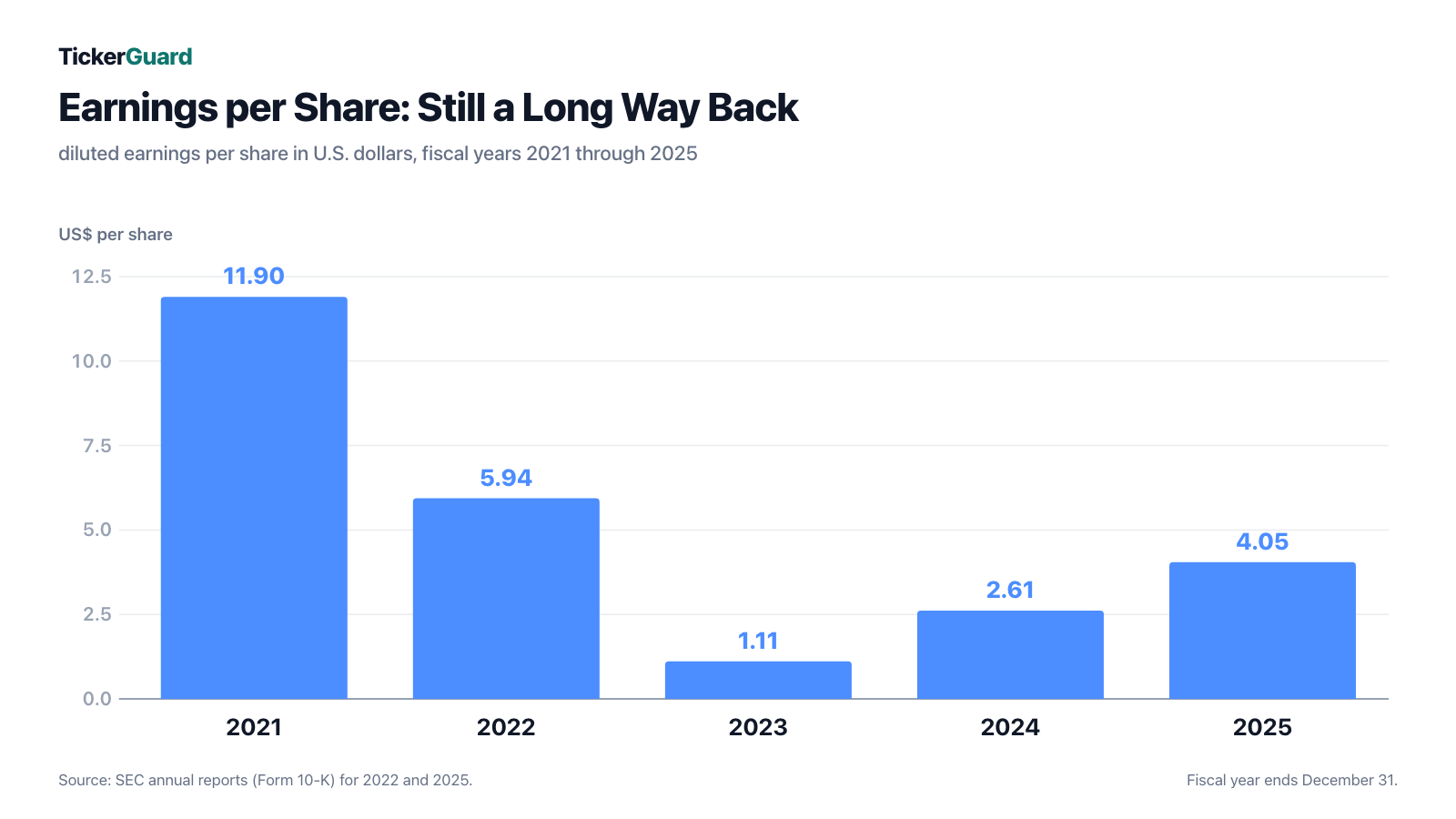
That gap is the real story. In 2021 Stewart generated $3,305.8 million of revenue and earned $11.90 per share. In 2025 revenue was $2,921.6 million — 88 percent — and earnings per share were $4.05, or 34 percent. Where did the rest go? The second chart shows most of the answer: revenue is nearly back, but it comes out of different pockets than it used to.
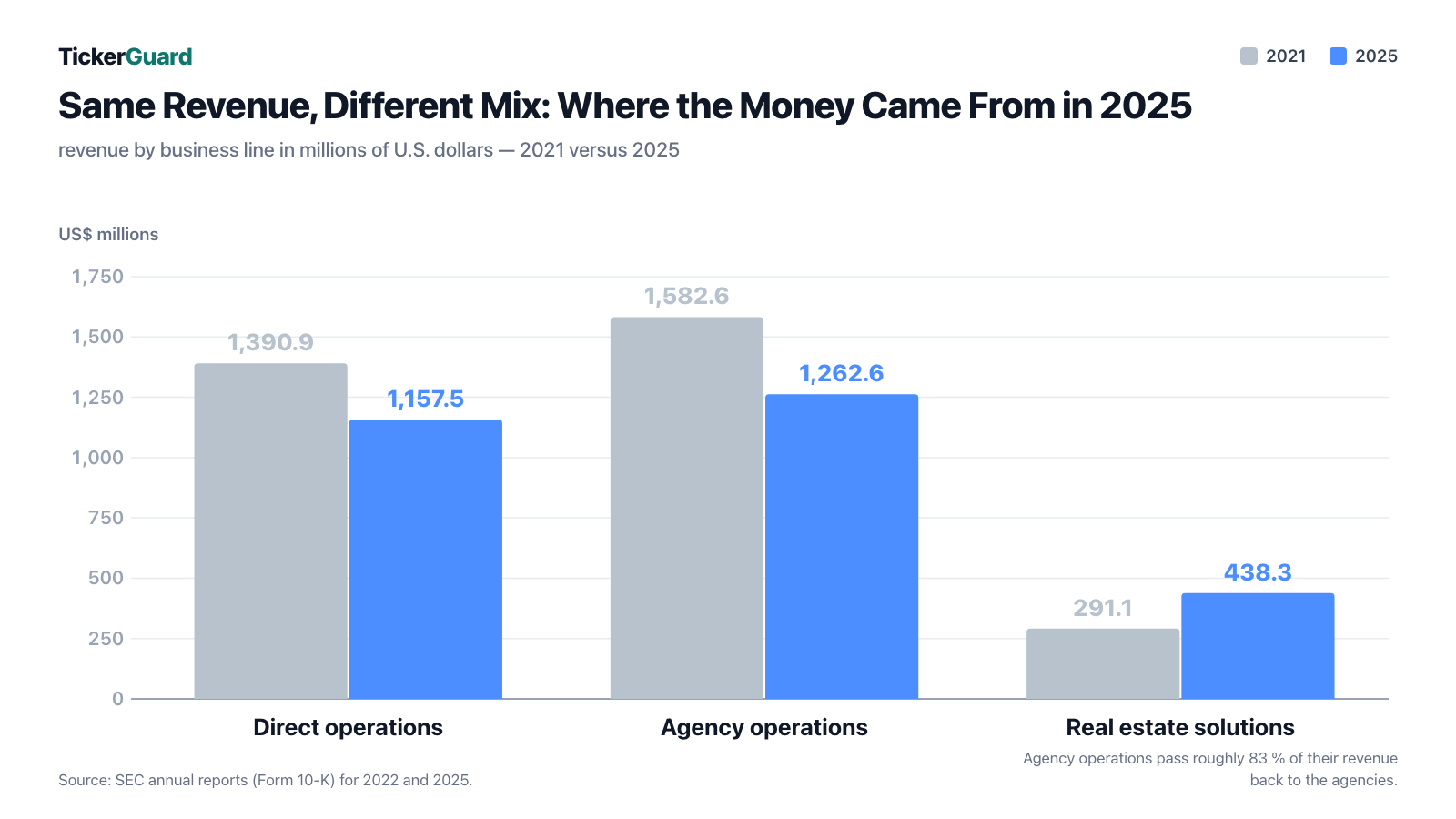
Put in everyday terms: picture a baker who used to sell most of his bread in his own shop. Today he books the same revenue, but a large share runs through market stalls he does not own and has to hand 83 cents of every dollar to, plus a café he bought at a steep price. Revenue on paper is unchanged. What sits in his till at month's end is not. Remember this: at Stewart, revenue growth and profit growth are not the same thing — and for a structural reason, not a one-time one. Which brings us to the uncomfortable truths.
What the Filings Say — the Uncomfortable Truths
Uncomfortable truth No. 1: of $54.63 of book value per share, roughly $1.58 is tangible
The quarterly report for the period ended June 30, 2026 states the book value itself — and it reads reassuringly:
“Our book value per share was $54.63 and $54.30 as of June 30, 2026 and December 31, 2025, respectively. As of June 30, 2026, our book value per share was based on approximately $1.66 billion of stockholders’ equity attributable to Stewart and 30,449,652 shares of Common Stock outstanding.”
— Stewart Information Services Corporation, Form 10-Q for the quarter ended June 30, 2026, Item 2 MD&A
Now the counter-calculation, every figure from the same balance sheet. Of the $1,663.4 million of equity attributable to Stewart, $1,293.8 million is goodwill and a further $321.6 million is other intangible assets — $1,615.4 million together, or roughly 97 percent. What remains is $48.0 million, or $1.58 per share. What is goodwill? In everyday terms: if you buy a company for $100 million whose machines, buildings and receivables are worth $20 million combined, the remaining $80 million is the price of things you cannot touch — customer relationships, a working team, a name. That amount sits on your balance sheet as goodwill and stays there as long as you can credibly argue it is still worth something. If the acquired business earns less than hoped, it must be written down — and equity disappears without a single dollar leaving the building.
How much cushion sits behind that judgement, Stewart does not say — the company discloses no margin between the calculated fair value and the carrying value of the units it tests. Auditor KPMG explicitly designates the goodwill assessment a critical audit matter, meaning one of the most difficult and judgement-heavy parts of the entire audit:
“Minor changes to those assumptions could have had a significant effect on the Company’s assessment of the carrying value of the goodwill.”
— KPMG LLP, report of independent registered public accounting firm, Form 10-K for 2025
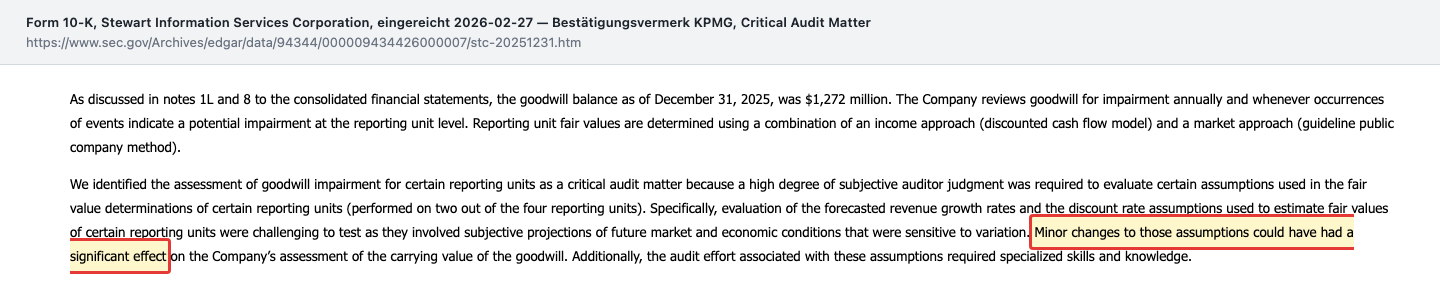
In fairness: Stewart has not had to write down goodwill in either 2024 or 2025, and for a services business without factories a high share of intangibles is normal. A title insurer needs no machines; it needs archives, software and people. The scale remains notable all the same — and it explains why a price-to-book ratio of roughly 1.26 tells a different story than it appears to at first glance.
Uncomfortable truth No. 2: the core business grew 15 percent — and earned less than a year earlier
This number needs reading twice. In the second quarter of 2026, operating revenue in the title segment — the actual insurance business — rose 15 percent to $683.6 million. Pretax income in that same segment fell 1 percent to $48.6 million. The segment margin dropped from 8.1 to 6.9 percent. Stewart lays it out in its own quarterly report:
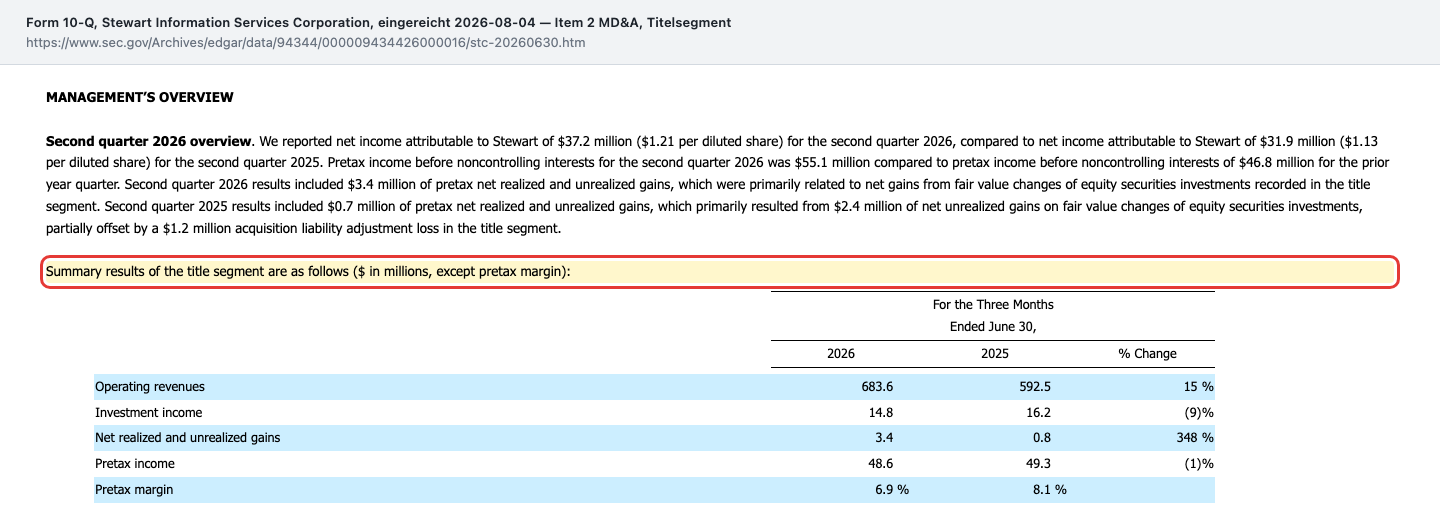
The reason appears a few lines further down in the same filing, and it is purely a question of mix. Direct operations — the channel where revenue stays in house — grew a modest 5 percent to $306.6 million. Agency operations, by contrast, jumped 25 percent gross, to $377.0 million. That sounds excellent until you read the next line: $314.9 million of it went to the agencies in the same quarter. Net, Stewart kept roughly $62 million rather than $377 million. And because the company carries the same examination, administrative and claims costs either way, expense grows with gross revenue while only a sixth of it arrives as Stewart's own income. Title segment employee and other operating costs rose $29.6 million, or 11 percent, in the quarter.
Put in everyday terms: you run a taxi company and celebrate that revenue is up a quarter. Then you notice almost all of the increase comes from rides you dispatch to outside drivers — and they keep 83 cents on the dollar. Your dispatch office, your insurance and your bookkeeper still work for the full revenue figure. At year-end you have worked more and earned less. One bright spot: in the real estate solutions segment the movement went the other way — pretax margin rose from 6.0 to 9.4 percent on 75 percent revenue growth. The acquisition is already contributing profit. Whether that holds, nobody knows after two quarters.
Uncomfortable truth No. 3: net income rose 17 percent, earnings per share only 7
In the fourth quarter of 2025, Stewart raised fresh equity in the market — and at a scale worth knowing before extrapolating per-share growth:
“During the fourth quarter 2025, we issued an aggregate of 2,185,000 new shares of Common Stock, which included shares purchased by the underwriters to the offering transaction. Total proceeds from the offering, net of issuance costs, was $140.8 million.”
— Stewart Information Services Corporation, Form 10-K for 2025, Item 7 MD&A

What that means for you as a shareholder shows up in a two-quarter comparison. In the second quarter of 2026, net income attributable to Stewart rose from $31.9 million to $37.2 million — up 17 percent. Diluted earnings per share rose from $1.13 to $1.21 — up 7 percent. The difference is dilution: the average diluted share count grew from 28.330 million to 30.853 million over the same period, or 8.9 percent. In everyday terms: the pizza is a sixth larger, but it is now split among nine people instead of eight. Your slice did grow — just by less than the headline promises.
Fairness demands the other side here too: the money was not raised to plug holes, it was raised to buy. Stewart spent $370.0 million on acquisitions in 2025, $332.7 million of it on service provider Mortgage Contracting Services in December. Whether that pays off will be settled in segment margins over the coming years — and the first two quarters, as described above, look good there. But: growth paid for with new shares only becomes growth for the existing shareholder once it outpaces the share count.
Uncomfortable truth No. 4: Stewart names artificial intelligence in its own annual report as a threat — not an opportunity
We searched the 2025 annual report systematically for the terms “artificial intelligence,” “AI” and “machine learning.” Result: six occurrences — and all six sit in the risk factors. Not one in the business description, none in management's discussion, none in the notes. The clearest reads:
“Further, advances in technologies, including technology such as AI and machine learning, could, over time, significantly disrupt the traditional business model of financial services and real estate-related companies, including title insurance.”
— Stewart Information Services Corporation, Form 10-K for 2025, Item 1A Risk Factors
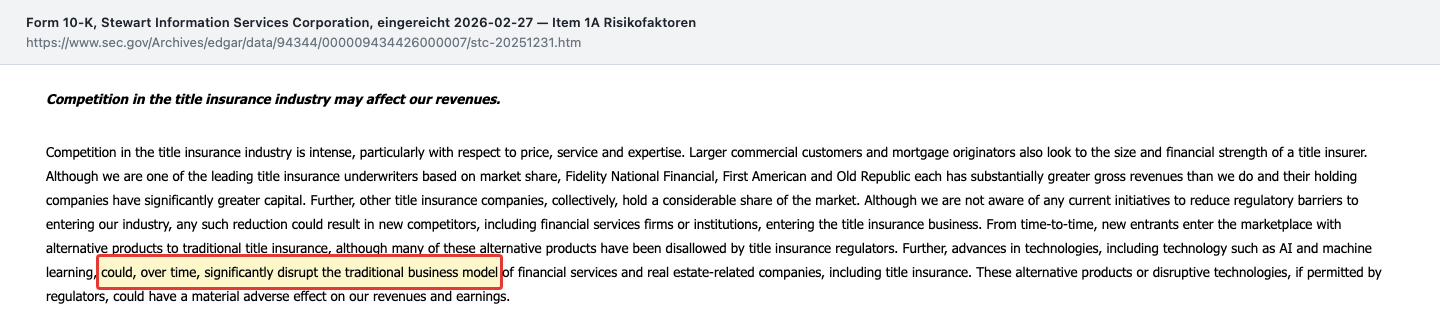
Why does this matter? Because Stewart's core business is, at bottom, document search and risk assessment — precisely the kind of work language models are making cheaper fastest. Where Stewart describes its own efficiency plans, the filing deliberately chooses the word automation rather than AI: margin targets are to be met through “additional automation of manual processes” and the consolidation of systems. That is not a weakness in itself — but it means the technology most likely to reshape the business is, so far, described as somebody else's risk rather than the company's own lever. One more sentence from the same paragraph belongs here: Fidelity National Financial, First American and Old Republic each have, by Stewart's own account, “substantially greater gross revenues.” Stewart is clearly the number four among the big four, and number four spreads technology spending across fewer policies.
Valuation: What the Market Pays for a Cyclical With a Goodwill Balance Sheet
Let us talk orders of magnitude, not intraday prices. At $68.96 on August 20, 2026 and roughly 30.52 million shares outstanding (as of July 28, 2026, per the cover page of the quarterly report), the market capitalization stood at about $2.10 billion. That yields the following magnitudes (data as of August 20/21, 2026): a price-to-earnings ratio of roughly 15 on trailing twelve-month earnings, a price-to-sales ratio of roughly 0.6, and a price-to-book ratio of roughly 1.26. Measured against tangible book value of about $1.58 per share, the market pays roughly 44 times — which shows that this metric is no sensible yardstick for a services business without factories, but is an honest reminder that the low price-to-book ratio does not describe a reserve of substance.
The price-to-earnings ratio of 15 is the more interesting number — and it cuts both ways. For a cyclical in recovery it can be cheap: if Stewart returned to something near its 2021 results in a normalized market, the stock would look very inexpensive today. It can also be expensive: in cyclical industries, low price-to-earnings ratios typically appear at the peak of the cycle and high ones at the trough. Stewart is plainly not at a peak — 2025 delivered a third of the 2021 earnings per share — but it is no longer at the 2023 trough either. The only analyst consensus we can find as of August 20, 2026 is thin: a single rating of hold with a price target of $82.25. That is too little data for a conclusion, and we treat it accordingly — as a footnote, not an argument.
What can be assessed cleanly is the dividend. Stewart has paid $0.525 per share per quarter since the third quarter of 2025, or $2.10 a year — roughly 3.0 percent at the price quoted above. In 2025 that cost $58.5 million against $132.3 million of free cash flow ($205.7 million of operating cash flow less $73.4 million of capital expenditure). That is 2.3 times coverage, and considerably more comfortable than 2023, when $45.2 million of free cash flow faced a $50.5 million dividend — in the trough year, the payout was not earned. One caveat matters for judging this: half-year figures make coverage look worse than it is, because the business runs seasonally stronger in the second half. The full-year comparison is the meaningful one.
Opportunities and Risks at a Glance
What speaks for Stewart:
- A genuine rate lever to the upside. The average 30-year fixed mortgage rate in the United States stood at 6.4 percent in the second quarter of 2026, down from 6.8 percent a year earlier — that alone drove refinancing activity up 45 percent. If rates fall further, transaction volume rises, and Stewart's cost base is already in place.
- Commercial is running strongly. Domestic commercial revenue rose 20 percent in the second quarter of 2026 and 28 percent in the first half — driven in part by large data center transactions. The average commercial fee per file was $16,900, against $3,200 on the residential side.
- The claims side is quiet. The title loss ratio fell to 3.2 percent of title revenue in the second quarter of 2026 (3.6 percent a year earlier); the reserve for title losses stood at $519.2 million.
- Cheap, long-dated debt. The $450 million note carries a 3.6 percent coupon and matures on November 15, 2031 — a quiet advantage in a materially higher rate environment. At the end of 2025 its fair value was $397.6 million, below par.
- A covered dividend and a balance sheet that carries. Coverage of 2.3 times in 2025, a debt-to-capitalization ratio near 28 percent, $261.6 million of cash and $97.5 million of undrawn credit line capacity (June 30, 2026).
What speaks against it:
- 97 percent of equity is goodwill and intangibles. $1,293.8 million plus $321.6 million against $1,663.4 million of equity (June 30, 2026). KPMG designates the goodwill assessment a critical audit matter; Stewart discloses no cushion between fair value and carrying value.
- Growth without profit growth in the core. Title segment, second quarter of 2026: revenue up 15 percent, pretax income down 1 percent, margin from 8.1 to 6.9 percent.
- Dilution. 2,185,000 new shares in the fourth quarter of 2025; the average diluted share count rose 8.9 percent within a year, to 30.853 million.
- Liability for outside agencies. Roughly 44 percent of operating revenue comes from agency operations. Stewart itself writes that case law in certain states holds the company liable for the acts or omissions of its agents — “regardless of contractual limitations.”
- The smallest of the big four. Fidelity National Financial, First American and Old Republic each have, by Stewart's own account, substantially greater gross revenues, and their holding companies significantly greater capital.
- A cycle that has already halved everything once. Going from $11.90 of earnings per share in 2021 to $1.11 in 2023 took two years. This business has no subscription character to smooth revenue.
A Human Bottom Line
We began with the book value illusion — the reassuring thought that a price-to-book ratio near one means you are getting something tangible for your money. At Stewart Information Services the metric is accurate and the conclusion still is not. Of $54.63 of book value per share, roughly $1.58 is tangible; the rest is the price Stewart has paid for other companies over decades. That is not an accusation — for a services business it is the norm, and Stewart has never had to write the goodwill down. It simply means: this particular metric carries no safety net here. Anyone buying Stewart is not buying an asset play, but a wager on the American real estate cycle — with a solid, but smallest, of four large underwriters.
And the honest ledger of this analysis has two sides. One: a company that came through a collapse from $11.90 to $1.11 in earnings per share without a single loss-making year, earns its dividend 2.3 times over, has financed itself at 3.6 percent until 2031, and whose commercial business is currently doing very well on data center deals, is no turnaround case. The other: revenue is back to 88 percent, earnings per share to 34 percent — and the three reasons behind that (shifted mix, higher interest expense, more shares) do not disappear on their own when the market recovers. Two of them are structural. What you make of that is your call. And that is exactly as it should be.
Sources
- Form 10-Q for the quarter ended June 30, 2026, filed August 4, 2026 — balance sheet, income statement, segment reporting, goodwill note, order table, book value per share
- Form 10-K for 2025, filed February 27, 2026 — business description, risk factors, KPMG audit report, equity offering, MCS acquisition, indebtedness, headcount
- Form 10-K for 2022, filed February 28, 2023 — revenue and earnings figures for fiscal 2021 and 2022
- Form 8-K (Item 2.02) dated July 22, 2026 — second quarter 2026 results
- Form 8-K (Item 7.01) dated June 1, 2026 — declaration of the $0.525 per share dividend for the second quarter of 2026
- SEC EDGAR filing index, CIK 0000094344 — verification that no further filings were submitted after August 4, 2026 (checked August 21, 2026)
- Fundamental data (price, market capitalization, valuation multiples, 52-week range, analyst rating; data as of August 20/21, 2026)
Disclaimer: This article is journalistic research and analysis. It is not investment advice, not a recommendation to buy or sell, and not a solicitation to buy or sell securities. All figures come from the primary sources linked above and carry the as-of date stated with them; operating figures refer to December 31, 2025 or June 30, 2026, market data to August 20/21, 2026. Share prices can fall substantially at any time and a total loss is possible. Positions held by the operator are disclosed daily; where one exists, it appears as a notice at the top of this deep dive. Verify every investment decision yourself and seek independent advice if in doubt.
Key figures at a glance
All monetary figures in millions of $; earnings per share as reported.
| Metric | 2021 | 2022 | 2023 | 2024 | 2025 |
|---|---|---|---|---|---|
| Revenue | 3,305.8 | 3,069.3 | 2,257.3 | 2,490.4 | 2,921.7 |
| Operating Income (EBIT) | 434.0 | 232.7 | 60.9 | 114.3 | 165.5 |
| Net Income | 323.2 | 162.3 | 30.4 | 73.3 | 115.6 |
| Net Margin | 9.8% | 5.3% | 1.3% | 2.9% | 4.0% |
| Earnings Per Share | 11.90 $ | 5.94 $ | 1.11 $ | 2.61 $ | 3.98 $ |
Source: fundamental data & SEC filings (annual and quarterly reports, 10-K/10-Q)
Our Bottom Line at a Glance
- Business model and market position positive
- Title insurance is a regulated business with high barriers to entry: archives, licences in every state, and a claims record spanning decades. Stewart has been in the market since 1893, and its underwriting subsidiary Stewart Title Guaranty carries “A-” ratings from Fitch and A.M. Best (as of December 31, 2025). The caveat: in its 2025 annual report the company itself concedes that Fidelity National Financial, First American and Old Republic each have substantially greater gross revenues.
- Earnings power through the cycle neutral
- Stewart came through the rate shock without a loss-making year — but earnings per share fell from $11.90 in 2021 to $1.11 in 2023 and had recovered only to $4.05 by 2025. Revenue of $2,921.6 million in 2025 equalled 88 percent of the 2021 level; earnings per share equalled 34 percent. In the first half of 2026 revenue rose 26 percent and net income climbed from $35.0 million to $54.2 million.
- Margin in the core business negative
- In the second quarter of 2026 title segment operating revenue grew 15 percent to $683.6 million while pretax income fell 1 percent to $48.6 million and the segment margin slipped from 8.1 to 6.9 percent. The cause is mix: agency revenue rose 25 percent gross, but $314.9 million of the $377.0 million was passed back to the agencies.
- Balance sheet quality negative
- Of the $1,663.4 million of equity as of June 30, 2026, $1,293.8 million is goodwill and $321.6 million other intangibles — roughly 97 percent. Tangible book value works out to $48.0 million, or $1.58 per share, against a reported $54.63. KPMG designates the goodwill assessment a critical audit matter in the 2025 annual report; Stewart discloses no cushion between fair value and carrying value.
- Financing and payout positive
- The $450 million note costs 3.6 percent and runs to November 15, 2031; debt-to-capitalization stood at roughly 28 percent as of June 30, 2026, cash at $261.6 million, and undrawn credit facility capacity at $97.5 million. The 2025 dividend of $58.5 million was covered 2.3 times by $132.3 million of free cash flow — unlike in the trough year 2023.
- Dilution negative
- In the fourth quarter of 2025 Stewart issued 2,185,000 new shares for $140.8 million net to help fund the MCS acquisition. Average diluted share count rose from 28.330 million to 30.853 million within a year, up 8.9 percent: in the second quarter of 2026 net income grew 17 percent while earnings per share grew only 7 percent.
Stewart Information Services came through the rate shock without a single loss-making year, finances itself at 3.6 percent until 2031, and covered its 2025 dividend 2.3 times over. Revenue in 2025 was back at 88 percent of the 2021 record year — earnings per share, at $4.05, only 34 percent of the $11.90 posted then. Three shifts sit behind that: a mix favouring the channels where less sticks, interest expense up 52 percent in the first half of 2026, and 2,185,000 additional shares. And of the $54.63 of book value per share, roughly $1.58 is tangible. Not investment advice.
What Our Rating Means
Open questions
The business works in principle, but one material question is open. As long as it stays open, our findings do not carry a quality verdict.
The substance test does not come out negative: there is no going-concern indication, equity is positive, interest coverage runs at roughly six times, debt-to-capitalization sits near 28 percent, and all covenants were most recently in compliance. Yellow here stands for two open operating questions. First, the core business grew revenue 15 percent in the second quarter of 2026 yet earned 1 percent less than a year earlier — whether Stewart can ever convert agency growth into profit is unproven. Second, 97 percent of equity consists of goodwill and intangibles whose valuation the auditor explicitly identifies as unusually judgement-heavy, with no cushion disclosed. This is a judgement on the substance of the company, not on the share price: whether the stock is expensive or cheap at $68.96 is for the scanners to answer, not this rating. The decision is yours.
A journalistic assessment by our editorial team at the time of the deep dive, based on public sources — not investment advice and not a solicitation to buy or sell. Your personal circumstances (investment goals, risk capacity, taxes) cannot be taken into account. What our levels mean, how verdicts are formed, and what conflicts of interest exist →
Worth Noting
- This analysis was prompted by the ongoing review of the U.S. equity universe rather than a hit in our in-house stock scanner — Stewart was not covered in our database before August 21, 2026. The timing was set by the quarterly report for the period ended June 30, 2026, filed August 4, 2026.
- Risk of confusion: the ticker STC belongs to Stewart Information Services Corporation (CIK 0000094344, NYSE, title insurance) — not to any of the identically abbreviated listings on foreign venues. The assignment was checked against the SEC ticker registry; the company reports no former names.
- Operating figures carry their own balance sheet or reporting date (December 31, 2025 or June 30, 2026); price, market capitalization, valuation multiples and the 52-week range are as of August 20/21, 2026. The 2021 and 2022 figures come from the annual report for 2022. Analyses are evergreen — an intraday price is not a reason to buy.
Stock Watch
This analysis is as of August 26, 2026. Stock Watch will tell you what's changed at STC since then.
Later $1 a month per stock — signing up is free, and you'll be the first to know when it launches.
The full analysis as a PDF for later
We will send you this analysis as a PDF — to print, file away, and read at your own pace. And we will add you to the free Stock Watch list for Stewart Information Services Corp (STC), so you hear about it when something material in this analysis changes.
Frequently Asked Questions
Stewart Information Services Corporation (NYSE: STC) is a U.S. title insurer: it searches property ownership records, verifies that the seller genuinely owns the property, and insures the result. The premium is paid once at closing and covers losses arising from events before the purchase for as long as the owner holds the property. Alongside that sit real estate services such as credit reporting, valuations and property preservation. The group is based in Houston, Texas, has operated since 1893 and employed roughly 7,800 people as of December 31, 2025.
Three documented reasons. First, mix: versus 2021 the high-margin direct business shrank 17 percent and agency operations 20 percent, while the lower-margin real estate solutions grew 51 percent. Second, interest: interest expense rose 52 percent to $15.1 million in the first half of 2026. Third, share count: 2,185,000 new shares were issued in the fourth quarter of 2025. In 2025 revenue reached 88 percent of the 2021 level, earnings per share only 34 percent.
Very little. As of June 30, 2026, equity attributable to Stewart stood at $1,663.4 million, equal to a book value of $54.63 per share. Of that, $1,293.8 million was goodwill and $321.6 million other intangible assets — roughly 97 percent combined. Tangible book value works out to about $48.0 million, or $1.58 per share. A high share of intangibles is normal for a services business without factories; the scale nevertheless means the low price-to-book ratio does not describe a reserve of substance.
On a full-year basis, yes, with room to spare. In 2025 Stewart paid $58.5 million in dividends against $132.3 million of free cash flow ($205.7 million of operating cash flow less $73.4 million of capital expenditure) — coverage of 2.3 times. In 2024 the factor was 1.8. In the trough year 2023, by contrast, the payout was not earned: $50.5 million of dividends against $45.2 million of free cash flow. Half-year figures look worse because the business runs seasonally stronger in the second half.
In December 2025 Stewart acquired service provider Mortgage Contracting Services for $332.7 million in cash. MCS performs property preservation and field services for mortgage servicers and sits in the real estate solutions segment. Of the purchase price, the 2025 annual report (Form 10-K) attributes roughly $152.2 million to goodwill and $175.0 million to other intangible assets — about 98 percent combined. The deal was funded with a $140.8 million net equity offering and a $200.0 million draw on the credit facility.
As of June 30, 2026 the balance sheet showed $646.7 million of debt. Of that, $446.4 million is an unsecured note carrying a 3.6 percent coupon and maturing on November 15, 2031, and $200.0 million is drawn on a credit facility with a $297.5 million commitment, of which $97.5 million remained available. The debt-to-capitalization ratio stood at roughly 28 percent. Fitch rates the note “BBB” and the insurance subsidiary Stewart Title Guaranty “A-”.
Stewart is the smallest of the four major underwriters. The 2025 annual report names Fidelity National Financial, First American and Old Republic as its largest competitors and concedes verbatim that each has “substantially greater gross revenues” and that their holding companies command significantly greater capital. Stewart discloses no market share percentage of its own; it describes itself as “one of the leading title insurers in the United States.”
At $68.96 on August 20, 2026 and roughly 30.52 million shares outstanding, market capitalization stood at about $2.10 billion. That works out to a price-to-earnings ratio of roughly 15 on trailing twelve-month earnings, a price-to-sales ratio of roughly 0.6, and a price-to-book ratio of roughly 1.26. The dividend yield is just above 3 percent. The 52-week range ran from $56.65 to $76.79 (data as of August 20, 2026).
Found an error?
Did you spot a factual error, an outdated number, or a typo in this deep dive? Let us know briefly — your report goes straight to the editorial team.