Sionna: One Company, One Thesis — and a Trial That Showed Nothing
Sionna Therapeutics set out to fix the exact spot in the genome where cystic fibrosis begins. Ten years of research, $579.2 million of capital paid in, an IPO at $18.00 in February 2025 — and on August 10, 2026, the first real test in patients. The result: a placebo-adjusted change of minus 1.0 mmol/L at a p-value of 0.7. Statistically, that is the same as nothing. What is left is $268.3 million in the bank, 59 employees, and the question of whether the thesis was wrong or merely poorly tested.
 Thomas Mücke
Founder & Publisher
Thomas Mücke
Founder & Publisher
As of Today
As of: September 29, 2026
- Closing price
- 5.20 $ +0.60%
- Market Capitalisation
- 0.2 $B
- AAQS
- 1/10
This analysis has a cut-off date. The Stock Guard tells you when something material changes in the numbers. Reserve your free spot
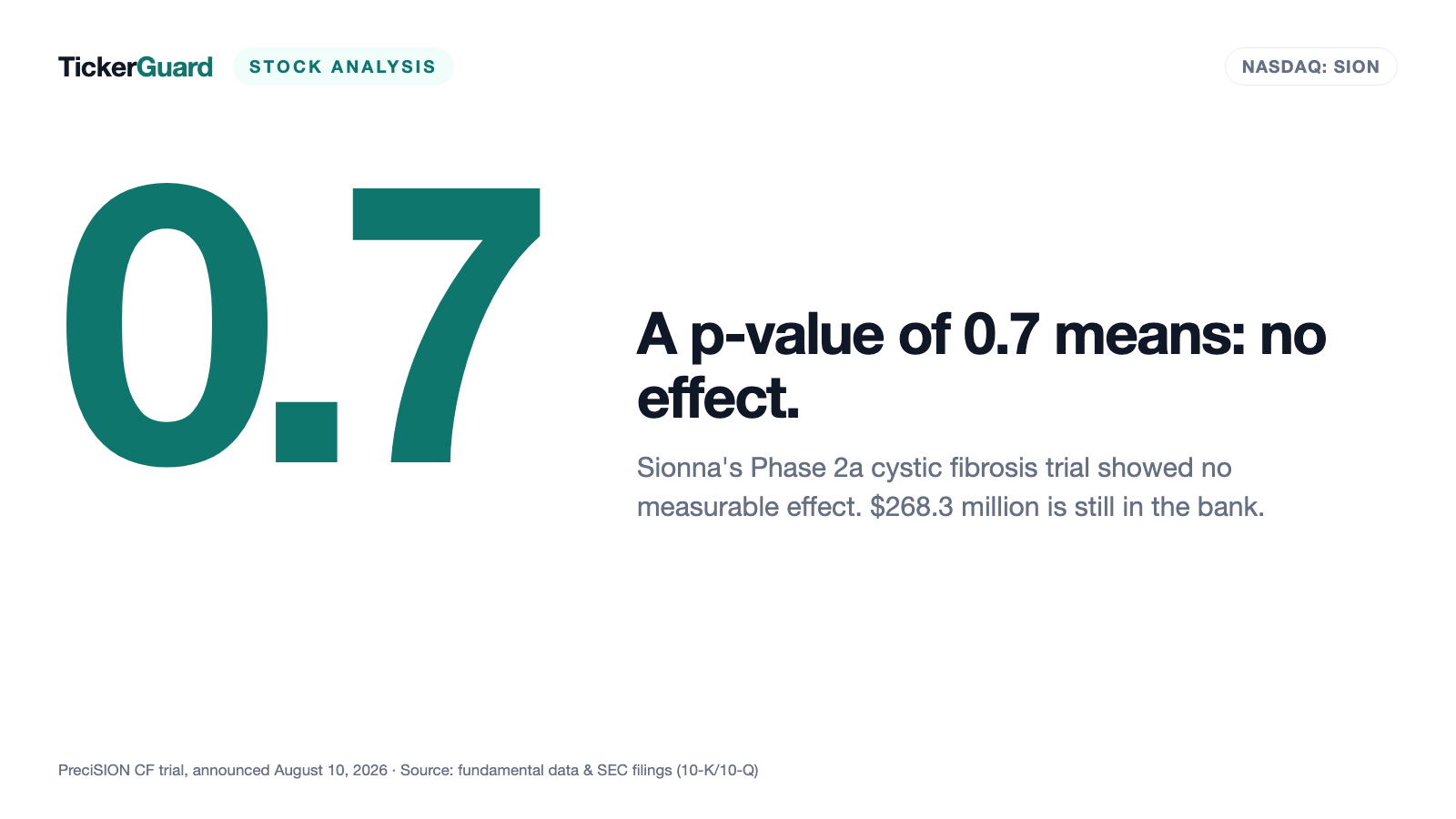
Chart
Interactive price chart (TradingView).
52-week range: 4.50 $ to 51.00 $ · Last price: 5.20 $ (As of: September 29, 2026)
Note: pure fact-based analysis, not investment advice and not a solicitation to buy or sell. All figures without guarantee.
The plausibility trap
Some stories are told so well that we forget to ask for the proof. In biotech they almost always take the same shape: everyone else has been looking in the wrong place. We found the right one. And the spot everyone considered impossible, we are cracking now.
Call it the plausibility trap. It closes whenever an explanation is so persuasive that our mind files it as a result. The cleaner the story, the less we ask: has this actually been measured in a human being? And what came out?
Sionna Therapeutics is a case study in that trap — one with a date attached. On August 10, 2026, this company's story was tested in patients for the first time. Until then it was among the most plausible in the sector. After that, a number sat on the table that cannot be talked away.
The deal for this article is the usual one: we read the original documents — the quarterly report filed August 6, 2026, the annual report for 2025, the announcement of August 10, 2026 — and check what they actually say. No price target, no recommendation.

What Sionna actually does
Cystic fibrosis (CF) is an inherited disease. The cause is a fault in a single gene that carries the blueprint for a protein called CFTR. That protein sits in the cell wall and works like a tiny valve: it lets chloride particles through, and water with them. When the valve fails, mucus in the lungs and pancreas turns thick instead of fluid. The consequences are recurring infections and declining lung function.
According to the Cystic Fibrosis Foundation, cited by Sionna in its annual report for 2025, roughly 106,000 people across 94 countries have been diagnosed, about 40,000 of them in the United States. Around 90 percent carry at least one copy of the most common mutation, known as F508del.
That is exactly where the company thesis begins. The CFTR protein consists of several building blocks, and the F508del fault sits in one of them: nucleotide binding domain 1, or NBD1. Today's approved medicines — above all Trikafta from Vertex Pharmaceuticals — act on other blocks. Nobody has managed to act on NBD1 itself, because it is considered untreatable. The annual report puts it plainly:
"Despite having long been identified as a critical component for proper CFTR function, NBD1 has been considered 'undruggable,' and none of the currently approved CF therapies directly stabilizes NBD1."
— Sionna Therapeutics, Inc., Form 10-K for 2025, Item 1 (Business), filed with the U.S. securities regulator, the SEC
That is a strong story, and it has a genuine market gap on its side. The same report states that at least two-thirds of patients on Trikafta do not reach normal CFTR function, measured as a sweat chloride level below 30 mmol/L. More than 6,000 patients have discontinued the approved modulators altogether.
As of the August 10, 2026 announcement, the pipeline had two parts. First, the NBD1 stabilizers SION-719 and SION-451 — the actual core. Second, complementary modulators designed to act on other blocks and work alongside the stabilizers: SION-2222 (galicaftor), SION-109, SION-2851 and SION-3067 (navocaftor).
One detail matters later: Sionna did not invent the complementary modulators. They are licensed — SION-2222 and the other CFTR modulators come from a July 2024 agreement with AbbVie, with further rights from a December 2019 agreement with Sanofi.
How the stock reached our desk
There was no classic screening hit here. SION arrived through the Reddit run of our in-house stock scanner — the observation that a ticker is suddenly mentioned unusually often in investor forums. As of August 14, 2026.
The reason for that attention is no mystery. On August 7, 2026, the stock closed at $51.04. On August 10, 2026, the first trading day after the announcement, it closed at $4.50 — a drop of roughly 91 percent in a single session, on volume of 38.6 million shares against 747,500 shares the previous Friday.
Moves like that attract two groups. One wants the rebound. The other has done the arithmetic on how much money sits inside this company and wonders whether the market is selling a bank account at a discount. Both questions are legitimate. Neither is answered by a price chart — they are answered in the filings.
The numbers over the years — what actually counts
For a company without revenue, the usual metrics are worthless. There is no margin, no price-to-earnings ratio, no revenue growth. Sionna has not taken in a single dollar from product sales since it was founded in August 2019. What does exist are three series that count: what the operation costs, what is left, and who owns it.
First, the cost side. In fiscal 2024, Sionna spent $57.3 million on research and development and $13.3 million on administration, leaving a net loss of $61.7 million. In 2025 the figures were $60.3 million, $28.7 million and a $75.3 million loss. The first half of 2026 added $40.8 million of research, $21.2 million of administration and a $56.7 million loss.
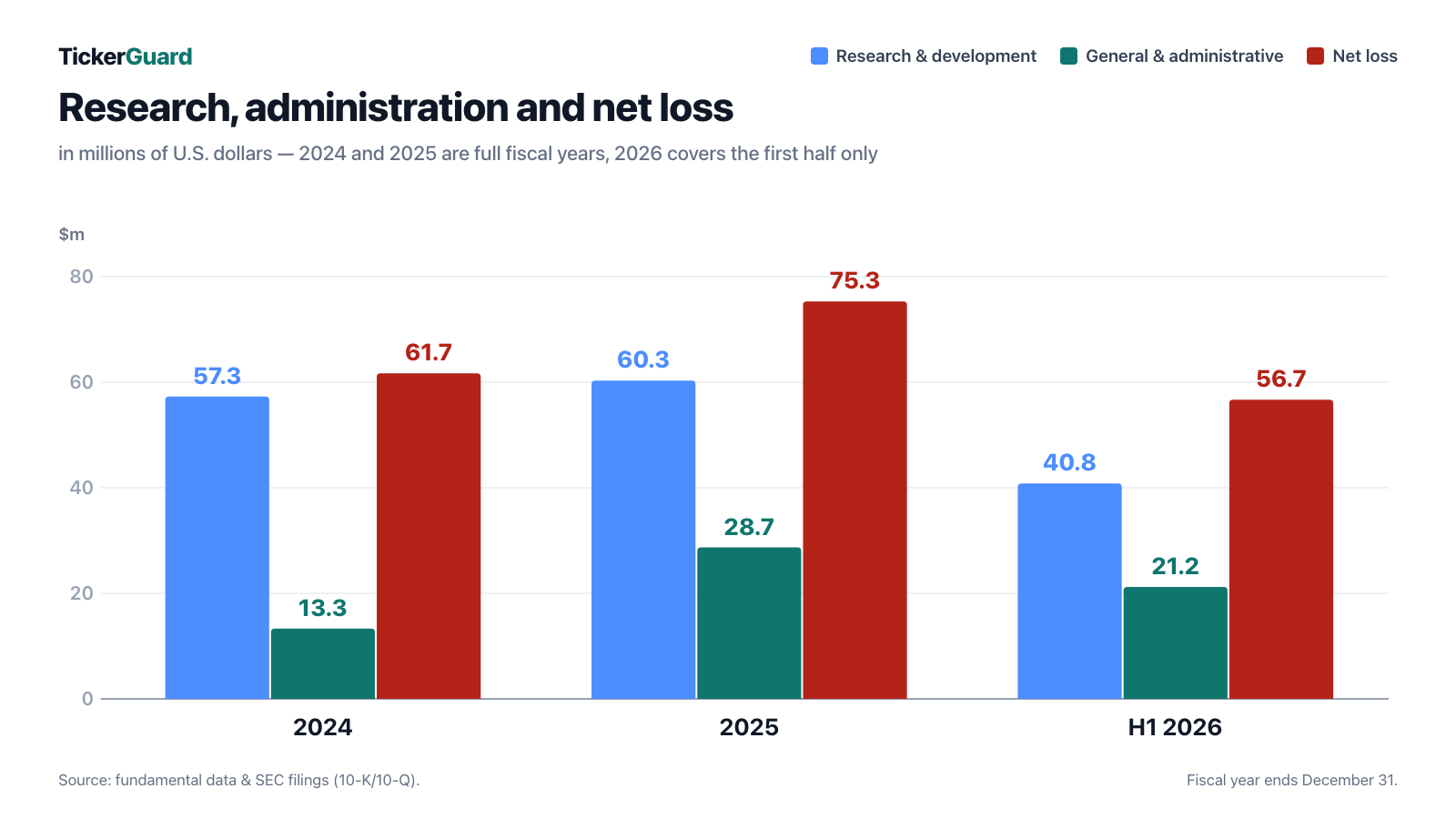
One number in that picture deserves a second look. General and administrative expenses rose from $13.3 million to $28.7 million — up 116 percent. Research grew 5 percent over the same period. Part of that is the ordinary price of going public: audit, legal, reporting obligations, stock-based compensation. It is still striking that a company with 59 employees let administration grow faster than the lab in the year it was preparing its decisive trial.
Second, the cash. Here the company is genuinely well set up. As of June 30, 2026, the balance sheet carried $268.3 million of cash, cash equivalents and marketable securities. Against that stand total liabilities of $17.5 million — and $8.1 million of that is lease obligations for office and lab space. There are no bank borrowings, no convertible notes, no sold royalty streams. In this sector, that is rare.
Third, who owns it. Shareholders have paid $579.2 million into this company over the years, through preferred rounds and the IPO. Since then, $313.0 million of losses have accumulated. What remains is $265.8 million of equity.
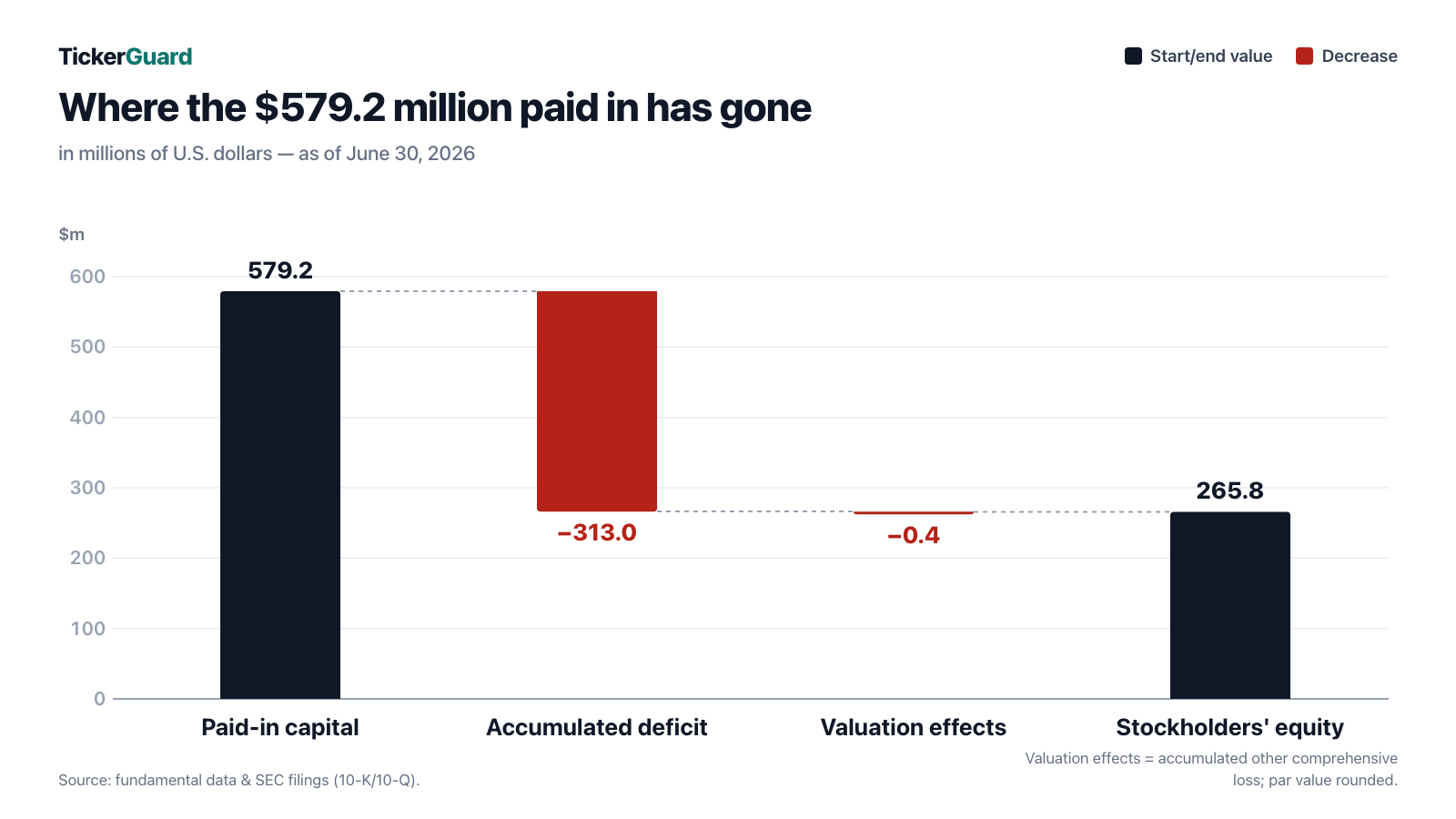
A line to hold on to for this section: the balance sheet is healthy, the business does not exist yet. Both are true at the same time — and that combination is exactly what makes this stock so hard to place.
What the filings say
Uncomfortable truth no. 1: The trial everything hinged on showed nothing
On August 10, 2026, Sionna reported results from the PreciSION CF trial. It was the first test of the company thesis in actual patients. The sentence that matters sits in Exhibit 99.1 to the Form 8-K:
"The PreciSION CF trial did not meet its key activity endpoint, with a -1.0 mmol/L mean placebo-adjusted sweat chloride change (p=0.7)."
— Sionna Therapeutics, Inc., Form 8-K dated August 10, 2026, Item 8.01, Exhibit 99.1

Translated into everyday language: sweat chloride is this disease's equivalent of a thermometer. The better the CFTR valve works, the less chloride ends up in sweat. An effective therapy lowers the number substantially; the company itself cites 30 mmol/L as the threshold for normal function.
What was measured was a reduction of 1.0 mmol/L. That is roughly like reading a thermometer twice and seeing a tenth of a degree less the second time. And the p-value of 0.7 says how often a difference like that arises by chance alone: in about 70 out of 100 cases. In research, only a value below 0.05 is normally taken as a sign of a real effect.
In fairness, this was a very small trial. Fifteen adult patients took part, all homozygous for F508del and stable on Trikafta; the add-on treatment ran for 14 days. Sionna itself names potential confounders in the announcement — higher than anticipated variability in individual sweat chloride levels, and differences in Trikafta exposure between the drug and placebo periods.
The company nonetheless drew the consequence immediately: SION-719 will not be advanced as an add-on to standard of care. That was one of the two routes by which the thesis was meant to earn money.
Uncomfortable truth no. 2: "Preserve capital" is the real sentence
On the same day, in the same release, sits a second sentence that got lost behind the headlines:
"The Company intends to take actions to preserve capital while evaluating next steps."
— Sionna Therapeutics, Inc., Form 8-K dated August 10, 2026, Item 8.01, Exhibit 99.1

"Preserve capital" is not a neutral phrase in this industry. It sits between two extremes. At one end it means cost discipline until the data analysis is finished. At the other it is the first link in a chain that in biotech often continues: workforce reduction, programs halted, review of strategic alternatives, sale or wind-down.
Which of the two it becomes was not decided as of August 14, 2026 and cannot be inferred from the documents. What matters is the basis for the arithmetic: four days before the announcement, on August 6, 2026, the company had still written in its quarterly release that its cash would fund operations "into 2028." That figure predates the result. It assumes a research program that no longer exists in that form, which makes it an unreliable anchor in either direction.
The arithmetic is still worth doing. Cash used in operations was $44.1 million in the first half of 2026, against $34.4 million a year earlier. Annualized, that is roughly $88 million; at an unchanged pace, the June 30, 2026 cash balance would cover a good three years — and longer for a program that has just been paused.
Uncomfortable truth no. 3: A $250 million dilution facility is armed and ready
In March 2026 — five months before the trial announcement — Sionna signed an agreement with the investment bank Leerink Partners. It allows the company to sell new shares directly into the market at any time, up to gross proceeds of $250.0 million. The industry term is an "at the market" program.
The everyday image: a credit card that always sits ready in the drawer, and whose bill is not paid by the company but by existing shareholders — their slice of the business gets a little smaller with every new share. And the facility is enormous relative to today's company: $250.0 million equals roughly 86 percent of the market capitalization as of August 14, 2026.
The quarterly report records how much has been used so far:
"As of June 30, 2026, the Company has not sold any shares of common stock under the sales agreement."
— Sionna Therapeutics, Inc., Form 10-Q for the quarter ended June 30, 2026, Note 1
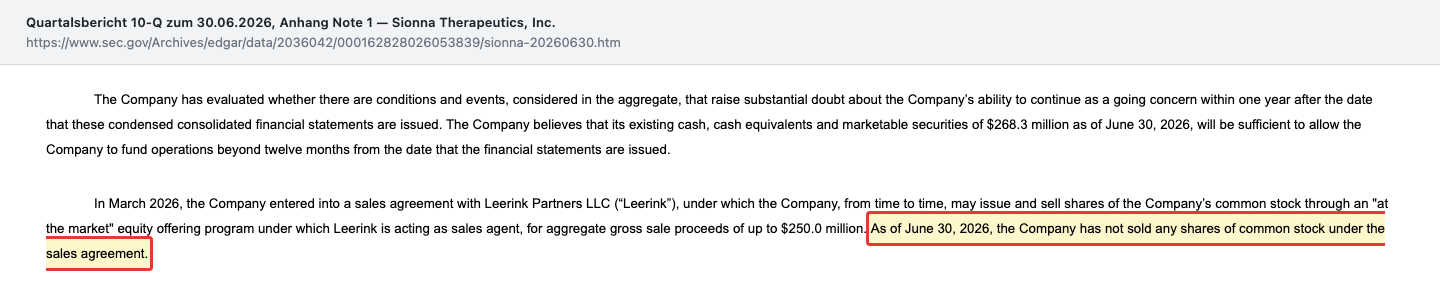
As of that date, this is good news — the drawer is shut. It is also the point at which the cash argument can turn. A company whose shares have fallen 91 percent receives a multiple of the shares for the same amount of money. Anyone holding the stock because there is more cash inside than the market is paying should know this agreement exists. In the same month, on March 2, 2026, Sionna also filed a shelf registration on Form S-3ASR — the formal precondition for issuing securities at short notice.
Uncomfortable truth no. 4: The now-preferred compound is not Sionna's alone
August 10, 2026 also brought news that was not bad. The second, parallel trial — a Phase 1 study in 120 healthy volunteers — met its objectives on safety, tolerability and how the compound is distributed in the body. It produced a preferred combination: SION-451 together with SION-2222.
But SION-2222 — generic name galicaftor — is not homegrown. It comes from the July 2024 license agreement with AbbVie. For those rights Sionna paid $5.0 million plus 1,414,445 of its own shares. And then there is this:
"In addition, we are required to pay AbbVie a total of up to $360.0 million upon achievement of certain development and commercial milestones, consisting of up to $70.0 million in late-stage development milestones and up to $290.0 million in commercial milestones."
— Sionna Therapeutics, Inc., Form 10-K for 2025, Item 1 (Business)
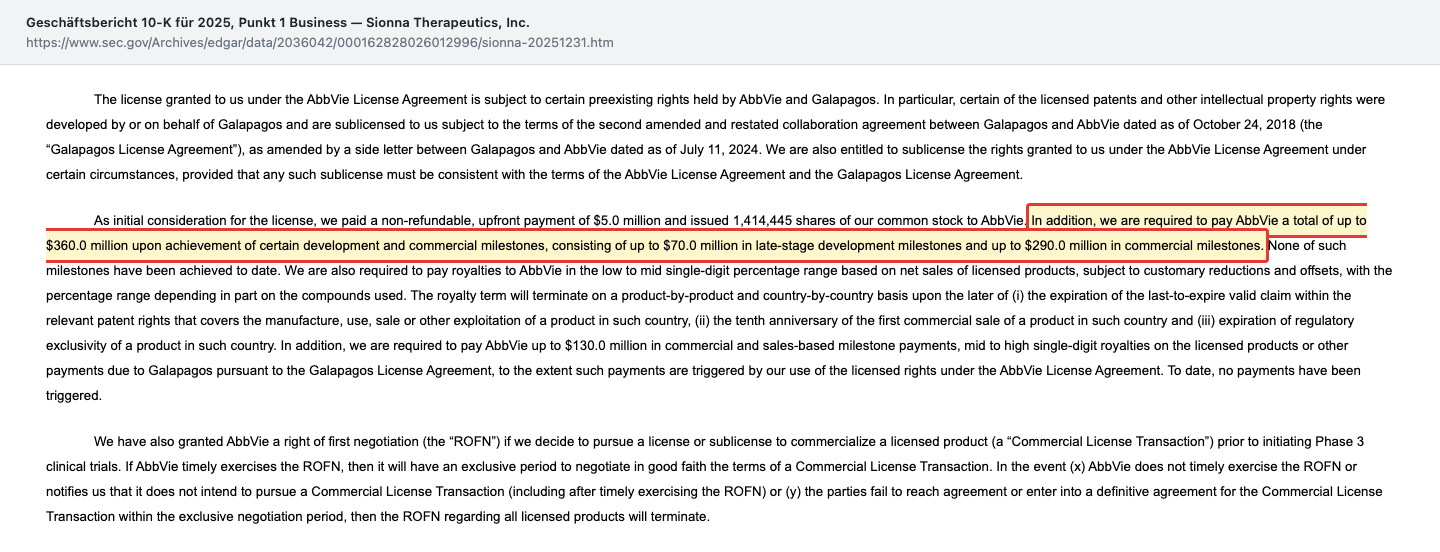
That $360.0 million is not payable today — it depends on successes that do not yet exist, which is why it appears in no balance sheet line. That is precisely what makes it easy to miss. For scale: it exceeds the entire $265.8 million of stockholders' equity as of June 30, 2026 by more than a third. On top come royalties in the low to mid single-digit percentage range and, if triggered through Galapagos, up to a further $130.0 million.
The second license works the same way: the December 2019 Sanofi agreement carries up to $40.0 million in milestones, and a third arrangement with the Cystic Fibrosis Foundation from the same month carries up to another $40.0 million. None of these milestones had been achieved as of December 31, 2025.
One last point from the same section, worth keeping in mind for any takeover or partnering scenario: AbbVie holds a right of first negotiation. If Sionna wants to license one of the covered products to a partner before starting a Phase 3 trial, AbbVie must be asked first.
What the market pays for Sionna
For a company without revenue and without profit, only one yardstick makes sense: comparing the market capitalization with what is tangibly on the balance sheet.
The arithmetic runs like this. As of July 31, 2026, 45,212,399 shares were outstanding. At $6.46 per share (data as of August 14, 2026), that gives a market capitalization of roughly $292 million. Against it stand $268.3 million of cash and securities as of June 30, 2026, less total liabilities of $17.5 million — about $250.8 million of net cash, or $5.55 per share.
Put differently: for everything Sionna owns other than money — the patents, the compounds, the licenses, the team, the data from two completed trials — the market is paying roughly $41 million in total. That is about 14 percent of the market capitalization.
For contrast, the starting point: at the IPO on February 7, 2025, a share cost $18.00. Sionna issued 12,176,467 shares and took in net proceeds of $199.6 million.
This arithmetic explains why the stock draws attention at all after the collapse. It does not explain whether it is cheap — and here it is worth looking at two other cases from the same sector we have already examined. Autolus Therapeutics shows how much capital is still needed even after a successful approval, and Abivax shows how quickly a single data release can reshape a valuation.
Because cash in a biotech is not treasure in a vault, it is fuel. It sits there in order to be burned — that is what it was raised for. The value of such a company therefore does not depend on how much money is there, but on whether what the money buys turns out to be worth more. At Sionna that is exactly the open question: after August 10, 2026 there is $250.8 million of net cash and a research program whose continuation the company itself is still reviewing.
A word on the price figures in this section: they are as-of anchors, not forecasts. Anyone reading this later should plug in the share count and cash balance from the most recent quarterly report.
Opportunities and risks at a glance
Opportunities
- The balance sheet is unusually clean: $268.3 million of cash and securities against $17.5 million of total liabilities as of June 30, 2026, with no bank debt and no sold royalty streams.
- Net of all liabilities, cash stands at roughly $250.8 million, or $5.55 per share — a tangible floor for as long as the money is not spent.
- The second trial delivered a usable result on August 10, 2026: the Phase 1 study in 120 healthy volunteers met its safety, tolerability and pharmacokinetic objectives, and SION-451 plus SION-2222 was named the preferred combination.
- The market problem persists: per the figures cited in the annual report for 2025, at least two-thirds of patients on standard of care do not reach normal CFTR function, and more than 6,000 patients have discontinued the approved modulators.
- The failed trial was small: 15 participants, 14 days of treatment. The company names confounders that limit its informative value — this result is not proof against the thesis.
Risks
- The first test of the company thesis in patients produced no measurable effect (-1.0 mmol/L, p=0.7). The route tested — an NBD1 stabilizer added to standard of care — is not being pursued further.
- There is no approved product, no revenue, and a loss in every year since the company was founded in August 2019. The accumulated deficit reached $313.0 million as of June 30, 2026.
- The remaining route sits in Phase 1. Per the annual report, several years and substantial further costs stand between that and any approval.
- An "at the market" program for gross proceeds of up to $250.0 million has been available since March 2026 and was unused as of June 30, 2026. After the share price collapse, drawing it in full would mean very substantial dilution.
- The now-preferred combination contains a licensed compound. The agreements with AbbVie, Sanofi and the Cystic Fibrosis Foundation carry milestones of up to $440.0 million plus royalties, and AbbVie holds a right of first negotiation ahead of a Phase 3 trial.
- The statement that cash would last "into 2028" dates from August 6, 2026 and therefore predates the trial result and the announced capital preservation. No updated runway was available as of August 14, 2026.
- Competitor Vertex Pharmaceuticals holds the market with Trikafta and with Alyftrek, approved in December 2024. Every advance there raises the bar for an add-on therapy.
A human conclusion
Back to the plausibility trap. Sionna shows it in its purest form — and not because anyone here cut corners. Quite the opposite: the company received the data on Friday, August 7, 2026, published it the following Monday, stopped the program, and supplied the confounder caveat in the same breath. That is more candor than this industry usually offers.
The trap is not with the company. It is with us. A thesis pursued for a decade by good scientists, underpinned by contracts with Sanofi, AbbVie and a respected patient foundation, worth $579.2 million to investors and strong enough to carry an IPO at $18.00 — a thesis like that feels proven long before it is. As of August 10, 2026, nothing had been proven. It had been believed.
And now? Now there is an honest calculation on the table that you may like or dislike. On one side, $250.8 million of net cash, 59 employees, no debt. On the other, a program in Phase 1, a licensed lead compound, a dilution facility in the drawer, and a management team that says it is still reviewing next steps.
Whoever buys here is no longer buying a story about NBD1. They are buying a bank account and a bet on what happens to it — keep researching, hand it back, sell, or burn it. That is an entirely different bet from the one offered at $18.00 in February 2025. Anyone taking it should know that they are taking it.
What you make of that is your decision. And that is exactly how it should be.
Sources
- Sionna Therapeutics, Inc., Form 8-K dated August 10, 2026, Exhibit 99.1 (Item 8.01) — results of the PreciSION CF Phase 2a trial and the Phase 1 combination trial, cash position, capital preservation announcement
- Sionna Therapeutics, Inc., Form 10-Q for the quarter ended June 30, 2026 (filed August 6, 2026) — balance sheet, statement of operations, cash flows, Note 1 (liquidity, "at the market" program), Note 8 (license agreements), share count as of July 31, 2026
- Sionna Therapeutics, Inc., Form 10-K for 2025 (filed March 2, 2026) — business model, NBD1 thesis, pipeline, license agreements with Sanofi, the Cystic Fibrosis Foundation and AbbVie, headcount, risk factors, financial statements for 2025 and 2024
- Sionna Therapeutics, Inc., quarterly release dated August 6, 2026 (Exhibit 99.1 to Form 8-K, Item 2.02) — quarterly figures, cash runway "into 2028", trial timelines
- Sionna Therapeutics, Inc., Form 8-K dated June 18, 2026 (Item 5.07) — annual meeting results, share count as of the April 21, 2026 record date, ratification of Deloitte & Touche LLP as auditor
- Fundamental data (market capitalization, price, sector and company master data), as of August 14, 2026
Note: This article is journalistic commentary on publicly available company filings and is not investment advice. It contains no buy or sell recommendation and is not a solicitation to buy or sell securities. Shares in companies without revenue and without an approved product can become entirely worthless — a total loss of capital is possible. Positions held by the operator are disclosed daily; where one exists, it appears as a notice at the top of this deep dive. at the time of publication. All figures are taken from the original documents named above and carry the as-of dates stated there.
Key figures at a glance
All monetary figures in millions of $; earnings per share as reported.
| Metric | 2022 | 2023 | 2024 | 2025 |
|---|---|---|---|---|
| Revenue | 0.0 | 0.0 | 0.0 | 0.0 |
| Operating Income (EBIT) | -41.4 | -50.3 | -70.6 | -89.0 |
| Net Income | -40.2 | -47.3 | -61.7 | -75.3 |
| Earnings Per Share | -0.91 $ | -1.07 $ | -1.40 $ | -1.88 $ |
Source: fundamental data & SEC filings (annual and quarterly reports, 10-K/10-Q)
Our Bottom Line at a Glance
- Balance sheet and debt positive
- As of June 30, 2026, $268.3 million of cash and securities faced only $17.5 million of total liabilities — no bank debt, no convertible notes, no sold royalty streams. Stockholders' equity is $265.8 million and net cash about $250.8 million, or $5.55 per share. For a company without revenue, that is an unusually clean starting position.
- Proof of efficacy negative
- The first test of the company thesis in patients produced no measurable effect: on August 10, 2026 the PreciSION CF Phase 2a trial reported a placebo-adjusted sweat chloride change of -1.0 mmol/L at a p-value of 0.7. SION-719 will not be advanced as an add-on to standard of care. One of the two planned routes to revenue is therefore closed.
- Remaining program neutral
- The parallel Phase 1 trial in 120 healthy volunteers met its safety, tolerability and pharmacokinetic objectives, and SION-451 plus SION-2222 was named the preferred combination. The company says it is still evaluating next steps. A Phase 1 program at a company whose Phase 2a result has just failed to appear is an option, not a roadmap.
- Capital structure and dilution neutral
- An "at the market" program for gross proceeds of up to $250.0 million has existed since March 2026 and was unused as of June 30, 2026 — roughly 86 percent of the market capitalization as of August 14, 2026. That it has not been drawn is a positive as of that date; after a share price decline of about 91 percent on August 10, 2026, using it would be particularly expensive for existing shareholders.
- License dependency negative
- The now-preferred combination partner SION-2222 comes from the July 2024 AbbVie agreement. It carries milestones of up to $360.0 million, up to a further $130.0 million through Galapagos, plus royalties and an AbbVie right of first negotiation ahead of a Phase 3 trial. Sanofi and the Cystic Fibrosis Foundation add up to $40.0 million each — together up to $440.0 million against $265.8 million of equity (June 30, 2026).
- Cash runway neutral
- At $44.1 million of cash used in operations in the first half of 2026, the June 30, 2026 balance would cover a good three years at an unchanged pace (roughly $88 million a year). The quarterly report explicitly raises no doubt about the company's ability to continue as a going concern. The company's own "into 2028" statement, however, dates from August 6, 2026 and predates the trial result; no updated runway was available as of August 14, 2026.
Sionna Therapeutics raised $579.2 million to test a single scientific thesis: that CFTR's NBD1 domain can be stabilized. On August 10, 2026 the first test in patients came back empty — the PreciSION CF Phase 2a trial missed its key endpoint with a placebo-adjusted change of -1.0 mmol/L at a p-value of 0.7, and SION-719 will not be advanced as an add-on to standard of care. What remains is an unusually clean balance sheet: $268.3 million of cash against $17.5 million of liabilities as of June 30, 2026, meaning about $250.8 million of net cash against a market capitalization of roughly $292 million (data as of August 14, 2026). Against that sit a Phase 1 program, a licensed lead compound carrying milestones of up to $440.0 million, and an unused $250.0 million dilution facility. Not investment advice.
What Our Rating Means
Open questions
The business works in principle, but one material question is open. As long as it stays open, our findings do not carry a quality verdict.
The quality light is amber because this company's decisive operating question is open and, since August 10, 2026, more open than ever: whether the NBD1 thesis can be turned into proof of efficacy is unproven — the first test in patients showed no measurable effect, the tested indication has been dropped, and the remaining route sits in Phase 1. Red is not warranted, because the documented balance sheet risks are absent: the quarterly report for the period ended June 30, 2026 explicitly raises no going concern doubt, equity is positive at $265.8 million, there is no financial debt, and the cash runway sits far above the four-quarter threshold even at an unchanged burn rate. Green is not warranted either: no approved product, no revenue since the company was founded in August 2019, no demonstrated efficacy. This is a judgement about the company, not about the share price or entry timing — that is what the scanners decide, not this light. The decision is yours.
A journalistic assessment by our editorial team at the time of the deep dive, based on public sources — not investment advice and not a solicitation to buy or sell. Your personal circumstances (investment goals, risk capacity, taxes) cannot be taken into account. What our levels mean, how verdicts are formed, and what conflicts of interest exist →
Worth Noting
- SION reached the research list through the Reddit run of our in-house stock scanner (as of August 14, 2026) — mentions jumped after the stock fell from $51.04 to $4.50 on August 10, 2026, on volume of 38.6 million shares against 747,500 the previous Friday.
- Currency note: the most recent periodic report is the Form 10-Q for the quarter ended June 30, 2026 (filed August 6, 2026). Every filing from that date onward was reviewed; the decisive one is the Form 8-K dated August 10, 2026, which changes the picture. The "into 2028" cash runway dates from August 6, 2026 and is superseded by the later capital preservation announcement.
- Name confusion: the company was founded in August 2019 as Sling Therapeutics, Inc. and has only been named Sionna Therapeutics, Inc. since November 2021. Older documents and the subsidiary still carry the former name.
- Valuation figures are dated and evergreen: market capitalization roughly $292 million at $6.46 per share and 45,212,399 shares (price as of August 14, 2026, share count as of July 31, 2026); net cash roughly $250.8 million as of June 30, 2026; the IPO price was $18.00 on February 7, 2025. All as-of anchors, not forecasts.
Stock Watch
This analysis is as of August 26, 2026. Stock Watch will tell you what's changed at SION since then.
Later $1 a month per stock — signing up is free, and you'll be the first to know when it launches.
The full analysis as a PDF for later
We will send you this analysis as a PDF — to print, file away, and read at your own pace. And we will add you to the free Stock Watch list for Sionna Therapeutics, Inc. (SION), so you hear about it when something material in this analysis changes.
Frequently Asked Questions
Sionna Therapeutics is a biotech company in Waltham, Massachusetts, developing medicines for cystic fibrosis. It aims to stabilize one building block of the CFTR protein, nucleotide binding domain 1 (NBD1) — the exact place where the most common disease-causing mutation, F508del, sits. Sionna has no approved product and has generated no revenue to date.
Sionna reported that its PreciSION CF Phase 2a trial had missed its key activity endpoint: the placebo-adjusted sweat chloride change was -1.0 mmol/L at a p-value of 0.7. SION-719 will not be advanced as an add-on to standard of care. At the same time the company said it intends to preserve capital while evaluating next steps.
The p-value indicates how likely a measured difference is to arise by chance alone. A value of 0.7 means about 70 out of 100 cases. In medical research, only a p-value below 0.05 is normally treated as a sign of a real effect. The measured difference of 1.0 mmol/L therefore cannot be distinguished from chance.
As of June 30, 2026, the balance sheet carried $268.3 million of cash, cash equivalents and marketable securities against $17.5 million of total liabilities. Cash used in operations was $44.1 million in the first half of 2026. The company statement of August 6, 2026 that cash would fund operations "into 2028" predates the trial result.
The quarterly report for the period ended June 30, 2026 shows no bank borrowings and no notes. Total liabilities of $17.5 million consist mainly of $8.9 million in accrued expenses and $8.1 million of lease obligations for office and lab space. Stockholders' equity stood at $265.8 million.
In March 2026 Sionna signed an agreement with Leerink Partners permitting the ongoing sale of new shares through the market for gross proceeds of up to $250.0 million. None of it had been used as of June 30, 2026. If the program were drawn after the share price collapse, existing shareholders' stake in the company would fall substantially.
Three agreements can trigger milestone payments of up to $440.0 million: up to $360.0 million to AbbVie (July 2024 agreement), up to $40.0 million to Sanofi and up to $40.0 million to the Cystic Fibrosis Foundation (both December 2019). None of these milestones had been achieved as of December 31, 2025. Single-digit percentage royalties apply on top.
The company was incorporated in Delaware in August 2019 under the name Sling Therapeutics, Inc. and changed its name to Sionna Therapeutics, Inc. in November 2021. Its subsidiary still carries the note "f/k/a Sling Therapeutics Securities Corporation." By the IPO on February 7, 2025, the company was already trading as Sionna.
Found an error?
Did you spot a factual error, an outdated number, or a typo in this deep dive? Let us know briefly — your report goes straight to the editorial team.