sino AG: EUR 26.6 Million of Profit in Six Months — and 25.5 of It Came From a Single Sale
sino AG of Düsseldorf is a small brokerage for very active retail traders: 25 employees, 308 custody accounts, a fiscal year that ends on September 30. In the first half of fiscal 2025/2026 it reported group net income of EUR 26.58 million — more than 26 times the entire prior fiscal year. The half-year report explains where the money came from: EUR 25,547 thousand from the sale of shares in Trade Republic Bank GmbH. The core business really is growing, but on the company's own guidance it contributes just EUR 2.3 to 3.1 million after tax. Not investment advice — just an attempt to separate an event from a characteristic inside a single earnings number.
 Thomas Mücke
Founder & Publisher
Thomas Mücke
Founder & Publisher
Chart
Interactive price chart (TradingView).
Note: pure fact-based analysis, not investment advice and not a solicitation to buy or sell. All figures without guarantee.
There is an investor trap that does not require you to be careless, and it catches almost everyone anyway: the jackpot trap. It works like this. You see a number that outshines everything else — a profit many times larger than anything the company has ever earned. Within milliseconds your brain converts it into a characteristic: "this is a highly profitable company." But it is not a characteristic at all. It is an event. The neighbour who wins the lottery does not suddenly become a high earner; he is a person on an ordinary salary who received a one-time windfall. sino AG of Düsseldorf is the textbook case of that confusion. In the first half of fiscal 2025/2026 — October 1, 2025 through March 31, 2026 — the group reported net income of EUR 26,581,288.88. In the entire fiscal year before that, the figure was EUR 1,004 thousand. So let us make a deal: before you file that number under earning power, we read together who produced it. The sources are public and verifiable — the half-year financial report as of March 31, 2026, published on June 30, 2026, and the annual report 2024/2025 of March 24, 2026. You decide at the end.
What sino AG Actually Does — a Specialist for the Loudest 300 Accounts
sino AG is not a broker for you and me. It is a niche provider for what it calls heavy traders — retail investors who do not fund a savings plan once a month but place hundreds of orders a week. The management report puts it plainly: founded in 1998, a specialist provider for heavy traders in Germany, focused on the most active and most demanding traders. At its heart sits the in-house trading front end MX-PRO, through which more than 99 percent of all orders ran in fiscal 2024/2025. sino AG does not hold accounts or securities itself — Baader Bank AG does that as a cooperation partner, and under its licence from the German securities institutions act sino AG is not permitted to take possession of client money or client securities at all. In everyday terms: sino AG is the driving instructor with the very good car, the bank is the garage where the car is kept.
The scale is deliberately small. As of March 31, 2026 the group employed 25 people (excluding the management board), 27 on average across the half year. As of September 30, 2025 sino AG served 300 custody accounts; as of June 30, 2026 the figure was 308. Three hundred accounts — that is not a bank, that is a workshop with unusually industrious customers. Which is precisely why the second half of the company matters so much: through its wholly owned subsidiary sino Beteiligungen GmbH, the group holds minority stakes in young financial firms. By far the most important is Trade Republic Bank GmbH — the neo-broker that, according to the half-year report, is active in 18 European countries, served more than 10 million customers as of September 2025 and administered more than EUR 150 billion of assets. Alongside it sit 9.83 percent of QUIN Technologies GmbH (the getquin platform), 5.43 percent of CAPTIQ GmbH and a small position in beatvest (Wisefolio GmbH) carried at EUR 276 thousand — all figures as of March 31, 2026.
That defines the central tension of this analysis, and it runs through every chapter: sino AG is a small, steadily growing broker — but its reported result has for years been determined by something else entirely: by a stake in a competitor that built the very business keeping sino AG small. One detail belongs here right away, because without it every annual figure slides out of place: sino AG closes its books on September 30, not December 31. Fiscal 2025/2026 therefore runs from October 1, 2025 to September 30, 2026, and the half-year report covers the six months to March 31, 2026.
How the Stock Reached Our Desk
Not through a screening filter but through conversation: on August 4, 2026 sino AG appeared on the list of the most-discussed stocks among German retail investors at wallstreet-online. That is an honest but weak hook — forum attention is not a quality signal, it is a hint that some number caused a stir. Which number is easy to guess: the half-year profit. What matters more is what our in-house stock scanner cannot do here. sino AG is a very small, very thinly traded name in the Primary Market of the Düsseldorf Stock Exchange, a quality segment of that exchange's open market. Standard ratios run into the void: a price-earnings ratio built on half-year profit measures a disposal gain, and a price-to-book ratio measures a balance sheet in which the most valuable asset sits at historical cost. Note the finding right at the start: with sino AG you have to take the ratio apart before you use it. That is exactly what we will do now.
The Numbers Over the Years — Given Their Due
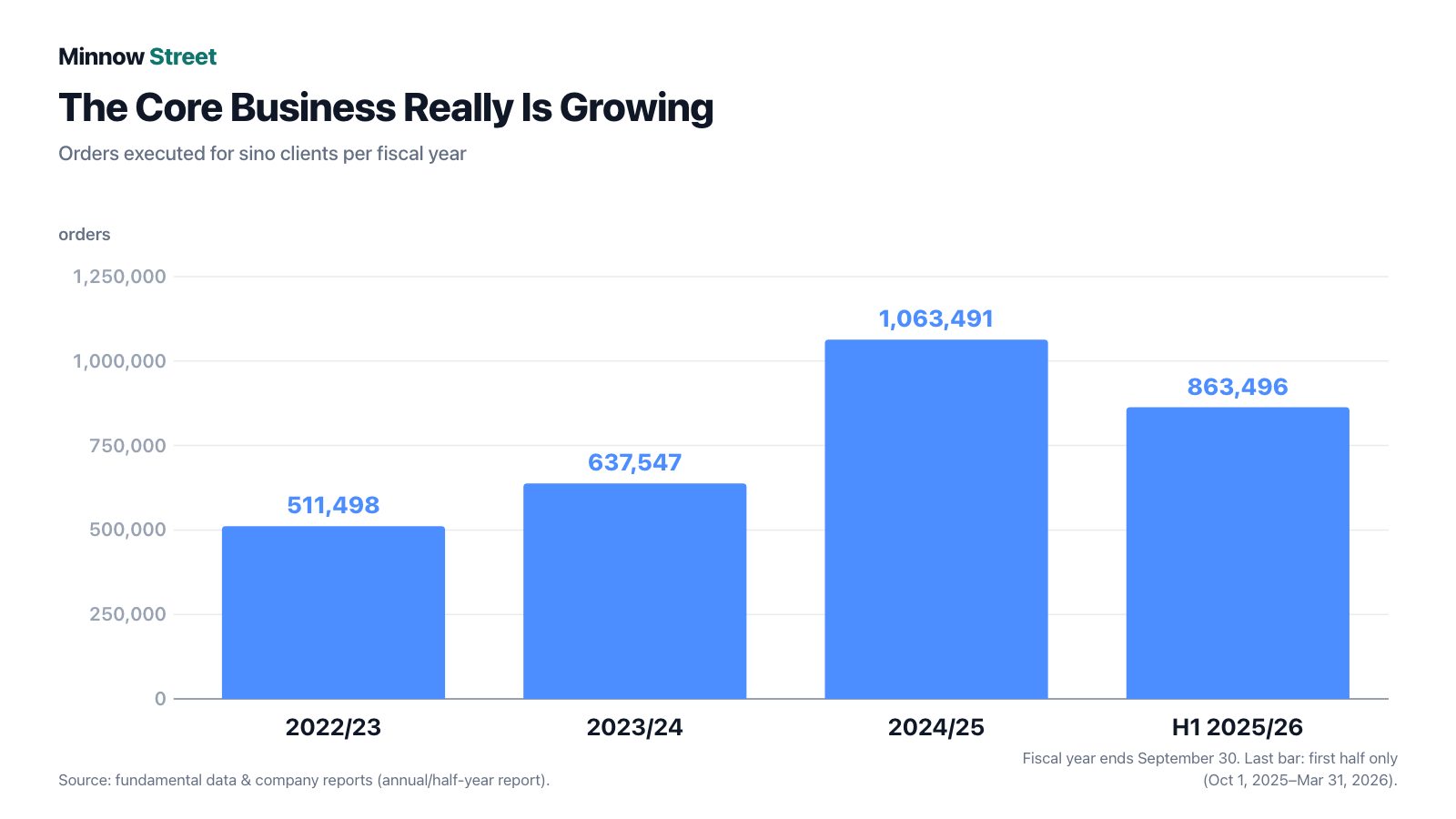
First the part that genuinely impresses, and there is more of it than the jackpot story suggests. sino AG's core business really is growing, and quickly. In the first half of fiscal 2025/2026 it executed 863,496 orders, against 450,690 in the prior-year period — up roughly 92 percent, or 412,806 orders. Group commission income rose about 71 percent to EUR 7.16 million (prior-year period: EUR 4.18 million). And this is no outlier: in fiscal 2024/2025 orders had already climbed 66.8 percent from 637,547 to 1,063,491. The trend continued after the balance sheet date — in June 2026 sino AG executed 146,630 orders according to its own release of July 7, 2026, 69.34 percent more than in June 2025.
Efficiency is improving measurably as well. The cost-income ratio — the share of operating income consumed by administrative expenses — fell to 0.69 in the reporting half year, from 0.85 a year earlier. In plain terms: 31 cents of every euro of income survive administrative costs instead of 15. In fiscal 2024/2025 the ratio stood at 0.82, the year before at 0.97, when costs swallowed almost the entire income. Management raised its guidance for 2025/2026 in the half-year report: operating income of EUR 12.2 to 13.8 million (previously 11.1 to 13.4), administrative expenses of EUR 8.7 to 9.4 million (previously 9.2 to 10.7), operating profit before tax of EUR 3.4 to 4.6 million (previously 2.9 to 4.1) and a cost-income ratio between 0.63 and 0.77. That is a real, clean operating improvement, and it deserves to be stated plainly before the uncomfortable chapters begin.
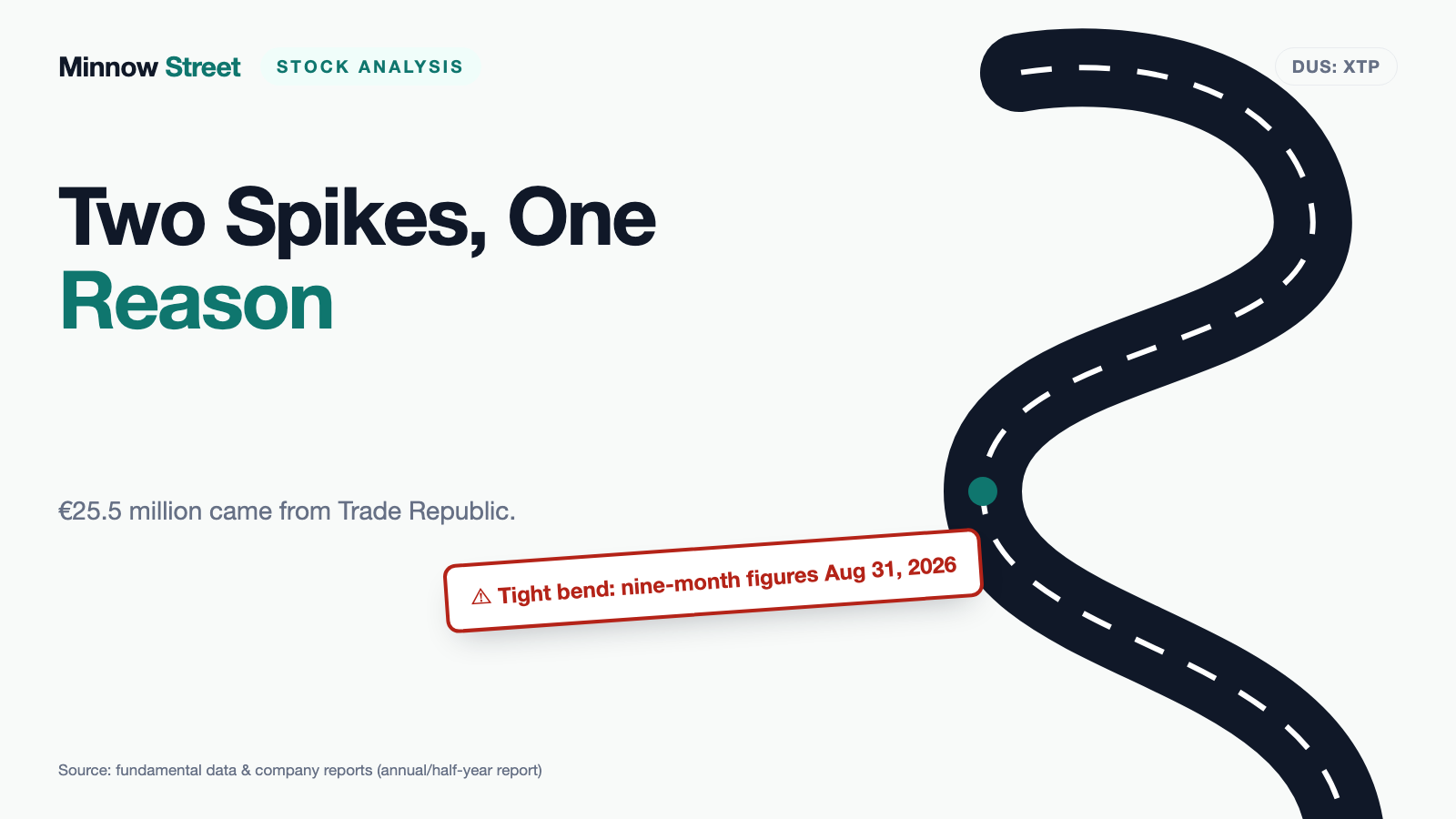
Now the curve that explains everything. It shows the group result from ordinary business activities — profit before tax — across five periods:
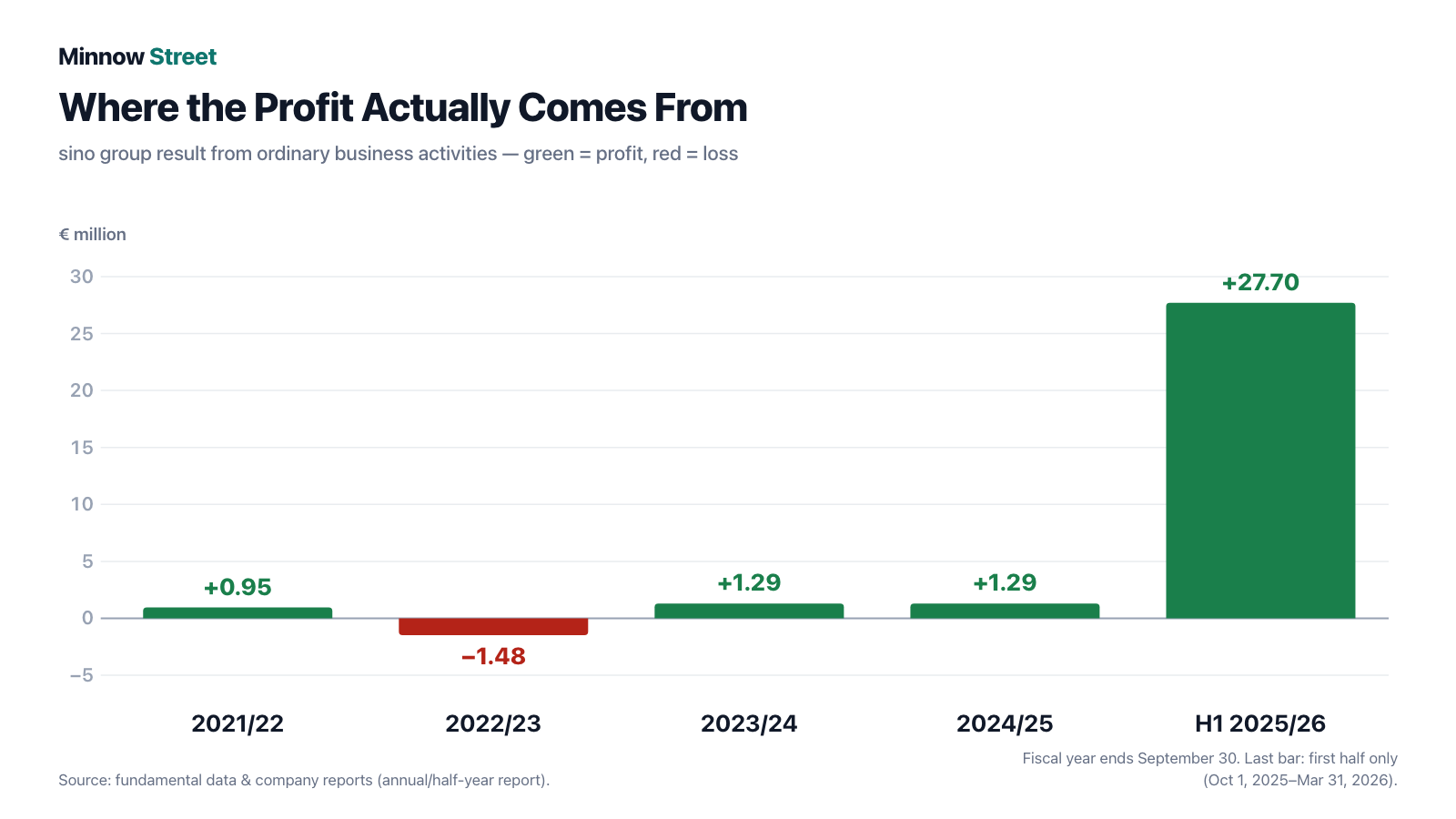
Four bars on the floor, one bar in the sky. And here is the remarkable part: this is not the first spike of its kind. In fiscal 2020/2021 the sino group reported a result from ordinary business activities of EUR 143.02 million — set out in the five-year table of the annual report 2023/2024. The cause back then was the same: the sale of shares in Trade Republic Bank GmbH. Two spikes, one reason. Between them sits a business that earned EUR 1.29 million before tax in its best year and closed fiscal 2022/2023 with a pre-tax loss of EUR 1.48 million. Anyone trying to understand sino AG's earning power therefore has to read two curves separately: the calm, slowly rising line of the brokerage — and the two flashes from the investment portfolio. We once dissected something similar when a reinsurer's profit turned out to be made not in underwriting but in the securities portfolio: in our analysis of Greenlight Capital Re.
What the Reports Say — the Uncomfortable Truths
A note on sourcing before we start. sino AG is a German issuer and is not registered with the U.S. securities regulator, the SEC. There are no 10-K or 10-Q filings; the primary sources are the annual and half-year reports published on the company website, prepared under German commercial law (HGB) and, for the annual accounts, audited. Every quotation below is reproduced in the German original with an English translation and a page reference, so you can check it yourself.
Uncomfortable Truth No. 1: The Record Profit Is a Disposal Gain, Not a Business Result
The half-year report makes no secret of it — it says so in a single sentence. Practically all of the half year's other operating income came from one source:
“Die sonstigen betrieblichen Erträge betragen insgesamt 25.748 TEUR. Sie resultieren im Wesentlichen aus den Erträgen der Veräußerung von Anteilen an der Trade Republic Bank GmbH (25.547 TEUR).”
Translation: "Other operating income totals EUR 25,748 thousand. It results essentially from the proceeds of the disposal of shares in Trade Republic Bank GmbH (EUR 25,547 thousand)."
— sino AG, half-year financial report as of March 31, 2026, condensed notes, page 8

Let us do the arithmetic properly. The result from ordinary business activities came to EUR 27,700,194.78 for the half year; after tax, EUR 26,581,288.88 of group net income remained. Spread across the 2,337,500 shares outstanding, that is roughly EUR 11.37 per share in six months. Without the disposal proceeds, a good EUR 1 million of the EUR 27.7 million pre-tax figure would be left — precisely the range sino AG has occupied for years. The management report puts the earnings contribution of the first disposal tranche at roughly EUR 25.16 million after tax.
And there is more to come: a second tranche of the same transaction closed after the balance sheet date, on May 28, 2026. Management expects a further contribution of roughly EUR 13.31 million after tax from it. Its guidance states the total:
“Unter Berücksichtigung des gesamten Ergebnisbeitrags aus der Secondary-Share-Sale-Transaktion (erste und zweite Tranche) von rund 38,47 Mio. EUR nach Steuern, der mit Vollzug der zweiten Tranche vollständig realisiert wurde, erwartet der Vorstand für das Geschäftsjahr 2025/2026 einen Konzernjahresüberschuss von rund 40,8 bis 41,6 Mio. EUR nach Steuern.”
Translation: "Taking into account the total earnings contribution from the secondary share sale transaction (first and second tranche) of roughly EUR 38.47 million after tax, which was fully realised upon completion of the second tranche, the management board expects group net income of roughly EUR 40.8 to 41.6 million after tax for fiscal year 2025/2026."
That is the decisive line of the whole analysis, and it comes from the company itself. Of the EUR 40.8 to 41.6 million of expected net income, EUR 38.47 million is a disposal gain. What the ongoing business contributes appears in the same paragraph: expected profit before tax of EUR 3.4 to 4.6 million and EUR 2.3 to 3.1 million after tax. Remember that pair — it is the yardstick for everything that follows: the company earns roughly EUR 2.3 to 3.1 million a year from operations. Everything above that is sold silverware.
Uncomfortable Truth No. 2: Seven Million Euros Went to the Company's Own Board — and the Report Gives Two Different Figures
Where does the proceeds money go? Part into money market funds (EUR 16.7 million), part into bank accounts. And part into a position you would not expect on the balance sheet of a securities institution. Within other assets, which jumped from EUR 1.79 million to EUR 8.84 million, an item labelled "loans to third parties" carries EUR 7,716 thousand. The notes reveal who that third party is:
“Unter Darlehen an Dritte wird eine Darlehensforderung in Höhe von 7.000 TEUR an den Vorstand ausgewiesen, Rückzahlungen waren bis zum Stichtag nicht fällig und wurden daher bislang nicht geleistet.”
Translation: "Within loans to third parties, a loan receivable of EUR 7,000 thousand from the management board is reported; repayments were not yet due as of the reporting date and have therefore not been made so far."
— sino AG, half-year financial report as of March 31, 2026, condensed notes, page 6

Seven million euros is no footnote at this company: it is roughly 16 percent of the EUR 43.5 million balance sheet total and roughly 18 percent of the EUR 39.9 million of equity — and a multiple of what the group earns in a normal year. And here is a detail easily missed on a fast read: the report states two different amounts in two places. The notes on page 6 say EUR 7,000 thousand. The management report on page 18 says:
“Wesentlicher Treiber dieser Entwicklung war die Vergabe eines Darlehens an ein Mitglied des Vorstands, das zum Bilanzstichtag mit 7,04 Mio. EUR ausgewiesen wird.”
Translation: "The main driver of this development was the granting of a loan to a member of the management board, which is reported at EUR 7.04 million as of the balance sheet date."
EUR 7.00 million against EUR 7.04 million. The EUR 40 thousand gap is small and plausibly accrued interest — except that nowhere does the report say so. It gives no interest rate, no maturity, no collateral, and does not name which of the two board members received the loan. It says only that the money went to the board and that nothing had been repaid by March 31, 2026. It does record that transactions of this kind changed the risk profile:
“Durch den Aufbau eines Wertpapierbestands sowie die Vergabe von Darlehen haben Marktpreis- und Adressausfallrisiken im Konzern jedoch an Bedeutung gewonnen.”
Translation: "Through the build-up of a securities portfolio and the granting of loans, however, market price and counterparty default risks have gained importance within the group."
— sino AG, half-year financial report as of March 31, 2026, risk, opportunity and forecast report, page 19
Two points of fairness. First, all of this is disclosed, in two places — concealment looks different. Second, there is a connection worth knowing: on July 22, 2026 sino AG published a directors' dealings notification. MMI Leisure & Capital Management GmbH, a company closely associated with chief executive Ingo Hillen, bought sino shares at EUR 90.00 each for a volume of EUR 2,700,000.00 — that is 30,000 shares, or roughly 1.3 percent of all shares outstanding, traded outside a trading venue. The same entity had already reported a purchase on June 24, 2026. A board member buying his own stock in size is generally a good sign. That the same company lent the same board member seven million euros shortly before, without disclosing terms, turns it into a question you have to answer for yourself. A third point applies to the entire half-year report: it is expressly neither audited nor reviewed by an auditor — the company states this itself in the notes on page 4. That does not apply to the annual accounts, but it does apply to every half-year figure in this analysis.
Uncomfortable Truth No. 3: Most of the Profit Does Not Belong to the Company — the Articles of Association Mandate a Payout
Now for the good news, which is also an uncomfortable one. sino AG is not allowed to keep the bulk of the Trade Republic proceeds. That is written into its own articles of association:
“Die Satzung der sino AG sieht ein Ausschüttungsgebot vor, wonach Gewinne aus der Veräußerung von Anteilen an der Trade Republic Bank GmbH grundsätzlich zu mindestens 90 % an die Aktionäre ausgeschüttet werden sollen.”
Translation: "The articles of association of sino AG provide for a distribution requirement under which profits from the disposal of shares in Trade Republic Bank GmbH are in principle to be distributed to shareholders to at least 90 percent."

The report names the size right afterwards: management plans to propose a dividend of at least EUR 14.80 per share to the annual general meeting that decides on the appropriation of profits for 2025/2026. Across 2,337,500 shares that is roughly EUR 34.6 million — almost the entire expected net income. For comparison: the annual general meeting of May 4, 2026 resolved a dividend of EUR 1.46 per share, and in the two years before that there was no distribution at all.
For you as an investor this cuts both ways, and both matter. The good side: a distribution requirement in the articles of association is strong protection. It prevents a one-time windfall from seeping away inside the company, into acquisitions nobody asked for, or into loans whose terms appear nowhere. The money reaches you, and the rule sits in the charter rather than in a press release. The uncomfortable side: precisely for that reason you must not book the record profit as a build-up of substance. After the payout, sino AG is again the company it was before — a small broker with roughly 300 custody accounts and annual earnings in the low single-digit millions, only with a smaller Trade Republic stake than before. The capital passes through the balance sheet once and then leaves.
Uncomfortable Truth No. 4: The Most Important Asset Sits on the Balance Sheet at a Value That Says Nothing About Its Worth
If selling roughly half a percentage point of a stake produces EUR 38.47 million after tax, the next question is obvious: what is the rest worth? The balance sheet is no help — and that is not a criticism, it is German accounting. The annual report 2024/2025 states it clearly:
“Die Anteile an der Trade Republic Bank GmbH, werden zum 30. September 2025 als Beteiligung zu fortgeführten Anschaffungskosten bilanziert.”
Translation: "The shares in Trade Republic Bank GmbH are carried as a participation at amortised cost as of September 30, 2025."

In everyday terms: it is as if the house you bought in 1998 appeared in your net-worth statement at the price you paid back then. The figure is booked entirely correctly — and is entirely useless for judging your wealth. Concretely: the whole balance sheet line "participations" stood at EUR 6.50 million as of March 31, 2026 — for every participation combined, Trade Republic included. A price-to-book ratio built on this balance sheet therefore does not measure what you get. Remember the principle: when the most important asset sits at historical cost, book value is a floor, not a valuation.
How large the remainder is, the half-year report does state precisely:
“Unter Berücksichtigung von Beteiligungsprogrammen für Gründer, Mitarbeiter und die Geschäftsleitung der Trade Republic Bank GmbH geht die Geschäftsführung der sino AG derzeit von einer wirtschaftlichen Beteiligung (fully diluted) der sino an der Trade Republic Bank GmbH von 1,77 % aus.”
Translation: "Taking into account participation programmes for founders, employees and the management of Trade Republic Bank GmbH, the management of sino AG currently assumes an economic interest (fully diluted) of sino in Trade Republic Bank GmbH of 1.77 percent."
— sino AG, half-year financial report as of March 31, 2026, condensed notes, list of shareholdings, page 10
The economic interest has therefore fallen from 2.27 percent via 2.05 percent to 1.77 percent fully diluted. "Fully diluted" means every share that founders, employees and management of Trade Republic can still receive is already counted — so your slice does not shrink again when those programmes are exercised. What those 1.77 percent are worth, the report deliberately does not say. It names a single partial figure, and a strikingly concrete one: for shares held in trust under management option agreements, whose full exercise the board considers "very likely" by August 2029, it expects a further disposal gain of roughly EUR 4.9 million after tax. There are no other anchors — and anyone extrapolating a total value from that is calculating with assumptions, not with evidence. We do not do that here.
Valuation: The Cheapest Price-Earnings Ratio in This Analysis Is Also the Most Useless
Here the jackpot trap becomes arithmetic. sino AG's market capitalisation stood at roughly EUR 252 million according to fundamental data (data as of August 3, 2026), spread across 2,337,500 shares — arithmetically about EUR 108 per share. The 52-week trading range ran from EUR 85 to EUR 113 (same as-of date); the directors' dealings notification of July 22, 2026 records EUR 90.00 per share for an off-market block, and on the day of the 2025 annual general meeting, May 6, 2025, the stock stood at EUR 86.40 according to the annual report. Those are the documented anchors; daily prices deliberately play no role in this analysis.
Set that market value against management's own guidance for 2025/2026 — EUR 40.8 to 41.6 million of group net income — and you get a price-earnings ratio of roughly 6. That looks like a bargain, and that is exactly how it gets quoted in forums. Now run the same calculation with the operating figure from the same report: EUR 2.3 to 3.1 million after tax. That produces a price-earnings ratio of roughly 81 to 110. Same company, same day, same source — once with and once without the disposal proceeds. Remember this sentence: a price-earnings ratio is only as reliable as the repeatability of the earnings beneath it.
A counter-calculation is only fair, and it favours the stock. A substantial part of the market value is money that is meant to flow back to you under the charter: at least EUR 14.80 per share is roughly EUR 34.6 million, or about 14 percent measured against the arithmetic EUR 108 share price. Subtract that planned distribution from the market value and roughly EUR 218 million remains for a business earning EUR 2.3 to 3.1 million after tax from operations — plus the remaining 1.77 percent of Trade Republic, whose value the balance sheet does not show. Whether that remainder justifies the premium is the real investment question. It is not an arithmetic question but a judgement call: to a large extent you are buying an unvalued stake in a competitor.
Two figures on substance belong here, and they are unusually good. Equity rose from EUR 13.3 million to EUR 39.9 million between September 30, 2025 and March 31, 2026, and the equity ratio to roughly 91.5 percent on a balance sheet total of EUR 43.5 million. The balance sheet shows no liabilities to banks at all as of the reporting date (September 30, 2025: EUR 300,000). Cash and cash-like items account for EUR 10.69 million, roughly a quarter of the balance sheet total, alongside EUR 16.7 million in money market funds. This company does not have a financing problem. It has an earning-power problem — which is something entirely different from what a heavily indebted provider under pressure goes through; we described what that looks like in our analysis of Western Union.
Opportunities and Risks at a Glance
What speaks for sino AG:
- The core business is growing for real and fast: 863,496 orders in the first half of fiscal 2025/2026 (up 92 percent), commission income of EUR 7.16 million (up 71 percent), and 146,630 orders in June 2026 alone (up 69.34 percent against June 2025).
- Efficiency is improving measurably: a cost-income ratio of 0.69 for the half year after 0.85 a year earlier and 0.97 in fiscal 2023/2024; guidance calls for 0.63 to 0.77 for the full year.
- An exceptionally solid balance sheet: a 91.5 percent equity ratio, EUR 39.9 million of equity, no remaining liabilities to banks, EUR 10.69 million of cash plus EUR 16.7 million in money market funds (all as of March 31, 2026).
- Shareholder-friendly articles of association: at least 90 percent of Trade Republic disposal gains are to be distributed, and a proposal of at least EUR 14.80 per share is planned, worth roughly EUR 34.6 million.
- Substance remains in the portfolio: 1.77 percent of Trade Republic fully diluted, plus 9.83 percent of QUIN Technologies GmbH (getquin) — and from the management options the board expects a further gain of roughly EUR 4.9 million after tax by August 2029.
- Continuity at the top: on August 3, 2026 the supervisory board reappointed both executives early — Ingo Hillen until August 2030 and Karsten Müller until August 2031.
What speaks against it:
- Earning power is small and volatile: EUR 1,004 thousand of group net income in fiscal 2024/2025 (EUR 0.43 per share), EUR 888 thousand the year before, and a pre-tax loss of EUR 1.48 million in 2022/2023 — guidance for 2025/2026 calls for EUR 2.3 to 3.1 million after tax from operations.
- The record profit is one-off and partly pre-committed: EUR 38.47 million of the expected EUR 40.8 to 41.6 million comes from the two disposal tranches, and at least 90 percent of it is meant to leave the company as a dividend.
- Seven million euros lent to the management board — roughly 16 percent of the balance sheet total — with no disclosure of interest rate, maturity or collateral, two different amounts in the same report (EUR 7,000 thousand in the notes, EUR 7.04 million in the management report), and no repayment through March 31, 2026.
- The half-year report is expressly neither audited nor reviewed by an auditor — every half-year figure in this analysis carries that level of assurance.
- Structural competition: management itself names the growth of mobile brokerage as a challenge. Trade Republic, the very source of the profit, served more than 10 million customers as of September 2025 — sino AG serves roughly 308 custody accounts.
- Concentration and valuation risk in the investment portfolio: on CAPTIQ GmbH (5.43 percent) the half-year report states verbatim that the situation is "very challenging"; the result from participations accounted for at equity was minus EUR 116,569.74 for the half year. The report also notes that the securities portfolio and the loans have increased market price and counterparty default risks.
- A very thin market: 2,337,500 shares on the Primary Market of the Düsseldorf Stock Exchange — even small orders can move the price, as the 52-week range of EUR 85 to EUR 113 (data as of August 3, 2026) shows.
A Human Conclusion
Back to the jackpot trap. Its core is not that the profit is fake — it is entirely real, the money moved, and a large part of it is meant to end up with you under the charter. Its core is that your brain turns an event into a characteristic. "EUR 26.6 million in six months" feels like a statement about the company. In truth it is a statement about a sale. The statement about the company sits two paragraphs further on in the same report and reads: EUR 2.3 to 3.1 million after tax in the current fiscal year.
The fair part: sino AG hides nothing. It writes the special effect down, it explicitly strips it out of its own guidance, it discloses the board loan in two places, and it has bound itself by charter to pass the proceeds on. That is more openness than you find at many far larger companies. What would be unfair is if you took away the wrong number. So here are the three questions to answer honestly before deciding — not as a recommendation but as a checklist. First: does the core business keep growing once no more stakes are sold? The next hard evidence arrives on August 31, 2026 with the nine-month figures for 2025/2026. Second: what happens to the board loan? Will the next report show a repayment, an interest rate, collateral — or again just an amount without terms? Third: how much is a stake worth to you that appears in no balance sheet at its value? Because that is a large part of what you are buying.
And one image to take with you, because it tells the whole story in a single line: sino AG earns most of its money from shares in the company that puts the most pressure on its own business model. That is not irony, it is its situation — and it was the smartest capital decision in its history. Whether it becomes a good stock depends on whether the broker grows large enough before the portfolio runs out. What you make of that is your decision. And that is exactly as it should be.
Sources
Every original document used in this analysis, so you can read it yourself:
- sino AG — half-year financial report as of March 31, 2026 (published June 30, 2026) — neither audited nor reviewed
- sino AG — annual report 2024/2025 (published March 24, 2026)
- sino AG — annual report 2023/2024 (five-year table of results, participations)
- sino AG — trading figures release of July 7, 2026: 146,630 orders in June, 308 custody accounts as of June 30, 2026
- sino AG — directors' dealings notification of July 22, 2026: MMI Leisure & Capital Management GmbH, purchase, EUR 90.00 per share, volume EUR 2,700,000.00, outside a trading venue
- sino AG — investor relations release of August 3, 2026: early reappointment of Ingo Hillen (until August 2030) and Karsten Müller (until August 2031)
- sino AG — financial calendar: publication of the results for the first nine months of fiscal 2025/2026 on August 31, 2026
- Fundamental data (market capitalisation, share count, 52-week range; data as of August 3, 2026), reconciled with the figures in the reports.
Transparency & disclaimer: This analysis is journalistic commentary on publicly available information. It is not investment advice, not a financial analysis in any regulatory sense, and not a solicitation to buy or sell securities. Equity investments carry substantial risk up to and including total loss. All information is provided without warranty; the as-of date of the data is noted in the text — the most recent periodic report evaluated is the half-year financial report as of March 31, 2026, and the nine-month figures for 2025/2026 are due on August 31, 2026. Positions held by the operator are disclosed daily; where one exists, it appears as a notice at the top of this deep dive.
Our Bottom Line at a Glance
- Core business positive
- The brokerage is growing for real: 863,496 orders in the first half of fiscal 2025/2026 against 450,690 in the prior-year period (up 92 percent), commission income of EUR 7.16 million (up 71 percent), and 308 custody accounts served as of June 30, 2026. The trend held after the balance sheet date: 146,630 orders in June 2026, 69.34 percent more than in June 2025.
- Earnings quality negative
- Half-year net income of EUR 26,581,288.88 is almost entirely a disposal gain: EUR 25,547 of EUR 25,748 thousand of other operating income comes from the sale of Trade Republic shares according to the notes. Management guidance of June 30, 2026 separates it cleanly — EUR 38.47 million of the expected EUR 40.8 to 41.6 million is one-off, leaving EUR 2.3 to 3.1 million after tax from operations.
- Balance sheet & substance positive
- As of March 31, 2026 equity stood at EUR 39.9 million after EUR 13.3 million six months earlier, the equity ratio at roughly 91.5 percent and total assets at EUR 43.5 million. The balance sheet shows no remaining liabilities to banks; EUR 10.69 million of cash and EUR 16.7 million in money market funds are available. No financing risk is apparent.
- Capital return positive
- The articles of association require that profits from disposals of Trade Republic shares be distributed to shareholders to at least 90 percent. A proposal of at least EUR 14.80 per share is planned, roughly EUR 34.6 million across 2,337,500 shares. The flip side: the windfall builds no lasting substance, it passes through the balance sheet and back out again.
- Governance & transparency negative
- The half-year report discloses a loan to the management board — EUR 7,000 thousand in the notes (page 6), EUR 7.04 million in the management report (page 18), roughly 16 percent of total assets — with no interest rate, maturity or collateral stated and no repayment through March 31, 2026. The report is also expressly neither audited nor reviewed. On the other side of the ledger: everything is disclosed, and an entity closely associated with the chief executive bought shares for EUR 2,700,000.00 at EUR 90.00 each on July 22, 2026.
- Valuation neutral
- At a market capitalisation of roughly EUR 252 million (fundamental data, as of August 3, 2026), the price-earnings ratio is roughly 6 against total guidance and roughly 81 to 110 against operating profit after tax. A substantial part of the price therefore rests on the remaining 1.77 percent of Trade Republic — carried at amortised cost, with no report putting a value on it.
sino AG is the jackpot trap in textbook form: group net income of EUR 26,581,288.88 in the first half of fiscal 2025/2026 looks like earning power, but by the company's own notes EUR 25,547 of EUR 25,748 thousand of other operating income comes from selling Trade Republic shares. The core business really is growing — 863,496 orders (up 92 percent), a cost-income ratio of 0.69 — yet on management guidance it delivers only EUR 2.3 to 3.1 million after tax. The balance sheet is exceptionally solid at a 91.5 percent equity ratio, and the charter forces a payout of at least 90 percent of the disposal gain. What remains open is earning power without the special effect, and a loan of roughly seven million euros to the company's own management board with no terms disclosed. Not investment advice.
What Our Rating Means
Open questions
The business works in principle, but one material question is open. As long as it stays open, our findings do not carry a quality verdict.
Yellow here stands for an open operating question, not for a risk to the substance. The substance is unusually well documented: EUR 39.9 million of equity and a 91.5 percent equity ratio as of March 31, 2026, no liabilities to banks, EUR 10.69 million of cash plus EUR 16.7 million in money market funds, a growing core business, and a management board that expressly sees no threat to the company's existence. What is open is earning power itself: the reported result hangs on a single event — the sale of Trade Republic shares, contributing EUR 38.47 of the guided EUR 40.8 to 41.6 million — while the ongoing business earns EUR 2.3 to 3.1 million after tax and still posted a pre-tax loss of EUR 1.48 million in 2022/2023. Added to that is a governance point that deserves watching: a loan to the management board of EUR 7,000 thousand per the notes, or EUR 7.04 million per the management report, with no interest rate, maturity or collateral stated. That the stock looks cheap against the windfall and expensive against operating profit is a price argument and does not drive this rating. The decision is yours.
A journalistic assessment by our editorial team at the time of the deep dive, based on public sources — not investment advice and not a solicitation to buy or sell. Your personal circumstances (investment goals, risk capacity, taxes) cannot be taken into account. What our levels mean, how verdicts are formed, and what conflicts of interest exist →
Worth Noting
- sino AG reached our research list through the list of the most-discussed stocks among German retail investors at wallstreet-online (as of August 4, 2026), not through a screening filter. Forum attention is not a quality signal — here it was the hint that a single earnings number had caused a stir.
- Data basis and level of assurance: the most recent periodic report evaluated is the half-year financial report as of March 31, 2026, published June 30, 2026 and expressly neither audited under section 317 of the German Commercial Code nor reviewed by an auditor. Every announcement after it was taken into account (trading figures July 7, 2026; directors' dealings July 22, 2026; board reappointments August 3, 2026). Results for the first nine months of 2025/2026 are due on August 31, 2026 per the financial calendar.
- Careful with comparisons: the fiscal year ends on September 30, not December 31. Book value also says little, because the Trade Republic shares are carried at amortised cost; the entire participations line stood at EUR 6.50 million as of March 31, 2026. sino AG should not be confused with similarly named companies in Asia.
The full analysis as a PDF for later
We will send you this analysis as a PDF — to print, file away, and read at your own pace.
Frequently Asked Questions
sino AG of Düsseldorf is a specialist brokerage for very active retail traders, so-called heavy traders. At its heart is the in-house MX-PRO trading front end, through which more than 99 percent of all orders ran in fiscal 2024/2025. Accounts and custody are handled by Baader Bank AG as a cooperation partner. Alongside that, the subsidiary sino Beteiligungen GmbH holds minority stakes in financial firms, including 1.77 percent fully diluted of Trade Republic Bank GmbH as of March 31, 2026.
Because it came almost entirely from a sale. The half-year financial report as of March 31, 2026 shows group net income of EUR 26,581,288.88. Of other operating income of EUR 25,748 thousand, the notes attribute EUR 25,547 thousand to the disposal of shares in Trade Republic Bank GmbH. The management report puts the earnings contribution of the first tranche at roughly EUR 25.16 million after tax.
On September 30. Fiscal 2025/2026 runs from October 1, 2025 to September 30, 2026; the half-year financial report covers the six months to March 31, 2026 and was published on June 30, 2026. Results for the first nine months of fiscal 2025/2026 are scheduled for August 31, 2026 according to the financial calendar. Anyone comparing sino figures with calendar years is therefore comparing shifted periods.
The company states the figure itself. In its guidance of June 30, 2026 the board expects operating profit before tax of EUR 3.4 to 4.6 million for 2025/2026 and EUR 2.3 to 3.1 million after tax — expressly excluding the book gain from the share sale. For comparison: group net income was EUR 1,004 thousand in fiscal 2024/2025 (EUR 0.43 per share) and EUR 888 thousand the year before.
The half-year report states the intention to propose a dividend of at least EUR 14.80 per share to the annual general meeting that decides on the appropriation of profits for 2025/2026. Across 2,337,500 shares that is roughly EUR 34.6 million. The background is a distribution requirement in the articles of association: profits from disposals of Trade Republic shares are to go to shareholders to at least 90 percent. The annual general meeting of May 4, 2026 had resolved EUR 1.46 per share.
That cannot be derived from the reports, and sino AG names no value. The shares are carried at amortised cost; the entire participations line stood at EUR 6.50 million as of March 31, 2026. The economic interest is 1.77 percent fully diluted, down from 2.27 percent before the sale. Only one partial figure is given: from management options the board expects a further disposal gain of roughly EUR 4.9 million after tax by August 2029.
The half-year report discloses a loan to the management board within other assets — EUR 7,000 thousand in the notes and EUR 7.04 million in the management report. That is roughly 16 percent of the EUR 43.5 million balance sheet total. Repayments were not due by March 31, 2026 and were not made. The report gives no interest rate, maturity or collateral. It does record that market price and counterparty default risks have gained importance through the securities portfolio and the loans.
The shares are admitted to trading on the Primary Market of the Düsseldorf Stock Exchange, a quality segment of that exchange's open market, and also trade on other German venues. There are 2,337,500 bearer shares. Market capitalisation stood at roughly EUR 252 million (fundamental data, as of August 3, 2026), with a 52-week range of EUR 85 to EUR 113. The market is therefore very thin — an off-market block of 30,000 shares changed hands at EUR 90.00 on July 22, 2026.
Found an error?
Did you spot a factual error, an outdated number, or a typo in this deep dive? Let us know briefly — your report goes straight to the editorial team.