Sable Offshore: A Presidential Order Got the Oil Flowing Again — the Bill Is in the Filings
For two years Sable Offshore reported zero revenue while it fought in court for permission to restart the oil field it had bought from ExxonMobil off the California coast. On March 13, 2026 the U.S. Energy Secretary ordered the pipeline back into service under the Defense Production Act, and on March 29 the first barrels were sold: $137.1 million of revenue in the second quarter of 2026 and, for the first time ever, positive operating cash flow of $9.4 million. The company paid for that moment on July 2, 2026 with a $675 million loan at 15 percent, $345 million of convertible notes struck at $4.00 and 37.3 million new shares sold at $3.08 — three days after the stock last closed at $6.97, according to its own prospectus supplement. We read the Form 10-Q for the quarter ended June 30, 2026 and the Form 10-K for 2025. Not investment advice — just the plain question of who ends up paying for a rescue.
 Thomas Mücke
Founder & Publisher
Thomas Mücke
Founder & Publisher
As of Today
As of: September 24, 2026
- Closing price
- 4.00 $ -4.30%
- Market Capitalisation
- 0.8 $B
- AAQS
- 0/10
This analysis has a cut-off date. The Stock Guard tells you when something material changes in the numbers. Reserve your free spot
Chart
Interactive price chart (TradingView).
52-week range: 3.10 $ to 24.50 $ · Last price: 4.00 $ (As of: September 24, 2026)
Note: pure fact-based analysis, not investment advice and not a solicitation to buy or sell. All figures without guarantee.
The “finally” trap
There is an investor trap that springs shut at the exact moment you turn out to be right. Call it the “finally” trap. It works like this: you own a stock whose entire case hangs on one event — an approval, a ruling, a permit. Nothing happens for months. Then the news you waited for lands, and something clicks in your head: “Finally. Now it starts.” In that moment you skip the question that actually matters: what did the waiting cost, and who paid for it?
At Sable Offshore Corp. (NYSE: SOC) that trap can be worked out in hard numbers like almost nowhere else. The event arrived, and on a scale no shareholder could have scripted: on March 13, 2026 the U.S. Energy Secretary invoked the Defense Production Act to direct the company to put its oil pipeline off the California coast, idle since 2015, back into service. Oil flowed the next day. Sales began on March 29. And in the second quarter of 2026 the first revenue in the company’s history hit the books: $137.1 million.
Even so: on July 1, 2026 the company sold new shares at $3.08 apiece. Three days earlier, on June 29, the stock had last closed at $6.97, according to the company’s own prospectus supplement. The event had happened — and the shareholder was poorer. So let us make a deal: before you buy a stock because its catalyst has finally arrived, we read together what the filings with the U.S. securities regulator, the SEC, actually say — the Form 10-Q for the quarter ended June 30, 2026, filed on August 10, 2026, and the Form 10-K for 2025. An SEC filing is honest under penalty of law. And this one tells a rescue story that comes with an invoice attached. The decision at the end is yours.
What Sable Offshore actually does — an empty listed shell buys an idle oil field
Until February 2024 the company now called Sable Offshore was an empty shell. It traded as Flame Acquisition Corp., a special purpose acquisition company — a listed entity with no business that raises money in order to buy something later. Think of it as a blank check on an exchange. On February 14, 2024 that check was cashed, and for something unusual: the Santa Ynez Unit off the coast of Santa Barbara, California, bought from ExxonMobil.
The Form 10-K for 2025 describes exactly what came with it: three production platforms in federal waters — Hondo, Harmony and Heritage, five to nine miles offshore — 16 federal leases, the Las Flores Canyon processing facility onshore, and the pipeline that carries the oil from there to Kern County: a 24-inch segment of roughly 10.8 miles and a 30-inch segment of roughly 113 miles, today known as Segments 324 and 325. This is no exploration project but a veteran asset: between 1981 and 2014 the field produced more than 671 million barrels of oil equivalent. In 2014, the last full year of operation, it averaged 29 thousand barrels of oil and condensate a day on a gross basis.
Then came May 19, 2015. The pipeline segment, then operated by Plains All American and known as Line 901, ruptured. Oil reached the Pacific at Refugio State Beach through a drainage culvert. Production stopped — and stayed stopped. ExxonMobil spent seven years trying to bring the assets back online and eventually gave up. That is where Sable stepped in, led by chairman and chief executive James C. Flores, an industry veteran whose personal involvement was written into the old Exxon loan agreement as a condition. As of December 31, 2025 the company employed roughly 200 people.
Which names the central tension of this analysis, and it runs through every chapter: Sable never had an oil problem, it had a permission problem. The oil was always there. What was missing was the right to push it through a pipe — and in the end that right came not from a regulator but from a federal order that is now being litigated. We dissected how expensive aging offshore fields and their decommissioning duties can get in the same series at W&T Offshore; how a heavily indebted oil producer works its way through a balance-sheet repair at SandRidge Energy.
How the stock landed on our desk
Sable Offshore is not a hit from our fundamental stock scanner — that tool finds companies with a track record of numbers, and until a few months ago this company simply had none. The ticker reached our research list through our in-house Reddit hype scanner, which collects the most frequently mentioned symbols in U.S. retail investor forums (run of August 11, 2026). The reason for the forum chatter is obvious: on August 10, 2026 the company filed its Form 10-Q and published its earnings release for the second quarter — the first report in its history with a revenue line in it.
That is precisely what makes this case interesting and dangerous at once. A stock that moves from standstill to operation produces headlines with real, big numbers: first revenue, first positive cash flow, production doubled. All of those statements are true. What forum posts rarely supply is the other side of the same balance sheet — the interest burden, the share count and the court calendar. So we read both.
The numbers over the years, fairly credited
Start with what genuinely impresses, because that is part of being honest. Restarting an offshore field with three platforms after eleven idle years is not a matter of flipping a switch. Sable did it, and the second-quarter 2026 numbers show it without embellishment:
- $137.1 million of revenue — the first meaningful revenue in company history, from 1,910 thousand barrels of oil equivalent of sales volume. Of that, $136.7 million came from oil and NGL sales — roughly $71.6 per barrel.
- $9.4 million of positive operating cash flow — according to the August 10, 2026 earnings release, the first quarter with positive cash flow since inception.
- A ramp that is working: roughly 26 wells were online on average in April 2026, roughly 39 in June and roughly 47 in July, producing an average of roughly 721 gross barrels a day per well. Sales volumes grew 149 percent from the first to the last day of the quarter, reaching roughly 40 thousand net barrels a day.
- Platform Heritage resumed production in early April 2026; the company points to September 2026 for Hondo and to the third quarter of 2026 for all 77 wells on Harmony and Heritage.
Now the same view across the years. The chart below shows revenue and net income for the periods after the assets were bought. It is worth a moment:
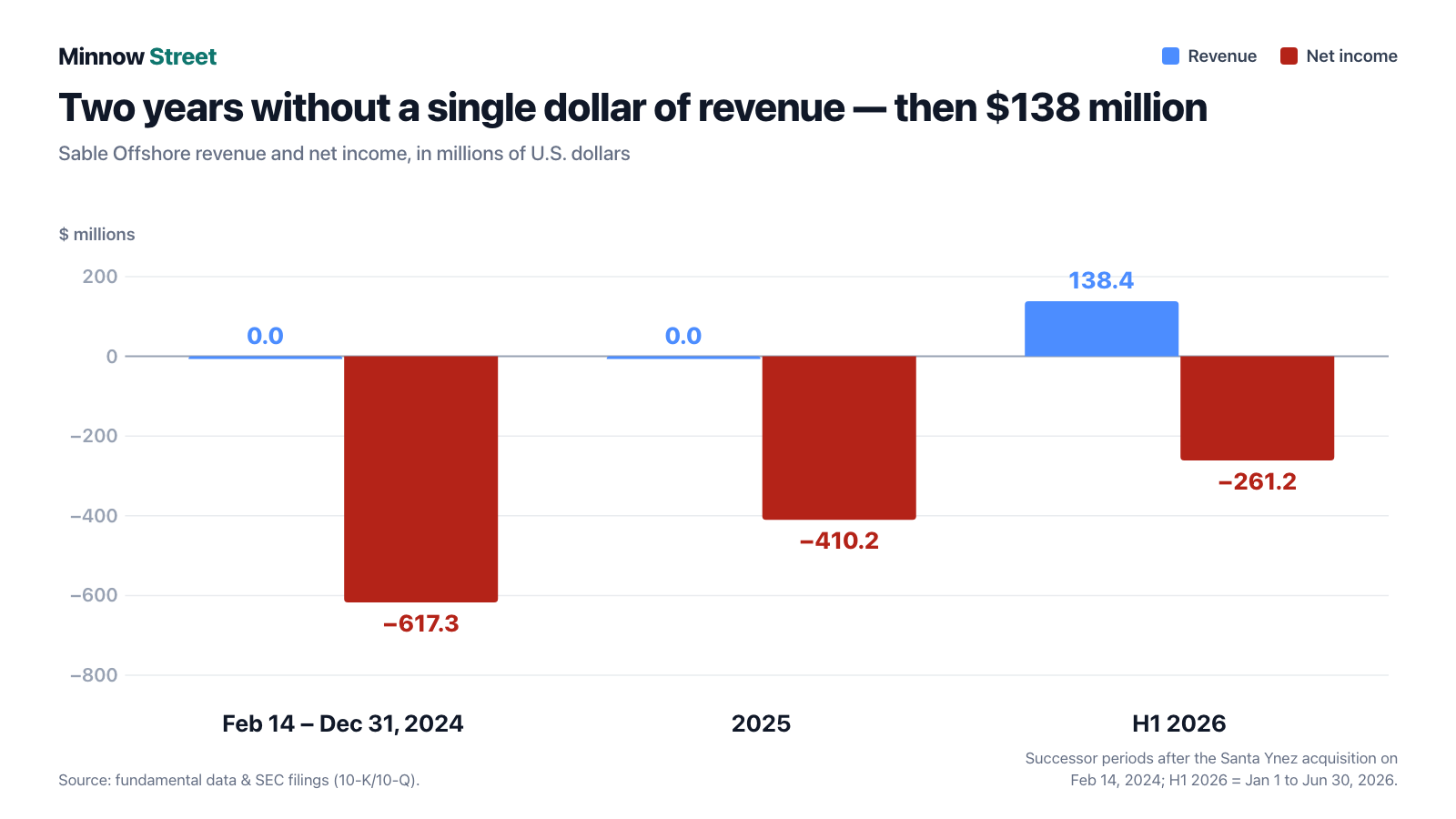
Those losses are enormous and they left marks: accumulated deficit stood at $1,369.7 million on June 30, 2026, and stockholders’ equity at $395.0 million (end of 2025: $534.3 million). Total assets of $1,761.6 million consist almost entirely of the oil and gas properties themselves ($1,611.4 million net). One detail explains part of the picture: the $617.3 million loss in the first period included $227.5 million from remeasuring warrants — a pure accounting item left over from the SPAC years, with no cash going out the door.
What does cost cash is running the business. In the second quarter of 2026, $137.1 million of revenue faced $113.5 million of operations and maintenance expense (roughly $59.4 per barrel of oil equivalent), plus $58.5 million of general and administrative expense and $32.0 million of depletion, depreciation, amortization and accretion. Part of that is start-up cost: $18.5 million was demurrage — fees for tankers kept waiting because California refineries had not planned for the sudden availability of the crude. The company says such charges should not recur. The rest is the plain arithmetic of a ramp-up phase: as long as not every well is online, fixed costs spread across too few barrels.
What the filings say — the uncomfortable truths
Uncomfortable truth no. 1: the rescue costs 15 percent, plus a guaranteed minimum return
On July 2, 2026 Sable Offshore rebuilt its entire capital structure and paid off the old Exxon loan. That was necessary: the audit report attached to the Form 10-K for 2025 carried an explicit going concern paragraph — in plain language, doubt over whether the company would survive the next twelve months.

To be fair: that doubt has since been lifted. The August 10, 2026 quarterly report says so explicitly:
“On July 2, 2026, the Company completed the 2026 Refinancing Transactions, which extended the maturity of the Company’s debt obligations and improved its liquidity position. As a result, management re-evaluated the Company’s ability to continue as a going concern and concluded that the conditions and events that previously raised substantial doubt had been alleviated.”
— Sable Offshore Corp., SEC Form 10-Q for the quarter ended June 30, 2026, Note 1 “Going Concern”
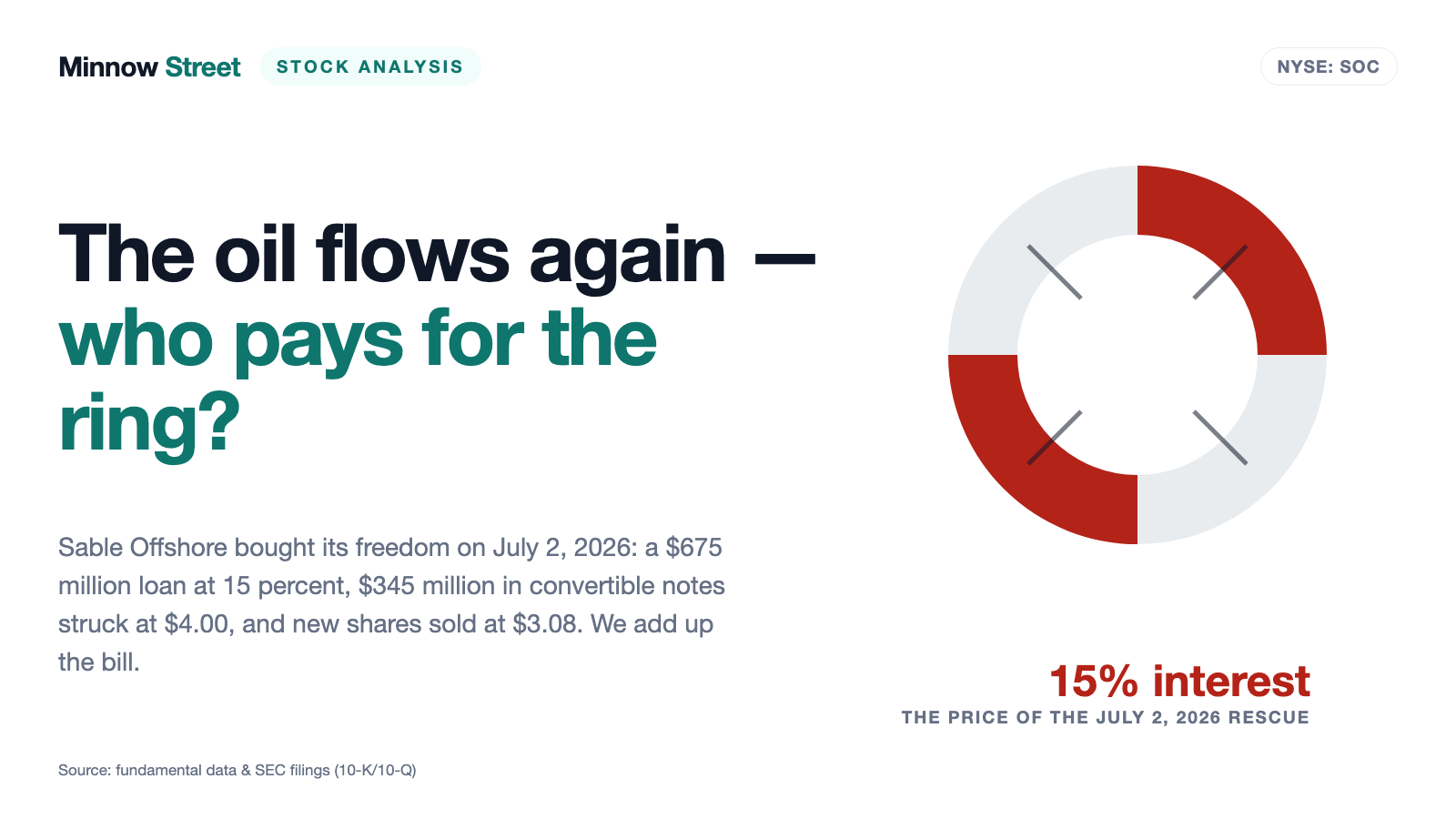
Except that it was lifted with the most expensive money a listed company can raise. The new facility is called Term Loan B, runs to $675.0 million, matures on December 15, 2028 — and carries interest of 15.00 percent a year.

Translate that into everyday money. 15.00 percent on $675.0 million is roughly $101 million of interest a year. Add the $345.0 million of convertible notes at 6.5 percent, another roughly $22 million. Together that is roughly $124 million of interest a year before a single dollar of principal is repaid. And principal is repaid too: 2.5 percent of the loan each quarter in the second half of 2026, then 5.0 percent — roughly $135 million of amortization a year from 2027. On top of that the agreement sweeps 100 percent of excess cash flow, subject to a $25.0 million minimum liquidity test. In other words: whatever the field earns belongs to the creditors first, not to the shareholders.
And then there is a clause borrowed from private equity rather than from lending: a 1.25x minimum multiple on invested capital at repayment, maturity or acceleration. That works out to roughly $169 million above the principal amount — on top of the 15 percent. Anyone betting that Sable simply swaps the expensive loan for a cheaper one once conditions improve has to pay that premium too. Remember this: a loan whose lenders demand a private-equity return is not a loan to a healthy company.
Uncomfortable truth no. 2: $6.97 became $3.08 — and the share count has more than doubled
Shareholders paid for the second half of the rescue themselves. On July 1, 2026 Sable placed 37,337,662 new shares at $3.08, raising roughly $115.0 million gross. The prospectus supplement for that offering carries both numbers in the same document — the offering price and the last stock price before it:
“The last reported sale price of our Common Stock on June 29, 2026, was $6.97.”
— Sable Offshore Corp., SEC prospectus supplement 424B5 of July 1, 2026, cover page
Fewer than three trading days separate those two figures. Anyone holding the stock on June 29 watched the company issue new shares at less than half that price. That is not malice; it is the logic of an emergency financing. Whoever urgently needs money is quoted the price the market feels like paying. For a shareholder it means exactly one thing — your slice of the pie gets smaller, and materially so.
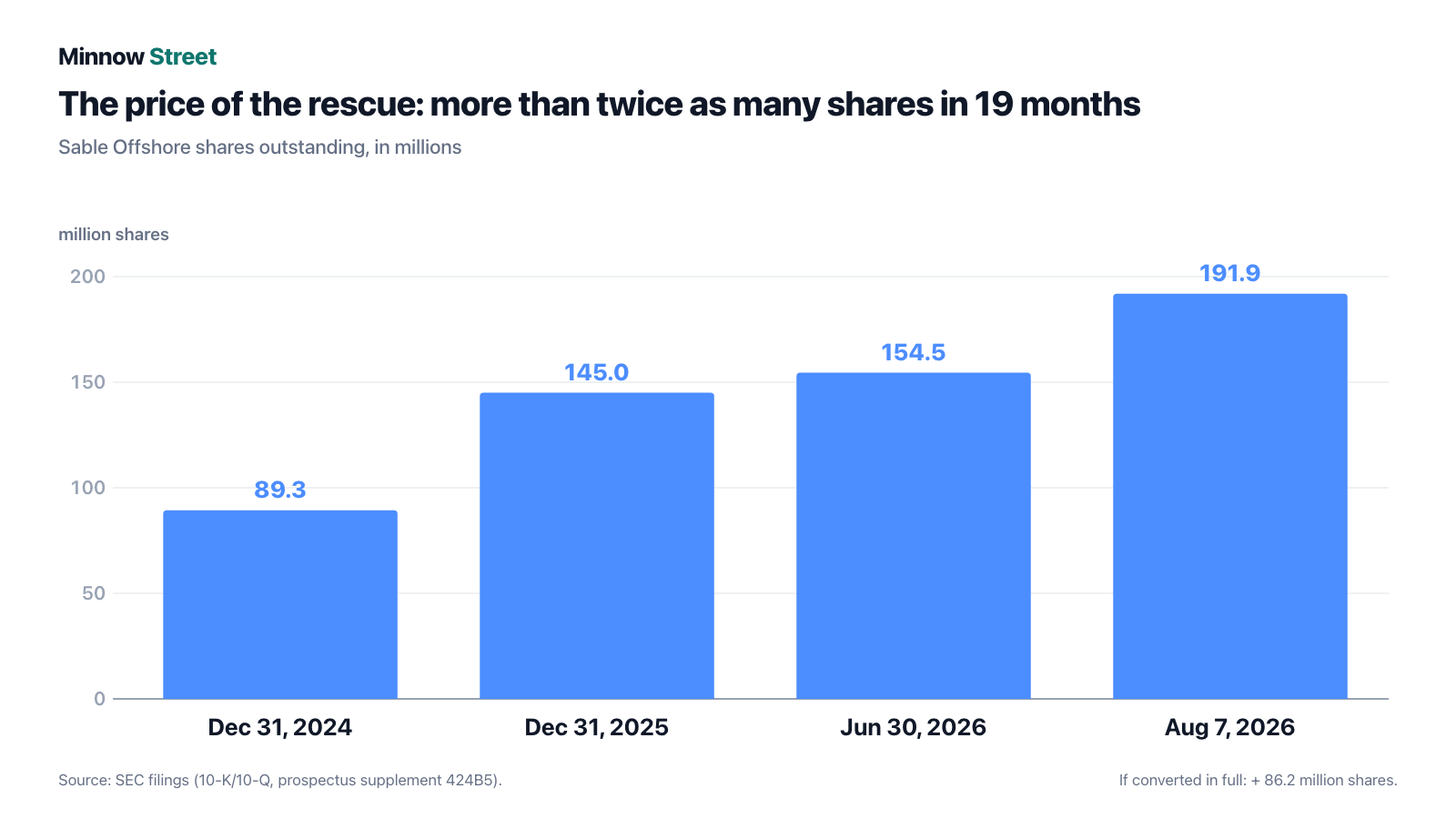
The figures in detail: 89,310,996 shares on December 31, 2024, 144,961,796 on December 31, 2025, 154,531,910 on June 30, 2026 and 191,869,572 on August 7, 2026 — the cover date of the latest quarterly report. That is more than a doubling in 19 months. And the dilution is not finished: the $345.0 million of convertible notes convert at 249.7502 shares per $1,000 of principal, an initial conversion price of roughly $4.00. Converted in full, that would create roughly 86.2 million additional shares — another 45 percent on top of today’s count. Add 7,568,870 warrants still outstanding from the SPAC years.
One side note makes the price trajectory tangible: through an at-the-market program, Sable issued 7,000,634 shares for roughly $95.0 million in the first half of 2026 — an average of roughly $13.57 a share. Six months later, the big placement went off at $3.08.
Uncomfortable truth no. 3: an oil company that, by its own filing, has no reserves
This passage deserves a second reading. An oil producer is normally valued on its reserves — the volumes that qualify as economically recoverable under the strict rules of the U.S. securities regulator. In its Form 10-K for 2025, Sable Offshore reports not a single one. Everything beneath the seabed is carried as contingent resources:
“As a result of the contingencies noted above, none of the estimated petroleum quantities attributed to the SYU Assets as of December 31, 2025 meet the requirements for disclosure as reserves pursuant to the guidelines published by the SEC in Rule 4-10(a) of Regulation S-X.”
— Sable Offshore Corp., SEC Form 10-K for 2025, Item 1 “SYU Contingent Resources”

This is not a technicality; it has a hard price. An oil producer usually funds day-to-day operations through a reserve-based lending facility: the bank values proved reserves and grants a line against them. Sable has such a facility — a substantial $500.0 million. Except that its borrowing base at closing was zero and, in the words of the quarterly report, it “will not provide for revolving availability until such time as a borrowing base is established.” For now the facility only supports commodity hedging. Picture a credit card with a $500 million limit where the limit is set to nothing until an engineer certifies the oil.
The fair counterpoint belongs here too: classifying the volumes as contingent resources was factually unavoidable as of December 31, 2025, because neither transport nor sales were running. Both are running now. It is entirely possible that the next annual report will disclose real reserves for the first time — that would be one of the most important pieces of news for this stock. It is not certain.
Uncomfortable truth no. 4: the oil flows by order — and the state is suing
The decisive sentence of this analysis sits in Note 6 of the quarterly report. The oil flows not because California granted permission but because the federal government ordered it. On March 13, 2026 the President signed an order delegating Defense Production Act authority to the Energy Secretary; the same day, Energy Secretary Chris Wright directed Sable to prioritize and allocate pipeline transportation capacity. The reasoning quoted in the filing: the problem is most acute on the West Coast, “where dangerous State and local policies jeopardize our Nation’s core national defense and security needs.”
On March 30, 2026 the State of California sued over that order (Case No. 2:26-cv-03396, U.S. District Court, Central District of California); a hearing on a motion to dismiss was set for September 28, 2026. A whole bundle of further proceedings runs alongside it, and the filing lists them across several pages:
- California Coastal Commission: imposed an administrative penalty of roughly $18.0 million in April 2025, which Sable considers unlawful and had not accrued as of June 30, 2026. The preliminary injunction obtained in May 2025 was discharged on July 22, 2026; judgment was entered on August 6, 2026, and Sable filed a notice of appeal on August 7, 2026. Sable itself quantifies its damages claim against the agency at more than $347.0 million.
- Senate Bill 237: effective January 1, 2026, the California statute requires a spike hydrostatic testing program and a new coastal development permit for pipelines idle for five years or more. Sable is suing for a declaration that its pipeline is not covered and that the law is preempted by federal law; hearings were set for September 8 and September 21, 2026.
- Environmental groups are suing the federal agencies BSEE and BOEM; a hearing is scheduled for February 12, 2027. The state and its parks department are separately litigating rights of way through Gaviota State Park.
For valuation this means one thing: the entire revenue line of this company depends on an administrative act that is before a court. That is not the ordinary regulatory uncertainty every oil company carries — it is an existential question with a calendar. If the order falls, the pipeline stops, and the revenue line goes back to zero. The filing itself flags the 2020 consent decree, still neither terminated nor modified, as an open condition.
Uncomfortable truth no. 5: federal prosecutors and the SEC have asked for documents
On December 2, 2025 Sable Offshore received subpoenas for documents — from the U.S. Attorney’s Office for the Southern District of New York and from the SEC. The company names the trigger itself:
“On December 2, 2025, the Company received subpoenas from the United States Attorney’s Office for the Southern District of New York (“SDNY”) and SEC requesting documents (the “Government Requests”). The document requests relate to issues raised in an October 31, 2025 report published by Hunterbrook Media and the trading of Company securities, as well as related issues. The Company is providing documents and cooperating with the Government Requests.”
— Sable Offshore Corp., SEC Form 10-Q for the quarter ended June 30, 2026, Note 6 “Government Requests”

Some context on the trigger. Hunterbrook Media is an investigative newsroom that publishes its research while stating openly that an affiliated fund trades on the back of those reports. That is a financial interest, which makes such a report an outside assessment, not a neutral source of fact. The October 31, 2025 report alleges, among other things, that the company selectively shared material information with individual investors; a later report set out how thin the cash position was at the time. Sable disputes the allegations and describes Hunterbrook in its annual report as the author of a report issued “to short sellers.” Its board formed a special committee of independent directors on November 3, 2025; according to the Form 10-K of February 27, 2026 that investigation was still under way, and the Form 10-Q of August 10, 2026 reports no conclusion.
What that means for you is plain: neither a report nor a subpoena is proof of wrongdoing. But both are an open risk with an undetermined outcome, which the company has itself added to its risk factors, including the possibility of civil penalties and sanctions. One more item from the filing calendar belongs next to it without being overdramatized: on July 10, 2026 the auditor changed from Ham, Langston & Brezina to CohnReznick because the previous firm sold parts of its business. The filing reports no disagreements — a technical change, not a warning sign.
Valuation: what the market itself paid
For a company that has only just booked its first revenue and sits deep in the red, the usual multiples — price to earnings, price to sales — mislead. So we use the anchors documented in the filings themselves, each with a date:
- $3.08 a share — the price at which the market was willing to absorb 37.3 million new shares on July 1, 2026.
- $4.00 a share — the conversion price of the July 2, 2026 notes, the level at which noteholders would rather be shareholders.
- $2.82 a share — tangible book value after the placement, calculated on the March 31, 2026 balance sheet as disclosed in the prospectus supplement itself (before: $2.81).
- $6.97 a share — the last reported sale price before the announcement, on June 29, 2026.
Those four numbers say more about the situation than any multiple. Immediately before the raise the market valued the stock at roughly two and a half times tangible book — and three days later was only willing to step in a hair above book. Anyone buying today is essentially betting on how much free cash flow reaches the shareholder after servicing roughly $124 million of annual interest and roughly $135 million of annual amortization from 2027.
Run that bet through the company’s own numbers — an order of magnitude, not a forecast. For 2027 Sable guides to 42,500 to 47,500 net barrels a day, with lease operating expense of $9.00 to $12.00 and cash general and administrative expense of $3.50 to $6.50 per barrel, plus marketing and transportation deductions of $21.00 to $25.00 per barrel. Take the company’s own hedge as the price anchor — roughly 25 thousand barrels a day for 2027 are protected by a floor of $65.00 per barrel of Brent — and roughly $40 to $44 per barrel is left after deductions. Over a full year that is roughly $620 million to $760 million of revenue, against roughly $195 million to $320 million of cash costs and $80 million to $100 million of capital expenditure. After roughly $259 million of interest and amortization, the range runs from about minus $25 million to plus $205 million. Put differently: at the low end of the company’s own plan the arithmetic does not work; at the high end it works very well. What sits in between is whether the ramp holds.
Two caveats belong with that. First, the hedge cuts both ways: the sold call caps the 2027 realization at $80.00 per barrel of Brent, so a higher oil price no longer helps on the hedged volumes. Second, deductions of $21.00 to $28.00 per barrel are unusually steep; the company attributes them to the sulfur content of the crude and to refineries that first have to plan the sudden supply into their slates. If those deductions fall, the arithmetic improves quickly — and the reverse is equally true.
Upside and risks at a glance
What speaks for Sable Offshore:
- The business is running again and producing real numbers: $137.1 million of revenue and, for the first time, $9.4 million of positive operating cash flow in the second quarter of 2026, with sales volumes up 149 percent from the first to the last day of the quarter.
- A proven field rather than an exploration hope: the Santa Ynez Unit produced more than 671 million barrels of oil equivalent between 1981 and 2014; the infrastructure stands and the wells exist, so this is a restart, not a development project.
- Tailwind from Washington: the Defense Production Act order of March 13, 2026 places pipeline operation under a national security interest, and the Department of Justice supports Sable in several proceedings, having itself moved to terminate the old consent decree.
- Maturities are pushed out to December 15, 2028, the going concern doubt is described as alleviated in the quarterly report, and roughly half of planned volumes are protected against a price slump by a $65.00 Brent floor.
- Meaningful cost reduction ahead of it: for 2027 the company plans lease operating expense of $9.00 to $12.00 per barrel against $17.00 to $21.00 in the second half of 2026, and it cut second-half 2026 capital expenditure by 41 percent to a midpoint of $85 million in order to accelerate debt repayment.
What speaks against it:
- Revenue rests on a contested administrative act: California has been suing over the Defense Production Act order since March 30, 2026, alongside proceedings involving the Coastal Commission, Senate Bill 237, the federal agencies BSEE and BOEM, and rights of way. If the order falls, transportation stops.
- The cost of capital is at distressed levels: 15.00 percent on $675.0 million, a 1.25x minimum multiple on invested capital for lenders at repayment, a 100 percent excess cash flow sweep, and total debt of $968.8 million as of June 30, 2026 against just $21.6 million of cash.
- Heavy and unfinished dilution: from 89.3 million shares at the end of 2024 to 191,869,572 on August 7, 2026, plus a further 86.2 million shares if the notes convert in full at $4.00 and 7,568,870 warrants still outstanding.
- No disclosable reserves as of December 31, 2025, only contingent resources — with the direct consequence that the $500 million credit facility opened with a borrowing base of zero and supplies no liquidity.
- Open legal exposure beyond operations: subpoenas from the SDNY and the SEC since December 2, 2025, an unfinished special committee investigation, an unaccrued administrative penalty of roughly $18.0 million, and asset retirement obligations of $119.8 million as of June 30, 2026 whose security to ExxonMobil is only deferred to December 2028.
A human conclusion
Back to the “finally” trap. At Sable Offshore it is especially treacherous, because the good news is genuine. The oil really is flowing. The revenue really is there. Operating cash flow really is positive for the first time. Anyone who bet on the restart in 2024 was right on the substance — and their portfolio still looks nothing like they imagined. Because between “the event happened” and “the shareholder made money” sat an invoice: 15 percent interest, a guaranteed minimum return for creditors, an equity raise at less than half the prior price, and a share count that more than doubled in 19 months.
What you have in front of you is therefore neither an ordinary oil stock nor a classic turnaround. It is a bet on two things at once that have nothing to do with each other: first, that the engineers hold the ramp and that cost per barrel falls as planned — second, that courts in Los Angeles, Santa Barbara and Sacramento leave standing the order that permits the whole operation in the first place. You can check the first bet against quarterly numbers. The second is decided by a judge, and no metric helps you there.
So the honest question is not “is the turnaround done?” but: do you want to own a company whose entire revenue line hangs on an administrative act that is before a court — and whose free cash flow goes 100 percent to creditors for the next several years? If you can answer yes and you know the litigation calendar, you have a thesis. If what you really bought was the headline “oil flows again,” you had a feeling. What you make of that is your decision. And that is exactly as it should be.
Sources
Every original document used in this analysis, for you to read yourself:
- Sable Offshore Corp. — SEC Form 10-Q for the quarter ended June 30, 2026 (filed August 10, 2026)
- Sable Offshore Corp. — SEC Form 10-K for 2025 (filed February 27, 2026)
- Sable Offshore Corp. — Second quarter 2026 earnings release and guidance (Exhibit 99.1 to the Form 8-K of August 10, 2026)
- Sable Offshore Corp. — SEC Form 8-K of July 2, 2026 (refinancing: Term Loan B, convertible notes, revolver)
- Sable Offshore Corp. — SEC prospectus supplement 424B5 of July 1, 2026 (equity offering at $3.08 a share)
- Sable Offshore Corp. — SEC Form 8-K of July 13, 2026 (change in certifying accountant)
- Complete SEC filing history for Sable Offshore Corp.: EDGAR overview (sec.gov)
- Outside assessment with a financial interest: Hunterbrook Media on Sable Offshore — report of October 31, 2025, named in the Form 10-K for 2025 and the Form 10-Q for the quarter ended June 30, 2026 as the trigger of the government requests. The affiliated fund Hunterbrook Capital trades on the basis of these reports.
- Fundamental data (profile, price history; as of August 11, 2026), reconciled with the SEC filings.
- Added to the research list by our in-house Reddit hype scanner, run of August 11, 2026.
Transparency & disclaimer: this analysis is journalistic commentary on publicly available information. It is not investment advice, not a regulated financial analysis, and not a solicitation to buy or sell securities. Equity investments carry substantial risk up to and including total loss. All information without warranty; the as-of date of each figure is stated in the text. Positions held by the operator are disclosed daily; where one exists, it appears as a notice at the top of this deep dive.
Key figures at a glance
All monetary figures in millions of $; earnings per share as reported.
| Metric | 2021 | 2022 | 2023 | 2024 | 2025 |
|---|---|---|---|---|---|
| Revenue | 0.0 | 0.0 | 0.0 | 0.0 | 0.0 |
| Operating Income (EBIT) | -1.7 | -6.2 | -94.5 | -338.4 | -408.3 |
| Net Income | 4.3 | -2.6 | -93.7 | -629.1 | -410.2 |
| Earnings Per Share | 0.12 $ | -0.07 $ | -2.11 $ | -7.04 $ | -4.18 $ |
Source: fundamental data & SEC filings (annual and quarterly reports, 10-K/10-Q)
Our Bottom Line at a Glance
- Operational turn positive
- The restart is real: $137.1 million of revenue in the second quarter of 2026 — the first meaningful revenue in company history — and $9.4 million of positive operating cash flow for the first time. Sales volumes grew 149 percent within the quarter to roughly 40 thousand net barrels a day, and roughly 47 wells were online in July 2026. A proven field that delivered more than 671 million barrels of oil equivalent between 1981 and 2014.
- Cost of capital and leverage negative
- The July 2, 2026 refinancing costs 15.00 percent on $675.0 million, additionally guarantees lenders a 1.25x minimum multiple on invested capital at repayment, and sweeps 100 percent of excess cash flow. As of June 30, 2026, $968.8 million of term loan debt faced just $21.6 million of cash; first-half interest expense of $77.7 million far exceeds any operating surplus in the period.
- Dilution negative
- Shares outstanding rose from 89,310,996 (December 31, 2024) to 191,869,572 (August 7, 2026). The July 1, 2026 placement priced at $3.08 after the stock last closed at $6.97 on June 29, according to the prospectus supplement. Full conversion of the notes at $4.00 would add roughly 86.2 million shares, on top of 7,568,870 warrants outstanding.
- Legal position and licence to operate negative
- All revenue rests on the Defense Production Act order of March 13, 2026, which California has been challenging since March 30, 2026 (hearing set for September 28, 2026). Proceedings involving the Coastal Commission (an unaccrued penalty of roughly $18.0 million), Senate Bill 237, BSEE and BOEM, and rights of way run alongside. The 2020 consent decree has still not been terminated.
- Substance and reserves neutral
- As of December 31, 2025 the annual report disclosed no SEC-qualifying reserves, only contingent resources — the visible consequence being a $500.0 million credit facility with a borrowing base of zero. That classification was factually unavoidable at the balance sheet date, because neither transport nor sales were running; both run now, so the next annual report could disclose reserves for the first time. That is not certain.
- Governance and open proceedings negative
- Subpoenas from the SDNY and the SEC have been outstanding since December 2, 2025, relating to a Hunterbrook Media report of October 31, 2025 and to trading in company securities. The special committee formed on November 3, 2025 had not completed its investigation according to the Form 10-K of February 27, 2026, and the Form 10-Q of August 10, 2026 reports no outcome. The July 2026 auditor change occurred without disagreements.
Sable Offshore pulled off what ExxonMobil failed to do in seven years: oil has been flowing from the Santa Ynez Unit again since March 29, 2026, and the second quarter of 2026 delivered $137.1 million of revenue and $9.4 million of positive operating cash flow for the first time. That was permitted not by a regulator but by an order under the Defense Production Act, which California is challenging in court — and the rescue was paid for with 15 percent interest on $675.0 million, a guaranteed 1.25x minimum return for lenders, and a share count that more than doubled in 19 months to 191,869,572. The operational turn is genuine, the funding position remains strained, and the licence to operate sits with a judge. Not investment advice.
What Our Rating Means
Substance risk
We found at least one documented issue that threatens the company itself — regardless of how the stock is currently valued.
Red here does not stand for an expensive share price but for documented risk to the substance of the business: first-half 2026 interest expense of $77.7 million is not covered by the operating result, cash stood at $21.6 million on June 30, 2026 against $968.8 million of term loan debt, the audit report attached to the 2025 annual report carried a going concern paragraph — and the entire revenue line depends on an administrative act that is before a court. That management considers those doubts alleviated after the July 2, 2026 refinancing does not change the fact that the new funding carries distressed terms. Two things decide whether this turns for the better, and both can be read in every quarterly report: operating cost per barrel and the litigation calendar. The decision is yours.
A journalistic assessment by our editorial team at the time of the deep dive, based on public sources — not investment advice and not a solicitation to buy or sell. Your personal circumstances (investment goals, risk capacity, taxes) cannot be taken into account. What our levels mean, how verdicts are formed, and what conflicts of interest exist →
Worth Noting
- SOC reached our research list through the in-house Reddit hype scanner (run of August 11, 2026), one day after the Form 10-Q for the quarter ended June 30, 2026 and the second-quarter earnings release were published. Our fundamental stock scanner produces no reliable metric series for this company, because there was no revenue at all until the first quarter of 2026.
- Comparability: periods before February 14, 2024 are predecessor figures from the ExxonMobil era and are not mixed with Sable Offshore numbers here. The $617.3 million loss for the period from February 14 to December 31, 2024 includes $227.5 million from remeasuring warrants — an accounting item with no cash impact.
- Valuation deliberately carries no market capitalization: the last share price documented in a filing dates from June 29, 2026 ($6.97), the placement price from July 1, 2026 ($3.08). The two diverge so far that any market capitalization or price-to-sales ratio derived from them would not be reliable. Analyses are evergreen; a daily quote is never a reason to buy.
Stock Watch
This analysis is as of August 29, 2026. Stock Watch will tell you what's changed at SOC since then.
Later $1 a month per stock — signing up is free, and you'll be the first to know when it launches.
The full analysis as a PDF for later
We will send you this analysis as a PDF — to print, file away, and read at your own pace. And we will add you to the free Stock Watch list for Sable Offshore Corp. (SOC), so you hear about it when something material in this analysis changes.
Frequently Asked Questions
Sable Offshore Corp. (NYSE: SOC) of Houston, Texas, produces oil from the Santa Ynez Unit off the coast of Santa Barbara, California. The assets comprise three federal-water platforms — Hondo, Harmony and Heritage — 16 federal leases, the Las Flores Canyon processing facility and the pipeline running to Kern County. The company bought them from ExxonMobil on February 14, 2024; they had been idle since the 2015 Refugio oil spill. Sable employed roughly 200 people as of December 31, 2025.
Not because of a California permit but because of a federal order. On March 13, 2026 the President delegated Defense Production Act authority to the Energy Secretary, and Energy Secretary Chris Wright directed Sable the same day to prioritize pipeline transportation capacity. The company resumed transportation on March 14, 2026 and began sales on March 29, 2026. The State of California has been suing over that order since March 30, 2026.
In the second quarter of 2026 Sable Offshore booked $137.1 million of revenue — the first meaningful revenue in its history, from 1,910 thousand barrels of oil equivalent. The bottom line was still a net loss of $64.2 million; for the first half of 2026 the loss came to $261.2 million. Prior periods had no revenue at all: a $410.2 million loss in 2025 and a $617.3 million loss for the period from February 14 to December 31, 2024.
As of June 30, 2026 the balance sheet showed $968.8 million of term loan debt, net, against $21.6 million of cash. The capital structure was rebuilt on July 2, 2026: a secured $675.0 million Term Loan B at 15.00 percent (due December 15, 2028), $345.0 million of 6.5 percent convertible notes (due July 1, 2031) and a $500.0 million revolving facility that opened with a borrowing base of zero. The term loan sweeps 100 percent of excess cash flow.
Shares outstanding rose from 89,310,996 (December 31, 2024) through 144,961,796 (December 31, 2025) and 154,531,910 (June 30, 2026) to 191,869,572 on August 7, 2026 — more than a doubling in 19 months. The July 1, 2026 placement covered 37,337,662 shares at $3.08. Full conversion of the notes at $4.00 would add roughly 86.2 million more shares, on top of 7,568,870 warrants still outstanding.
Not under the rules of the U.S. securities regulator, the SEC. The Form 10-K for 2025 classifies the estimated petroleum quantities of the field expressly as contingent resources and states that as of December 31, 2025 none of them met the requirements for disclosure as reserves under Rule 4-10(a) of Regulation S-X. The visible consequence: the $500.0 million credit facility opened with a borrowing base of zero. The field itself produced more than 671 million barrels of oil equivalent between 1981 and 2014.
The company received subpoenas for documents from the U.S. Attorney's Office for the Southern District of New York and from the SEC on December 2, 2025. According to the quarterly report they relate to issues raised in a Hunterbrook Media report of October 31, 2025 and to trading in company securities. Sable is providing documents and cooperating; its board formed a special committee for an independent investigation on November 3, 2025. No outcome was reported in the Form 10-Q of August 10, 2026.
For the second half of 2026 the company guides to 40,000 to 45,000 net barrels of oil equivalent a day, and for full-year 2027 to 42,500 to 47,500. Roughly 47 wells were online on average in July 2026; all 77 wells on Harmony and Heritage are meant to be running in the third quarter of 2026, with platform Hondo added in September 2026. Lease operating expense per barrel is guided to fall from $17.00 to $21.00 in the second half of 2026 to $9.00 to $12.00 in 2027.
Found an error?
Did you spot a factual error, an outdated number, or a typo in this deep dive? Let us know briefly — your report goes straight to the editorial team.