Rocky Brands: That 51.4 Percent Gross Margin Is a Court Ruling, Not a Sales Win
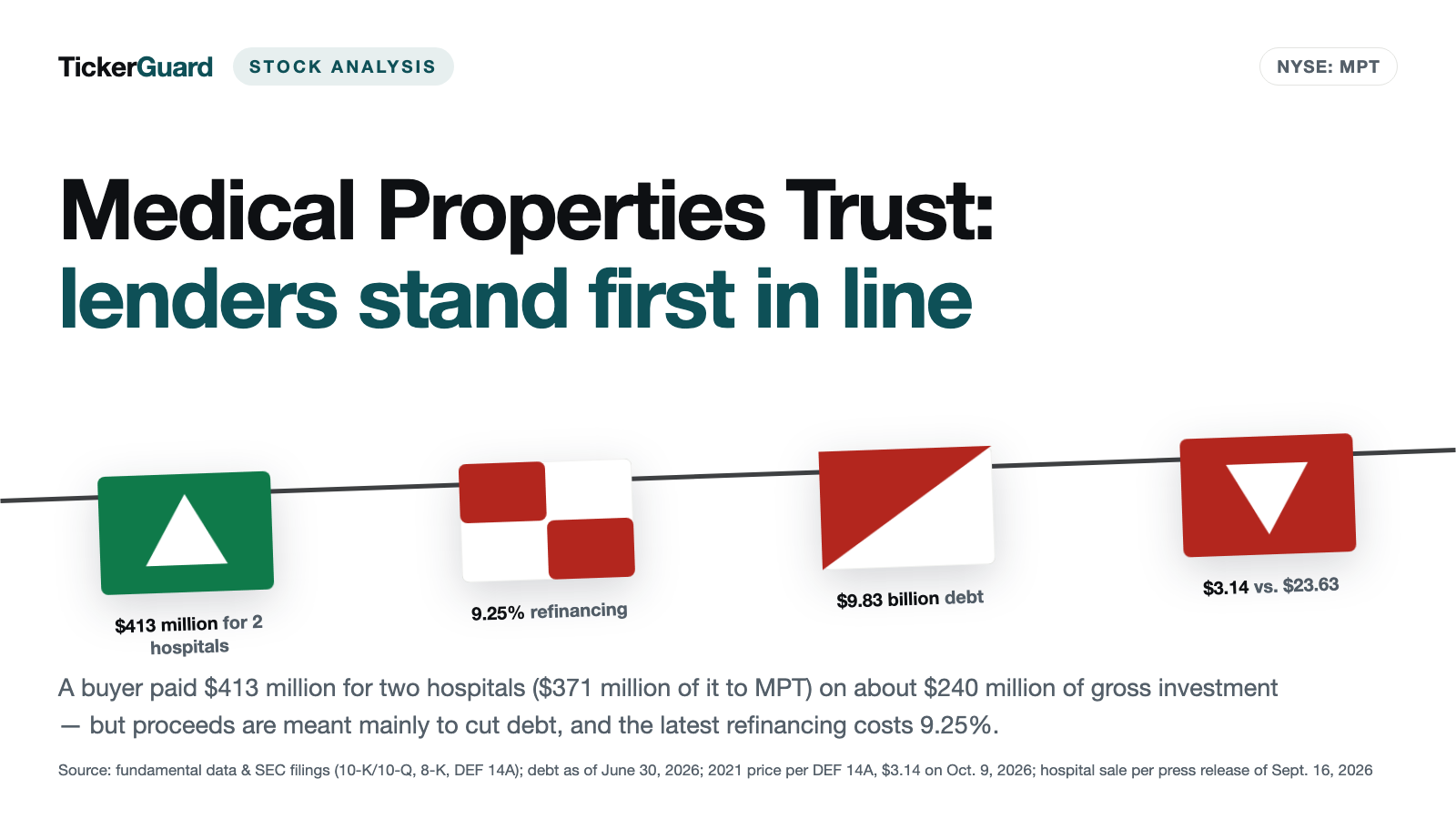
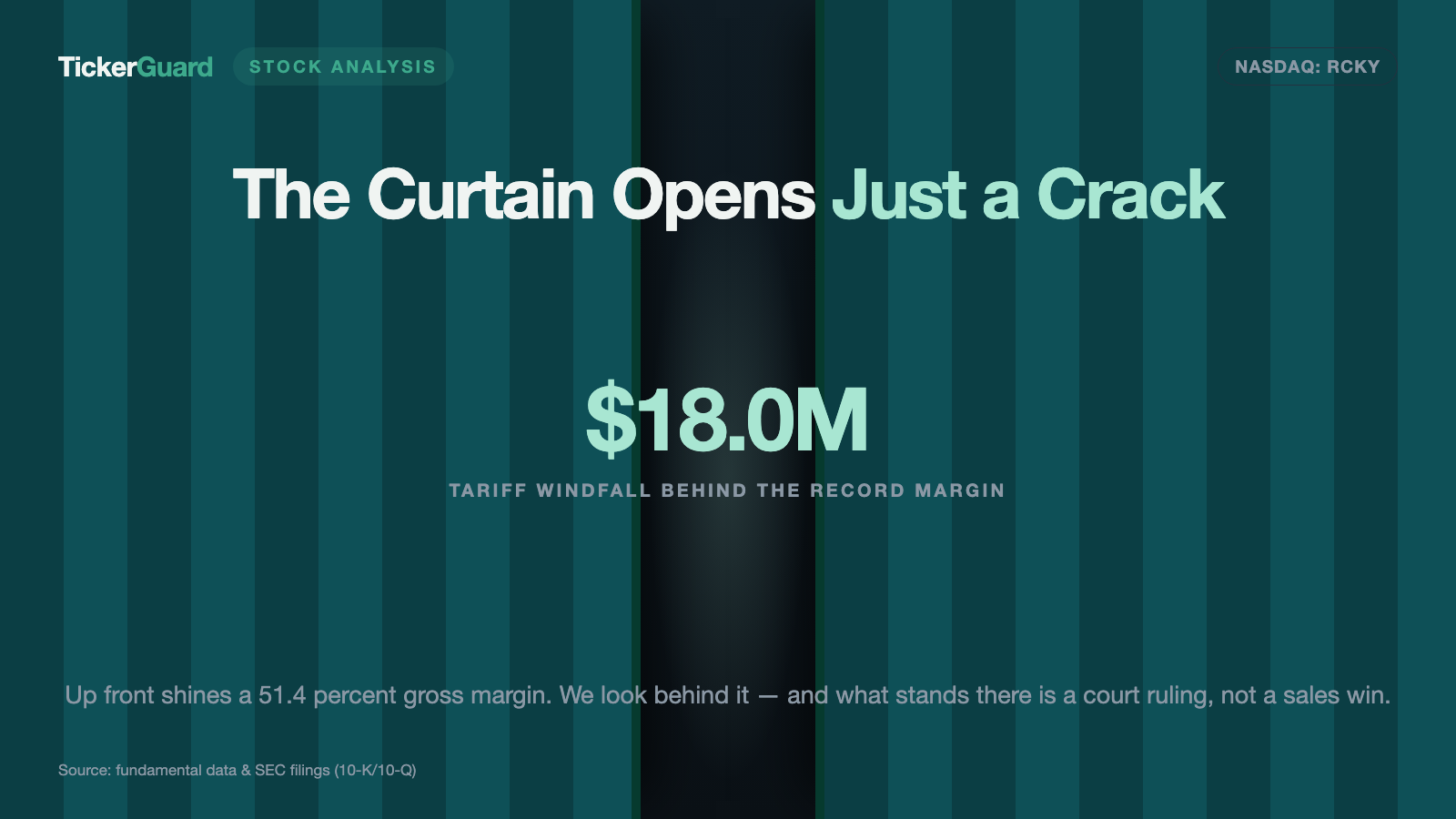
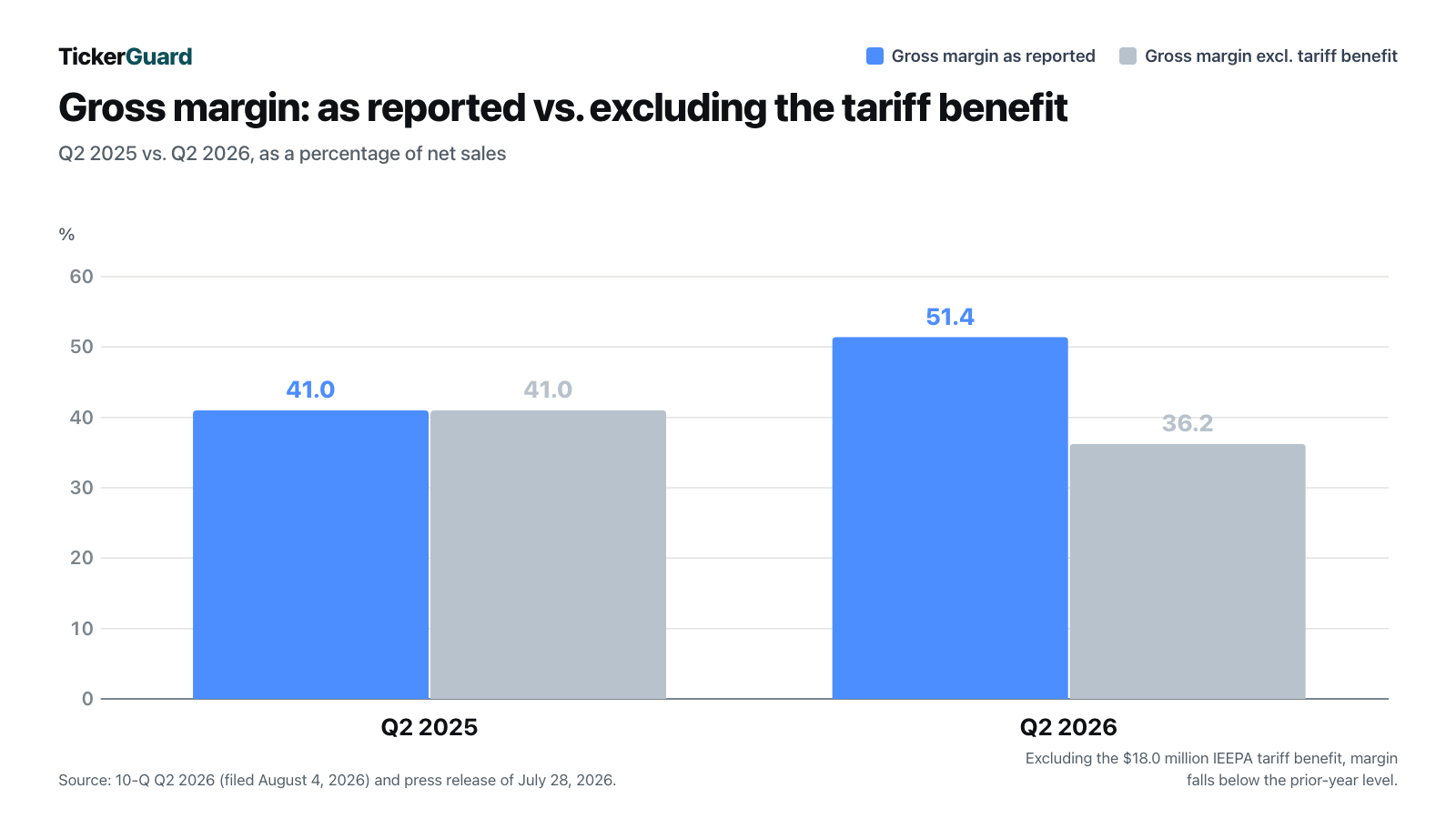
Rocky Brands reported a 51.4 percent gross margin for the second quarter of 2026 — the highest in years. The reason is not in the sales office; it is in a courtroom. A ruling against invalidated IEEPA tariffs handed the bootmaker an $18.0 million windfall. Strip it out and the margin is 36.2 percent — below last year's level. At the same time, the company has cut net debt 54 percent since its 2021 Honeywell acquisition — a turnaround few are celebrating because the tariff ruling is louder, even though roughly $103 million of debt comes due all at once in 2029. We read both: the loud one-time gain and the quiet deleveraging. Not investment advice — just the numbers as they actually stand in the filings with the U.S. securities regulator, the SEC.
 Thomas Mücke
Founder & Publisher
Thomas Mücke
Founder & Publisher
As of Today
As of: October 9, 2026
- Closing price
- 44.90 $ -1.10%
- Market Capitalisation
- 0.3 $B
- P/E
- 18.5
- Growth Score
- 4/10
- AAQS
- 7/10
Price change since August 26, 2026: -0.7%
This analysis has a cut-off date. The Stock Guard tells you when something material changes in the numbers. Reserve your free spot
Chart
Interactive price chart (TradingView).
52-week range: 26.60 $ to 50.80 $ · Last price: 44.90 $ (As of: October 9, 2026)
Note: pure fact-based analysis, not investment advice and not a solicitation to buy or sell. All figures without guarantee.
$18.0 million in tariff refunds sits behind the headline "record gross margin of 51.4 percent" — and that single number lodges in your mind like an anchor on the seabed (the so-called anchoring bias), no matter what follows. That is exactly what happened at Rocky Brands, Inc. (Nasdaq: RCKY), the bootmaker out of Nelsonville, Ohio, whose brands Muck, XTRATUF, Rocky, Durango and Georgia Boot are probably better known than the company's own name: in the second quarter of 2026, the company reported exactly that record figure. What the headline doesn't say: the reason for that number sits not in the sales office but in a court ruling on invalidated tariffs. So let's make a deal before the anchor sets: we read together what Rocky Brands itself reported to the U.S. securities regulator, the SEC — the quarterly report (10-Q) as of June 30, 2026, the annual report (10-K) for 2025, and eight press releases from the last two years. In the end, the decision is yours about where your own anchor should sit.
What Rocky Brands actually does
Rocky Brands makes boots and work footwear — today across six product lines: work, outdoor, western, duty, commercial military and military, priced between $45 and $680. Under the corporate roof sit several brands with distinct identities: Rocky (work and hunting boots), Georgia Boot and Durango (western and work boots), Lehigh (safety footwear sold directly at the workplace through the Lehigh CustomFit B2B program), plus two brands acquired in 2021: Muck (The Original Muck Boot Company) and XTRATUF, and the licensed brand Michelin. Sales run through three segments: Wholesale (more than 10,000 points of sale across the U.S., U.K. and Europe; FY2025 revenue $316.6 million, up 1.0 percent), Retail (owned e-commerce sites, third-party marketplaces, the Rocky Outdoor Gear Store; FY2025 $152.9 million, up 20.5 percent — the growth engine), and Contract Manufacturing (U.S. military and private label; FY2025 just $12.5 million, down 7.7 percent, with segment margin collapsing from 11.9 to 4.8 percent). Despite its international-sounding brands, this is practically a domestic U.S. business: only 2.3 percent of 2025 revenue came from abroad (2024: 3.2 percent).
The defining event of the company's recent history was the purchase of Honeywell International's lifestyle and outdoor footwear business on March 15, 2021, for roughly $207 million net plus a $5.4 million working-capital true-up — financed from cash and two newly taken credit facilities. That brought Muck, XTRATUF, Servus, NEOS and Ranger into the fold (Servus was sold back off in March 2023). That single transaction has shaped Rocky Brands' balance sheet for years since — and that's exactly where the central tension of this analysis begins, running through every chapter: since the Honeywell acquisition, Rocky Brands has been running two parallel stories at once — a quiet, genuine repair of the balance sheet that deal inflated, and a loud, one-time tariff story that completely overshadows the latest quarter. If you want to see how another U.S. bootmaker with work and outdoor brands is doing, our Wolverine World Wide stock analysis covers exactly that.
Company history for investors
-
2021
Honeywell acquisition financed with debt
On 3/15/2021, Rocky Brands buys Honeywell's lifestyle footwear business for roughly $212 million, financed from cash and two new credit facilities. For shareholders, this begins a deleveraging phase still running today.
-
2023
Servus sold back off, deleveraging becomes visible
In March 2023, the company sells the Servus brand it had acquired in 2021. Total debt already falls by roughly $84 million over 2023 versus 2022.
-
2024
Refinancing with Bank of America through 2029
On 4/26/2024, a new credit agreement (ABL facility $175.0 million plus term facility $50.0 million) replaces the old lines — with a one-time $2.6 million debt extinguishment charge ($1.5 million prepayment penalty, $1.1 million loss on extinguishment), but lower rates for the years ahead.
-
2026
$7.5 million buyback program approved
On 2/23/2026, the board approves a new share buyback program running through 2/23/2027 — a signal of the financial room gained after five years of deleveraging.
-
2026
Court ruling on IEEPA tariffs lifts the quarterly result
A refund benefit of $18.0 million deemed probable in the second quarter of 2026, tied to invalidated tariffs, sends gross margin jumping to 51.4 percent — a one-time effect, not a repeatable operating win.
Where the stock shows up — and why it wasn't a typical scanner pick
Rocky Brands did not land on our research list through a momentum or value scanner but through a threshold filing: on August 14, 2026, asset manager AllianceBernstein L.P. filed a Schedule 13G/A reporting 647,175 shares — 8.6 percent of all shares outstanding, as of June 30, 2026, as a purely passive holding under Rule 13d-1(b). That filing reflects the position as of June 30, 2026 — before the July 28, 2026 earnings report — and says nothing on its own about how AllianceBernstein views the later "record margin"; a passive manager adding to a position doesn't change a company's picture regardless. What made it worth a look was simply the timing of the filing itself: it is dated about two weeks after the price-moving earnings report — reason enough to check the actual SEC filings: what really drove the reported margin? For context, Rocky Brands reported 64 registered shareholders (record holders) as of February 27, 2026 (10-K FY2025) — a figure that mainly reflects how much of the stock sits in "street name" at custodian banks, not the number of beneficial owners. Per fundamental data (as of August 26, 2026), institutional ownership stands at 82.5 percent, led by Dimensional (7.4 percent per the 2026 proxy), AllianceBernstein (6.8 percent per the proxy, 8.6 percent since the threshold filing), BlackRock (6.6 percent) and Raymond James (6.4 percent).
The numbers over the years — honestly appraised
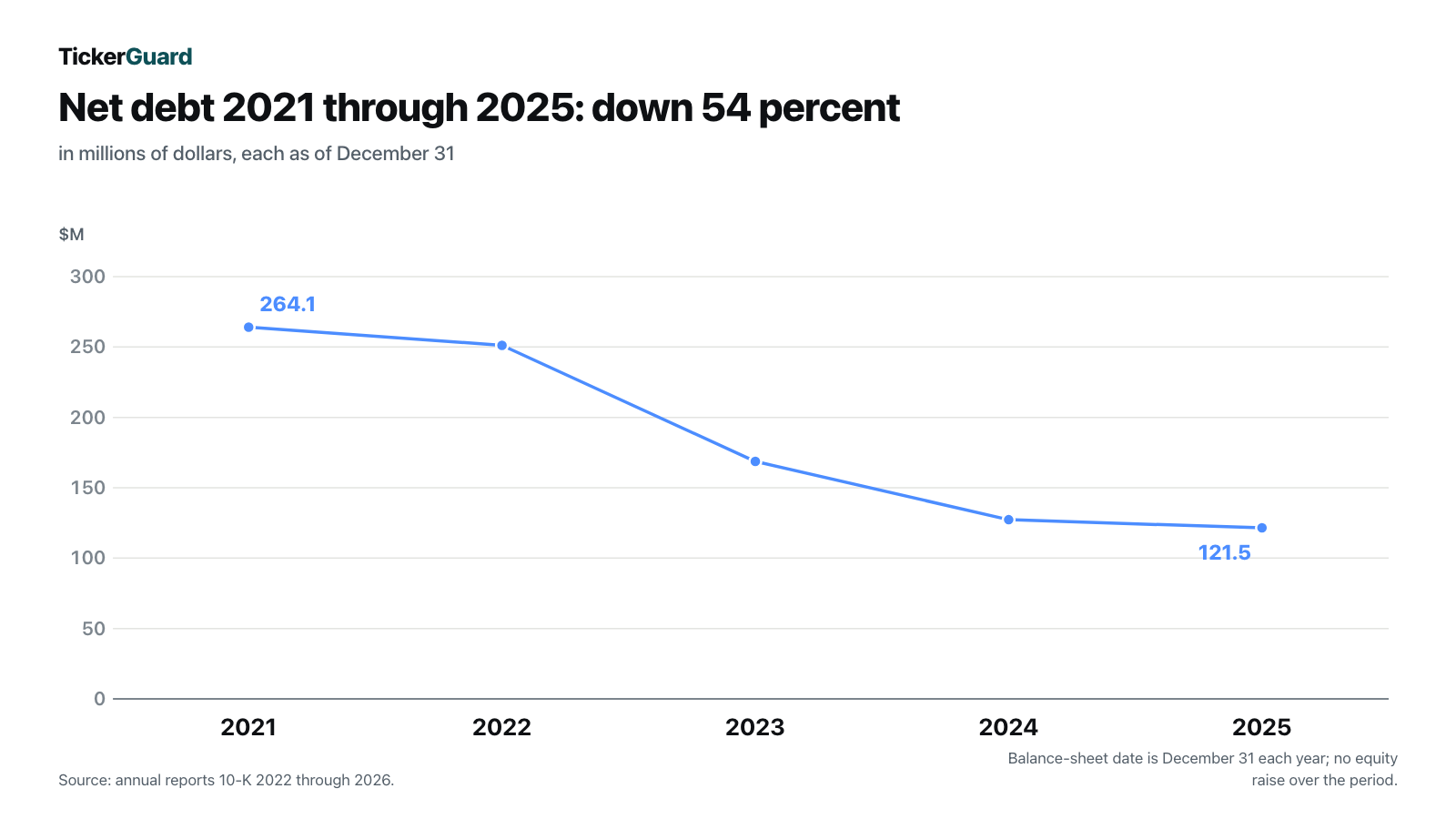
Let's start with what genuinely impresses — and it's more than the latest quarter suggests. Since the debt-financed Honeywell purchase, Rocky Brands has cut net debt from $264.1 million (12/31/2021) to $121.5 million (12/31/2025) — a 54 percent decline (the 2021 figure is stated net of debt issuance costs, while the 2025/2026 figures are gross before that deduction; on a consistent basis the decline would be roughly 55 percent), with no equity raise; total debt stood at $123.9 million as of 6/30/2026 (see chart below). Net debt to EBITDA fell over the same period from 5.6x to 2.6x (as of FY2025), and interest coverage (EBIT over interest expense) improved from a low of 1.7x (2023) to 3.7x (2025). That's the turnaround story that makes no headlines.
Revenue tells a different story: $514.2 million (2021, inflated by the first Honeywell partial year), $615.5 million (2022, the first full Honeywell year), then a decline to $461.8 million (2023) and $453.8 million (2024), before 2025 rebounded to $482.0 million (up 6.2 percent). Gross margin improved steadily over that stretch: 37.8 percent (2021), 36.6 percent (2022, the peak of input costs), 38.7 percent (2023), 39.4 percent (2024) and 40.9 percent (2025) — a genuine, multi-year operating improvement that has nothing to do with the 2026 tariff effect. Net income swung between $10.4 million (2023, the low) and $22.3 million (2025, the highest since the acquisition), and diluted earnings per share ranged from $1.41 to $2.96. Fiscal 2024 also carried two special charges: a $4.0 million impairment on the Muck trademark and a one-time $2.6 million debt extinguishment charge from the second-quarter 2024 refinancing, of which $1.5 million was a prepayment penalty and $1.1 million a loss on extinguishment.
At the quarterly level, the first half of 2026 reads strong at first glance: revenue $242.8 million (up 10.5 percent), gross profit $106.2 million (43.8 percent of sales), net income $15.1 million (prior-year half: $8.6 million). But that half-year carries exactly the effect this analysis is about — as the first chart shows:
The flip side of the good debt news: 83 percent of the $123.9 million in debt remaining as of June 30, 2026 — roughly $103.0 million — is not repaid on a rolling basis but comes due all at once in 2029 (the maturity schedule from the Q2 2026 10-Q: just $4.2 million in 2026, $8.4 million each in 2027 and 2028, then $103.0 million in 2029). That equals 41 percent of the $252.1 million in equity as of December 31, 2025. That leaves a good three years — plenty of time if deleveraging continues, but a maturity wall worth watching should refinancing conditions worsen by then. Purely as arithmetic, not a forecast: were the roughly $8.6 million currently still outstanding from the tariff refund (as of the 10-Q filing on 8/4/2026, see below) actually collected, that would equal about 8 percent of the $103.0 million due in 2029 — an improvement, but not one that removes the maturity wall. How that debt reduction reads over the years is shown in the second chart:
What the filings say — the uncomfortable truths
Five findings from the SEC filings, each documented verbatim.
Uncomfortable truth no. 1: the record quarter is a court ruling, not a sales win
The quarterly report itself explains where the benefit came from:
"We have paid approximately $20.5 million in tariffs for products that were subject to the invalidated IEEPA tariffs. We applied the loss recovery model and determined the expected receipt of the refund of the previously paid IEEPA tariffs is probable. Accordingly, we recognized a benefit of $18.0 million as a reduction to cost of goods sold within the accompanying Unaudited Condensed Consolidated Statement of Operations for the three and six months ended June 30, 2026."
— Rocky Brands, Inc., SEC quarterly report 10-Q as of June 30, 2026, Note 1 (Business Overview)
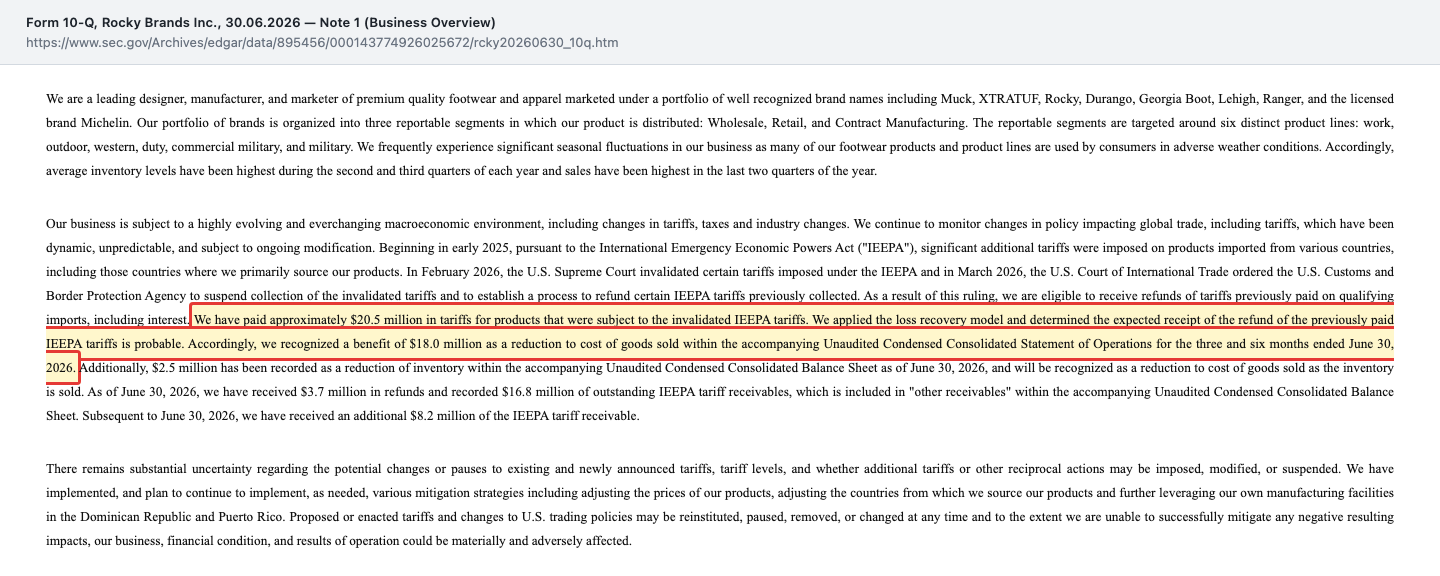
What this means for results: strip out the effect and quarterly operating income (EBIT) falls from $19.7 million to $1.7 million — versus $7.2 million in the prior-year quarter. Using the "net" effect of roughly $15.0 million named in the press release (which nets out tariffs actually paid the same quarter), EBIT lands at $4.7 million — still below the prior-year quarter. Under every reading of the numbers, operating profit for the quarter came in below the prior year.
Uncomfortable truth no. 2: the 51.4 percent margin is not a margin improvement
The quarterly report itself names the reason for the jump — and it isn't pricing:
"Gross margin in the second quarter of 2026 was $60.8 million, or 51.4% of net sales, compared to $43.3 million, or 41.0% of net sales, in the second quarter of 2025. The increase in gross margin as a percentage of net sales was primarily due to the recognition of actual and expected IEEPA tariff refunds, which reduced cost of goods sold in the second quarter of 2026."
— Rocky Brands, Inc., SEC quarterly report 10-Q as of June 30, 2026, Item 2 (Management's Discussion & Analysis)
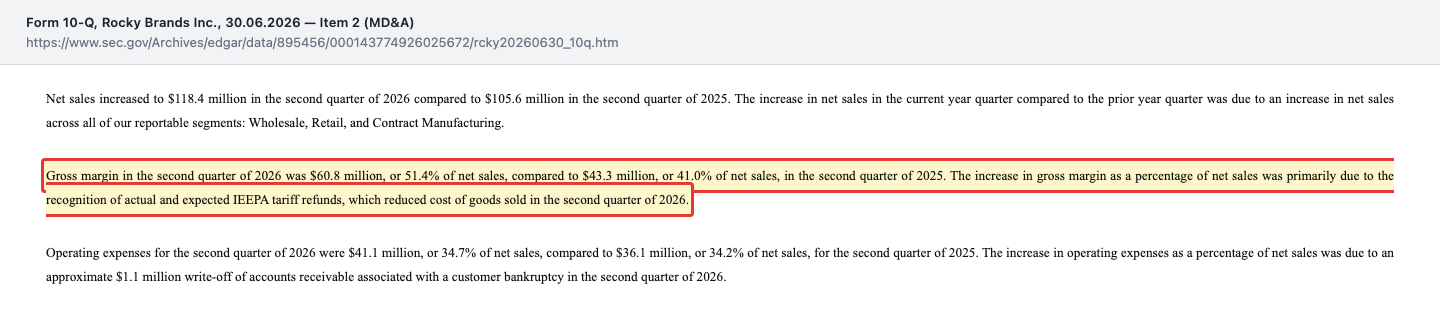
Adjusted for the gross benefit, margin is 36.2 percent; adjusted for the net effect, it's 38.7 percent — either way below the prior-year quarter's 41.0 percent. The same holds for the first half of 2026: reported 43.8 percent, excluding the tariff benefit 36.3 percent, versus 41.1 percent in the first half of 2025.
Uncomfortable truth no. 3: the company's own "adjusted" metric strips the small stuff — and keeps the windfall
In the same press release that names the net tariff effect, Rocky Brands "adjusts" its operating expenses — but for a very different, much smaller item:
"Excluding $0.7 million of acquisition-related amortization in the second quarter of 2026 and 2025, adjusted operating expenses were $40.4 million, or 34.2% of net sales…"
— Rocky Brands, Inc., 8-K Item 2.02, Exhibit 99, filed July 28, 2026
Just $0.7 million of amortization gets stripped out, while the roughly $15.0 million tariff windfall stays fully inside the "adjusted" number. The "adjusted" result of $14.4 million ($1.90 per share) is therefore itself smaller than the one-time gain it's supposed to neutralize. For comparison, management itself named a real ex-tariff figure on the same call: roughly $3.26 for full-year 2026 — essentially flat versus the prior year's adjusted figure.
Uncomfortable truth no. 4: the business hinges on a tariff policy the company itself can't assess
The annual report is blunt about its own uncertainty:
"There remains substantial uncertainty regarding the duration of existing and newly announced tariffs, potential changes or pauses to such tariffs, tariff levels, and whether additional tariffs or other retaliatory actions may be imposed, modified, or suspended."
— Rocky Brands, Inc., SEC annual report 10-K for 2025, Item 1A (Risk Factors)

In everyday terms: imagine half your paycheck depended on a lawsuit whose outcome even your employer can't predict. That is essentially what Rocky Brands says here about its own 2026 earnings driver — tariff policy is neither predictable nor within the company's control, and the company says so itself.
Uncomfortable truth no. 5: new customer concentration and a customer bankruptcy in the same half-year
The 2025 annual report shows a concentration that did not exist a year earlier:
"As of December 31, 2025, one customer represented approximately 15.0% of net trade receivables. Management believes the credit risk associated with this customer is limited. As of December 31, 2024, there were no customers that represented 10.0% or more of net trade receivables."
— Rocky Brands, Inc., SEC annual report 10-K for 2025, Note 1 (Concentration of Credit Risk)

That same half-year, the concentration risk already showed up in practice — with a different customer:
"Our operating expenses as a percentage of net sales for the three and six months ending June 30, 2026 increased due to an approximate $1.1 million write-off of accounts receivable associated with a customer bankruptcy during the second quarter of 2026."
— Rocky Brands, Inc., SEC quarterly report 10-Q as of June 30, 2026, Item 2 (MD&A)
Overall, the provision for bad debts rose to $1.539 million in the first half of 2026, up from $0.434 million a year earlier — a 255 percent increase. For a company shipping to more than 10,000 wholesale points of sale, a 15 percent concentration with a single customer is a risk that did not exist before 2025.
What management promised — and what it delivered
A note on sourcing first: the quotes below come from public transcript portals (Motley Fool, Investing.com, Yahoo Finance) and were cross-checked against the 8-K earnings releases where possible. Eight calls from October 2024 through July 2026 were reviewed, consistently featuring CEO and Chairman Jason Brooks and COO/CFO Thomas "Tom" Robertson.
2025 was a year of beaten promises for Rocky Brands: in February 2025 management guided to "low single digit" revenue growth and EPS "just below" $2.54 — the company delivered 6.2 percent revenue growth and adjusted earnings of $3.26. Gross margin also beat its own more cautious forecast, at 40.9 percent. Even the company's own tariff-cost estimate of "about $5 million" (February 2025) doubled over the year to roughly $10 million.
2026 started out just as confident. In February 2026, management promised "low teens" earnings growth on gross margin "at last year's level" of 40.9 percent — and on the same call, Robertson explicitly cautioned against reading too much into a possible tariff change:
"If tariff rates do change in August, we won't see that benefit until 2027."
— Thomas Robertson, COO/CFO, earnings call transcript, February 24, 2026 (public source, cross-checked against the same-day 8-K earnings release)
Five months later, the benefit arrived anyway — through a completely different door: not the supply chain, but the courts. In April 2026, Robertson had still framed the tariff refund as pure upside not baked into guidance:
"The guidance that we provided assumes no refunds are captured, so that would be all upside."
— Thomas Robertson, COO/CFO, earnings call transcript, April 28, 2026 (public source, cross-checked against the same-day 8-K earnings release)
By July 28, 2026, that "upside" had become the quarter's main pillar:
"The actual and expected refund had a very positive impact on gross margins and profitability this quarter."
— Tom Robertson, COO/CFO, earnings call transcript, July 28, 2026 (public source, cross-checked against the same-day 8-K earnings release)
And the original "low teens" growth promise had turned into flat growth: tariff-adjusted earnings per share for 2026 sit at roughly $3.26 — essentially at the prior year's adjusted level. Reported earnings, lifted by the refund, jump to roughly $5.00. Those two numbers side by side are the real story of 2026.
On tone across the quarters: in October 2024, management was still self-critical — Jason Brooks admitted then, "We just kind of missed both sides… missed the upside and we were probably a little overconfident in the other brands" (earnings call transcript, October 31, 2024). By February 2026 the tone had shifted to "a very good year for our Company" — and by July 2026 it was distinctly upbeat: Brooks described sales accelerating "after two consecutive quarters of high single-digit sales growth" to a 12 percent increase in the second quarter.
On analyst-call quality: the analyst circle is small — Baird (Jonathan Komp), BTIG (Janine Stichter), and occasional investors like Geller Ventures and Titan Capital — a structural point for a company of this size. Most questions were answered directly and with real numbers; four instances stood out as evasive: relative brand sizes (Q3 2024, explicitly confidential), a direct-to-consumer breakdown and specific second-half debt-reduction targets (Q2 2025), start-of-year trends (Q4 2025, in response to BTIG), and the status and timing of the tariff refund (Q1 2026). Notably, on the Q1 2026 call, it wasn't management but investor Bruce Geller who worked out the after-tax per-share tariff impact at roughly $0.70 for the quarter — the company confirmed the math but had not presented it itself. Two earlier commitments also quietly disappeared from later calls: the goal of "45 percent in-house manufacturing by 2026" (Q2 2025 call) and the promise of a China exposure "just under 20 percent" by year-end 2025 (Q1 2025 call) — a later actual figure for either was not mentioned in the sources reviewed.
Valuation: what the market pays for a turnaround with a windfall attached
The last stock price documented in a filing is 14 months old ($22.19 as of June 30, 2025, per the 10-K FY2025 cover page); the most recent transaction anchor is the buyback average of $37.09 from the second quarter of 2026. Fundamental data (as of August 26, 2026) put market cap at roughly $340 million (as of late August 2026), on 7,491,911 shares outstanding (10-Q cover page, as of July 31, 2026) — metrics derived from it carry the same date caveat. On that basis, the price-to-earnings ratio is roughly 15 on reported 2025 earnings ($2.96 per share) and roughly 14 on the company's own tariff-adjusted 2026 estimate of about $3.26. On the reported 2026 outlook of about $5.00 (with the windfall included), the stock would look strikingly cheap at a P/E of roughly 9 — yet the low number comes solely from a one-time effect, not from sustainable earning power. Price-to-sales sits at roughly 0.7 on 2025 revenue ($482.0 million) — low, but that is partly explained by the thin margin in the contract-manufacturing segment and the small number of registered shareholders, with shares held mostly at custodian banks. The automatic metrics box above calculates on a trailing-twelve-months (TTM) basis and can therefore differ from the figures cited here, which are deliberately tied to fiscal year 2025 — both calculations are correct; only the basis differs. For comparison, growth-oriented footwear brands trade at a very different multiple — our Deckers stock analysis shows how that is justified there.
Opportunities and risks at a glance
What speaks for Rocky Brands:
- Genuine, multi-year deleveraging: net debt cut from $264.1 million to $121.5 million (2021 through 2025, -54 percent), total debt $123.9 million as of 6/30/2026; interest coverage back to 3.7x (2025), no equity raise.
- Gross margin improved steadily even before the tariff effect: from 37.8 percent (2021) to 40.9 percent (2025).
- Retail is growing far faster than the rest: up 20.5 percent (FY2025), up 18.9 percent (H1 2026) — diversifying away from the thin-margin contract-manufacturing segment.
- Quarterly dividend raised to $0.17 since May 2026 (from $0.155), a $7.5 million buyback program active through February 2027, low dilution (+1.2 percent weighted shares).
- Broad brand portfolio spanning $45 to $680 price points; authorized capital only 30 percent utilized.
What speaks against it:
- The 2026 "record quarter" is almost entirely a one-time effect: excluding the IEEPA tariff benefit, operating income falls below the prior-year quarter under every reading of the numbers.
- FY2026 guidance collapsed within five months from "low teens" earnings growth to essentially flat (about $3.26 adjusted).
- 83 percent of the debt remaining as of 6/30/2026 (roughly $103.0 million) comes due all at once in 2029 — 41 percent of current equity.
- New customer concentration (15.0 percent of net trade receivables with one customer) plus a customer bankruptcy in the same half-year ($1.1 million write-off).
- A small number of registered shareholders (64 record holders, shares held mostly at custodian banks), CEO and Chairman combined in one person since 2021, chronically thin cash ($2.6 to $5.7 million over the last four years), and a tariff policy the company itself says it cannot assess.
A human conclusion
Back to the anchor from the start. Its core is not that the number was wrong — 51.4 percent gross margin really was in the filing. Its core is that a single, loud number spares you the scrutiny an investment thesis actually requires. Whoever reads "record quarter" is really buying three very concrete things: a one-time court-ruling effect of $18.0 million that, in truth, pushes operating income below the prior year's level; a genuine, years-long turnaround that has nothing to do with this one quarter and keeps running regardless of the next tariff ruling; and a 2029 maturity wall that doesn't come due for three more years but already sits on the balance sheet today. That can be perfectly fine for you — if you know which part of the story you're buying. So the honest question for you isn't "was the quarter good?" but: would you still find this stock attractive with the $18.0 million stripped out of gross margin — and do you still see the quiet turnaround underneath, or only the decline? Two more check points for future reports, because they quietly disappeared from the calls: the promise of 45 percent in-house manufacturing by 2026 and a China exposure under 20 percent by year-end 2025 — neither with a recent actual figure attached. If you see the turnaround, you have a thesis. If you only see the decline, you had an anchor. What you make of it is your decision. And that is exactly as it should be.
Sources
All original documents used in this analysis — to read for yourself:
- Rocky Brands, Inc. — SEC quarterly report 10-Q as of June 30, 2026 (filed August 4, 2026, latest periodic report)
- Rocky Brands, Inc. — SEC annual report 10-K for 2025 (filed March 11, 2026)
- Rocky Brands, Inc. — SEC annual report 10-K for 2023 (filed March 15, 2024, three-year column)
- Rocky Brands, Inc. — SEC annual report 10-K for 2021 (filed March 15, 2022, Honeywell acquisition)
- Rocky Brands, Inc. — 8-K Item 2.02, Q2 2026 earnings release (filed July 28, 2026)
- Rocky Brands, Inc. — proxy statement DEF 14A 2026 (filed April 28, 2026)
- Rocky Brands, Inc. — Schedule 13G/A, AllianceBernstein L.P. (filed August 14, 2026)
- Full SEC filing history of Rocky Brands, Inc.: EDGAR overview (sec.gov)
- Earnings calls: eight transcripts, October 2024 through July 2026, via public transcript portals (Motley Fool, Investing.com, Yahoo Finance), guidance figures cross-checked against the 8-K earnings releases.
- Fundamental data (market cap, share count, institutional ownership; data as of August 26, 2026), reconciled with the SEC filings.
Transparency & disclaimer: This analysis is a journalistic contextualization of publicly available information and is not investment advice, not a financial analysis in the regulatory sense, and not a solicitation to buy or sell securities. Stock investments carry substantial risks up to total loss. All information without warranty; the data cut-off is noted in the text. Positions held by the operator are disclosed daily; where one exists, it appears as a notice at the top of this deep dive.
Key figures at a glance
All monetary figures in millions of $; earnings per share as reported.
| Metric | 2021 | 2022 | 2023 | 2024 | 2025 |
|---|---|---|---|---|---|
| Revenue | 514.2 | 615.5 | 461.8 | 453.8 | 482.0 |
| Operating Income (EBIT) | 36.0 | 44.0 | 35.4 | 31.1 | 37.2 |
| Net Income | 20.6 | 20.5 | 10.4 | 11.4 | 22.3 |
| Net Margin | 4.0% | 3.3% | 2.3% | 2.5% | 4.6% |
| Earnings Per Share | 2.77 $ | 2.78 $ | 1.41 $ | 1.52 $ | 2.96 $ |
Source: fundamental data & SEC filings (annual and quarterly reports, 10-K/10-Q)
Our Bottom Line at a Glance
- Business model & segments positive
- An established brand portfolio (Rocky, Muck, XTRATUF, Georgia Boot, Durango, Lehigh) across six product lines; the higher-margin, growing Retail segment (+20.5% FY2025, +18.9% H1 2026) is gaining weight against the shrinking Contract Manufacturing segment (-7.7% FY2025).
- Q2 2026 earnings quality negative
- The reported 51.4% gross margin and $19.7 million EBIT come almost entirely from an $18.0 million tariff benefit (10-Q as of 6/30/2026). Strip it out and EBIT is $1.7 million — below the prior year's $7.2 million. FY2026 guidance collapsed from "low teens" growth (February 2026) to essentially flat (July 2026).
- Balance sheet & deleveraging neutral
- Genuine progress: net debt cut from $264.1 million to $121.5 million (2021 through 2025, -54%), total debt $123.9 million as of 6/30/2026; interest coverage back to 3.7x. On the other hand: 83% of remaining debt (roughly $103.0 million) comes due all at once in 2029, and cash remains thin at $2.6 million.
- Customer concentration negative
- For the first time, 15.0% of net trade receivables sat with one customer as of 12/31/2025 (prior year: none over 10%); the second quarter of 2026 also brought a $1.1 million write-off tied to a customer bankruptcy (10-K FY2025, 10-Q Q2 2026).
- Governance & shareholder structure neutral
- CEO and Chairman combined in one person since 2021 (Jason Brooks); 64 registered shareholders (record holders, 10-K FY2025) — shares sit almost entirely at custodian banks (institutional ownership 82.5% per fundamental data). No governance or accounting breaches documented.
Rocky Brands tells two stories at once: a genuine turnaround running since the 2021 Honeywell acquisition (net debt down 54%, gross margin organically up from 37.8% to 40.9%) and a 2026 "record quarter" that is almost entirely a court ruling on invalidated tariffs — strip out the $18.0 million effect and operating income falls below the prior year. Add a collapsed annual guidance, a new customer concentration, and a debt wall coming due all at once in 2029. Not investment advice.
What Our Rating Means
Open questions
The business works in principle, but one material question is open. As long as it stays open, our findings do not carry a quality verdict.
The business model holds up, and the deleveraging is genuinely documented — that speaks for substance. But a real operating question remains open: the latest, most-discussed quarter hinges on a one-time tariff ruling whose further course the company itself says it cannot predict, and its own annual guidance was cut within five months from double-digit growth to essentially zero. Anyone considering this stock should check one thing in every future report: how large is the result excluding the tariff effect — and is it moving back up? The decision is yours.
A journalistic assessment by our editorial team at the time of the deep dive, based on public sources — not investment advice and not a solicitation to buy or sell. Your personal circumstances (investment goals, risk capacity, taxes) cannot be taken into account. What our levels mean, how verdicts are formed, and what conflicts of interest exist →
Worth Noting
- Rocky Brands landed on the research list via a threshold filing: Schedule 13G/A from AllianceBernstein L.P., filed August 14, 2026 (position as of June 30, 2026, 8.6 percent) — before the price-moving Q2 2026 report.
- The last stock price documented in a filing is 14 months old ($22.19, June 30, 2025); the roughly $340 million market cap therefore explicitly carries the date caveat "as of late August 2026" — as does every metric derived from it.
- Earnings-call quotes come from public transcripts (Motley Fool, Investing.com, Yahoo Finance), not a licensed primary source, and were cross-checked against the 8-K earnings releases.
Stock Watch
This analysis is as of August 28, 2026. Stock Watch will tell you what's changed at RCKY since then.
Later $1 a month per stock — signing up is free, and you'll be the first to know when it launches.
The full analysis as a PDF for later
We will send you this analysis as a PDF — to print, file away, and read at your own pace. And we will add you to the free Stock Watch list for Rocky Brands Inc (RCKY), so you hear about it when something material in this analysis changes.
Frequently Asked Questions
Rocky Brands, Inc. (Nasdaq: RCKY) of Nelsonville, Ohio, designs and sells work, outdoor, western, duty and military boots under the brands Rocky, Muck, XTRATUF, Durango, Georgia Boot and Lehigh (plus the licensed brand Michelin). Sales run through three segments: wholesale (more than 10,000 points of sale), retail (owned e-commerce sites), and contract manufacturing (U.S. military, private label). More than 2,200 employees as of December 31, 2025, about 1,700 of them in company-owned plants in the Dominican Republic, Puerto Rico and Chuzhou, China.
Because a court ruling against invalidated IEEPA tariffs triggered an $18.0 million benefit the company deemed probable to recover, which reduced cost of goods sold for the quarter (10-Q as of June 30, 2026). Strip that out and margin is 36.2 percent — below the prior-year quarter's 41.0 percent. The company itself names the tariff refund as the main driver of the increase, not operating improvements.
Only a small part of it. Of $20.5 million in tariffs paid, only $3.7 million had actually been refunded as of June 30, 2026; $16.8 million sat on the balance sheet as a receivable. After the balance-sheet date, another $8.2 million was received, leaving roughly $8.6 million still outstanding (10-Q as of June 30, 2026, Note 15).
As of June 30, 2026, total debt stood at $123.9 million. Net debt fell from $264.1 million on December 31, 2021 (shortly after the Honeywell acquisition) to $121.5 million on December 31, 2025 — a 54 percent decline. The maturity schedule in the Q2 2026 10-Q shows just $4.2 million due in 2026, $8.4 million in each of 2027 and 2028 — but roughly $103.0 million (83 percent of remaining debt) comes due all at once in 2029.
Yes. The quarterly dividend was raised from $0.155 to $0.17 per share on May 18, 2026, payable since June 15, 2026. A $7.5 million share buyback program has also run since February 23, 2026, through February 23, 2027, of which about $2.0 million had been used as of June 30, 2026. Both forms of payout are restricted by covenants under the credit agreement.
As of December 31, 2025, 15.0 percent of net trade receivables sat with a single customer for the first time — a year earlier no customer exceeded 10 percent (10-K FY2025, Note 1). The second quarter of 2026 also brought a $1.1 million write-off tied to a customer bankruptcy; the total provision for bad debts in the first half of 2026 rose 255 percent versus the prior year as a result. A concentration risk that did not exist before 2025.
Found an error?
Did you spot a factual error, an outdated number, or a typo in this deep dive? Let us know briefly — your report goes straight to the editorial team.