Plumas Bancorp: The Bank Is Reporting Records — And In The Same Filing Its Problem Loans Hit A Multi-Year High
Plumas Bancorp (Nasdaq: PLBC) is the holding company of a 45-year-old community bank in sparsely populated north-eastern California. At the halfway mark of 2026 it reported the most profitable six months in its history, a net interest margin of 5.13% and capital ratios far above every requirement. The same quarterly filing shows nonperforming loans of $23.5 million — more than five times the level of late 2024 — and an allowance that no longer covers them. Two sets of numbers, one bank: we check which of them describes the business.
 Thomas Mücke
Founder & Publisher
Thomas Mücke
Founder & Publisher
As of Today
As of: October 9, 2026
- Closing price
- 61.00 $ -1.30%
- Market Capitalisation
- 0.4 $B
- P/E
- 13.0
- Growth Score
- 4/10
- AAQS
- 7/10
Price change since August 27, 2026: -0.3%
This analysis has a cut-off date. The Stock Guard tells you when something material changes in the numbers. Reserve your free spot

Chart
Interactive price chart (TradingView).
52-week range: 40.40 $ to 63.60 $ · Last price: 61.00 $ (As of: October 9, 2026)
Note: pure fact-based analysis, not investment advice and not a solicitation to buy or sell. All figures without guarantee.
There is an investor weakness that works quietly, which is precisely why it rarely gets noticed: the familiarity trap. We treat as safe whatever feels familiar. A community bank with branches in small towns, in the same place for 45 years, paying a dividend on time every quarter — that feels like the opposite of risk. And that feeling is exactly why bank filings so seldom get read: you think you already know what is in them. With Plumas Bancorp (Nasdaq: PLBC), the holding company of Plumas Bank in sparsely populated north-eastern California, the reading is unusually worthwhile. Because the same quarterly filing that reports the most profitable half-year in company history also shows the weakest credit quality in years. So let us make a deal: before you file this bank under "solid and boring", we look together at what it told the US Securities and Exchange Commission — the annual report (Form 10-K) for 2025 and the quarterly report (Form 10-Q) for the period ended 30 June 2026. An SEC filing is honest under penalty of law. A press release is not necessarily.
And because it is the central tension of this analysis, it belongs right at the top: two sets of numbers sit side by side in Plumas Bancorp's filings, pointing in opposite directions. One tells of rising margins, record profits and capital far above every requirement. The other tells of loans that are no longer being serviced, of a reserve that is not keeping pace, and of a concentration in commercial real estate that the bank addresses in its own risk factors. Which of the two describes the business? That question runs through every chapter.
What Plumas Bancorp actually does
Plumas Bancorp is the holding company of Plumas Bank, founded in 1980 and named after Plumas County in California's Sierra Nevada. Its territory is north-eastern California and northern Nevada — a region with plenty of land and few people, where agriculture, forestry, tourism and small businesses carry the economy. The administrative headquarters has for some years no longer been in California but in Reno, Nevada, on Kietzke Lane. The company is run by Andrew J. Ryback as president and chief executive and Richard L. Belstock as chief financial officer.
A bank's business model fits in one sentence: it takes money from savers (deposits), lends part of it out (loans) and earns the difference between what it pays savers and what borrowers pay it. That difference is the net interest margin, and for a bank it is roughly what gross margin is for a manufacturer. Revenue, gross margin and free cash flow, by contrast, say almost nothing about a bank: a bank produces nothing you could net against cost of goods, and its operating cash flow is dominated by deposit and lending movements that have nothing to do with earning power. What does carry meaning is four things — margin, deposit mix, credit quality and capital. Those are the four we examine.
The real strength of Plumas sits in the deposit mix, and it is remarkable. As of 30 June 2026, 45.8% of all deposits were non-interest-bearing demand deposits — $864.1 million out of $1,885.1 million. That is money on which the bank pays nothing: checking accounts of tradespeople, clubs, municipalities, farmers. The quarterly filing puts it plainly: "On June 30, 2026, 46% of the Company's deposits were in the form of non-interest-bearing demand deposits." Many comparable institutions sit at 20% to 30%. That is where the high margin comes from — not from unusually expensive loans, but from unusually cheap money.
How different community banks can be shows up in comparison with others we have examined. Our analysis of Chicago-based Byline Bancorp covered a bank that also grew through acquisitions — there as a serial acquirer with a practised integration routine. And our analysis of Carter Bankshares showed how a single large lending relationship can drive an entire bank's results for years. Plumas now provides a third case containing elements of both: a bank that has just bought a rival — and that is simultaneously carrying one lending relationship forward.
Company history for investors
-
1980
Plumas Bank is founded
A start as the bank for sparsely populated north-eastern California — 45 years of uninterrupted banking are the foundation of today's deposit base.
-
2024
Branch sale-leaseback and securities restructuring
Nine branches sold for $25.7 million (a $19.9 million gain), offset by a $19.8 million loss on selling low-yielding bonds — earnings-neutral for shareholders, but the foundation of the later margin.
-
2025
An agricultural lending relationship defaults
In the second quarter of 2025 the bank places 15 loans to one farmer, totalling $9.8 million, on nonaccrual — the start of the rise in problem loans, one quarter before the acquisition.
-
2025
Cornerstone Community Bancorp acquisition closes
Effective 1 July 2025, four branches, $478 million of loans and $580 million of deposits are added. For shareholders it meant new shares, $7.3 million of one-off costs and a weak third quarter.
-
2026
Record half-year alongside the weakest credit quality in years
Net income of $19.7 million in the first half, a 10% dividend increase and a buyback launched — while allowance coverage of problem loans falls below 100%.
How this stock landed on our desk
Plumas Bancorp reached our list through an editorial screen of small US community banks in search of unusually high net interest margins. A margin of 5.13%, as Plumas reported for the second quarter of 2026, is exceptional for a bank this size — many comparable institutions sit between 3% and 3.5%, and even those regarded as strong rarely exceed 4.5%. Add a valuation that looks moderate at first glance: roughly twelve times trailing twelve-month earnings.
The case only became striking on second look, at a single spot: in the nonperforming loans table of the quarterly report, the figure for 30 June 2026 is $23.5 million — and in the same table, two columns to the right, the figure for 31 December 2024 is $4.1 million. More than a fivefold increase in eighteen months at a bank reporting records in the same document is why we looked closer.
The numbers over the years — given their due
First, what genuinely impresses. The net interest margin has risen almost without interruption over five years: from 3.63% (2021) through 3.82% (2022), 4.71% (2023) and 4.79% (2024) to 4.91% in 2025. Net interest income grew over the same span from $46.9 million to $87.8 million. And the capital base has thickened rather than thinned: the bank's tier 1 risk-based ratio rose from 14.4% (2021) to 15.8% as of 30 June 2026, and the leverage ratio from 8.4% to 11.8%. This is a bank that has funded its growth out of its own earnings.
Now the uncomfortable side of the same series. Net income was $21.0 million in 2021, rose to $26.4 million (2022) and $29.8 million (2023) — and has been flat since: $28.6 million (2024), $29.6 million (2025). Despite an acquisition that enlarged the balance sheet by 38% and the loan book by 49%, 2025 still came in below the 2023 result. On a per-share basis the trend is starker, because new shares were issued for the acquisition: $5.02 (2023), $4.80 (2024), $4.54 (2025) — three consecutive years of decline.
Return on equity fell accordingly from 23.4% (2023) through 17.2% (2024) to 13.6% (2025), and return on assets from 1.88% to 1.52%. The efficiency ratio — expense per dollar of revenue, where lower is better — worsened from 46.6% (2023) through 51.3% (2024) to 52.8% (2025). In fairness, 2025 was distorted by $7.3 million of merger-related items; without them, net income would have been $35.0 million and earnings per share $5.37. That adjustment, however, comes from the company itself, not from statutory accounting.
In the first half of 2026 the picture does turn. Net income rose to $19.7 million from $13.5 million a year earlier, diluted earnings per share from $2.25 to $2.79, return on assets to 1.79% and return on equity to 14.9%. That is the most profitable first half in company history — the previous best was 2023 at $14.3 million.
One point of precision belongs here, because headlines obscure it: the company titled its 15 July 2026 release "record second quarter 2026 earnings". That is literally correct — it was the best second quarter the bank has ever had. It was not the highest quarterly profit in company history: in the fourth quarter of 2025 Plumas earned $10.9 million, against $9.96 million in the second quarter of 2026.
What management promised — and what came of it
One thing up front, in full candour: no analyst call transcripts could be reviewed for Plumas Bancorp, because the company does not hold a public conference call with a transcript alongside its quarterly numbers. For banks of this size that is not unusual. What does exist, and what we reviewed instead, are the earnings releases for all 15 quarters from late 2022 through mid-2026 — each carrying a personal comment from the chief executive. Read across three years, they produce a strikingly clear picture.
Start with what was delivered. The securities portfolio restructuring announced in January 2024 was executed and worked: the yield on the securities book rose from 3.29% (2023) through 3.93% (2024) to 4.22% (2025). The new Chico branch promised for the first half of 2023 opened in the second quarter of 2023. And the margin, the leitmotif of all 15 releases, has in fact been delivered quarter after quarter. Anyone who believed this management on rate matters was not let down.
Credit quality is another story. In January 2024 the chief executive wrote a sentence that later proved the weakest claim in the whole series:
"At Plumas, however, we do not expect significant losses because criticized assets are being proactively addressed with advanced preparation of solutions and collaborative monitoring for potential challenges. Additionally, non-performing loans are well-collateralized."
— Plumas Bancorp, quarterly earnings releases, Exhibit 99.1 to Form 8-K, release for fiscal year 2023 dated 17 January 2024
On losses he was right: actual charge-offs stayed tiny. On nonperforming loans he was not: they rose from $4.8 million (end of 2023) to $23.5 million (mid-2026). In April 2024 he went further, saying the bank expected "resolution on significant amounts in the coming quarter" — in the following quarter nonperforming loans instead rose from $5.6 million to $9.0 million.
Most revealing, though, is what disappears over time. Until early 2024, Plumas compared itself with its peers in almost every release: "exceeding peer averages in a variety of metrics including ROA, ROE, and efficiency ratio" (January 2023), "funding costs significantly lower than most peer institutions" (October 2023), "we expect to continue to out-perform the industry" (January 2024). Then the series breaks off: in the ten subsequent releases through July 2026, management measures its own performance against peers only once more — in July 2024, in the form of a list of awards whose juries benchmark the bank against comparable institutions. A first-person metrics claim like those of the prior years appears no more. Over exactly that stretch the efficiency ratio deteriorated from 46.6% to 52.8%.
And the language on credit quality grows quieter and more hedged with each passing quarter. "We do not expect significant losses" (January 2024) becomes, two years on, "improving nonperforming metrics … will continue to be a priority" (January 2026) and finally, in July 2026: "Asset quality remains a key area of focus … we believe our loan portfolio remains well diversified". A claim about the future has become an opinion about the present.
The Cornerstone acquisition — price and payoff
On 29 January 2025 Plumas announced the acquisition of Cornerstone Community Bancorp of Red Bluff, California; it closed on 1 July 2025. The deal added four branches in Anderson, Red Bluff and Redding. Plumas took on assets with a book value of $658 million, gross loans of $478 million and deposits of $580 million. Goodwill of $18.7 million remained on the balance sheet, alongside a core deposit intangible of $11.6 million.
What makes this case notable is that the commitments were unusually specific — and appear only in the announcement release, never again in any subsequent quarterly release:
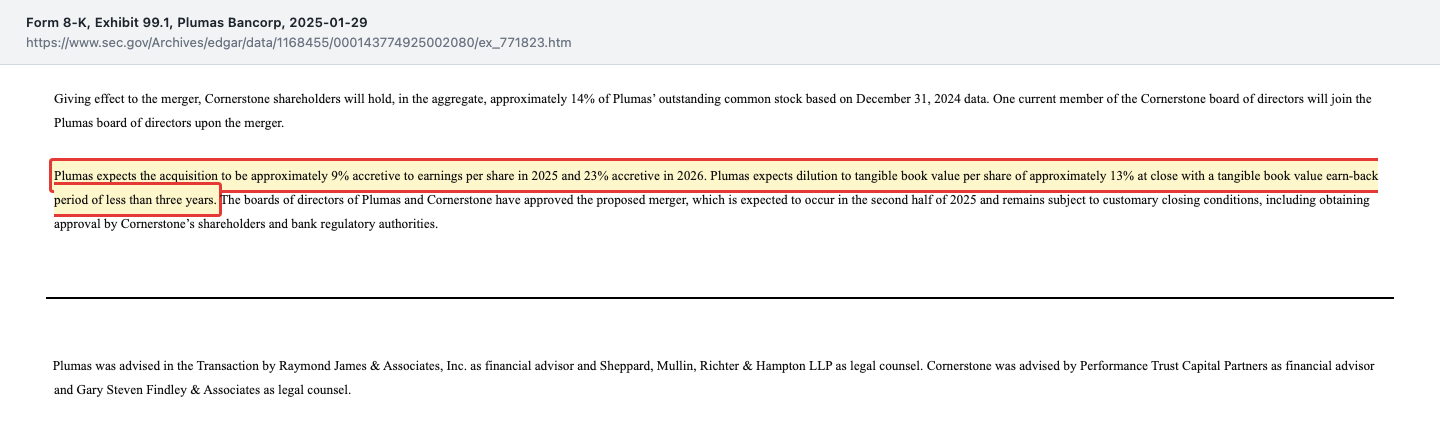
Hold the three commitments against what actually happened. First, the 2025 earnings accretion: diluted earnings per share fell from $4.80 to $4.54, a decline of 5.4%, rather than rising by roughly 9%. On the company's own adjusted basis, excluding merger costs, it would have been $5.37, a gain of 11.9% — with the caveat that an accretion commitment formally references an estimate for the bank without the deal, not the prior year. Second, the 2026 accretion: in the first half, diluted earnings per share rose from $2.25 to $2.79, a gain of 24% — putting the 23% commitment on track. Third, tangible book value: here management clearly beat what it promised. Instead of the announced 13% dilution, tangible book value per share fell only from $31.49 (30 June 2025) to $30.21 (30 September 2025), or 4.1% — and by 31 December 2025 it stood at $32.44, already above the starting point. "Less than three years" turned into roughly two quarters.
One commitment, however, remains unverifiable to this day: the cost savings. The investor presentation cited 25% of Cornerstone's operating expense, half phased in during 2025 and fully from 2026. Not one quarterly release since closing puts a number to it. What can be observed instead: full-time employees rose to 238 by 30 June 2026, and salaries and benefits in the first half of 2026 to $15.3 million from $11.4 million a year earlier.
What the filings say — the uncomfortable truths
Now to the parts that do not make the headlines.
First: the allowance no longer covers the problem loans. This is the hardest finding in this analysis, and it can be told in four pairs of numbers.
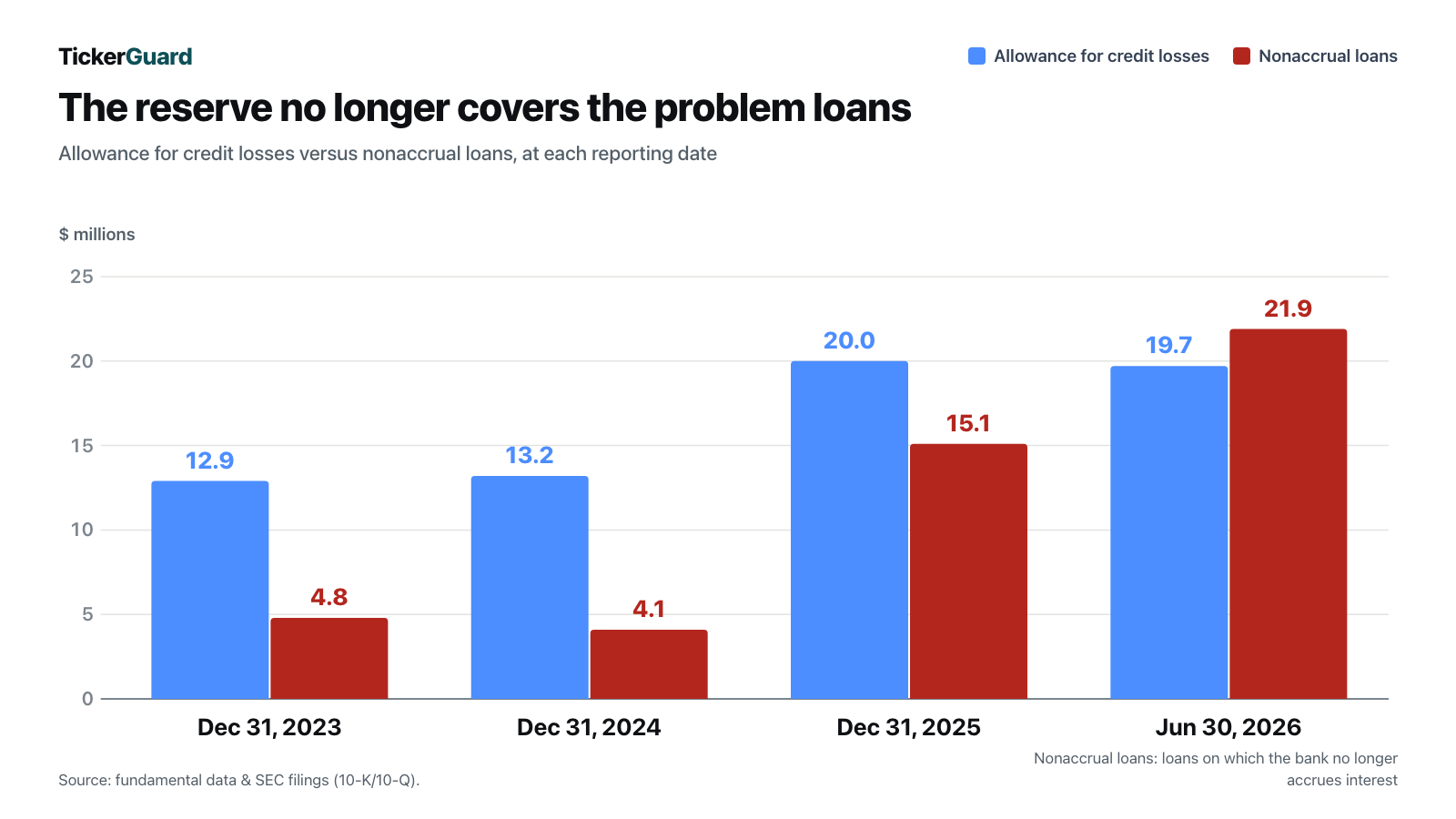
Expressed as a ratio: coverage — how much allowance sits behind each dollar of defaulted loans — fell from 321% (end of 2024) through 132% (end of 2025) to roughly 90%. Total nonperforming loans, including one $1.6 million loan more than 90 days past due but still accruing at the reporting date, amounted to 1.55% of the loan book, up from 0.40% at the end of 2024. The stage before default has grown too: substandard loans rose from $34.2 million to $42.8 million and special mention loans from $20.1 million to $33.6 million — together from 3.6% to 5.1% of the book, within six months. Eighteen months before the reporting date, at the end of 2024, those two categories stood at just $23.0 million and $12.0 million.
Important for context, and worth stating explicitly: this deterioration did not come from the acquisition. The annual report names the cause unambiguously:
"The increase in nonperforming loans is related to one agricultural loan relationship of 15 loans totaling $9.8 million. The borrower on these loans was unable to meet his commitments under modified loan agreements and therefore during the second quarter of 2025 we placed the loans on nonaccrual status."
— Plumas Bancorp, SEC annual report Form 10-K for 2025, asset quality section
The second quarter of 2025 ended on 30 June — the acquisition closed on 1 July. The problem is therefore home-grown and sat in the legacy book. It remains the focus today: of the $21.9 million of nonaccrual loans at 30 June 2026, $12.0 million are agricultural. That is 8.4% of the entire $142.9 million agricultural portfolio. What is new in the first half of 2026 is a sharp rise in commercial real estate nonaccruals: from $2.0 million to $6.7 million, more than tripling.
Second: two thirds of the loan book sits in commercial real estate — more than regulators like to see.
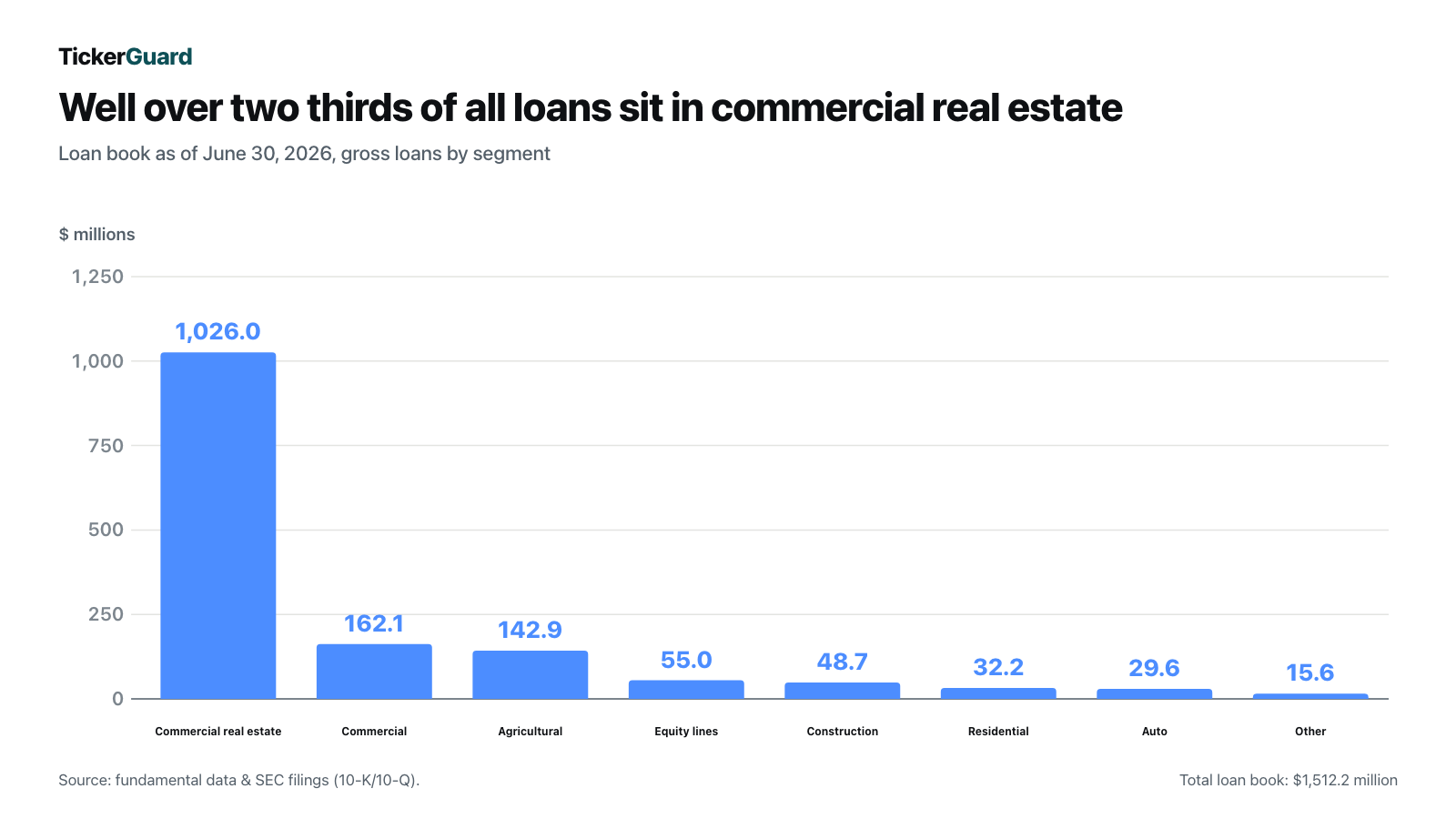
US bank regulators know this pattern and apply a fixed yardstick: once a bank's commercial real estate loans exceed 300% of its total risk-based capital, it is treated as potentially concentrated and draws additional attention. Plumas states its own figure in the annual report:
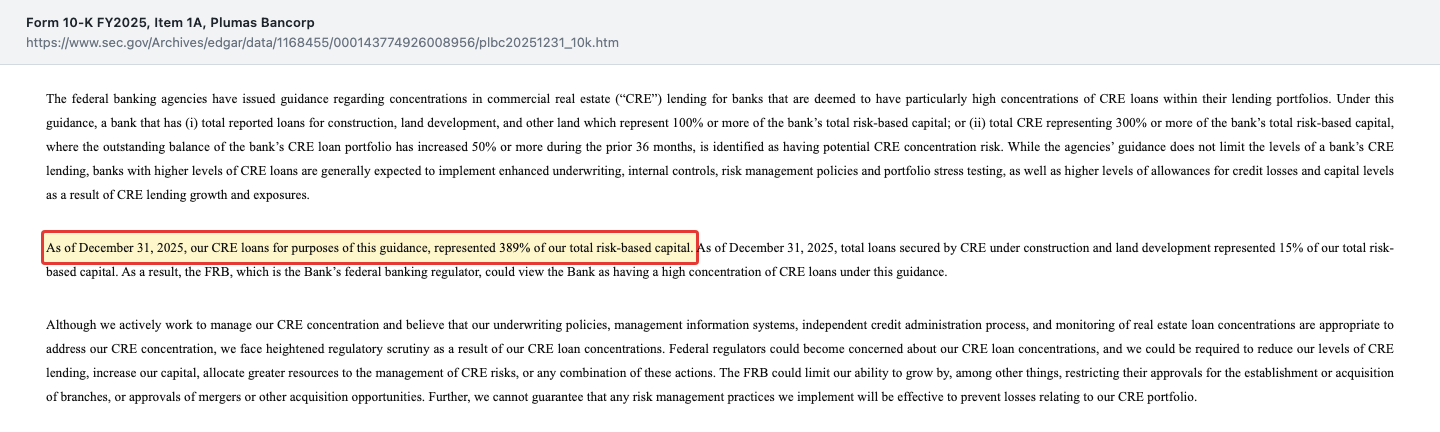
Context matters for how this portfolio is composed: per the annual report, 43% of commercial real estate loans are investor-owned, 43% owner-occupied and 14% multi-family. Owner-occupied properties are considered markedly less vulnerable, because the borrower operates its own business in the building. Office property, the sector's problem child, accounts for 13% of the commercial real estate book and is, per the filing, "typically small and located in more rural areas". The second regulatory threshold — construction and land development loans above 100% of capital — Plumas comfortably meets at 15%.
Third: the record margin is largely a purchase-accounting entry. When a bank acquires another, it must bring the acquired loans onto its balance sheet at fair value. Because acquired loans usually carry lower rates than current ones, that fair value sits below face value — a discount arises. The discount is unwound over the remaining life and flows piece by piece into interest income. It is real, properly recorded income — but it comes from the purchase price, not from ongoing business, and it ends once the discount is used up.
At Plumas the loan discount at closing was $15.8 million. How much of it reached earnings, the quarterly filing states itself, unusually clearly:
"The accretion of discounts on loans acquired from Cornerstone totaled $1.3 million during the quarter an increase of $800 thousand from $500 thousand during the first quarter of 2026. The increase in accretion during the current quarter relates to an increase in prepayments on this portfolio."
— Plumas Bancorp, SEC quarterly report Form 10-Q for the period ended 30 June 2026, MD&A
Let us work that out. Net interest income in the second quarter of 2026 was $26.007 million at a net interest margin of 5.13%. Without the $1.3 million of purchase-accounting accretion, $24.707 million remains — a margin of roughly 4.87%. In the second quarter of 2025 it was 4.83%. Of the reported 30-basis-point gain, roughly 4 survive. For the full first half the arithmetic is the same: the filing cites $1.8 million of accretion, against nothing in the prior-year period because the acquisition had not yet happened; adjusted, the half-year margin falls from 5.08% to roughly 4.90% — against 4.89% a year earlier.
Two qualifications belong here so the picture is fair. First, this accretion is genuine income, correctly recorded — it simply is not repeatable. Second, it flows mainly into the margin, less into the bottom line: running against it is the amortisation of the core deposit intangible, which the company projects at $2.082 million for 2026. And the timetable is shifting: for the whole of 2026 Plumas forecast accretion of $1.233 million in its annual report — after six months it was already $1.8 million. What accelerates, however, is also over sooner.
Fourth: the reserve model was changed in the record quarter of all quarters — with the effect of a lower allowance.

A model change is not in itself improper and can be well justified — banks review these assumptions regularly. What matters for anyone reading the numbers is the effect: the 2026 reserve is produced under different rules than the 2025 one, which blurs the comparison over time. And the provision charged through the income statement for the whole of the first half of 2026 was just $270 thousand, while nonperforming loans grew by $8.4 million.
Fifth: the only representative of the acquired bank has left the board.
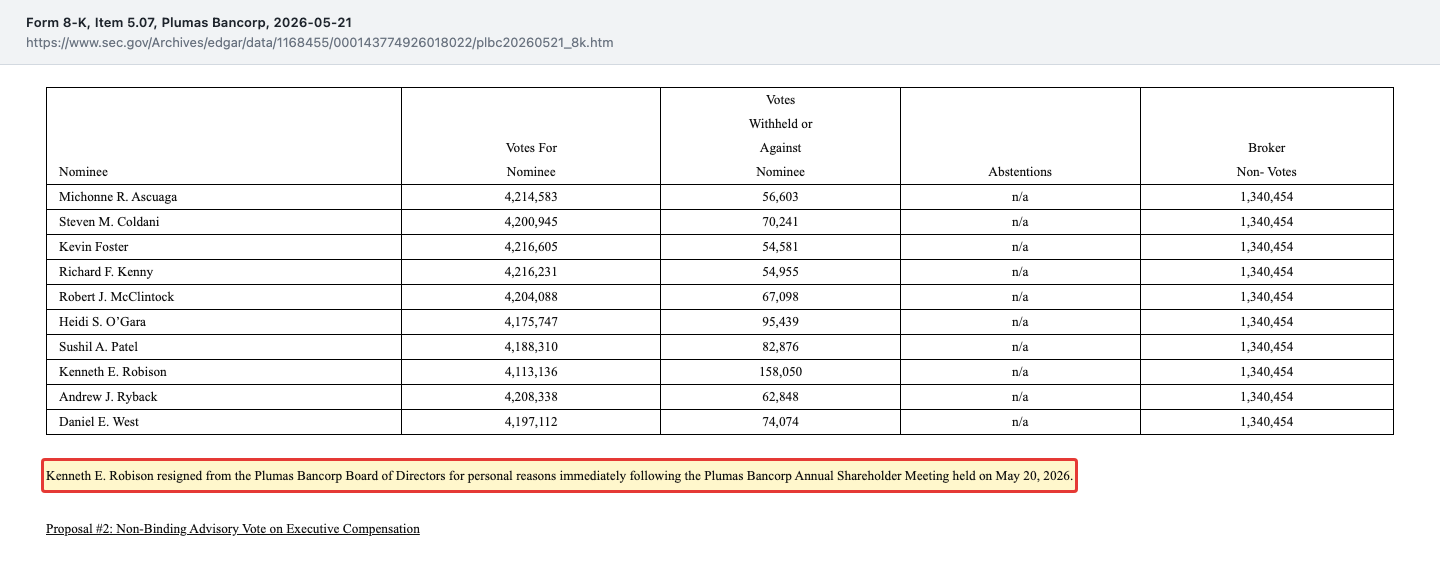
The filing cites "personal reasons" and contains no indication of a disagreement. There is therefore no evidence of a dispute, and we allege none. The configuration remains notable all the same: eleven months after the combination, the acquired bank no longer has a seat at the acquirer's board table.
Sixth, and most closely tied to the first finding: precisely as credit quality turned, the bank's most senior credit officer changed. Jeffrey T. Moore had been chief credit officer of Plumas Bank since 21 February 2019 and, as one of the three highest-paid executives, was a named executive officer. He retired on 31 December 2025; Kevin C. Kaiser, previously the bank's credit administrator, took over on 1 January 2026. What stands out is not the change itself — Moore was 69 — but how it was communicated: the SEC filing of 2 January 2026 reports only the appointment of the successor and does not mention Moore at all. That he had left surfaces only in a footnote to the proxy statement of 9 April 2026: "Mr. Moore retired at December 31, 2025." The retirement of another executive — the chief banking officer — had by contrast been announced by Plumas in a dedicated SEC filing in April 2025, three months before her departure. For anyone reading the numbers this means the person responsible for the loan book changed in the very quarter in which nonperforming loans hit a multi-year high — and you had to go looking for it.
And finally, because nobody expects it: in the first quarter of 2026 the bank lost $726 thousand to two fraudulent wire transfers — both involving the same customer. The quarterly filing cites the amount as the main driver of the increase in other expense. Measured against quarterly net income of $9.8 million, that is roughly 7% simply gone.
Valuation — cheap, but not without reason
As of 27 August 2026 the stock traded at $61.19. With 6,959,016 shares outstanding (as of 1 August 2026 per the cover page of the quarterly report), that implies a market capitalisation of roughly $426 million. The price-to-earnings ratio on trailing twelve-month earnings is around 12. Book value per share was $39.08 as of 30 June 2026, giving a price-to-book ratio of roughly 1.57.
For banks, however, tangible book value is the more usual yardstick — the substance value excluding goodwill and other intangibles, because it sits closer to what could actually be realised. Deduct from $272.1 million of equity the $24.2 million of goodwill and the $10.0 million core deposit intangible, and $238.0 million remains, or $34.17 per share. On that basis the market pays roughly 1.8 times. That is no bargain, but nor is it a premium that has already priced in every future advance — for a bank earning 15% on equity in the latest quarter it is fairly unremarkable. The stock sits between its 52-week low of $38.80 and high of $64.00, considerably closer to the upper end.
The dividend has been $0.33 per quarter since the payment of 18 February 2026, up from $0.30 — an increase of 10%; the most recent payment went out on 17 August 2026 (declared 15 July 2026 in a Form 8-K filing). Annualised, that is $1.32 and, at the 27 August 2026 price, a yield of roughly 2.2%. Dividends paid in the first half of 2026 came to $4.6 million, just over 23% of earnings — plenty of headroom. A share repurchase programme of up to $25 million has been running since 2 February 2026, of which only $2.8 million had been drawn by 30 June 2026.
What this valuation does not capture is the question raised by the third finding: if a meaningful part of current earning power comes from unwinding the purchase discount, and that item is finite, then trailing twelve-month earnings are not a reliable base for what follows. A price-to-earnings ratio of 12 on earnings that contain an expiring one-off is in truth more expensive than it looks.
Opportunities and risks at a glance
What speaks for the bank:
- A deposit base many larger banks would envy: 45.8% non-interest-bearing demand deposits (30 June 2026) — the source of the above-average margin.
- Capital far above every requirement: the bank's common equity tier 1 ratio of 15.8% against 6.5% for a "well capitalized" designation, and total risk-based capital of 17.0% against 10.0% (30 June 2026).
- Not a single held-to-maturity security. The entire portfolio is carried at fair value, and the losses are in plain sight: $21.9 million gross; net of offsetting gains and tax, $13.6 million of that sits as a deduction in equity — 5.0% of the $272.1 million of shareholders’ equity. Hidden off-balance-sheet losses — the 2023 pattern — do not exist here.
- Actual losses remain tiny: $419 thousand of net charge-offs in the first half of 2026, roughly 0.06% of average loans. The early indicator has improved too: loans 30 to 89 days past due fell from $8.6 million to $2.6 million.
- Roughly $549 million of undrawn credit lines at the Federal Home Loan Bank, the Federal Reserve and correspondent banks, plus $135.5 million of cash — with nothing drawn.
What speaks against it:
- Nonperforming loans of $23.5 million, or 1.55% of the loan book (30 June 2026), up from 0.40% at the end of 2024, with allowance coverage of only about 90%.
- An agricultural portfolio in which 8.4% of loans have defaulted — in a region whose water supply the bank itself flags as a drought risk in its risk factors.
- Commercial real estate equal to 389% of risk-based capital (31 December 2025) — well above the 300% supervisory threshold.
- The record margin rests substantially on the unwinding of a purchase discount that is finite and already accelerating.
- Geographic concentration: roughly 92% of loans go to borrowers who live or do business in northern California or northern Nevada — a region exposed to earthquake, wildfire and drought risk. That this is not theoretical shows in one line of 2025 income: $1.1 million from a settlement relating to the 2021 Dixie Fire.
- Uninsured deposits of roughly $811 million (43% of deposits), of which $230 million is collateralised — leaving roughly $581 million, or 31%, with neither.
- The loan book has stopped growing: $1,512.2 million as of 30 June 2026 against $1,512.1 million at 31 December 2025 — a gain of $117 thousand in six months.
A human conclusion
Back to the familiarity trap. Plumas Bancorp looks exactly the way a safe bank is supposed to look: 45 years old, branches in small towns, capital twice as thick as required, a dividend that has risen for years, and not a single line of held-to-maturity securities in which losses could hide. Anyone looking only at those features sees a thoroughly solid institution — and is not even wrong.
But the filings tell the other story too. An agricultural borrower who could no longer meet his obligations set something in motion in 2025 that, a year later, has left the bank's reserves no longer covering its problem loans. The record margin making the headlines comes substantially from a purchase-accounting entry that expires on its own. And in the very quarter in which defaulted loans rose most sharply, the reserve model was changed in a way that left the allowance lower even as defaults rose.
None of this proves this bank is in trouble — realised losses are tiny, capital is ample, and the collateral is there. It does prove that "familiar" and "examined" are two different things. Whether a bank with this deposit base and this capital position is worth the open questions on credit quality is not something an analysis can decide for you. What you make of it is your decision. And that is exactly as it should be.
Sources
Every original document used in this analysis — for you to read yourself:
- Plumas Bancorp — SEC quarterly report Form 10-Q for the period ended 30 June 2026 (filed 5 August 2026)
- Plumas Bancorp — SEC annual report Form 10-K for 2025 (filed 19 March 2026)
- Plumas Bancorp — SEC quarterly report Form 10-Q for the period ended 31 March 2026 (filed 6 May 2026)
- Plumas Bancorp — SEC annual report Form 10-K for 2024 (filed 19 March 2025)
- Plumas Bancorp — Release on the combination with Cornerstone Community Bancorp, SEC Exhibit 99.1 to Form 8-K dated 29 January 2025
- Plumas Bancorp — Second-quarter 2026 earnings release, SEC Exhibit 99.1 to Form 8-K dated 15 July 2026
- Plumas Bancorp — SEC Form 8-K dated 21 May 2026 on the annual meeting and a director resignation (Item 5.07)
- Plumas Bancorp — SEC Form 8-K dated 2 January 2026 on the appointment of the new chief credit officer (Item 5.02)
- Plumas Bancorp — 2026 proxy statement (SEC Form DEF 14A dated 9 April 2026) with details on executives and compensation
- Plumas Bancorp — SEC Form 8-K dated 1 April 2025 on the retirement of the chief banking officer (Item 5.02)
- Complete SEC filing history of Plumas Bancorp (CIK 0001168455): EDGAR overview (sec.gov)
- Source: fundamental data & SEC filings (annual and quarterly reports, 10-K/10-Q) for price, market capitalisation and valuation ratios; data as of 27 to 28 August 2026.
Transparency & disclaimer: This analysis is a journalistic assessment of publicly available information. It is not investment advice, not a financial analysis in any regulatory sense, and not an invitation to buy or sell securities. Equity investments carry substantial risk up to and including total loss. All information is provided without warranty; the as-of date for each figure is noted in the text. The author holds no position in Plumas Bancorp shares at the time of publication.
Key figures at a glance
All monetary figures in millions of $; earnings per share as reported.
| Metric | 2021 | 2022 | 2023 | 2024 | 2025 |
|---|---|---|---|---|---|
| Revenue | 56.5 | 70.5 | 84.9 | 72.9 | 108.2 |
| Operating Income (EBIT) | 28.5 | 35.7 | 40.2 | 39.0 | 39.6 |
| Net Income | 21.0 | 26.4 | 29.8 | 28.6 | 29.6 |
| Net Margin | 37.2% | 37.5% | 35.1% | 39.3% | 27.4% |
| Earnings Per Share | 3.76 $ | 4.47 $ | 5.02 $ | 4.80 $ | 4.54 $ |
Source: fundamental data & SEC filings (annual and quarterly reports, 10-K/10-Q)
Our Bottom Line at a Glance
- Deposit base and margin positive
- With 45.8% non-interest-bearing demand deposits (30 June 2026), Plumas has funding many larger banks can only dream of. That is the source of the 5.13% net interest margin in the second quarter of 2026 — an exceptional figure for this size class, and one that has risen steadily from 3.63% in 2021.
- Capital and liquidity positive
- A common equity tier 1 ratio of 15.8% and total risk-based capital of 17.0% at bank level as of 30 June 2026 — more than double the "well capitalized" thresholds. Add roughly $549 million of undrawn credit lines, $135.5 million of cash and not a single held-to-maturity security in which losses could hide.
- Credit quality negative
- Nonaccrual loans rose from $4.1 million (31 December 2024) to $21.9 million (30 June 2026), and total nonperforming loans to 1.55% of the book. Allowance coverage fell from 321% through 132% to roughly 90%; criticised and classified loans rose from 3.6% to 5.1% within six months. The cause is an in-house agricultural relationship of $9.8 million, not the acquisition.
- Quality of earnings neutral
- The first half of 2026 was the best in company history at $19.7 million. Strip out the $1.3 million of purchase-discount accretion the quarterly filing reports for the second quarter of 2026, however, and the quarterly margin falls from 5.13% to roughly 4.87% — against 4.83% in the prior-year quarter. The effect is finite and accelerating: $1.233 million was forecast for all of 2026, yet $1.8 million had accrued after six months.
- Commercial real estate concentration negative
- Commercial real estate accounts for 67.9% of the loan book and equalled 389% of total risk-based capital at 31 December 2025 per the annual report — well above the 300% supervisory threshold. Mitigating: 43% of it is owner-occupied, office property is only 13% of the commercial real estate book, and the 100% construction threshold is comfortably met at 15%.
- Shareholder returns positive
- The quarterly dividend rose 10% to $0.33 in 2026, and the annual dividend has more than doubled since 2021 ($0.56). A payout ratio of roughly 23% in the first half of 2026 leaves ample room. A repurchase programme of up to $25 million has been running since 2 February 2026, though only $2.8 million had been drawn by 30 June 2026.
Plumas Bancorp is a well-capitalised community bank with unusually cheap funding and a margin that has risen over five years. Its 2026 record headlines, however, rest substantially on the expiring unwind of a purchase discount from the Cornerstone acquisition, and in parallel nonperforming loans have more than quintupled since the end of 2024 — triggered by an in-house agricultural relationship, not by the deal. Capital, liquidity and the minimal actual charge-offs stand on the other side. Not investment advice.
What Our Rating Means
Open questions
The business works in principle, but one material question is open. As long as it stays open, our findings do not carry a quality verdict.
The business model has worked for 45 years, capital is very solid at a 15.8% common equity tier 1 ratio, there are no hidden securities losses and no existential dependency — there is no evidence whatsoever of the kind of solvency risk a red rating would require. But one material operating question is open, and it is a big one: whether credit quality is passing through a dip or marking a turn. Allowance coverage has fallen to roughly 90%, criticised loans rose from 3.6% to 5.1% of the book within six months, and the provision charged in the first half of 2026 was just $270 thousand while the reserve model was changed in the same quarter. That realised charge-offs remain tiny and the early indicator has improved argues the other way — but it does not yet answer the question. Until it is answered, the more cautious rating applies. That the stock looks undemanding at roughly 1.8 times tangible book value plays no part in this assessment — that is a question of price, not of quality. The decision is yours.
A journalistic assessment by our editorial team at the time of the deep dive, based on public sources — not investment advice and not a solicitation to buy or sell. Your personal circumstances (investment goals, risk capacity, taxes) cannot be taken into account. What our levels mean, how verdicts are formed, and what conflicts of interest exist →
Worth Noting
- This analysis began with an editorial screen of small US community banks for unusually high net interest margins: Plumas stood out at 5.13% in the second quarter of 2026, and the look into credit quality produced the actual finding (data as of 27 August 2026).
- All balance sheet and income figures carry an as-of date of 30 June 2026 (Form 10-Q) or 31 December 2025 (Form 10-K); price, market capitalisation and valuation ratios are dated 27 August 2026 and change daily with the market. Capital ratios apply to Plumas Bank, not to the holding company: as a small bank holding company, Plumas Bancorp is exempt from consolidated capital rules.
- No analyst call transcripts were available for Plumas Bancorp; the chapter on management commitments draws on the earnings releases for all 15 quarters from late 2022 through mid-2026 and on the merger press release of 29 January 2025.
- Not to be confused with other institutions carrying "Community Bank" or "Bancorp" in their name — this analysis covers only Plumas Bancorp, Nasdaq ticker PLBC, CIK 0001168455, headquartered in Reno, Nevada.
Stock Watch
This analysis is as of August 28, 2026. Stock Watch will tell you what's changed at PLBC since then.
Later $1 a month per stock — signing up is free, and you'll be the first to know when it launches.
The full analysis as a PDF for later
We will send you this analysis as a PDF — to print, file away, and read at your own pace. And we will add you to the free Stock Watch list for Plumas Bancorp (PLBC), so you hear about it when something material in this analysis changes.
Frequently Asked Questions
Plumas Bancorp (Nasdaq: PLBC) is the holding company of Plumas Bank, a community bank founded in 1980 serving north-eastern California and northern Nevada; its administrative headquarters is in Reno, Nevada. As of 30 June 2026 the bank held $2.278 billion in total assets, $1.885 billion in deposits and $1.512 billion in gross loans, with 238 full-time employees. Its lending focuses on commercial real estate, commercial and agricultural credit.
That is your decision — this analysis gives no buy recommendation. The facts as of 27 August 2026: a price of $61.19, a price-to-earnings ratio of roughly 12 on trailing twelve-month earnings, roughly 1.8 times tangible book value of $34.17 per share, and a dividend yield of about 2.2%. Capital is very solid, but a meaningful part of current earning power comes from an expiring purchase-accounting effect, and credit quality has deteriorated markedly.
Nonaccrual loans rose from $4.1 million (31 December 2024) to $21.9 million (30 June 2026); total nonperforming loans reached 1.55% of the loan book, up from 0.40%. Allowance coverage fell from 321% to roughly 90%. Important for context: actual charge-offs remain very low at $419 thousand in the first half of 2026, and loans 30 to 89 days past due fell from $8.6 million to $2.6 million. So far these are collateralised payment problems, not realised losses.
Plumas acquired Cornerstone Community Bancorp of Red Bluff, California, effective 1 July 2025, gaining four branches, $478 million of loans and $580 million of deposits; $18.7 million of goodwill remained. The commitment was roughly 9% earnings-per-share accretion in 2025 and 23% in 2026. In 2025 earnings per share instead fell from $4.80 to $4.54; in the first half of 2026 they rose 24%, putting the commitment on track. The promised 13% tangible book value dilution came in far lower at 4.1%.
Plumas Bank's common equity tier 1 ratio stood at 15.8% as of 30 June 2026 and total risk-based capital at 17.0% — both far above the 6.5% and 10.0% thresholds for a "well capitalized" designation. The holding company itself is exempt from consolidated capital rules as a small bank holding company. Roughly $811 million of deposits exceed insurance limits, of which $230 million is collateralised. Unlike the 2023 bank failures, there is no held-to-maturity portfolio hiding unrealised losses.
Yes, and it has risen for years: from $0.56 per share (2021) through $1.00 (2023) and $1.20 (2025) to a current $0.33 per quarter, paid on 18 February, 15 May and 17 August 2026. Annualised that is $1.32, or roughly 2.2% at the 27 August 2026 price. The payout ratio in the first half of 2026 was about 23% of earnings. A repurchase programme of up to $25 million has also been running since 2 February 2026.
Four documented points. First, the allowance no longer fully covers defaulted loans, at roughly 90% coverage. Second, commercial real estate loans equal 389% of risk-based capital (31 December 2025), well above the 300% supervisory threshold. Third, a meaningful part of the record margin comes from the expiring unwind of the purchase discount. Fourth, roughly 92% of loans sit in a region exposed to wildfire, earthquake and drought risk, and 8.4% of the agricultural portfolio has already defaulted.
Found an error?
Did you spot a factual error, an outdated number, or a typo in this deep dive? Let us know briefly — your report goes straight to the editorial team.