Personalis Stock: A Takeover Price With a Ceiling — and No Floor
On July 20, 2026, Personalis signed a merger agreement with Tempus AI. One number made the headlines: $16.25 per share. The agreement itself says something different — that number is an upper limit, not a promise. We read the 2025 annual report (10-K), the quarterly report for June 30, 2026 and the current report announcing the deal: revenue that ended 2025 below its 2021 level, an accumulated deficit of $631 million, three customers accounting for almost two thirds of sales — and a buyer who was already a major shareholder, a sales partner and a data licensee long before the offer. If you buy in here, you should know what you are buying.
 Thomas Mücke
Founder & Publisher
Thomas Mücke
Founder & Publisher
As of Today
As of: October 6, 2026
- Closing price
- 16.00 $ -2.30%
- Market Capitalisation
- 1.7 $B
- Growth Score
- 3/10
- AAQS
- 5/10
Price change since August 21, 2026: -12.9%
This analysis has a cut-off date. The Stock Guard tells you when something material changes in the numbers. Reserve your free spot
Chart
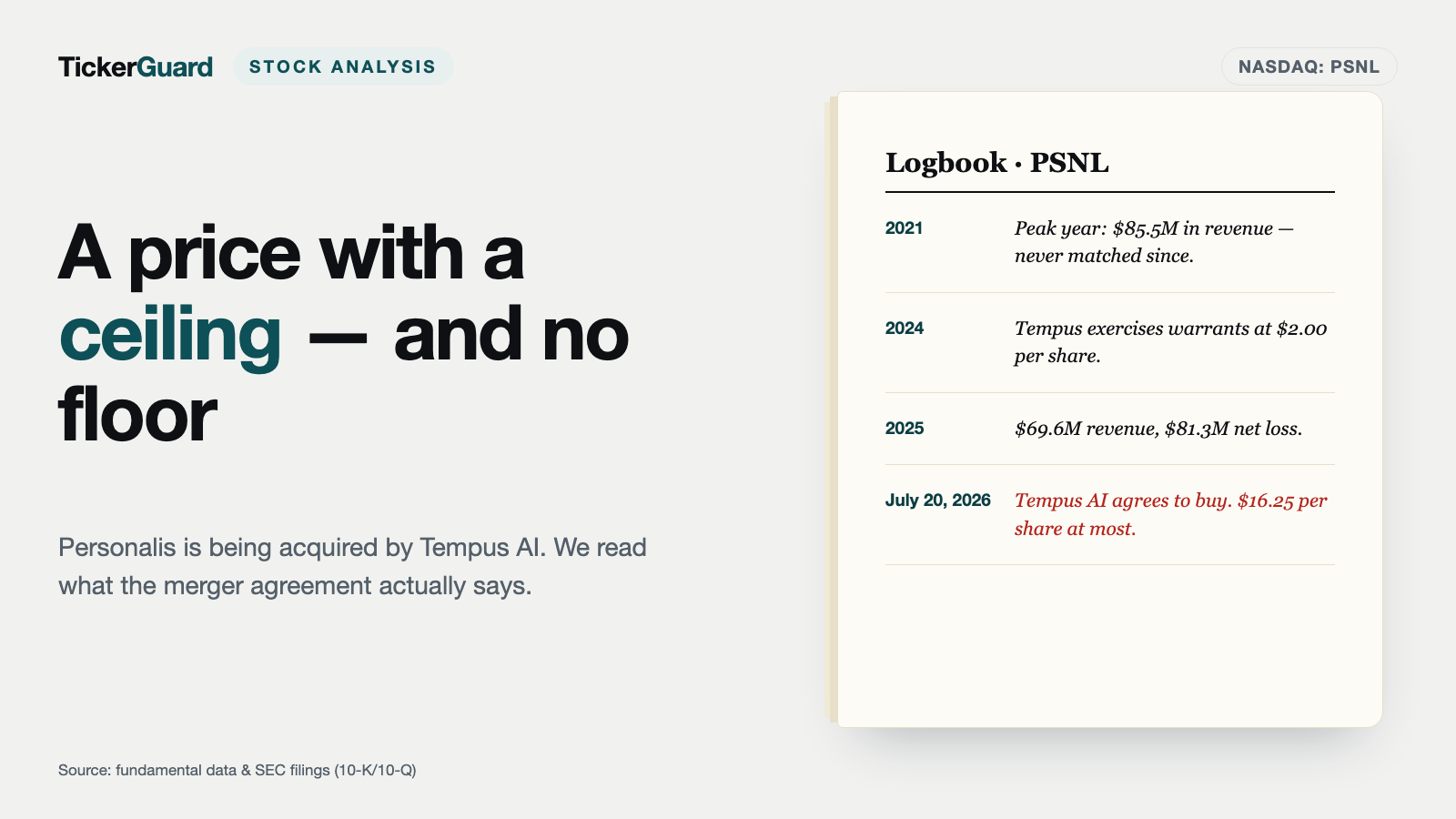
Interactive price chart (TradingView).
52-week range: 5.00 $ to 18.40 $ · Last price: 16.00 $ (As of: October 6, 2026)
Note: pure fact-based analysis, not investment advice and not a solicitation to buy or sell. All figures without guarantee.
The trap: when a price suddenly lands on the table
There is a moment when a stock feels as if the risk had evaporated. Not after a good quarter — some doubt always survives that. It happens when a takeover is announced. Suddenly there is a number in the room. Not estimated, not hoped for, but negotiated and signed. For Personalis that number is $16.25 per share.
And this is exactly where one of the oldest traps in investing snaps shut: anchoring. Our brain latches on to the first concrete number it hears and measures everything else against it. $16.25 sounds like a floor. It sounds like: worst case, that is what I get. Except that is not what the agreement says.
So today we do something unglamorous. We read. What does the merger agreement of July 20, 2026 actually say? How good is the business being bought? And who exactly is sitting on the other side of the table? The decision at the end is yours — but you should at least know what you are deciding about.
Company history for investors
-
2021
Record revenue of $85.5 million
The best annual revenue to date — accompanied by a $65.2 million net loss. For shareholders it became the benchmark against which every later year is measured.
-
2023
Commercialization agreement with Tempus AI
In November, Tempus takes over U.S. sales of the NeXT Personal Dx test and receives warrants plus access to the genomic data. The eventual buyer has been at the table ever since.
-
2024
Merck and Tempus become major shareholders
Merck buys 14.0 million shares at $3.56; Tempus exercises warrants at $2.00 and adds shares at $5.07. Shares outstanding jump from 50.5 million to 85.2 million.
-
2025
Natera business winds down, revenue falls to $69.6 million
Losing the key account costs roughly $19.5 million of revenue. A further 16.2 million shares are sold into the market, raising $126.8 million net.
-
2026
Merger agreement with Tempus AI on July 20
Up to $16.25 per share, mostly in Tempus stock and capped on the upside. From that day the value of a Personalis share depends chiefly on another company's price.
What Personalis actually does
Personalis is a laboratory. More precisely, a specialist cancer genetics lab based in Fremont, California, which employed roughly 260 people as of January 31, 2026 (annual report on Form 10-K for 2025). The company decodes the genetic makeup of tumors, and it does so with unusual precision.
Its flagship product is called NeXT Personal. Think of it as a tracker dog trained for a single scent. First a patient's tumor is sequenced, capturing its genetic fingerprint. Personalis then builds a personalized blood test that hunts for exactly those traces. If the test finds them, tumor material is still present — or the cancer is coming back. Clinicians call this minimal residual disease; the idea is to catch a relapse before any imaging scan can see it.
The company sells this to four groups, and that split matters, because it is shifting dramatically right now:
- Pharma testing services — contract analysis for drug developers running clinical trials. By far the largest pillar: $48.7 million in 2025.
- Population sequencing — genome analysis at scale. There is exactly one customer here: the Million Veteran Program of the U.S. Department of Veterans Affairs. $11.8 million in 2025.
- Clinical diagnostics — tests ordered by physicians for individual patients, reimbursed by Medicare and private insurers. Small, but growing fast: $2.0 million in 2025 after $0.8 million in 2024.
- Enterprise sales — analysis delivered as an input to another company's product. In practice that meant one customer, Natera. $25.4 million in 2024, $5.9 million in 2025 — and exactly zero in the second quarter of 2026.
On that last point the company is unusually blunt in its quarterly report for June 30, 2026:
“We no longer have a commercial relationship with Natera and do not expect to have one going forward.”
— Personalis, Inc., SEC quarterly report on Form 10-Q for June 30, 2026, MD&A, "Enterprise sales"
Roughly 30 percent of 2024 revenue has vanished with no replacement — that was Natera’s share of sales that year, per the customer table in the 2025 annual report. It accounts for a large part of what you are about to see in the annual figures.
How this stock landed on our desk
Not through a screener. Personalis reached us through a mandatory filing with the U.S. securities regulator, the SEC: on July 20, 2026, the company filed a current report on Form 8-K disclosing a signed Agreement and Plan of Merger with Tempus AI, Inc.
The structure has two steps and is confusing on first reading, so here it is in plain terms. A Tempus subsidiary first merges into Personalis; the result then merges into a second Tempus subsidiary. The net effect is that Personalis ceases to exist as an independent, publicly traded company and becomes part of Tempus. For a shareholder only one question matters: what do you get for your shares?
The answer sits in that same document — and it is more intricate than the headline suggests. That is the subject of the chapter after next.
One more thing is worth noting. Four weeks later, on August 20, 2026, Personalis announced a new task order from the Department of Veterans Affairs worth up to $18.3 million, effective September 30, 2026. That brings cumulative task orders under the program to roughly $243.3 million.

The numbers over the years, given their due
Start with what genuinely impresses. The clinical diagnostics business is turning. In the second quarter of 2026 Personalis booked $2.5 million there, up from $0.5 million a year earlier — more than a fourfold increase. Behind it stand five Medicare coverage decisions between January 2024 and May 2026, most recently for immunotherapy monitoring and for monitoring response to neoadjuvant breast cancer therapy. Clinical test volume reached 16,233 tests in 2025, up from 3,285 in 2024 — and in the second quarter of 2026 alone it hit 10,384 tests, up from 3,478 a year earlier, a gain of 199 percent.
The quarter as a whole looked good too: $22.4 million of revenue in the second quarter of 2026, up 30 percent from $17.2 million a year earlier. In its quarterly release of August 4, 2026, management stands by one clear target:
“We remain firmly on-track to achieve more than a 500% increase in our clinical revenue over last year.”
— Personalis, Inc., SEC current report on Form 8-K of August 4, 2026, Exhibit 99.1
To put that number in perspective: a 500 percent increase on the $2.0 million booked in 2025 would be roughly $12 million. Measured against total revenue of just under $70 million, clinical diagnostics would still be a small slice of the whole even in the best case — around one sixth. It is the hope for the future, not yet the present.
And now the view you cannot skip — the one across several years:
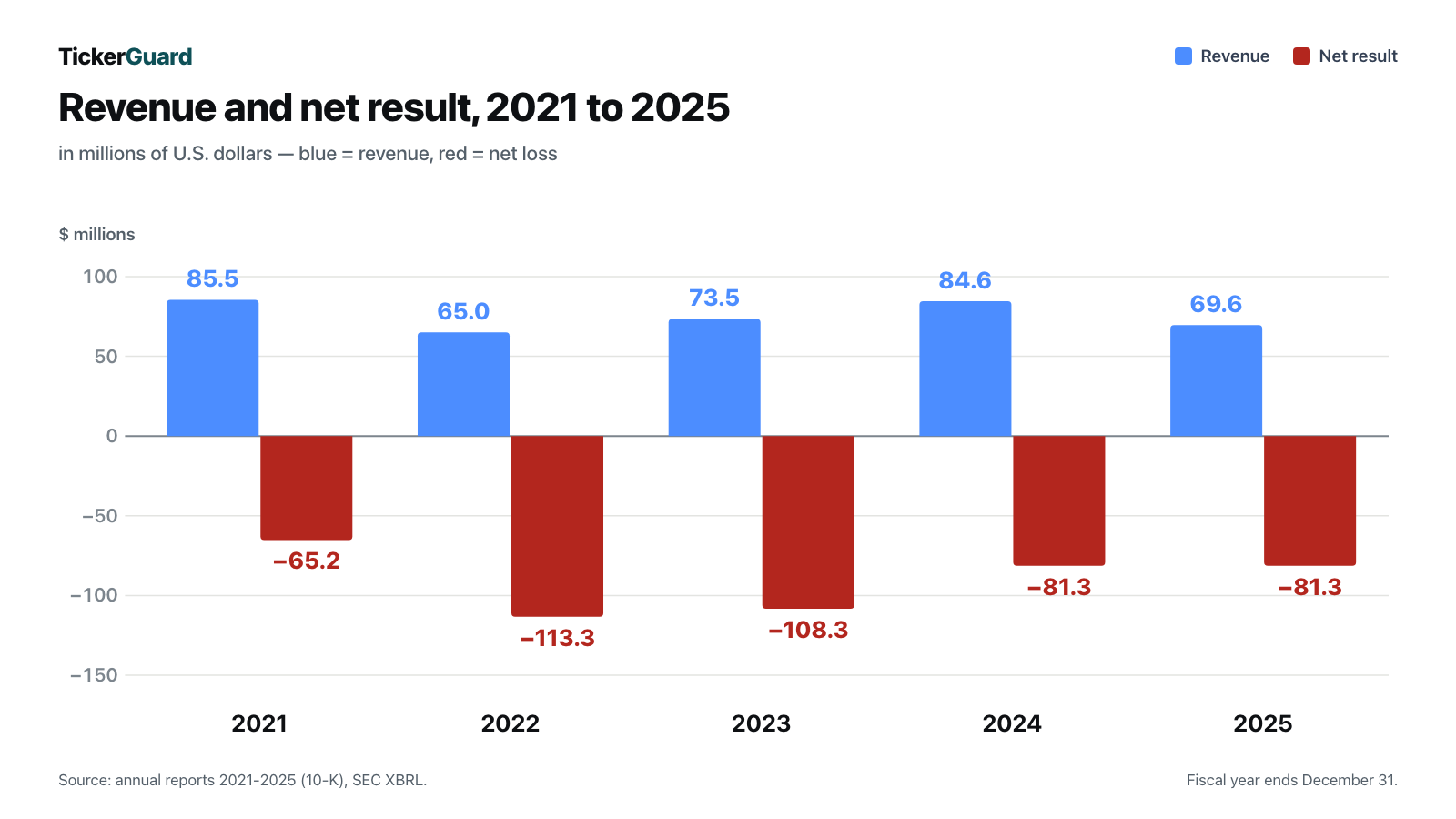
That is the uncomfortable baseline: five years of zigzag without progress. Revenue was $85.5 million in 2021 and only $69.6 million in 2025, with a slump to $65.0 million in 2022, a recovery to $84.6 million in 2024 and then the fresh setback. The accumulated deficit since inception stood at roughly $631 million as of December 31, 2025.
The current year does not improve that arithmetic — it changes its shape. In the first half of 2026 Personalis generated $37.8 million of revenue, exactly matching the first half of 2025 ($37.8 million). The net loss over the same period rose from $35.8 million to $61.7 million. Cash used in operating activities grew from $30.9 million to $48.2 million.
A word on reconciling the strong quarter with the flat half-year, because they look contradictory. Both are true. The second quarter of 2026 really was 30 percent better than the year-earlier quarter — but the first quarter of 2026 was correspondingly weaker than the first quarter of 2025. Over six months the two cancel out. Anyone extrapolating a trend from that one good quarter is measuring against the wrong base.
The balance sheet remains a genuine positive: $212.7 million of cash and short-term investments as of June 30, 2026, with stockholders' equity of $235.2 million. None of the filings we reviewed contains a going-concern warning, and the company considers its resources sufficient for at least the next twelve months.
Uncomfortable truth number one: the price has a ceiling but no floor
Now to the heart of it. The consideration is paid mostly in Tempus shares, and how many Tempus shares you receive per Personalis share depends on the Tempus price. The agreement sets it out like this:
“if the Parent Stock Price (as defined below) is equal to or less than the Floor Price of $48.42, the Exchange Ratio will be fixed at 0.3356; and if the Parent Stock Price is greater than the Floor Price, the Exchange Ratio will be equal to $16.25 divided by the Parent Stock Price.”
— Personalis, Inc., SEC current report on Form 8-K of July 20, 2026, Item 1.01

Work the math, because the asymmetry lives right here:
- Tempus trades at $60. Exchange ratio: 16.25 divided by 60 equals 0.2708 shares. Value: 0.2708 times 60 equals $16.25.
- Tempus trades at $90. Exchange ratio: 0.1806 shares. Value: $16.25 again. You do not participate in the upside.
- Tempus trades at $40. Now the fixed ratio of 0.3356 applies. Value: 0.3356 times 40 equals $13.42. You do participate in the downside.
Put plainly: capped on the way up, open on the way down. That is not an insinuation, it is the formula in the contract. And the "Parent Stock Price" is not today's quote but a volume-weighted average across the fifteen trading days before closing — a number nobody knows today.
Two mitigating features exist, and they deserve a fair mention. First, Tempus may elect to pay cash for up to 50 percent of the shares, also at $16.25. Whether it does is Tempus's call. Second, Personalis may terminate the agreement if the relevant Tempus price drops below a second, lower threshold of $46.00 — though that right is expected to be exercisable only within a two-business-day window immediately before the scheduled closing.
Closing itself is not guaranteed. It depends on, among other things, approval by Personalis stockholders, antitrust clearance under the Hart-Scott-Rodino Act, effectiveness of a registration statement on Form S-4 and Nasdaq listing of the new Tempus shares. The outside date is April 20, 2027, extendable twice by six months each. If the deal collapses for certain reasons, a termination fee of roughly $76.8 million becomes payable — in either direction.
We have dissected what a takeover-driven share price jump really leaves behind once before, in our analysis of Iridium and the Rocket Lab acquisition.
Uncomfortable truth number two: three customers carry almost two thirds of revenue
Buying a laboratory means buying its customer list. The Personalis list is short — very short.
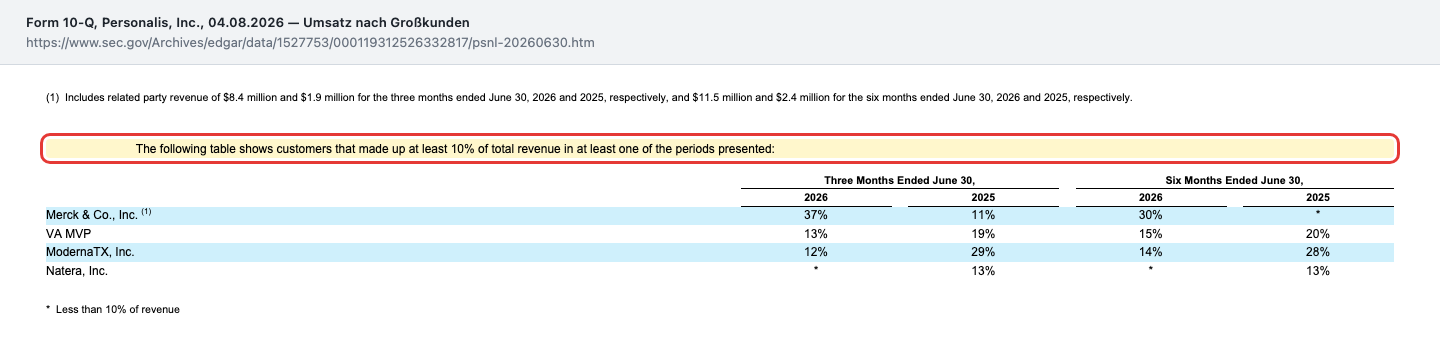
Merck alone accounted for 37 percent of second-quarter 2026 revenue. Add 13 percent from the veterans program and 12 percent from ModernaTX and you reach 62 percent from three sources. A year earlier the distribution was entirely different, with ModernaTX leading at 29 percent and Merck at 11 percent.
Receivables are more concentrated still: as of June 30, 2026, 49 percent of all accounts receivable were owed by Merck. Almost half the money Personalis is still waiting for depends on a single debtor.
It also belongs in the picture that Merck is not an ordinary customer. Merck Sharp & Dohme LLC holds more than 10 percent of Personalis stock and is therefore treated as a related party in the filings. It bought 14,044,943 shares at $3.56 each — $50 million in total. And alongside the merger agreement, Merck signed a voting agreement covering roughly 13 percent of the voting power: it votes for the Tempus deal and against any competing proposal.
This is the kind of dependence that looks like a partnership in good times and like concentration risk in bad ones. It is not a threat to the company's substance — Personalis has cash and no crushing debt. But it explains why the business swings so violently from quarter to quarter.
Uncomfortable truth number three: the buyer was already at the table, at two dollars
Tempus AI does not enter this story in July 2026. Tempus had been involved for nearly three years — in three roles at once.
“Tempus acquired its ownership stake in August 2024 by exercising two warrants issued to Tempus in November 2023 in consideration of Tempus’ obligations to Personalis under the Tempus Agreement (as defined below), for an aggregate of 9,218,800 shares of Personalis’ common stock at an average exercise price of $2.00 per share, and purchasing an additional 3,500,000 shares of Personalis’ common stock at a price per share of $5.07 under an investment agreement entered into with Tempus in August 2024.”
— Personalis, Inc., SEC quarterly report on Form 10-Q for June 30, 2026, Note 8 (Related Party Transactions)
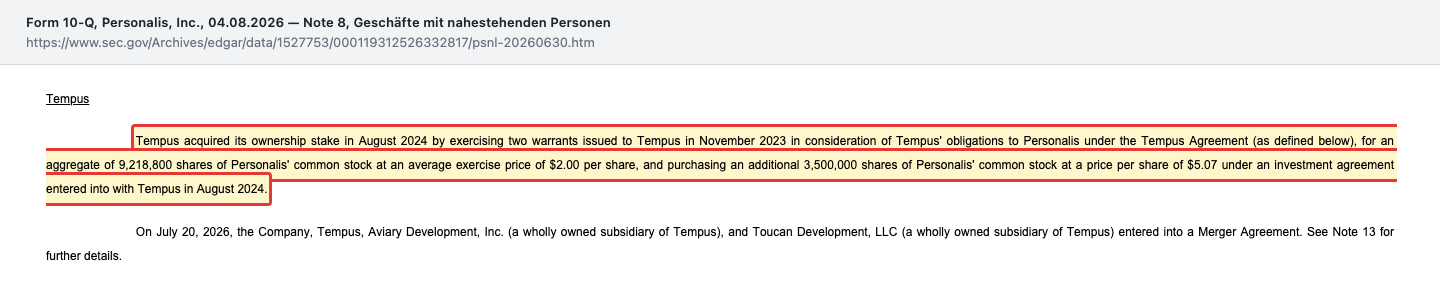
Three roles, then. Tempus is first a major shareholder holding more than 10 percent. Tempus is second a sales partner: since November 2023 it has marketed the NeXT Personal Dx test in the United States through its own, considerably larger sales force; Personalis performs the tests, bills the payors and compensates Tempus on a per-test basis. That agreement runs through November 25, 2029.
And Tempus is third a data licensee:
“The Tempus Agreement also granted Tempus access to initial and longitudinal genomic data derived from performance of the tests and Tempus will have the right to use such data.”
— Personalis, Inc., SEC quarterly report on Form 10-Q for June 30, 2026, Note 8
If Tempus licenses that data on to a third party, Personalis is entitled to between 10 and 20 percent of the gross revenue. What Personalis actually earned from that arrangement in the first half of 2026, and in the first half of 2025: nothing.
None of this needs to be spun into a scandal. The buyer simply knew the business better than any outsider could, and a board of directors approved the price. But you should know it. When the party that controls distribution and uses the data also ends up buying the company, price discovery looks different than it does in an auction between strangers. The agreement does expressly permit a superior proposal — which would trigger that $76.8 million termination fee, roughly 4 percent of the total transaction value.
Uncomfortable truth number four: fifty million shares became one hundred and seven
A quick word on dilution. Picture a cake being cut into ever more slices. The cake does not grow — your slice shrinks. That is precisely what happened at Personalis over two and a half years.
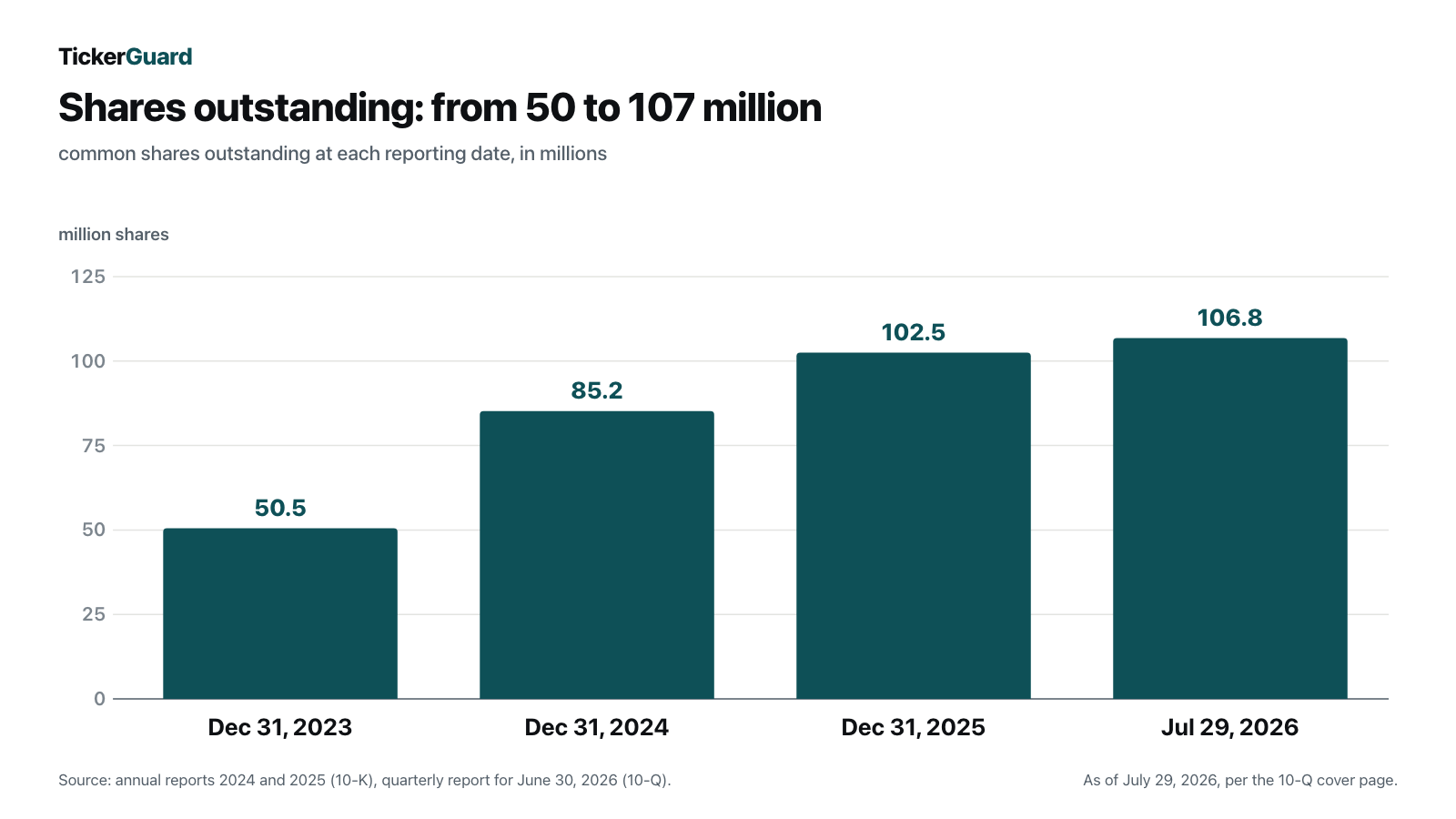
The statements of stockholders' equity show where the new shares came from. In 2024 alone: 14.0 million shares to Merck, 9.2 million from the Tempus warrants, 3.5 million to Tempus under the investment agreement and 6.7 million through the at-the-market program. In 2025 a further 16.2 million shares went out the same way, raising roughly $126.8 million net. The first half of 2026 added another 2.8 million shares for $25.5 million net, at a weighted-average price of $9.02.
For the company that was sensible — without that money there would be no cash pile funding operations today. For long-standing shareholders it means something else: anyone who was there at the end of 2023 now owns less than half their original slice of the same company. And every one of those sales happened at prices below today's $16.25.
What the takeover is worth, and what the market makes of it
On orders of magnitude, deliberately without reading anything into a daily quote: with 106,799,872 shares outstanding as of July 29, 2026, a price of $16.25 per share implies a transaction value of roughly $1.74 billion. Measured against trailing twelve-month revenue of about $70 million, that is roughly 25 times annual sales — a punchy multiple for a laboratory that loses money every year. Tempus is not buying earnings here. It is buying a technology, a Medicare coverage list and control over data it already uses.
The market cross-check is the interesting part. On August 21, 2026, Personalis stock closed at $18.38, roughly 13 percent above the maximum the merger agreement provides for. That is unusual. In a takeover the target normally trades slightly below the offer, because time and completion risk cost a discount.
There are essentially two readings of a premium. Either part of the market expects a better offer — the agreement expressly allows the board to accept a superior proposal. Or part of the market simply has not read the cap and assumes the value rises with the Tempus price. We do not know which reading is right. What we do know: a premium paid on a capped price is a bet, not a safety net.
Forming your own view is made harder by a decision Personalis disclosed in that same quarterly release of August 4, 2026: because of the merger there is no financial guidance and no earnings call any more.
“As a result of the announcement on July 20, 2026 that Personalis and Tempus AI, Inc. have entered into an Agreement and Plan of Merger, Personalis will no longer provide financial guidance or conduct a quarterly earnings conference call.”
— Personalis, Inc., SEC current report on Form 8-K of August 4, 2026, Exhibit 99.1, "Full Year 2026 Outlook"
This is standard practice once a takeover is announced, and it is no accusation. It has a consequence for you as an investor all the same: the most useful source of information about how the business is actually developing — management's own expectations and the questions analysts put to them — disappears for the entire waiting period until closing. What remains are the bare quarterly reports and the 500 percent target from that same release.
Two numbers to remember. The ceiling: $16.25, and the agreement offers nothing beyond it. The floor price below which the value starts sliding: a Tempus quote of $48.42.
Upside and risks at a glance
Upside
- The merger agreement is signed, approved by both boards of directors, and a shareholder holding roughly 13 percent of the votes has contractually committed to support it.
- Clinical diagnostics is growing quickly: $2.5 million in the second quarter of 2026 after $0.5 million a year earlier, driven by five Medicare coverage decisions between January 2024 and May 2026.
- The balance sheet carries the business: $212.7 million of cash and short-term investments and $235.2 million of stockholders' equity as of June 30, 2026, with no going-concern warning.
- Government work continues: roughly $243.3 million of cumulative task orders under the veterans program, most recently a new one worth up to $18.3 million (as of August 20, 2026).
- If the deal fails on certain points attributable to the buyer, Personalis receives a reverse termination fee of roughly $76.8 million.
Risks
- The consideration is capped at $16.25 and unprotected on the downside: below a Tempus price of $48.42 a fixed ratio of 0.3356 applies and the value falls with it.
- Closing depends on the stockholder vote, antitrust clearance and registration; the outside date is April 20, 2027, extendable twice. Capital stays tied up until then.
- Three customers accounted for 62 percent of second-quarter 2026 revenue, and Merck alone for 49 percent of receivables as of June 30, 2026.
- No revenue progress across five years: $69.6 million in 2025 after $85.5 million in 2021, with losses throughout and an accumulated deficit of $631 million.
- Cash used in operating activities accelerated to $48.2 million in the first half of 2026, up from $30.9 million a year earlier.
- Shares outstanding have more than doubled since the end of 2023; if the takeover fails, returning to the equity market is the most likely route.
- Since August 4, 2026 there has been neither financial guidance nor an earnings call because of the merger — the information available to investors is thinner than usual until closing.
A human bottom line
We started with anchoring: a number lands on the table and the mind turns it into a floor. At Personalis, $16.25 is not a floor. It is a ceiling. The floor is missing — it was deliberately negotiated away, in the buyer's favor.
That does not make the takeover a bad outcome. For a company whose revenue has circled back to where it stood in 2021, that loses money every year and whose cash burn recently accelerated, a signed buyer is real news. And Personalis achieved something genuinely hard: five Medicare coverage decisions in a little over two years and a clinical business that is finally accelerating. It is simply happening too late for the market to value it standalone.
What stayed with us longest is not the price but the seating arrangement. The buyer was a sales partner, a major shareholder and a data licensee — it knew every number before it became public, and it entered at $2.00 a share. The other major shareholder is simultaneously the largest customer and has already pledged its vote. All of this is lawful, disclosed and board-approved. It is still a configuration in which the retail shareholder sits last at the table and did not help write the menu.
If configurations like this interest you, look at one from the opposite direction: our analysis of Replimune, where the auditor doubts the company can continue and the market bets on approval anyway. Takeovers and approvals are both events where a single date decides everything.
We are not telling you what to do. We are telling you what the agreement says: your upper limit is fixed, your lower limit is not. What you make of that is your call. And that is exactly how it should be.
Sources
- SEC EDGAR — all filings by Personalis, Inc. (CIK 0001527753)
- Annual report on Form 10-K for 2025 (filed February 26, 2026) — business description, headcount, revenue by customer type, statements of stockholders' equity, accumulated deficit
- Annual report on Form 10-K for 2024 (filed February 27, 2025) — 2024 share issuances, entry of Merck and Tempus
- Quarterly report on Form 10-Q for June 30, 2026 (filed August 4, 2026) — half-year figures, customer concentration, Note 8 (related parties), liquidity, shares outstanding
- Quarterly report on Form 10-Q for March 31, 2026 (filed May 7, 2026)
- SEC current report on Form 8-K of July 20, 2026, Item 1.01 — merger agreement with Tempus AI, exchange ratio, floor prices, termination fee, Merck voting agreement
- SEC current report on Form 8-K of July 20, 2026, Items 2.02/7.01 — joint press release on the proposed acquisition
- SEC current report on Form 8-K of August 4, 2026, Exhibit 99.1 — quarterly release: clinical test volume, clinical revenue target, withdrawal of guidance and earnings calls
- SEC current report on Form 8-K of August 20, 2026, Item 8.01 — new VA Million Veteran Program task order
- Fundamental data & SEC filings (annual and quarterly reports, 10-K/10-Q) — price and valuation figures, data as of August 21, 2026
Disclosure. This article is journalistic research and analysis. It is not investment advice and not a solicitation to buy or sell securities. Share prices can move sharply, and a total loss of invested capital is possible. In takeover situations there is the added risk that an announced transaction fails to close and that the consideration — as here — is variable. All figures come from the primary sources linked above and carry the reporting dates stated there. Positions held by the operator are disclosed daily; where one exists, it appears as a notice at the top of this deep dive. or Tempus AI, Inc. at the time of publication.
Key figures at a glance
All monetary figures in millions of $; earnings per share as reported.
| Metric | 2021 | 2022 | 2023 | 2024 | 2025 |
|---|---|---|---|---|---|
| Revenue | 85.5 | 65.0 | 73.5 | 84.6 | 69.6 |
| Operating Income (EBIT) | -65.4 | -115.5 | -96.3 | -68.3 | -88.1 |
| Net Income | -65.2 | -113.3 | -108.3 | -81.3 | -81.3 |
| Net Margin | -76.3% | -174.2% | -147.4% | -96.1% | -116.7% |
| Earnings Per Share | -1.49 $ | -2.48 $ | -2.25 $ | -1.37 $ | -0.91 $ |
Source: fundamental data & SEC filings (annual and quarterly reports, 10-K/10-Q)
Our Bottom Line at a Glance
- Business model neutral
- Highly specialized cancer genetics with demonstrated technical performance and five Medicare coverage decisions between January 2024 and May 2026. The commercial proof is missing: revenue of $69.6 million in 2025 is below the $85.5 million booked in 2021.
- Profitability negative
- A net loss in every year from 2021 through 2025, most recently $81.3 million. In the first half of 2026 the loss widened to $61.7 million (prior year $35.8 million) and cash used in operations to $48.2 million (prior year $30.9 million).
- Balance sheet positive
- $212.7 million of liquidity and $235.2 million of stockholders' equity as of June 30, 2026, with no going-concern warning in any reviewed filing. The cash position carries operations for several quarters even without the takeover.
- Customer base negative
- Three customers accounted for 62 percent of second-quarter 2026 revenue (Merck 37 %, VA MVP 13 %, ModernaTX 12 %), and Merck for 49 percent of receivables as of June 30, 2026. Former key account Natera has fallen away with no replacement.
- Dilution negative
- Shares outstanding rose from 50,480,694 (December 31, 2023) to 106,799,872 (July 29, 2026). In 2025 alone, 16.2 million shares were issued through the at-the-market program, raising $126.8 million net.
- Deal structure neutral
- A signed agreement with Tempus AI dated July 20, 2026 and a shareholder holding roughly 13 percent of the votes committed to it. The consideration is capped at $16.25 and declines below a Tempus price of $48.42 — and closing is not guaranteed.
Personalis is a technically strong specialist laboratory whose revenue has circled back to its 2021 level and which has accumulated $631 million of losses since inception. Since July 20, 2026 the stock has been driven mainly by the merger agreement with Tempus AI — an agreement that caps the consideration at $16.25 without protecting it on the downside. Buying in here means betting on a closing date and on another company's share price, not on the cancer genomics business. Not investment advice.
What Our Rating Means
Open questions
The business works in principle, but one material question is open. As long as it stays open, our findings do not carry a quality verdict.
The business fundamentally works and the balance sheet holds: $212.7 million of liquidity, $235.2 million of equity and no going-concern warning. Green is out of reach because the operating proof is missing — 2025 revenue came in below 2021, the first half of 2026 was flat on revenue while the loss nearly doubled, and three customers carry 62 percent of sales. Red does not apply either: there is no over-indebtedness, no threatening cash runway and no accounting or governance breach. That leaves yellow — one material operating question is open, and the takeover does not answer it, it simply skips past it. The decision is yours.
A journalistic assessment by our editorial team at the time of the deep dive, based on public sources — not investment advice and not a solicitation to buy or sell. Your personal circumstances (investment goals, risk capacity, taxes) cannot be taken into account. What our levels mean, how verdicts are formed, and what conflicts of interest exist →
Worth Noting
- Hook: merger agreement with Tempus AI, Inc. dated July 20, 2026 (SEC current report on Form 8-K, Item 1.01) — not a screener hit.
- Data status: SEC filings evaluated through August 20, 2026; the most recent periodic report is the quarterly report for June 30, 2026 (filed August 4, 2026). Price and valuation figures as of August 21, 2026.
- Possible confusion: the buyer, Tempus AI, Inc. (Nasdaq: TEM), is a separate, also publicly traded company. This analysis assesses Personalis, not Tempus — even though the value of the consideration depends on the Tempus share price.
- The quality rating assesses the company, not the entry point and not the outcome of the takeover.
Stock Watch
This analysis is as of August 29, 2026. Stock Watch will tell you what's changed at PSNL since then.
Later $1 a month per stock — signing up is free, and you'll be the first to know when it launches.
The full analysis as a PDF for later
We will send you this analysis as a PDF — to print, file away, and read at your own pace. And we will add you to the free Stock Watch list for Personalis Inc (PSNL), so you hear about it when something material in this analysis changes.
Frequently Asked Questions
The merger agreement of July 20, 2026 provides $16.25 per Personalis share, paid mostly in Tempus stock. That amount is a ceiling. If the relevant Tempus share price is above $48.42, the exchange ratio is calculated so that the value comes to exactly $16.25. If it is at or below that level, a fixed ratio of 0.3356 Tempus shares applies and the value falls accordingly.
Yes, but only in a narrow case. If the relevant Tempus share price falls below a second threshold of $46.00, Personalis may terminate. Under the agreement that right is expected to be exercisable only within a two-business-day window immediately before the scheduled closing. Separately, the board may respond to a superior competing proposal — which would trigger a termination fee of roughly $76.8 million.
The agreement names April 20, 2027 as the outside date. That date extends automatically twice, by six months each time, if certain conditions remain unsatisfied. Closing depends on, among other things, approval by Personalis stockholders, antitrust clearance under the Hart-Scott-Rodino Act and effectiveness of a registration statement on Form S-4.
Through cancer genomics analysis. The largest segment in 2025 was testing services for pharmaceutical companies running clinical trials, at $48.7 million. Population sequencing for the U.S. Department of Veterans Affairs added $11.8 million, enterprise sales to other businesses $5.9 million and clinical diagnostics $2.0 million. Total revenue for 2025 was $69.6 million.
Heavily. In the second quarter of 2026, Merck accounted for 37 percent of revenue, the Million Veteran Program of the U.S. Department of Veterans Affairs for 13 percent and ModernaTX for 12 percent — 62 percent combined. As of June 30, 2026, Merck also represented 49 percent of all outstanding receivables. Merck simultaneously holds more than 10 percent of Personalis stock.
Yes, in three roles. Since November 2023 Tempus has marketed the NeXT Personal Dx test in the United States. In August 2024 it became a major shareholder, acquiring 9,218,800 shares from warrants at an average exercise price of $2.00 plus 3,500,000 shares at $5.07. The agreement also grants Tempus the right to use the genomic data generated by the tests.
No. Personalis reported a net loss in each year from 2021 through 2025, most recently $81.3 million in 2025. The accumulated deficit since inception stood at roughly $631 million as of December 31, 2025. In the first half of 2026 the net loss widened to $61.7 million from $35.8 million in the prior-year period.
As of June 30, 2026, Personalis held $212.7 million in cash and short-term investments and reported $235.2 million of stockholders' equity. The filings we reviewed contain no going-concern warning, and the company considers its resources sufficient for at least twelve months. Cash used in operating activities in the first half of 2026 was, however, $48.2 million.
Found an error?
Did you spot a factual error, an outdated number, or a typo in this deep dive? Let us know briefly — your report goes straight to the editorial team.