Palladyne AI: Revenue Jumped 470 Percent — None of It Came From Selling the AI Software
Palladyne AI Corp. (Nasdaq: PDYN) reported revenue of $5.783 million for the quarter ended June 30, 2026, up 470 percent year over year. Two pages later the same filing explains where it came from: avionics, precision machining and engineering services — businesses the company only bought on November 14, 2025. About its own autonomy software, that filing says in plain words that it "has no software product revenue to date". Behind all of it sits an accumulated deficit of $505.7 million built up under three company names and three strategies since 2021. Not investment advice — just the question of when the name turns into revenue.
 Thomas Mücke
Founder & Publisher
Thomas Mücke
Founder & Publisher
As of Today
As of: October 6, 2026
- Closing price
- 5.40 $ +4.70%
- Market Capitalisation
- 0.3 $B
- Growth Score
- 2/10
- AAQS
- 5/10
Price change since August 21, 2026: -11.9%
This analysis has a cut-off date. The Stock Guard tells you when something material changes in the numbers. Reserve your free spot
Chart
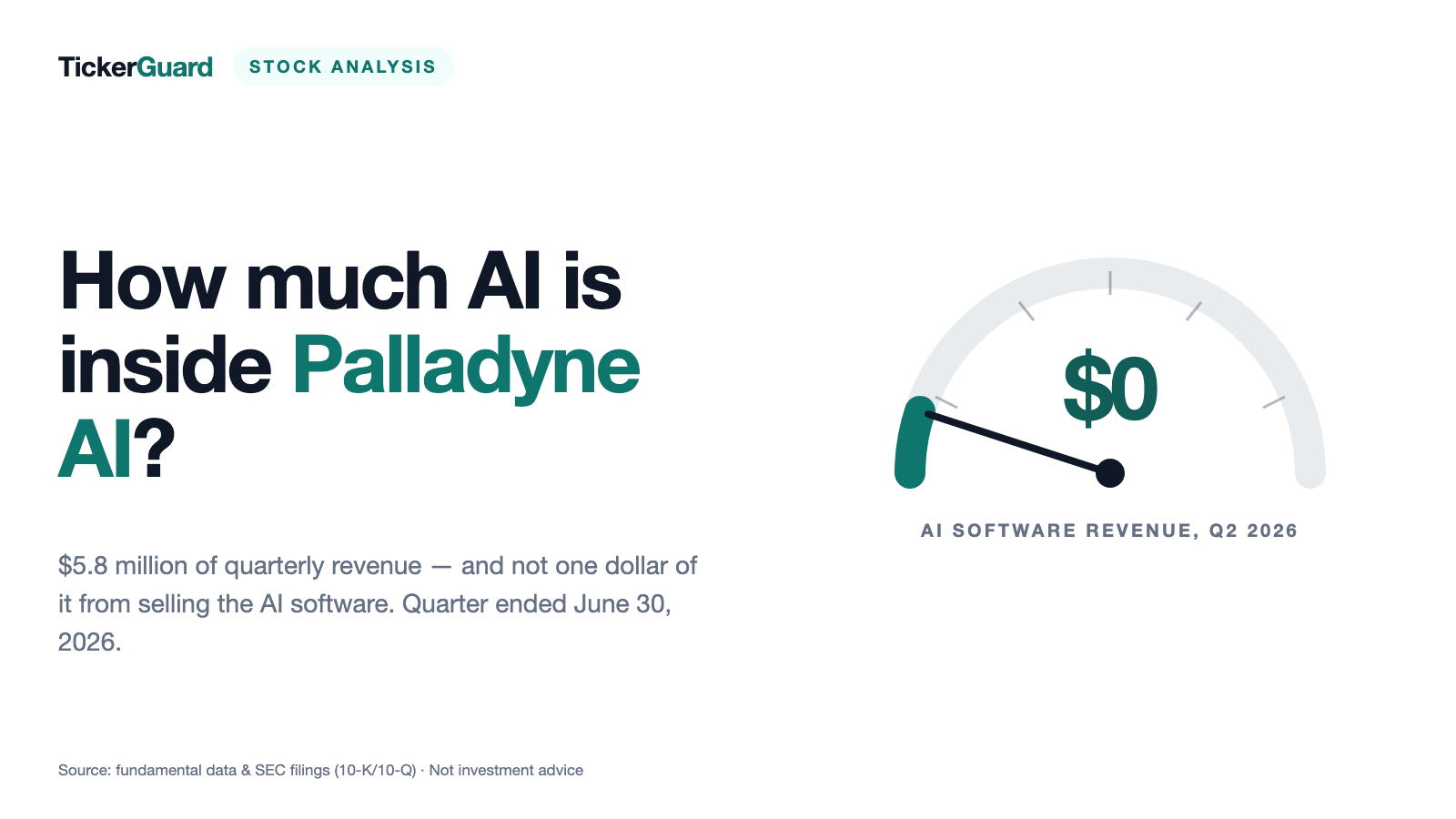
Interactive price chart (TradingView).
52-week range: 4.20 $ to 10.30 $ · Last price: 5.40 $ (As of: October 6, 2026)
Note: pure fact-based analysis, not investment advice and not a solicitation to buy or sell. All figures without guarantee.
There is an investor weakness that feels like generosity and still costs money: the permanent-renovation trap. You may know it from a friend who has been rebuilding his house for eight years. Every time you visit, something new has happened — a different kitchen, a different roof, a different name on the doorbell. It always looks like progress, and you always leave thinking things are moving along. Until one day it dawns on you that you never asked the one question that matters: are you actually living in it yet? Markets work the same way. We mistake motion for progress, and a company that is constantly doing something new feels more alive than one that boringly sells the same thing.
Palladyne AI Corp. (Nasdaq: PDYN) is a company in constant motion. It has carried three different names in five years, reversed its strategy once, done a reverse stock split, bought three businesses in November 2025 and reported a 470 percent revenue jump for the quarter ended June 30, 2026. So let us make a deal: we will ask the impolite question. We will read the quarterly report (Form 10-Q) for the quarter ended June 30, 2026, the results release of August 6, 2026, the annual report (Form 10-K) for 2025 and the annual meeting results of June 8, 2026 — and check whether anyone is living in the house yet. A filing with the U.S. securities regulator, the SEC, is honest under penalty of law. The conclusion is yours to draw.
What Palladyne AI actually does — autonomy software, avionics and two machine shops
At its core Palladyne AI sells an idea you can state in one sentence: software that teaches other people's robots how to think. The company calls it embodied AI. This is not a chatbot; it is control software that uses cameras and sensors to see what is happening around a machine, learns from it, and moves the arm or the drone accordingly. Three products carry that promise: Palladyne IQ for industrial robots and collaborative robots (arms that work alongside people without a safety cage), SwarmOS for military drone swarms, and Palladyne Pilot, a stripped-down version for public safety and commercial customers. The 2025 annual report describes the software as "hardware agnostic" — it is meant to run on any manufacturer's machines, not only the company's own.
That is the idea. Today the money comes from somewhere else. On November 14, 2025 Palladyne AI bought three businesses at once: GuideTech, LLC (engineering services and aerospace avionics products), Warnke Precision Machining, LLC and MKR Fabrication, LLC — two U.S. precision manufacturing and fabrication shops supplying defense and industrial customers. Total consideration was $22.6 million: $5.4 million in cash, $15.9 million in 2,672,013 of its own shares, and $1.4 million of contingent consideration. As a result Palladyne AI now owns a fabrication plant in Saginaw, Michigan, a machining shop in Oxford, Michigan, and offices in Lenexa, Kansas, and Tucson, Arizona — roughly 160,000 square feet in all. The company employed about 161 full- and part-time people as of February 3, 2026, roughly 48 percent of them in engineering roles.
Then there is the defense side, which supplied the summer 2026 headlines. Palladyne AI says it was competitively selected for two U.S. Army programs that put SwarmOS and its own Gremlin-X mini drone in front of soldiers in the field. On June 8, 2026 it also announced a partnership with Israel Aerospace Industries granting exclusive U.S. rights to the HARPY, HAROP and Mini HARPY loitering munitions — with no upfront payment and up to ten years of exclusivity. That is a real door, and it should not be dismissed. As of the quarterly report to June 30, 2026, it is also not yet revenue. We have seen the same pattern at another drone supplier to the U.S. Army, whose contract announcements ran years ahead of its balance sheet: Red Cat Holdings.
Which sets up the central tension of this analysis, and it runs through every chapter: Palladyne AI explicitly walked away from hardware in 2023 in order to sell AI software — and today earns its money from hardware, machining and engineering hours again, while the software has produced no product revenue at all through the latest filing.
Company history for investors
-
2021
Public listing through a SPAC
Sarcos Corp. merged with Rotor Acquisition Corp. on 09/24/2021. For investors that meant access to a robotics promise without the scrutiny of a conventional IPO.
-
2023
1-for-6 reverse stock split
Effective 07/05/2023, six shares became one. Holdings shrank, value did not change — the usual step once a share price has fallen too far.
-
2023
Exit from hardware robotics
On 11/14/2023 the company suspended commercialization of its robots and bet on AI software. Anyone invested for the exoskeletons owned a different company afterwards.
-
2024
Renamed Palladyne AI, share dispenser switched on
The new name arrived on 03/18/2024; since 11/13/2024 an at-the-market program with Jefferies has been feeding new shares into the market — 10,653,920 by 06/30/2026.
-
2025
Three acquisitions for $22.6 million
GuideTech, Warnke Precision Machining and MKR Fabrication joined on 11/14/2025, paid partly with 2,672,013 of the company's own shares. Most revenue has come from them since.
-
2026
Annual meeting approves nearly ten million new shares
On 06/08/2026 shareholders approved 4,500,000 plan shares and 5,360,659 executive awards. Votes against were 6,865,822 and 3,440,470 respectively.
-
2026
Revenue up 470 percent, guidance reaffirmed
On 08/06/2026 Palladyne AI reported $5.783 million of quarterly revenue and $24.6 million of backlog. For shareholders, the line still at zero matters too: software revenue.
How the stock landed on our desk
Palladyne AI is not a hit from one of our valuation or momentum filters. It came onto the research list through our Reddit hype scanner, in the run of August 22, 2026. No mention count survives for that run, so we cannot say how loudly the stock was being discussed — only that it was on the list. That is an honest finding, not a gap we intend to fill with an estimate.
More interesting is what our in-house stock scanner says about the numbers as of August 22, 2026 — and it cuts both ways. In its favor: an equity ratio of 78 percent and a debt-to-equity ratio of 0.01. Palladyne AI carries almost no bank debt, and for a company burning cash that is a genuine advantage — it owes nobody interest, and nobody can call a loan. Against it, two numbers that cannot be talked away: a Piotroski score of 2 out of 9 and an Altman Z-score of 1.12.
Both need translating. The Piotroski score is a checklist of nine yes-or-no questions about balance sheet health — is the company profitable, is cash flow growing, are margins improving, is leverage falling, were no new shares issued. Two out of nine is weak; a genuinely healthy company scores 8 or 9, a solid average is 5 or 6. The Altman Z-score bundles five balance sheet ratios into a single number originally designed to estimate the bankruptcy risk of industrial firms; below 1.8 is the warning zone. Both measures, however, systematically punish exactly what defines Palladyne AI: losses and a young, small revenue base. So they do not say "this company is going bankrupt". They say something more sober: this company has not yet proved that its business works. To repeat it yourself: open the scanner and pull up Palladyne AI through the quick search; the values are recalculated daily.
The numbers over the years — fairly credited
Start with what genuinely impresses, because it is more than the rest of this chapter suggests. Revenue for the quarter ended June 30, 2026 was $5.783 million, against $1.015 million a year earlier — up 470 percent. Against the prior quarter ($3.538 million) that is growth of 63 percent, and that is the more informative figure, because both quarters already include the acquisitions. Backlog — everything customers have firmly ordered and not yet received — rose 43 percent during the quarter to $24.6 million, including roughly $13.0 million of new awards. The company expects most of it to convert into revenue over the next 12 to 18 months. And it reaffirmed full-year 2026 revenue guidance of $24.0 million to $27.0 million. President and CEO Benjamin Wolff says in the results release what he anchors that on:
"The headline this quarter is the $13 million of new contract awards, and it is why we are comfortable reiterating guidance for the year."
— Palladyne AI Corp., Form 8-K of August 6, 2026, Exhibit 99.1
That is a real backlog with real customers, and a company that reaffirms guidance instead of cutting it deserves credit for it. Now the question the revenue jump raises: where did the $4.8 million of growth come from? The quarterly report answers it in a table that splits revenue into three categories.
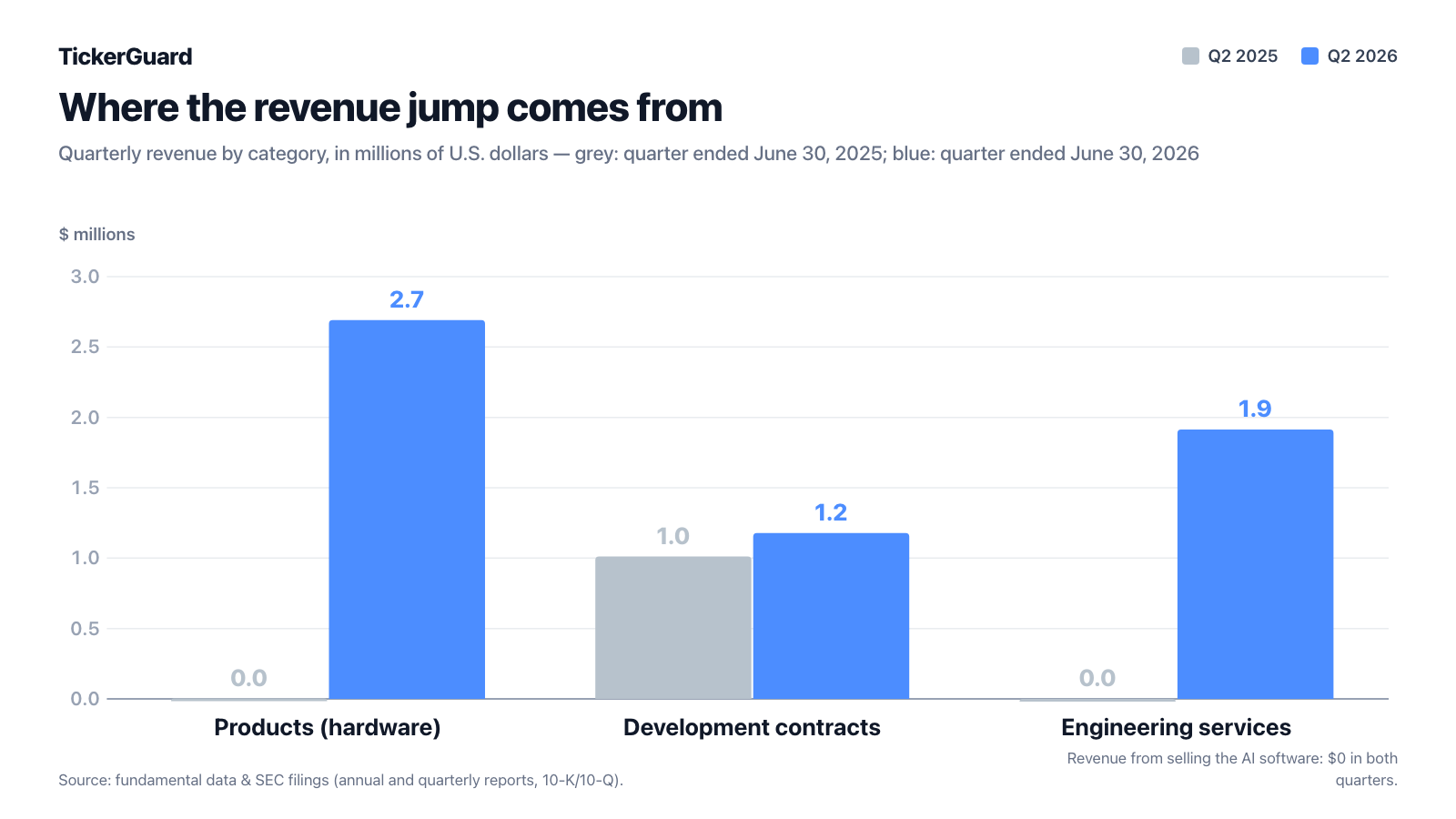
Read it fairly: acquisitions are a legitimate way to grow, and Palladyne AI paid for these — in cash and in its own stock. But the difference between 470 percent and 16 percent is exactly the difference between bought and grown. The company itself writes that growth was "driven by both acquisitions and organic growth". Both statements are true. The magnitudes simply are not comparable.
The multi-year view is worth having too, because it cuts against the story of a company taking off. Annual revenue fell in 2025, from $7.786 million to $5.246 million — down 33 percent. And it depended on very few customers: in 2025 a single customer accounted for 73 percent of revenue ($3.852 million); in 2024 two customers together made up 98 percent. That dependency is precisely what the acquisitions have meaningfully reduced, and it is one of the better pieces of news in the filings.
What the filings say — the uncomfortable truths
Uncomfortable truth no. 1: the AI software has produced no product revenue to date
The company is called Palladyne AI, is classified by the SEC under the industry code for prepackaged software, and describes itself as a provider of embodied artificial intelligence. What its own quarterly report to June 30, 2026 says in the revenue section stands in remarkable contrast:
"Software product revenue consists of the sale of the Company’s commercially available software products. The Company is in the early stages of its sales activities for its software products and has no software product revenue to date."
— Palladyne AI Corp., Form 10-Q for the quarter ended June 30, 2026, note 1 ("Product Revenue")
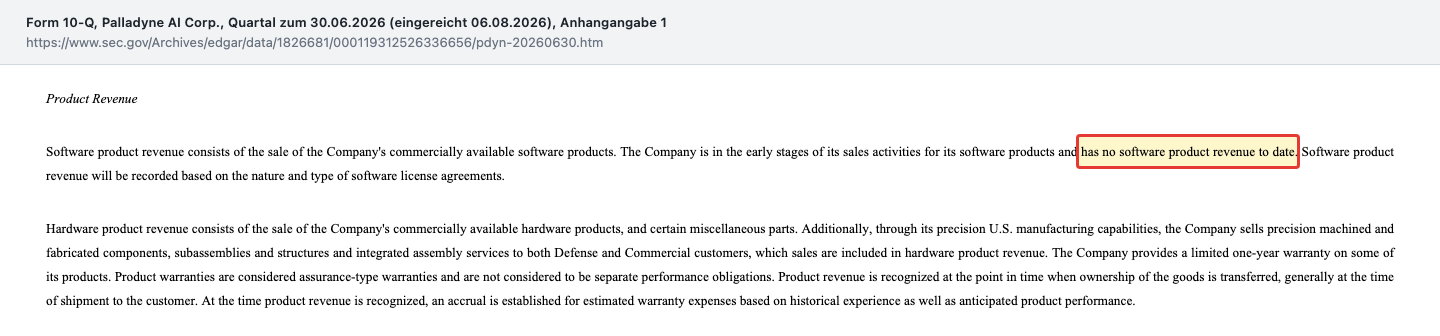
In fairness, the AI technology is still a source of income — just a different one from what the name implies. The development contracts that form the third revenue category relate, according to the same filing, "primarily to the Company's AI/ML software and related technology". They are paid for by the customer, usually a U.S. government agency, on a cost-plus-margin basis. In the quarter ended June 30, 2026 they came to $1.179 million. That is real money, and it is a quality signal: getting an agency to fund your development means you have something worth funding. It is simply a fundamentally different business from selling software. Under a development contract the customer pays for hours; when you license software, the tenth copy costs almost nothing. Keep the distinction as your anchor: contract research scales with headcount, software scales with customers. At Palladyne AI only the first is demonstrated so far. We have seen the same gap between technical recognition and absent revenue at edge-AI chip designer BrainChip.
Uncomfortable truth no. 2: the 2025 profit was not a profit
Skim the 2025 full-year numbers and you find net income of $10.039 million at the bottom. One line above sits an operating loss of $32.404 million. Between them are two items that have nothing to do with the operating business: a $37.740 million gain on warrant liabilities and a $2.538 million tax benefit.
What is happening there can be put in everyday terms. Palladyne AI issued warrants in earlier financings — vouchers that let the holder buy shares later at a fixed price. Because some of those vouchers count as a liability in accounting terms, the company has to revalue them at every reporting date. If the share price falls, the vouchers are worth less, the liability shrinks, and the company books a gain. If the price rises, the reverse. The bottom line therefore measures, among other things, the movement of the company's own share price rather than the performance of the business. The year-on-year comparison makes that plain: in 2024 the same instrument cost $46.935 million and turned an operating loss of $26.923 million into a net loss of $72.617 million. And in the first half of 2025, a $29.351 million gain from the same line produced reported net income of $15.272 million while the business lost $15.025 million.
The number that holds up is therefore the operating loss — and it is growing: $13.413 million in the quarter ended June 30, 2026 against $8.094 million a year earlier, and $25.332 million for the half year against $15.025 million. The reason is understandable: the company is hiring for the defense work, and stock-based compensation for the quarter doubled to $2.319 million. Understandable, however, is not the same as paid for.
Uncomfortable truth no. 3: $505.7 million has been consumed — and the share machine is still running
The accumulated deficit at June 30, 2026 stands at $505.726 million. That is the sum of every loss this company and its predecessors have booked since inception. Against it sits additional paid-in capital of $576.564 million — everything shareholders have ever put in. What remains is equity.
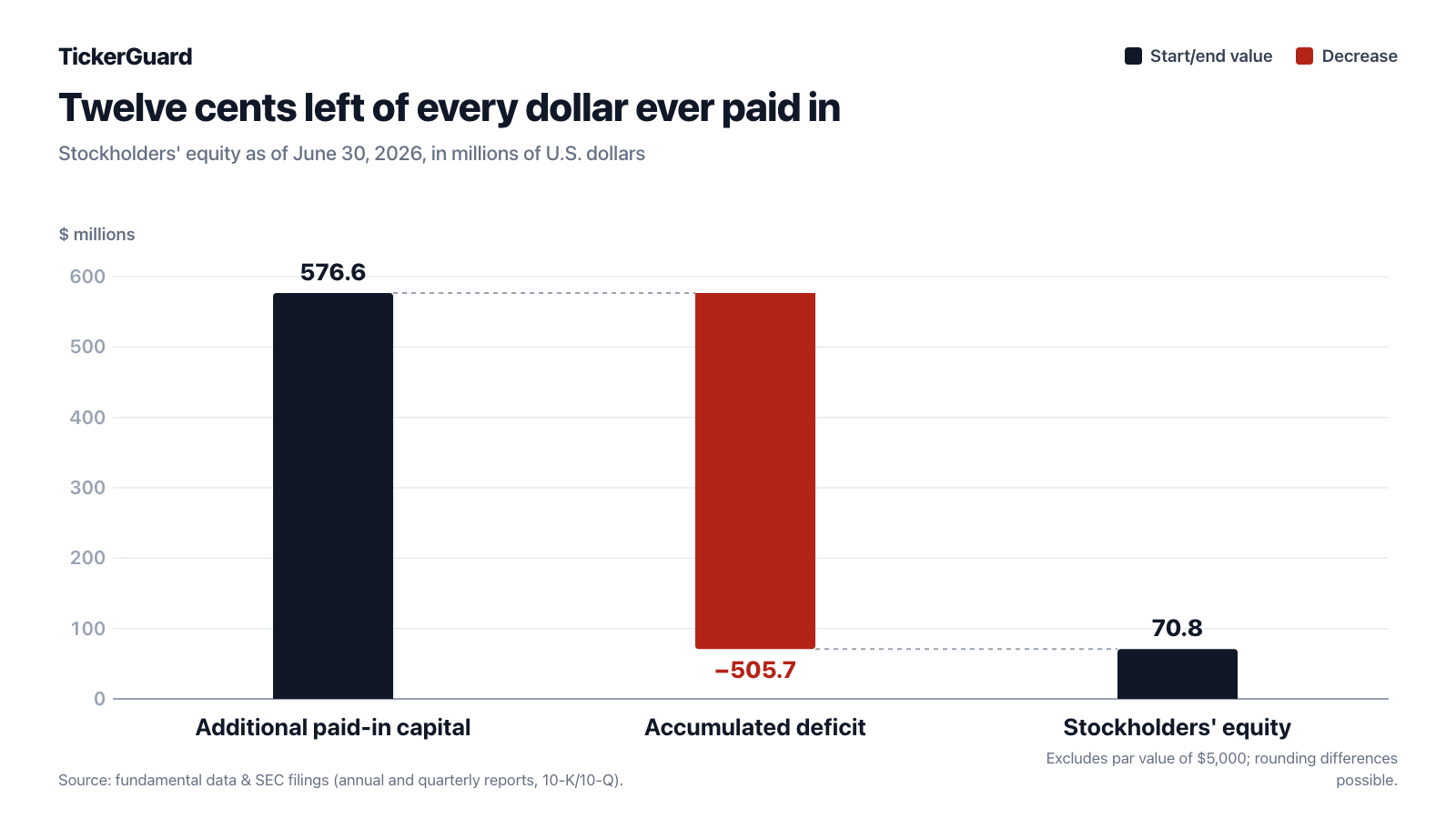
That figure is history and, on its own, no verdict on the future — it contains the failed exoskeleton dream of the Sarcos years as much as the development of today's software. But it does say something about how the business is funded. And the answer there is unambiguous: with new shares. Since November 13, 2024 an at-the-market program has been running with the investment bank Jefferies — in everyday terms, a share dispenser that drips new stock into the open market whenever the company needs cash.
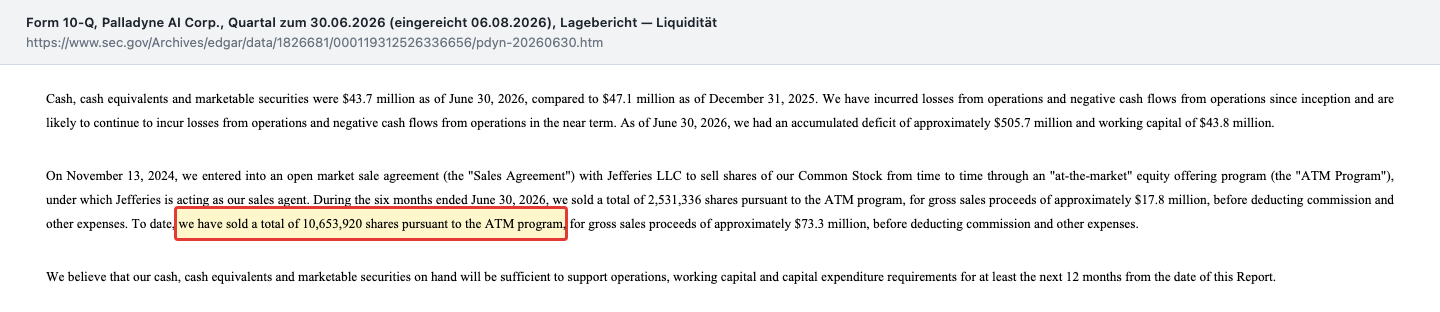
The scale: 10,653,920 shares for roughly $73.3 million in gross proceeds since the program began, including 2,531,336 shares for about $17.8 million in the first half of 2026 alone. Against 49,338,510 shares outstanding at July 29, 2026 that means better than one in five shares in existence today came out of that dispenser. Dilution, in everyday terms, means your slice of the cake gets smaller without you having done anything wrong — the cake is simply cut into more pieces.
And the knife stays busy. The quarterly report discloses 16,026,027 potentially dilutive securities excluded from the earnings calculation at June 30, 2026 because they would have reduced the reported loss per share — restricted stock units, options, warrants and employee purchase rights. That is roughly 33 percent of shares outstanding. On top of it comes what the annual meeting approved on June 8, 2026: an increase of 4,500,000 shares in the employee equity plan and restricted stock units for senior executives covering 5,360,659 shares. Together that is nearly ten million further shares, roughly a fifth of the current count, approved in a single day. In fairness: the executive awards are tied to ten stepped share-price goals and are forfeited if those are not met by November 15, 2030 — so they only cost shareholders if the stock rises substantially first. Votes against the plan increase totaled 6,865,822, and against the executive awards 3,440,470 — meaningful dissent for an annual meeting. Unrecognized stock-based compensation still to be expensed: $40.1 million over 2.8 years. That is more than the company expects in revenue for all of 2026.
Uncomfortable truth no. 4: the company's own guidance requires halving the cash burn
Palladyne AI measures its cash consumption with a metric it defines in the results release itself: operating cash burn, meaning cash used in operations plus capital expenditures. For 2026 it has guided to $32.0 million to $36.0 million and expressly reaffirmed that on August 6, 2026 — which by its own arithmetic is $8.0 million to $9.0 million per quarter on average.
In the first half of 2026, $20.401 million flowed out of operations, plus $0.889 million of capital expenditures: $21.290 million in total, or roughly $10.6 million per quarter. The company's own average has therefore already been exceeded in the first half. For the full-year guidance to hold, only $10.7 million to $14.7 million may flow out in the second half — $5.4 million to $7.4 million per quarter, about half the pace so far. Management says it expects exactly that: backlog converting into revenue, margins ramping. It is possible. It is not settled.
What happens if it does not work out? Nothing dramatic, initially. Cash and marketable securities stood at $43.7 million at June 30, 2026, working capital at $43.8 million, and there is essentially no bank debt. At the first-half pace that funds a little over four quarters; at the company's own guidance, roughly five. Management states that it believes it has sufficient financial resources for at least the next 12 months, and there is no going concern paragraph from the auditor. The realistic consequence of overspending is therefore not insolvency but another visit to the share dispenser. That is a shareholder problem, not an existential one — but it is a problem.

That self-assessment is part of the permanent renovation, and it is notably candid. Predecessor Sarcos built exoskeletons — wearable robotic suits meant to make workers strong. On November 14, 2023 the company announced it would suspend commercialization of its hardware robotics and concentrate on AI software; on March 18, 2024 the name changed to Palladyne AI Corp. Twenty months later, the same company bought two manufacturing shops and an avionics maker. You can read that as a smart course correction — vertical integration, in-house production, a shorter path to the defense customer. You can also read it the way the revenue table reads: the company earns its money from hardware again.
Valuation: what the market pays for a 24.6 million dollar backlog
A price-to-earnings ratio cannot be formed here — there is no operating profit. That leaves revenue and substance. At the valuation anchor of $6.13 per share (closing price on August 21, 2026) and 49,338,510 shares, the market capitalization is roughly $302 million. Measured against trailing twelve-month revenue of $11.8 million, that is a price-to-sales ratio of about 25; measured against the midpoint of the company's own 2026 guidance ($25.5 million), about 12. For context: a software business with high margins and recurring revenue often trades at eight to fifteen times revenue; a machine shop trades at one to two times. Palladyne AI is priced like the former and mostly delivers the latter.
On substance: against that market value sit $70.8 million of stockholders' equity, of which $14.7 million is goodwill and $9.7 million other intangibles from the acquisitions. Strip both out and roughly $46.4 million of tangible equity remains — so the market pays about six and a half times what you can physically touch. Deduct the $43.7 million of cash and marketable securities and the market values the operating business at roughly $259 million. That is the figure the $24.6 million backlog, and everything that follows it, has to justify.
As for the professionals: fundamental data show a mean price target of $10.75 as of August 22, 2026 — but based on a single analyst estimate. That is not a consensus; it is one opinion, and it deserves to be treated as such. More telling is the other side of the trade: short interest stood at 19.8 percent of the float as of August 22, 2026. Roughly one in five freely tradable shares has been borrowed and sold — there is a large, money-backed opposing view. Over twelve months the stock traded between $4.14 and $10.73. Anyone buying in should treat swings of that magnitude as normal, not exceptional.
Opportunities and risks at a glance
What speaks for Palladyne AI:
- The backlog is real and growing: $24.6 million at June 30, 2026, up 43 percent in the quarter, including roughly $13.0 million of new awards; the company expects most of it as revenue within 12 to 18 months and reaffirmed full-year guidance of $24.0 million to $27.0 million.
- The balance sheet is unusually clean for a company this size: $43.7 million of cash and marketable securities, a 78 percent equity ratio, effectively no bank debt (debt-to-equity of 0.01) and no going concern paragraph as of June 30, 2026.
- The acquisitions of November 14, 2025 defused an extreme customer concentration — one customer still represented 73 percent of 2025 revenue, and two customers 98 percent in 2024 — and bring in-house U.S. manufacturing, an advantage in defense procurement.
- The doors to defense procurement are open: two U.S. Army evaluation programs using SwarmOS and Gremlin-X, a $2.9 million Air Force option exercise (taking total program value above $10.6 million) and, since the second quarter of 2026, exclusive U.S. rights to three Israel Aerospace Industries loitering munitions with no upfront payment.
- Executive pay is tied to stepped share-price goals: the 5,360,659 restricted stock units approved on June 8, 2026 are forfeited if the ten price hurdles are not met by November 15, 2030.
What speaks against it:
- The core promise is unproven: per the filing to June 30, 2026 the AI software "has no software product revenue to date". Revenue tied to the AI technology arises only through customer-funded development contracts ($1.179 million in the quarter) — an hours business, not a licensing business.
- The revenue jump is mostly bought: of $5.783 million of quarterly revenue, $4.6 million comes from categories that barely existed before November 14, 2025; the line that did exist grew 16 percent. Annual revenue had previously fallen from $7.786 million to $5.246 million in 2025.
- The bottom line is useless as a yardstick: 2025 net income of $10.039 million against a $32.404 million operating loss (thanks to a $37.740 million warrant gain), 2024 a net loss of $72.617 million against a $26.923 million operating loss (a $46.935 million warrant loss). The operating loss itself is growing: $13.413 million in the quarter ended June 30, 2026, up from $8.094 million.
- Dilution as a permanent condition: 10,653,920 shares through the at-the-market program for $73.3 million gross (as of June 30, 2026), 16,026,027 potentially dilutive securities (roughly 33 percent of shares outstanding) and nearly ten million further shares approved on June 8, 2026; $40.1 million of stock compensation is still to be expensed.
- The company's own guidance requires halving the burn: after $21.290 million of cash consumption in the first half, only $10.7 million to $14.7 million may flow out in the second. With $43.7 million of cash and marketable securities, the first-half pace funds a little over four quarters — after which the capital market sets the price of continuing.
A human bottom line
Back to the permanent renovation. The point is not that rebuilding is wrong — quite the opposite: a company that does not stubbornly plough on after the exoskeletons fail, but changes course, is behaving sensibly, and the November 2025 acquisitions made Palladyne AI measurably more solid. The point is how easily motion gets mistaken for progress. Three names, one strategy reversal, a reverse split, three acquisitions, a 470 percent revenue jump — all of it feels like a company taking off. And then, in a note to its own filing, sits the sentence you read twice: no software product revenue, to date.
Anyone buying Palladyne AI today is therefore not buying what the doorbell says. They are buying three very concrete things: a small, growing supplier to defense and industry with $24.6 million of backlog and its own plants in Michigan; a clean balance sheet with $43.7 million of cash and almost no debt; and a bet that software which evidently convinces on technical merit will one day become a licensing business. The first two are demonstrable today. The third is not.
So the honest question is not "is this an AI stock?" but: would you buy this supplier if it had a different name — and are you willing to pay roughly twelve times expected annual revenue for the software hope? If yes, you have a thesis, and you know exactly what to watch in the coming filings: the software product revenue line, the backlog, and the share count. If no, what you had was a doorbell. What you make of it is your decision. And that is exactly as it should be.
Sources
Every original document used in this analysis, for you to read yourself:
- Palladyne AI Corp. — Form 10-Q for the quarter ended June 30, 2026 (filed August 6, 2026)
- Palladyne AI Corp. — Form 8-K of August 6, 2026, Exhibit 99.1 (results release and 2026 guidance)
- Palladyne AI Corp. — Form 10-K for 2025 (filed March 5, 2026)
- Palladyne AI Corp. — Form 8-K of June 8, 2026 (annual meeting results, equity plan and executive awards)
- Palladyne AI Corp. — Prospectus 424B3 of January 21, 2026 (closing and earnout shares)
- Full SEC filing history for Palladyne AI Corp.: EDGAR overview (sec.gov)
- Fundamental data (price, market capitalization, trading range, short interest, Piotroski score, Altman Z-score, analyst view; as of August 22, 2026), reconciled against the SEC filings.
- Reddit mentions: our in-house Reddit hype scanner, run of August 22, 2026; ratios from our in-house stock scanner.
Transparency & disclaimer: this analysis is journalistic commentary on publicly available information. It is not investment advice, not a regulated financial analysis and not a solicitation to buy or sell securities. Equity investments carry substantial risk up to and including total loss. Forward-looking statements — guidance, backlog, planned programs — are inherently uncertain. All information is provided without warranty; the as-of date is noted in the text. Positions held by the operator are disclosed daily; where one exists, it appears as a notice at the top of this deep dive.
Key figures at a glance
All monetary figures in millions of $; earnings per share as reported.
| Metric | 2021 | 2022 | 2023 | 2024 | 2025 |
|---|---|---|---|---|---|
| Revenue | 5.1 | 14.6 | 6.1 | 7.8 | 5.2 |
| Operating Income (EBIT) | -81.0 | -177.0 | -121.0 | -26.9 | -32.4 |
| Net Income | -81.5 | -157.1 | -115.6 | -72.6 | 10.0 |
| Net Margin | -1,606.1% | -1,078.5% | -1,880.8% | -932.7% | 191.4% |
| Earnings Per Share | -4.32 $ | -6.42 $ | -4.51 $ | -2.71 $ | 0.24 $ |
Source: fundamental data & SEC filings (annual and quarterly reports, 10-K/10-Q)
Our Bottom Line at a Glance
- Backlog and revenue momentum positive
- Backlog rose 43 percent during the quarter ended June 30, 2026 to $24.6 million, including roughly $13.0 million of new awards; revenue grew 63 percent sequentially to $5.783 million. Full-year guidance of $24.0 million to $27.0 million was reaffirmed on August 6, 2026 rather than cut.
- The core promise: AI software negative
- The quarterly report to June 30, 2026 records that the company "has no software product revenue to date". Revenue tied to the AI technology arises only through customer-funded development contracts ($1.179 million for the quarter, up 16 percent year over year) — an hours business, not a licensing business.
- Where the growth comes from neutral
- Of $5.783 million of quarterly revenue, $4.6 million comes from categories that barely existed before the acquisitions of November 14, 2025. Acquiring is a legitimate route and it defused the customer concentration (73 percent with one customer in 2025). But bought is not the same as grown — annual revenue had fallen from $7.786 million to $5.246 million in 2025.
- Earnings quality negative
- The bottom line mostly measures warrant remeasurement: 2025 net income of $10.039 million against a $32.404 million operating loss (a $37.740 million gain from that line), 2024 a net loss of $72.617 million against a $26.923 million operating loss (a $46.935 million loss). The operating loss itself grew to $13.413 million in the quarter ended June 30, 2026.
- Balance sheet and funding neutral
- At June 30, 2026 the company held $43.7 million in cash and marketable securities, a 78 percent equity ratio and effectively no bank debt, against $21.290 million of cash consumption in the first half alone. To hold its own $32.0 million to $36.0 million guidance, the outflow must roughly halve in the second half. There is no going concern paragraph.
- Dilution negative
- The at-the-market program with Jefferies placed 10,653,920 shares for roughly $73.3 million gross through June 30, 2026 — better than one in five of the 49,338,510 shares outstanding at July 29, 2026. Add 16,026,027 potentially dilutive securities (about 33 percent) and nearly ten million further shares approved by the annual meeting on June 8, 2026.
Palladyne AI sells an idea and earns its money from something else: the 470 percent jump to $5.783 million of revenue in the quarter ended June 30, 2026 includes $4.6 million from businesses bought only on November 14, 2025, while the AI software that gives the company its name "has no software product revenue to date" by its own account. What remains is a small defense and industrial supplier with $24.6 million of backlog and a clean balance sheet ($43.7 million of cash, almost no debt) — carrying a market value of roughly $302 million priced on a software yardstick. Not investment advice.
What Our Rating Means
Open questions
The business works in principle, but one material question is open. As long as it stays open, our findings do not carry a quality verdict.
Yellow, because one material operating question is open without the substance being at risk. Open: whether the AI software ever becomes a licensing business — that line stood at zero as of June 30, 2026 — and whether cash burn falls as planned from $10.6 million to $5.4 million to $7.4 million per quarter. Against the more cautious rating stand demonstrable facts: $43.7 million of cash and marketable securities, a 78 percent equity ratio, effectively no bank debt, no going concern paragraph and $24.6 million of backlog. The realistic consequence of overspending is therefore not collapse but further dilution through the running at-the-market program — a shareholder risk, not a solvency risk. Whether roughly twelve times expected 2026 revenue is a fair price is expressly not what this rating decides. The decision is yours.
A journalistic assessment by our editorial team at the time of the deep dive, based on public sources — not investment advice and not a solicitation to buy or sell. Your personal circumstances (investment goals, risk capacity, taxes) cannot be taken into account. What our levels mean, how verdicts are formed, and what conflicts of interest exist →
Worth Noting
- Palladyne AI reached our research list through the Reddit hype scanner, run of August 22, 2026; no mention count survives for that run, so none is quoted. From our in-house stock scanner, as of August 22, 2026: Piotroski score 2 of 9, Altman Z-score 1.12, equity ratio 78 percent and short interest of 19.8 percent of the float. Scanner values are recalculated daily.
- Identity and possible confusion: the same company was called Rotor Acquisition Corp. (a SPAC) until September 24, 2021 and Sarcos Technology and Robotics Corporation until March 18, 2024. A 1-for-6 reverse stock split took effect on July 5, 2023; all share counts in this analysis follow the post-split basis, as the SEC filings do. Alongside the common stock PDYN, Nasdaq also lists the warrant PDYNW with an exercise price of $69.00 per share, expiring September 24, 2026 — it is not a substitute for the share.
- Recency note: the most recent quarterly report (10-Q) is dated August 6, 2026 and has been fully evaluated, as has the Form 8-K of the same day carrying the results release and the reaffirmed guidance. Filings after that date: on August 21, 2026, three Forms 4 and three Forms 144 from the CFO, CTO and chief legal officer covering 27,232 shares in total at $6.1589 each — around 0.06 percent of shares outstanding and therefore immaterial to this assessment. A Schedule 13G had been filed shortly before the quarterly report, on July 29, 2026. No Form 15 and no Form 25 has been filed since the quarterly report; the Nasdaq listing continues.
- The market capitalization used here is dated and cross-checked: 49,338,510 shares (10-Q cover page, as of July 29, 2026) times $6.13 (closing price August 21, 2026) gives roughly $302 million; the same share count times $6.74 — the closing price documented in prospectus 424B3 for January 20, 2026 — gives roughly $333 million. The deviation of about 9 percent is far below the one fifth at which we discard a market capitalization and every figure derived from it.
Stock Watch
This analysis is as of August 26, 2026. Stock Watch will tell you what's changed at PDYN since then.
Later $1 a month per stock — signing up is free, and you'll be the first to know when it launches.
The full analysis as a PDF for later
We will send you this analysis as a PDF — to print, file away, and read at your own pace. And we will add you to the free Stock Watch list for Palladyne AI Corp (PDYN), so you hear about it when something material in this analysis changes.
Frequently Asked Questions
Palladyne AI Corp. (Nasdaq: PDYN) of Salt Lake City, Utah, builds autonomy software that lets other manufacturers' robots and drones operate on their own: Palladyne IQ for industrial robots, SwarmOS for military drone swarms and Palladyne Pilot for public safety and commercial customers. Since November 14, 2025 the group also owns avionics and engineering provider GuideTech and the manufacturers Warnke Precision Machining and MKR Fabrication. It employed about 161 people as of February 3, 2026.
Because the three businesses acquired on November 14, 2025 are now included. Of the $5.783 million of revenue in the quarter ended June 30, 2026, $2.691 million came from products and $1.913 million from engineering services — categories that barely existed a year earlier ($3,000 and nil respectively). The only line that already existed grew from $1.012 million to $1.179 million, or 16 percent.
Not from selling it, so far. The quarterly report to June 30, 2026 states that the company "has no software product revenue to date". Revenue linked to the AI technology arises solely through customer-funded development contracts, which the same filing says relate primarily to the company's AI and machine-learning software: $1.179 million in the quarter ended June 30, 2026, up from $1.012 million a year earlier.
It is the same company. SPAC vehicle Rotor Acquisition Corp. merged with Sarcos Corp. on September 24, 2021 and was renamed Sarcos Technology and Robotics Corporation. On November 14, 2023 the company announced it would suspend commercialization of its hardware robotics and focus on AI software; on March 18, 2024 it was renamed Palladyne AI Corp. A 1-for-6 reverse stock split also took effect on July 5, 2023. The security identifier and SEC file number are unchanged.
At June 30, 2026 the company held $43.7 million in cash and marketable securities with effectively no bank debt. In the first half of 2026, $21.290 million flowed out ($20.401 million from operations plus $0.889 million of capital expenditures), roughly $10.6 million per quarter. At that pace the balance funds a little over four quarters; at the company's own guidance of $8.0 million to $9.0 million per quarter, about five. Management states it has sufficient resources for at least the next 12 months, and there is no going concern paragraph.
PDYNW are warrants left over from the 2021 SPAC transaction and are also listed on Nasdaq. Because of the reverse stock split of July 5, 2023, each warrant now buys one sixth of a share for $11.50, which works out at $69.00 per whole share. They expire on September 24, 2026. The quarterly report to June 30, 2026 states there is no guarantee they will ever be in the money before expiration and that they may expire worthless. For context, the share closed at $6.13 on August 21, 2026.
A price-to-earnings ratio cannot be formed because there is no operating profit. At the valuation anchor of $6.13 (closing price August 21, 2026) and 49,338,510 shares, market capitalization is roughly $302 million. That is about 25 times trailing twelve-month revenue of $11.8 million and about 12 times the midpoint of 2026 guidance ($24.0 million to $27.0 million). Against it sit $70.8 million of equity, of which $24.5 million is goodwill and other intangibles.
Found an error?
Did you spot a factual error, an outdated number, or a typo in this deep dive? Let us know briefly — your report goes straight to the editorial team.