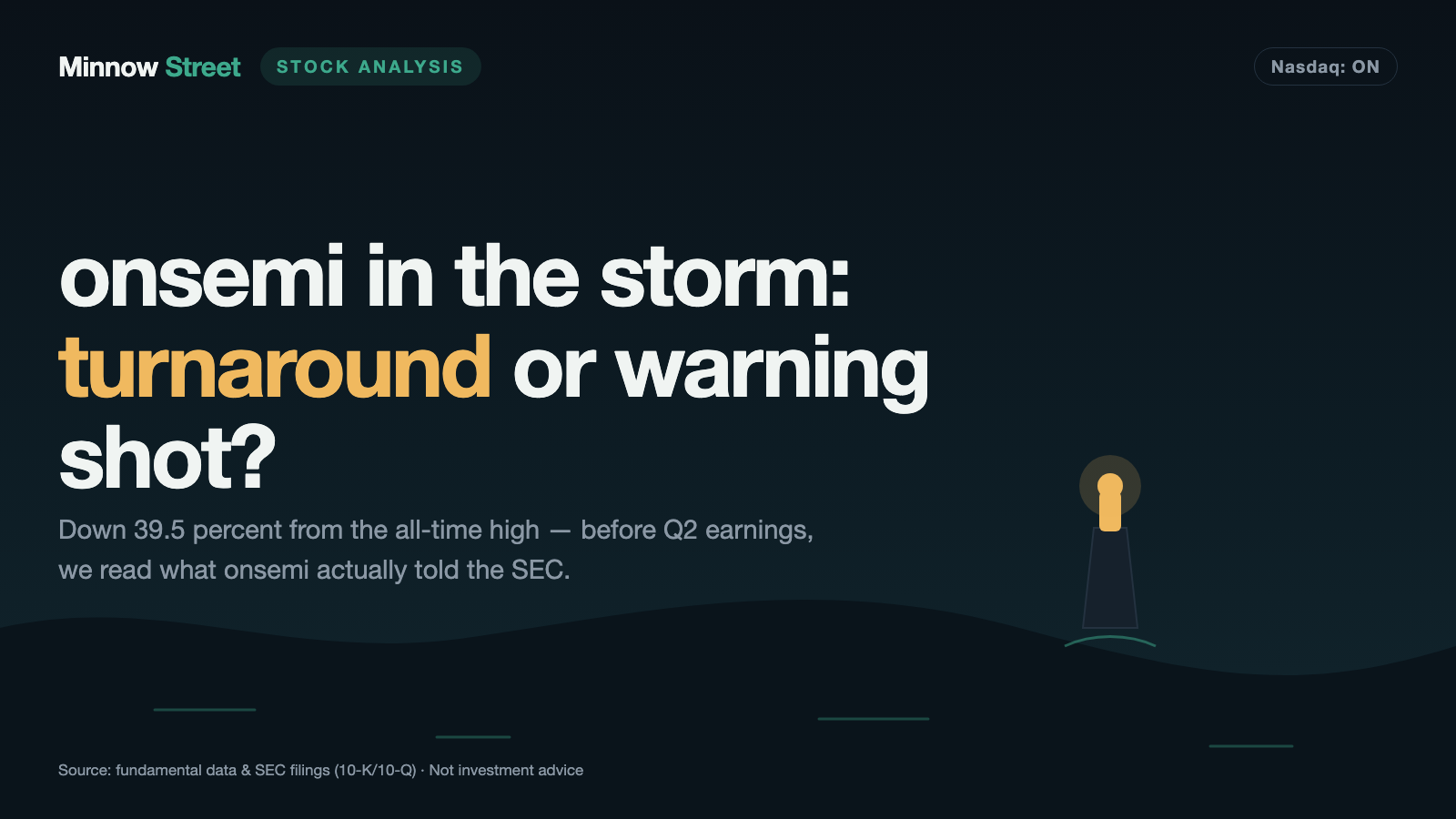
onsemi Stock: Down 39.5 Percent From the High, One Day Before Earnings — Turnaround or Warning Shot?
onsemi fell from its all-time high of $134.92 (June 3, 2026) to $81.61 (July 31, 2026) — first the all-stock Synaptics deal (−23.66 percent in a single day), then an industry-wide chip sell-off that caught Texas Instruments too. Behind that price action sits a company that generated a record $1,418.6 million in free cash flow in 2025 and returned to growth in the first quarter of 2026 after two down years — while diluted GAAP earnings per share collapsed from $4.89 to $0.29. On August 3, 2026, after the close, onsemi reports second-quarter results — consensus calls for $1.59 billion in revenue and $0.72 in non-GAAP earnings per share. We read together what the company actually told the U.S. securities regulator, the SEC, before the numbers land.
 Thomas Mücke
Founder & Publisher
Thomas Mücke
Founder & Publisher
As of Today
As of: September 17, 2026
- Closing price
- 68.30 $ +2.60%
- Market Capitalisation
- 27.5 $B
- P/E
- 49.6
- Growth Score
- 4/10
- AAQS
- 6/10
Price change since August 4, 2026: -15.0%
This analysis has a cut-off date. The Stock Guard tells you when something material changes in the numbers. Reserve your free spot
Chart
Interactive price chart (TradingView).
52-week range: 44.90 $ to 133.90 $ · Last price: 68.30 $ (As of: September 17, 2026)
Note: pure fact-based analysis, not investment advice and not a solicitation to buy or sell. All figures without guarantee.
There's an investor trap that strikes hardest in moments exactly like this one: the anchoring trap. Your brain locks onto a number — here, $134.92, onsemi's all-time high from June 3, 2026 — and everything afterward gets measured against it. Sitting at $81.61, that anchor whispers "down 39.5 percent, so it must be cheap now." Except the anchor knows nothing about the business. It only knows the old price. And on the very day before onsemi (Nasdaq: ON) reports second-quarter results after the close on August 3, 2026, that anchor is more tempting than usual: a chipmaker whose operating story is visibly turning — more revenue, more margin, record cash flow — while its reported profit has collapsed like almost never before. So let's make a deal before tomorrow's numbers rewrite everything: set the anchor aside, and read together what onsemi actually told the U.S. securities regulator, the SEC — the annual report (10-K) for fiscal 2025 and the quarterly disclosures through the first quarter of 2026. By the end, the decision about what $81.61 really means is yours.
What onsemi actually does
onsemi (formally ON Semiconductor Corporation, headquartered in Scottsdale, Arizona, spun off from Motorola in 1999) builds power and sensing semiconductors — chips that switch and convert electrical power efficiently, plus image sensors. In plain terms: wherever an electric vehicle converts battery power into propulsion, or a factory floor manages energy flow, there's a good chance an onsemi component sits inside. Beyond classic silicon, the technology core runs on silicon carbide (SiC), branded "EliteSiC," and gallium nitride (GaN) — materials that make power chips smaller, faster, and less lossy than silicon alone. Products ship as discrete chips, packages, or complete power modules. The 10-K for fiscal 2025 breaks the business into three segments: the Power Solutions Group (PSG) — power semiconductors including SiC and GaN — at $2,805.1 million, roughly 47 percent of 2025 revenue; the Analog & Mixed-Signal Group (AMG) — analog, power-management, and connectivity chips, plus the new "Treo" platform — at $2,261.9 million, roughly 38 percent; and the Intelligent Sensing Group (ISG) — chiefly automotive image sensors, where onsemi is considered the market leader — at $928.4 million, roughly 15 percent. By end market, automotive dominates at roughly 51 percent of 2025 revenue, with industrial following at roughly 28 percent. Sales run mostly through distributors (54 percent of 2025 revenue); the single largest customer is itself a distributor at roughly 11 percent of revenue — not a classic concentration risk in a single end customer, but a heavy reliance on the distribution channel overall. In silicon carbide power semiconductors, industry data puts onsemi at No. 2 worldwide behind STMicroelectronics — in 2024 the top five suppliers (ST, Infineon, Wolfspeed, onsemi, Rohm) together controlled more than 90 percent of that market. Since 2023/24 the company has pursued a "Fab Right" strategy: consolidating its own fabrication network (including East Fishkill, New York, plus sites in the Czech Republic, South Korea, and Japan) for structurally higher margins. In January 2025 onsemi paid $118.8 million to acquire Qorvo's SiC JFET business — aimed squarely at power supplies for AI data centers, the company's newest growth area. Readers curious about the tooling side of the same chip market can find it in our Applied Materials stock analysis.
How the stock landed on our desk — a crash and a deadline tomorrow
onsemi didn't land on our research list through a quiet value screen; it landed through one of the sharpest price moves in the 2026 semiconductor sector. At the end of 2025 the stock traded around $56, close to its 52-week low of $44.56. In the first half of 2026 it more than doubled: the market cheered an "end of the analog winter" — kicked off in part by a strong outlook from Texas Instruments in early February 2026 — plus onsemi's own margin turnaround, an AI data-center growth story, and a new $6 billion buyback program. On June 3, 2026, the stock hit its all-time high of $134.92. From there it fell in three waves. First, the stock drifted from June 3 to June 25, 2026, down to roughly $118.70 (−12 percent) — profit-taking after a gain of more than 140 percent since the start of the year. Second, onsemi announced the acquisition of Synaptics on the evening of June 25, 2026 (details in the next chapter); the stock fell roughly 9 percent after hours and closed the following trading day at $90.65, down $28.09, or 23.66 percent, in a single session — its worst trading day since March 2024. Third, in July 2026 an industry-wide chip sell-off hit the already-bruised stock: the Philadelphia Semiconductor Index (SOX) lost more than 20 percent from its June high in three weeks, after having risen 65 percent in the first half — a textbook correction of a crowded trade. Sentiment worsened further when Texas Instruments dropped 13.3 percent after reporting earnings, because its own automotive business shrank even sequentially — a warning sign for the whole sector that the hoped-for auto-chip recovery is running flatter than expected, compounded by tariff worries in the auto sector. onsemi lost another roughly 14 percent in the month before its own results and closed at $81.61 on July 31, 2026 — a total of −39.5 percent from the all-time high. And this is exactly where you, the reader, stand today: on Monday, August 3, 2026, onsemi reports second-quarter 2026 results after the U.S. market close (call at 5:00 p.m. Eastern) — the first hard data point since the double shock of the acquisition and the sector sell-off, and the central question is whether management can back up its late-April message that "the second half will be stronger than the first," after Texas Instruments just cast doubt on exactly that for itself.
The numbers over the years — honestly appraised
First, what genuinely speaks for onsemi's operating story. In 2025 the company generated $1,759.8 million in operating cash flow and, after $341.2 million in capital expenditures, a free cash flow of $1,418.6 million — a 24 percent FCF margin and a company record, in a year when revenue simultaneously fell 15.3 percent to $5,995.4 million. onsemi put nearly all of that cash into its own stock: $1,375.0 million in buybacks (27.9 million shares at an average price of $49.24) — practically 100 percent of 2025 free cash flow, at a price well below today's level. In February 2026 the board authorized an additional $6 billion buyback program spread over three years. And the cycle has visibly turned: in the first quarter of 2026, revenue grew 5 percent to $1,513.3 million — the first growth quarter after two down years, above the midpoint of the company's own guidance. Gross margin rose to 38.5 percent, a third straight quarterly increase, driven by utilization climbing to 77 percent (full utilization would run above 90 percent). The PSG segment (power semiconductors) grew 14 percent year over year in the first quarter, and the AI data-center business — from a still-small base of roughly $250 million in annual revenue in 2025 — grew more than 30 percent sequentially and, per company guidance, is expected to double again in 2026 to roughly $500 million. On a trailing-twelve-month basis (as of August 2, 2026), revenue stands at $6.06 billion and GAAP net income at $573.7 million. Now for the flip side that keeps this story honest: reported GAAP earnings per share collapsed to a fraction of their earlier level over that same period — $4.89 (2023), $3.63 (2024), just $0.29 (2025). Non-GAAP, stripping out one-time items, the picture looks better but the trend still points the same way: $3.98 (2024) down to $2.35 (2025). The reason for the gap between strong cash flow and weak reported earnings is the subject of the next chapter.
What the filings say — the uncomfortable truths
Uncomfortable truth no. 1: the profit collapse is real — and largely self-inflicted
Read only the cash-flow numbers and you might think everything at onsemi is running smoothly. But the 10-K for fiscal 2025 shows GAAP earnings per share of just $0.29 — a decline of roughly 94 percent from $4.89 in 2023. The main driver is a self-imposed course correction: the 2025 Manufacturing Realignment Program, announced in the first quarter of 2025, under which onsemi cut roughly 2,400 positions, paid $67.1 million in severance, and booked $496.0 million in non-cash impairment charges, plus $268.2 million in excess-inventory write-downs (of which $230.3 million was in the ISG sensing segment). Those charges are accounting items, not cash outflows — which is exactly why operating cash flow stayed strong despite them. For judging ongoing earnings power, that matters: the trailing P/E of roughly 57.7 (based on trailing-twelve-month EPS of $1.41) is an artifact of these one-time charges, not a mirror of the underlying business — the non-GAAP run rate averaged roughly $0.59 per quarter in 2025 and had already recovered to $0.64 in the first quarter of 2026. Still, the finding stays uncomfortable, because it measures the short-term volatility investors actually have to live with: the analyst consensus for 2026 sits at roughly $3.09 per share — still about 40 percent below the 2023 level. The stock is therefore also a bet on a recovery the consensus doesn't expect to approach old highs until 2027 (2027 estimate: $4.36), not a bet on profits already delivered.
Uncomfortable truth no. 2: the Synaptics deal dilutes you by roughly 12 percent — while onsemi simultaneously buys back its own stock
On June 25, 2026, onsemi announced the acquisition of Synaptics — a maker of connectivity and human-machine-interface chips with $1.074 billion in fiscal 2025 revenue (through June 2025, up 12 percent). The structure: a pure stock-for-stock deal — 1.35 onsemi shares for every Synaptics share, an enterprise value of roughly $7 billion, and a premium of roughly 19 percent over Synaptics' 10-day volume-weighted average price. Here's what matters for you as an onsemi shareholder: because it's an all-stock deal, it costs onsemi no cash — but it costs shares. Once the deal closes, former Synaptics shareholders will own roughly 12 percent of the combined company on a fully diluted basis. Strategically, onsemi wants to extend its power-and-sensing portfolio into edge AI and connectivity, aiming at "physical AI" (robotics, autonomous systems) — management pegs the addressable-market expansion at roughly $30 billion, bringing the total to $243 billion by 2030, and expects roughly $200 million in annual cost synergies within 18 months of closing, plus non-GAAP EPS accretion within the same window. Why the market punished the stock so hard anyway (−23.66 percent the next trading day) comes down to three things. First, that roughly 12 percent dilution, arriving just as onsemi was simultaneously running a $6 billion buyback program — two capital flows that look contradictory at first glance. Second, a strategic pivot toward more consumer-adjacent IoT markets, for which no proven revenue synergies had been shown at announcement, only cost synergies. Third, the timing: the deal was announced while the stock traded near its all-time high — which the market read as a signal that management itself viewed its own stock as richly valued and was using it as "currency" for the purchase. As of the August 2, 2026, data cutoff, the deal had not closed; it still requires approval from Synaptics shareholders and antitrust clearance in multiple jurisdictions, and is expected to close in mid-2027. No known opposition to the deal has surfaced so far — the real overhang is whether the promised synergies actually materialize.
Uncomfortable truth no. 3: Chinese silicon carbide suppliers are pressuring price exactly where onsemi's growth story lives
onsemi's own growth narrative leans heavily on silicon carbide: per management commentary on the Q1 2026 earnings call, onsemi SiC content was designed into roughly 55 percent of the new electric-vehicle models shown at the 2026 Beijing Auto Show, and the company's share of the SiC market for stationary energy storage systems (ESS) is, in its own words, approaching 60 percent. But competition is intensifying sharply in exactly that field: Chinese SiC makers have, per industry observers, reached near technical parity in standard diodes (the 650-volt and 1,200-volt classes), 6-inch SiC substrate prices have collapsed to roughly $400, and the price war is increasingly spreading into automotive-grade components — precisely the category where onsemi sees its strength. At the same time, established competitors are also expanding capacity: market leader STMicroelectronics most recently held roughly 32.6 percent of the SiC power market per industry data (as of 2023), Infineon is targeting roughly 30 percent by 2030, and industry analysts also warn of broader inventory overhang in mature manufacturing processes. This isn't an episodic problem, it's structural: onsemi's growth field is simultaneously the field under the greatest pricing pressure. There's a geographic dimension too — roughly 27 percent of 2025 invoicing ran through Hong Kong; since that largely reflects distribution hubs rather than end demand, actual China exposure is likely higher than the invoicing geography suggests, especially since onsemi's SiC growth leans heavily on Chinese EV makers such as NIO and Geely.
Uncomfortable truth no. 4: after the stock crash, several law firms called for investigations — with no lawsuit filed so far
In early July 2026, several U.S. law firms — including Pomerantz, the Schall Law Firm, and Bronstein, Gewirtz & Grossman — publicly announced "investigations" into onsemi, citing possible securities-law violations tied to the Synaptics deal and the June 26, 2026, stock plunge. Here's the sober context: this is, plainly, the standard business model of such firms after any single-day loss above 20 percent — a client search, not a legal finding. As of the August 2, 2026, data cutoff, no class-action lawsuit with a specific, named claim (such as alleged misstatements or insider trading) has been filed — only announcements that a review is underway. This would become substantive only if a lawsuit is actually filed naming a defined period and specific alleged misstatements, which has not happened yet. For you as a reader, that means: a sentiment drag worth watching, but currently not a quantifiable financial risk and not a governance finding in the strict sense.
Valuation: between the January low and the June euphoria, landing at industry level
How expensive is onsemi after the drop to $81.61 (closing price, July 31, 2026)? The trailing P/E on a GAAP basis works out to 57.7 — as explained above, a value distorted by restructuring charges and of limited use. The consensus estimates tell a more useful story: on the roughly $3.09 per share expected for 2026, the P/E works out to about 26; on the 2027 estimate of $4.36, about 19. The forward P/E (12 months) sits at 20.9 — essentially in line with the analog/mixed-signal industry median of 20.0 and comparable to peer NXP at 20.9. The price-to-sales ratio on a trailing-twelve-month basis is 5.2 — well below the June high (roughly 8.7 at a $135 price) but also noticeably above the start-of-year level (roughly 3.7 at $56). The price-to-free-cash-flow ratio stands at 26.9 (a 3.7 percent FCF yield), versus roughly 16 at the start of the year. Put together: after the crash, onsemi trades neither at the start-of-year bargain level nor at the June euphoria valuation — but roughly at industry level on next-twelve-months expected earnings, and at roughly 19 times 2027 expected earnings. Whether that valuation "holds up" depends entirely on whether the earnings estimates — which assume roughly 31 percent growth in 2026 and another roughly 41 percent in 2027 — actually materialize, and that is precisely what's at stake at events like the one on August 3, 2026. The analyst consensus (29 analysts) currently reads "buy" with an average price target of $113.12 (+39 percent from $81.61) — though most of those targets were set before the July sell-off and should be read accordingly.
Opportunities and risks at a glance
What speaks for onsemi:
- Record free cash flow in 2025 ($1,418.6 million, a 24 percent margin) and a fundamentally healthy balance sheet: $2,547.6 million in cash and short-term investments against $2,980.5 million in debt, no maturity before May 2027, an undrawn $1.5 billion credit facility, and a net-positive interest position in 2025.
- The cycle has operationally turned: the first growth quarter (Q1 2026, +5 percent) after two down years, gross margin up for a third straight quarter (38.5 percent), utilization at 77 percent with room to run toward full capacity.
- A leading position in silicon carbide (No. 2 worldwide) and market leadership in automotive image sensors; the AI data-center business is guided to double again in 2026, to roughly $500 million, as a new growth lever.
- Active capital return: $1,375.0 million in buybacks in 2025 (nearly 100 percent of free cash flow), plus an additional $6 billion program since February 2026.
- Valuation after the crash back at industry level (forward P/E 20.9) rather than a growth premium — neither the start-of-year trough nor the June euphoria.
What speaks against it:
- Objectively weak earnings momentum: GAAP EPS fell from $4.89 (2023) to $3.63 (2024) to $0.29 (2025); even the 2026 consensus estimate (roughly $3.09) sits roughly 40 percent below the 2023 level.
- Dependence on the auto cycle (51 percent of revenue) at a moment when Texas Instruments just reported a flatter-than-hoped recovery; a persistently weak cycle would directly hit the recently improved 77 percent utilization rate and, with it, the margin trajectory — 2025's PSG gross margin (24.5 percent, down from 41.3 percent the prior year) already showed how hard underutilization bites.
- Structural pricing pressure from Chinese silicon carbide suppliers in exactly onsemi's growth field, plus capacity expansion from established rivals ST and Infineon.
- Roughly 12 percent dilution from the Synaptics acquisition (expected to close mid-2027) against as-yet-unproven revenue synergies; until closing, the deal remains an overhang on the stock.
- High volatility is built in (beta of 2.01): a guidance misstep on August 3, 2026, could move the stock by double digits — in either direction.
A human conclusion
Back to the anchoring trap from the start. The anchor at $134.92 tells you nothing about whether $81.61 is cheap or expensive — it only tells you how far the price has drifted from its own high-water mark. What you've read instead is a company with two honest, simultaneously true stories: an operating turnaround visible in cash flow, margin, and growth — and an earnings picture objectively damaged by restructuring, dilution, and cycle doubt. Both stories sit side by side, unresolved, until tomorrow. On August 3, 2026, after the close, one of them gains new weight — maybe the turnaround gets confirmed, maybe the doubts do. So the honest question for you isn't "is $81.61 cheap because it's below $134.92?" but: do you trust management to back up its own message that the second half will be stronger than the first — despite a competitor that just cast doubt on exactly that? If yes, you have a thesis that tomorrow's numbers will either confirm or refute. If no, you simply wait. What you make of it is your decision. And that is exactly as it should be.
Sources
All original documents used in this analysis — to read for yourself:
- onsemi (ON Semiconductor Corporation) — SEC annual report 10-K for fiscal 2025 (accession 0001097864-26-000006, filed February 2026)
- onsemi — "Reports Fourth Quarter and Full Year 2025 Results," press release dated February 9, 2026
- onsemi — "Reports First Quarter 2026 Results," press release dated May 4, 2026
- onsemi — "to Announce Second Quarter Financial Results," press release dated July 16, 2026 (date set for August 3, 2026, call at 5:00 p.m. Eastern)
- SEC Form 425 for the proposed Synaptics acquisition, June 2026 (exchange ratio of 1.35 onsemi shares per Synaptics share)
- Full SEC filing history for onsemi: EDGAR overview (sec.gov)
- Fundamental and market data (metrics, valuation; closing price of $81.61 as of July 31, 2026, data as of August 2, 2026), reconciled with the SEC filings.
- Analyst estimates and industry comparisons (Zacks, StockStory, GuruFocus; late July/early August 2026).
Transparency & disclaimer: This analysis is a journalistic contextualization of publicly available information and is not investment advice, not a financial analysis in the regulatory sense, and not a solicitation to buy or sell securities. Stock investments carry substantial risks up to total loss. All information without warranty; the data cut-off is noted in the text. Second-quarter 2026 results were not yet known at the time this analysis was published. Positions held by the operator are disclosed daily; where one exists, it appears as a notice at the top of this deep dive.
Key figures at a glance
All monetary figures in millions of $; earnings per share as reported.
| Metric | 2021 | 2022 | 2023 | 2024 | 2025 |
|---|---|---|---|---|---|
| Revenue | 6,739.8 | 8,326.2 | 8,253.0 | 7,082.3 | 5,995.4 |
| Operating Income (EBIT) | 1,287.6 | 2,360.0 | 2,538.7 | 1,767.7 | 747.6 |
| Net Income | 1,009.6 | 1,902.2 | 2,183.7 | 1,572.8 | 121.0 |
| Net Margin | 15.0% | 22.8% | 26.5% | 22.2% | 2.0% |
| Earnings Per Share | 2.27 $ | 4.24 $ | 4.89 $ | 3.63 $ | 0.29 $ |
Source: fundamental data & SEC filings (annual and quarterly reports, 10-K/10-Q)
Our Bottom Line at a Glance
- Balance sheet & liquidity positive
- Cash and short-term investments of $2,547.6 million (12/31/2025) against $2,980.5 million in total debt, no maturity before May 2027, an undrawn $1.5 billion credit facility, and a net-positive 2025 interest position ($95.1 million interest income vs. $70.9 million interest expense).
- Operating turnaround positive
- Q1 2026 was the first growth quarter after two down years (+5% revenue), gross margin rose for a third straight quarter (38.5%), utilization at 77% with room to run higher; record 2025 free cash flow of $1,418.6 million (a 24% margin).
- Earnings quality negative
- GAAP EPS collapsed from $4.89 (2023) to $3.63 (2024) to $0.29 (2025); the 2026 consensus (roughly $3.09) still sits about 40% below the 2023 level — the recovery is an expectation, not a delivered result yet.
- Cycle and competitive risk negative
- 51% of revenue rides on the auto cycle, which Texas Instruments just signaled is running flatter than hoped; Chinese silicon carbide suppliers are structurally pressuring price in onsemi's most important growth field, while ST and Infineon expand capacity.
- Synaptics integration risk neutral
- Roughly 12% dilution from the stock-for-stock deal is certain; the $200 million in cost synergies and the "physical AI" revenue story are not, as of the data cutoff. The deal is neither dead nor closed and remains an overhang until mid-2027.
- Legal / sentiment risk neutral
- Several law-firm "investigations" following the stock crash amount, as of August 2, 2026, to client solicitation with no lawsuit naming a specific claim filed — a sentiment drag, not a currently quantifiable risk.
As of the August 2, 2026, data cutoff, onsemi shows two parallel, equally well-documented stories: an operating turnaround with record free cash flow, rising margin, and restored growth — and a GAAP earnings picture collapsed by restructuring to $0.29 per share, plus a valuation that hinges on the auto-chip recovery and on the success of the Synaptics integration. The second-quarter results on August 3, 2026, are the next hard data point for both sides of this story. Not investment advice.
What Our Rating Means
Open questions
The business works in principle, but one material question is open. As long as it stays open, our findings do not carry a quality verdict.
The balance sheet is fundamentally healthy, there is no governance or accounting breach, and no existential dependence on a single counterparty — the law-firm "investigations" are routine, with no lawsuit filed. There is no substance risk here. But a central operating question remains open: does the margin and growth turnaround already underway hold up if the auto cycle stays weak for longer, as Texas Instruments has just signaled — and will the roughly 12 percent dilution from the Synaptics acquisition be offset by real synergies? As long as those two questions stay open, and GAAP earnings sit far below their old level, the fair verdict on company quality is "open, with a documented upward trend" — not "proven healthy" and not "at risk." The numbers on August 3, 2026, are the next piece of evidence one way or the other. The decision is yours.
A journalistic assessment by our editorial team at the time of the deep dive, based on public sources — not investment advice and not a solicitation to buy or sell. Your personal circumstances (investment goals, risk capacity, taxes) cannot be taken into account. What our levels mean, how verdicts are formed, and what conflicts of interest exist →
Worth Noting
- Hook for this analysis: the drop from the all-time high of $134.92 (06/03/2026) to $81.61 (07/31/2026, −39.5%) immediately ahead of the Q2 2026 results on 08/03/2026 after the close — a moment when both the operating turnaround and the earnings collapse are visible at once.
- Data cutoff: this analysis reflects facts known through August 2, 2026, including the earnings-date announcement of 07/16/2026 and the early-July 2026 law-firm investigations. The second-quarter 2026 results themselves were not yet known at publication and are deliberately not anticipated here.
- Market-cap cross-check: 389.19 million shares × $81.61 ≈ $31.76 billion — consistent with the reported market capitalization of $31.76 billion.
- This rating judges the company, not the entry point: whether $81.61 is expensive or cheap depends on tomorrow's numbers and your own valuation yardstick, not on this rating.
Stock Watch
This analysis is as of August 26, 2026. Stock Watch will tell you what's changed at ON since then.
Later $1 a month per stock — signing up is free, and you'll be the first to know when it launches.
The full analysis as a PDF for later
We will send you this analysis as a PDF — to print, file away, and read at your own pace. And we will add you to the free Stock Watch list for ON Semiconductor Corporation (ON), so you hear about it when something material in this analysis changes.
Frequently Asked Questions
onsemi (ON Semiconductor Corporation, headquartered in Scottsdale, Arizona) designs and makes power and sensing semiconductors — chiefly silicon carbide and silicon chips that efficiently switch power in electric vehicles and industrial equipment, plus image sensors, sold mostly into automotive (roughly 51 percent of 2025 revenue) and industrial (roughly 28 percent) end markets. The company is considered the world's No. 2 in silicon carbide power semiconductors behind STMicroelectronics.
From its all-time high of $134.92 (June 3, 2026), the stock fell to $81.61 by July 31, 2026 — a 39.5 percent decline. The triggers were first the announcement of the Synaptics acquisition on June 25, 2026 (a −23.66 percent reaction the next trading day on roughly 12 percent dilution from the stock-for-stock deal), then an industry-wide chip sell-off in July 2026 that also dropped Texas Instruments 13.3 percent after weak results.
On Monday, August 3, 2026, after the U.S. market close (call at 5:00 p.m. Eastern) — confirmed by a company announcement dated July 16, 2026. Analyst consensus expects roughly $1.59 billion in revenue and $0.72 in non-GAAP earnings per share; the company's own guidance from May 4, 2026, calls for $1,535-1,635 million in revenue and $0.65-0.77 in EPS.
Diluted GAAP earnings per share fell from $4.89 (2023) to $3.63 (2024) to just $0.29 (2025) — mainly because of the 2025 Manufacturing Realignment Program: roughly 2,400 positions cut, $67.1 million in severance, and $496.0 million in non-cash impairment charges. Operating cash flow was largely unaffected by these charges.
Solid: $2,547.6 million in cash and short-term investments (as of December 31, 2025) against $2,980.5 million in total debt, with net debt of roughly $0.4 to $0.6 billion. No bond matures before May 2027, a $1.5 billion credit facility is undrawn, and in 2025 the company earned $95.1 million in interest income against $70.9 million in interest expense.
The all-stock deal announced June 25, 2026 (1.35 onsemi shares per Synaptics share, an enterprise value of roughly $7 billion) dilutes existing onsemi shareholders by roughly 12 percent but costs no cash. The deal is expected to close in mid-2027 and had not closed as of August 2, 2026; management expects roughly $200 million in annual cost synergies.
That decision is yours — this analysis gives no buy or sell recommendation. After the drop to $81.61 (July 31, 2026), onsemi trades at a forward P/E of 20.9, roughly in line with the industry — neither at the start-of-year trough nor at the June euphoria valuation. The Q2 results on August 3, 2026, are likely to reset that valuation one way or the other.
Found an error?
Did you spot a factual error, an outdated number, or a typo in this deep dive? Let us know briefly — your report goes straight to the editorial team.