Neuronetics: The Loss Is Shrinking — But the Fine Print Says “Going Concern”
There is an investor bias that looks like plain common sense: the Trend Trap. We see a metric improving quarter after quarter, and our brain automatically extrapolates the line into the future. Neuronetics, Inc. (Nasdaq: STIM) delivers exactly that line: net loss shrank to $3.464 million in the second quarter of 2026, down from $9.839 million a year earlier. Read only that number and you see a turnaround. Read on in the 10-Q for the quarter ended June 30, 2026, and you find a sentence the company itself filed: substantial doubt exists about its ability to continue as a going concern. Add a lender that became the largest shareholder through a debt conversion, and a CFO seat that changed hands twice in 14 months. Not investment advice — just a look beneath the improvement story.
 Thomas Mücke
Founder & Publisher
Thomas Mücke
Founder & Publisher
As of Today
As of: October 2, 2026
- Closing price
- 2.20 $ -2.70%
- Market Capitalisation
- 0.2 $B
- Growth Score
- 4/10
- AAQS
- 3/10
Price change since August 18, 2026: -30.2%
This analysis has a cut-off date. The Stock Guard tells you when something material changes in the numbers. Reserve your free spot
Chart
Interactive price chart (TradingView).
52-week range: 1.20 $ to 3.30 $ · Last price: 2.20 $ (As of: October 2, 2026)
Note: pure fact-based analysis, not investment advice and not a solicitation to buy or sell. All figures without guarantee.
There is an investor bias that disguises itself well, because it looks like plain common sense: the Trend Trap. It works like this — you see a metric improving quarter after quarter, the loss getting smaller and smaller, and your brain automatically extends the line into the future. Black ink soon, you think. Neuronetics, Inc. (Nasdaq: STIM) of Malvern, Pennsylvania, delivers exactly that line in the second quarter of 2026: net loss shrank from $9.839 million a year earlier to $3.464 million — an improvement of roughly two-thirds, alongside rising revenue. Read only that one number and you see a turnaround. Read further into the 10-Q for the quarter ended June 30, 2026, and you find a single sentence the company filed word for word: "Therefore, substantial doubt exists about the Company's ability to continue as a going concern." So let's make a deal: before you buy the improvement story, let's read together what Neuronetics actually told the SEC — the 10-K for fiscal 2025, the 10-Q for the quarter ended June 30, 2026, and three 8-K filings from this summer. An SEC filing is honest under penalty of law. In the end, the decision is yours.
What Neuronetics Actually Does — a Device Maker That Bought Its Own Clinics
Neuronetics builds and sells the NeuroStar Advanced Therapy System: a non-invasive device that uses transcranial magnetic stimulation (TMS) to generate a pulsed, MRI-strength magnetic field aimed at brain regions associated with mood. In plain terms: instead of swallowing a pill, the patient sits in a clinic chair several times a week and receives targeted magnetic pulses through a coil near the scalp — no anesthesia, none of the systemic side effects that come with medication. The device was traditionally sold to psychiatrists, who equipped their own practices with it and billed per session. That's how the business worked from the 2018 IPO onward — until December 9, 2024. On that date, Neuronetics closed its acquisition of Greenbrook TMS Inc., an operator of TMS and SPRAVATO (esketamine nasal spray) treatment centers with, most recently, 93 company-operated U.S. locations. The pure device maker thus also became a clinic operator — a company that no longer just sells its devices to independent doctors, but increasingly runs the clinics itself. That's the tension running through this whole analysis: the operating story looks like a straightforward growth acquisition, but the details of how that acquisition was financed, and what has happened in the executive suite since, tell a more turbulent story.
Company history for investors
-
2018
IPO on the Nasdaq
Neuronetics went public on June 28, 2018. It has reported openly on revenue, losses and costs every quarter since.
-
2024
Greenbrook acquisition closes
On December 9, 2024, the device maker also became a clinic operator; Greenbrook's lender Madryn became Neuronetics' largest shareholder via a debt conversion.
-
2025
CEO retirement announced
On November 4, 2025, Keith Sullivan announced his retirement after five years as CEO; the search for a successor began.
-
2026
Credit agreement renegotiated
On March 12, 2026, revenue and liquidity covenants were loosened — but only through year-end 2026 and September 2027, respectively; the clock keeps running.
-
2026
New CEO and workforce reduction
Daniel Reuvers was named the new CEO on March 17, 2026; a workforce reduction of up to 5% followed on April 2, 2026.
-
2026
Third CFO within 14 months
After Pfanstiel's resignation and an interim period, Nir Naor took over as CFO from July/August 2026 — the third person in that role since July 2025.
-
2026
Going-concern note in the 10-Q
The 10-Q for the quarter ended June 30, 2026 (filed August 11, 2026) states openly, for the first time, the risk that the lender could call the credit facility.
Why This Stock Landed on Our Desk
Not through a momentum or value scanner, but because the most recent quarterly report contains a phrase that should make any investor sit up: "going concern" — the accounting term for substantial doubt about a company's ability to continue operating. That language doesn't appear in marketing brochures; auditors and management only use it when they consider it legally necessary. That's exactly why it's worth a closer look: the headline number (shrinking loss, growing revenue) and the footnote number (covenant risk) tell two different stories at Neuronetics — and only reading both gives you the full picture.
The Numbers Over the Years — Weighed Honestly
First, the facts, without spin. Neuronetics' revenue grew from $71.348 million (2023) to $74.890 million (2024) to $149.157 million (2025) — a 99% jump. But that jump isn't organic magic: it happens because the Greenbrook acquisition, closed December 9, 2024, was in the consolidated books for only about three weeks in 2024 but a full year in 2025. Net loss didn't move in lockstep over those three years: $30.189 million (2023), $43.727 million (2024) — the loss actually got bigger, not smaller, as Greenbrook came aboard — and $39.135 million (2025).
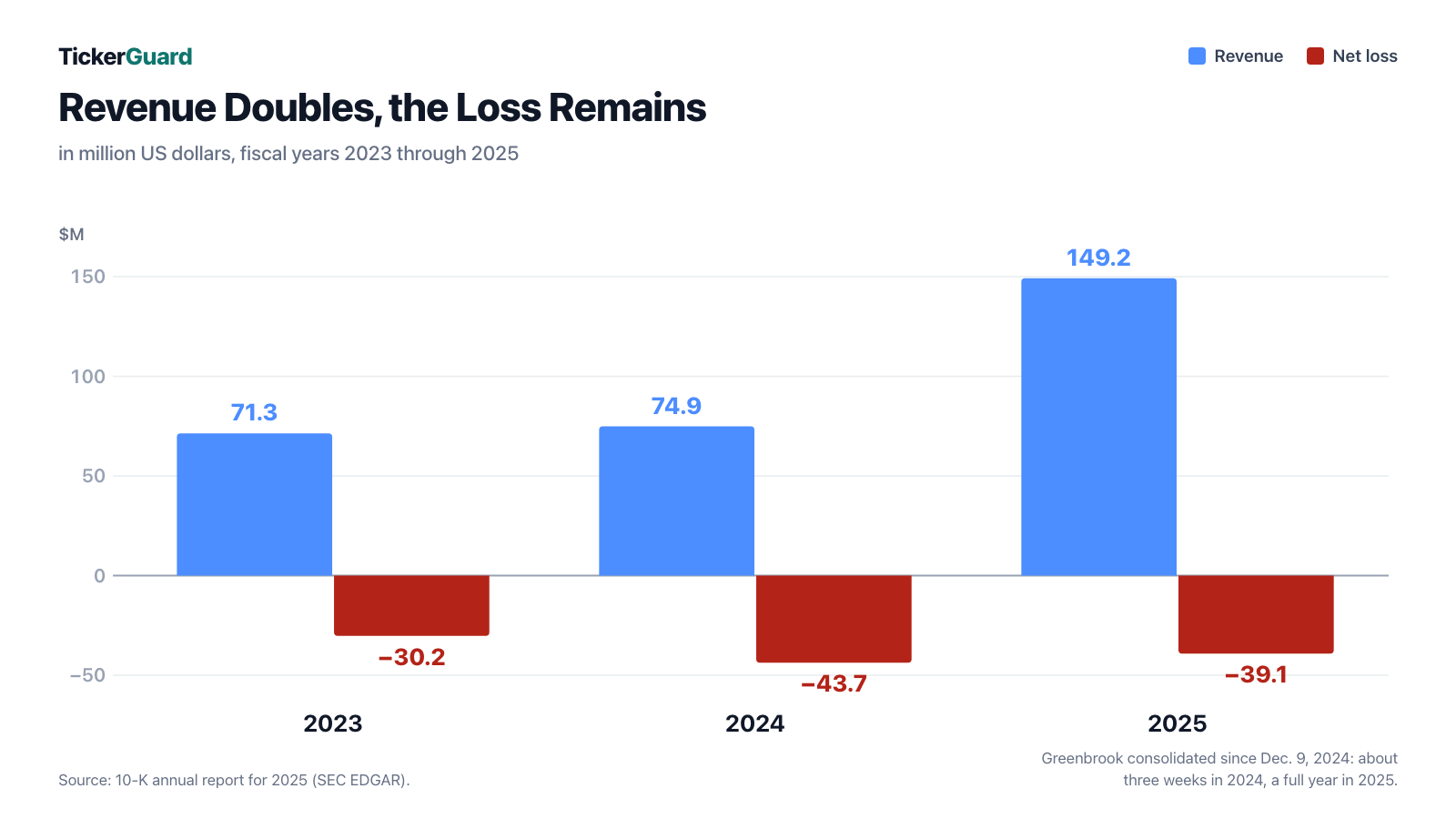
Only in the first half of 2026 does a genuine improvement show up, not just a consolidation effect: revenue rose from $70.083 million to $76.022 million (+8.5%), gross profit from $33.496 million to $37.377 million, and net loss shrank from $22.528 million to $14.244 million. In the second quarter alone, the loss fell from $9.839 million to $3.464 million — helped by a workforce reduction of up to 5% that the company initiated on April 2, 2026 (about $0.2 million in restructuring costs, planned annual savings of $2.5–3.0 million, mostly effective from the third quarter of 2026 onward). But the two segments are moving in opposite directions:
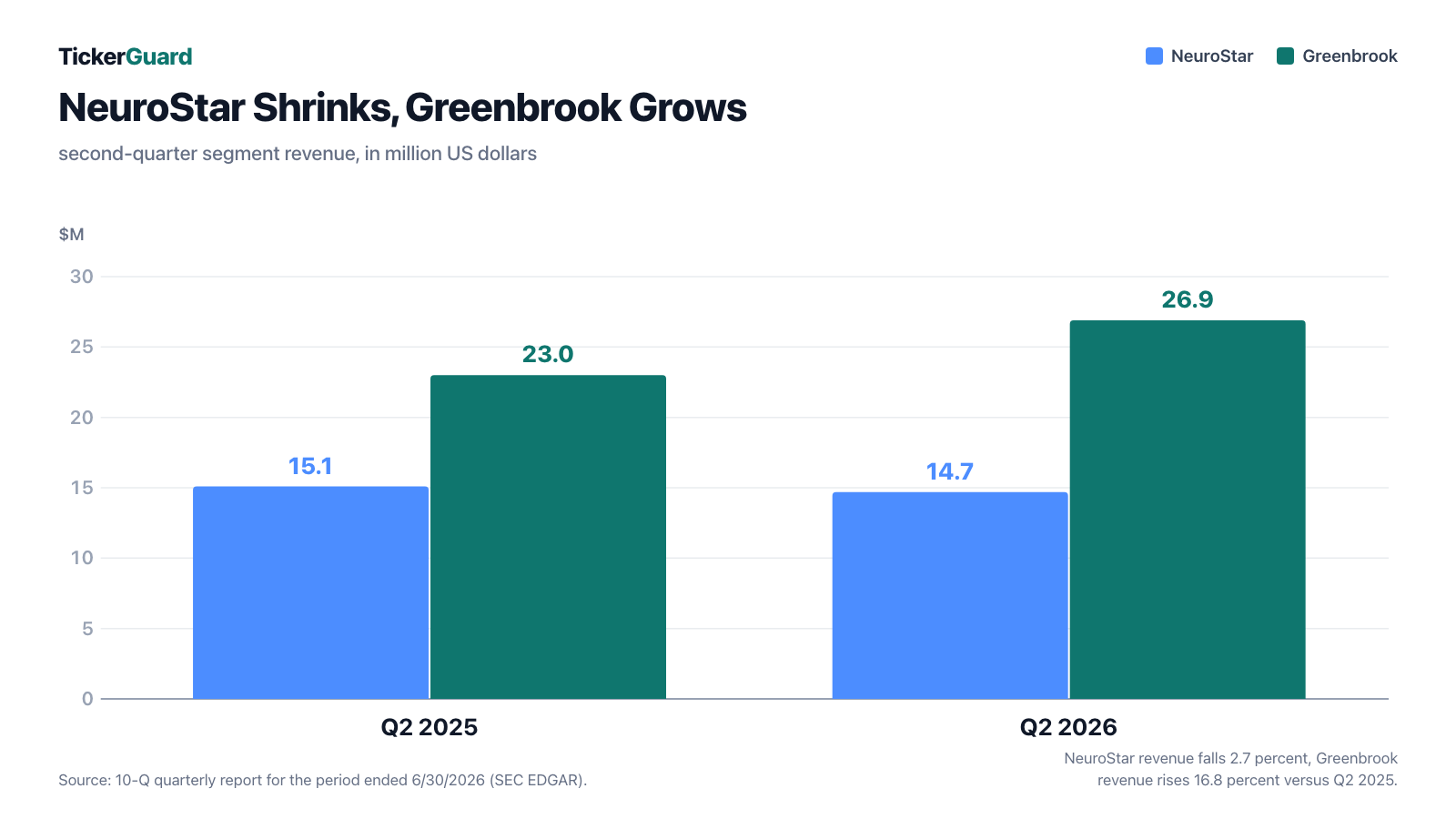
Remember that picture: the acquired business is now carrying the growth, while the original business — selling NeuroStar devices and treatment sessions to independent practices — is shrinking slightly. Whether that's a transition effect or a structural problem in the core business can't be determined from two quarters alone. What can be said with confidence: without Greenbrook, Neuronetics would be worse off today than it is with it — and that very dependence on the acquired chain leads us to the first uncomfortable truth.
What the Filings Actually Say — the Uncomfortable Truths
Uncomfortable Truth No. 1: The Company's Own 10-Q Uses the Words "Going Concern"
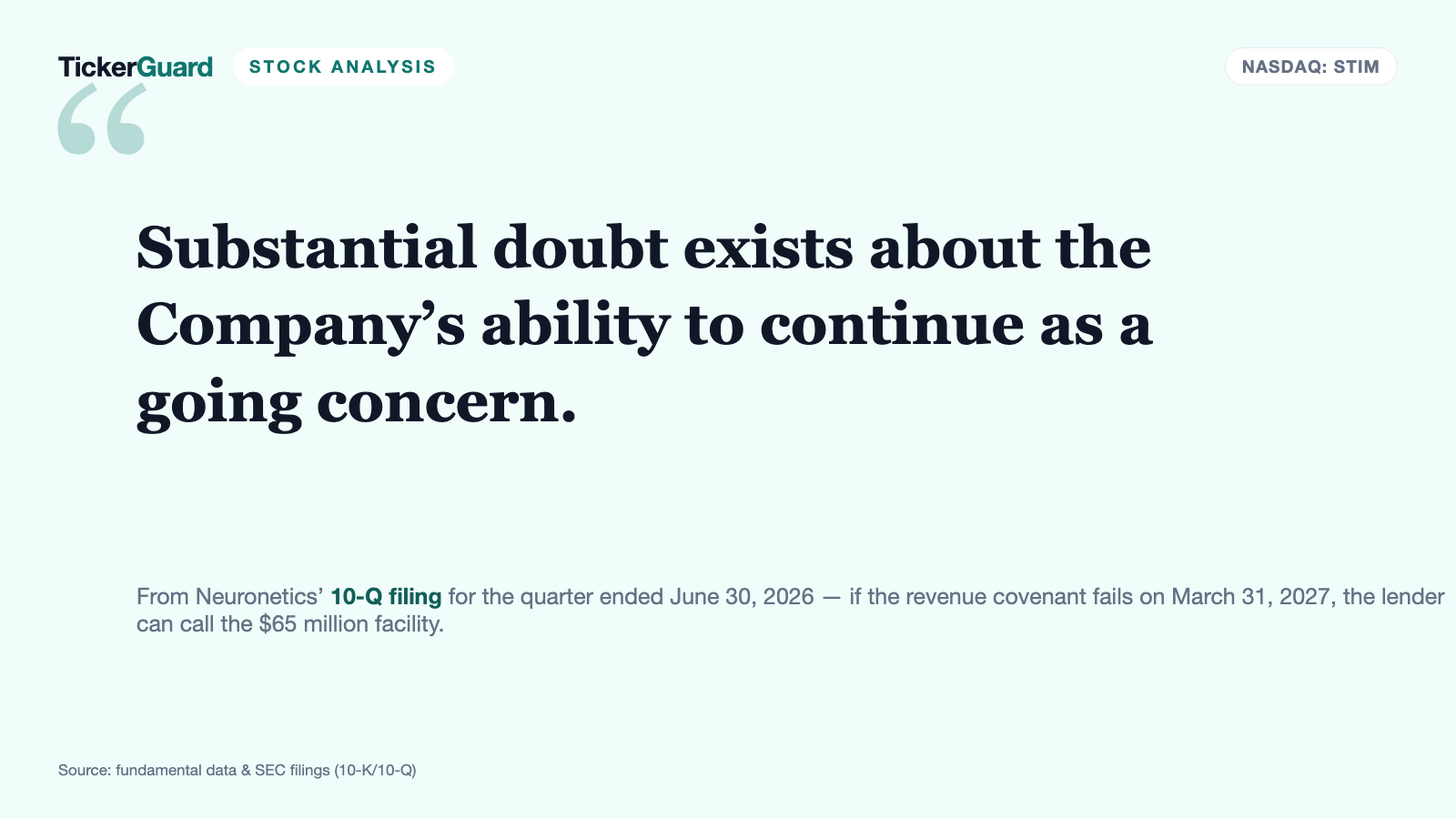
The shrinking loss is real. But the same report that shows it also contains a warning that outweighs any single quarterly figure. Neuronetics had $65.0 million outstanding under its credit facility as of June 30, 2026, maturing in July 2029. That facility carries covenants — including a quarterly trailing-twelve-month minimum-revenue covenant. On March 12, 2026, the company already loosened that covenant once via an amendment: the revenue covenants through the end of 2026, the liquidity covenants through September 2027. As of June 30, 2026, Neuronetics was in compliance with all covenants. The next sentence in the filing is the one that matters:
"The Company currently projects trailing twelve-month revenue for the period ended March 31, 2027 to be below the minimum required revenue for that period as stated in the credit agreement. Should the Company not be able to meet its March 31, 2027 minimum revenue covenant, the lender may at that time and at its discretion, call the credit facility. Should the lender call the facility, the Company is not projected to have the liquidity required to meet its requirement to pay off the loan. Therefore, substantial doubt exists about the Company's ability to continue as a going concern."
— Neuronetics, Inc., SEC Form 10-Q for the quarter ended June 30, 2026, note "Liquidity and Going concern"
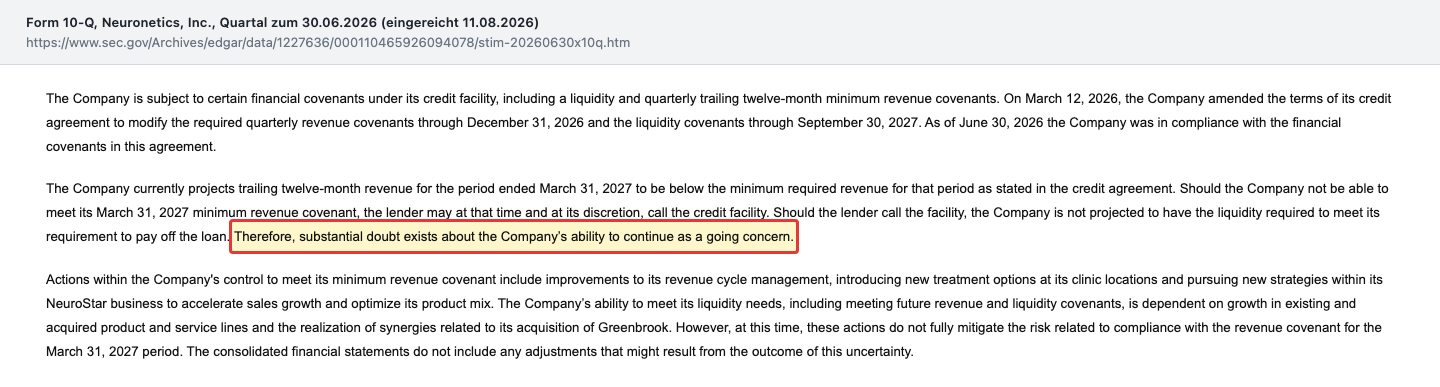
In plain terms: imagine a small business owner whose bank says, "if your revenue doesn't hit a certain level over the next seven months, we can call the entire loan at once — and you don't have the cash for that." That's exactly what's on the table here, except for a publicly traded company with a $240 million market cap. The filing itself lists mitigating actions (better revenue-cycle management, new treatment offerings, Greenbrook integration synergies) — and states in the very next sentence that these actions do "not fully mitigate" the risk. That's not us being alarmist; that's the company's own language.
How tight it is shows in the outlook Neuronetics filed the same day as the quarterly report (Form 8-K filed August 11, 2026, Exhibit 99.1): for full-year 2026 the company expects revenue of $160 million to $164 million — the top end of its previous $160–166 million range was cut. That revenue line is precisely the measure the credit covenant is tested against; lowering it does not make a breach less likely. On the other side sits an improvement: expected cash outflow from operations and investing combined is now $10.5 million to $14.5 million, whereas the prior guidance had called for $13 million to $17 million from operations alone — a bigger outflow on a narrower basis. Gross margin guidance also improved, to 48–50% from 47–49%. So the picture isn't one-sided: the cost side is running better than planned, the revenue side — the one that decides the covenant — worse.
Uncomfortable Truth No. 2: The Acquired Company's Lender Became the Largest Shareholder
How did Neuronetics end up with Greenbrook in the first place — and why does that matter for governance? The 10-K describes an unusual mechanism that preceded the actual acquisition:
"Madryn Asset Management, LP and its affiliates (collectively, "Madryn") converted (i) all of the outstanding amount owing under Greenbrook's credit agreement into 2,056,453,835 Greenbrook Shares, representing 95.3% of the Greenbrook Shares (including the Greenbrook Shares held by Madryn prior to such conversion) immediately prior to closing of the Arrangement and (ii) all of the interim period funding provided by Madryn to Greenbrook into an additional 252,999,770 Greenbrook Shares, which Greenbrook Shares were exchanged for shares of common stock of Neuronetics ("Neuronetics Shares") at the Exchange Ratio upon closing of the Arrangement."
— Neuronetics, Inc., SEC 10-K annual report for fiscal 2025, "Greenbrook Acquisition"
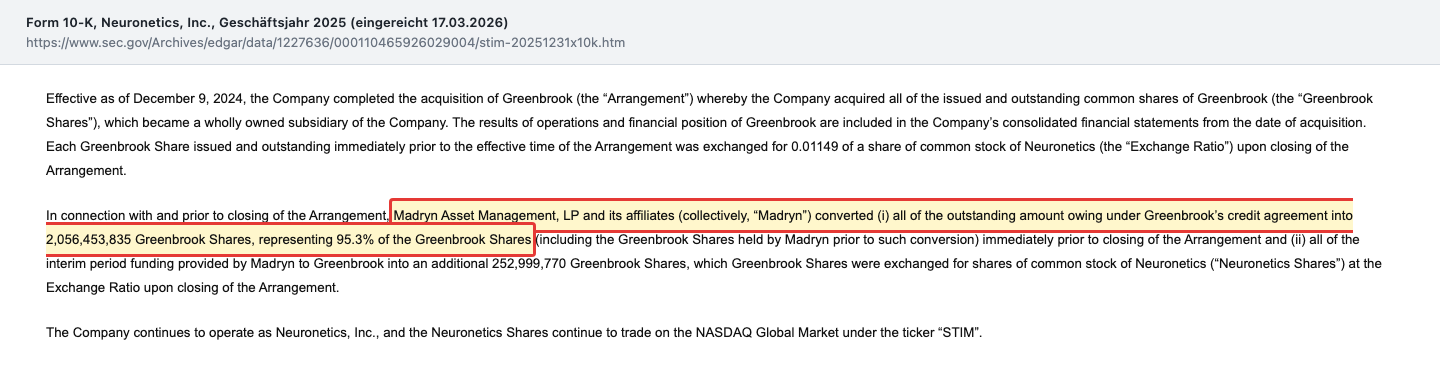
In plain terms: Madryn was Greenbrook's bank. When Greenbrook could no longer service its debt, Madryn simply converted the claim into shares — effectively taking control of the near-insolvent company before it was folded into Neuronetics. Per the most recent available holdings data (as of March 31, 2026), Madryn holds about 26.8% of Neuronetics shares (18,475,893 shares) — more than any other shareholder. That's not illegal and it's fully disclosed. But it's worth putting in context: Neuronetics' largest single shareholder isn't a long-term fund that believed in the business model from day one, but a lender whose original goal was recovering a troubled loan and who, through the share swap, now shares in the upside of the integration — or the downside, if it fails.
Uncomfortable Truth No. 3: A New CEO and the Third CFO Within 14 Months
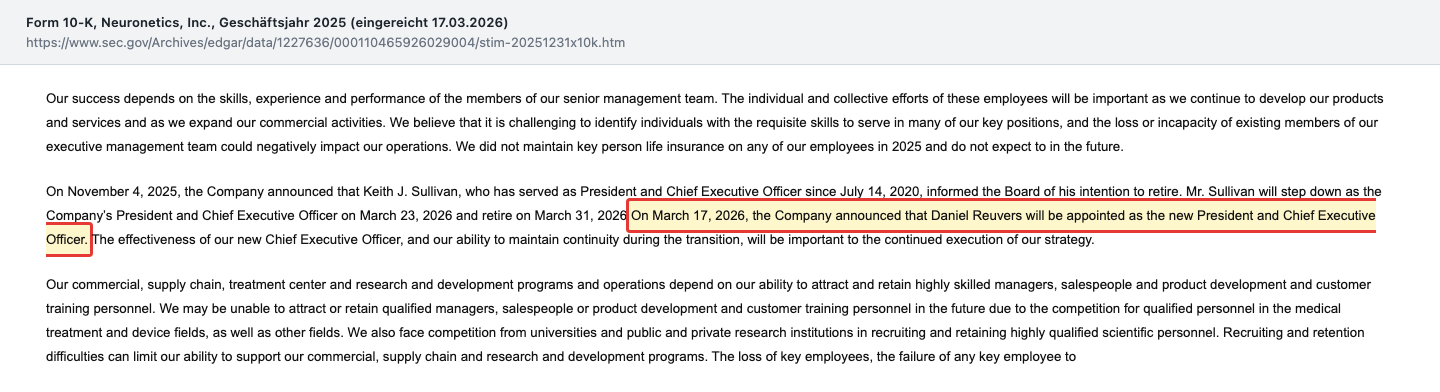
While Neuronetics integrates a complex acquisition and manages a credit covenant deadline, its leadership also turned over — nearly completely. On November 4, 2025, the board announced that CEO Keith J. Sullivan, in the role since July 2020, would retire. On March 17, 2026, his successor was named:
"On March 17, 2026, the Company announced that Daniel Reuvers will be appointed as the new President and Chief Executive Officer."
— Neuronetics, Inc., SEC 10-K annual report for fiscal 2025, "Human Capital"
Almost simultaneously, the CFO seat also changed hands — twice. Steven Pfanstiel had only been in the role since July 15, 2025 when he announced his resignation:
"Steven E. Pfanstiel, who has served as Executive Vice President, Chief Financial Officer, and Treasurer since July 15, 2025, informed the Company of his intention to resign on May 1, 2026."
— Neuronetics, Inc., SEC Form 8-K filed April 6, 2026, Item 5.02

After Pfanstiel, Francis X. Brown III stepped in as interim principal financial and accounting officer. Starting July 23, 2026, Nir Naor took over as the new Executive Vice President and Chief Financial Officer, adding the title of principal financial and accounting officer on August 12, 2026 — making him the third person to hold this position within roughly 14 months. None of these departures is described as a dispute in the filings, and resignations for personal reasons are unremarkable on their own. But taken together — a new CEO, three CFOs in 14 months, in the middle of a complex integration and a looming covenant deadline — that's a level of leadership turnover that complicates continuity, exactly when precise working-capital management and credible communication with the lender matter most.
Valuation: What the Market Pays for an Improvement Story With a Footnote Risk
At a share price of $3.15 (as of August 18, 2026), Neuronetics carried a market capitalization of roughly $240 million on 76,197,222 shares outstanding. Enterprise value (market cap plus net debt) was around $306 million, and the price-to-sales ratio around 1.5 (against trailing-twelve-month revenue of $155.1 million) — with negative trailing-twelve-month EBITDA (-$19.263 million), a price-to-earnings multiple isn't meaningful. Notably, about 27.2% of the float was sold short as of the data date — an unusually high figure showing that a large part of the market remains skeptical despite the shrinking losses. The 52-week range of $0.80 to $3.71 also shows how sharply this stock reacts to news. One more data point for context: in the second quarter of 2026, the company sold 6,052,953 new shares through its at-the-market program (with Canaccord Genuity) at an average price of just $1.31 — well below the current price and near the 52-week low. Whoever needed fresh capital sold shares when they were cheap, not expensive. That's not a valuation call for today, but it does show how tight the capital cushion recently was. We recently showed how badly a lopsided debt-to-market-cap ratio can weigh on a stock in our analysis of Upland Software, where $234 million of debt stood against a market cap of just $12 million — at Neuronetics the ratio ($65 million in debt against a $240 million market cap) is considerably more moderate, but the covenant deadline of March 31, 2027 remains the hinge point of any valuation.
Opportunities and Risks at a Glance
What speaks for Neuronetics:
- Net loss is genuinely shrinking: from $22.528 million to $14.244 million in the first half of 2026, and from $9.839 million to $3.464 million in the second quarter alone — helped by the April 2026 workforce reduction (planned annual savings of $2.5–3.0 million).
- The acquired clinic business Greenbrook is growing by double digits (Q2 2026: +16.8%) and now carries the larger share of consolidated revenue.
- The credit facility itself doesn't mature until July 2029 — the acute risk isn't an immediate default but a possible early call triggered by a covenant breach on March 31, 2027.
- Management has already successfully renegotiated with the lender once (the March 12, 2026 amendment) and names concrete mitigating actions (billing processes, new treatment offerings, synergies).
What speaks against it:
- The company itself states "substantial doubt" about its ability to continue as a going concern in the 10-Q for the quarter ended June 30, 2026 — and says its own mitigating actions do not "fully mitigate" the risk.
- Cash on hand ($19.2 million as of 6/30/2026) is dwarfed by a $65.0 million credit facility; an accumulated deficit of $473.2 million reflects a long history of losses.
- The largest shareholder (about 26.8%, Madryn Asset Management) became an owner through a debt-for-equity conversion — not a classic long-term investor, but the acquired company's former lender.
- CEO and CFO (twice) all changed within 14 months — a level of leadership turnover that complicates continuity during a critical integration and refinancing phase.
- The original NeuroStar device business is shrinking slightly (Q2 2026: -2.7%) — growth comes almost entirely from the acquired clinic business.
A Human Takeaway
Back to the Trend Trap from the start. Its point isn't that an improvement is worthless — the shrinking loss at Neuronetics is real, measured, and not dressed up. Its point is that an improving line spares you the second question: why is it improving, and what sits next to it in the fine print? Buy Neuronetics and you're really buying three things at once: an operating business that has genuinely stabilized of late; a covenant deadline on March 31, 2027 that the company itself calls a going-concern risk; and a leadership team that was just entirely reassembled, right as it's supposed to navigate that very deadline. That can be fine for you — if you're willing to read the next two or three quarterly reports closely, watching both revenue trends and the exact covenant language. So the honest question isn't "did the loss get smaller?" but: would you invest in a company whose own quarterly report tells you its ability to continue isn't assured — even while the trend line is currently pointing the right way? If yes, you have a thesis. If no, you had a trend. What you do with that is your decision. Not investment advice.
Sources
All original documents used in this analysis — for your own reading:
- Neuronetics, Inc. — SEC Form 10-K annual report for fiscal 2025 (filed March 17, 2026)
- Neuronetics, Inc. — SEC Form 10-Q quarterly report for the period ended June 30, 2026 (filed August 11, 2026)
- Neuronetics, Inc. — SEC Form 8-K filed April 6, 2026 (CEO retirement agreement, workforce reduction, CFO resignation)
- Neuronetics, Inc. — SEC Form 8-K filed August 11, 2026, Exhibit 99.1 (second-quarter results and full-year 2026 outlook)
- Neuronetics, Inc. — SEC Form 8-K filed August 17, 2026 (CFO title change)
- Full SEC filing history for Neuronetics, Inc.: EDGAR overview (sec.gov)
- Fundamental data (price, market cap, valuation, ownership structure, short interest; as of August 18–19, 2026), cross-checked against the SEC filings.
Transparency & disclaimer: This analysis is a journalistic review of publicly available information and does not constitute investment advice, a regulated financial analysis, or a solicitation to buy or sell securities. Stock investments carry substantial risk, including total loss — explicitly including the risk of total loss for a company carrying a going-concern note. All figures are provided without guarantee; data dates are noted in the text. Positions held by the operator are disclosed daily; where one exists, it appears as a notice at the top of this deep dive.
Key figures at a glance
All monetary figures in millions of $; earnings per share as reported.
| Metric | 2021 | 2022 | 2023 | 2024 | 2025 |
|---|---|---|---|---|---|
| Revenue | 55.3 | 65.2 | 71.3 | 74.9 | 149.2 |
| Operating Income (EBIT) | -27.6 | -35.1 | -30.6 | -34.6 | -31.4 |
| Net Income | -31.2 | -37.2 | -30.2 | -43.7 | -39.0 |
| Net Margin | -56.4% | -57.0% | -42.3% | -58.4% | -26.1% |
| Earnings Per Share | -1.22 $ | -1.38 $ | -1.05 $ | -1.38 $ | -0.59 $ |
Source: fundamental data & SEC filings (annual and quarterly reports, 10-K/10-Q)
Our Bottom Line at a Glance
- Operating trend positive
- Net loss narrowed from $22.528 million to $14.244 million in the first half of 2026, and from $9.839 million to $3.464 million in the second quarter alone — alongside rising revenue (+8.5% H1 2026) and growing gross profit. An April 2026 workforce reduction (planned annual savings of $2.5–3.0 million) supports the trend.
- Balance sheet substance & going concern negative
- The 10-Q for the quarter ended June 30, 2026 states, word for word, "substantial doubt" about the company's ability to continue as a going concern: the minimum-revenue covenant on the $65.0 million credit facility is projected to be breached for the period ended March 31, 2027, and cash on hand ($19.2 million) would not cover repayment if the facility is called. An accumulated deficit of $473.2 million reflects a long loss history.
- Ownership structure negative
- The largest shareholder (about 26.8%, Madryn Asset Management) became an owner via a debt-for-equity conversion, not a conventional investment decision — Madryn was previously Greenbrook's lender. That's disclosed and legal, but it changes the character of the controlling stake.
- Governance & leadership continuity negative
- CEO (Sullivan to Reuvers, March 2026) and CFO (Pfanstiel to interim CFO Brown to Naor, July/August 2026) both changed within 14 months — in the middle of the Greenbrook integration and an active covenant deadline. None of the changes is described as a dispute, but the pace complicates continuity.
- Segment mix neutral
- The acquired clinic business Greenbrook is growing by double digits (Q2 2026: +16.8%) and now accounts for nearly two-thirds of consolidated revenue; the original NeuroStar device business is shrinking slightly (-2.7%). Whether that's a transition or a structural pattern will only become clear over further quarters.
Neuronetics shows an improvement story with a warning in the fine print: net loss is genuinely shrinking (H1 2026: $14.244 million, down from $22.528 million a year earlier), carried by the acquired clinic operator Greenbrook. At the same time, the company's own 10-Q for the quarter ended June 30, 2026 states, word for word, "substantial doubt" about its ability to continue as a going concern, because a credit covenant is projected to be breached on March 31, 2027. The largest shareholder became an owner through a debt conversion, and both the CEO and CFO changed within 14 months. Not investment advice.
What Our Rating Means
Substance risk
We found at least one documented issue that threatens the company itself — regardless of how the stock is currently valued.
The company's own 10-Q for the quarter ended June 30, 2026 states, word for word, a going-concern note: a credit covenant is currently projected to be breached for the period ended March 31, 2027, and existing liquidity would not be sufficient to repay the credit facility if it is then called. A documented going-concern note is, by definition, a substance risk — regardless of the fact that operating loss figures are improving at the same time. This is a quality judgment about the company, not a call on the current share price or timing.
A journalistic assessment by our editorial team at the time of the deep dive, based on public sources — not investment advice and not a solicitation to buy or sell. Your personal circumstances (investment goals, risk capacity, taxes) cannot be taken into account. What our levels mean, how verdicts are formed, and what conflicts of interest exist →
Worth Noting
- This analysis was not triggered by a scanner hit but by the wording of the 10-Q for the quarter ended June 30, 2026 itself, which uses the term "going concern" — a rare disclosure, filed under penalty of law, that goes beyond the usual risk-factor boilerplate.
- Data as of: SEC filings through August 17, 2026 (8-K, Items 5.02/9.01); fundamental data (price, market cap, ownership, short interest) as of August 18–19, 2026.
- Not to be confused: the company consists of two segments with very different dynamics — the shrinking NeuroStar device business and the growing Greenbrook clinic business. Reading only the consolidated number misses that distinction.
Stock Watch
This analysis is as of August 26, 2026. Stock Watch will tell you what's changed at STIM since then.
Later $1 a month per stock — signing up is free, and you'll be the first to know when it launches.
The full analysis as a PDF for later
We will send you this analysis as a PDF — to print, file away, and read at your own pace. And we will add you to the free Stock Watch list for Neuronetics Inc (STIM), so you hear about it when something material in this analysis changes.
Frequently Asked Questions
Neuronetics, Inc. (Nasdaq: STIM) of Malvern, Pennsylvania, makes the NeuroStar TMS device for depression and sells it to psychiatrists. On December 9, 2024, it also acquired clinic operator Greenbrook TMS Inc., which operates 93 U.S. treatment centers offering TMS and SPRAVATO (esketamine nasal spray) therapies.
Because the company states in its 10-Q for the quarter ended June 30, 2026 that it currently expects to breach the minimum-revenue covenant on its $65.0 million credit facility for the period ended March 31, 2027. The lender could then call the facility, and cash on hand ($19.2 million as of 6/30/2026) would not be enough to repay it. The filing itself states that "substantial doubt exists" about the company's ability to continue as a going concern.
Madryn Asset Management was the lender to Greenbrook TMS before Neuronetics acquired it. Shortly before the deal closed, Madryn converted its entire claim against Greenbrook into shares — 95.3% of Greenbrook's stock — and became Neuronetics' largest shareholder as a result, holding about 26.8% as of March 31, 2026.
CEO Keith Sullivan announced his retirement on November 4, 2025; Daniel Reuvers was named his successor on March 17, 2026. At the same time, CFO Steven Pfanstiel (in the role since July 2025) announced his resignation on March 31, 2026, effective May 1, 2026. After an interim period, Nir Naor took over as the third CFO within 14 months, starting July/August 2026. The filings do not cite disputes as the reason for any of these departures.
At a share price of $3.15 (August 18, 2026), market cap stood at roughly $240 million and the price-to-sales ratio at about 1.5 — a price-to-earnings multiple isn't meaningful given the lack of profit. About 27.2% of the float was sold short, a sign of persistent market skepticism. Whether that's cheap or expensive depends heavily on whether the March 31, 2027 covenant is met — a valuation ratio alone doesn't answer that.
The December 9, 2024 acquisition turned a pure device maker into a clinic operator as well. Revenue rose from $74.890 million (2024) to $149.157 million (2025) as a result. In the second quarter of 2026, Greenbrook already contributed $26.891 million to consolidated revenue (+16.8%), while the original NeuroStar business, at $14.677 million, shrank slightly (-2.7%).
Found an error?
Did you spot a factual error, an outdated number, or a typo in this deep dive? Let us know briefly — your report goes straight to the editorial team.