Lifeway Foods: 27 straight quarters of growth — and the company still earns no more than it did three years ago
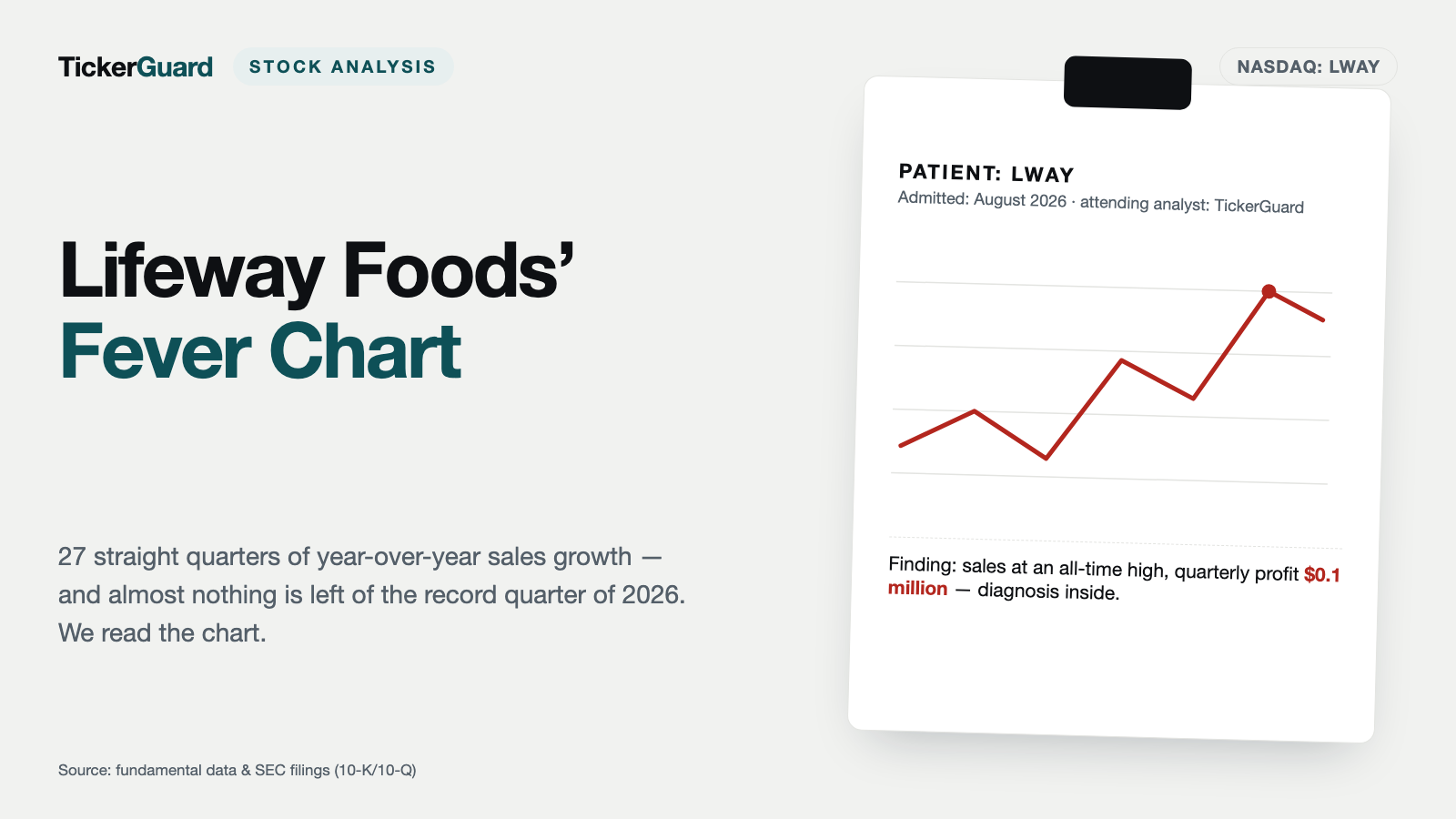
Lifeway Foods sells drinkable kefir, and it sells it well: 27 consecutive quarters of year-over-year sales growth, most recently a record 66.9 million dollars. Except that this record quarter left 0.1 million dollars of profit — gross margin fell from 28.6 to 19.5 percent. Operating income in 2025 was below 2023 despite a third more revenue. In between sit a rejected takeover bid, a fight inside the founding family and 10.7 million dollars of legal fees. In May 2026 the strategic anchor shareholder Danone sold its entire stake — at a price well below what it had itself offered eighteen months earlier. Not investment advice, just a close look at the filings.
 Thomas Mücke
Founder & Publisher
Thomas Mücke
Founder & Publisher
As of Today
As of: October 12, 2026
- Closing price
- 22.60 $ +1.90%
- Market Capitalisation
- 0.4 $B
- Growth Score
- 7/10
- AAQS
- 8/10
Price change since August 28, 2026: -14.2%
This analysis has a cut-off date. The Stock Guard tells you when something material changes in the numbers. Reserve your free spot
Chart
Interactive price chart (TradingView).
52-week range: 17.80 $ to 32.30 $ · Last price: 22.60 $ (As of: October 12, 2026)
Note: pure fact-based analysis, not investment advice and not a solicitation to buy or sell. All figures without guarantee.
There is an investor trap that springs precisely when everything looks good — the streak trap. It works like this: a company reports its twenty-ninth, thirtieth, twenty-seventh best quarter in a row. The mind hears "twenty-seven consecutive quarters" and puts the homework aside, because a streak feels like proof. It is not. A streak proves only that one single number went up. At Lifeway Foods (Nasdaq: LWAY) of Morton Grove near Chicago, that single number is net sales, and it really has risen without interruption for almost seven years. What happened alongside it is not in the headline of the press release but twelve pages deeper into the quarterly report filed with the U.S. Securities and Exchange Commission. So let us make a deal: before you buy the streak, we read together what the company itself reported — the Form 10-Q for the quarter ended June 30, 2026, the annual reports (10-K) for 2023 through 2025, the current reports (8-K) of the past two years, the prospectus supplement covering the anchor shareholder's exit and the 2026 proxy statement. An SEC filing is made under penalty of law: false statements in one are a criminal offence. And this one tells the story of a family business that has sold kefir for forty years, that sells more of it every year — and that still earns no more today than it did three years ago. In the end, you decide.
What Lifeway Foods actually sells — 85 percent kefir in a bottle
Kefir is a cultured milk drink: tangy, thicker than buttermilk, full of live cultures — an everyday staple in Eastern Europe, for a long time a niche in the United States. Lifeway Foods essentially created that niche in America. Michael Smolyansky founded the company in 1986, ten years after he and his family emigrated from Eastern Europe to the United States; since her father's death in June 2002 his daughter Julie Smolyansky has run the business as chief executive. By its own account Lifeway was the first company to introduce kefir to U.S. consumers on a commercial scale and is today the country's largest kefir producer. The drink is sold under the Lifeway, Fresh Made and GlenOaks Farms brands and as private label for individual chains.
What stands out is the concentration. The 2025 annual report breaks net sales down by category: drinkable kefir excluding the children's ProBugs line brought in 181.4 million dollars — 85 percent of total net sales of 212.5 million. A year earlier it was 82 percent. Everything else is small: European-style soft cheeses 16.6 million (8 percent), cream and by-products 8.7 million (4 percent), drinkable yogurt 2.3 million (1 percent), ProBugs 2.2 million (1 percent), other dairy 1.3 million (1 percent). The new products management talks about so much — the Muscle Mates protein-and-creatine drink, the kefir butter, the licence for partner Open Farm's dog food — do not appear in that table at all yet. Hold on to this image: Lifeway is not a broad-line dairy, it is one bottle with a company built around it.
Almost everything is made in house: 95 percent of 2025 net sales came from the company\'s own plants (Morton Grove in Illinois, Waukesha in Wisconsin, Philadelphia in Pennsylvania; plus a pure warehouse and distribution site in Niles, Illinois), only 5 percent from co-packers — one of them in Ireland, serving the European market. Fifty-one percent of net sales go directly to retail chains, 47 percent through distributors and 2 percent via the company's own trucks in metropolitan Chicago. Seven percent of net sales go abroad, mostly to Mexico, Central America and the Caribbean. And here is the first number worth remembering: two retail customers alone accounted for 24 percent of 2025 net sales and 24 percent of net receivables; in the first half of 2026 it was 25 percent. The filing does not say who they are — only how much depends on them. That sets the central tension of this analysis, and it runs through every chapter: a single product, sold through a handful of chains, has grown without interruption for seven years — and it is exactly that narrowness which decides whether any of the growth turns into profit.
Company history for investors
-
1986
Founded by Michael Smolyansky
The founder, who had emigrated from Eastern Europe, brings kefir into U.S. retail — the basis of today's business.
-
1988
Trading in the shares begins
The shares have traded since March 29, 1988; the family remains the largest shareholder group to this day.
-
2002
Julie Smolyansky takes over
After her father's death the daughter runs the company — the root of the later family conflicts.
-
2024
Danone bids 25.00 and then 27.00 dollars per share
The board rejects both offers and adopts a rights plan — shareholders never got the price.
-
2025
Cooperation agreement with Danone, board refreshed
Four new independent directors join, the litigation is stayed — and Danone's shares are registered for resale.
-
2026
Danone exits in full at 19.50 dollars
The strategic anchor shareholder sells all 22.61 percent on May 14; in June the takeover defence is removed.
-
2026
Record sales on a collapsed margin
The second quarter delivers 66.9 million dollars of net sales — and only 0.1 million of profit.
The numbers over the years — an honest look
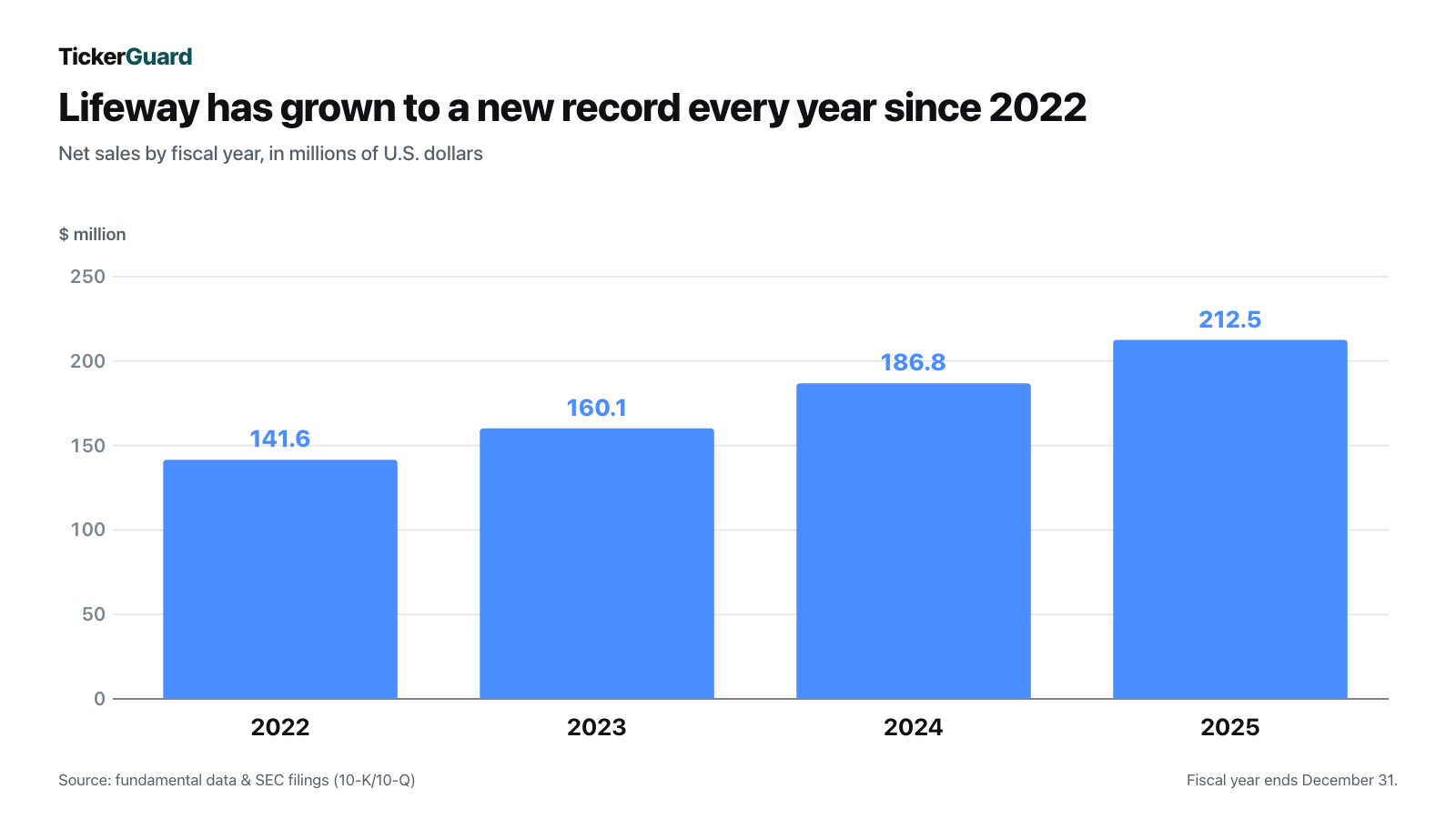
First what genuinely speaks for Lifeway, and there is plenty. Net sales have hit a new high four years running, and they rise on volume rather than price — management calls its growth "volume-led" on every call. The sequence of fiscal years:
The balance sheet also looks orderly. At June 30, 2026, total assets of 132.4 million dollars faced liabilities of 47.8 million; equity stood at 84.6 million, or 64 percent of total assets. There is no going-concern language, no impairment of the 11.7 million dollar goodwill balance, and the financial covenants agreed with the lender were met at the reporting date. For a company of this size, that is a sound footing.
Now the number that appears in no headline. Operating income — what is left after all the costs of running the business, before interest and taxes — went like this: 17.0 million dollars in 2023, 13.9 million in 2024, 16.2 million in 2025. Over the same period net sales rose from 160.1 to 212.5 million, a third more. Operating income did not. Put plainly: Lifeway has added 52 million dollars of annual net sales in three years and earns less on the bottom operating line than before. The operating margin fell from 10.6 percent (2023) to 7.5 percent (2025).
Part of that is explainable and even defensible: selling expenses rose from 14.7 million (2024) to 19.9 million dollars (2025) because the company is investing heavily in advertising and sampling — a deliberate choice, and the sales line vindicates it. Another part is not. The annual report puts the legal and professional fees connected with Danone's takeover proposal and "non-routine stockholder action" at approximately 6.2 million dollars in 2025 and approximately 4.5 million in 2024 — 10.7 million dollars in total that went to lawyers and advisers; for 2024 the report names a third occasion alongside them, the retention bonus agreement for the chief executive. That equals two thirds of the entire 2025 operating income. And the 2025 net income of 13.9 million carries a one-off item: a 3.4 million dollar gain on the sale of the company's Simple Mills investment. Without it, the figure celebrated as "54 percent net income growth" would have been considerably smaller.
What the filings reveal — the uncomfortable truths
First: margin collapsed in the second quarter of 2026 — and hard. On August 13, 2026 Lifeway reported the highest quarterly net sales in company history: 66.9 million dollars, 24.1 percent above the prior-year quarter. The same filing shows what was left of it: 0.1 million dollars of net income, 0.01 dollars per share — against 4.3 million and 0.28 dollars per share a year earlier. The cause is gross margin, the share of net sales left after the pure cost of making the product:
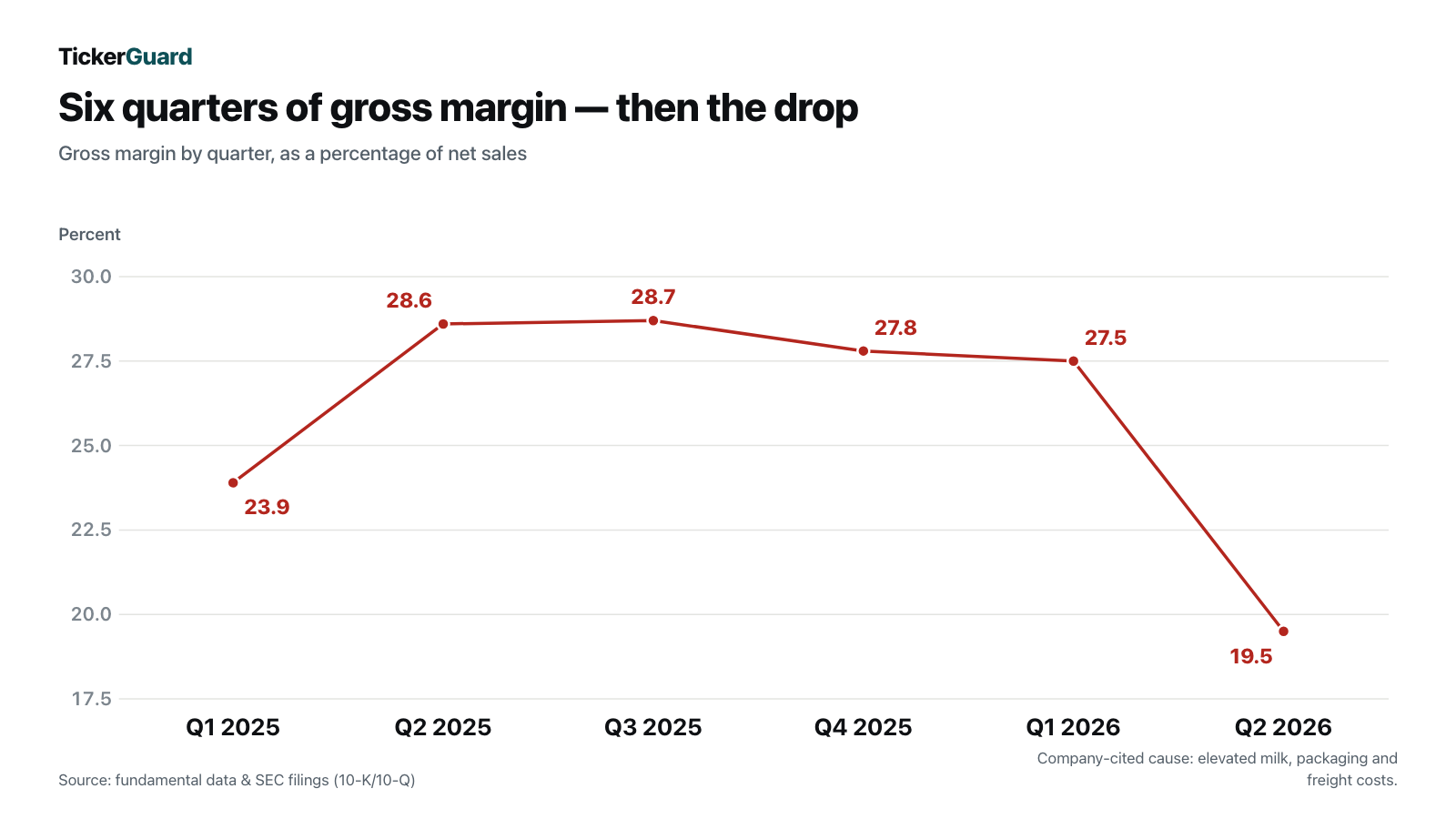
The company names the cause itself in the quarterly report:
“Gross profit as a percentage of net sales was 19.5% and 28.6% in the three-month period ended June 30, 2026 and 2025, respectively. The decrease versus the prior year was driven by the unfavorable impact of milk pricing and to a lesser extent the unfavorable impact of resin-based packaging inputs and transportation costs.”
— Lifeway Foods, Inc., Form 10-Q for the quarter ended June 30, 2026, "Gross Profit"

Milk prices are weather, not management — that is a fair objection. But it cuts both ways: on the calls for the third and fourth quarters of 2025 and the first quarter of 2026, management attributed the margin improvement in part to "favorable conventional milk pricing". When the same factor is booked as skill on the way up and as weather on the way down, the story does not agree with itself. The annual report explicitly calls milk "our primary raw material" — a commodity whose minimum prices U.S. federal authorities set every month — and the risk section says what can follow: that customer pricing actions may lag input cost changes, or that the full effect of higher input costs may not be passed on. The defensible conclusion is therefore: a business whose primary raw material carries a government-set minimum price earns reliably only if it can push price increases through the trade — and that is exactly the open question.
Second: growth now consumes more cash than it brings in. In the first half of 2026 the business generated 4.0 million dollars of operating cash flow. Over the same period 19.5 million went into property and equipment — almost all of it into the Waukesha expansion. That leaves a gap of some 15 million, and the bank filled it. The filing is unambiguous here:

Cash stood at 7.1 million dollars at the reporting date; a year earlier it was 21.2 million. The rate on the drawn facility was 5.48 percent, and the lender requires a fixed charge coverage ratio of at least 1.25 and a cash flow leverage ratio of no more than 2.00 — both were met at June 30, 2026. For the remainder of the plant build-out the company signed an additional equipment financing facility of up to 22.0 million dollars with the same bank on June 30, 2026 (SOFR plus 1.65 percent, interim funding period to June 30, 2027). It was undrawn at the reporting date. So the funding is arranged — it is simply debt, and it costs interest in a year in which second-quarter operating income shrank to 0.6 million dollars.
Third: the plant got more expensive and later — without a separate announcement. On the third-quarter 2025 call the chief executive named "approximately $45,000,000 in capital expenditures" for the Waukesha expansion and completion of the project "in 2026". The quarterly report for the period ended June 30, 2026 says: "The Company currently estimates investing approximately $50,500" — 50.5 million dollars. Completion is now scheduled "during the first fiscal quarter of 2027", with production at the larger scale beginning in January 2027. Cash paid through June 30, 2026 was 38.9 million, of which 27.9 million sits in construction in process. The 5.5 million dollar overrun appears in the quarterly report only; the new date shows up in the earnings release of August 13, 2026 merely in passing ("the planned completion of our transformative Waukesha expansion in early 2027"), with no indication that it differs from the earlier guidance. There was no separate announcement of the change.
Fourth: a quarter of net sales depends on two customers. The 2025 annual report names two retail customers accounting together for 24 percent of net sales and 24 percent of receivables; in the first half of 2026 it was 25 percent. In U.S. food retail that is not unusual — the trade is concentrated, and Lifeway itself flags the concentration as a risk. It is not existential. But it limits exactly the ability the company needs right now: passing higher milk costs on to customers. Whoever has a quarter of their revenue with two counterparties does not negotiate from strength.
Who owns the company — and why the buyer walked away
The most interesting story at Lifeway is not in the income statement but in the chapter on shareholders. Four parties hold roughly three quarters of the company, and three of them share a surname.
The 2025 annual report states the position as of December 31, 2025 plainly: Julie Smolyansky, the chief executive and daughter of the founder, held about 18 percent; Edward Smolyansky, her brother and the company's former chief operations officer, about 20 percent; Ludmila Smolyansky, the mother and the founder's widow, about 6 percent; Danone North America about 23 percent; and the investment firm Divisadero about 9 percent. The 2026 proxy statement gives the precise figures as of April 30, 2026: Julie Smolyansky 2,678,767 shares (17.52 percent), Edward Smolyansky 2,927,632 (19.61 percent), Ludmila Smolyansky 807,823 (5.29 percent), Danone 3,454,756 (22.61 percent), Divisadero 1,347,635 (8.82 percent). Do the arithmetic and the point is immediate: brother and mother together hold 24.90 percent — more than the chief executive.
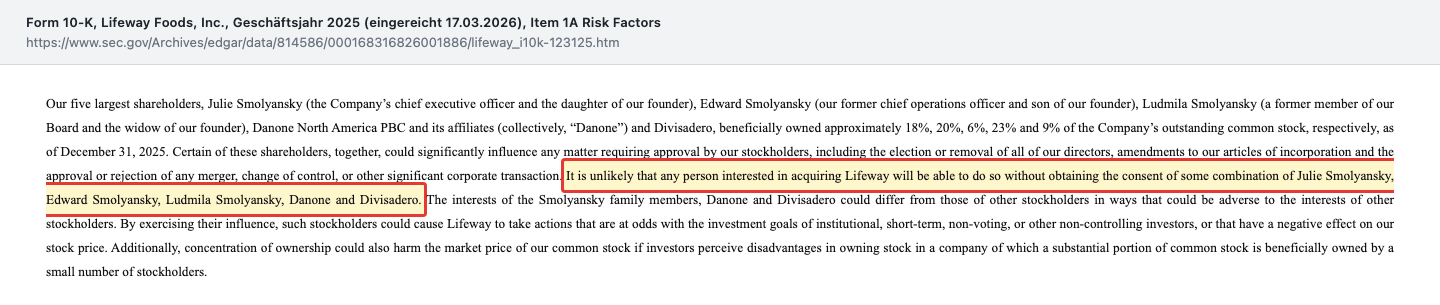
The filing draws the conclusion itself:
“It is unlikely that any person interested in acquiring Lifeway will be able to do so without obtaining the consent of some combination of Julie Smolyansky, Edward Smolyansky, Ludmila Smolyansky, Danone and Divisadero.”
— Lifeway Foods, Inc., Form 10-K for 2025, Item 1A Risk Factors
That is precisely where the takeover failed. On September 23, 2024 Danone — tied to the founding family since a stockholders' agreement dated October 1, 1999 — offered 25.00 dollars per share for the shares it did not already own. The board rejected it on November 5, 2024 as substantially undervaluing the company. On the same day it adopted a classic takeover defence, a shareholder rights plan that massively dilutes anyone acquiring 20 percent or more. On November 15, 2024 Danone raised its offer to 27.00 dollars per share. On November 20, 2024 the board rejected it again.
What followed was eighteen months of trench warfare: Danone sued in the Circuit Court of Cook County to enforce the 1999 stockholders\' agreement, and Edward Smolyansky ran his own campaign against the board in 2025. How seriously the company took it shows in the cooperation agreement itself: it expressly covers the case that Edward or Ludmila Smolyansky calls a special meeting or commences a consent solicitation — in which case Danone votes with the board. On September 30, 2025 the company and Danone settled in a cooperation agreement: the board was refreshed with four new independent directors unaffiliated with the family and with Danone; Danone waived its right to board representation; the litigation was jointly stayed — and the company registered Danone's shares for resale.
The rest is quickly told and, for shareholders, the actual news. On May 14, 2026 Danone placed its entire block of 3,454,756 shares at 19.50 dollars through the bank BTIG. The bank paid Danone 18.425 dollars per share, roughly 63.6 million in total. The prospectus supplement carries the comparison on the same page: the last reported sale price on May 13, 2026 was 27.25 dollars.

Lifeway itself repurchased 4.9 million dollars of stock out of that placement — paid in a half-year in which 23 million dollars of bank debt were drawn. On June 5, 2026 the board redeemed the rights plan, paying holders 0.001 dollars per right. At the annual meeting on June 17, 2026 every board nominee was elected — but not unanimously: 3,536,740 shares voted against Julie Smolyansky out of 13,982,124 shares represented, and 3,347,326 against the compensation resolution. Roughly a quarter of the votes cast still stands against the board. And the cooperation agreement has a side effect the proxy statement states openly: the company may not grant equity compensation to the chief executive and her family. That is why previously vested share awards held by the chief executive were settled in cash for 283,000 dollars in the first quarter of 2026.
What management said on the calls — and what it actually delivered
Three transcripts of Lifeway's earnings presentations are available to us: the third quarter of 2025 (November 12, 2025), the fourth quarter and full year 2025 (March 17, 2026) and the first quarter of 2026 (May 14, 2026). No transcript of the most recent report, for the second quarter of 2026, was available at the time of writing; there our reading rests on the earnings release of August 13, 2026.
The first finding concerns not the content but the format — and it is unusual enough to come first: none of the three transcripts contains a question-and-answer section. Each ends with a word of thanks and a sign-off once the chief executive has read out her prepared remarks. According to the introduction, only one executive is present on each call — the chief financial officer appears on none of the three recordings. And the August 13, 2026 earnings release does not invite analysts to a call; it points to a "webcast", that is, a recording on the company website. For our analyses the question-and-answer section is normally the most valuable part: that is where the follow-ups happen, where a management team dodges, where the sentences arise against which it can later be measured. At Lifeway that part does not exist. Anyone wanting to know how management answers an uncomfortable question will not find out — because the question cannot be asked.
What can still be checked is how the statements match what later appeared in the filings. Three points:
The plant expansion. In November 2025 the company said it had "to date, in 2025, […] invested over 9,000,000 in this project" and estimated the total at "approximately $45,000,000"; full capacity would come "upon completion of the project in 2026". In March 2026 it was still the "$45 million Waukesha expansion". In May 2026 the project remained "on track for completion by the end of this year" — while the same passage said the full effect would arrive "once the full initiative comes online in Q1 2027". The quarterly report of August 13, 2026 then gives 50.5 million dollars and the first quarter of 2027. The distance between the first statement and the latest filing is 5.5 million dollars and roughly one quarter.
Milk prices. In November 2025 the margin improvement was attributed in part to "favorable conventional milk pricing", in March 2026 to "the favorable impact of conventional milk pricing", in May 2026 to "favorable conventional milk pricing during that period". In August 2026 the same factor is "the primary margin headwind" and the pressure is described as "temporary". Both can be true — but it shows that this company's margin depends far more, in both directions, on the milk price than on its own execution.
The 2027 profit target. On the calls in November 2025 and March 2026 the chief executive expressly reaffirmed a profit target for 2027; in March 2026 in her own words: "$45 million to $50 million in adjusted EBITDA for fiscal year 2027" — adjusted earnings before interest, taxes, depreciation and amortisation of 45 to 50 million dollars in 2027. For context: 2025 operating income was 16.2 million and depreciation and amortisation about 4.0 million. In the second-quarter 2026 earnings release of August 13, 2026 the word "EBITDA" no longer appears; instead the company says gross margin and profitability will "fully recover in 2027". Anyone holding that 2027 target in mind holds the single most important number against which this management can be measured — and should check the next filing to see whether it is still stated.
Valuation: what the market is paying for Lifeway Foods
At a price of 26.35 dollars (as of August 28, 2026) and 15,106,747 shares outstanding (as of August 7, 2026), Lifeway is valued at roughly 398 million dollars. Measured against net sales of the last four reported quarters (242.4 million) that is a price-to-sales ratio of about 1.6. Measured against net income of the same four quarters (10.9 million) it is a price-to-earnings ratio of about 37 — and that is where the argument starts: 37 is a multiple you expect from a fast-growing branded consumer company, not from a dairy processor running a 7.5 percent operating margin. Book value per share was 5.60 dollars at June 30, 2026, so the price is a good four and a half times equity. Add net debt of roughly 15 million dollars and enterprise value comes to about 413 million, or a good twenty times trailing four-quarter earnings before interest, taxes, depreciation and amortisation.
Two things qualify every one of those numbers. First, the earnings denominator has just collapsed — a price-to-earnings ratio built on a quarter with 0.1 million dollars of profit says little about what the business earns in a normal year. Anyone who believes margin returns to the old 27 percent in 2027 is working with an entirely different denominator. Anyone who does not is working with a worse one. Second, trading is thin: of the 15.1 million shares only about 6.5 million are in free float, the rest sits with the family and institutional holders. The 52-week range ran from 17.31 to 34.20 dollars (as of August 28, 2026) — close to a factor of two within a year, in a stock whose measured sensitivity to the broad market is only about 0.46. Translated: the price moves do not come from the market, they come from the company.
And then there is the price anchor no valuation model supplies, but the company's own history does: a strategic buyer who knew the business from the inside thought the company worth 27.00 dollars per share in November 2024 — and sold eighteen months later at 19.50. Anyone buying today pays more than the price at which the best-informed seller got out. That is not a verdict, but it is a number worth knowing. We have described comparable patterns in the food sector in our analysis of Freshpet and, on the retail side, in our analysis of Sprouts Farmers Market.
Opportunities and risks at a glance
What speaks for the company. Demand is real and not manufactured: 27 consecutive quarters of growth, carried by volume rather than price. The category has a tailwind — protein, gut health and fermented foods have been consumer trends for years, and by its own account in the annual report Lifeway is the largest kefir producer in the United States. The balance sheet carries the business, equity is just under two thirds of total assets, and the debt funding of the plant build-out is arranged through two facilities. Doubling capacity at Waukesha from the start of 2027 is precisely the investment a manufacturer running into a capacity ceiling has to make, and it should lower the cost per bottle.
What speaks against it. Earning power is not keeping pace with revenue: operating income in 2025 was below 2023, on a third more sales. Milk determines the margin more than management does, and in the second quarter of 2026 exactly 0.1 million dollars of profit was left from 66.9 million dollars of net sales. Free cash flow was clearly negative in the first half of 2026, the revolving facility is 88 percent drawn, and cash has fallen to 7.1 million. Eighty-five percent of the range rests on one product, a quarter of net sales on two customers. And the ownership conflict is contained rather than settled: the chief executive's brother and mother together hold more shares than she does, roughly a quarter of the votes at the 2026 annual meeting went against the board, and the strategic suitor has closed the door behind him. Ten point seven million dollars of legal and advisory fees in two years show what that fight costs — money that did not go into plants and brands.
A human conclusion
We started with the streak trap: twenty-seven consecutive quarters sounds like proof. After reading the filings we know what it proves and what it does not. It proves that people increasingly like drinking this product — that is real, that is earned, and it is the harder half of a consumer business to build. It does not prove that any of it turns into profit. Between the bottle on the shelf and the profit sit the milk price, two retail chains that share the decision on price, a plant that is finishing later and dearer than announced, and an ownership fight that, together with the rebuffed takeover attempt, has cost 10.7 million dollars in legal and professional fees over two years.
The picture that remains: a company that is very good at selling and, so far, not good at keeping. 2027 is the year that decides it — the new plant runs, the margin is meant to return, and the company's own target of 45 to 50 million dollars of adjusted earnings has to be delivered. Until then every quarterly number is an interim report on exactly one question: is the margin coming back, or was the old margin the exception? Watching Lifeway does not require a price forecast. It requires three lines from the next quarterly report — the gross margin, the remaining headroom on the credit facility, and the sentence carrying the Waukesha cost estimate. They always sit in the same place. What you make of them is your decision.
Sources
- Form 10-Q for the quarter ended June 30, 2026 (filed 2026-08-13) — balance sheet, income statement, cash flow statement, customer concentration, debt obligations, Waukesha investment
- Form 8-K dated August 13, 2026, Exhibit 99.1 — second-quarter 2026 earnings release
- Form 10-K for 2025 (filed 2026-03-17) — product categories, routes to market, employees, risk factors, cooperation agreement with Danone, legal and professional fees
- Form 10-K for 2024 (filed 2025-03-14) — Danone's proposals at 25.00 and 27.00 dollars per share, rights agreement, credit agreement
- Form 10-K for 2023 (filed 2024-03-20) — 2023 comparatives
- Prospectus supplement 424B7 dated May 14, 2026 — full sale of the Danone stake, pricing, company repurchase
- Proxy statement DEF 14A dated April 30, 2026 — ownership as of 2026-04-30, chief executive compensation, effects of the cooperation agreement
- Form 8-K dated June 18, 2026, Item 5.07 — voting results of the June 17, 2026 annual meeting
- Form 8-K dated June 5, 2026 — redemption of the shareholder rights plan
- Form 8-K dated July 7, 2026 — equipment financing of up to 22.0 million dollars
- Transcripts of the earnings presentations of November 12, 2025 (third quarter 2025), March 17, 2026 (fourth quarter and full year 2025) and May 14, 2026 (first quarter 2026)
- Fundamental data: price, share count, free float, 52-week range, trailing four-quarter metrics — as of August 28, 2026
This text is journalistic analysis and not investment advice, not a buy or sell recommendation and not a solicitation to acquire or dispose of securities. All figures come from the sources named and carry their respective reporting dates. Shares can lose substantial value.
Key figures at a glance
All monetary figures in millions of $; earnings per share as reported.
| Metric | 2021 | 2022 | 2023 | 2024 | 2025 |
|---|---|---|---|---|---|
| Revenue | 119.1 | 141.6 | 160.1 | 186.8 | 212.5 |
| Operating Income (EBIT) | 5.9 | 2.3 | 17.0 | 13.9 | 16.2 |
| Net Income | 3.3 | 0.9 | 11.4 | 9.0 | 13.9 |
| Net Margin | 2.8% | 0.7% | 7.1% | 4.8% | 6.5% |
| Earnings Per Share | 0.21 $ | 0.06 $ | 0.75 $ | 0.59 $ | 0.89 $ |
Source: fundamental data & SEC filings (annual and quarterly reports, 10-K/10-Q)
Our Bottom Line at a Glance
- Demand & market position positive
- 27 consecutive quarters of year-over-year net sales growth and four record years in a row (141.6 million dollars in 2022 to 212.5 million in 2025), described by the company as consistently volume-led. Lifeway describes itself in its annual report as the largest kefir producer in the United States and makes 95 percent of its net sales in its own plants.
- Earning power negative
- Operating income was 16.2 million dollars in 2025, below the 17.0 million of 2023 — on a third more revenue. The operating margin fell from 10.6 to 7.5 percent. In the second quarter of 2026, 66.9 million dollars of net sales left 0.1 million of net income.
- Margin & raw-material exposure negative
- Gross margin fell from 28.6 to 19.5 percent in the second quarter of 2026; the company names milk prices as the main cause. The same factor was cited on the three preceding calls as the reason for margin improvements — the margin follows the commodity more closely than it follows execution.
- Cash position & cash flow negative
- In the first half of 2026, 4.0 million dollars of operating cash flow met 19.5 million of capital spending; cash fell to 7.1 million and 22.0 million of the 25.0 million revolving facility was drawn. An equipment financing facility of up to 22.0 million stands ready; the bank covenants were met at 2026-06-30.
- Balance-sheet substance positive
- Equity of 84.6 million dollars on total assets of 132.4 million (2026-06-30), no going-concern language, no impairment of the 11.7 million goodwill balance, and interest cover of roughly 24 times in the first half of 2026.
- Ownership & governance negative
- The chief executive's brother and mother together hold 24.90 percent against her 17.52 percent (2026-04-30); a campaign against the board by her brother in 2025, roughly a quarter of votes against the board at the 2026 annual meeting, 10.7 million dollars of legal and advisory fees over two years, and strategic holder Danone exited at 19.50 dollars per share in May 2026.
- Concentration neutral
- 85 percent of 2025 net sales came from drinkable kefir and 24 percent from two retail customers (first half of 2026: 25 percent). In U.S. food retail that is neither unusual nor existential, but it limits the ability to pass higher input costs on.
Lifeway Foods demonstrably sells more kefir every year — 27 consecutive quarters, four record years in a row. What that turns into as profit is the open question: operating income in 2025 was below 2023, gross margin collapsed to 19.5 percent in the second quarter of 2026, and the Waukesha expansion is being funded with bank debt while the revolving facility is 88 percent drawn. On top of that sits an ownership structure in which the chief executive's brother and mother together hold more shares than she does, and in which the strategic anchor shareholder exited in May 2026 at a clear discount to its own earlier bid. The decisive numbers in the next filings are the gross margin, the remaining headroom on the credit facility and the Waukesha cost estimate. Not investment advice.
What Our Rating Means
Open questions
The business works in principle, but one material question is open. As long as it stays open, our findings do not carry a quality verdict.
The business fundamentally works: demand is real, the brand leads its category, the balance sheet carries the company, and there is no evidence of a threat to its substance. What is open is one material operating question — does gross margin return to its earlier level after the drop to 19.5 percent, or was that earlier level the exception? Until that is settled, what stands here is a company that has added a third to its revenue since 2023 and earns less on it, that funds its plant expansion with debt, and whose takeover and ownership fight has cost 10.7 million dollars in legal and professional fees over two years. Anyone waiting should check three lines in the next filing: the gross margin, the remaining headroom on the credit facility and the Waukesha cost estimate. The decision is yours.
A journalistic assessment by our editorial team at the time of the deep dive, based on public sources — not investment advice and not a solicitation to buy or sell. Your personal circumstances (investment goals, risk capacity, taxes) cannot be taken into account. What our levels mean, how verdicts are formed, and what conflicts of interest exist →
Worth Noting
- The source base is the Form 10-Q for the quarter ended 2026-06-30 (filed 2026-08-13), the Forms 10-K for 2023 through 2025, the Forms 8-K dated 2026-06-03, 2026-06-05, 2026-06-18, 2026-07-07 and 2026-08-13, the prospectus supplement 424B7 dated 2026-05-14 and the proxy statement DEF 14A dated 2026-04-30.
- The 2025 net income of 13.9 million dollars includes a one-off gain of 3.4 million dollars on the sale of the Simple Mills investment; the reported 54 percent increase over 2024 is considerably smaller without that item.
- Only the prepared remarks are available for the three earnings presentations analysed (2025-11-12, 2026-03-17, 2026-05-14); none of the transcripts contains a question-and-answer section. No transcript was available for the second quarter of 2026 at the time of writing.
- The ownership figures come from two dates: the annual report gives rounded values as of 2025-12-31 (roughly 18, 20, 6, 23 and 9 percent), the proxy statement exact values as of 2026-04-30. Danone sold its entire block on 2026-05-14.
- Analyst coverage is very thin; a price target from that source would not be a meaningful sample and is therefore not used as an anchor.
Stock Watch
This analysis is as of August 29, 2026. Stock Watch will tell you what's changed at LWAY since then.
Later $1 a month per stock — signing up is free, and you'll be the first to know when it launches.
The full analysis as a PDF for later
We will send you this analysis as a PDF — to print, file away, and read at your own pace. And we will add you to the free Stock Watch list for Lifeway Foods Inc (LWAY), so you hear about it when something material in this analysis changes.
Frequently Asked Questions
Lifeway Foods, Inc. (Nasdaq: LWAY) of Morton Grove near Chicago makes drinkable kefir — a cultured milk drink with live cultures. That single product category brought in 181.4 million dollars of 212.5 million total net sales in 2025, or 85 percent. The company also sells European-style soft cheeses (8 percent), cream and by-products (4 percent) and smaller lines such as drinkable yogurt, the ProBugs children's range and butter. Its brands are Lifeway, Fresh Made and GlenOaks Farms.
Because gross margin fell from 28.6 to 19.5 percent. The quarterly report for the period ended June 30, 2026 names milk prices as the main cause and, to a lesser extent, costlier resin-based packaging and transportation. Despite record net sales of 66.9 million dollars, only 0.1 million of net income was left (0.01 dollars per share) against 4.3 million a year earlier. The company calls the pressure temporary and expects margin and profitability to recover fully in 2027.
Danone had offered 25.00 dollars per share in September 2024 and 27.00 in November 2024 for a full takeover; the board rejected both as substantially undervaluing the company and adopted a shareholder rights plan. After a cooperation agreement dated September 30, 2025 that refreshed the board and registered Danone's shares for resale, Danone placed its entire block of 3,454,756 shares (22.61 percent) at 19.50 dollars on May 14, 2026. The last reported sale price the day before was 27.25 dollars. Danone gives no reason for the timing in the filings.
According to the proxy statement as of April 30, 2026, chief executive Julie Smolyansky held 2,678,767 shares (17.52 percent), her brother and former chief operations officer Edward Smolyansky 2,927,632 (19.61 percent), her mother Ludmila Smolyansky 807,823 (5.29 percent) and the investment firm Divisadero 1,347,635 (8.82 percent); Danone still held 3,454,756 shares (22.61 percent) at that date and sold them shortly afterwards. Brother and mother therefore hold more between them than the chief executive. The annual report states expressly that an acquisition is unlikely without the consent of some combination of these shareholders.
The project is meant to double capacity at the Waukesha, Wisconsin plant. The quarterly report for the period ended June 30, 2026 puts the total investment at roughly 50.5 million dollars; the earnings calls of November 2025 and March 2026 still spoke of roughly 45 million. Cash paid through June 30, 2026 was 38.9 million. Completion is announced for the first quarter of 2027, with production at the larger scale from January 2027. The remainder is funded through the revolving credit facility (22.0 million of 25.0 million drawn at June 30, 2026) and an equipment financing facility of up to 22.0 million dollars signed in June 2026, undrawn at the reporting date.
We have three transcripts (third quarter 2025, full year 2025, first quarter 2026). The format stands out first: none of them contains a question-and-answer section, and only the chief executive is present, not the chief financial officer. On content, two divergences stand out: the plant expansion grew from roughly 45 to roughly 50.5 million dollars and slipped from 2026 to the first quarter of 2027 without a separate announcement. And the milk price was cited on three calls as a favourable driver of margin improvement, then in August 2026 as a temporary headwind.
At a price of 26.35 dollars (as of August 28, 2026) and 15,106,747 shares, the market value is roughly 398 million dollars. That is about 1.6 times sales and about 37 times earnings of the last four reported quarters, and a good 4.5 times equity. The high price-to-earnings ratio comes mainly from the recent collapse in profit — it therefore says more about the weak quarter than about normal earning power. For context: strategic anchor shareholder Danone exited in full at 19.50 dollars per share in May 2026.
Heavily, but not existentially. The 2025 annual report names two customers accounting together for 24 percent of net sales and 24 percent of net receivables; in the first half of 2026 it was 25 percent of net sales. The company does not name them. Fifty-one percent of net sales go directly to retail chains, 47 percent through distributors and 2 percent via the company's own trucks in metropolitan Chicago.
Found an error?
Did you spot a factual error, an outdated number, or a typo in this deep dive? Let us know briefly — your report goes straight to the editorial team.