LENZ Therapeutics: 27,000 Packs in One Quarter — and $39 Million Spent to Sell Them
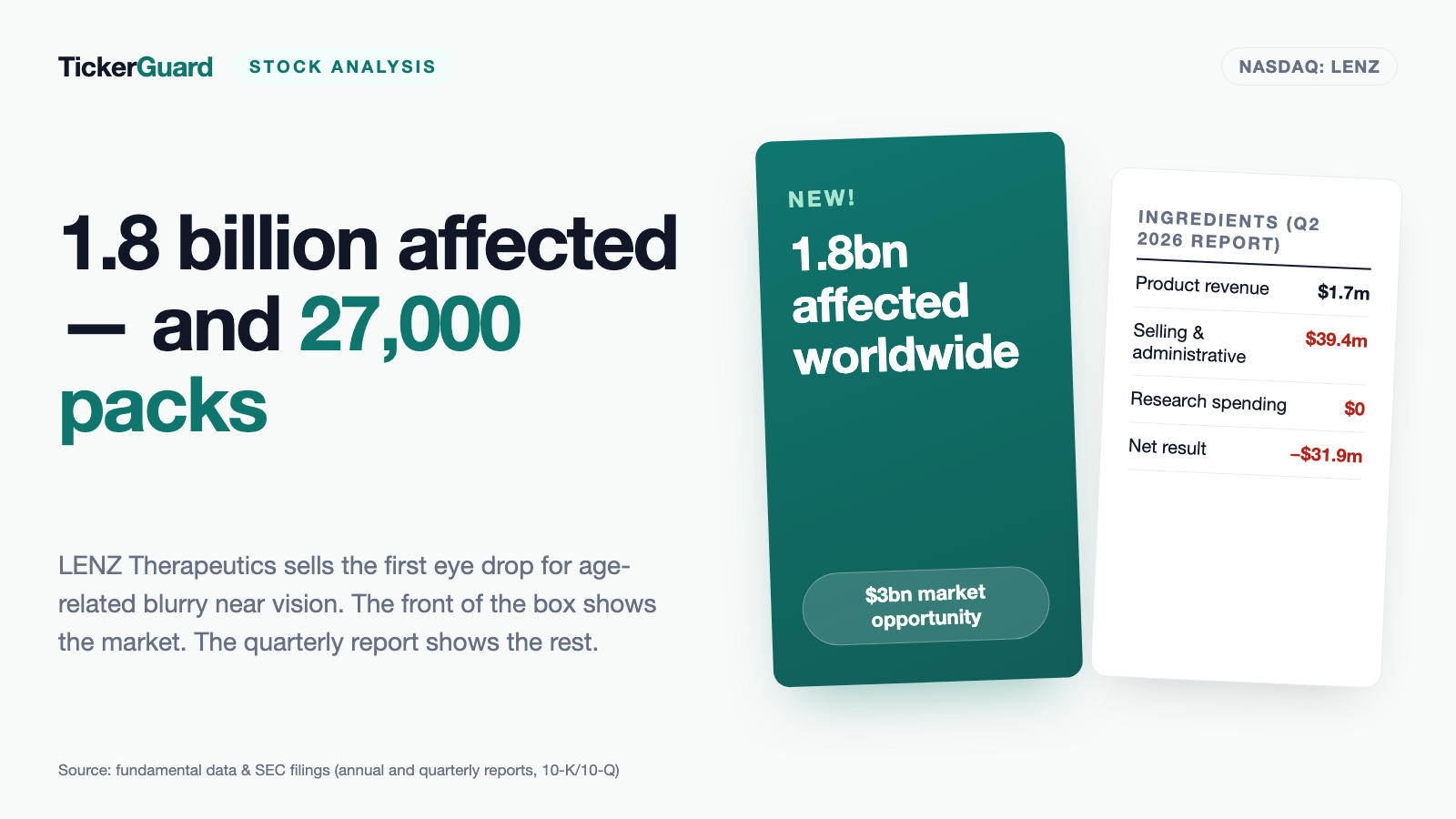
There is an investing weakness that feels like plain common sense: the self-test trap. You belong to the target group yourself, the product makes instant sense to you, so you treat commercial success as settled. LENZ Therapeutics, Inc. (Nasdaq: LENZ) sells VIZZ, the first and so far only aceclidine-based eye drop for presbyopia; the company counts 1.8 billion people affected worldwide and 128 million in the United States. In the second quarter of 2026, roughly 27,000 packs went out the door for $1.736 million in revenue, against $39.378 million of selling, general and administrative expense. This analysis does the arithmetic on what a single pack brings in and what it costs.
 Thomas Mücke
Founder & Publisher
Thomas Mücke
Founder & Publisher
As of Today
As of: October 5, 2026
- Closing price
- 3.60 $ +0.30%
- Market Capitalisation
- 0.1 $B
- Growth Score
- 2/10
- AAQS
- 3/10
Price change since August 20, 2026: -22.7%
This analysis has a cut-off date. The Stock Guard tells you when something material changes in the numbers. Reserve your free spot
Chart
Interactive price chart (TradingView).
52-week range: 3.60 $ to 48.60 $ · Last price: 3.60 $ (As of: October 5, 2026)
Note: pure fact-based analysis, not investment advice and not a solicitation to buy or sell. All figures without guarantee.
There is an investing weakness that does not feel like a weakness at all. It feels like common sense. Call it the self-test trap, and it strikes hardest when you are the target customer. You are past 45, the menu keeps drifting further from your face, there is a pair of reading glasses somewhere in the house — and then you read about an eye drop that takes care of all of it for ten hours. In that second your brain runs a calculation it mistakes for analysis: "I would buy that. So everyone will." This is exactly where LENZ Therapeutics, Inc. (Nasdaq Global Select Market: LENZ) of Solana Beach, near San Diego, stands. Since August 2025 the company has been selling VIZZ, the first and so far only eye drop based on aceclidine approved by the U.S. Food and Drug Administration for presbyopia — age-related blurry near vision. The affected population is enormous: 1.8 billion people worldwide, 128 million in the United States alone. So let us make a deal. Before you mistake the size of the population for the size of the revenue, we read together what LENZ itself told the U.S. securities regulator, the SEC: the Form 10-Q for the quarter ended June 30, 2026, filed on August 11, 2026, the Form 10-K for 2025, and the earnings release issued the same day as the 10-Q. An SEC filing is honest under penalty of law. And this one describes roughly 27,000 packs sold in a quarter, $39.4 million of selling and administrative expense, a research department that no longer exists — and a stock market that now assigns the entire operating business a negative price tag. What you make of it is your call.
What LENZ Therapeutics actually sells — and what became of Graphite Bio
LENZ Therapeutics is a single-product company. The product is VIZZ, an eye drop containing aceclidine at a concentration of 1.44 percent, dosed once daily, preservative-free, in single-dose vials. The mechanism is easy to picture. The drop contracts the pupil to under two millimeters, producing the same effect as a very small aperture on a camera: more of the scene stays sharp across a wider range of distances. The technical term is depth of focus; the label calls it a pinhole effect. Clear near vision is meant to last up to ten hours.
Sales are U.S.-only and prescription-only. Three channels carry the drug. Eye care professionals are called on by a dedicated field force, built in 2025 with 88 territories and expanded to 117 during the first half of 2026. A dedicated e-pharmacy partner ships direct to patients. And since July 2026 a telehealth platform lets an independent licensed eye care provider evaluate patients online and route the prescription straight to that pharmacy. Since July 2026 all of this has been backed by a national television campaign which, according to the company’s second-quarter 2026 earnings release, is fronted by brand spokesperson Sarah Jessica Parker. One point matters more than it looks: insurance does not pay. The quarterly report describes VIZZ explicitly as a product for the "out-of-pocket, cash-pay market" — the patient pays for every pack personally, every month.
The second revenue stream is out-licensing. LENZ has granted regional rights to VIZZ to partners: Everest Medicines, via CORXEL, for Greater China (since April 2022), Lotus for Southeast Asia (May 2025), Laboratoires Théa for Canada (July 2025), Lunatus for the Middle East (January 2026) and Arrotex for Australia and New Zealand (June 2026). These agreements bring upfront payments and milestones — and, so the promise goes, royalties later.
Anyone searching the archives for the corporate history will first find a different company. Until 2024 the listed shell belonged to Graphite Bio, Inc., a gene therapy company that went public on Nasdaq in 2021 under the ticker GRPH and whose development program failed. On March 21, 2024, the operating business, LENZ Therapeutics Operations, Inc., merged into that shell. The share count was consolidated 1-for-7, a special dividend of $1.03 per Graphite share was paid, and the company was renamed; the stock has traded as LENZ since March 22, 2024. In accounting terms this was a reverse recapitalization — LENZ is the accounting acquirer, and the historical figures are LENZ's, not Graphite's. That sets up the central tension of this analysis, and it runs through every chapter: the affected population is vast and the product is genuinely without a rival in its drug class — but the number of packs actually sold is tiny, and the machine that sells them costs a multiple of what they bring in.

Company history for investors
-
2021
The listed shell goes public as Graphite Bio
Graphite Bio first traded under the ticker GRPH on June 25, 2021. The gene therapy program failed; what remained for holders was largely the cash.
-
2024
Merger, 1-for-7 consolidation and a $1.03 special dividend
LENZ merged into the shell on March 21, 2024. Graphite holders received $1.03 per share in cash, the share count was consolidated 1-for-7, and the ticker has read LENZ since March 22, 2024.
-
2025
FDA approval for VIZZ and $147.7 million of fresh equity
The FDA approved VIZZ on July 31, 2025. In the same year LENZ placed 3,618,634 shares at a weighted-average $41.45 — after which the $150 million facility was fully exhausted.
-
2026
The first full selling quarters expose the volume gap
Q1 and Q2 2026 together delivered roughly 52,000 packs and $3.387 million of product revenue against $84.338 million of selling and administrative expense. Cash fell from $292.3 million to $220.0 million.
-
2026
Telehealth and a television campaign launch in July
Since July 2026 VIZZ can be prescribed online and delivered to the door, backed by a national television campaign. Both levers only reach the numbers from the third quarter of 2026 onward.
How the stock reached our desk
LENZ is not a momentum screen hit — quite the opposite. The stock reached our research list through a confluence of three signals in our in-house stock scanner (as of August 21, 2026) that rarely appear together. First, the stock sits in our near-52-week-low screen: the twelve-month high was $50.40, the low $4.535, and the stock trades at the bottom of that range. Second, it shows up below both its 50-day and its 200-day average price — in plain language, anyone who bought in recent months is under water. Third, it meets our "institutions above 80 percent" criterion: the register is held almost entirely by professional investors.
That third point deserves an honest footnote, because the reported institutional figure in the fundamental data exceeds 100 percent (as of August 21, 2026). That is not an arithmetic error but a familiar double count: when a fund lends its shares to a short seller, the same share appears twice in the filings, once with the lender and once with the buyer. And short selling here is heavy. The same data set shows roughly 11.3 million shares sold short as of August 21, 2026 — against 31,420,343 shares outstanding, that is a little over a third. Hold on to the picture: professionals sit on both sides of this trade, some holding, others betting on a fall.
The signal that actually mattered, though, is not in the price data but on the balance sheet: the market value is below the cash balance. That is why we looked at the company at all, and it is what the valuation chapter is about. Anyone who likes these setups will recognize the pattern from our work on Arcus Biosciences, where a billion dollars in the bank still landed the stock in the insolvency warning screen: a large cash pile is no safety net when it is being spent on purpose.
The numbers over the years — credit where it is due
First the case for LENZ, which is stronger than the loss line suggests. The company achieved what most biotech firms never do: it got a drug through approval. On July 31, 2025 the FDA cleared VIZZ, the first and so far only aceclidine-based product. The active ingredient qualifies as a new chemical entity in the United States and therefore carries regulatory exclusivity until July 2030 — in plain terms, until then no copycat may lean on the LENZ approval studies for a product of its own. The company puts U.S. patent protection at 2044 at a minimum. The launch went to plan: field force and physician samples from August 2025, e-pharmacy shipments from October 2025, broad retail pharmacy availability from November 2025.
The early commercial indicators are not bad either. According to the earnings release of August 11, 2026, more than 13,000 distinct eye care professionals had prescribed VIZZ through the second quarter of 2026, roughly three quarters of them more than once. More than 60 percent of patients in the e-pharmacy channel bought more than one monthly pack, and the patient cohorts from the fourth quarter of 2025 and the first quarter of 2026 are tracking toward about five packs a year. For a cash-pay prescription product competing against a pair of drugstore reading glasses, that is a respectable finding. And the revenue line is climbing: $1.588 million of product revenue in the fourth quarter of 2025, $1.651 million in the first quarter of 2026, $1.736 million in the second quarter of 2026.
Now the chart that puts all of it in proportion — the same quarters, with the cost of selling alongside:
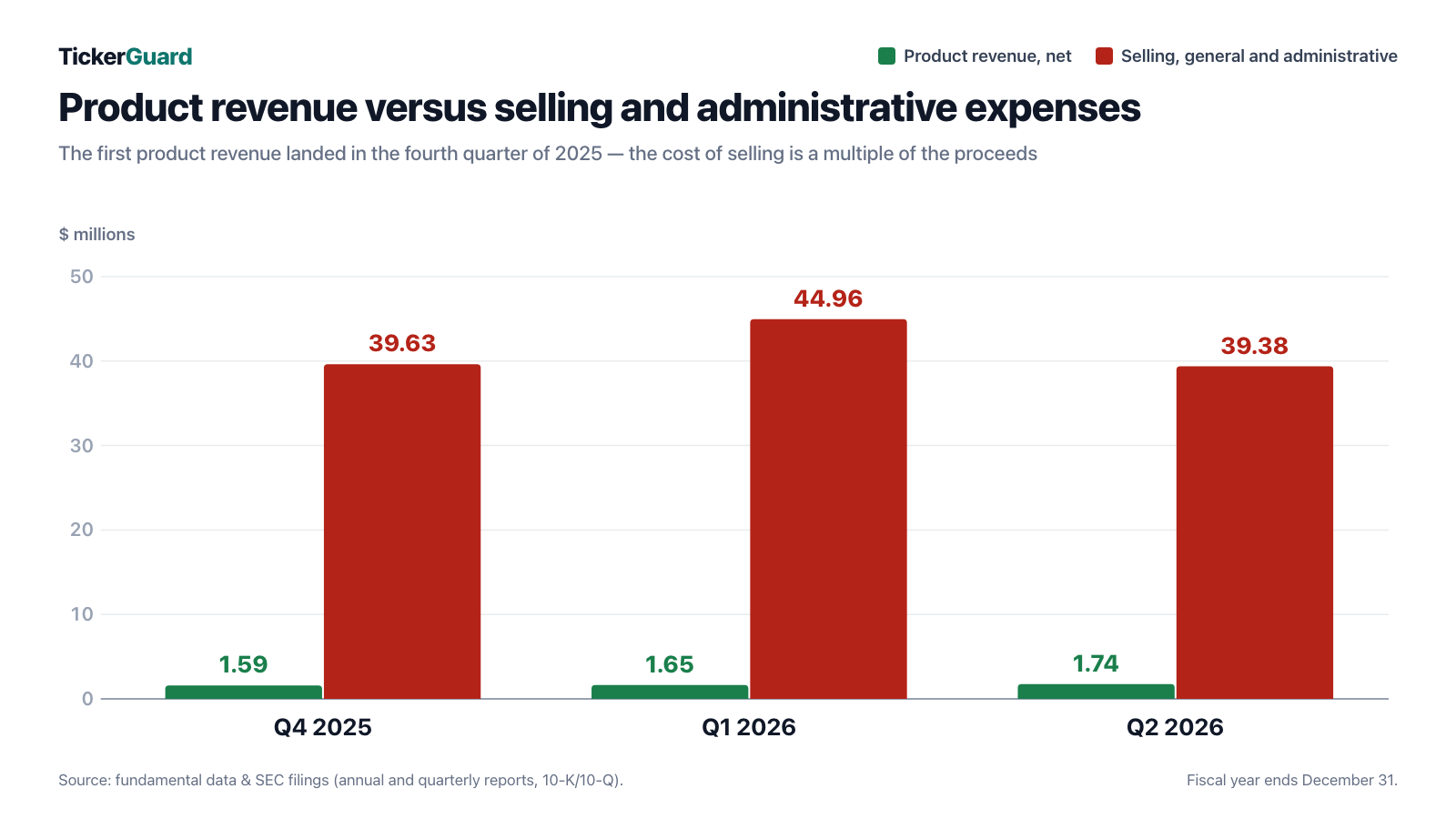
The multi-year view explains how it got there. In 2023 LENZ still spent $59.5 million on research and development against $12.9 million on selling, general and administrative expense — a textbook development company. In 2024 the ratio tipped ($29.8 million against $28.8 million), and in 2025 it inverted: $18.7 million of research against $91.1 million of selling and administrative expense. Revenue in 2025 was $19.088 million — but only $1.588 million of that came from product sales; the remaining $17.5 million was upfront and milestone payments from the international partners. The bottom line showed a loss of $82.127 million after $49.769 million in 2024. Accumulated deficit stood at $300.5 million as of June 30, 2026. Remember the finding: a research company has become a sales company — the cost base stayed, only the label changed.
What the filings say — the uncomfortable truths
Uncomfortable truth number 1: every pack sold brings in $64 — and carries $1,458 of overhead
Let us bring the second quarter of 2026 down to the level of a single pack, because only then does the scale become visible. The earnings release of August 11, 2026 cites "over $1.7 million" of product revenue on "approximately 27,000 packs sold"; the quarterly report puts net revenue at $1.736 million. That works out to roughly $64 of net revenue per pack (for the first half: $3.387 million across roughly 52,000 packs, or about $65). Against that stands $39.378 million of selling, general and administrative expense in the same quarter. Spread across 27,000 packs, that is roughly $1,458 per pack sold — twenty-two times what the pack brings in.
The calculation is deliberately crude, and it deserves a fair reading. Those $39.4 million include build-out costs that will later be spread across many more packs: the expansion of the field force from 88 to 117 territories, the television campaign, the construction of the telehealth platform. A company in the first year of a launch is supposed to spend more than it takes in. Even so, the order of magnitude is striking, and it survives the control test: selling, general and administrative expense was already $39.633 million in the fourth quarter of 2025 and $44.960 million in the first quarter of 2026. This is not a one-off spike; it is the run rate. A picture for it: imagine a shop paying the rent, staff and advertising of a department store while selling, for three quarters running, the merchandise volume of a newsstand. The price is not the problem. The volume is.
To put that volume in perspective, a cautious extrapolation using the company's own figures helps. Roughly 27,000 packs in a quarter annualize to about 108,000 packs. At the five packs per patient per year that management cites, that would correspond to roughly 21,600 people on continuous therapy — out of 128 million affected Americans. Two caveats belong with that number: what is counted are packs delivered to wholesalers and the e-pharmacy, not packs that actually reached a bathroom cabinet; and both telehealth and the television campaign only launched in July 2026, so their effect appears in none of these figures.
Uncomfortable truth number 2: 152 employees, not one in research — and zero research spending
The Form 10-K for 2025 contains a sentence you rarely see stated this plainly:
"As of December 31, 2025, we had 152 employees, none of whom were engaged in research and development activities."
— LENZ Therapeutics, Inc., Form 10-K for 2025, Item 1, "Human Capital"

The numbers confirm the sentence. Research and development expense fell from $59.504 million in 2023 to $29.801 million in 2024 and $18.670 million in 2025 — and to zero in the first half of 2026. The quarterly report explains it dryly: after approval, the remaining personnel, chemistry and regulatory costs were reclassified into selling, general and administrative expense. That is accounting-correct, and for a company with exactly one approved drug it is understandable. It has one consequence, though, that has to be said out loud:
"We do not currently have other product candidates in our development pipeline, and our success depends entirely on VIZZ."
— LENZ Therapeutics, Inc., Form 10-Q for the quarter ended June 30, 2026, Part II Item 1A, "Risk Factors"
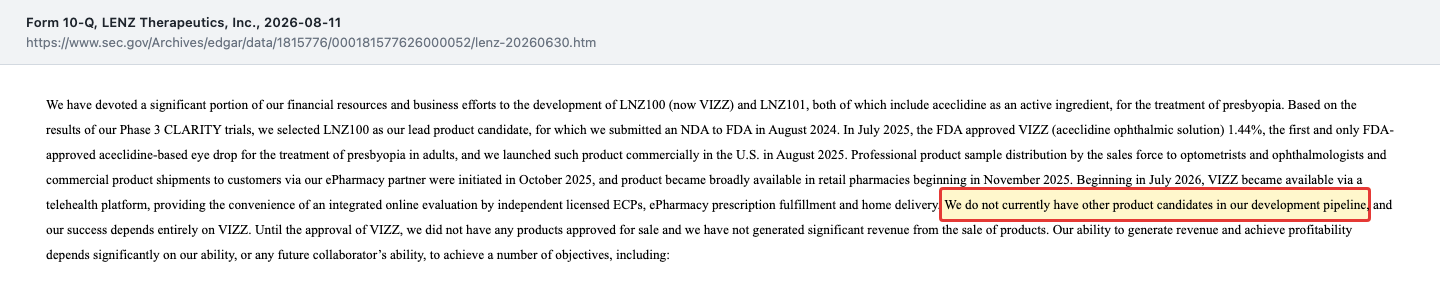
In everyday terms: a restaurant with exactly one dish on the menu can do very well — but it gets no second attempt. For LENZ that means concretely that if VIZZ does not take off, there is nothing to pivot to. And because nobody is doing research any more, nothing new is being created.
Uncomfortable truth number 3: the gross margin so far was a gift, and it has run out
Look at the product margin on VIZZ and the first impression is encouraging: $1.736 million of revenue in the second quarter of 2026 against direct product cost of sales of only $0.3 million — roughly 83 percent gross margin. That margin does not come from cheap manufacturing but from an accounting rule. Everything made before FDA approval in July 2025 had already been expensed as research at the time of production. That inventory carries a book value of zero and is therefore released almost free of charge when sold. The quarterly report spells out the consequence itself:
"Once zero cost inventory is depleted, cost of sales of VIZZ will increase on a per unit basis. Substantially all of our zero cost inventory has been sold as of June 30, 2026."
— LENZ Therapeutics, Inc., Form 10-Q for the quarter ended June 30, 2026, Item 2 MD&A, "Cost of sales"

The size of the effect can be bracketed. As of June 30, 2026, current inventories stood at $4.121 million — this time carried at real cost. Against quarterly revenue of $1.736 million, a shift of a few hundred thousand dollars in cost of sales is immediately material in double-digit percentage terms. Remember the pattern: the first number that shows what a pack of VIZZ really costs to make will appear in the quarterly report for the third quarter of 2026.
Uncomfortable truth number 4: the international partners have not paid a single royalty
Nine regulatory filings outside the United States, five licensing partners, milestone promises of up to $85.0 million (Greater China), $120.0 million (Southeast Asia) and $65.0 million (Canada) — the international story sounds like a second, larger earnings stream. In the second quarter of 2026 license revenue did indeed account for $3.750 million of $5.486 million in total revenue, more than two thirds and more than double the product revenue. But what flows in are upfront and milestone payments, not recurring participation in sales. The quarterly report is unambiguous:
"To date, we have not recognized any royalty revenue resulting from any of our license agreements."
— LENZ Therapeutics, Inc., Form 10-Q for the quarter ended June 30, 2026, Note 2, "Revenue Recognition"
The distinction matters. An upfront payment arrives once and is then gone. A royalty arrives every quarter — but only after the partner obtains approval in its territory and actually sells there. Every milestone beyond those already received is described in the filing as fully constrained, because it depends on approvals and sales thresholds. And there is a second consequence: because license revenue is lumpy, the revenue line is lumpy too. In the third quarter of 2025 LENZ reported $12.5 million of revenue, almost entirely licensing. One quarter later it was $1.588 million. Anyone reading a trend into curves like these is reading a contract payment schedule, not demand for eye drops.
Uncomfortable truth number 5: the competition has arrived — and the category has disappointed before
VIZZ is the only aceclidine drop, but not the only presbyopia drop. The quarterly report names the competition explicitly: Vuity from AbbVie, available as an Amneal generic since August 2025; Qlosi from Orasis, on the market since April 2025; and Yuvezzi from Tenpoint Therapeutics, approved in January 2026 and launched in March 2026. What is striking is how LENZ writes about them: the company says it expects Qlosi, Yuvezzi and generic Vuity to face "similar challenges to those faced by Vuity." Between the lines, that is the company conceding what the industry knows: the first presbyopia drop did not live up to expectations.
The argument cuts both ways, and both edges belong in the record. In LENZ's favor: if Vuity struggled chiefly because of its pharmacology — pilocarpine also stimulates the ciliary muscle and can cause a myopic shift and dim vision — then a pupil-selective agent is precisely the right answer. Against LENZ: the problem may not have been the molecule but the category. A cash-pay prescription product at roughly $64 net per month competes with reading glasses that cost twenty dollars once and then sit in a drawer. Fairness also requires the safety profile from the label: instillation site irritation in 20 percent of trial participants, dim vision in 16 percent and headache in 13 percent — mostly mild and self-resolving, but present. For a picture of what a biotech looks like once it has made the jump to profitable commercialization, see our analysis of TG Therapeutics, where the first record profit turned out to be three quarters tax benefit — the road from approved drug to earned money was long there too.
Valuation: the market pays less than the cash in the bank
There is no price-to-earnings ratio for LENZ, because there are no earnings. A price-to-sales ratio misleads, because two thirds of revenue comes from one-off licensing payments. The most honest yardstick is therefore the balance sheet, and it produces an unusual number. As of June 30, 2026, LENZ held $220.0 million in cash and marketable securities against total liabilities of only $17.3 million; the balance sheet carries no interest-bearing debt. Stockholders' equity stood at $219.262 million. Spread across the 31,420,343 shares outstanding as of August 5, 2026, that is roughly $7.00 of cash per share.
At the closing price of $4.66 on August 20, 2026, market value works out to roughly $146 million. Per share that means $4.66 of price against roughly $7.00 of cash — about two thirds. What that means for enterprise value is best shown as a bridge:
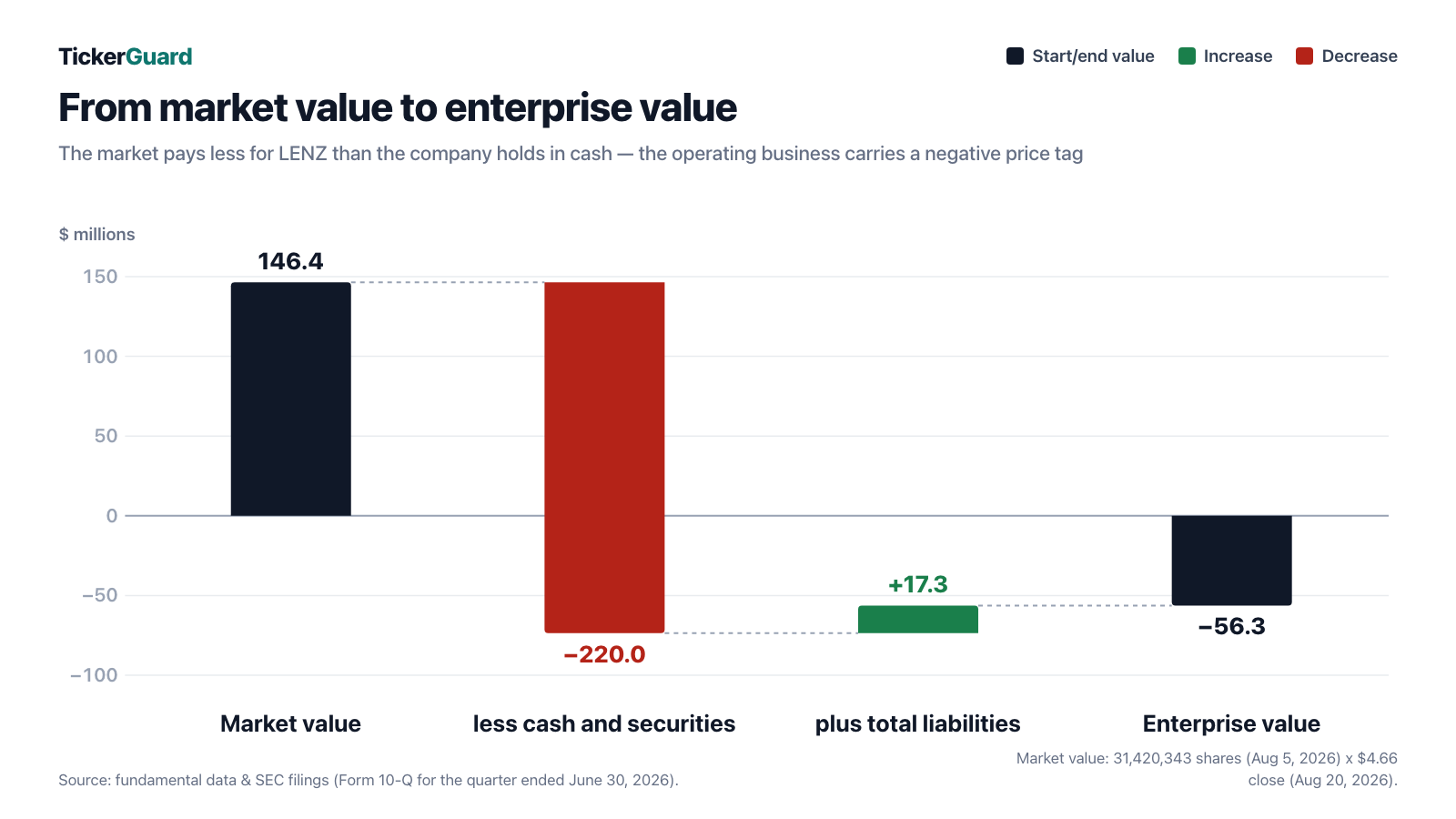
A negative enterprise value sounds like a bargain, but it is really a verdict. The market is not saying the business is worthless; it is saying the business will consume part of that money. And it has evidence: $72.295 million flowed out of operations in the first half of 2026, a little over $36 million per quarter. Extrapolated linearly, the cash lasts about six quarters — roughly through the end of 2027. That is not acute distress, but it is not a cushion from which you fund television advertising indefinitely either. The filing puts it carefully: management believes the resources allow continued commercialization of VIZZ, but the belief rests on assumptions that may prove wrong, and the company may need additional funds sooner than planned.
That is exactly where the catch sits. The most convenient financing tool is spent. Under the at-the-market facility signed in April 2025, LENZ placed 3,618,634 shares during 2025 at a weighted-average price of $41.45 for net proceeds of $147.7 million — and the $150.0 million capacity was fully exhausted as of December 31, 2025. What remains is a $500 million shelf registration, effective since April 14, 2025 for three years. Fresh equity at today's prices would be expensive: at $41.45, 3.6 million shares raised $147.7 million; anywhere near the August 20, 2026 close it would take a multiple of that share count for the same sum. On top of that sit 5,522,010 potentially dilutive instruments from options, share awards and warrants — roughly 17.6 percent of shares outstanding. Dilution, in everyday terms, means the cake stays the same size but is cut into more slices.
And what do the professionals think? The fundamental data as of August 21, 2026 show eight analyst estimates, averaging a $24 price target, with not a single sell rating — five times the August 20, 2026 close. At the same time roughly 11.3 million shares sit short in the same data set. That is not a disagreement over detail but one bet against another. Remember the finding: at LENZ the argument is not whether the product is good, but whether enough people buy it before the money runs out.
Upside and risks at a glance
What speaks for LENZ Therapeutics:
- An approved product without a rival in its drug class: VIZZ received FDA approval on July 31, 2025, carries new-chemical-entity exclusivity until July 2030, and the company puts U.S. patent protection at 2044 at a minimum.
- A debt-free balance sheet: $220.0 million of cash and marketable securities against $17.3 million of total liabilities as of June 30, 2026, with stockholders' equity of $219.262 million — no interest burden, no covenant, no maturity date.
- Early indicators that work: more than 13,000 distinct prescribing eye care professionals through the second quarter of 2026, roughly three quarters of them repeat prescribers; more than 60 percent of e-pharmacy patients bought more than one monthly pack, and the Q4 2025 and Q1 2026 cohorts track toward about five packs a year.
- Two new commercial levers launched in July 2026 whose effect appears in none of the figures cited here: the telehealth platform with online evaluation and home delivery, and the national television campaign with Sarah Jessica Parker.
- Five international partners and nine regulatory filings outside the United States, most recently Saudi Arabia in July 2026, with outstanding milestone promises of up to $85.0 million for Greater China, $120.0 million for Southeast Asia and $65.0 million for Canada.
What speaks against it:
- The proportions: roughly 27,000 packs sold and $1.736 million of product revenue in the second quarter of 2026 against $39.378 million of selling, general and administrative expense — about $64 of revenue per pack against roughly $1,458 of cost.
- No second leg to stand on: no further product candidates in development, zero research spending in the first half of 2026, and, per the 2025 annual report, not one of the 152 employees working in research and development.
- The product margin reported so far cannot be extrapolated: inventory carried at zero cost was substantially sold as of June 30, 2026, and the company explicitly flags rising cost of sales per unit.
- Burn rate and funding: $72.295 million of operating cash outflow in the first half of 2026, implying roughly six quarters of runway; the $150 million at-the-market facility was exhausted as of December 31, 2025, and 5,522,010 potentially dilutive instruments equal roughly 17.6 percent of shares outstanding.
- Competition and channel concentration: Vuity and its generic, Qlosi, and Yuvezzi since March 2026 mean three other presbyopia drops are on the market; three wholesalers accounted for 54 percent of gross accounts receivable as of June 30, 2026, up from 44 percent six months earlier.
A human bottom line
Back to the self-test trap. Its core is not that your judgment about the product is wrong. VIZZ is probably exactly what it looks like: a well-designed, cleanly approved drop that fixes a very real annoyance. The error sits one level down. "I would like that" does not automatically become "I buy it again every month, out of pocket, with a prescription." That gap between need and purchase is precisely what has been measured at LENZ — by the company itself, quarter by quarter: roughly 27,000 packs against 128 million affected Americans, $64 of revenue against $1,458 of cost per pack, no backup product in the drawer, and a cash balance that at this pace lasts about six quarters.
On the other side stands a company with no debt, a patent running to 2044, two commercial levers that only started in July 2026, and a market valuation that now pays less for the whole business than the company holds in cash. Both things are true. So the honest question is not "is the product good?" but: do you trust this sales machine to convert enough of the 128 million affected Americans — the only market LENZ sells in itself — into paying customers over the next six quarters, before new shares have to be issued? If yes, you have a thesis. If no, you had a need. What you make of it is your call. And that is exactly as it should be.
Sources
Every primary document used in this analysis, for you to read yourself:
- LENZ Therapeutics, Inc. — Form 10-Q for the quarter ended June 30, 2026 (filed August 11, 2026)
- LENZ Therapeutics, Inc. — Form 10-Q for the quarter ended March 31, 2026 (filed May 11, 2026)
- LENZ Therapeutics, Inc. — Form 10-K for 2025 (filed March 24, 2026)
- LENZ Therapeutics, Inc. — Second-quarter 2026 earnings release, Exhibit 99.1 to the Form 8-K of August 11, 2026
- Complete SEC filing history of LENZ Therapeutics, Inc.: EDGAR overview (sec.gov)
- Fundamental data (metrics, quarterly series, price data, analyst picture; as of August 21, 2026; closing price $4.66 on August 20, 2026), reconciled against the SEC filings.
- Scanner membership (near 52-week low, below the 50- and 200-day averages, institutions above 80 percent): our in-house stock scanner, as of August 21, 2026.
Transparency & disclaimer: This analysis is journalistic commentary on publicly available information. It is not investment advice, not a regulated financial analysis and not a solicitation to buy or sell securities. Equity investments carry substantial risk up to and including total loss. All information is provided without warranty; the as-of date of each figure is stated in the text. Positions held by the operator are disclosed daily; where one exists, it appears as a notice at the top of this deep dive.
Key figures at a glance
All monetary figures in millions of $; earnings per share as reported.
| Metric | 2021 | 2022 | 2023 | 2024 | 2025 |
|---|---|---|---|---|---|
| Revenue | 0.0 | 15.0 | 0.0 | 0.0 | 19.1 |
| Operating Income (EBIT) | -60.4 | -10.5 | -72.4 | -58.6 | -91.1 |
| Net Income | -70.8 | -10.8 | -70.0 | -49.8 | -82.1 |
| Net Margin | – | -72.1% | – | – | -430.3% |
| Earnings Per Share | -8.54 $ | -1.38 $ | -8.59 $ | -2.34 $ | -2.85 $ |
Source: fundamental data & SEC filings (annual and quarterly reports, 10-K/10-Q)
Our Bottom Line at a Glance
- Product and protection positive
- VIZZ received FDA approval on July 31, 2025 and is the first and so far only aceclidine-based eye drop for presbyopia. As a new chemical entity the active ingredient carries regulatory exclusivity until July 2030, and the Form 10-Q for June 30, 2026 puts U.S. patent protection at 2044 at a minimum. More than 13,000 distinct eye care professionals had prescribed it through the second quarter of 2026, roughly three quarters of them more than once.
- Commercial economics negative
- In the second quarter of 2026, roughly 27,000 packs and $1.736 million of product revenue stood against $39.378 million of selling, general and administrative expense — about $64 of revenue per pack against roughly $1,458 of cost. This is not an outlier: the same block was $39.633 million in the fourth quarter of 2025 and $44.960 million in the first quarter of 2026.
- Single-product dependence negative
- The Form 10-Q for June 30, 2026 states that no further product candidates are in development and that success depends entirely on VIZZ. Research and development expense was zero in the first half of 2026 (prior-year half: $14.879 million), and the 2025 annual report lists 152 employees, none of whom worked in research and development.
- Quality of earnings negative
- Two thirds of second-quarter 2026 revenue ($3.750 million of $5.486 million) was licensing upfronts and milestones; the company states it has recognized no royalty revenue from any agreement through June 30, 2026. The roughly 83 percent product margin reported so far also stemmed from inventory carried at zero cost, substantially sold as of June 30, 2026; the company itself flags rising cost of sales per unit.
- Balance sheet and funding neutral
- The balance sheet is debt-free: $220.0 million of liquidity against $17.3 million of total liabilities and $219.262 million of equity as of June 30, 2026. Against that stands $72.295 million of operating cash outflow in the first half of 2026 — roughly six quarters of runway on a straight-line basis. The $150 million at-the-market facility was exhausted as of December 31, 2025, and 5,522,010 potentially dilutive instruments equal roughly 17.6 percent of shares outstanding.
LENZ Therapeutics achieved what most biotech companies never do: it took a drug through approval. VIZZ has been on the U.S. market since August 2025, has no rival in its drug class and is protected. The gap sits behind it: roughly 27,000 packs sold and $1.736 million of product revenue in the second quarter of 2026 against $39.378 million of selling, general and administrative expense, no further product candidates, zero research spending in the first half of 2026 and exhausted zero-cost inventory. The balance sheet is debt-free and carries about six quarters at the $72.295 million half-year burn — yet the market values the operating business at roughly minus $56 million. Not investment advice.
What Our Rating Means
Open questions
The business works in principle, but one material question is open. As long as it stays open, our findings do not carry a quality verdict.
Yellow, because one single but decisive operating question is open: whether the sales machine finds enough paying cash-pay customers before the money runs out. The gap is documented — about $64 of net revenue per pack against roughly $1,458 of selling and administrative cost in the second quarter of 2026, plus no further product candidates and a product margin that from the third quarter of 2026 will carry real manufacturing cost for the first time. Red would still be wrong: the June 30, 2026 balance sheet shows $220.0 million of liquidity, no interest-bearing debt, $219.262 million of equity and roughly six quarters of runway, and the filing contains no going-concern warning. Green is ruled out by the unproven commercialization. That the stock closed below its cash per share on August 20, 2026 is a price argument and changes nothing here — it belongs to the valuation question, not to the quality rating. The decision is yours.
A journalistic assessment by our editorial team at the time of the deep dive, based on public sources — not investment advice and not a solicitation to buy or sell. Your personal circumstances (investment goals, risk capacity, taxes) cannot be taken into account. What our levels mean, how verdicts are formed, and what conflicts of interest exist →
Worth Noting
- The stock reached our research list through a confluence of three in-house scanner signals (as of August 21, 2026): proximity to the 52-week low, a price below both the 50- and 200-day averages, and institutional ownership above 80 percent. What tipped the decision, though, was the balance sheet — market value sits below the cash reported in the latest quarterly report.
- As-of dates and scope: all balance sheet and income figures come from the Form 10-Q for the quarter ended June 30, 2026 (filed August 11, 2026), the most recent filing; no further filing was made through August 21, 2026. Price and market data carry an as-of date of August 21, 2026, and the price anchor is the August 20, 2026 close. Packs sold are shipments to wholesalers and the e-pharmacy, not necessarily patient consumption.
- Possible confusion: the listed shell belonged to Graphite Bio, Inc. (ticker GRPH) until March 2024, so historical price and metric series before March 22, 2024 partly reflect that predecessor, including the 1-for-7 share consolidation and the $1.03 per share special dividend paid to Graphite holders.
Stock Watch
This analysis is as of August 26, 2026. Stock Watch will tell you what's changed at LENZ since then.
Later $1 a month per stock — signing up is free, and you'll be the first to know when it launches.
The full analysis as a PDF for later
We will send you this analysis as a PDF — to print, file away, and read at your own pace. And we will add you to the free Stock Watch list for LENZ Therapeutics Inc (LENZ), so you hear about it when something material in this analysis changes.
Frequently Asked Questions
LENZ Therapeutics, Inc. (Nasdaq: LENZ), based in Solana Beach near San Diego, sells a single product: VIZZ, an eye drop containing aceclidine at 1.44 percent for presbyopia, or age-related blurry near vision. The U.S. Food and Drug Administration approved it on July 31, 2025, and U.S. sales have run since August 2025 through eye care professionals, an e-pharmacy partner and, since July 2026, a telehealth platform. LENZ also licenses VIZZ to partners in Greater China, Southeast Asia, Canada, the Middle East, and Australia and New Zealand.
Product revenue was $1.736 million in the second quarter of 2026 on roughly 27,000 packs sold, and $3.387 million in the first half of 2026 on roughly 52,000 packs. That works out to about $64 to $65 of net revenue per pack. Total revenue in the second quarter of 2026 was $5.486 million — the difference of $3.750 million was licensing income from international partners, not product sales.
As of June 30, 2026 LENZ held $220.0 million in cash and marketable securities against only $17.3 million of total liabilities — roughly $7.00 of cash per share. The closing price on August 20, 2026 was $4.66. The discount reflects the burn rate: $72.295 million flowed out of operations in the first half of 2026. The market is pricing in that part of the cash will be consumed.
The listed shell, yes; the business, no. Graphite Bio, Inc. went public on Nasdaq in 2021 under the ticker GRPH and its gene therapy program failed. On March 21, 2024 the operating company, LENZ Therapeutics Operations, Inc., merged into that shell; the share count was consolidated 1-for-7 and a special dividend of $1.03 per Graphite share was paid. In accounting terms LENZ is the acquirer, so the historical figures are LENZ's own.
Roughly six quarters on a straight-line basis. The balance sheet showed $220.0 million of cash and marketable securities as of June 30, 2026, while $72.295 million flowed out of operations in the first half of 2026 — a little over $36 million per quarter. The filing contains no going-concern warning. The $150.0 million at-the-market share facility, however, was fully exhausted as of December 31, 2025.
The Form 10-Q for June 30, 2026 names three other presbyopia drops in the U.S. market: Vuity from AbbVie, available as an Amneal generic since August 2025; Qlosi from Orasis, on the market since April 2025; and Yuvezzi from Tenpoint Therapeutics, approved in January 2026 and launched in March 2026. VIZZ is the only aceclidine-based drop; the others use pilocarpine or carbachol.
No. The quarterly report describes VIZZ explicitly as a product for the out-of-pocket, cash-pay market in the United States. Patients pay for every pack themselves and need a prescription to do so. LENZ realized roughly $64 of net revenue per pack in the second quarter of 2026 — the retail price a patient pays can differ, because distribution margins, discounts and service fees sit in between.
Because the development program ended with the approval of VIZZ. Research and development expense fell from $59.504 million in 2023 to $29.801 million in 2024 and $18.670 million in 2025, and to zero in the first half of 2026; the remaining personnel and regulatory costs were reclassified into selling, general and administrative expense. The 2025 annual report lists 152 employees, none of them in research and development — and there are no further product candidates.
Found an error?
Did you spot a factual error, an outdated number, or a typo in this deep dive? Let us know briefly — your report goes straight to the editorial team.