Investors Title Company: What Is Left of 19 Percent More Profit Once You Read the Appendix
Investors Title Company reported second-quarter 2026 earnings per share up 19.3 percent — the kind of headline most investors are happy to stop reading at. The North Carolina title insurer discloses a second, quieter number in the same report: an adjusted pre-tax income that grew only 7.0 percent once market-driven investment gains are stripped out. Add a company majority-adjacent to the founding Fine family for five decades, a debt-free balance sheet, and a shareholder list that carries one of the best-known names in U.S. insurance investing. Not investment advice — just the appendix the headline does not show you.
 Thomas Mücke
Founder & Publisher
Thomas Mücke
Founder & Publisher
As of Today
As of: September 24, 2026
- Closing price
- 287.20 $ -1.20%
- Market Capitalisation
- 0.5 $B
- P/E
- 14.9
- Growth Score
- 5/10
- AAQS
- 4/10
Price change since August 10, 2026: +0.5%
This analysis has a cut-off date. The Stock Guard tells you when something material changes in the numbers. Reserve your free spot

Chart
Interactive price chart (TradingView).
52-week range: 210.10 $ to 306.00 $ · Last price: 287.20 $ (As of: September 24, 2026)
Note: pure fact-based analysis, not investment advice and not a solicitation to buy or sell. All figures without guarantee.
There is a reflex that hits especially hard with quarterly earnings: you read the first bold number in a press release — here: net income up 19.3 percent per share — and your brain quietly files the stock under "doing well" before you've read the second page. Behavioral economists call this the anchoring effect: the first number you see becomes the yardstick for everything that follows, and the rest of the text gets skimmed only to confirm it. That is exactly what happened with Investors Title Company (NASDAQ: ITIC), a title insurer out of Chapel Hill, North Carolina, on August 6, 2026: net income $14.6 million, $7.73 per diluted share, up 19.3 percent from the prior-year quarter. The headline is accurate — it is lifted word for word from the company's own earnings release. But the same document, two pages later in Appendix A, carries a second calculation the company itself labels "adjusted" — and it grows a lot less impressively. Today we read both numbers, plus the freshly filed quarterly report (10-Q) dated August 10, 2026, and the annual report (10-K) for 2025 — primary documents filed under penalty of law with the U.S. Securities and Exchange Commission. By the end, you'll know which of the two numbers the business actually earns.
What Investors Title Company does
Title insurance is required in practice on nearly every U.S. real estate purchase — and a concept many international readers rarely encounter, because most other countries rely on a centralized land registry for the same purpose. The U.S. has no single, fully reliable land registry; instead, a title insurer checks a property's entire chain of ownership before every sale for errors, old liens, inheritance disputes or fraud — and, for a one-time premium, takes on the risk that a defect surfaces years later. Investors Title Company was incorporated in North Carolina in 1973 as a holding company and became operational in 1976, when it acquired Investors Title Insurance Company ("ITIC," operating since 1972); National Investors Title Insurance Company ("NITIC," operating since 1973, redomesticated to Texas in November 2014) followed in 1983. Through these two subsidiaries the company is licensed in 44 U.S. states and the District of Columbia, and writes as a primary insurer in 21 states plus D.C. (mostly in the eastern U.S., via ITIC) and in Texas (via NITIC) — each subsidiary also reinsures the other, and third-party title insurers.
Alongside the core business, subsidiaries Investors Title Exchange Corporation and Investors Title Accommodation Corporation run a second, smaller segment: services around so-called 1031 exchanges — a U.S. tax mechanism that lets real-estate owners defer capital-gains tax on a sale if the proceeds are reinvested in a like-kind replacement property. The company holds the interim funds in trust. Rounding things out are an agency management subsidiary (Investors Title Management Services) and a small investment and trust business (Investors Trust Company) for individuals and institutions. As of December 31, 2025 the company employed 548 full-time and 26 part-time staff. In the second quarter of 2026, 70.8 percent of premium revenue came in through independent agents, 29.2 percent direct — a typical split for the industry.
Company history for investors
-
1973
Founded as a holding company in North Carolina
Investors Title Company is formed as a parent entity; the actual insurance business initially runs through a subsidiary founded in 1972.
-
1976
The company becomes operational
Acquisition of Investors Title Insurance Company as a wholly owned subsidiary — the starting point of today's business.
-
1983
Second title insurer NITIC joins the group
National Investors Title Insurance Company broadens the primary-insurer base; based in Texas since November 2014, where it has since written primarily.
-
2015
Share repurchase program approved
The board approves buying back up to 500,000 shares — a program still running today, though unused in the second quarter of 2026.
-
2026
Strongest quarter in years reported
On August 6, 2026, the company reports its highest quarterly profit in years — with the caveat that part of it comes from investment gains, as the company's own report discloses.
The numbers over the years
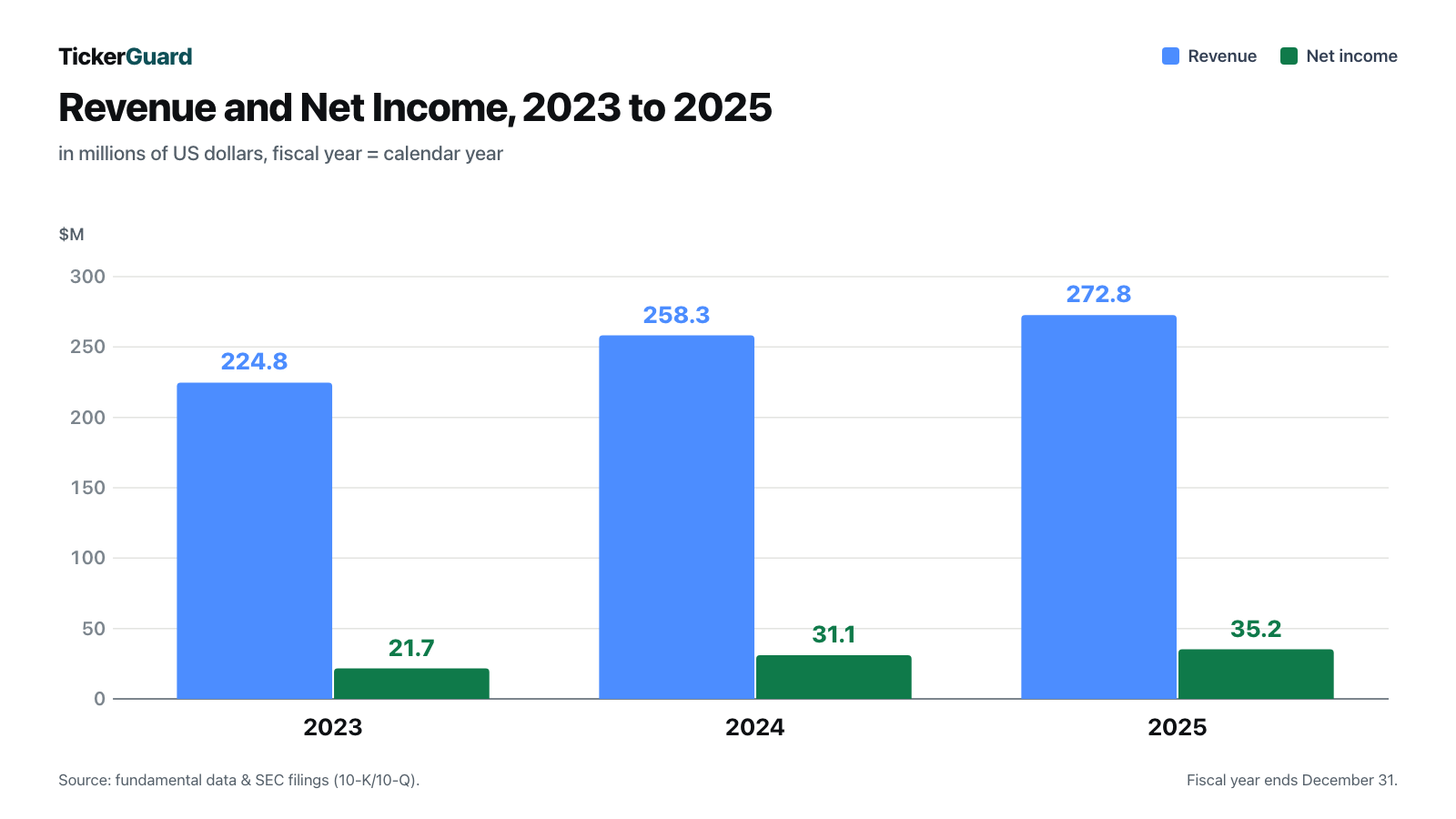
Let's start with what isn't in dispute: Investors Title has grown solidly and profitably for years. Revenue rose from $224.8 million (2023) to $258.3 million (2024) to $272.8 million (2025); net income over the same span went from $21.7 million to $31.1 million to $35.2 million. Fiscal year equals calendar year.
Then came the second quarter of 2026, reported August 6, 2026: revenue $86.5 million (+17.5% year over year), pre-tax income $19.4 million (+23.1%), net income $14.6 million or $7.73 per diluted share (+19.3% versus $6.48). At first glance, an acceleration on top of an already solid multi-year trend. The company attributes most of the revenue growth to a $13.3 million rise in premium and fee income, "resulting from higher real estate activity levels and ongoing expansion initiatives" — that's the good, operating story. But there's a second number in the same report that tempers the headline. The next section is devoted to it.
What the filings say — the uncomfortable truths
Uncomfortable truth No. 1: A third of the earnings jump is a capital-markets coincidence, not a business achievement
Anyone reading "19.3 percent more profit per share" and assuming an across-the-board stronger operating business is only partly right. Buried in the quarter's numbers is a line called net investment gains: $4.8 million in Q2 2026, versus $2.1 million in the prior-year quarter — a $2.7 million swing that flows straight into revenue and earnings. The filing names the source itself: "primarily driven by favorable changes in the estimated fair value of equity security investments" — translation: mostly unrealized, market-dependent gains on the company's own equity portfolio, not income from the actual title insurance business. Because management evidently considers this distinction important, it publishes its own adjusted metric in Appendix A of the earnings release:
"Excluding the impact of net investment gains, adjusted income before income taxes (non-GAAP) increased to $14.7 million for the current year quarter, versus $13.7 million in the prior year period."
— Investors Title Company, earnings release (8-K, Exhibit 99.1), August 6, 2026, Appendix A

Converting that into percentages makes the gap plain: reported pre-tax income grew 23.1 percent, the adjusted figure only 7.0 percent — less than a third. Picture a small manufacturing shop whose owner also runs a private stock portfolio on the side. When the market has a good run, the shop's year-end results suddenly look a lot better than the order book alone would justify — not because more customers walked in, but because the portfolio gained value. Something similar is happening here, except that Investors Title, as an insurer, is required to hold an investment portfolio in the first place (premiums collected today aren't paid out as claims for years, and must be invested in the meantime) — the swings in that portfolio's value are a normal, but non-operating, part of earnings. Context matters here too: over six months the gap narrows. Adjusted pre-tax income for the first half of 2026 rose from $18.9 million to $21.8 million — up 15.4 percent, solid and closer to the multi-year trend of recent years. So the quarter wasn't wrong, but the 19.3 percent headline isn't the whole story either. A small side note reinforces the caution: the "Other" revenue line fell from $2.9 million to $0.15 million in the quarter because the prior-year quarter included a "non-recurring gain" — meaning last year's comparison base wasn't entirely clean either, in this instance actually working against this year's growth comparison.
Uncomfortable truth No. 2: The tailwind is still missing — growth is self-made, not market-driven
A good quarter in a tough market is, in fairness, a strength rather than a weakness — but an honest analysis still owes readers the context. The quarterly filing describes conditions plainly: the Federal Reserve raised its policy rate to a range of 5.25 to 5.50 percent between March 2022 and July 2023, cut it gradually through 2024 and 2025, and last cut it in December 2025 to a range of 3.5 to 3.75 percent — where it stayed throughout the second quarter of 2026. The policy rate doesn't set mortgage rates directly, but lenders pass rate changes on to buyers, and the filing states: "The current period of elevated mortgage interest rates has impacted the demand and pricing of real estate." Chairman J. Allen Fine is quoted in the earnings release itself:
"Enabled by the strength of our balance sheet and financial position, we have continued investing in initiatives to build market share as well as internal efforts to increase capabilities and efficiency. Despite sluggish market conditions, we believe we are well positioned to create long-term shareholder value over the course of a slower phase of the real estate cycle."
— J. Allen Fine, Chairman, Investors Title Company, earnings release (8-K, Exhibit 99.1), August 6, 2026

That's a remarkably candid line for a press release meant to sell good numbers — and it explains why operating growth (see above: +7.0 percent adjusted for the quarter) came through despite an inherently difficult market: by the company's own account, it is largely self-made, driven by "expansion initiatives" rather than a broad real-estate boom. For investors, that cuts two ways. First, the company can grow against the wind — a genuine operating strength. Second, an eventual turn in the rate cycle toward higher real-estate activity represents an additional, not-yet-priced-in lever — but it also means much of today's growth was earned without that tailwind, and any slowdown in "expansion initiatives" would bite harder than at a competitor riding a strong market.
Uncomfortable truth No. 3: A quarter of the company belongs to the founding family, another tenth to a single insurance conglomerate
Only 1,887,996 shares are outstanding at Investors Title (as of July 28, 2026, per the quarterly report's cover page) — one of the smallest share counts among U.S. small caps, which is why the per-share price runs high ($285.83 on August 10, 2026) and shouldn't be compared to a typical retail-friendly stock price. Ownership is unusually concentrated: per the 2026 proxy statement (as of April 1, 2026), Chairman J. Allen Fine holds 196,475 shares (10.41%), his brother W. Morris Fine holds 178,804 shares (9.47%), and President James A. Fine, Jr. holds 178,491 shares (9.45%) — with partially overlapping holdings through a shared entity, together roughly a quarter of the company, in the same family since the 1970s. The single largest shareholder, though, isn't a family name: it's Markel Corporation, with 213,300 shares (11.30%), reportable since a Schedule 13G amendment filed in February 2017.
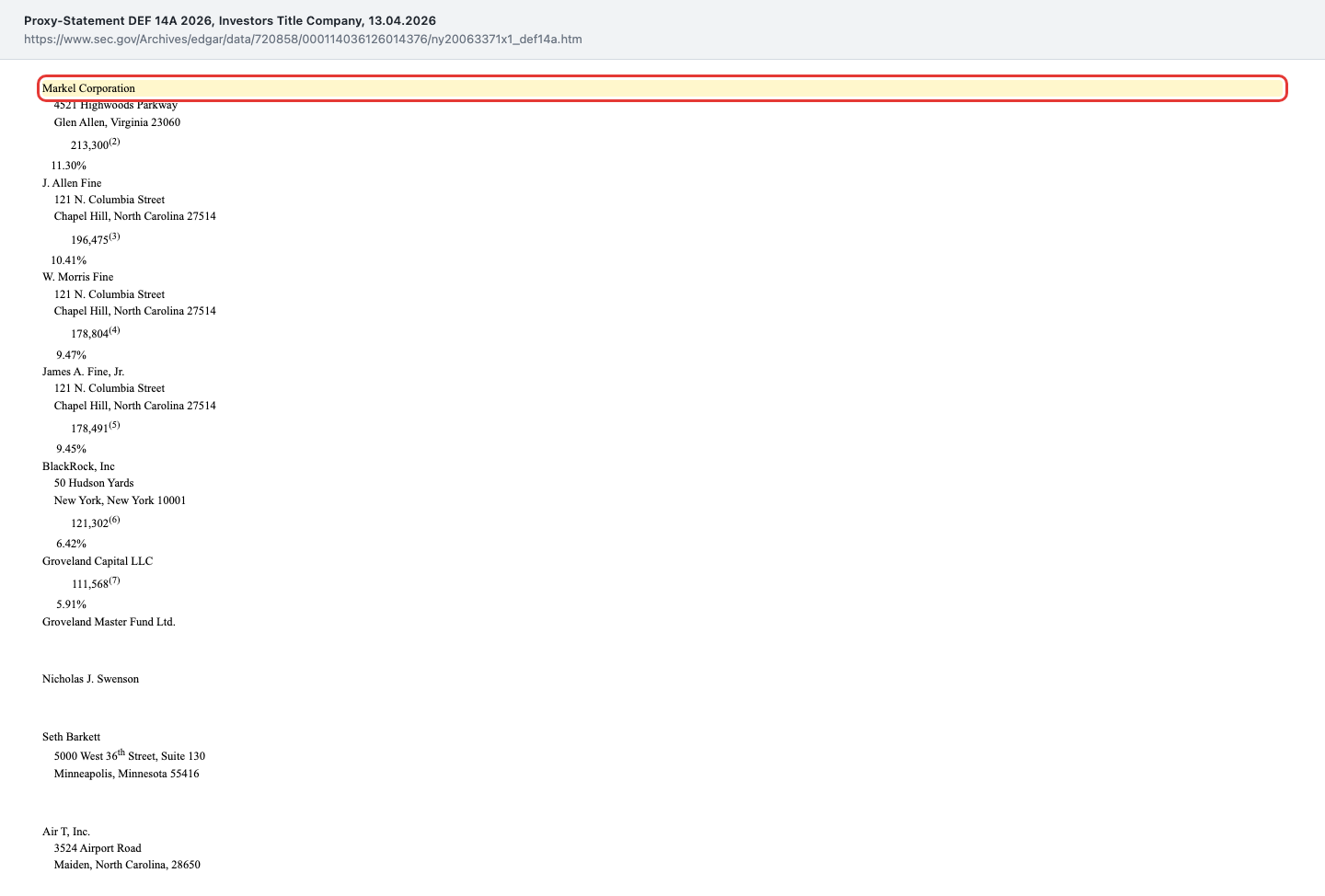
Markel is itself an insurance conglomerate whose investment philosophy is often described in financial media as a "mini-Berkshire" — a well-known, long-term-oriented investor that has been on the register for nearly a decade. Add a cluster of smaller, small-cap-community-known investors (Groveland Capital/Nicholas Swenson, GrizzlyRock Capital/Kyle Mowery, Vivaldi Asset Management and related parties) with a combined 5.91 percent, plus BlackRock as a passive index holder at 6.42 percent. Taken together, a very large share of the stock sits in a small number of hands, several unchanged for years. As with other owner-operated special situations we've covered before — including the similarly family-steered holding company Biglari Holdings — this is no governance violation and is fully disclosed, but it's a concrete fact for anyone considering a position: free float is thin, trading volume is correspondingly light, and a sudden position change by a major holder can move the price more than it would for a widely held stock.
Valuation: solid, not obviously cheap
At $285.83 (August 10, 2026), Investors Title carries a market capitalization of roughly $539.6 million — shares outstanding times price lands almost exactly on that figure, good evidence the underlying share count checks out. The trailing-twelve-month price-to-earnings ratio sits around 13.4 — for a debt-free insurer with a return on equity near 14.6 percent and three straight years of rising profit, that's not an obviously expensive level, but it's not a screaming bargain either. Price-to-book sits around 1.9 (stockholders' equity of $286.6 million as of June 30, 2026, or roughly $151.79 book value per share) — a premium to book that a profitable, growing insurer typically earns, but one investors still have to pay for. We deliberately didn't lead with a data provider's "forward P/E" figure of under 8: for a stock this thinly covered by analysts with such a small float, a single estimate can distort that number heavily, and we didn't want to print a figure that implies more precision than it has. The 52-week range runs from $208.91 to $297.31 — the current price sits closer to the top of that range, consistent with the solid operating trend, but also a sign that some of the good news is likely already priced in. The stock offers no meaningful dividend yield (under 0.5 percent) — an investment here is a bet on price appreciation and book-value growth, not current income.
Opportunities and risks at a glance
What speaks for Investors Title Company:
- Three straight years of rising revenue and profit (2023 through 2025), plus a strong first half of 2026 — including on an adjusted, investment-gains-excluded basis (+15.4% over six months).
- Debt-free balance sheet with $380.1 million in total assets, $286.6 million in stockholders' equity, and a return on equity around 14.6 percent.
- Growth is, by the company's own account, mostly driven by "expansion initiatives" rather than a favorable market — the company is growing despite "sluggish market conditions," which leaves extra upside once the real-estate cycle turns.
- Experienced management with deep roots in the business since the 1970s and strong personal stakes (the Fine family owns roughly a quarter of the shares); a well-regarded insurance value investor, Markel Corporation, has held a stake for nearly a decade.
- Ordinary, business-as-usual legal risk: the quarterly filing shows no material pending litigation, no governance or accounting red flags, and no reportable events after the balance-sheet date.
What argues against it:
- A good third of the Q2 earnings jump (23.1% versus 7.0% adjusted growth) comes from unrealized, market-dependent investment gains rather than the core business — a stock-market pullback would reverse that effect.
- Only 1,887,996 shares outstanding, roughly a quarter held by the founding family and another 11.3 percent by a single large holder (Markel) — correspondingly thin float and light trading liquidity.
- The business remains structurally dependent on the U.S. real estate and mortgage market; persistently elevated mortgage rates continue, by the company's own account, to weigh on demand and pricing.
- Valuation, at roughly 13.4x trailing earnings and 1.9x book, is not obviously cheap, and the stock trades near the top of its 52-week range ($208.91 to $297.31).
- Non-title-related revenue (part of the smaller "non-title services" segment) declined in Q2 2026 ($5.1 million versus $5.5 million) — a small but visible counter-trend to an otherwise strong picture.
A human conclusion
Back to the anchoring effect from the opening. Its lesson isn't that the headline was wrong — Investors Title Company did earn 19.3 percent more profit per share in the second quarter of 2026, every cent of it real and reported. Its lesson is that the first number you read can stop you from looking for the second one — and the second number sits right here, voluntarily disclosed by the company itself, in Appendix A. Read only the headline, and you see a quarter suddenly growing much faster than in prior years. Read the appendix, and you see a solid but not spectacularly accelerating company — run by management honest enough to spell out the difference itself, and owned by people who know the numbers best and have stayed invested for decades. So the honest question isn't "Is 19 percent more profit good news?" It's: would you still find this stock attractive if you underwrote it on the 7.0 to 15.4 percent of adjusted growth — not the headline? If yes, you have a thesis grounded in the operating business. If no, you had a headline. What you do with that is your call. And that's exactly how it should be.
Sources
All primary documents used in this analysis — for further reading:
- Investors Title Company — SEC quarterly report 10-Q as of 06.30.2026 (filed August 10, 2026)
- Investors Title Company — earnings release 8-K, Exhibit 99.1, dated August 6, 2026
- Investors Title Company — SEC annual report 10-K for 2025 (filed March 16, 2026)
- Investors Title Company — SEC annual report 10-K for 2024 (filed March 17, 2025)
- Investors Title Company — SEC proxy statement DEF 14A 2026 (filed April 13, 2026)
- Complete SEC filing history for Investors Title Company: EDGAR overview (sec.gov)
- Fundamental data (price, metrics, valuation; data as of August 10, 2026), reconciled against the SEC filings.
Transparency & disclaimer: this analysis is a journalistic assessment of publicly available information and is not investment advice, not a regulated financial analysis, and not a solicitation to buy or sell any security. Stock investments carry significant risk, including total loss. All figures are provided without guarantee; the data date is noted throughout the text. Positions held by the operator are disclosed daily; where one exists, it appears as a notice at the top of this deep dive.
Key figures at a glance
All monetary figures in millions of $; earnings per share as reported.
| Metric | 2021 | 2022 | 2023 | 2024 | 2025 |
|---|---|---|---|---|---|
| Revenue | 329.5 | 283.4 | 224.8 | 258.3 | 272.8 |
| Operating Income (EBIT) | 84.9 | 30.1 | 26.2 | 39.5 | 44.5 |
| Net Income | 67.0 | 23.9 | 21.7 | 31.1 | 35.2 |
| Net Margin | 20.3% | 8.4% | 9.6% | 12.0% | 12.9% |
| Earnings Per Share | 35.27 $ | 12.59 $ | 11.46 $ | 16.42 $ | 18.56 $ |
Source: fundamental data & SEC filings (annual and quarterly reports, 10-K/10-Q)
Our Bottom Line at a Glance
- Operating substance positive
- Revenue and net income rose every year from 2023 to 2025 (revenue $224.8 million → $272.8 million, net income $21.7 million → $35.2 million), and the first half of 2026 continues the trend — including on an investment-gains-adjusted basis (+15.4% adjusted pre-tax income). An established core business dating back to the 1970s.
- Q2 2026 earnings quality neutral
- The reported earnings jump (+19.3% per share) includes a meaningful, company-disclosed non-operating component: $4.8 million in net investment gains, mostly unrealized. Adjusted pre-tax income grew only 7.0% for the quarter. Not a red flag, but a headline that needs a closer read.
- Balance-sheet quality positive
- No reported borrowings, $286.6 million in stockholders' equity against $380.1 million in total assets, return on equity around 14.6%. The claims reserve ($39.1 million) is mostly actuarially estimated (IBNR), which is normal for a long-established title insurer with a stable claims history.
- Ownership & liquidity neutral
- Only 1,887,996 shares outstanding, roughly a quarter held by the founding Fine family, another 11.3% by Markel Corporation. Fully disclosed and free of governance red flags, but a small free float with correspondingly thin trading liquidity — a structural, not a quality, finding.
- Market environment neutral
- The business remains structurally tied to the U.S. real estate and mortgage market. The company itself describes conditions as "sluggish" and attributes recent growth mostly to its own expansion initiatives, not a broad market upswing — an as-yet-unused lever should the rate cycle turn.
Investors Title Company is a solid, debt-free title insurer with three straight years of rising revenue and profit — but the 19.3 percent earnings headline from the second quarter of 2026 only partly holds up under closer inspection: a good third of it comes from market-dependent, mostly unrealized investment gains that the company itself discloses in Appendix A of its earnings release. Adjusted operating pre-tax income grew 7.0 percent for the quarter, 15.4 percent over six months. Add a highly concentrated ownership structure (the founding family plus Markel Corporation together holding roughly a third of the shares) with correspondingly thin free float. Not investment advice.
What Our Rating Means
Quality confirmed
Business model, numbers and balance sheet hold up to our review. Whether the current price supports an entry is a separate question — it hangs on the price, not on the company.
The business model has held up for five decades, the numbers have grown reliably over multiple years, the balance sheet carries no debt, and the filings show no going-concern language, no governance or accounting red flags, and no material pending litigation. The only significant open question isn't about the company's substance — it's about how to read a single quarterly headline. That's an interpretation risk, not a solvency risk. Anyone investing should track, in every future report: does adjusted, investment-gains-excluded income keep growing double digits? Does the ownership structure shift? And does the U.S. real estate cycle turn, adding a tailwind that isn't there yet? The decision is yours.
A journalistic assessment by our editorial team at the time of the deep dive, based on public sources — not investment advice and not a solicitation to buy or sell. Your personal circumstances (investment goals, risk capacity, taxes) cannot be taken into account. What our levels mean, how verdicts are formed, and what conflicts of interest exist →
Worth Noting
- This analysis was prompted by the quarterly report as of June 30, 2026 (10-Q, filed 08.10.2026; earnings release 8-K dated 08.06.2026) — the most recent report available at publication. All subsequent filings were reviewed for anything picture-changing (none found).
- Data source: fundamental data & SEC filings (annual and quarterly reports, 10-K/10-Q). Market capitalization was cross-checked against shares outstanding times price and matched almost exactly.
- Not to be confused: "Investors Title Company" (ITIC) is a standalone U.S. title insurer based in North Carolina — not to be confused with other companies carrying "Title" or "Investors" in their name.
Stock Watch
This analysis is as of August 26, 2026. Stock Watch will tell you what's changed at ITIC since then.
Later $1 a month per stock — signing up is free, and you'll be the first to know when it launches.
The full analysis as a PDF for later
We will send you this analysis as a PDF — to print, file away, and read at your own pace. And we will add you to the free Stock Watch list for Investors Title Company (ITIC), so you hear about it when something material in this analysis changes.
Frequently Asked Questions
Investors Title Company (NASDAQ: ITIC), based in Chapel Hill, North Carolina, is a title insurer. Through subsidiaries ITIC and NITIC, it checks and insures the chain of ownership on real estate sales — required on nearly every U.S. property purchase. It also provides services for tax-deferred property exchanges (1031 exchanges) and runs a smaller investment and trust business. Licensed in 44 U.S. states plus D.C., writing as a primary insurer in 21 states plus D.C. and in Texas.
Reported net income rose 19.3 percent and pre-tax income rose 23.1 percent. A meaningful share of that — $4.8 million in net investment gains, mostly unrealized gains on the company's equity portfolio — is market-driven, not operating income. The company's own Appendix A to the earnings release discloses an adjusted pre-tax income that, excluding this effect, grew only 7.0 percent ($14.7 million versus $13.7 million).
Per the 2026 proxy statement, the founding Fine family holds roughly a quarter of the 1,887,996 outstanding shares across three related individuals (J. Allen Fine 10.41%, W. Morris Fine 9.47%, James A. Fine, Jr. 9.45%). The single largest shareholder is Markel Corporation at 11.30 percent, plus BlackRock (6.42%, passive) and a group of smaller small-cap investors around Groveland Capital/GrizzlyRock Capital holding a combined 5.91 percent.
Only 1,887,996 shares were outstanding as of July 28, 2026 (10-Q cover page) — one of the smallest share counts among U.S. small caps. Because the market capitalization (roughly $539.6 million on August 10, 2026) is spread across so few shares, the per-share price runs high ($285.83) rather than sitting in the low range typical for retail investors.
No. The quarterly report as of June 30, 2026 shows no reported borrowings on the balance sheet. Total assets stand at $380.1 million, stockholders' equity at $286.6 million (year-end 2025: $268.3 million). The largest liability is the claims reserve at $39.1 million, roughly $36.3 million of which is actuarially estimated.
Revenue and net income rose every year from 2023 to 2025: revenue from $224.8 million to $272.8 million, net income from $21.7 million to $35.2 million. The first half of 2026 continued the trend (net income $20.7 million versus $15.4 million a year earlier), including on an adjusted, investment-gains-excluded basis (+15.4% adjusted pre-tax income).
The dividend yield sits under 0.5 percent and is not meaningful for income investors. A buyback program has existed since 2015 (authorization for up to 500,000 shares, 413,177 of which remained unused as of June 30, 2026) — no shares were repurchased in the second quarter of 2026.
Found an error?
Did you spot a factual error, an outdated number, or a typo in this deep dive? Let us know briefly — your report goes straight to the editorial team.