Intershop: From a EUR 123 Million-Revenue Dot-Com Star to a EUR 185,000 Operating Profit — What Is Real About the Comeback
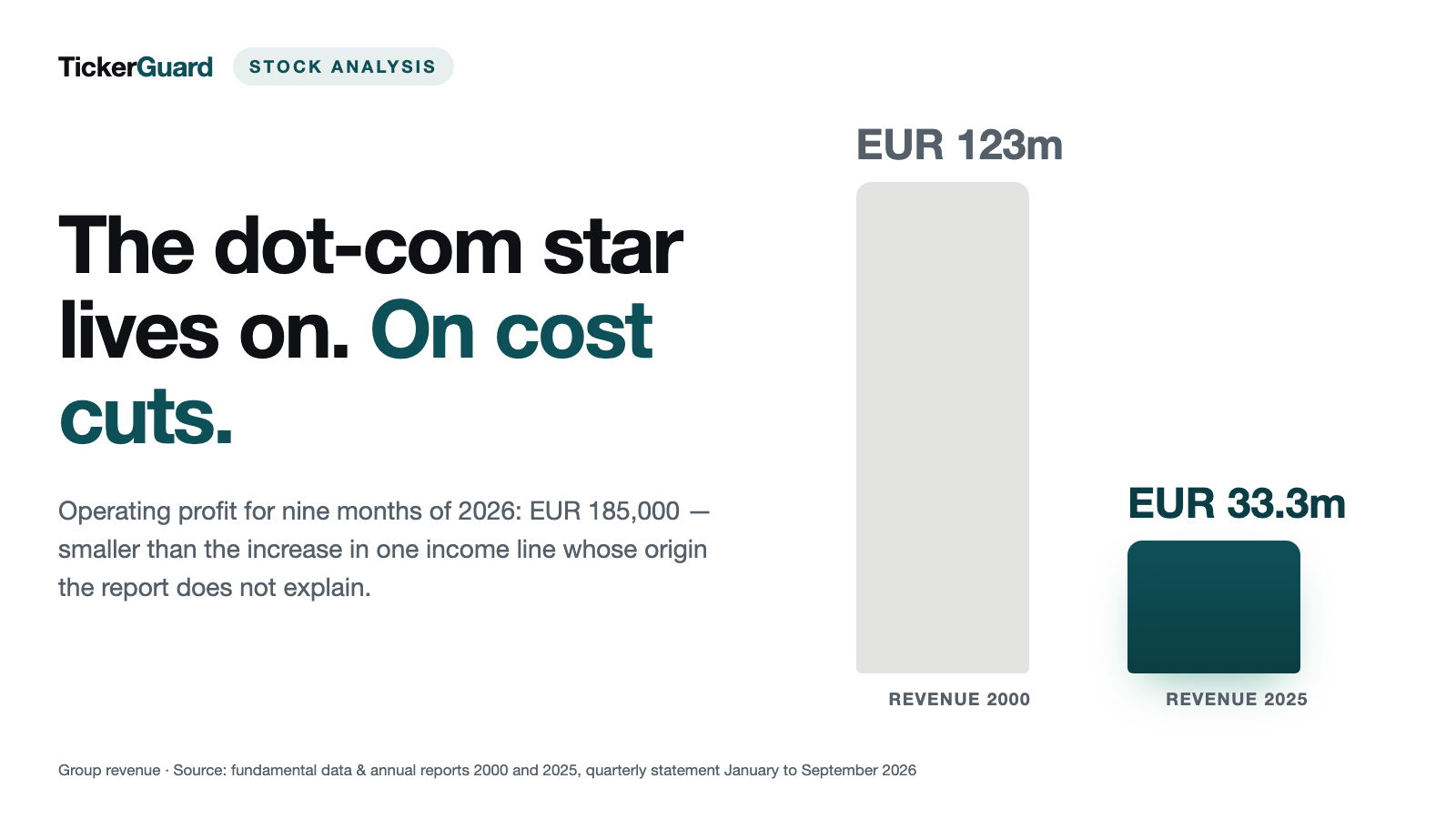
Updated October 28, 2026 (Q1–Q3 figures). A name you remember from the dot-com boom easily feels like a company you know — that is the comeback trap: familiarity feels like knowledge. At INTERSHOP Communications, the entire operating profit for nine months — EUR 185,000 — is smaller than the increase in a single income line whose origin the report does not explain. Revenue keeps shrinking. On Xetra the stock doubled from an intraday low of EUR 0.98 in March 2026 to EUR 1.98 on July 8, 2026 and closed at EUR 1.415 on October 26, 2026.
 Thomas Mücke
Founder & Publisher
As of Today
As of: October 28, 2026
- Closing price
- 1.41 € -4.02%
- Market Capitalisation
- 26.6 €M
Price change since October 26, 2026: -0.7%
This analysis has a cut-off date. The Stock Guard tells you when something material changes in the numbers. Reserve your free spot
Chart
Interactive price chart (TradingView).
Last price: 1.41 € (As of: October 28, 2026)
Note: pure fact-based analysis, not investment advice and not a solicitation to buy or sell. All figures without guarantee.
Update of October 28, 2026: Intershop published its figures for the first nine months on October 21, 2026 — a third positive quarter in a row at the operating line, net new ARR back above zero, full-year guidance reaffirmed. Everything new is in the chapter "Update October 2026" and has been worked into the other chapters. That includes two points the first edition of August 14, 2026 did not cover: the new and much larger authorization for further shares that the annual general meeting approved in May, and a contingent purchase-price obligation for an acquisition that Intershop now reports as current.
There is a trap that catches experienced investors more reliably than beginners, and it has nothing to do with greed. It has to do with memory. Call it the comeback trap: a name you know from an earlier market cycle feels more familiar than a name you have never heard. Familiarity feels like knowledge. And when that name also stands for a story that ended badly, a second reflex kicks in — we like resurrections. We pay up for them.
INTERSHOP Communications (Xetra: ISHA) of Jena triggers both reflexes. In 2026 the stock is back on the most-discussed lists in the large German retail investor forums, after doubling from a Xetra intraday low of EUR 0.98 (first reached on March 23, 2026) to a Xetra high of EUR 1.98 on July 8, 2026. So let us make a deal: we read the Annual Report 2025, the half-year report and the nine-month statement for 2026 ourselves, line by line, and look at what is actually behind the comeback. You decide at the end.
Why the Name Carries So Much Weight
To place this stock you need a short look back. Intershop listed on the Neuer Markt of the Frankfurt Stock Exchange on July 16, 1998, at a split-adjusted issue price of EUR 3.41. The price rose so fast that the company split the stock twice within a year: 1-for-3 on August 23, 1999, and 1-for-5 on August 16, 2000. A NASDAQ secondary listing followed on September 29, 2000, at USD 32.09 per American Depositary Share. At the end of 2000 there were 88,003,016 Intershop shares outstanding.
And the business behind it? The Annual Report 2000 reports group revenue of EUR 122.994 million, up from EUR 46.266 million in 1999 — alongside a net loss of EUR 38.923 million. Then it broke. The report itself describes the moment the story ended:
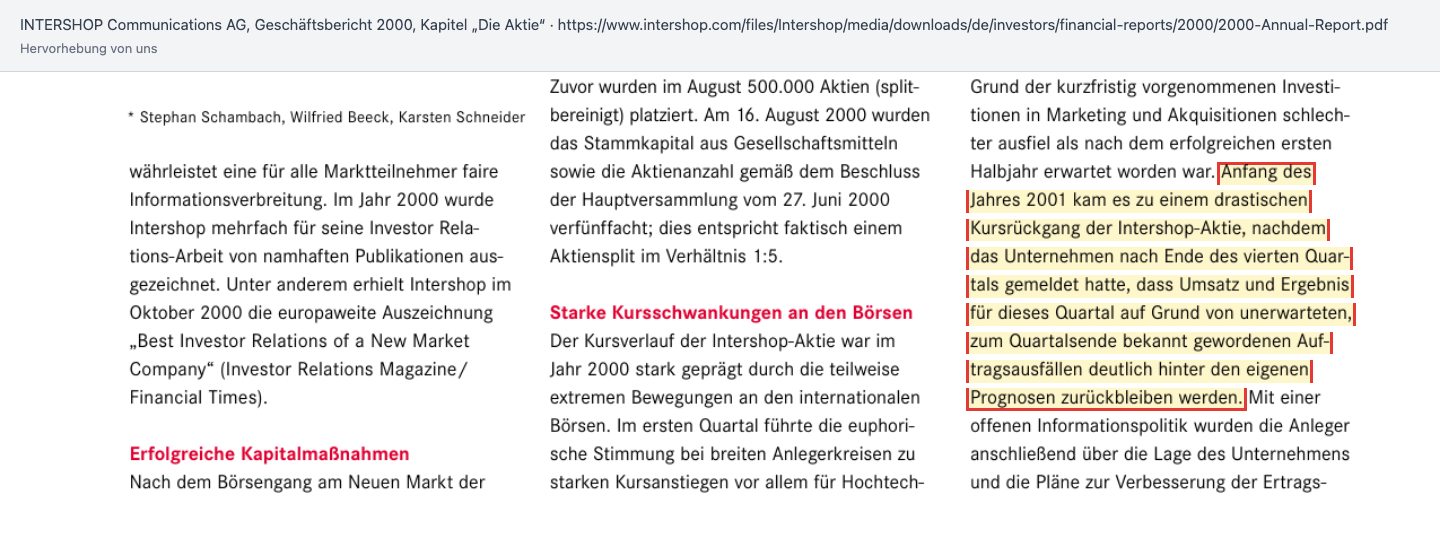
“Anfang des Jahres 2001 kam es zu einem drastischen Kursrückgang der Intershop-Aktie, nachdem das Unternehmen nach Ende des vierten Quartals gemeldet hatte, dass Umsatz und Ergebnis für dieses Quartal auf Grund von unerwarteten, zum Quartalsende bekannt gewordenen Auftragsausfällen deutlich hinter den eigenen Prognosen zurückbleiben werden.”
Translation: "At the beginning of 2001 the Intershop share price fell sharply after the company announced, following the close of the fourth quarter, that revenue and earnings for that quarter would fall significantly short of its own forecasts because of unexpected order losses that became known at quarter end."
— INTERSHOP Communications AG, Annual Report 2000, chapter "Die Aktie"
Two numbers make the distance to today tangible. First, market value: the Annual Report 2000 gives a fully diluted market capitalization of EUR 632 million as of February 28, 2001 — by which point the crash was well under way. As of June 30, 2026 it was EUR 28.62 million. Second, revenue: EUR 122.994 million in 2000 against EUR 33.256 million in 2025. Intershop today books roughly a quarter of what it booked a quarter of a century ago.
Important for any price comparison: the share count has been changed repeatedly since. On December 20, 2019 an extraordinary general meeting resolved a simplified capital reduction in a ratio of 3-to-1 "zum Ausgleich von Verlusten und sonstigen Wertminderungen" (to offset losses and other write-downs); it took legal effect with registration in the commercial register on February 4, 2020, and the technical share consolidation was carried out after the close on February 14, 2020. Three shares became one. Old price charts that fail to adjust for this will mislead you — only market capitalizations and revenues are directly comparable, not per-share prices.
Company history for investors
-
1998
Listing on the Neuer Markt
First trade on July 16, 1998 at a split-adjusted EUR 3.41. Two stock splits followed within a year.
-
2000
EUR 123 million in revenue and a NASDAQ secondary listing
EUR 122.994 million of revenue, plus a NASDAQ listing on September 29, 2000. It stayed the peak: in early 2001 the stock collapsed after orders fell through.
-
2020
Simplified 3-for-1 capital reduction
On February 14, 2020 three shares are consolidated into one. Unadjusted price charts have been misleading ever since — only market values and revenue still compare.
-
2022
Acquisition of Dutch Sparque B.V.
The deal supplies the AI search behind the later agentic platform — and sits inside goodwill of EUR 7.533 million (December 31, 2025), almost two thirds of total equity.
-
2025
10-for-3 rights issue at the legal minimum price
Registered on October 16, 2025: 4,374,684 new shares at EUR 1.00 — the share count rose 30 percent.
-
2026
Three positive quarters and a new capital authorization
Nine-month EBIT of plus EUR 185,000 on 7 percent less revenue; the shareholder meeting approves up to 9.45 million new shares. The turn comes from the cost side.
What Intershop Actually Does Today
Picture a tool wholesaler carrying 40,000 items whose customers are trade businesses. In the old world the shop foreman called in and an inside sales rep typed the order into the system. Today that foreman is meant to do it himself in a browser — with his individually negotiated prices, his framework contract, his delivery address, his spare-parts lists. That is exactly the software Intershop builds: an online store for business-to-business trade. Not Amazon for consumers, but the digital sales channel of a manufacturer or wholesaler.
The business splits into two segments. "Software and Cloud" covers licence and maintenance revenue from the old model — the customer buys the software once and pays annually for upkeep — plus cloud and subscription revenue from the new model, where Intershop runs the software and the customer pays monthly. "Service" is the project business: consulting, implementation, customization. According to the Annual Report 2025 the customer base numbers more than 300 companies, among them Miele, Trumpf and the E/D/E buying group. Europe contributed roughly 72 percent of 2025 revenue, the United States 20 percent and Asia-Pacific 8 percent.
Two strategic decisions shape everything that follows. First, the partner-first strategy: new implementation projects should go to partner firms rather than to Intershop itself. That deliberately depresses its own service revenue — at EUR 4.885 million in the first nine months of 2026 it was 2 percent below the prior year. Second, the rebuild into an "agentic B2B commerce platform." Behind the label sits this idea: the software should not merely display forms but carry out tasks — write product copy, identify spare parts from a photograph, prepare quotes. One foundation is Sparque B.V. of the Netherlands, acquired in 2022, a specialist in AI-driven search and product recommendations. May 2026 brought the "Spring 2026 Release" with a copilot for buyers, a copilot for sellers and a credit-based pricing model covering all AI features.
As of September 30, 2026 the group employed 224 full-time staff: 171 in technical departments, 30 in sales and marketing, 23 in administration. Of those, 190 work in Europe, 20 in Asia-Pacific and 14 in the United States. For comparison: at the end of 2024 the figure was 261, a year earlier (September 30, 2025) 244. The fiscal year matches the calendar year — unlike, say, Serviceware, whose fiscal year ends on November 30.
Why There Is No 10-K Here — and Where the Numbers Come From Instead
One point up front, because it shapes the whole evidence base: Intershop files no annual report on the U.S. pattern (10-K) and no quarterly report on the U.S. pattern (10-Q). Since the end of its NASDAQ era the company has not been a U.S. reporting issuer; a search of the database of the U.S. securities regulator, the SEC, returns nothing. Intershop is listed in the Prime Standard (Regulated Market) of the Frankfurt Stock Exchange and is a member of the CDAX, Prime All Share and Technology All Share indices.
What is mandatory instead is an audited IFRS consolidated statement plus German-GAAP single-entity accounts for the parent company, and a half-year financial report — both far more substantial than a bare quarterly statement. Every figure in this analysis therefore carries the attribution "Source: fundamental data & company reports (annual and half-year reports, Prime Standard, Frankfurt Stock Exchange)" rather than "SEC filings." We read the Annual Report 2025 (signed in Jena on March 4, 2026), the interim report for January to June 2026 (responsibility statement dated July 20, 2026, published July 22, 2026), the quarterly statements for Q1 2026 and for Q1 to Q3 2026 (signed in Jena on October 19, 2026, published October 21, 2026) and the documents of the May 19, 2026 annual general meeting in the original, and marked the decisive passages. Intershop did not announce an earnings call for the nine-month figures; we had no call transcripts.
One more note on diligence: the market data feed we use diverges from the reports in Intershop's case — it shows an operating result of minus EUR 1.98 million for 2025, whereas the audited accounts show minus EUR 2.767 million. This analysis uses the reported figures exclusively. Only prices, market values and trading volumes come from the feed.
How This Stock Landed on Our Desk
Intershop did not reach our research list through our in-house stock scanner, which primarily covers U.S.-listed names. The trigger was different: since the summer of 2026 the stock has appeared regularly on the most-discussed lists in the large German retail investor forums (as of our review: August 14, 2026). That is not a buy signal, it is an attention signal — and precisely the kind of reason to go and read the original reports.
The price history explains the attention. After a Xetra close of EUR 1.08 on December 31, 2025, the stock fell to a Xetra intraday low of EUR 0.98 — first reached on March 23, 2026, last on April 14, 2026 — then rose to a high of EUR 1.98 on July 8, 2026: a double in fifteen weeks. On August 14, 2026 it closed at EUR 1.55, worth about EUR 29 million at the time. It has slipped since: on September 15 and 16, 2026 it touched an intraday low of EUR 1.30, and on October 26, 2026 it closed at EUR 1.415 — about EUR 26.8 million in market value. The attention shows up in the tape as well: average daily trading volume across all venues was 20,458 shares in the first half of 2026, after 13,349 in 2025 and 5,626 in 2024.
What the balance sheet says about the price is strikingly sober: at EUR 1.415 on October 26, 2026, the stock costs about 2.2 times its book value of EUR 0.63 per share (September 30, 2026). Translated: the balance sheet is not overstretched, but the market pays more than twice the equity that stands behind it on paper — and how much that equity is really worth is something we examine in detail below. The second finding is illiquidity: on some August 2026 trading days on Xetra, only two- or three-digit share counts changed hands, and on August 11 and August 27 just one share each; on October 13, 2026 just two shares changed hands on Xetra. Anyone moving a sizeable order here moves the price themselves.
The Numbers Over the Years — and What Genuinely Impresses
Start with what Intershop rightly presents as progress. The cloud business is winning orders again. Cloud revenue rose 2 percent to EUR 15.686 million in the first nine months of 2026, its share of total revenue climbed six percentage points to 67 percent, and the cloud margin improved from 65 to 66 percent. Cloud order intake — the volume of newly signed cloud contracts — advanced 29 percent to EUR 14.186 million, of which EUR 3.7 million came from new customers and EUR 10.5 million from existing ones. Over nine months Intershop won ten new customers (prior-year period: seven), four of them in the third quarter.
Second: costs have genuinely come down. Total costs, comprising cost of sales and operating expenses, fell 13 percent to EUR 23.2 million in the first nine months of 2026 while revenue gave up only 7 percent. The gross margin rose two percentage points to 48 percent as a result. The operating result (EBIT) swung from minus EUR 1.384 million to plus EUR 185,000, and the result after tax was near breakeven at minus EUR 66,000, against minus EUR 1.730 million a year earlier.
Third: the cash holds up. Cash flow from operating activities came to EUR 3.640 million in the first nine months of 2026 (prior year: EUR 1.601 million). Cash and cash equivalents stood at EUR 9.593 million on September 30, 2026 — more than at the end of 2025 (EUR 8.773 million), but less than at mid-year (EUR 11.072 million); the update chapter explains why. Bank borrowings are only a fraction of that (details in the verdict below, "Balance sheet and liquidity"); the equity ratio rose to 37 percent. The Annual Report 2025 states explicitly in its risk section: "Es sind keine bestandsgefährdenden Risiken zu erkennen" — no risks threatening the company's existence are discernible.
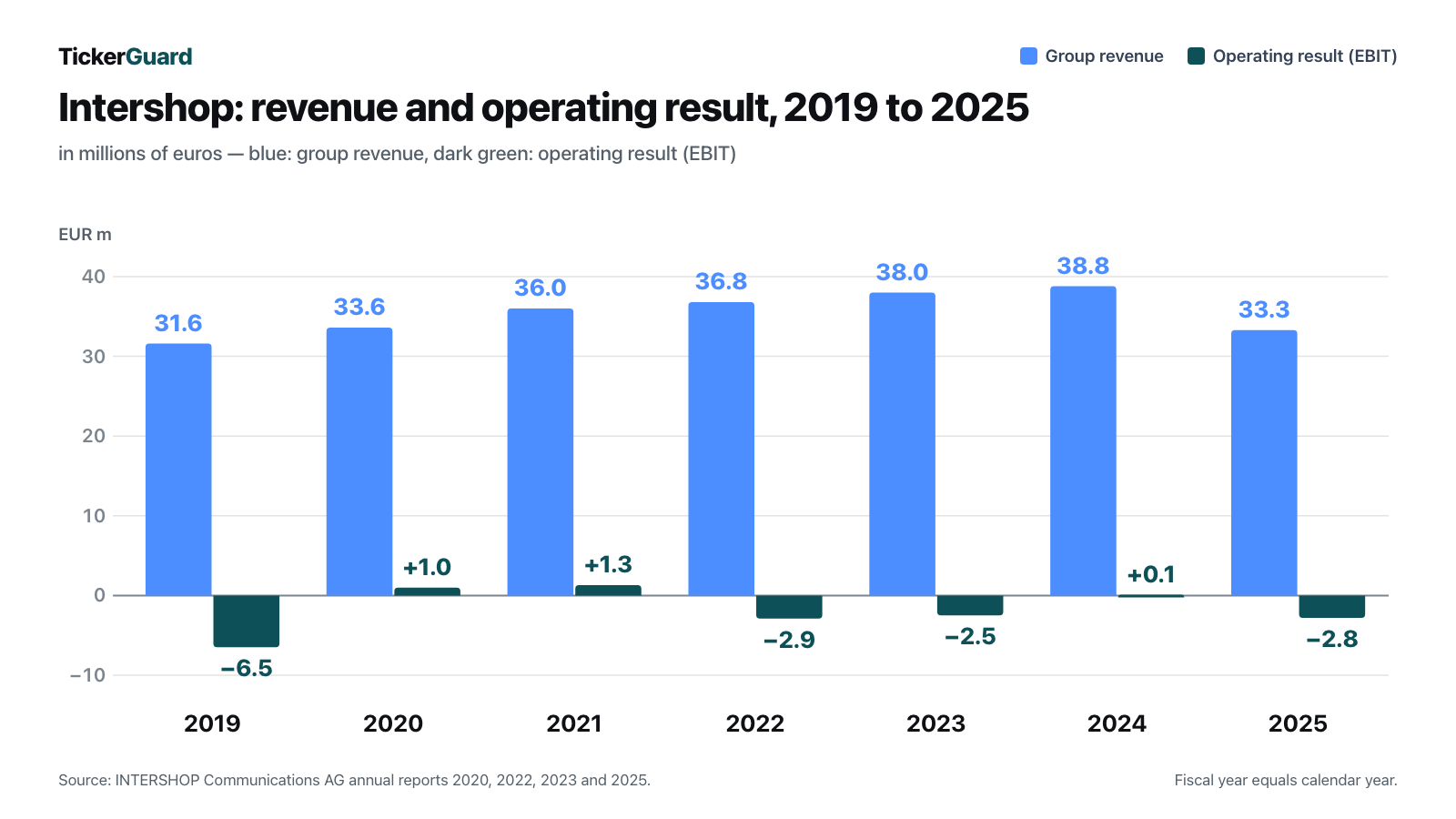
Now the long view. Revenue rose from EUR 31.6 million (2019) through EUR 33.6 million (2020), EUR 36.0 million (2021), EUR 36.8 million (2022) and EUR 38.0 million (2023) to EUR 38.8 million in 2024, the highest figure since 2019 — then fell back to EUR 33.3 million in 2025. Over the same span the operating result ran minus EUR 6.5 million (2019), plus EUR 1.0 million (2020), plus EUR 1.3 million (2021), minus EUR 2.9 million (2022), minus EUR 2.5 million (2023), plus EUR 0.1 million (2024) and minus EUR 2.8 million (2025). Translated: in seven years Intershop produced a positive operating result in exactly three, and the best of them was EUR 1.3 million. A company that reliably earns money looks different.
Update October 2026: What the First Nine Months Show
At 7:20 a.m. on October 21, 2026 Intershop published its quarterly statement for January 1 to September 30, 2026. The third quarter alone brought EUR 7.664 million of revenue (prior-year quarter: EUR 7.994 million, down 4 percent) and an operating result of plus EUR 45,000 (prior-year quarter: minus EUR 492,000). That makes three positive EBIT quarters in a row. After nine months the books show EUR 23.427 million of revenue (down 7 percent) and EUR 185,000 of EBIT.
The best news of the quarter concerns the very metric on which this analysis pinned its biggest worry in August. Intershop writes:
“Seit dem zweiten Quartal zeigt sich ein klarer Aufwärtstrend: Im dritten Quartal stieg der Net New ARR auf 0,5 Mio. Euro (zweites Quartal: 0,2 Mio. Euro).”
Translation: "Since the second quarter a clear upward trend has emerged: in the third quarter net new ARR rose to EUR 0.5 million (second quarter: EUR 0.2 million)."
— INTERSHOP Communications AG, Quarterly statement Q1–Q3 2026, "Geschäftsentwicklung" section, page 4
The arithmetic shows why: in the first half cancellations of EUR 1.798 million had eaten up new business; after nine months the figure is EUR 1.966 million — so the third quarter added only about EUR 168,000. The service business has steadied too: service revenue rose to EUR 1.693 million in the third quarter (prior-year quarter: EUR 1.239 million), and according to the statement after the large project was signed off in the first quarter the statement reports a service margin that was "auch im dritten Quartal spürbar verbesserten, positiven" (noticeably improved and positive in the third quarter as well).
The other direction sits in the same tables. Cloud revenue itself did not grow in the third quarter: by our arithmetic it was EUR 5.152 million, against EUR 5.221 million in the prior-year quarter and EUR 5.212 million in the second quarter of 2026. Over nine months that leaves growth of only 2 percent, down from 4 percent at mid-year. Licences and maintenance fell 47 percent to EUR 819,000 in the third quarter, and software and cloud revenue combined fell 12 percent. The quarter's gross margin slipped to 47 percent (prior-year quarter: 50 percent). And in the United States revenue dropped 24 percent to EUR 3.8 million over nine months — "in allen Geschäftsbereichen" (in all business lines), as Intershop puts it.
The cash tells a second story as well. Cash and equivalents fell from EUR 11.072 million to EUR 9.593 million in the third quarter, a drop of almost EUR 1.5 million. By our arithmetic about EUR 679,000 flowed out of operations in the quarter (nine months: plus EUR 3.640 million; half-year: plus EUR 4.319 million). Part of that is seasonal: customers often prepay cloud and maintenance contracts, contract liabilities fell from EUR 7.0 million (June 30) to EUR 5.745 million (September 30), and the prior-year quarter also saw an operating outflow of roughly EUR 292,000. Loan and lease repayments came on top. And one payment may still be ahead. For Sparque B.V., acquired in 2022, the Annual Report 2025 carried a contingent purchase-price obligation of EUR 2.074 million in total as of December 31, 2025, of which EUR 1.785 million was non-current. EUR 300,000 went out in the first nine months of 2026 as “payments for a business acquisition” in the cash flow statement. Intershop reclassified the non-current EUR 1.785 million to current liabilities at mid-year — under IFRS that means due within twelve months or not deferrable beyond that; the 2025 annual report still expected the payment in 2027 through 2030, Intershop has not given a new date since the reclassification, and the payment depends on contractual conditions. That is almost 19 percent of today's cash.
The board reaffirmed its guidance — and it is not a foregone conclusion:
“Vor diesem Hintergrund bestätigt Intershop die Prognose für das Geschäftsjahr 2026 und erwartet nach wie vor einen Cloud-Auftragseingang und einen Net New ARR auf Vorjahresniveau.”
Translation: "Against this background Intershop confirms its forecast for fiscal 2026 and continues to expect cloud order intake and net new ARR at the prior-year level."
— INTERSHOP Communications AG, Quarterly statement Q1–Q3 2026, outlook, page 9
Let us do the math. On net new ARR, reaching the prior year's plus EUR 577,000 still takes EUR 478,000 in the fourth quarter — slightly less than the third quarter delivered on its own, but clearly more than the fourth quarter of 2025 (roughly EUR 305,000 by our math: EUR 577,000 for the full year minus EUR 272,000 after nine months). On cloud order intake the prior-year figure was EUR 21.703 million; after EUR 14.186 million in nine months, the closing quarter needs about EUR 7.5 million, more than any of the first three quarters of 2026. It can be done: by our arithmetic the fourth quarter of 2025 brought about EUR 10.7 million, which the annual report attributes to an order-rich closing quarter. On EBIT the guidance calls for a balanced result — with a EUR 185,000 cushion, the fourth quarter may come in slightly negative.
Two more points belong to the new picture. First, the annual general meeting of May 19, 2026 substantially widened the authorization for new shares; the details are in Uncomfortable Truth No. 3. Second, on October 22, 2026 a study by Quirin Privatbank appeared via the EQS newswire, reiterating its "Buy" rating; the EQS notice carries the standard line that the publisher of the study alone is responsible for its content (“The issuer is solely responsible for the content of this research.”) Through October 28, 2026 Intershop has published no reportable share dealings by board members, no voting-rights notices and no ad hoc releases since the half-year report.
Uncomfortable Truth No. 1: The Operating Profit Comes From Saving, Not From the Business
The breakeven result for the first nine months of 2026 is real — but it did not come from more business, it came from lower costs. Revenue fell 7 percent to EUR 23.427 million in the first nine months of 2026. In full-year 2025 it had fallen 14 percent to EUR 33.256 million. The old licence business is hit hardest: pure licence revenue fell from EUR 2.511 million to EUR 142,000 in 2025, a decline of 94 percent. Maintenance revenue follows with a lag; in the first nine months of 2026 licences and maintenance together fell 42 percent to EUR 2.856 million.
Part of this is deliberate: Intershop is shifting from licence to subscription and from its own service to partners. But cloud revenue is growing far more slowly than the legacy business is falling away — plus EUR 353,000 in cloud against minus EUR 2.078 million in licences and maintenance and minus EUR 86,000 in services in the first nine months of 2026. The management board says as much itself, and reaffirmed it on October 21, 2026:
“Insgesamt erwartet Intershop für das Geschäftsjahr 2026 einen Cloud-Auftragseingang und einen Net New ARR auf Vorjahresniveau. Hinsichtlich des Umsatzes wird ein leicht geringerer prozentualer Rückgang im Vergleich zum Vorjahr prognostiziert. Durch die verbesserte Kostenbasis rechnet Intershop mit einem ausgeglichenen operativen Ergebnis (EBIT).”
Translation: "Overall, Intershop expects cloud order intake and net new ARR at the prior-year level for fiscal 2026. On revenue, a slightly smaller percentage decline than in the prior year is forecast. Thanks to the improved cost base, Intershop expects a balanced operating result (EBIT)."
— INTERSHOP Communications AG, Annual Report 2025, outlook section, "Gesamtaussage für das Jahr 2026"
Read that again. The best the board holds out for 2026 is a further decline in revenue and a result of zero. The counter-entry is the payroll: 261 full-time staff on December 31, 2024, 224 on December 31, 2025, 222 on June 30, 2026 and 224 again on September 30, 2026. That is down 14 percent in twenty-one months; since the start of 2026 the number has been stable. The Annual Report 2025 puts group one-off expenses for headcount reduction at EUR 0.9 million (2024: EUR 0.5 million). Cost cutting works — but it only works once. Sooner or later revenue has to take over.
And even the small profit does not rest on costs alone. The income statement in the quarterly statement contains a line the text of the statement does not explain: other operating income rose from EUR 304,000 to EUR 853,000 in the first nine months of 2026 — an increase of EUR 549,000, more than the entire nine-month EBIT of EUR 185,000. Without that increase, the operating result would arithmetically stand at minus EUR 364,000. Most of it came in the second quarter: EUR 581,000, against EUR 72,000 a year earlier. In the third quarter, other income of EUR 208,000 was close to the prior-year quarter (EUR 171,000); the quarterly EBIT of EUR 45,000 was carried by a different line there — other operating expenses, which fell from EUR 594,000 to EUR 54,000. Without that EUR 540,000 decline, the quarter would arithmetically have shown a loss of about EUR 495,000. The quarterly statement attributes the decline only in general terms to the cost-cutting measures, without breaking it down; where the income came from, neither the half-year report nor the quarterly statement says. In the second quarter, Intershop also settled a damages lawsuit out of court; whether it is connected to the income cannot be seen from the reports, and Intershop does not say which way the payment went.
Uncomfortable Truth No. 2: The Growth Metric Is Only Slowly Climbing Out of the Red
In subscription software one metric matters more than any single quarter's revenue: ARR, annual recurring revenue. It says how much money arrives automatically without a single new sale, as long as no customer cancels. And the decisive derivative is net new ARR: newly won recurring revenue less cancellations. Picture a bathtub — the inflow is new business, the outflow is churn. Net new ARR is the question of whether the water level rises or falls.
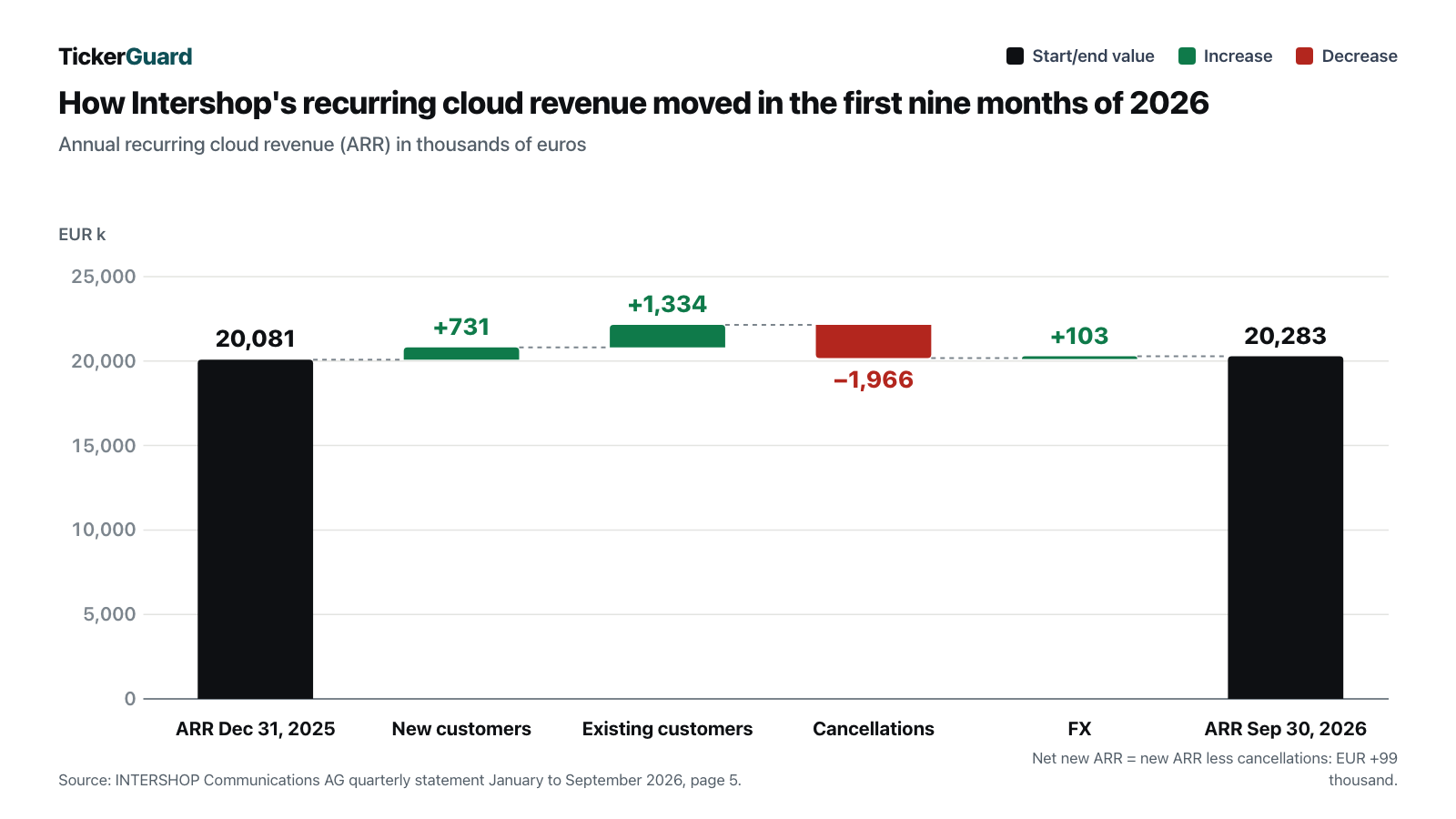
At Intershop it fell in the first half of 2026 — and has been rising only slowly since. ARR stood at EUR 20.081 million on December 31, 2025. In the first nine months of 2026, EUR 731,000 came from new customers and EUR 1.334 million from existing customers, for EUR 2.065 million of new business. Against that stood EUR 1.966 million of cancellations. Add EUR 103,000 of currency effects and ARR lands at EUR 20.283 million on September 30, 2026 — with net new ARR of plus EUR 99,000, against plus EUR 272,000 a year earlier. Almost every euro of new business was eaten up again by a cancellation.
At mid-year the figure was still deep in negative territory. The company stated this openly at the time — and supplied an explanation with it:
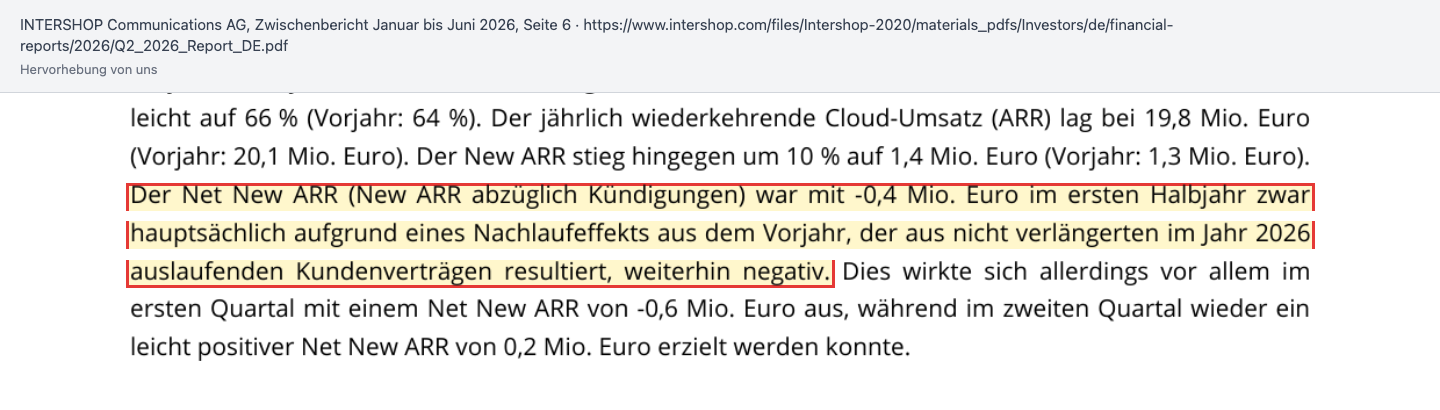
“Der Net New ARR (New ARR abzüglich Kündigungen) war mit -0,4 Mio. Euro im ersten Halbjahr zwar hauptsächlich aufgrund eines Nachlaufeffekts aus dem Vorjahr, der aus nicht verlängerten im Jahr 2026 auslaufenden Kundenverträgen resultiert, weiterhin negativ.”
Translation: "Net new ARR (new ARR less cancellations) remained negative at minus EUR 0.4 million in the first half, mainly because of a carry-over effect from the prior year arising from customer contracts that were not renewed and expire in 2026."
— INTERSHOP Communications AG, Interim report January to June 2026, page 6
The third quarter fits the explanation about expiring legacy contracts: cancellations ebbed and net new ARR rose to about EUR 0.5 million. The tension that decides this year remains all the same: on October 21, 2026 the board reaffirmed its guidance once more — net new ARR "at the prior-year level," meaning the plus EUR 577,000 booked in 2025. We work out in the update chapter what the fourth quarter still has to deliver: about what the third quarter produced — achievable, but only if the good quarter was not a one-off. And even then: a subscription business with about EUR 20 million of recurring revenue that adds a net half million or so in a year is growing by less than 3 percent.
Uncomfortable Truth No. 3: EUR 4.4 Million of Fresh Money — at the Legal Minimum Price
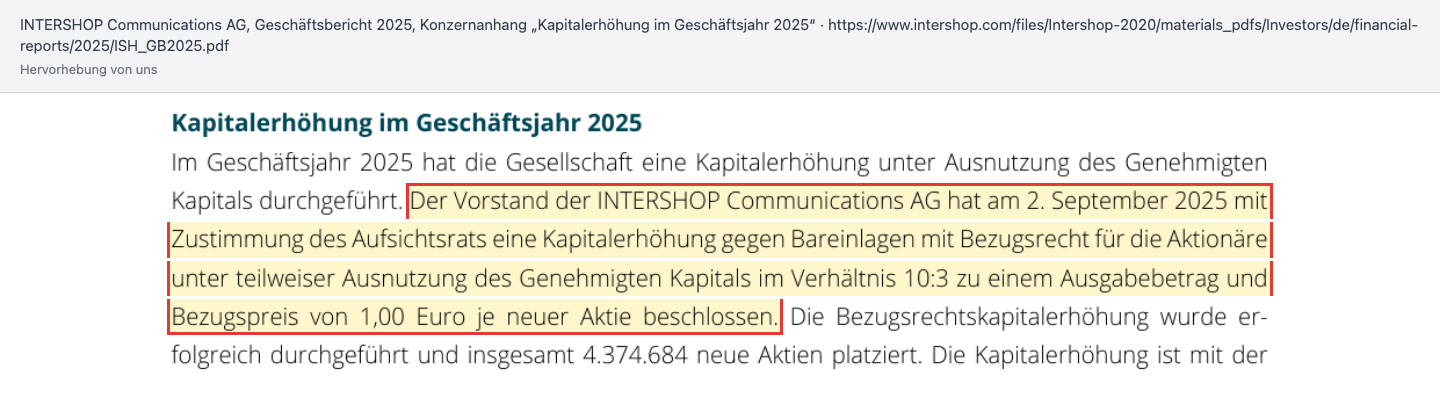
Dilution means your slice of the cake gets smaller because new slices are handed out. At Intershop that happened on a large scale in the autumn of 2025. On September 2, 2025 the management board, with supervisory board approval, resolved a rights issue in a ratio of 10-for-3 — for every ten old shares you could subscribe for three new ones. The price: EUR 1.00 per new share.
“Der Vorstand der INTERSHOP Communications AG hat am 2. September 2025 mit Zustimmung des Aufsichtsrats eine Kapitalerhöhung gegen Bareinlagen mit Bezugsrecht für die Aktionäre unter teilweiser Ausnutzung des Genehmigten Kapitals im Verhältnis 10:3 zu einem Ausgabebetrag und Bezugspreis von 1,00 Euro je neuer Aktie beschlossen.”
Translation: "On September 2, 2025 the management board of INTERSHOP Communications AG, with the approval of the supervisory board, resolved a cash capital increase with pre-emption rights for shareholders, partially drawing on the authorized capital, in a ratio of 10-for-3 at an issue and subscription price of EUR 1.00 per new share."
— INTERSHOP Communications AG, Annual Report 2025, notes, "Kapitalerhöhung im Geschäftsjahr 2025"
Why exactly EUR 1.00? Because that is the legal minimum: each Intershop share carries a notional interest in the share capital of precisely EUR 1.00, and under the German Stock Corporation Act a company may not issue new shares below that par amount. Intershop therefore issued at the lowest price the law allows. For comparison, the Xetra close on December 31, 2025 was EUR 1.08.
The result: 4,374,684 new shares, effective on registration in the commercial register at the Jena local court on October 16, 2025. Subscribed capital rose from EUR 14,582,291 to EUR 18,956,975 — a 30 percent increase in the share count. Intershop received EUR 4.375 million, less EUR 73,000 of transaction costs. Put differently: an existing shareholder who did not subscribe now holds roughly a quarter less of the same company.
And the reserve is not just unexhausted — it has been refilled. After the rights issue, authorized capital had fallen from EUR 7,200,000 to EUR 2,825,316. The annual general meeting of May 19, 2026, with 99.74 percent of votes cast, resolved to cancel that remainder effective upon registration of the new authorized capital and created new authorized capital of EUR 9,450,000; until registration, the old remainder of EUR 2,825,316 stays in force. Under the new authorization the management board, with supervisory board approval, may issue up to 9,450,000 new shares for five years from registration in the commercial register — almost half of today's 18,956,975. Under the wording of the articles, pre-emption rights can be excluded for cash issues of up to 20 percent of share capital if the issue price is not materially below the market price; for contributions in kind such as acquisitions, the authorization sets no such cap on excluding pre-emption rights. The summary rationale in the meeting invitation, by contrast, speaks of an authorization to exclude pre-emption rights "für Bar- und/oder Sacheinlagen" (for cash and/or in-kind contributions) amounting to "20 % des aktuellen Grundkapitals" (20 percent of current share capital). It also says:
“Um es dem Vorstand auch in Zukunft zu ermöglichen, flexibel auf Marktgegebenheiten zu reagieren, und um die zwischenzeitliche Erhöhung des Grundkapitals bei der Bemessung der Kapitalia zu berücksichtigen, soll das bestehende Genehmigte Kapital I aufgehoben und ein neues Genehmigtes Kapital I in Höhe von EUR 9.450.000,00 mit einer erneuten Laufzeit von fünf Jahren neu geschaffen werden.”
Translation: "To allow the management board to continue to respond flexibly to market conditions, and to reflect the interim increase in share capital when sizing the capital authorizations, the existing authorized capital I is to be cancelled and new authorized capital I of EUR 9,450,000.00 created with a fresh term of five years."
— INTERSHOP Communications AG, Invitation to the annual general meeting of May 19, 2026, agenda item 7
According to the half-year report, registration was applied for in May 2026 but had not been completed by July 20, 2026; the quarterly statement of October 21, 2026 does not say whether it has happened since. The new capital can only be used once it is registered. Together with conditional capital II of EUR 6,242,000 for convertible and warrant bonds (renamed simply “conditional capital” by the shareholder meeting, registration applied for), that adds up to headroom of 15,692,000 potential new shares — 82.8 percent of today's share count, with no further shareholder meeting required. Intershop has not used it so far: the quarterly statement as of September 30, 2026 still shows 18,956,975 shares. An authorization is not a plan. But after a placement at the legal minimum in 2025, a larger reserve than before has been available since May 2026.
Uncomfortable Truth No. 4: Almost Two Thirds of Equity Is Goodwill
Equity stood at EUR 12.000 million on September 30, 2026, for an equity ratio of 37 percent. That sounds solid. Except that the largest asset-side item is intangibles at EUR 11.416 million — and inside that sits goodwill of EUR 7.533 million (as of December 31, 2025, unchanged year on year; the quarterly statement does not show it separately).
Goodwill arises when a company pays more for an acquisition than the acquired assets are worth individually. It is not a building, not a machine, not a bank balance — it is capitalized hope that the purchase price will pay off. At Intershop it stems mainly from earlier acquisitions and from Sparque B.V., bought in 2022. The striking part: the Annual Report 2025 backs it out itself when things get serious. In the risk-management chapter, on how potential damage is measured, it states: "Das wirtschaftliche Eigenkapital bestimmt sich aus dem Eigenkapital abzüglich des Firmenwertes" — economic equity is equity less goodwill. On the company's own definition, economic equity as of September 30, 2026 comes to roughly EUR 4.47 million.
How fragile this item has historically been shows in the fixed-asset schedule in the same report: the acquisition cost of goodwill is EUR 27.157 million, and accumulated write-downs against it total EUR 19.624 million. Around 72 percent of the goodwill once paid for has therefore already been written off over the years. The annual impairment test required no further write-down in 2024 or 2025; it uses a post-tax discount rate of 11.5 percent and, according to the report, would still have held even if planned cash flows had come in up to 40 percent lower. There is a second item worth knowing about: at the parent company, after a 2025 net loss of EUR 3.7 million, the accumulated deficit stands at EUR 11.0 million (2024: EUR 7.3 million). As long as it remains, a dividend is effectively out of the question.
Uncomfortable Truth No. 5: Who Really Decides Here
The ownership structure is concentrated. As of December 31, 2025, four shareholders coordinated their voting: Shareholder Value Beteiligungen AG, Shareholder Value Management AG, Value Focus Beteiligungs GmbH and Reiner Sachs via Sachs Assets GmbH. Together they hold 40.11 percent of voting rights according to the Annual Report 2025. Separately, Frankfurter Investmentgesellschaft mit variablem Kapital (SICAV) of Grevenmacher, Luxembourg, notified a holding of 18.59 percent on July 28, 2025. The free float is given as 41 percent.
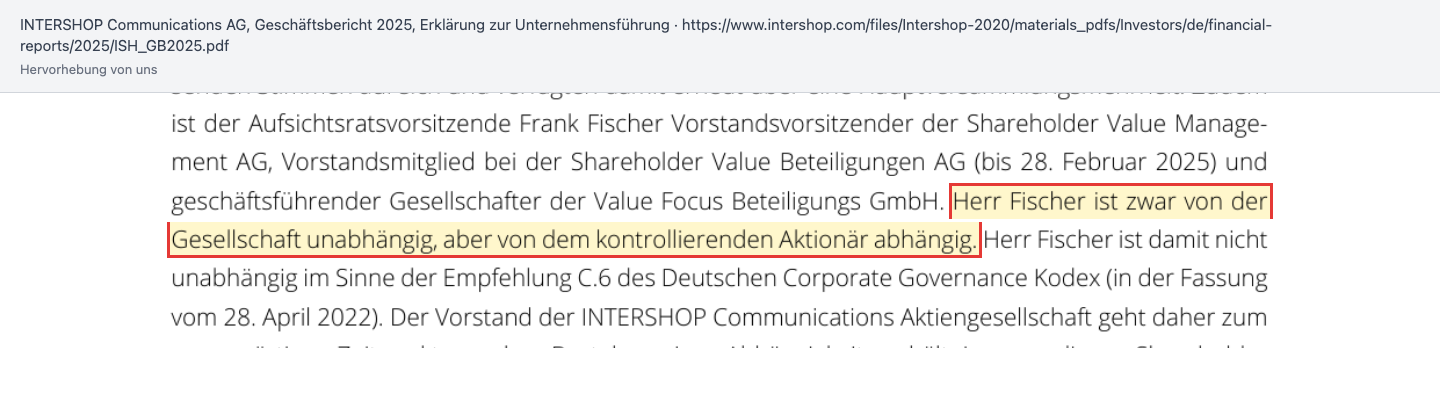
More interesting than the percentages is who chairs the supervisory board. Chairman Frank Fischer is simultaneously chief executive of Shareholder Value Management AG, was a management board member of Shareholder Value Beteiligungen AG until February 28, 2025, and is managing shareholder of Value Focus Beteiligungs GmbH — that is, of all three companies in the voting pool. The company spells out the consequence itself in its corporate governance statement:
“Herr Fischer ist zwar von der Gesellschaft unabhängig, aber von dem kontrollierenden Aktionär abhängig.”
Translation: "Mr Fischer is independent of the company, but dependent on the controlling shareholder."
— INTERSHOP Communications AG, Annual Report 2025, corporate governance statement
This is not an accusation — the open disclosure is exactly what the code requires, and an anchor shareholder with a long horizon can be an advantage for a company in transition. It is information: the supervisory board, which oversees the management board, is chaired by a person who, according to the annual report, is dependent on the controlling shareholder. A second finding from the half-year report fits the picture: as of June 30, 2026, chief executive Markus Dränert and chief financial officer Petra Stappenbeck each held 8,450 shares — 16,900 in total out of 18,956,975, or 0.09 percent of the capital. At the October 26, 2026 price that is roughly EUR 24,000. Through October 28, Intershop has published no reportable share dealings by management or supervisory board members for 2026.
What the Stock Costs
For scale, with a reference date: at the Xetra close of EUR 1.415 on October 26, 2026 and 18,956,975 shares, market capitalization is about EUR 26.8 million. Measured against 2025 group revenue of EUR 33.256 million, that is a price-to-sales ratio of roughly 0.8; on the last four quarters (by our arithmetic EUR 31.4 million of revenue) it is just under 0.9. There is no price-to-earnings ratio because there are no earnings — earnings per share were minus EUR 0.21 in 2025 and EUR 0.00 in the first nine months of 2026.
The more revealing calculation strips out the cash. Of the roughly EUR 26.8 million market value, EUR 9.593 million is cash and equivalents (September 30, 2026), against bank borrowings of EUR 1.426 million. The market is therefore paying about EUR 18.7 million for the operating business excluding net cash — on 2025 revenue of EUR 33.3 million. Add in IFRS 16 lease liabilities of EUR 6.481 million and the EUR 1.785 million portion of the contingent Sparque purchase-price obligation now shown as current, and you arrive at an enterprise value of roughly EUR 27 million. Measured against revenue, that is little for a software company — but the price builds in no growth.
Book value per share was EUR 0.63 on September 30, 2026, so the stock costs about 2.2 times book. Strip out goodwill and it costs six times economic equity. Professional coverage is thin: the most visible voice is a Quirin Privatbank study of October 22, 2026 rated "Buy", distributed via EQS with the standard line that the publisher of the study alone is responsible for its content. Intershop pays no dividend; the parent company's EUR 11.0 million accumulated deficit stands in the way in any case.
For how we assessed another German e-commerce stock, see our analysis of The Platform Group. Whoever buys here is not buying a growth story but betting that the bottom is in.
Opportunities and Risks at a Glance
What speaks for Intershop:
- The cloud business is winning orders again: cloud order intake up 29 percent, ten new customers and a cloud margin of 66 percent in the first nine months of 2026.
- Net new ARR has turned: roughly plus EUR 0.5 million in the third quarter of 2026 after minus EUR 0.6 million in the first; plus EUR 99,000 after nine months.
- The cost base is genuinely lower: total costs down 13 percent, gross margin up two percentage points to 48 percent, EBIT positive for three quarters in a row (nine months: plus EUR 185,000 after minus EUR 1.384 million).
- The balance sheet holds: EUR 9.593 million of cash against EUR 1.426 million of bank debt, an equity ratio of 37 percent, operating cash inflow of EUR 3.640 million in the first nine months of 2026 — and explicitly no existence-threatening risks in the 2025 risk report.
- The large service project that consumed resources and margin in 2025 was signed off in the first quarter of 2026; according to the company the service margin has been positive and noticeably better since.
- The target market is growing: the Annual Report 2025 (outlook report, section “Rahmenbedingungen,” i.e. general conditions) cites data from Capital One Shopping Research and the Big Commerce B2B Report according to which global B2B commerce will grow 14.5 percent a year to USD 62.2 trillion by 2030 — a third-party industry forecast, not an Intershop figure.
What speaks against it:
- Revenue is shrinking for a second consecutive year — down 14 percent in 2025 and a further 7 percent in the first nine months of 2026 — and the board itself guides to another decline for full-year 2026. By our arithmetic, third-quarter cloud revenue was even slightly below the prior-year quarter.
- Net new ARR after nine months is plus EUR 99,000, 64 percent below the prior year; cancellations of EUR 1.966 million ate up almost all of the EUR 2.065 million of new business.
- The third-quarter profit (EUR 45,000) rests on other operating expenses, which fell from EUR 594,000 to EUR 54,000; without that decline the quarter would arithmetically have shown a loss of about EUR 495,000. The decline is not broken down.
- Cash fell by almost EUR 1.5 million in the third quarter; EUR 1.785 million of contingent purchase price for Sparque is now carried as a current liability.
- After the 2025 rights issue (30 percent more shares at the legal minimum price), the new capital headroom allows up to 15,692,000 further shares without a new shareholder meeting once registered.
- Of EUR 12.000 million of equity, EUR 7.533 million is goodwill; the parent company carries an accumulated deficit of EUR 11.0 million.
- The stock is illiquid: an average of 20,458 shares a day across all venues in the first half of 2026, and on individual Xetra days in August and October 2026 only one- to three-digit share counts.
- According to the 2026 half-year report, a French implementation partner is claiming a commercial agent indemnity "im hohen sechsstelligen Bereich" (in the high six figures); Intershop considers the claim unfounded in principle and in amount. The third-quarter statement gives no update.
A Human Verdict
Back to the comeback trap. It works because familiarity feels like knowledge and because we like resurrection stories. At Intershop both come together: a name from the Neuer Markt era, and a share price that doubled inside fifteen weeks. Buy in there and you quickly buy the narrative along with it — the phoenix from the ashes.
The reports tell something more sober. Here is a company that has got its costs under control, that has been in the black at the operating line for three quarters running, carries no pressing debt and whose cloud business is winning orders again — and whose recurring revenue finally grew noticeably again in the third quarter. And here is the same company whose revenue is falling for a second year, whose cloud revenue stalled in the third quarter, whose net result after nine months stands at minus EUR 66,000 despite the operating profit — and whose share count rose 30 percent a year ago, issued at the lowest price the law permits. In May, the annual general meeting approved a new and larger reserve on the proposal of the management and supervisory boards.
Both are true. The October 21, 2026 quarterly statement has provisionally answered one of this analysis's two big questions: net new ARR is back in positive territory after nine months, and the third quarter was in the black even without elevated other income — if only by EUR 45,000, and only thanks to lower other expenses that the statement does not break down in detail. The second question remains open: whether the cost turnaround ever becomes growth. The next evidence comes with the full-year 2026 figures — and with them the answer to whether the fourth quarter carries the reaffirmed guidance. Until then it remains open whether the market is trading a turnaround here or a memory.
What you make of that is your decision. And that is exactly how it should be.
Sources
- INTERSHOP Communications AG Annual Report 2025 (IFRS consolidated and German-GAAP single-entity accounts, signed in Jena on March 4, 2026)
- Quarterly statement Q1–Q3 2026 (January to September 2026, signed in Jena on October 19, 2026, published October 21, 2026) and the press release of October 21, 2026
- Interim report January to June 2026 (half-year financial report, published July 22, 2026)
- Invitation to the annual general meeting of May 19, 2026 and voting results (new authorized capital, agenda items 7 and 8)
- Q1 2026 quarterly statement (published April 22, 2026)
- Annual Report 2020 (revenue and EBIT for 2019 and 2020, 3-for-1 simplified capital reduction)
- Annual Report 2022 and Annual Report 2023 (multi-year revenue and EBIT series)
- Annual Report 2000 (Neuer Markt, NASDAQ secondary listing, revenue and net loss for 2000)
- INTERSHOP Communications AG investor relations page (financial calendar, ad hoc releases, voting-rights notices; reviewed through October 28, 2026)
- Quirin Privatbank study of October 22, 2026 (EQS release)
- Prices, market values and trading volumes: fundamental data, as of August 14, 2026 (first edition) and October 26, 2026 (update)
Disclaimer: This article is journalistic analysis of publicly available company reports. It is not investment advice, not a recommendation to buy or sell, and not a solicitation to buy or sell securities. Small-cap stocks of this size are particularly volatile and illiquid; a total loss of invested capital is possible. All figures are stated with their respective reporting dates and may have changed since. Positions held by the operator are disclosed daily; where one exists, it appears as a notice at the top of this deep dive.
Our Bottom Line at a Glance
- Revenue trend negative
- Group revenue fell 14 percent to EUR 33.256 million in 2025 and a further 7 percent to EUR 23.427 million in the first nine months of 2026. The board itself guides to another decline for full-year 2026. Pure licence revenue collapsed from EUR 2.511 million to EUR 142,000 in 2025.
- Cloud business neutral
- Cloud order intake advanced 29 percent to EUR 14.186 million in the first nine months of 2026, net new ARR came to roughly plus EUR 0.5 million in the third quarter, and the cloud margin was 66 percent. Cloud revenue itself, however, grew only 2 percent to EUR 15.686 million and, by our arithmetic, was slightly below the prior-year quarter in the third quarter.
- Earnings quality negative
- The positive nine-month EBIT of EUR 185,000 is smaller than the increase in other operating income over the same period (from EUR 304,000 to EUR 853,000, or plus EUR 549,000). In the third quarter alone that income was close to the prior year; EBIT of EUR 45,000 there rested on other operating expenses that fell from EUR 594,000 to EUR 54,000. The reports do not explain where the income came from.
- Balance sheet and liquidity positive
- As of September 30, 2026, EUR 9.593 million of cash stood against bank borrowings of EUR 1.426 million; the equity ratio was 37 percent and operating cash inflow over nine months came to EUR 3.640 million. Cash fell by almost EUR 1.5 million in the third quarter, and EUR 1.785 million of contingent purchase price for Sparque is now reported as current. The 2025 risk report explicitly identifies no risks threatening the company's existence.
- Substance of equity neutral
- Of EUR 12.000 million of equity (September 30, 2026), EUR 7.533 million is goodwill. On the Annual Report 2025's own definition — equity less goodwill — roughly EUR 4.47 million of economic equity remains. The impairment test required no write-down in 2024 or 2025.
- Dilution and ownership negative
- The share count rose 30 percent to 18,956,975 on October 16, 2025, issued at EUR 1.00 per share — the legal minimum. After the resolutions of the May 19, 2026 annual general meeting, the new authorized capital (9,450,000 shares) and the older conditional capital II together allow up to 15,692,000 further shares without a new shareholder meeting, once registration is complete. A voting pool holds 40.11 percent, the supervisory board chairman is dependent on the controlling shareholder by the company's own statement, and the management board holds 0.09 percent of the shares.
Intershop is in the black at the operating line after nine months of 2026 with EUR 185,000, the third positive quarter in a row; cloud order intake rose 29 percent, net new ARR is back in positive territory after nine months, and the balance sheet is under no pressure: cash exceeds bank debt many times over. The price of that: revenue is shrinking for a second consecutive year, cloud revenue did not grow in the third quarter, the result is not yet carried by the business itself, and after the 2025 rights issue the headroom for further shares grew to up to 15.7 million. Not investment advice.
What Our Rating Means
Open questions
The business works in principle, but one material question is open. As long as it stays open, our findings do not carry a quality verdict.
Yellow, because Intershop has cut its way to health but is not yet growing its way there. This is not an existential question: cash covers bank borrowings many times over (figures under "Balance sheet and liquidity"), and the 2025 risk report sees no risks threatening the company's existence. The open question is operational: revenue is shrinking for a second year in a row, cloud revenue did not grow in the third quarter, and the small operating profit rests on line items the reports do not break down. The next answer comes from the fourth quarter, on which the reaffirmed net new ARR guidance hinges. The decision is yours.
A journalistic assessment by our editorial team at the time of the deep dive, based on public sources — not investment advice and not a solicitation to buy or sell. Your personal circumstances (investment goals, risk capacity, taxes) cannot be taken into account. What our levels mean, how verdicts are formed, and what conflicts of interest exist →
Worth Noting
- The trigger for this analysis is the recurring presence of Intershop stock on the most-discussed lists in the large German retail investor forums (as of our review: August 14, 2026), not our in-house stock scanner, which primarily covers U.S.-listed names.
- Risk of confusion: INTERSHOP Communications AG (Jena, Xetra: ISHA, ISIN DE000A254211) has nothing to do with Intershop Holding AG (Zurich, SIX: ISN, ISIN CH1338987303), a Swiss real estate company whose shares trade in the triple-digit Swiss franc range. Both are known in short form as "Intershop"; buying the wrong one means buying a completely different company.
- The market data feed diverges from the audited figures in Intershop's case: it shows EBIT of minus EUR 1.98 million, EBITDA of EUR 1.31 million and total assets of EUR 37.2 million for 2025. The Annual Report 2025 shows EBIT of minus EUR 2.767 million, EBITDA of EUR 0.520 million and total assets of EUR 33.332 million. This analysis uses the reported figures exclusively; prices, market values and trading volumes come from fundamental data (as of August 14, 2026, and October 26, 2026 for the update).
- This edition is current as of October 28, 2026 (quarterly statement Q1 to Q3 2026 of October 21, 2026). Since the half-year report of July 22, 2026 we found no ad hoc release, no voting-rights notice, no reportable share dealing by management or supervisory board members and no capital measure on the investor relations page or the EQS newswire through October 28, 2026. We have added the May 19, 2026 shareholder meeting resolutions on authorized and conditional capital, which the first edition of August 14, 2026 missed.
- The ticker ISHA.DE used in this analysis is shorthand for "Intershop, listed in Germany" — it is not an official exchange code. The stock trades as Xetra: ISHA and, among other venues, in Frankfurt, on Tradegate and on Gettex.
Stock Watch
This analysis is as of October 28, 2026. Stock Watch will tell you what's changed at ISHA.DE since then.
Later $1 a month per stock — signing up is free, and you'll be the first to know when it launches.
The full analysis as a PDF for later
We will send you this analysis as a PDF — to print, file away, and read at your own pace. And we will add you to the free Stock Watch list for INTERSHOP Communications Aktiengesellschaft (ISHA.DE), so you hear about it when something material in this analysis changes.
Frequently Asked Questions
INTERSHOP Communications AG of Jena, Germany, develops software for online trade between businesses (B2B commerce): manufacturers and wholesalers run their digital sales channel on it, complete with individually negotiated prices, framework contracts and spare-parts lists. More than 300 customers use the platform, among them Miele, Trumpf and the E/D/E buying group. Since 2025 Intershop has been extending it into an "agentic B2B commerce platform" with AI agents.
It is the same company but not the same share. Intershop has been listed in Frankfurt since July 16, 1998 and has been through several capital measures, most recently a simplified capital reduction in a ratio of 3-to-1: the share consolidation was carried out after the close on February 14, 2020. Old prices are therefore only comparable if adjusted — market values and revenues, by contrast, can be compared directly.
The stock fell to a Xetra intraday low of EUR 0.98, first reached on March 23, 2026, and rose to a Xetra high of EUR 1.98 on July 8, 2026 — a double in fifteen weeks. The reports name no single trigger. The rise included the quarterly statement of April 22, 2026, with a positive operating result for the first quarter and cloud order intake up 8 percent. The stock has given back ground since: on October 26, 2026 it closed at EUR 1.415 on Xetra.
ARR stands for annual recurring cloud revenue. Net new ARR is newly won recurring revenue less all cancellations — in other words, whether the installed base is growing or shrinking. At mid-2026 it was minus EUR 397,000; after nine months it was plus EUR 99,000: EUR 2.065 million of new business against EUR 1.966 million of cancellations. ARR rose as a result from EUR 20.081 million (December 31, 2025) to EUR 20.283 million (September 30, 2026).
Intershop is listed in the Prime Standard (Regulated Market) of the Frankfurt Stock Exchange and is no longer a U.S. reporting issuer; the NASDAQ secondary listing of 2000 no longer exists. What is mandatory instead is an audited IFRS consolidated statement plus German-GAAP parent accounts and a half-year financial report. This analysis draws on the Annual Report 2025, the interim report for the first half of 2026 and the quarterly statements for Q1 2026 and Q1 to Q3 2026.
Substantially. On September 2, 2025 the management board resolved a 10-for-3 rights issue at an issue price of EUR 1.00 per share — the legal minimum. With registration in the commercial register on October 16, 2025 the share count rose 30 percent, from 14,582,291 to 18,956,975 shares. Intershop received EUR 4.375 million. On May 19, 2026 the annual general meeting also approved new authorized capital for up to 9,450,000 new shares; together with conditional capital II, up to 15,692,000 new shares are possible without a further shareholder meeting once the resolution is entered in the commercial register.
As of December 31, 2025, Shareholder Value Beteiligungen AG, Shareholder Value Management AG, Value Focus Beteiligungs GmbH and Reiner Sachs (through Sachs Assets GmbH) coordinated their voting and together held 40.11 percent of voting rights. Frankfurter Investmentgesellschaft mit variablem Kapital (SICAV) notified 18.59 percent on July 28, 2025. The free float stands at 41 percent.
No. Earnings per share were minus EUR 0.21 in 2025. At INTERSHOP Communications AG as a single entity, the accumulated deficit stood at EUR 11.0 million on December 31, 2025 after a net loss of EUR 3.7 million (2024: EUR 7.3 million). As long as that deficit remains, a distribution is effectively out of the question.
Found an error?
Did you spot a factual error, an outdated number, or a typo in this deep dive? Let us know briefly — your report goes straight to the editorial team.