Western Union Promises $16 in Cash for Intermex — California Has Other Plans
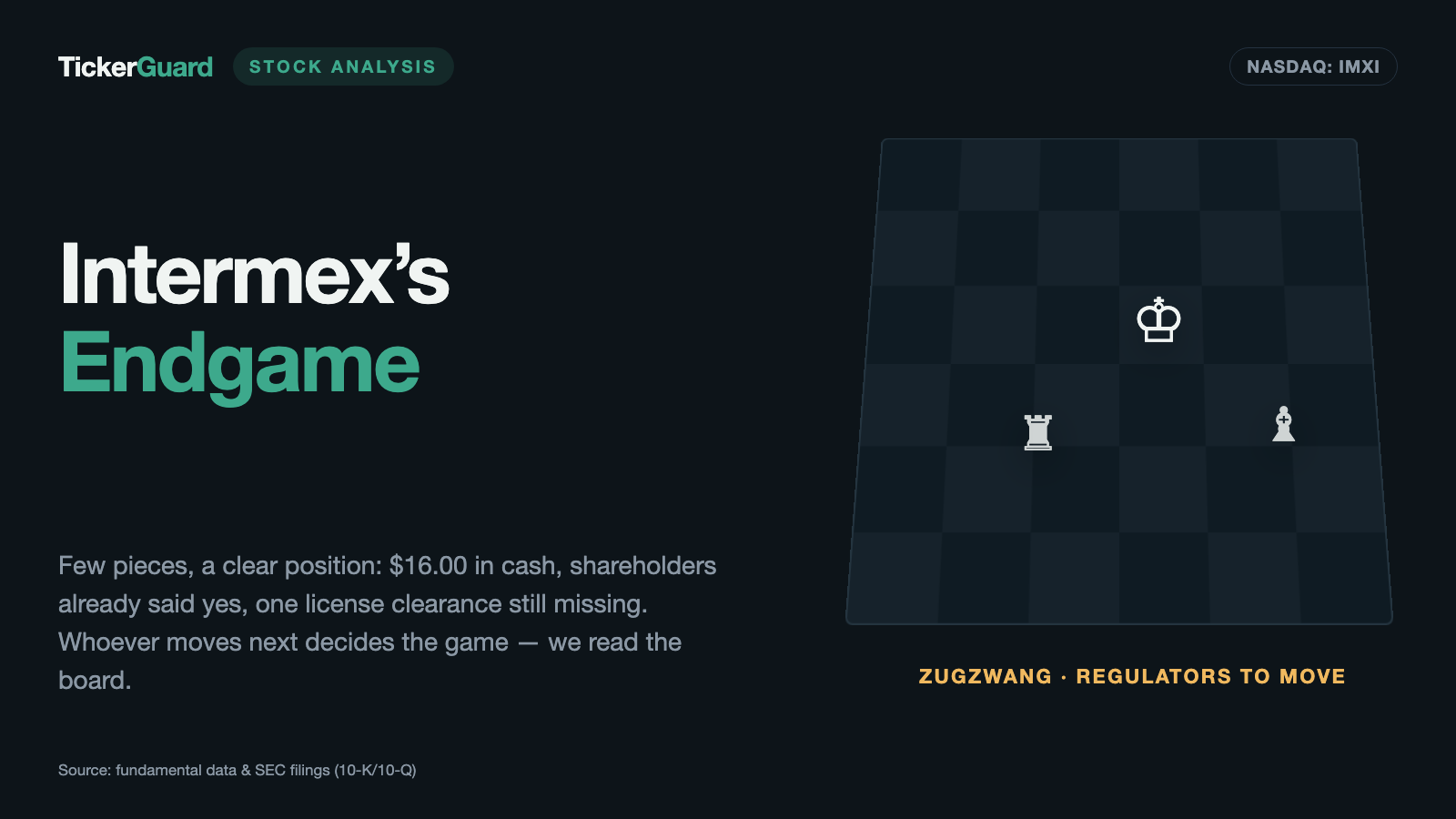
On August 13, 2026, California's financial regulator suspended an approval it had already granted — right in the middle of a takeover that looked all but done: Western Union has legally committed to buy every Intermex share (Nasdaq: IMXI) for $16.00 in cash, and shareholders and antitrust regulators have signed off. Yet the stock trades at just $14.30, while the contractual outside date of November 10, 2026 keeps approaching — a date that extends automatically while approvals are pending. Meanwhile the actual business is shrinking: revenue and adjusted earnings per share both fell sharply. Not investment advice — just the question of whether a signed contract is really money in the bank.
 Thomas Mücke
Founder & Publisher
Thomas Mücke
Founder & Publisher
As of Today
As of: October 9, 2026
- Closing price
- 12.70 $ +1.90%
- Market Capitalisation
- 0.4 $B
- P/E
- 15.2
- Growth Score
- 6/10
- AAQS
- 6/10
Price change since August 26, 2026: -11.2%
This analysis has a cut-off date. The Stock Guard tells you when something material changes in the numbers. Reserve your free spot
Chart
Interactive price chart (TradingView).
52-week range: 10.60 $ to 15.90 $ · Last price: 12.70 $ (As of: October 9, 2026)
Note: pure fact-based analysis, not investment advice and not a solicitation to buy or sell. All figures without guarantee.
On August 13, 2026, a California agency did something that rarely happens in takeover stories: it suspended an approval it had already granted — not because of any new finding, but simply because six months had passed since the approval was issued. Why should you care? Because $16.00 per share hangs on that approval. There's an investor blind spot that feels smart while it's happening: the guarantee illusion. It works like this: you read that a buyer has legally committed to pay exactly $16.00 in cash for a stock. Shareholders have approved it. Antitrust regulators have cleared it. And the stock itself trades at $14.30. Your brain does the math in half a second: "11.9 percent free money, practically risk-free." That's the exact moment you've confused a promise with a fact. A signed merger agreement is a promise with conditions attached — and one of those conditions changed on its own in the week before this analysis was written. So let's make a deal: before you buy "basically free money," let's read together what International Money Express, Inc. (Nasdaq: IMXI) — called "Intermex" in its own filings — and its buyer, The Western Union Company, told the U.S. securities regulator, the SEC: the quarterly report (10-Q) for the period ended June 30, 2026, filed August 10, 2026, and a filing from August 14, 2026, that shows "basically certain" and "certain" are two different words. Along the way we'll hit a footnote that says more than any press release: the two parties agreed on strikingly unequal break fees — depending on who walks away and why, it's $27.3 million on one side against $19.8 million on the other. Why those fees are so lopsided — and what that says about how risk is split in this deal — is something we'll unpack in the first uncomfortable truth.
What Intermex Actually Does
At its core, Intermex is a money messenger. Picture a construction worker in Houston or a home health aide in Los Angeles walking into a corner store, handing over cash, and minutes later their mother in Guatemala City or San Pedro Sula can pick up that same money at a counter. That's called a remittance, and Intermex has done essentially that since 1994 — just now across three channels at once: more than 100,000 independent sending and paying agents, 114 company-operated stores, and a growing digital channel through its website and app. The dominant corridor remains U.S.-to-Latin-America-and-Caribbean (LAC) — chiefly Mexico, Guatemala, El Salvador, Honduras and the Dominican Republic — with smaller flows to Africa and Asia and from Canada, Spain, Italy and Germany. As of December 31, 2025, the company employed 1,270 people (531 in the U.S., 518 in Mexico, 131 in Guatemala, 90 across Spain, Italy, Germany and the U.K.). Intermex's typical customer often has no traditional bank relationship — they pay for reliability and convenience, not for a brokerage account. By comparison, mostly digital rivals like Remitly lean harder into the app over the storefront — Intermex deliberately keeps both channels alive. And that exact business — cash in, cash out, a fee in between — is now up for sale.
Company history for investors
-
2018
Public listing via SPAC merger
Intermex goes public by merging with the blank-check company Fintech Acquisition Corp. II. Older sources under that name refer to the same company (CIK 0001683695).
-
2025
Merger agreement signed with Western Union
On 2025-08-10, Intermex and Western Union agree on a purchase price of $16.00 per share in cash — the fixed point the stock has traded around ever since.
-
2025
Shareholders approve the acquisition
On 2025-12-09, Intermex shareholders approve the deal at a special meeting — one of two remaining hurdles clears; the regulatory one stays open.
-
2026
New York approves, California suspends
On 2026-08-13, Western Union resolves New York's concerns in exchange for its own three-year commitments — the same day, California's DFPI suspends an approval it had already granted.
-
2026
Quarterly report shows a genuine business decline
The report for the second quarter, filed 2026-08-10, shows revenue down 18.6 percent — a standalone warning sign for shareholders, independent of the deal.
How This Stock Landed on Our Desk
This analysis is prompted by the quarterly report for the period ended June 30, 2026, which Intermex filed on August 10, 2026 — and by a filing just four days later that turned the story again. On August 10, 2025, Intermex signed a merger agreement with The Western Union Company: Western Union would acquire Intermex outright, converting every share into $16.00 in cash. On October 6, 2025, the antitrust waiting period (Hart-Scott-Rodino Act) expired. On December 9, 2025, Intermex shareholders approved the deal at a special meeting. Textbook so far. Then, on August 13, 2026 — three days after the quarterly report — Western Union disclosed two things at once in its own SEC filing. First, Western Union settled competition concerns with the New York Attorney General and the New York State Department of Financial Services (NYDFS) and received approval for the change of control of Intermex's New York money-transmitter license. Second — the very same day — California's Department of Financial Protection and Innovation (DFPI) suspended the approval extension it had granted on July 31, 2026, in order to review the matter again given "the intervening six months since approval was originally granted." The stock jumped double digits — New York was the headline. The California news sat in the same document, two paragraphs down.
The Numbers Over the Years
Before we get to the deal and its conditions, it's worth honestly looking at the business itself — because the business is what Western Union is actually buying, not a date on a calendar. Revenue grew from $459.2 million (2021) through $546.8 million (2022) to $658.7 million (2023) — then two years of stagnation: $658.6 million in 2024, and in 2025 the first real step back, to $607.8 million, down 7.7 percent. Net income shows a sharper curve: $46.8 million (2021), $57.3 million (2022), $59.5 million (2023), $58.8 million (2024) — and then a drop to $32.7 million in 2025, down 44.5 percent year over year.
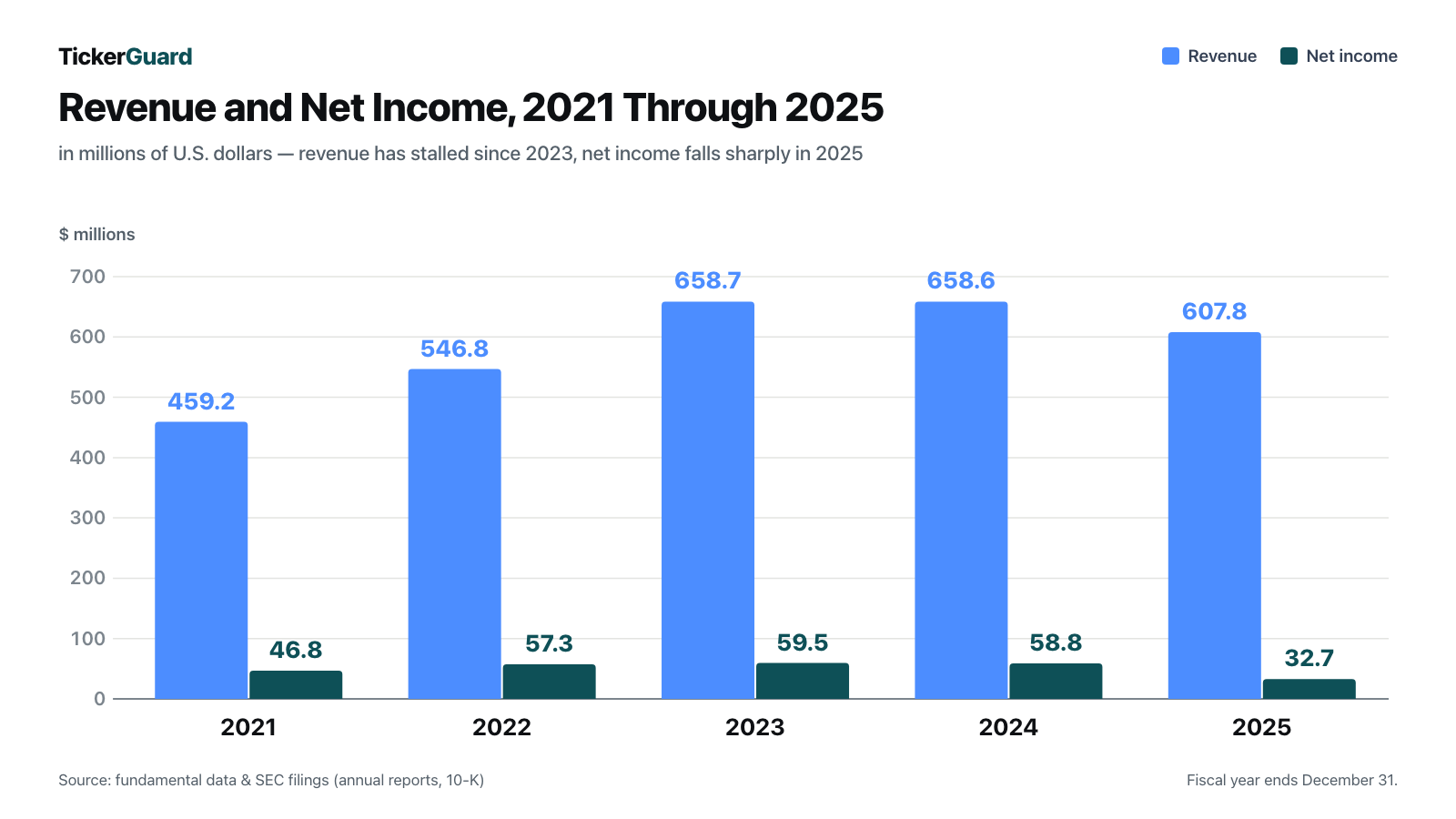
That curve is the real reason a buyer like Western Union moves before the story tells itself: a larger company with more capital can ride out a rough patch; a single niche operator has a harder time. The balance sheet as of June 30, 2026 shows the company hasn't run into trouble: $150.6 million in cash (December 31, 2025: $168.7 million) against $113.8 million in outstanding debt (down sharply from $194.8 million at year-end) — cash exceeds debt by roughly $36.8 million — and stockholders' equity of $169.6 million. The company is paying down debt, not burning cash. The question isn't solvency — it's where the operating curve points next.
What the Filings Reveal: The Uncomfortable Truths
Uncomfortable Truth No. 1: $16 Is a Promise, Not a Balance — and the Clock Is Running
The merger agreement's terms are unambiguous. The quarterly report quotes them directly:
"The Merger Agreement provides that each share of the Company's common stock issued and outstanding immediately prior to the effective time of the Merger … will be cancelled and converted into the right to receive $16.00 per share in cash, without interest."
— International Money Express, Inc., Form 10-Q for the period ended June 30, 2026, Note 1
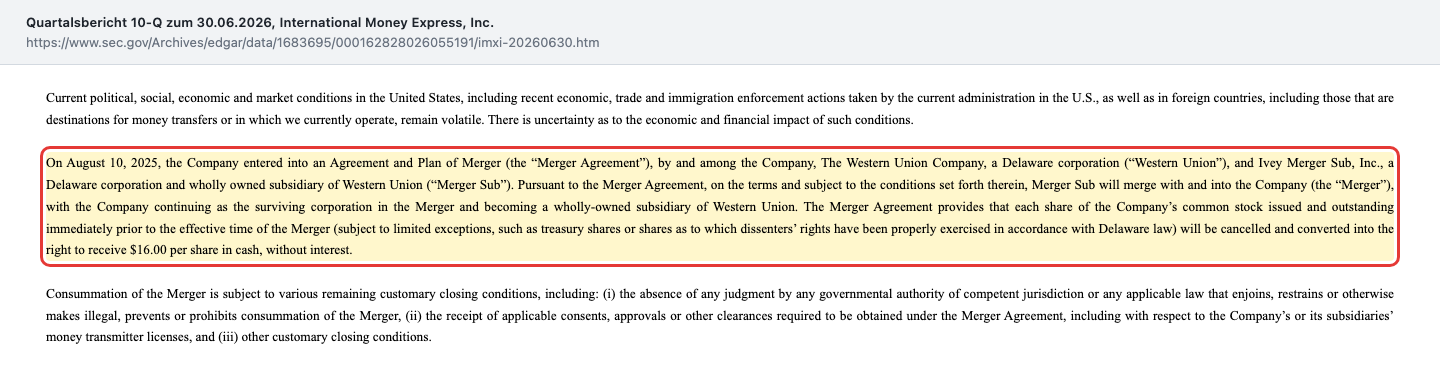
What's easy to miss in that passage: right next to the purchase price sits a condition — "applicable consents, approvals or other clearances … including with respect to the Company's or its subsidiaries' money transmitter licenses." And this contract isn't open-ended. It has an expiration date:
"The Merger Agreement contains termination rights for the Company and Western Union, including a right for either party to terminate if the Merger is not consummated by November 10, 2026 (as automatically extended to obtain certain regulatory approvals as set forth in the Merger Agreement)."
— International Money Express, Inc., Form 10-Q for the period ended June 30, 2026
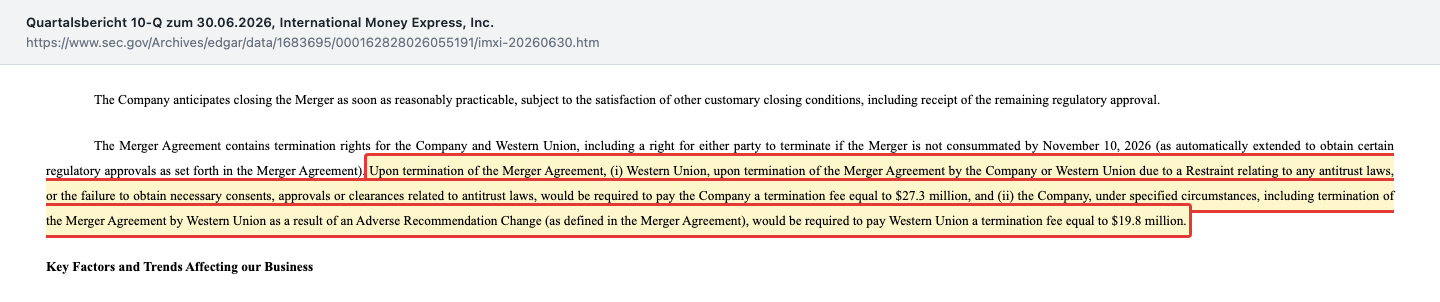
Two details in that passage deserve a closer read. First, the extension clause: November 10, 2026 is not an automatic death date for the agreement — as long as regulatory approvals are still pending, the deadline extends itself under the contract's own terms. The ticking clock is less a countdown to detonation than the moment both sides get to choose whether they want to keep waiting. Second, the lopsided break fees: Western Union owes $27.3 million if the deal dies on antitrust grounds — the buyer explicitly took on that risk and priced it at roughly $0.90 per Intermex share ($27.3 million spread across 30.2 million shares). The mere $19.8 million in the other direction becomes due — among other cases — if Intermex's board flips its recommendation, say in favor of a better offer: a comparatively low hurdle. What's striking is what the quoted passage does not cover: for the currently acute license risk in California, it names no fee of its own — the antitrust chapter is settled, the money transmitter licenses are not.
Picture it this way: you've signed a contract to buy a house, closing is scheduled — but one of two relevant local building departments just pulled back a permit it had already granted, and the contract has a date after which either side can walk. The $16.00 is real and contractually promised. But "real and promised" isn't the same as "already in your account."
Uncomfortable Truth No. 2: New York Said Yes — California Just Pulled Back
The August 14, 2026 filing is revealing precisely because it points two regulators in two different directions on the same day. New York demanded concessions and got them: Western Union itself committed, for three years after closing, to maintain a specified retail footprint in New York, keep offering cash remittance services to the affected countries, limit certain price changes, and report periodically to regulators — in exchange for a green light on the change of control of Intermex's New York license. California went the other way:
"Also on August 13, 2026, the California Department of Financial Protection and Innovation (the 'DFPI') sent a letter to the Company and IMXI suspending the approval extension previously granted on July 31, 2026 for the Company's pending acquisition of IMXI. In its letter, the DFPI stated that the suspension is 'based on a need to further review the transaction as a result of the intervening six months since approval was originally granted, and to further examine the impact of the proposal on operations in this state.' The Company and IMXI intend to engage promptly with the DFPI to address its questions and to seek reinstatement of the approval as soon as practicable."
— The Western Union Company, Form 8-K filed August 14, 2026

What stands out is the regulator's own stated reason: this isn't a new objection, it's the simple passage of time — six months since the original approval, during which market conditions can change. That's a mostly procedural rationale — though the regulator also says it wants to re-examine the impact on operations in the state — but it's a brake running directly against the November 10, 2026 outside date. As of this analysis, the DFPI had not reinstated its approval.
Uncomfortable Truth No. 3: The Core Business Is Really Shrinking — and the Filing Says Why
Blaming the price spread entirely on deal risk would be too easy. The quarterly report shows a second, independent problem: the operating business itself is getting smaller.
"Wire transfer and money order fees, net of $107.6 million for the three months ended June 30, 2026 decreased by $25.4 million, or 19.1%, from $133.0 million for the three months ended June 30, 2025. The decrease was primarily due to a lower transaction volume processed through our retail network of sending agents and Company-operated stores in the second quarter of 2026 compared to the second quarter of 2025 as a result of a contraction in the retail remittance market, particularly the LAC corridor."
— International Money Express, Inc., Form 10-Q for the period ended June 30, 2026
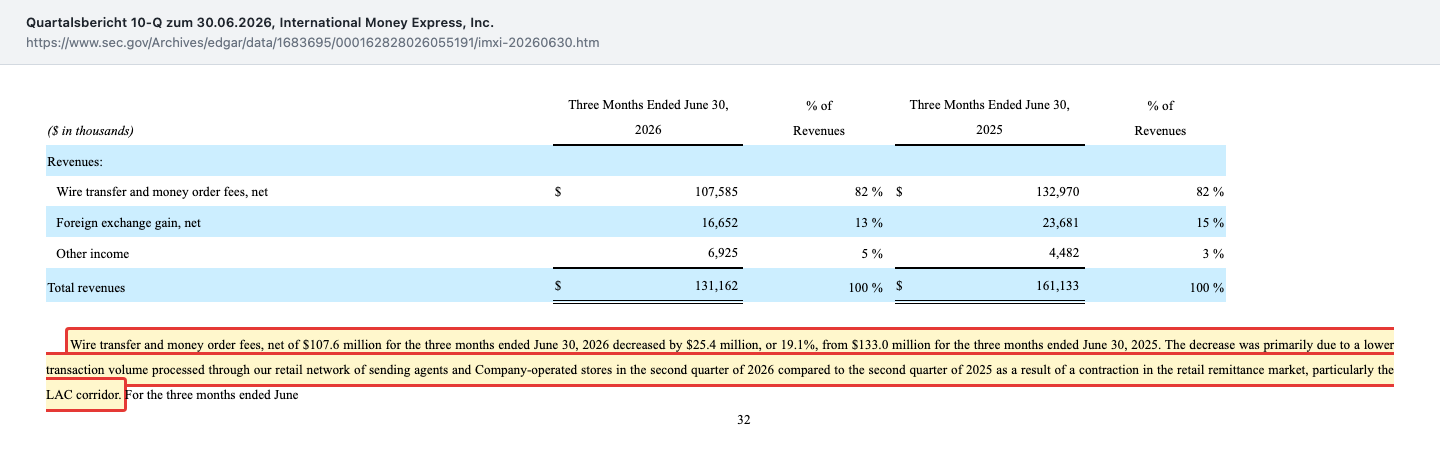
In numbers: total transaction volume fell 12.0 percent in the second quarter of 2026, and total principal amount sent fell 12.5 percent — both versus the same quarter of 2025. Picture a store with the same hours, the same staff, the same prices — but noticeably fewer customers walking through the door because their circumstances changed, not because the store is doing anything wrong. This isn't a one-quarter blip: for the first half of 2026 combined, revenue of $253.1 million was down 17.1 percent from the year-earlier half ($305.4 million). One bright spot: digital partnerships (RaaS) grew roughly 178 percent in transactions in the same quarter — a small but fast-growing counterweight to the shrinking retail business.
Uncomfortable Truth No. 4: Even Adjusted, Only Half the Profit Is Left
Whenever earnings drop sharply, it's worth asking the counter-question: is this just accounting — one-time costs that show up in 2026 and vanish in 2027 — or is it real? Intermex itself reports an adjusted metric meant to answer exactly that. It strips out share-based compensation, advisory fees tied to the pending acquisition, other one-time charges, and amortization of intangible assets. The result: even without all of those items, earnings per share still fall sharply.
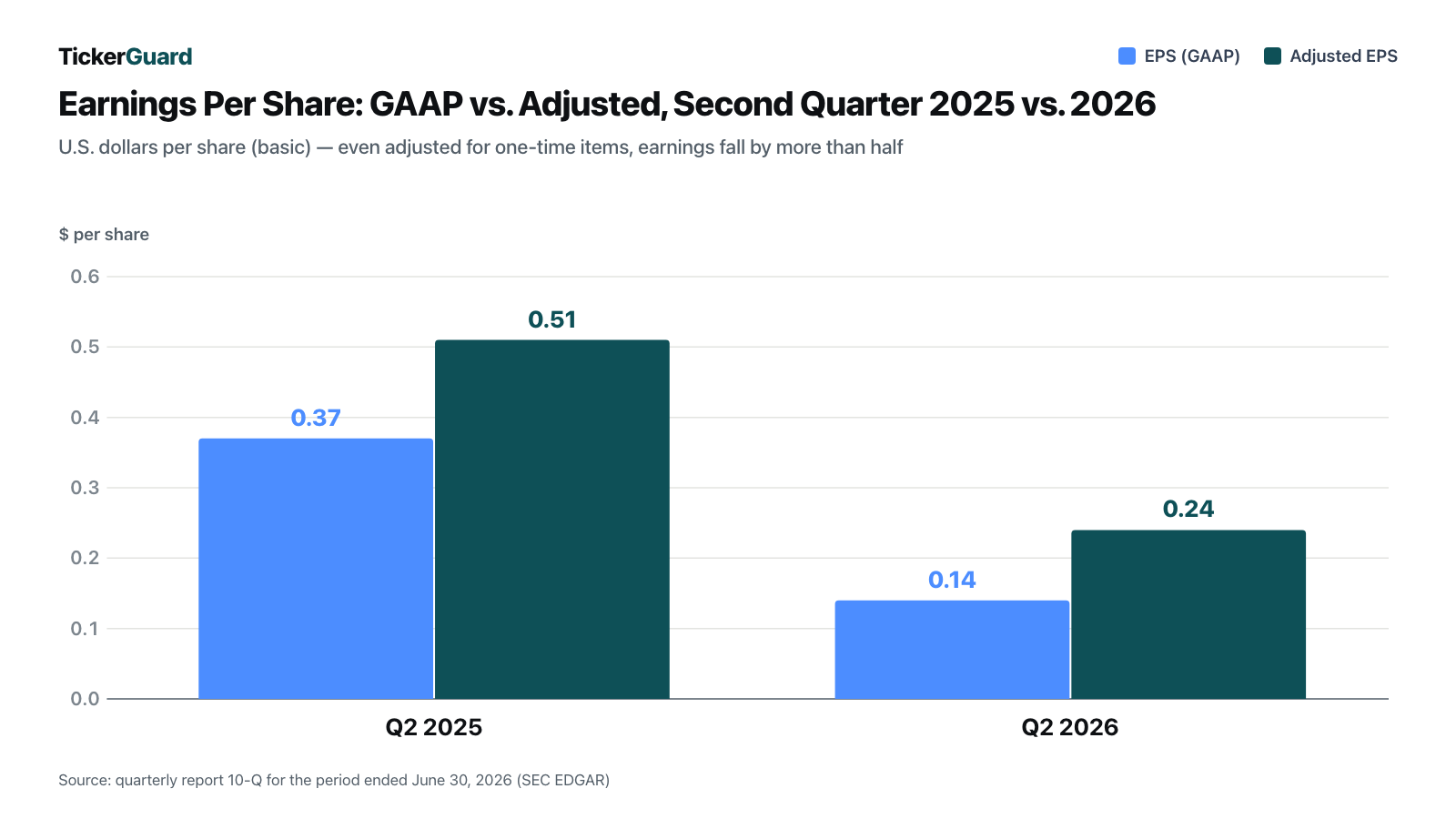
In dollar terms: adjusted net income fell from $15.2 million (Q2 2025) to $7.2 million (Q2 2026) — down 52.9 percent. For comparison, actual one-time transaction costs tied to the deal totaled just $0.7 million in the second quarter of 2026 — far too small to explain a decline of this size on their own. The honest read: this isn't primarily a one-time-charge story, it's a demand story. If you only look at the GAAP number, you might say "the special items are distorting the picture" — true, but only partly. If you only look at the adjusted number, you might say "down 53 percent is still a lot" — and you'd be right.
Valuation
Classic metrics like the price-to-earnings ratio are misleading for an acquisition target, because the market is no longer pricing the business — it's pricing the probability the deal closes at the agreed price. At a closing price of $14.30 (August 26, 2026) against an agreed deal price of $16.00, the stock trades roughly 10.6 percent below the deal price — measured the other way, from the current price up to the deal price, that gap is an 11.9 percent "spread." That gap is the market's price for the remaining risk: that California's approval stays delayed, that November 10, 2026 keeps getting closer, that something ultimately falls apart. For scale: spread across the roughly two and a half months from August 26 to the contractual outside date, an 11.9 percent gap works out to an annualized magnitude of roughly 57 percent — the market only pays gaps that wide when it seriously doubts the deal will close. The spread isn't a gift; it's the price tag on the remaining risk. With roughly 30.2 million shares outstanding (as of August 3, 2026), the closing price implies a market capitalization of about $432 million; at the deal price, it would be roughly $483 million. Wall Street analysts have adjusted to the deal too: all eight analysts still covering the stock carry a price target of exactly $16.00 — seven rate it "hold," one rates it "buy," none rate it "sell." That's no longer an independent earnings-based valuation — it's a collective bet on the deal closing.
Opportunities and Risks at a Glance
What's in Intermex's favor:
- A legally binding merger agreement with a much larger buyer at $16.00 per share in cash — antitrust clearance and shareholder approval are already in hand.
- New York resolved its competition concerns on August 13, 2026, and approved the change of control of the company's New York license.
- A solid balance sheet with no red flags: $150.6 million in cash, meaningful debt reduction from $194.8 million to $113.8 million in six months, and positive stockholders' equity.
- A growing digital side business (RaaS partnerships) with roughly 178 percent more transactions in the second quarter of 2026 — a counterweight to the shrinking retail business.
- An asymmetric break fee that favors Intermex shareholders: $27.3 million from Western Union if the deal fails on antitrust grounds, versus just $19.8 million the other way.
What's working against it:
- California suspended its already-granted approval extension on August 13, 2026, with no reinstatement date given, while the November 10, 2026 outside date keeps approaching.
- The core business is genuinely shrinking: second-quarter 2026 revenue down 18.6 percent, transaction volume down 12.0 percent, driven per the company's own filing by contraction in the LAC corridor and by "immigration enforcement actions" in the U.S.
- Even earnings adjusted for one-time items fell 52.9 percent per share in the second quarter of 2026 — the decline is mostly operational, not accounting.
- The purchase price is capped: even if the business recovers, shareholders receive no more than $16.00 per share if the deal closes.
- If the acquisition falls apart, the stock would likely revert to its standalone value — reflecting a shrinking, if still profitable, business with no takeover premium. A rough landmark: on August 8, 2025, the last trading day before the merger agreement was announced, the stock closed at $9.28 — about 35 percent below the August 26, 2026 price (source: fundamental data). The business has measurably shrunk since then, so that price is a reference point, not a floor attached.
A Human Conclusion
Back to the guarantee illusion from the start. Its flaw isn't that the $16.00 is fake — it's contractually committed, shareholder-approved, cleared by antitrust regulators, and New York just signed off. Its flaw is that a signed contract feels like a completed transaction, even though legally it only becomes one with the last missing stamp of approval. Between the signature and that stamp sits a regulator in Sacramento that took six months and decided it wants another look — and a business that got noticeably smaller during that same stretch of time. Both are part of the truth about this stock, not just the number 16. So the honest question isn't "Is an 11.9 percent spread a bargain?" It's: are you willing to carry a risk whose next milestone is just weeks away — even if the contract can push it back — and whose outcome that sits in the hands of a single regulator, for a capped upside? If yes, you have a calculated bet. If no, you had a guarantee illusion. What you do with that is your call. Not investment advice.
Sources and Transparency
All original documents used in this analysis — for your own reading:
- International Money Express, Inc. — Form 10-Q for the period ended June 30, 2026 (filed August 10, 2026)
- International Money Express, Inc. — Form 10-K for fiscal year 2025 (filed March 6, 2026)
- The Western Union Company — Form 8-K filed August 14, 2026 (New York settlement and California suspension)
- International Money Express, Inc. — Form 8-K filed October 7, 2025 (expiration of the antitrust waiting period)
- Full SEC filing history for International Money Express, Inc.: EDGAR overview (sec.gov)
- Fundamental data (metrics, analyst estimates, price history; data as of August 26–27, 2026), cross-checked against the SEC filings.
Transparency & disclaimer: This analysis is a journalistic assessment of publicly available information. It is not investment advice, not a regulated financial analysis, and not a solicitation to buy or sell securities. Stock investments — especially bets on the outcome of a pending acquisition — carry substantial risk, including total loss. All figures are provided without guarantee; each figure's data date is noted in the text. The author holds no position in Intermex or Western Union stock as of publication. Publicly available earnings call transcripts for Intermex were not available through the data source used for this research and are therefore not analyzed in this piece.
Key figures at a glance
All monetary figures in millions of $; earnings per share as reported.
| Metric | 2021 | 2022 | 2023 | 2024 | 2025 |
|---|---|---|---|---|---|
| Revenue | 459.2 | 546.8 | 658.7 | 658.6 | 607.8 |
| Operating Income (EBIT) | 67.9 | 82.9 | 95.5 | 95.0 | 68.1 |
| Net Income | 46.8 | 57.3 | 59.5 | 58.8 | 32.7 |
| Net Margin | 10.2% | 10.5% | 9.0% | 8.9% | 5.4% |
| Earnings Per Share | 1.20 $ | 1.48 $ | 1.63 $ | 1.79 $ | 1.08 $ |
Source: fundamental data & SEC filings (annual and quarterly reports, 10-K/10-Q)
Our Bottom Line at a Glance
- Contractual deal price positive
- A legally binding merger agreement locks in $16.00 per share in cash; antitrust clearance (2025-10-06) and shareholder approval (2025-12-09) have been in hand for months, and the asymmetric break fee ($27.3M vs. $19.8M) favors Intermex shareholders.
- Regulatory status negative
- New York resolved its concerns on 2026-08-13 in exchange for Western Union's own three-year commitments — the same day, California's DFPI suspended an approval extension it had already granted, with no reinstatement date given. That leaves the 2026-11-10 contractual outside date approaching without the final approval step settled.
- Core operating business negative
- Revenue fell 18.6 percent and transaction volume fell 12.0 percent in the second quarter of 2026 — per the filing, driven by contraction in the LAC corridor and U.S. immigration enforcement actions. First-half 2026 revenue was down 17.1 percent year over year.
- Adjusted metrics negative
- Even adjusted for share-based compensation, deal-advisory costs and amortization, earnings per share fell 52.9 percent to $0.24 in the second quarter of 2026 — actual one-time items of $0.7 million explain only a small part of that. The decline is mostly operational.
- Balance sheet & liquidity positive
- As of 2026-06-30, the company held $150.6 million in cash against $113.8 million in outstanding debt (cut from $194.8 million within six months) — a net cash surplus of roughly $36.8 million — with positive stockholders' equity of $169.6 million: no solvency or existential question.
- Digital side business neutral
- Digital RaaS partnerships grew roughly 178 percent in transactions in the second quarter of 2026 — a fast-growing but still small counterweight to the shrinking retail network.
Intermex is financially solid (outstanding debt cut by roughly 42 percent within six months, cash exceeds it by roughly $36.8 million, positive equity) but under real operating pressure: revenue and adjusted earnings per share both fell by double digits in the second quarter of 2026, per the company's own filing driven by shrinking demand in the LAC corridor. The $16.00 merger agreement with Western Union is legally binding but not yet completed: New York has approved, California suspended an approval it had already granted, and the contractual outside date is November 10, 2026. Not investment advice.
What Our Rating Means
Open questions
The business works in principle, but one material question is open. As long as it stays open, our findings do not carry a quality verdict.
Yellow, because a material operating question remains open: revenue fell 18.6 percent and transaction volume fell 12.0 percent in the second quarter of 2026 — and even earnings adjusted for one-time items fell 52.9 percent per share. Per the company's own filing this is mostly a demand question (LAC corridor contraction, U.S. immigration policy), not a balance-sheet question — cash sits at $150.6 million and exceeds outstanding debt (cut by roughly 42 percent within six months) by roughly $36.8 million, and equity is positive. Whether the LAC corridor recovers or stays structurally smaller can't be answered confidently from two quarters alone — that alone rules out both green and red. The pending $16.00 acquisition by Western Union doesn't change this rating: it's a price argument, not a quality argument, and its outcome (California suspended an already-granted approval on 2026-08-13, with an outside date of 2026-11-10) remains open as of this analysis. The decision is yours.
A journalistic assessment by our editorial team at the time of the deep dive, based on public sources — not investment advice and not a solicitation to buy or sell. Your personal circumstances (investment goals, risk capacity, taxes) cannot be taken into account. What our levels mean, how verdicts are formed, and what conflicts of interest exist →
Worth Noting
- Trigger for this analysis: the Form 10-Q for the quarter ended June 30, 2026, filed August 10, 2026, and Western Union's SEC filing of August 14, 2026 on the New York settlement and California suspension.
- Data as of: annual and quarterly figures come from the fiscal 2025 Form 10-K (filed March 6, 2026) and the Form 10-Q for the period ended June 30, 2026. Price, market-cap and valuation figures are as of August 26-27, 2026.
- Disclosed data gap: public earnings-call transcripts for Intermex were unavailable through the data source used for any of the last twelve quarters (0 of 12 candidates delivered) — they are therefore deliberately not part of this analysis.
Stock Watch
This analysis is as of August 27, 2026. Stock Watch will tell you what's changed at IMXI since then.
Later $1 a month per stock — signing up is free, and you'll be the first to know when it launches.
The full analysis as a PDF for later
We will send you this analysis as a PDF — to print, file away, and read at your own pace. And we will add you to the free Stock Watch list for International Money Express Inc (IMXI), so you hear about it when something material in this analysis changes.
Frequently Asked Questions
International Money Express, Inc. (Nasdaq: IMXI), called "Intermex" in its own filings, is a cash remittance company focused on the U.S.-to-Latin-America-and-Caribbean (LAC) corridor, chiefly Mexico, Guatemala, El Salvador, Honduras and the Dominican Republic. It operates through more than 100,000 independent agents, 114 company-operated stores and digital channels; as of December 31, 2025 it employed 1,270 people.
Yes. On August 10, 2025, Intermex signed a merger agreement with The Western Union Company: every share converts into $16.00 in cash. The antitrust waiting period expired on October 6, 2025, and shareholders approved the deal on December 9, 2025. Closing remains subject to outstanding regulatory approvals for the company's money transmitter licenses.
Because closing isn't certain yet. On August 13, 2026, Western Union settled with New York and received approval for Intermex's license there — but the same day, California's financial regulator (DFPI) suspended an approval extension it had already granted, in order to review the matter again. The $14.30 closing price (August 26, 2026) reflects that remaining risk, plus the approaching November 10, 2026 contractual outside date.
California's DFPI had approved the deal on July 31, 2026, with an extension attached. On August 13, 2026, it suspended that extension, citing a need to review the matter again given the six months that had passed since the original approval. No reinstatement date was given, and as of this analysis it was still outstanding.
Either side can then terminate the merger agreement — though that date automatically extends as long as regulatory approvals remain pending. If the deal ultimately fails on antitrust grounds, Western Union owes Intermex a $27.3 million break fee; if Intermex walks away for a better offer, it owes Western Union $19.8 million.
The quarterly report cites "a contraction in the retail remittance market, particularly the LAC corridor" as the main driver, and elsewhere points to recent U.S. economic, trade and immigration enforcement actions. Revenue fell 18.6 percent to $131.2 million, transaction volume fell 12.0 percent, and even adjusted earnings per share fell 52.9 percent.
Found an error?
Did you spot a factual error, an outdated number, or a typo in this deep dive? Let us know briefly — your report goes straight to the editorial team.