Innodata: From $121.50 to $46 — the Real Risk Is Two Customers With 71 Percent
Innodata makes real money on training data for AI models. But two customers generated roughly 71 percent of revenue in Q2 2026, and their agreements are generally terminable on 30 to 90 days’ notice. From its closing high of $121.50 (June 4, 2026), the stock fell to $46.17 by October 29, 2026; on October 27, 2026 alone it lost a quarter of its value without Innodata reporting any event. We work out what the business carries once you forget the old high.
 Thomas Mücke
Founder & Publisher
As of Today
As of: October 30, 2026
- Closing price
- 43.80 $ -5.10%
- Market Capitalisation
- 1.4 $B
- P/E
- 33.5
- Growth Score
- 7/10
- AAQS
- 7/10
Price change since October 29, 2026: -5.1%
This analysis has a cut-off date. The Stock Guard tells you when something material changes in the numbers. Reserve your free spot
Chart
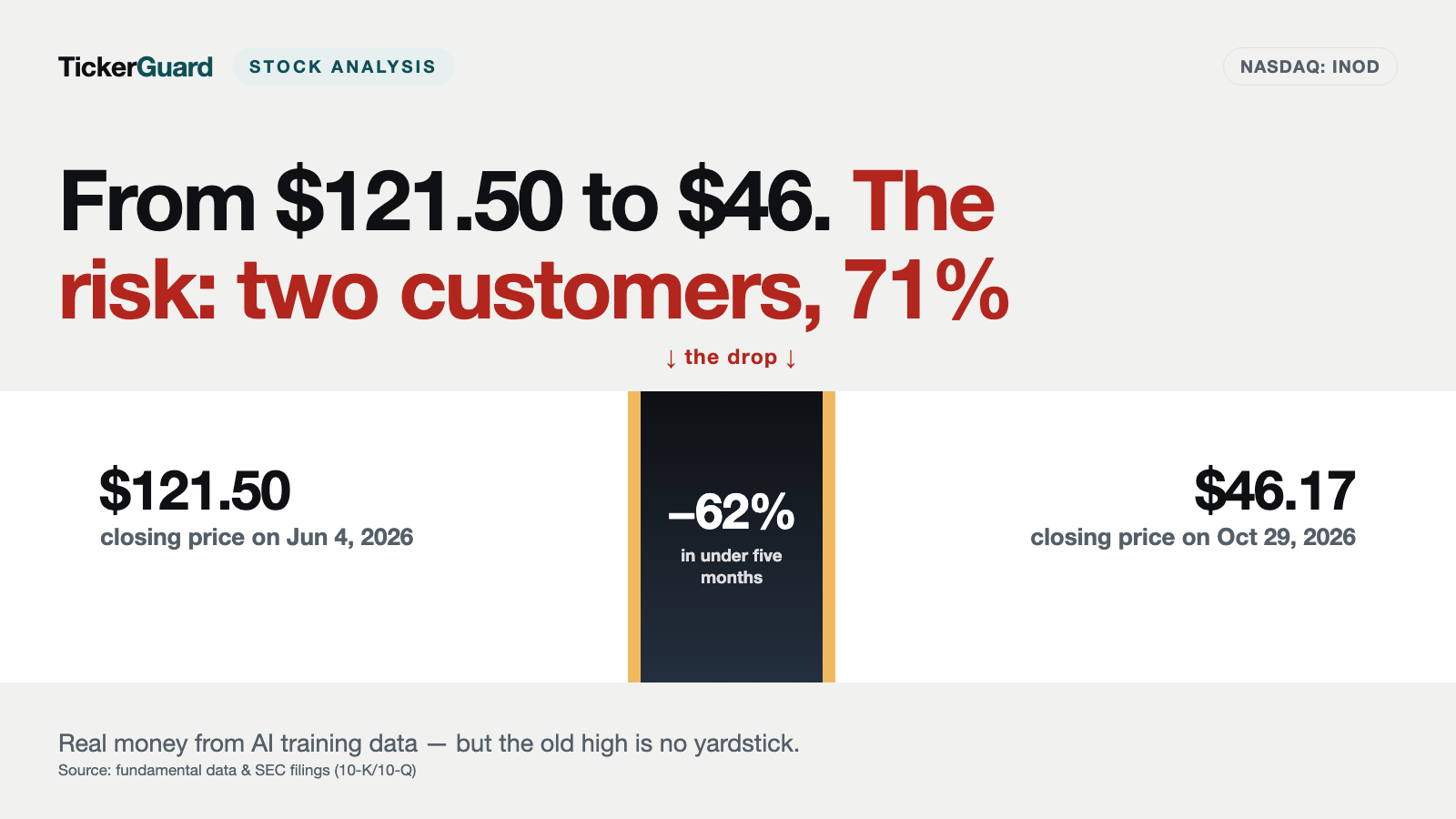
Interactive price chart (TradingView).
52-week range: 34.50 $ to 121.50 $ · Last price: 43.80 $ (As of: October 30, 2026)
Note: pure fact-based analysis, not investment advice and not a solicitation to buy or sell. All figures without guarantee.
The anchor trap: when an old high starts to look like a price tag
There is a thinking error that feels like bargain hunting: anchoring. It works like this. You have seen a stock trade at $121.50. Later it costs barely more than a third of that — and your brain does the math on its own: “Down 62 percent, that’s a fire sale.” The old price becomes the tag you measure the new one against. But yesterday’s price says nothing about what a company is worth. It only says what somebody paid for it on a given day.
Innodata (NASDAQ: INOD) is exactly that kind of stock. On May 8, 2026, after its quarterly results, it jumped in a single day from $45.64 to $84.89; on June 4, 2026 it closed at $121.50; on October 27, 2026 it fell in one day from $59.91 to $44.74, and on October 29, 2026 it closed at $46.17 — 62 percent below the high, in under five months. With Innodata, the anchor even comes in pairs: the average price target of the four analysts covered in the fundamental data, $122.75, sits almost exactly on the old high (third-party figure, as of October 30, 2026). Measuring against numbers like these means measuring against a single day in June — not against what the business earns.
On October 28, 2026, one day after the crash, the stock showed up in our in-house Reddit hype scanner with 15 mentions. So let’s make a deal: we drop the anchor and read together what Innodata itself told the U.S. securities regulator, the SEC — the annual report (10-K) for 2025, the quarterly reports (10-Q) for the first and second quarters of 2026, and every current report through the end of October 2026. False statements in SEC filings can be penalized. At the end, you decide.
Company history for investors
-
2023
Last loss year before the AI boom
Revenue of $86.8 million, net loss of $0.9 million. For shareholders, Innodata was still a small data services firm without sustained profits.
-
2024
Revenue nearly doubled, first big profit
Revenue of $170.5 million (up 96 percent), net income of $28.7 million. Dependence grew too: the largest customer accounted for about 48 percent of revenue.
-
2025
One customer, 58 percent
Revenue of $251.7 million, net income of $32.2 million. The largest customer brought about 58 percent — more than half of the business hung on one name.
-
2026
Price spike, insider sales, stock program
After the Q1 results, the stock rose 86 percent on 5/8/2026; the CEO sold shares worth $121.9 million by mid-June. Separately, on 8/6/2026 Innodata set up a stock program of up to $300 million.
-
2026
New CEO, low price
Since 9/30/2026, Rahul Singhal has led the company, longtime CEO Jack Abuhoff became executive chairman. On 10/27/2026 the stock fell from $59.91 to $44.74 in one day, with no current report on any event.
What Innodata actually does — tutoring for artificial intelligence
A large language model learns like a student: from examples, corrections and exams. In plain terms, Innodata is a tutoring school for AI models. The company from Ridgefield Park, New Jersey, assembles training data, has experts grade and correct model answers, builds test tasks and checks whether a model works safely and reliably. Its quarterly report for June 30, 2026 describes it as a data engineering company that supports the development, training, post-training, evaluation and deployment of advanced AI systems. Most of it is skilled manual work: as of December 31, 2025, Innodata employed 10,107 people at locations in the U.S. and Canada, the Philippines, India, Sri Lanka, the United Kingdom, Israel and Germany; according to the annual report, many of them hold advanced degrees in fields such as law, medicine or technology.
Through 2025, Innodata reported three segments; since the first quarter of 2026 it reports a single segment. The core business, Digital Data Solutions, brought in about $220.9 million in revenue in 2025 (up 57 percent), alongside Agility (media intelligence and PR software, $23.5 million) and Synodex (turning medical records into structured data for insurance and healthcare, $7.3 million). The customer list is impressive: per the annual report, it includes five of the so-called “Magnificent Seven” plus several leading AI labs. Sounds like an endless tailwind? Partly, it is. But that also names the central tension of this analysis, and it runs through every chapter: Innodata is genuinely growing and genuinely profitable — but that growth rests on very few, very powerful customers who can scale back on short notice at any time.
How the stock landed on our desk
No metrics-based screen flagged Innodata; other investors’ attention did. Our in-house Reddit hype scanner first recorded the ticker INOD on October 28, 2026 with 15 mentions; the market value at that point was about $1.54 billion. The trigger is easy to spot: on October 27, 2026 the stock closed at $44.74, down from $59.91, on about 9.8 million shares traded — on a typical trading day in the three months before, it was about 1.1 million. There was no current report (8-K) on a corporate event that day; the only filing was a registration of 600,000 additional shares for the employee equity plan (Form S-8). So the filings do not explain why so many shares changed hands — and we won’t guess. Keep this in mind from the start: a price crash without a filing is not a discount coupon; it is an open question. Our job is to hold the forum story up against the paperwork.
The numbers over the years — given their due
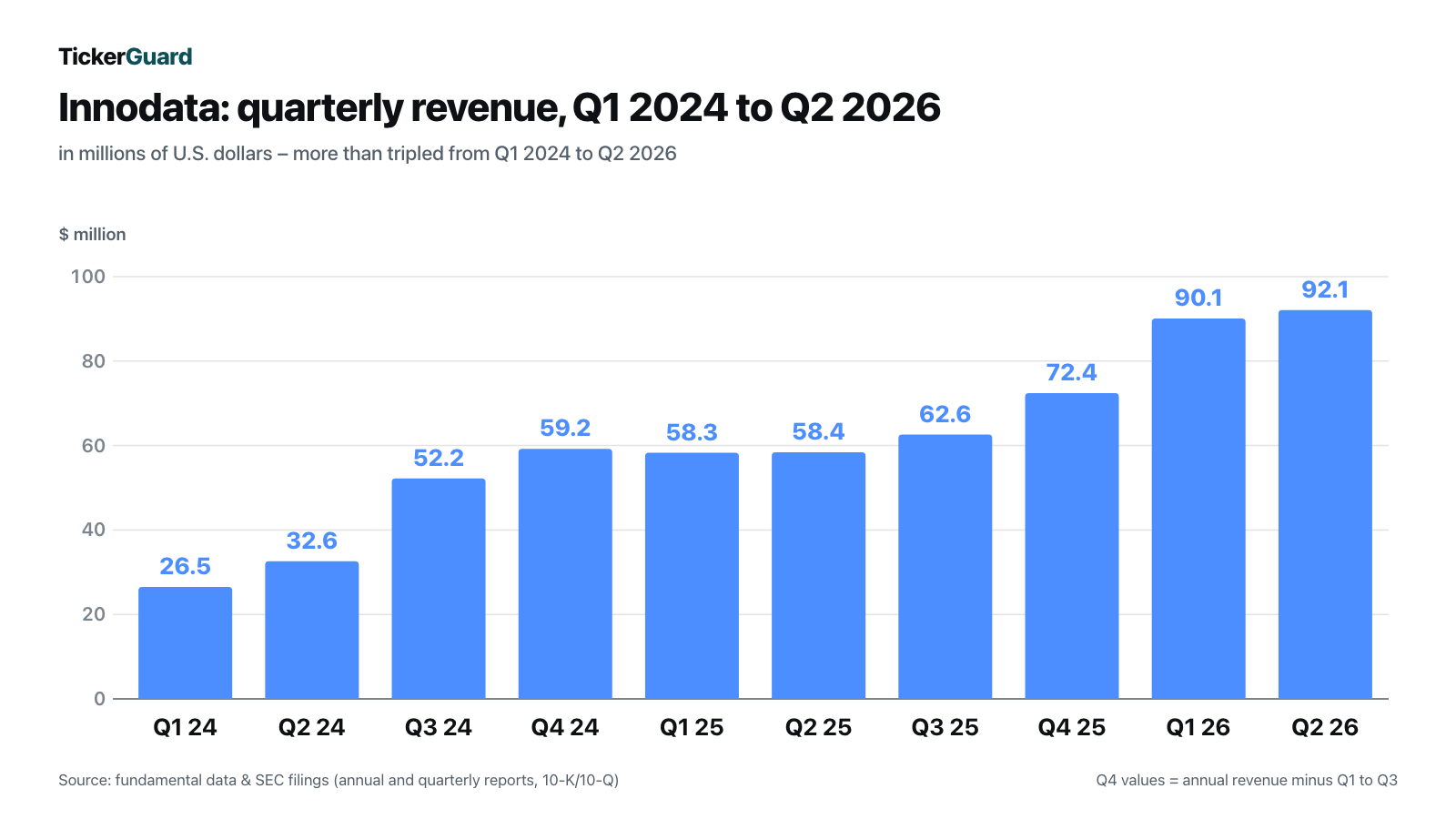
First, what is genuinely impressive — and there is a lot. In three years, Innodata has turned from a small, loss-making company into a profitable growth business. Revenue was $79.0 million in 2022 and $86.8 million in 2023. Then came the AI boom: $170.5 million in 2024 (up 96 percent) and $251.7 million in 2025 (up 48 percent). The first half of 2026 alone brought $182.2 million, 56 percent more than a year earlier. The chart shows the staircase quarter by quarter:
And this is not growth on credit. Net income went from a $11.9 million loss (2022) and a $0.9 million loss (2023) to a $28.7 million profit in 2024 and $32.2 million in 2025. One detail belongs to the honest picture: 2024 was helped by a $4.2 million income tax benefit, including a one-time $6.0 million effect from releasing a valuation allowance on loss carryforwards, while Innodata recorded a $9.2 million tax expense in 2025. Pre-tax income is therefore the cleaner comparison — and it rose from $24.5 million to $41.4 million. In Q2 2026 the company earned $14.4 million net (prior year: $7.2 million), or $0.41 per diluted share. The balance sheet carries no drawn debt: according to the quarterly report, the Wells Fargo credit line of up to $50 million (limited by a borrowing base of about $30.8 million at June 30, 2026) was not used in the first half of 2026, and shareholders’ equity rose from $107.1 million (end of 2025) to $159.6 million (June 30, 2026). Remember the picture: real money is being earned here with real work. The only question is: for whom.
What the filings say — the uncomfortable truths
Uncomfortable truth No. 1: two customers, 71 percent — on 30 to 90 days’ notice
Customer concentration is the technical term. The everyday version: a contractor where two clients write seven out of ten invoices. When both are happy, business is great. When one walks, you don’t lose a job — you lose about a third of the work. At Innodata, it looks like this: the largest customer accounted for about 48 percent of revenue in 2024, about 58 percent in 2025 and 56 percent in Q1 2026. In Q2 2026 its share fell to 37 percent — not because revenue spread across many shoulders, but because a second major customer jumped from 17 to 34 percent. For scale: 34 percent of $92.1 million is about $31 million in revenue in a single quarter, 37 percent about $34 million.
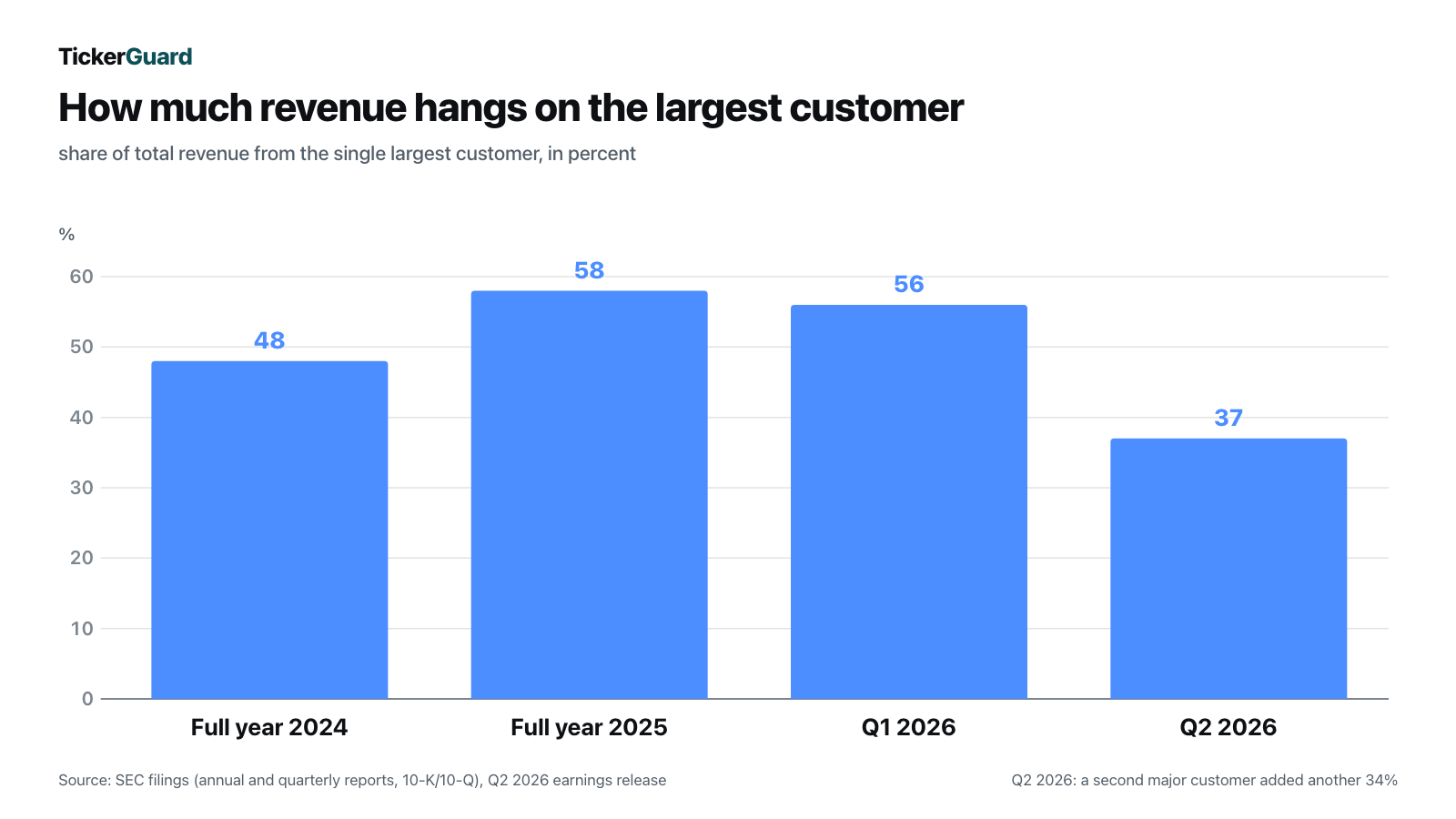
The quarterly report puts it plainly:
“One customer generated approximately 37% and 58% of the Company’s total revenues for the three months ended June 30, 2026 and 2025, respectively. Another customer generated approximately 34% of the Company’s total revenues for the three months ended June 30, 2026. No other customer accounted for 10% or more of total revenues during these periods. Revenues from non-U.S. customers accounted for 13% and 17% of the Company’s total revenues for the three months ended June 30, 2026 and 2025, respectively.”
— Innodata Inc., SEC quarterly report 10-Q for June 30, 2026, Note 13 “Segment reporting and concentrations”

That alone would be bearable if those customers were locked in for the long term. They are not. The annual report describes the contracts like this:
“Our customer agreements are generally terminable by our customer upon 30 to 90 days’ notice.”
— Innodata Inc., SEC annual report 10-K for 2025, Item 1 “Business”

To be fair: Innodata has in fact reduced its dependence on its largest customer. At the same time, the market is crowded: according to its annual report, Innodata competes with Scale AI, Surge AI, Appen and TELUS Digital, among others, and customers can also do such work with their own staff. But one cluster has become two, not a broad customer base. For comparison, another provider of AI data services: in our TaskUs analysis, the largest customer generated about 26 percent of 2025 revenue — and even that counted as concentration risk there. At Innodata, the largest customer alone was still bigger in Q2 2026, at 37 percent, and the top two together are almost three times that size. Remember the line: revenue that can be cancelled on 30 to 90 days’ notice is a promise on loan, not an asset.
Uncomfortable truth No. 2: about half of the record cash is already spoken for
The Q2 2026 earnings release reports $250.4 million in cash and short-term investments — up $168.2 million in six months. Read that and you think of a cash machine. The quarterly report shows where a large part of it came from:
“As of June 30, 2026, cash and cash equivalents were $240.3 million, including amounts received in advance in connection with ongoing customer programs. At June 30, 2026, $67.0 million remained recorded within advances from customers, while $61.8 million of related project costs that had been incurred but remained unpaid was included in accounts payable and accrued expenses.”
— Innodata Inc., SEC quarterly report 10-Q for June 30, 2026, Item 2 “Liquidity and Capital Resources”

In everyday terms: a travel agency whose bank account is full because customers prepaid their trips — while the hotel bills are still on their way. The money is there, but it is already spoken for. In its earnings release, Innodata itself strips out the prepayments and cites about $134 million as cash net of those customer funds. The release does not break down exactly how it arrives at that figure; deducting customer advances and unpaid project costs in full from the $250.4 million would leave $121.6 million. Where the difference of just over $12 million comes from remains an open question for the next report. The same applies to operating cash flow: $164.4 million in the first half of 2026 sounds huge, but $117.9 million of it came from changes in working capital — essentially these very advances and unpaid bills. That is cleanly disclosed and perfectly legal. Still: anyone judging Innodata’s balance sheet strength should work with $134 million, not $250 million. And that is still a decent cushion.
Uncomfortable truth No. 3: the company’s own guidance would be met even with a weaker second half
On August 6, 2026, Innodata reaffirmed its full-year guidance: revenue growth of “40% or more” for 2026. Sounds ambitious — let’s do the math. Forty percent on $251.7 million gives at least about $352 million. The first half has already booked $182.2 million. That leaves at least about $170 million for the second half, or just over $85 million per quarter if the remainder is split evenly across both quarters — less than the $92.1 million of the second quarter. Put differently: the guidance would be met even if second-half revenue fell below the spring level. That fits with growth already slowing quarter to quarter: from Q1 to Q2 2026, revenue rose only a little over 2 percent.
Management stresses that possible large programs from new customers are not yet included in the 40 percent. That may be true — but it is an expectation, not an order. And one more number should keep you alert: selling and administrative expenses rose about 89 percent in Q2 2026 to $26.6 million, while revenue grew 58 percent. On top of that, stock-based compensation more than doubled to $13.1 million in the first half (prior year: $5.6 million). Remember: when costs run faster than revenue, it takes new large programs to hold the margin.
Uncomfortable truth No. 4: insider sales and a program for new stock — two separate events
Between May and September 2026, insiders sold stock, properly reported on Form 4. The insider filings show that CEO Jack Abuhoff exercised options with strike prices between $1.24 and $43.01 between May 12 and June 16, 2026, and sold 1,233,651 shares for about $121.9 million, or $98.83 per share. That equals about 38 percent of the 3,240,048 shares the proxy statement attributed to him as of April 15, 2026 (9.4 percent, including options). In total, five executives and directors sold about 1.64 million shares for about $159.4 million between May and September 2026. That is legal. The filings say nothing about the reasons.
Separately, on August 6, 2026 — the day of the quarterly results — Innodata entered into an at-the-market program: in plain terms, the company may sell new shares gradually, directly into the market through five banks, without a big offering and without a fixed date.
“We have entered into an equity distribution agreement (the “Sales Agreement”) with Goldman Sachs & Co. LLC, Craig-Hallum Capital Group LLC, Wells Fargo Securities, LLC, Maxim Group LLC and Wedbush Securities Inc. as our sales agents (the “Sales Agents”), under which we may offer and sell from time to time our common stock having an aggregate offering price of up to $300,000,000. The Sales Agents may act as agents on our behalf or purchase shares of our common stock as principal.”
— Innodata Inc., SEC prospectus supplement 424B5 of August 6, 2026

How big is that? On July 31, 2026, 34,382,651 shares were outstanding. At the October 29, 2026 close ($46.17), $300 million would be about 6.5 million new shares — almost one fifth more. That is called dilution: your slice of the pie gets smaller when new slices are cut. Whether Innodata has already used the program is not stated in the filings through the end of October 2026; the next quarterly report will show it. A year earlier, Innodata filed its third-quarter report on November 6. On October 27, 2026, the company also registered 600,000 more shares for its employee equity plan. And the people responsible have changed: since September 30, 2026, Rahul Singhal has been CEO, while Abuhoff, CEO since 1997, became executive chairman with a $600,000 base salary; CFO Jayant Chauhan has been in office since July 6, 2026. Keep two separate facts in mind: insiders sold, and the company may issue new shares. Both are disclosed; the filings do not establish any link between the two.
Valuation: what the market still pays after the crash
At the October 29, 2026 close ($46.17), the 34,382,651 shares outstanding on July 31, 2026 add up to a market value of about $1.59 billion; the fundamental data show the same order of magnitude. Revenue over the last four reported quarters (Q3 2025 through Q2 2026) adds up to $317.2 million, net income to about $46.5 million. That implies a price-to-sales ratio of about 5 and a price-to-earnings ratio of about 34. In plain terms: the market value equals about 34 times the earnings of the last four quarters. That multiple assumes the growth continues — and those earnings already include the sharply higher selling, general and administrative expenses of Q2 2026. Deducting the roughly $134 million in cash net of customer funds changes little. Another provider of AI data services offers a yardstick: at the end of July 2026, TaskUs was valued at about 0.5 times its annual revenue and about 5 times its annual earnings, according to our analysis (data as of July 29, 2026). Per dollar of revenue, the market therefore values Innodata roughly ten times as highly — that much growth is already priced in. Four analysts covered in the fundamental data rate the stock a “buy”; their average price target is $122.75 (third-party figure, as of October 30, 2026). Average here means all four targets added up and divided by four — a single outlier on the high side pulls it up noticeably. Treat that number with care: it sits close to the old June high — which makes it exactly the anchor we warned you about at the start. Fair value here depends less on a ratio than on one question: will the two big customers stay — and will new ones join?
Upside and risks at a glance
What speaks for Innodata:
- Real, profitable growth: revenue from $86.8 million (2023) to $251.7 million (2025), $92.1 million in Q2 2026 (up 58 percent) with $14.4 million in net income; pre-tax income of $41.4 million in 2025 after $24.5 million.
- First-tier customers: per the annual report, five of the “Magnificent Seven” and several leading AI labs; according to the earnings release, another fast-scaling frontier lab was added in Q2 2026.
- Dependence on the largest customer is falling: from 58 percent (2025) to 37 percent (Q2 2026).
- Solid balance sheet: $50 million credit line unused, equity of $159.6 million (June 30, 2026), about $134 million in cash net of customer advances.
What speaks against it:
- Concentration risk: two customers with roughly 71 percent of quarterly revenue, agreements generally terminable on 30 to 90 days’ notice and without purchase commitments.
- About half of the cash is spoken for: $240.3 million in cash is set against $67.0 million in customer advances and $61.8 million in unpaid project costs.
- Growth is slowing: only a little over 2 percent from Q1 to Q2 2026; full-year guidance is met with just over $85 million in each second-half quarter. Selling and administrative expenses up about 89 percent in Q2.
- Selling and dilution: the CEO sold stock worth about $121.9 million, and the company may issue up to $300 million in new shares — at the October 29, 2026 close, almost one fifth of the share count.
- New leadership: CEO transition on September 30, 2026, CFO since July 2026 — the new team still has to prove itself.
A human conclusion
Back to the anchor trap from the start. Its core is not whether roughly $46 on October 29, 2026 is too expensive or too cheap. Its core is that June’s $121.50 hands you an answer before you have asked the question. The old price was the highest close of the year, nothing more and nothing less. On October 29, 2026 the close was 62 percent below it. What remains once you let go of the anchor? A company that nearly tripled its revenue in three years, makes a profit and, according to its annual report, works for five of the so-called Magnificent Seven and several leading AI labs. And a company with roughly 71 percent of its revenue tied to two customers who can leave on 30 to 90 days’ notice, with about half of its cash already earmarked for customer programs, and with the right to sell $300 million in new stock. So the honest question for you is not “Is this cheap now?” but: would you buy this company if you had never learned the stock once traded at $121? If yes, you have a thesis. If no, you had an anchor. What you do with it is your decision. And that is exactly how it should be.
Sources
All primary documents used in this analysis — read them yourself:
- Innodata Inc. — SEC quarterly report 10-Q for June 30, 2026 (filed August 6, 2026)
- Innodata Inc. — Q2 2026 earnings release, Exhibit 99.1 to Form 8-K (filed August 6, 2026)
- Innodata Inc. — SEC prospectus supplement 424B5 for the at-the-market program (filed August 6, 2026)
- Innodata Inc. — SEC quarterly report 10-Q for March 31, 2026 (filed May 7, 2026)
- Innodata Inc. — SEC annual report 10-K for 2025 (filed February 26, 2026)
- Innodata Inc. — SEC proxy statement DEF 14A for the 2026 annual meeting (filed April 24, 2026)
- Innodata Inc. — Current report 8-K/A on the CEO transition (filed September 30, 2026)
- Innodata Inc. — Registration statement S-8 for the employee equity plan (filed October 27, 2026)
- Insider filings (Form 4) and the full SEC filing history of Innodata Inc.: EDGAR overview (sec.gov)
- Fundamental data (prices, market value, analyst estimates; as of October 30, 2026), reconciled with the SEC filings and the SEC’s XBRL data series.
- Reddit mentions: 15 mentions, first recorded on October 28, 2026 via our in-house stock scanner.
Transparency & disclaimer: this analysis is journalistic commentary on publicly available information. It is not investment advice, not a regulated investment research product and not a solicitation to buy or sell securities. Equity investments carry substantial risk up to and including total loss. All information is provided without warranty; the as-of date for each figure is stated in the text. Positions held by the operator are disclosed daily; where one exists, it appears as a notice at the top of this deep dive.
Key figures at a glance
All monetary figures in millions of $; earnings per share as reported.
| Metric | 2021 | 2022 | 2023 | 2024 | 2025 |
|---|---|---|---|---|---|
| Revenue | 69.8 | 79.0 | 86.8 | 170.5 | 251.7 |
| Operating Income (EBIT) | -1.5 | -10.3 | 0.9 | 24.2 | 40.2 |
| Net Income | -1.7 | -11.9 | -0.9 | 28.7 | 32.2 |
| Net Margin | -2.4% | -15.1% | -1.0% | 16.8% | 12.8% |
| Earnings Per Share | -0.06 $ | -0.44 $ | -0.03 $ | 0.89 $ | 0.92 $ |
Source: fundamental data & SEC filings (annual and quarterly reports, 10-K/10-Q)
Our Bottom Line at a Glance
- Growth & earnings power positive
- Revenue from $86.8 million (2023) to $251.7 million (2025), $92.1 million in Q2 2026 (up 58 percent) with $14.4 million in net income. Pre-tax income rose to $41.4 million in 2025 (2024: $24.5 million). The growth is real and profitable.
- Customer concentration negative
- Two customers generated roughly 71 percent of Q2 2026 revenue (37 and 34 percent); the largest alone about 58 percent in 2025. Per the 2025 annual report (10-K), agreements are generally terminable on 30 to 90 days’ notice and do not obligate future purchases.
- Balance sheet & liquidity positive
- No drawn credit line, equity of $159.6 million (June 30, 2026). The $250.4 million in cash and short-term investments is set against $67.0 million in customer advances and $61.8 million in unpaid project costs; net of prepayments, the company cites about $134 million — still a solid cushion.
- Growth momentum & costs neutral
- From Q1 to Q2 2026, revenue grew only a little over 2 percent; full-year guidance (at least 40 percent, about $352 million) is met with just over $85 million in each second-half quarter. Selling and administrative expenses rose about 89 percent in Q2.
- Insiders & dilution negative
- CEO Jack Abuhoff sold stock worth about $121.9 million in May and June 2026; since August 6, 2026 the company may issue up to $300 million in new shares — at the October 29, 2026 close, almost one fifth of the share count. The filings do not show any link between the two. Plus a CEO transition on September 30, 2026.
Innodata benefits measurably from the AI boom: revenue nearly tripled from 2023 to 2025, the company makes money (Q2 2026: $14.4 million net) and has no drawn debt. But the foundation is narrow: two customers carry roughly 71 percent of quarterly revenue and can generally cancel on 30 to 90 days’ notice, about half of the record cash is earmarked for customer programs, and quarter-over-quarter growth is slowing. Between May and September 2026, insiders sold stock, properly reported on Form 4; separately, the company secured a program to sell new shares. Not investment advice.
What Our Rating Means
Open questions
The business works in principle, but one material question is open. As long as it stays open, our findings do not carry a quality verdict.
The business works — profitable, debt-free, with first-tier customers. What remains open is the one operational question everything hinges on: will the two major customers, who together bring roughly 71 percent of revenue and can cancel on 30 to 90 days’ notice, stay? Losing one would not threaten the company’s existence on the figures as of June 30, 2026 — about $134 million in cash net of customer funds and an unused credit line see to that — but it would reverse growth in one stroke. The next quarterly report will bring clarity: how are customer shares distributed, how many shares were sold under the $300 million program, and is revenue growing faster than costs again? The decision is yours.
A journalistic assessment by our editorial team at the time of the deep dive, based on public sources — not investment advice and not a solicitation to buy or sell. Your personal circumstances (investment goals, risk capacity, taxes) cannot be taken into account. What our levels mean, how verdicts are formed, and what conflicts of interest exist →
Worth Noting
- This analysis was triggered by our in-house Reddit hype scanner: 15 mentions, first recorded on October 28, 2026 at a market value of about $1.54 billion — one day after the stock closed at $44.74, down from $59.91. There was no current report (8-K) for that drop; the only filing that day was a registration of plan shares (S-8).
- The latest periodic report is the quarterly report (10-Q) for June 30, 2026 (filed August 6, 2026); all current reports through October 31, 2026 were also reviewed (latest company filing: Form S-8 of October 27, 2026; on October 30, 2026 Vanguard Capital Management also reported a 4.98 percent stake as of September 30, 2026 on Schedule 13G/A). Q3 2026 results were not yet available as of that date. Innodata does not name its customers in its filings; neither do we.
- The analyst price target of $122.75 (the average, i.e. all 4 estimates added up and divided by four; fundamental data, as of 10/30/2026) is a third-party figure for context, not a price target of ours. Company-adjusted metrics (adjusted EBITDA of $25.4 million in Q2 2026) are not GAAP figures and are mentioned for context only.
Stock Watch
This analysis is as of October 31, 2026. Stock Watch will tell you what's changed at INOD since then.
Later $1 a month per stock — signing up is free, and you'll be the first to know when it launches.
The full analysis as a PDF for later
We will send you this analysis as a PDF — to print, file away, and read at your own pace. And we will add you to the free Stock Watch list for Innodata Inc (INOD), so you hear about it when something material in this analysis changes.
Frequently Asked Questions
Innodata Inc. (NASDAQ: INOD) of Ridgefield Park, New Jersey, supplies data and subject-matter experts for training, evaluating and safeguarding large AI models. As of December 31, 2025, it employed 10,107 people, including staff in the Philippines, India and Sri Lanka. Its core Digital Data Solutions segment generated about $220.9 million in 2025 revenue, alongside what were, through 2025, the Agility (media intelligence) and Synodex (medical records) segments; since 2026 Innodata reports a single segment.
Revenue rose from $86.8 million (2023) to $170.5 million (2024) and $251.7 million (2025). In Q2 2026 it reached $92.1 million, 58 percent above the prior-year quarter, with $14.4 million in net income. Compared with Q1 2026 ($90.1 million), however, revenue grew only a little over 2 percent. For 2026 the company guides to growth of 40 percent or more.
Very. The largest customer generated about 58 percent of 2025 revenue. In Q2 2026 it was 37 percent, plus a second customer at 34 percent — roughly 71 percent combined. According to the annual report (10-K), customer agreements are generally terminable on 30 to 90 days’ notice and do not obligate future purchases. Innodata does not name these customers in its filings.
At June 30, 2026, Innodata reported $250.4 million in cash and short-term investments. According to the quarterly report, that includes customer prepayments, set against $67.0 million in customer advances and $61.8 million in project costs incurred but not yet paid. Net of those prepayments, the company itself puts its cash at about $134 million. The credit line (up to $50 million, limited by a borrowing base of about $30.8 million) was unused.
Yes. CEO Jack Abuhoff exercised options between May 12 and June 16, 2026 and sold 1,233,651 shares for about $121.9 million, or $98.83 per share (proceeds divided by shares sold). In total, five executives and directors sold about 1.64 million shares for roughly $159.4 million between May and September 2026. Since September 30, 2026, Rahul Singhal has been CEO, with Abuhoff as executive chairman.
Since August 6, 2026, Innodata may sell new shares gradually, directly into the market through five banks, up to a total of $300 million (an at-the-market program). At the October 29, 2026 close ($46.17), that would equal about 6.5 million new shares, almost one fifth of the 34.4 million outstanding. Whether any have been sold will only show in the next quarterly report.
At the October 29, 2026 close ($46.17), the market value was about $1.59 billion. With $317.2 million in revenue and about $46.5 million in net income over the four quarters through June 30, 2026, that equals a price-to-sales ratio of about 5 and a price-to-earnings ratio of about 34. Whether that is reasonable depends mainly on whether the big customers stay and growth continues.
Found an error?
Did you spot a factual error, an outdated number, or a typo in this deep dive? Let us know briefly — your report goes straight to the editorial team.