Infleqtion: 30 Logical Qubits — and a Quarter That Was Recounted Five Days Later
Infleqtion builds atomic clocks, quantum sensors and a quantum computer, has had about $582 million in the bank since its February 2026 listing, and carries no debt. Yet in the second quarter 82 percent of revenue came from a single customer, the earnings release had to be corrected five days later, and operating cash flow contained $27.4 million of withheld payroll tax that goes to the tax authorities. Stare only through the telescope, and you miss what is lying on the table.
 Thomas Mücke
Founder & Publisher
As of Today
As of: October 30, 2026
- Closing price
- 8.90 $ -5.80%
- Market Capitalisation
- 1.9 $B
- AAQS
- 3/10
Price change since October 30, 2026: +0.2%
This analysis has a cut-off date. The Stock Guard tells you when something material changes in the numbers. Reserve your free spot
Chart
Interactive price chart (TradingView).
52-week range: 8.60 $ to 19.90 $ · Last price: 8.90 $ (As of: October 30, 2026)
Note: pure fact-based analysis, not investment advice and not a solicitation to buy or sell. All figures without guarantee.
There is an investor trap that stargazers know well. Let’s call it the telescope trap: you bring a point far out in the sky into sharp focus, and everything close by goes blurry. With quantum stocks, that point is usually a year like 2028 or 2030 — the day quantum computers solve problems today’s machines cannot. Infleqtion (NYSE: INFQ) gives you good reasons to look through the telescope: 30 logical qubits — error-corrected, more stable computing units — on a commercial machine, contracts with NASA and the U.S. Department of Defense, about $582 million in the bank. Let’s make a deal: before you raise the telescope again, we look at the table together — at what Infleqtion reported to the U.S. securities regulator, the SEC. On that table lie, for example, a record quarterly revenue figure that looked different five days after the release, and a single customer who brings in four out of every five dollars of revenue. In the end, the decision is yours.
What Infleqtion actually does — atoms as measuring instrument and as computer
Infleqtion is based in Louisville, Colorado, and was called ColdQuanta until its listing. The company works with so-called neutral atoms: individual, electrically uncharged atoms that are trapped, cooled and controlled with laser light. In plain terms, Infleqtion builds tools that use the behavior of single atoms as an extremely precise measuring instrument or as a computing unit. That yields three product families. First, sensors and clocks: the Tiqker optical atomic clock, quantum radio-frequency receivers, and sensors that measure gravity and motion — for navigation without GPS, for example. Second, the Sqale quantum computer. Third, software: Superstaq, a compiler that optimizes workloads for different quantum computers, and CML, an AI tool that the annual report says is sold by subscription.
One thing matters for reading the numbers: today Infleqtion earns almost all of its money from government development contracts. In the second quarter of 2026, 92 percent of revenue came from government customers. The annual report describes the largest single contract as a $20 million award for the first phase of NASA’s Quantum Gravity Gradiometer Pathfinder program — an instrument meant to measure tiny differences in Earth’s gravity from space. Infleqtion is the prime sensor developer. As of December 31, 2025, the company had 205 employees, including more than 160 physicists and engineers by its own count. According to the quarterly report, partners and customers include NVIDIA, Lockheed Martin, the French aerospace and defense supplier Safran and the U.K. National Quantum Computing Centre. Through NVIDIA’s NVQLink interface, Infleqtion connects its quantum processor to graphics chips to form a hybrid computer; how that partner itself stacks up is the subject of our Nvidia analysis.
Infleqtion did not go public through a classic IPO but through a SPAC merger: an empty listed shell called Churchill Capital Corp X had raised money from investors and merged with Infleqtion on February 13, 2026. In plain terms, instead of listing itself, Infleqtion slipped into a shell that was already trading. According to the quarterly report, that brought in $528.2 million — $401.6 million from the shell’s trust account and operating cash accounts and $126.5 million from additional investors. The quarterly report for March 31, 2026 spells out the sequence: on February 12, 2026 the shell moved its domicile from the Cayman Islands to Delaware, and on February 13 it acquired the former ColdQuanta, Inc. and renamed itself Infleqtion, Inc. That same day Infleqtion itself filed a Form 25 with the SEC (as recorded in the filing index of the SEC’s EDGAR database), voluntarily withdrawing the old SPAC securities from Nasdaq. That sounds like a delisting, but here it was a change of exchange: according to the 8-K of February 17, 2026, Nasdaq trading in the units, the shares (CCCX) and the warrants (CCCXW) ended on February 13, and the shares and warrants were listed on the New York Stock Exchange. Since February 17, 2026, the stock has traded there as INFQ and the warrants as INFQ WS.
That sets up the central tension of this analysis: technically and financially, Infleqtion has what many young companies lack: plenty of cash, no debt, measurable progress. But the business on the table is small, depends on a single customer, and the accounting department just had to correct its own numbers.
Company history for investors
-
2024
Loss year with an impairment
Revenue $28.1 million, net loss $55.7 million (as corrected), including $13.5 million of impairments. Still privately funded through preferred stock.
-
2025
Merger agreement with Churchill Capital Corp X
On 09/08/2025 Infleqtion agrees to the SPAC merger. Revenue rises to $31.1 million, the loss narrows to $32.2 million (both as corrected).
-
2026
Listing with $528.2 million
Merger on 02/13/2026, trading as INFQ from 02/17. For the first time Infleqtion holds more than half a billion dollars — and a share price that punishes mistakes instantly.
-
2026
Corrected numbers, 30 logical qubits
On 08/17/2026 Q2 revenue rises from $12.6 million to $13.5 million, prior-year revenue falls. On 09/24/2026 Infleqtion reports 30 logical qubits.
How the stock landed on our table
Infleqtion made our research list through our in-house Reddit hype scanner, which first recorded the stock on October 28, 2026. By then the share price had been on a roller coaster. On its first trading day as INFQ, February 17, 2026, the stock closed at $15.59; at the end of March it stood at $9.81, and on June 2, 2026 it reached its highest close at $19.87. From there it slid: on October 16, 2026 it closed at $8.55, and on October 30 at $8.88 (fundamental data). Shortly before that peak, starting May 21, 2026, an early investor and the CEO sold large blocks of stock, according to insider filings (Form 4) — more on that shortly.
Seven analysts provide a rating in our fundamental data: six rate the stock a strong buy and one a hold, with an average price target of $20.43 (data as of October 31, 2026) — well above the October 30 close and above the highest close of June 2. Average here means all price targets added up and spread evenly — with only seven votes, a single very high target can pull the figure up noticeably. These are third-party views, not a TickerGuard forecast, and we do not adopt them.
We reviewed the annual report (10-K) for 2025, the quarterly reports (10-Q) as of March 31 and June 30, 2026, the earnings releases and a late-filing notice, through October 31, 2026. Filing false information with the SEC carries penalties, which makes these mandatory reports the most reliable public source. That Infleqtion itself had to revise them this time is part of the story.
The numbers over the years — honestly appraised
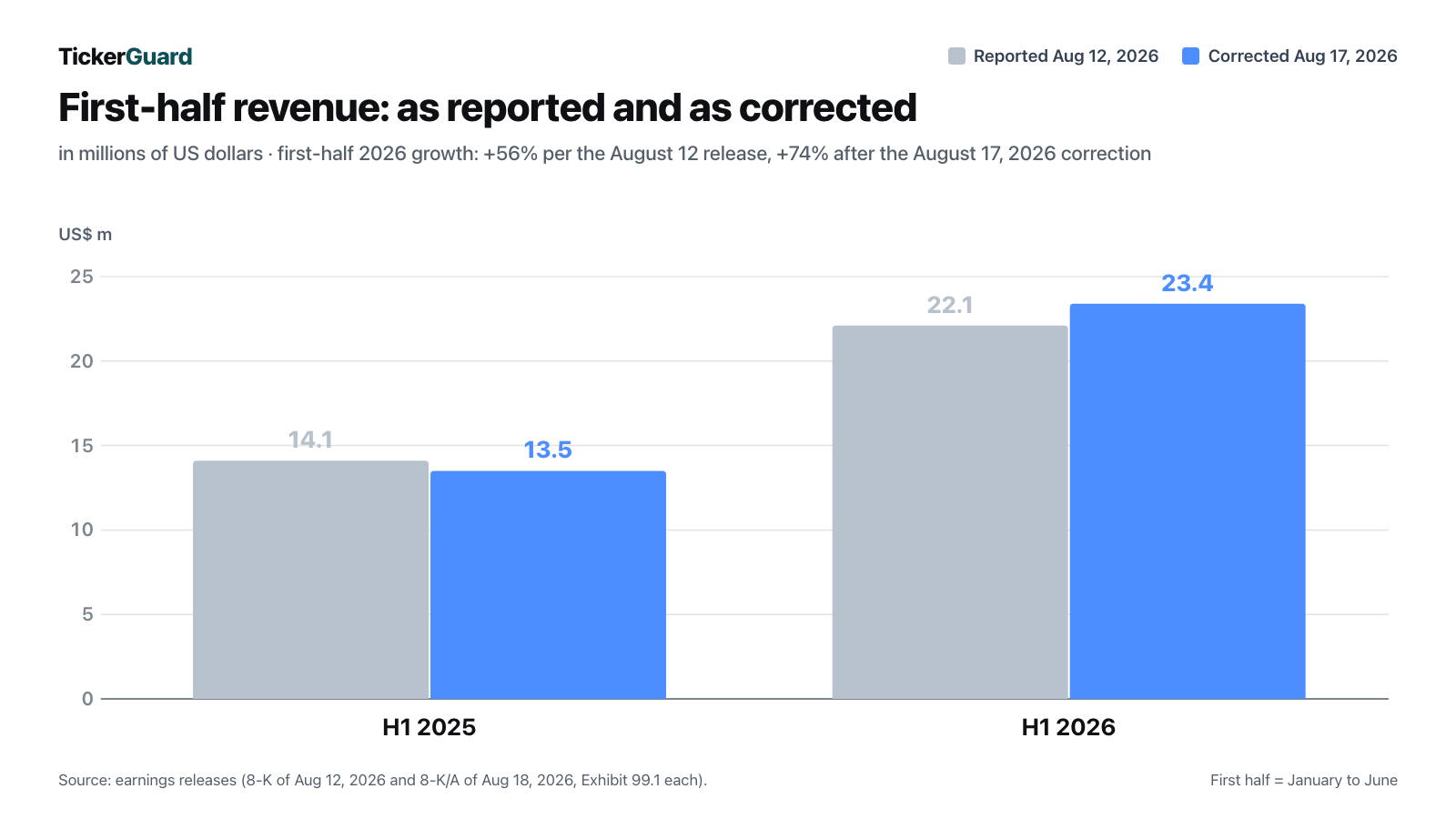
First, what impresses. In the second quarter of 2026, revenue rose to $13.5 million, up 157 percent from a year earlier ($5.3 million). The first half of 2026 brought in $23.4 million after $13.5 million in the prior-year period, an increase of 74 percent. For full-year 2026, Infleqtion expects about $45.1 million (8-K/A of August 18, 2026). For comparison: revenue was $28.1 million in 2024 and $31.1 million in 2025 — both after the correction we will get to in a moment.
Technically, Infleqtion delivered what it promised. On September 24, 2026, the company announced that it had entangled 30 logical qubits on Sqale, using only 80 physical qubits. A logical qubit is a computing unit built from several error-prone physical qubits, which makes it compute more reliably — like a choir in which individual wrong notes get drowned out. That hit the 2026 target; the roadmap calls for 100 logical qubits by 2028 and about 1,000 by 2030. A quantum computer for the Illinois Quantum & Microelectronics Park is under contract for 2027.
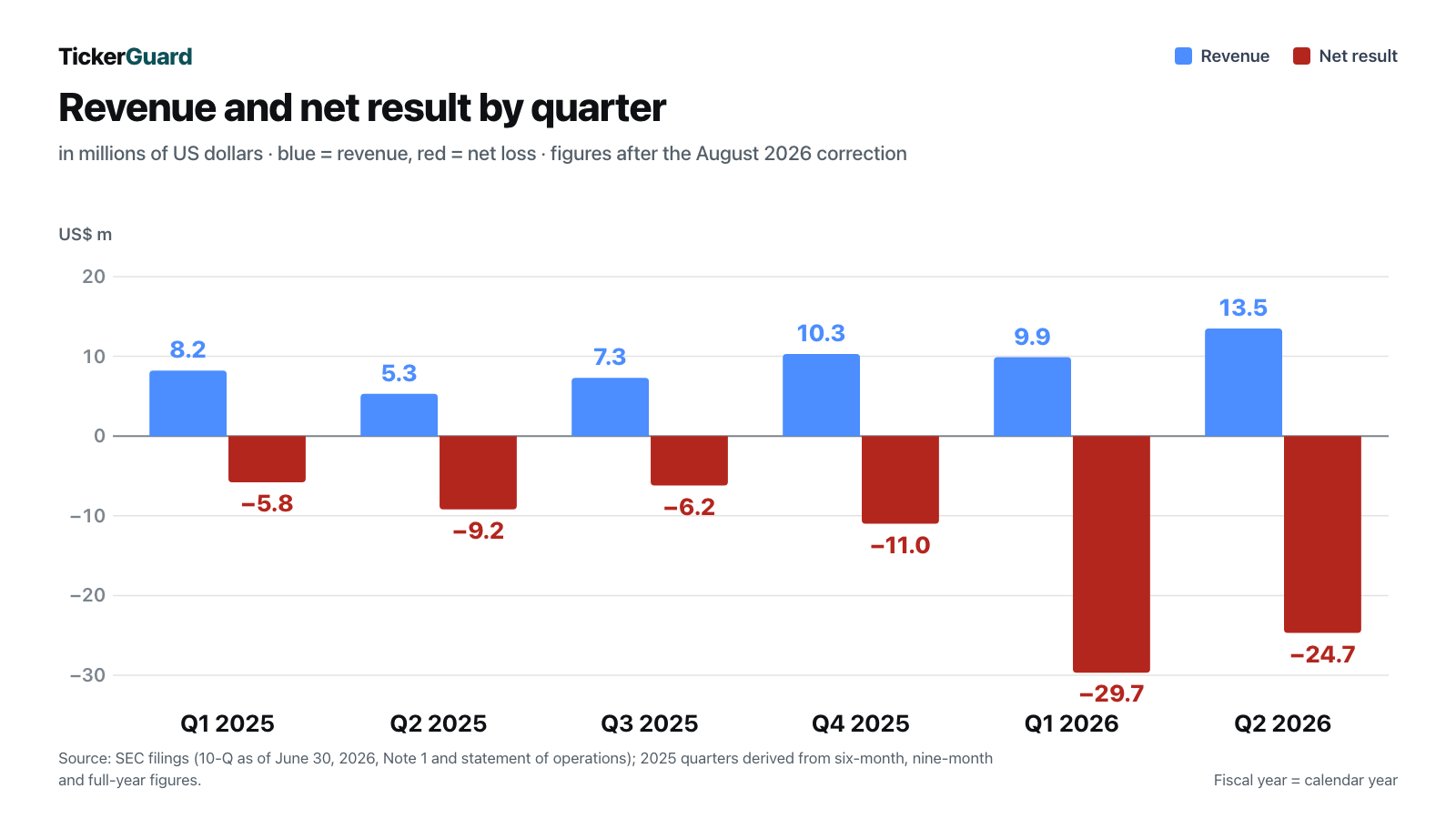
The chart also shows the flip side. In the first half of 2026, Infleqtion lost $54.4 million; for all of 2025 the loss was $32.2 million. Part of that is one-time: $11.5 million of merger costs. Another part costs no cash but costs shareholders: $20.4 million of stock-based compensation in the first half, after $1.9 million a year earlier. In plain terms, employees are partly paid in stock, and every new share makes your slice of the pie a little smaller. Gross margin — what is left of revenue after direct costs — is thin as well. It was 16 percent in the second quarter of 2026, 20 percent in the first half, and still 37 percent in 2025. The quarterly report gives the reason: Infleqtion pays a lot to subcontractors on the NASA contract. And the interest earned on the listing proceeds — $8.2 million in the first half — narrows the loss, but it is not a business.
The strength is the balance sheet. As of June 30, 2026, Infleqtion held $59.3 million in cash and $522.5 million in securities, together $581.7 million, and had no bank debt. Equity stood at $574.4 million. Management writes that the money will last at least twelve months; at the pace of the first half it would mathematically last far longer. The annual report, however, says losses are expected to be “significantly higher” in future periods. Remember: a full cash pile buys time. Whether the time is enough is decided by the business, not by the cash.
What the filings say — the uncomfortable truths
Uncomfortable truth no. 1: the quarter was recounted five days later
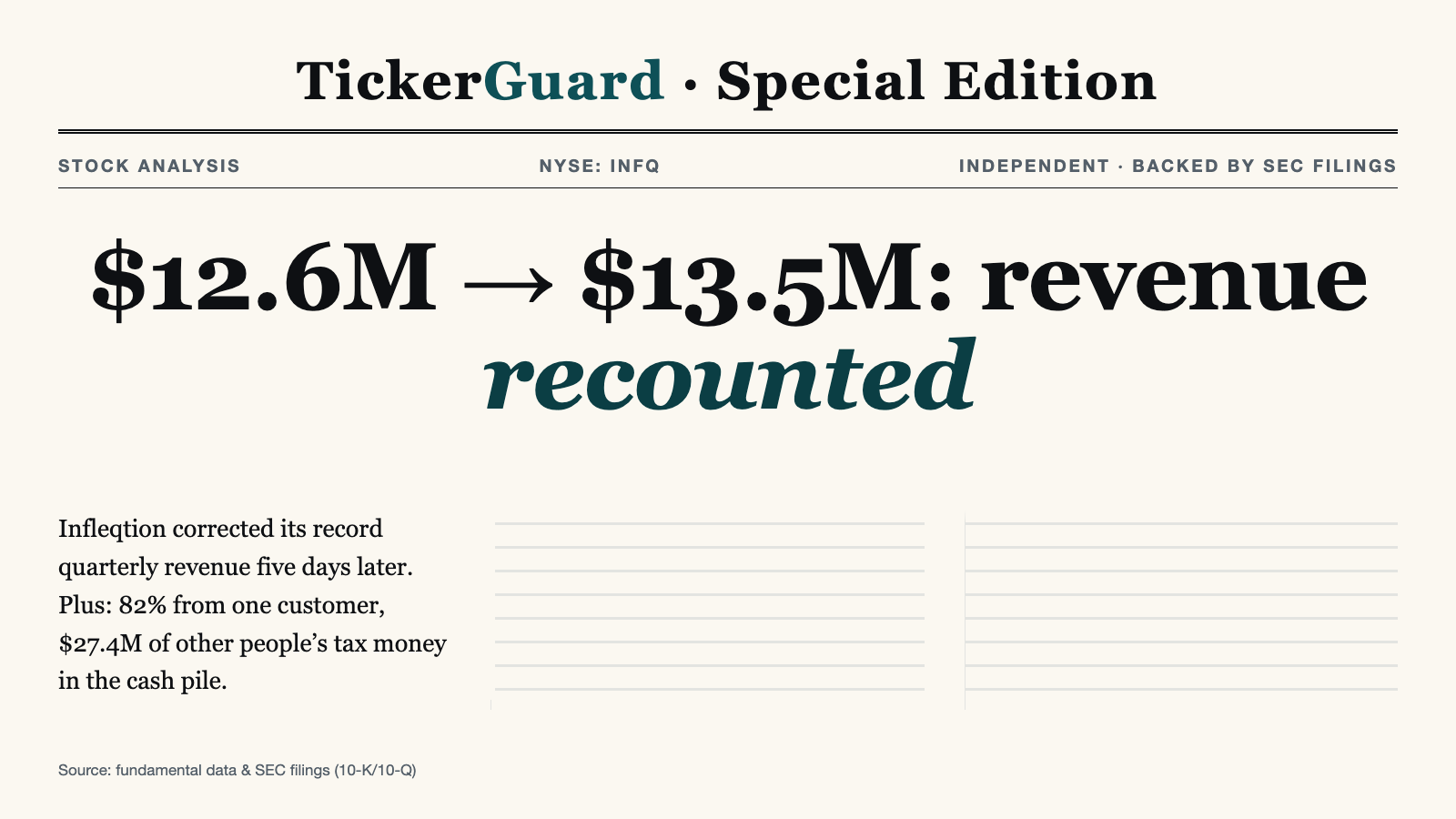
On August 12, 2026, Infleqtion reported record quarterly revenue of $12.6 million, up 116 percent. Five days later, on August 17, a new release followed: $13.5 million, up 157 percent. At the same time, Infleqtion filed a late-filing notice (Form 12b-25) because the quarterly report was not finished on time. The reason is stated plainly:
“These adjustments are expected to increase revenue recognized in the year ending December 31, 2026, as a portion of revenue previously reported for the years ended December 31, 2024 and December 31, 2025 will instead be recognized in 2026, with a corresponding reduction in previously reported revenue for those prior years.”
— Infleqtion, Inc., SEC late-filing notice Form 12b-25 (NT 10-Q) of August 17, 2026, Part III
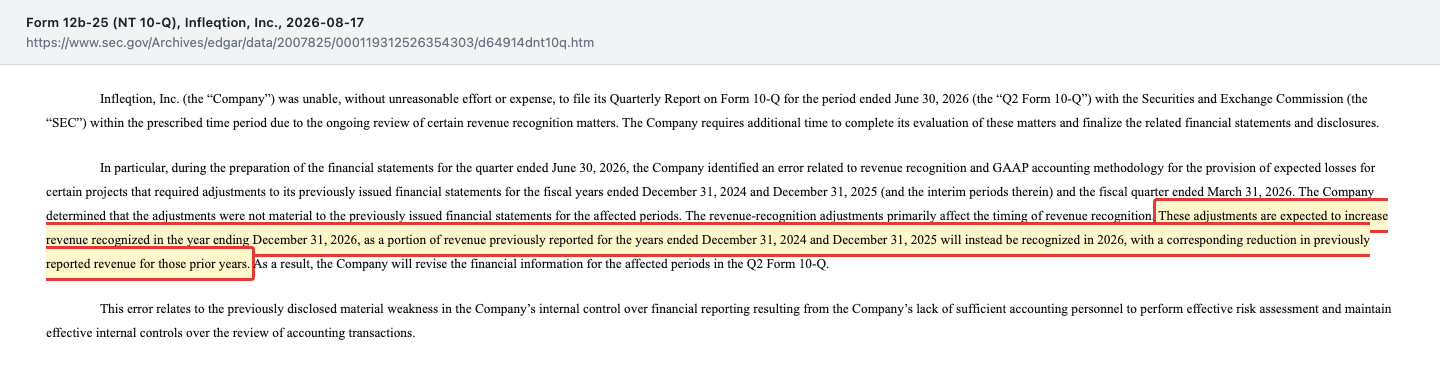
The consequences are in the quarterly report (Note 1): 2025 revenue falls from $32.5 million to $31.1 million, 2024 revenue from $28.8 million to $28.1 million, and first-quarter 2026 revenue rises from $9.5 million to $9.9 million. According to the company, two government contracts were affected, the error was “not material,” and cash is unchanged. That is true. But it changes the story: first-half 2026 growth was 56 percent in the first release and 74 percent after the correction — because revenue migrated from the past into the present. The full-year outlook also rose from about $43 million to $45.1 million, explicitly through “accounting-based revenue adjustments.”
The error has a known cause. Since its listing, Infleqtion has disclosed material weaknesses in internal control over financial reporting: too few accounting staff, no proper segregation of duties, missing controls at the U.K. subsidiary. The quarterly report adds something new for 2026:
“During 2026, we have identified pervasive ineffective general information technology controls for information technology systems, which resulted in the corresponding failure of automated process level controls and manual controls dependent on the accuracy and completeness of information derived from those information technology systems.”
— Infleqtion, Inc., SEC quarterly report 10-Q as of June 30, 2026, Item 4 “Controls and Procedures”
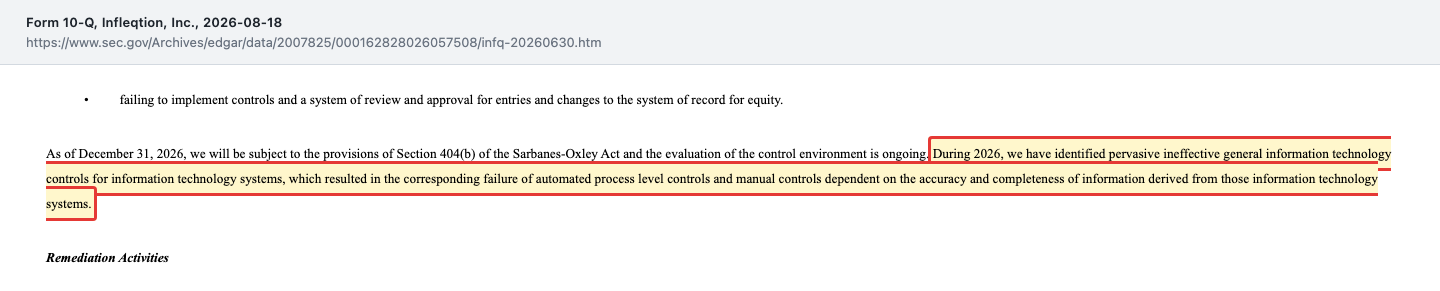
According to the report, remediation may extend “into 2027.” In plain terms, the numbers — which deserve less weight at a young company anyway — rest on internal controls the company itself describes as ineffective. For balance: KPMG audited the predecessor and has been engaged as the group’s auditor for 2026, and the correction concerned timing, not invented revenue. Remember: a record that grows five days later is not worse — but it tells you how much caution the other numbers deserve.
Uncomfortable truth no. 2: 82 percent from one customer — and a cash cushion with other people’s money
According to the quarterly report, 82 percent of second-quarter 2026 revenue came from a single customer (Note 1, “Customer A”), and 74 percent in the first half; in the second quarter of 2025 it was already 64 percent. The report does not name this customer. Customers associated with the U.S. government also accounted for 74 percent of first-half revenue, up from 40 percent a year earlier; U.K. government contracts had expired. Picture a neighbor telling you his business is booming — but four out of every five dollars come from one client. Would you swallow hard? With governments there is the added fact that they can generally end contracts at their own discretion. The annual report puts it this way:
“In addition, government contracts generally include the ability of government agencies to terminate for its convenience which, if exercised, would result in a lower contract value and lower than anticipated revenues generated by such arrangement.”
— Infleqtion, Inc., SEC annual report 10-K for 2025, Item 1A “Risk Factors”
The second topic of this chapter is the cash cushion. For the second quarter of 2026, Infleqtion reported positive operating cash flow of $13.2 million — remarkable for a company with a $24.7 million quarterly loss. The explanation is in the quarterly report:
“As of June 30, 2026, cash and cash equivalents included approximately $27.4 million received from employees and former employees in connection with stock option exercises for the payment of related tax withholding obligations. The Company is required to remit these amounts to the applicable taxing authorities, and such funds are not available to fund the Company’s operations.”
— Infleqtion, Inc., SEC quarterly report 10-Q as of June 30, 2026, Item 2 “Liquidity and Capital Resources”
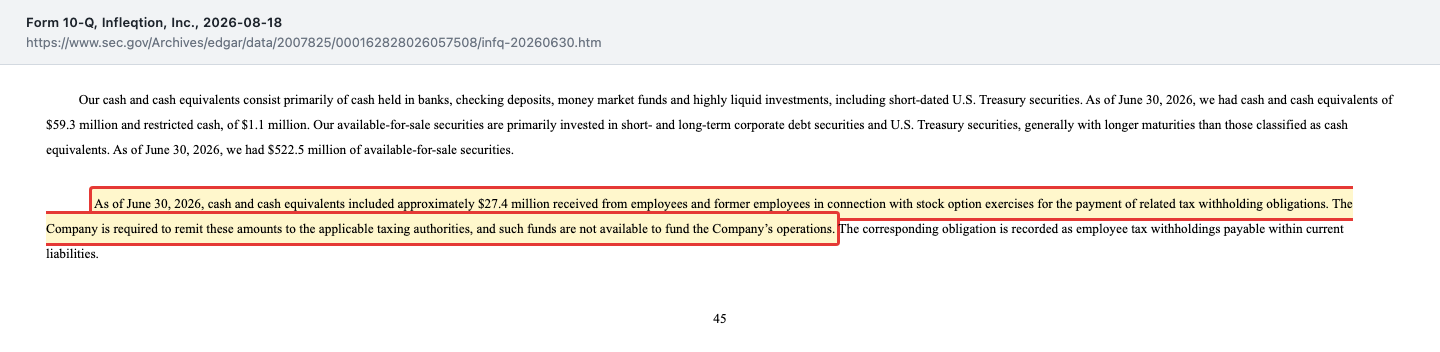
Excluding that tax money, about $14 million flowed out in the second quarter according to the company, after $19.2 million in the first quarter. Infleqtion said so openly in its earnings release and announced it would remit the $27.4 million in the third quarter. Whether that happened will only show in the third-quarter report, which had not been filed as of October 31, 2026. Nothing was hidden. But anyone who reads only the headline “positive cash flow” is back at the telescope. The company’s own funds as of June 30, 2026 were closer to $554 million than to $582 million.
Uncomfortable truth no. 3: the breakthrough is a promise — and insiders sold early
The 30 logical qubits are a real milestone. What they are not, Infleqtion states in its own annual report:
“No current quantum computers, including our quantum computing platform, have reached a broad quantum advantage, and they may never reach such advantage.”
— Infleqtion, Inc., SEC annual report 10-K for 2025, Item 1A “Risk Factors”
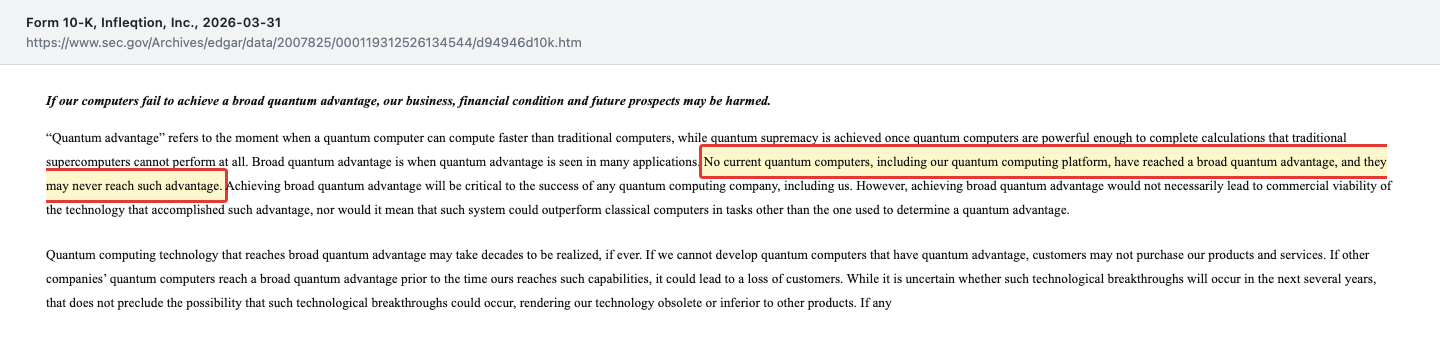
Broad quantum advantage means a quantum computer solves many useful tasks faster than any classical machine. Until then, Infleqtion mainly sells research and prototypes to government agencies. The annual report adds the sober sentence: “Our business model is unproven and may never allow us to cover our costs.”
Those who put money in first have already taken some of it out. After the merger, legacy holders were barred from selling for 180 days — unless the volume-weighted average price reached at least $12 on 15 trading days within a 180-trading-day period (prospectus dated April 9, 2026, filed April 10). In May 2026, the investor Maverick Capital sold about 16.8 million shares for about $262 million combined, according to insider filings (Form 4). CEO Matthew Kinsella exercised 545,824 options at $0.90 each on May 22, 2026 and sold a total of 769,954 shares on May 22 and 26 at prices between $15.56 and $17.91, about $13.1 million in all. That is legal and understandable after years without a public market. The $27.4 million of tax money from the previous chapter also shows how many employee options have already been exercised. And per the prospectus supplement of August 26, 2026, up to 121.8 million shares are registered for resale by legacy holders — about 54 percent of all shares outstanding. Remember: insider sales after a lock-up are common, but they add to the supply of shares.
Valuation: about $2 billion for $41 million of revenue
At a closing price of $8.88 on October 30, 2026, the 225.4 million shares (as of August 14, 2026) are worth about $2.0 billion. The “as of today” price box on this page, by contrast, shows the current price, rounded to ten cents, and the market value from fundamental data; it therefore differs from this point-in-time calculation. As a cross-check: on August 25, 2026, the prospectus supplement cited a price of $13.83 — about $3.1 billion at the time. In the four quarters through June 2026, Infleqtion generated $41.1 million of revenue. That is a price-to-sales ratio of about 49; in plain terms, the market pays 49 times what Infleqtion takes in over a year — not earns, takes in. On the $45.1 million outlook for 2026, the multiple is about 44. Subtract the company’s own funds of about $554 million, and an enterprise value of about $1.45 billion remains, roughly 35 times revenue. There is no price-to-earnings ratio: the four quarters through June 2026 produced a loss of $71.6 million.
Then there is potential dilution. According to the quarterly report (Note 16), rights to another 38.4 million shares were outstanding as of June 30, 2026: 27.0 million employee options, 10.4 million warrants with an exercise price of $11.50, plus smaller items. That is about 17 percent on top of the 224.7 million shares at the end of June. A possible stake by the U.S. Department of Commerce would come on top: per the earnings release of August 12, 2026, a letter of intent covers up to $100 million in funding for which the department is to receive shares — terms still open.
Is that expensive? For a company with a 16 percent gross margin and one main customer: clearly yes. As a bet on a technology that could one day open billion-dollar markets, the price is a matter of faith in the future — exactly where the telescope is pointing. The roughly $554 million of cash covers a little over a quarter of the market value; the remaining not-quite three quarters pay for what is still to come.
Opportunities and risks at a glance
What speaks for Infleqtion:
- Strong cash position: $581.7 million in cash and securities, no bank debt, equity of $574.4 million (June 30, 2026).
- Technical progress: 30 logical qubits with 80 physical qubits (8-K of September 24, 2026), quantum computer for Illinois under contract from 2027.
- Growing revenue: $13.5 million in the second quarter of 2026 (+157 percent), 2026 outlook about $45.1 million.
- Broad technology base: sensors, clocks and software already bring in revenue while the quantum computer matures; partners such as NVIDIA, Lockheed Martin and Safran.
- Government backing: letter of intent from the U.S. Department of Commerce for up to $100 million (not yet binding; it would be paid for with new shares, meaning dilution).
What speaks against it:
- Concentration risk: 82 percent of second-quarter 2026 revenue from one customer, 92 percent from governments that can terminate contracts at their convenience.
- Heavy losses: $54.4 million in the first half of 2026, second-quarter gross margin of only 16 percent; the company expects losses to rise.
- Accounting: revenue corrected five days after the earnings release, quarterly report only after the regular deadline (grace period via NT 10-Q), material control weaknesses expected to last into 2027.
- Dilution and selling pressure: 38.4 million potential new shares, up to 121.8 million shares registered for resale, large insider sales in May 2026.
- Valuation: about 49 times the revenue of the last four quarters (October 30, 2026), no profit in sight.
- Technology risk: per the annual report, no quantum computer has reached broad quantum advantage; the company itself calls its business model unproven.
A human conclusion
Back to the telescope. The telescope trap does not mean the distant target is unimportant — at Infleqtion it is real: 30 logical qubits, a roadmap to 2030, partners everyone knows. The trap lies in overlooking, for the sake of the distant target, what is lying on the table. And on the table lie a quarter that was recounted five days later, a customer who pays four out of every five dollars, a cash cushion padded with other people’s tax money, and insiders who sold early. None of it is forbidden or hidden; it is all in the filings. So the honest question for you is not “Will quantum computing be big?” It is: would you pay about 49 times revenue for a company whose accounting, by its own account, has to fix material control weaknesses that are expected to last into 2027 — and can you sit through the years until the distant target is reached? Anyone who has answered these questions for themselves knows what they are getting into — with or without the stock. What you make of it is your decision. And that is exactly as it should be.
Sources
All original documents used in this analysis — so you can check them yourself:
- Infleqtion, Inc. — SEC quarterly report 10-Q as of June 30, 2026 (filed August 18, 2026)
- Infleqtion, Inc. — SEC late-filing notice Form 12b-25 (NT 10-Q) of August 17, 2026
- Infleqtion, Inc. — SEC filing 8-K of August 12, 2026, Exhibit 99.1 (second-quarter 2026 earnings release) and 8-K/A of August 18, 2026, Exhibit 99.1 (corrected earnings release of August 17, 2026)
- Infleqtion, Inc. — SEC quarterly report 10-Q as of March 31, 2026 (filed May 15, 2026)
- Infleqtion, Inc. — SEC annual report 10-K for 2025 (filed March 31, 2026) and predecessor’s 2025 financial statements in the 8-K/A of March 31, 2026, Exhibit 99.1
- Infleqtion, Inc. — SEC filing 8-K of September 24, 2026, Exhibit 99.1 (30 logical qubits)
- Infleqtion, Inc. — prospectus supplement 424B3 of August 26, 2026 and prospectus dated April 9, 2026, filed April 10 (resale, lock-up)
- Infleqtion, Inc. — SEC filing 8-K/A of March 31, 2026 (change of auditor)
- Insider filings (Form 4) from April to August 2026: EDGAR overview Infleqtion (sec.gov)
- Fundamental data (prices through the October 30, 2026 close, analyst ratings; retrieved October 31, 2026), reconciled with the SEC filings.
- Reddit mentions: our in-house Reddit hype scanner, INFQ first recorded on October 28, 2026.
Transparency & disclaimer: this analysis is journalistic commentary on publicly available information. It is not investment advice, not a regulated investment research product and not a solicitation to buy or sell securities. Equity investments carry substantial risk up to and including total loss. All information is provided without warranty; the as-of date for each figure is stated in the text. Positions held by the operator are disclosed daily; where one exists, it appears as a notice at the top of this deep dive.
Key figures at a glance
All monetary figures in millions of $; earnings per share as reported.
| Metric | 2023 | 2024 | 2025 |
|---|---|---|---|
| Revenue | 11.0 | 28.8 | – |
| Operating Income (EBIT) | -55.8 | -0.1 | -2.0 |
| Net Income | -52.8 | -0.1 | -66.9 |
| Net Margin | -481.9% | -0.2% | – |
| Earnings Per Share | -1.50 $ | 0.00 $ | -1.29 $ |
Source: fundamental data & SEC filings (annual and quarterly reports, 10-K/10-Q)
Our Bottom Line at a Glance
- Liquidity & balance sheet positive
- $581.7 million in cash and securities, no bank debt, equity $574.4 million (06/30/2026); about $554 million of own funds after the $27.4 million of payroll tax to be remitted.
- Technology & growth positive
- 30 logical qubits on Sqale (8-K of 09/24/2026); Q2 2026 revenue $13.5 million (+157%), 2026 outlook about $45.1 million.
- Customer concentration negative
- 82% of Q2 2026 revenue from one customer, 92% from governments that, per the 2025 10-K, can terminate contracts at their convenience.
- Losses & margin negative
- Net loss of $54.4 million in H1 2026, Q2 2026 gross margin 16%; per the 10-K, significantly higher losses expected.
- Financial reporting negative
- Q2 2026 revenue corrected from $12.6 million to $13.5 million after five days, NT 10-Q of 08/17/2026, material control weaknesses expected to last into 2027 per the 10-Q.
- Dilution & selling pressure negative
- 38.4 million potential new shares (06/30/2026), up to 121.8 million shares registered for resale (424B3 of 08/26/2026), insider sales in May 2026.
Infleqtion is a textbook case of the telescope trap: technically and financially the company is on solid footing — about $554 million of its own funds, no debt and 30 logical qubits. But the business on the table is small ($41.1 million of revenue over four quarters), depends on one customer for 82 percent, runs heavy losses, and the accounting had to correct its quarterly numbers after five days. The stock trades at about 49 times revenue. Not investment advice.
What Our Rating Means
Open questions
The business works in principle, but one material question is open. As long as it stays open, our findings do not carry a quality verdict.
Yellow, because the central operating question is open: whether government development contracts can turn into a viable business is unproven — the annual report says so itself. Add a customer with an 82 percent revenue share and a revenue correction alongside material control weaknesses. Red would require a substance risk, and there is none: about $554 million of own funds with no debt last many years at the first-half 2026 burn rate, and per the company the correction concerned timing, not the existence of revenue. At about 49 times revenue the stock is still expensive. The decision is yours.
A journalistic assessment by our editorial team at the time of the deep dive, based on public sources — not investment advice and not a solicitation to buy or sell. Your personal circumstances (investment goals, risk capacity, taxes) cannot be taken into account. What our levels mean, how verdicts are formed, and what conflicts of interest exist →
Worth Noting
- Infleqtion made our research list via our in-house Reddit hype scanner (first recorded on October 28, 2026).
- The 10-K for 2025 (03/31/2026) contains Infleqtion’s business description and risk factors but the financial statements of the shell Churchill Capital Corp X; the operating predecessor’s financial statements are in the 8-K/A of 03/31/2026. Revenue and losses for 2024/2025 in this analysis are the corrected figures from the 10-Q as of 06/30/2026.
- 2025 quarterly figures are derived from the corrected six-month, nine-month and full-year figures (10-Q as of 06/30/2026, Note 1 and statement of operations).
- Market value calculated in-house: 225,357,052 shares (10-Q cover, 08/14/2026) × closing price $8.88 (10/30/2026). Cross-check: the price series shows exactly the $13.83 cited in the 424B3 on 08/25/2026; the gap to today’s value is the decline since then.
- Insider sales summed from Form 4 filings: Maverick Capital about 16.8 million shares in May 2026 (filings of 05/26, 05/28 and 05/29/2026, including the 4/A amendment of 05/29/2026); Matthew Kinsella 769,954 shares on 05/22 and 05/26/2026.
Stock Watch
This analysis is as of October 31, 2026. Stock Watch will tell you what's changed at INFQ since then.
Later $1 a month per stock — signing up is free, and you'll be the first to know when it launches.
The full analysis as a PDF for later
We will send you this analysis as a PDF — to print, file away, and read at your own pace. And we will add you to the free Stock Watch list for Infleqtion, Inc. (INFQ), so you hear about it when something material in this analysis changes.
Frequently Asked Questions
Infleqtion, Inc. (NYSE: INFQ) of Louisville, Colorado, develops quantum technology based on neutral atoms: optical atomic clocks, radio-frequency, gravity and motion sensors, the Sqale quantum computer, and software such as Superstaq and the AI tool CML. In the second quarter of 2026, 92 percent of revenue came from government customers.
Through a SPAC merger: the blank-check company Churchill Capital Corp X merged on February 13, 2026 with the former ColdQuanta, Inc. (brand name Infleqtion), bringing in $528.2 million. The Form 25 filed the same day withdrew the old SPAC securities from Nasdaq; since February 17, 2026, the stock has traded under the ticker INFQ on the New York Stock Exchange.
In the second quarter of 2026, revenue was $13.5 million (+157 percent) and the net loss $24.7 million. In the first half of 2026, $23.4 million of revenue faced a $54.4 million loss. Infleqtion expects about $45.1 million of revenue for 2026; 2025 revenue was $31.1 million after the correction.
While preparing its financial statements for the second quarter of 2026, Infleqtion found an error in revenue recognition on two government contracts. Revenue from 2024 and 2025 was shifted into 2026: on August 17, 2026 quarterly revenue rose from the reported $12.6 million to $13.5 million, and the quarterly report came only after the regular August 14 deadline, within the grace period of a late-filing notice (Form 12b-25).
As of June 30, 2026, Infleqtion held $59.3 million in cash and $522.5 million in securities, $581.7 million in total, and no bank debt. That included $27.4 million of payroll tax from option exercises that must be remitted to the tax authorities, leaving about $554 million of the company’s own funds.
No. Infleqtion has lost money in every period since inception — $32.2 million in 2025 after the correction and $54.4 million in the first half of 2026. The annual report calls the business model unproven and expects significantly higher losses ahead, so there is no meaningful price-to-earnings ratio.
Found an error?
Did you spot a factual error, an outdated number, or a typo in this deep dive? Let us know briefly — your report goes straight to the editorial team.