IBEX: Five Record Quarters in a Row — and a Shareholder Who, Until Recently, Ran the Board
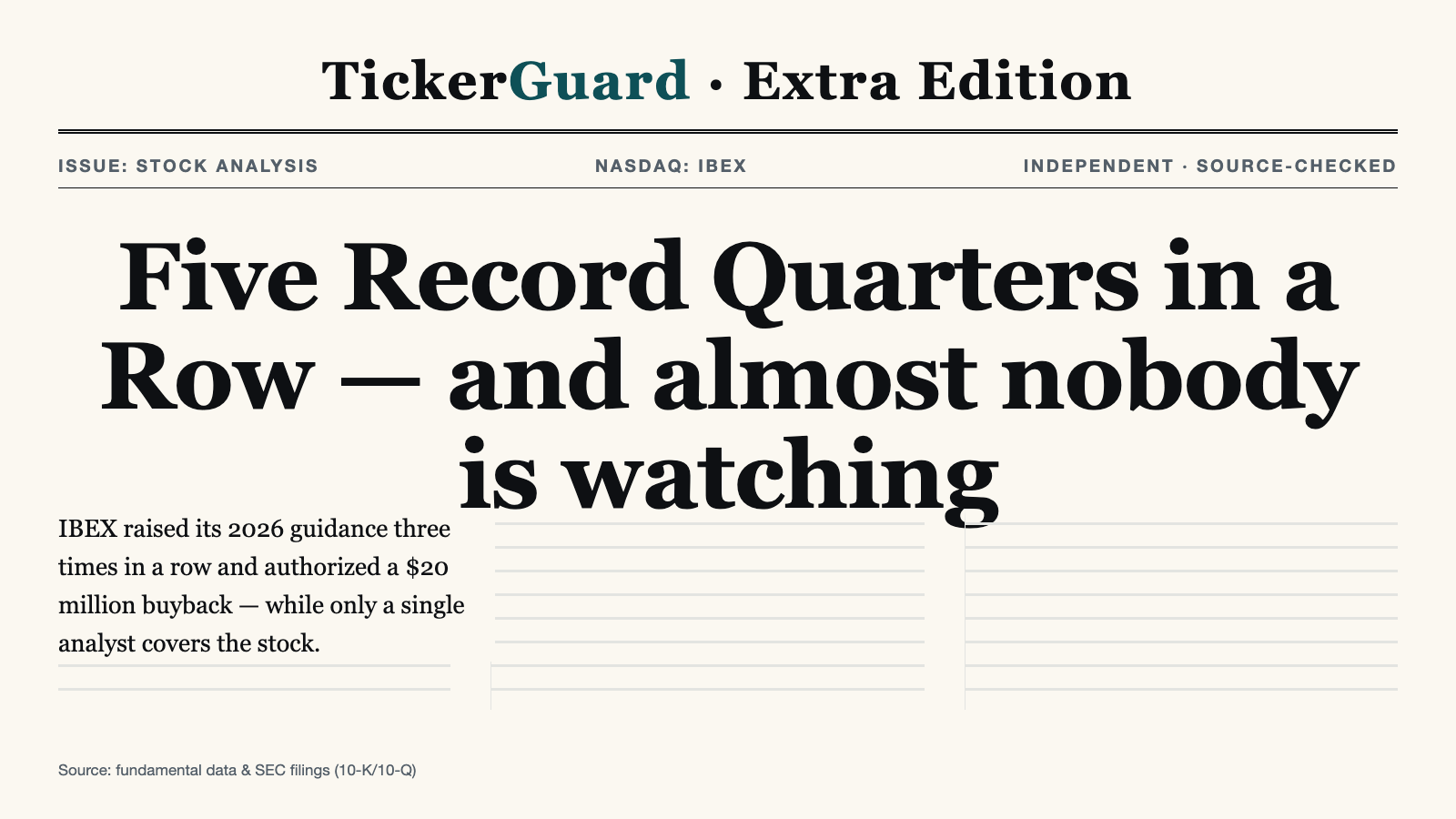
IBEX Limited (Nasdaq: IBEX) runs call centers and digital customer-service hubs for more than 140 corporate clients — mostly out of the Philippines, Jamaica, Pakistan and Nicaragua. Revenue has grown double digits every quarter for a year, management has raised its fiscal 2026 guidance three times already, and in May 2026 the board authorized a $20 million share buyback. Yet only a single Wall Street analyst covers the stock, and no earnings-call transcripts were anywhere to be found for this analysis. One reason sits in the fine print: until November 2024, anchor shareholder TRGI had the right to appoint a majority of the board — and its chief still sits at the table as Chairman today. Not investment advice — just a look at who actually benefits from a record quarter.
 Thomas Mücke
Founder & Publisher
Thomas Mücke
Founder & Publisher
As of Today
As of: October 9, 2026
- Closing price
- 44.50 $ +0.30%
- Market Capitalisation
- 0.6 $B
- P/E
- 14.1
- Growth Score
- 5/10
- AAQS
- 8/10
Price change since August 26, 2026: +21.5%
This analysis has a cut-off date. The Stock Guard tells you when something material changes in the numbers. Reserve your free spot
Chart
Interactive price chart (TradingView).
52-week range: 26.40 $ to 44.50 $ · Last price: 44.50 $ (As of: October 9, 2026)
Note: pure fact-based analysis, not investment advice and not a solicitation to buy or sell. All figures without guarantee.
There is an investor weakness that rarely gets a name, because it doesn't feel like an error — it feels like common sense: the boring-business bias. It works like this: you read "call center operator" or "business process outsourcing," and your mind has already reached a verdict before it has seen a single number — "sounds like a low-margin grind, not for me." That exact verdict has followed IBEX Limited (Nasdaq: IBEX) for years, and it has a measurable side effect: a single Wall Street analyst covers the stock, with a plain "Hold" rating (price target $37.50, as of August 26, 2026). While preparing this analysis, we set out to review the recent earnings-call transcripts, as we do for every deep dive — and had to admit honestly: none were publicly available anywhere; a systematic search on August 27, 2026 came back empty. That is rare, and it is part of the story, not a footnote. So what actually drives a stock that almost nobody is watching? We read what IBEX is legally required to file with the U.S. securities regulator, the SEC, instead: the quarterly report (Form 10-Q) for the period ended March 31, 2026, the annual report (Form 10-K) for fiscal 2025, and the 2025 proxy statement. They tell the story of a company growing double digits for five straight quarters, raising its own annual guidance three times in a row — and, until not quite two years ago, controlled by a single shareholder whose chief still sits at the boardroom table.
What IBEX Actually Does
IBEX Limited is incorporated in Bermuda but operationally headquartered in Washington, D.C. — a pattern common among internationally operating service providers and, on its own, no red flag. The business is business process outsourcing (BPO): in everyday terms, other companies hand off their customer contact the way a restaurant outsources its laundry instead of running its own washroom. Concretely, IBEX offers three building blocks: ibex Connect (customer service, technical support, upselling and back-office tasks such as accounting or HR administration on clients' behalf), ibex Digital (digital customer acquisition — marketing, e-commerce technology, platform solutions) and a smaller ibex CX offering that measures and analyzes the customer experience. As of the quarterly report for the period ended March 31, 2026, the company operates 32 delivery centers worldwide and employs roughly 36,000 people — concentrated, in the filing's own words, "in the Philippines, Jamaica, Pakistan and Nicaragua." More than 140 corporate clients across industries such as banking, healthcare, travel and retail route their customer inquiries, support tickets and sales conversations through IBEX.
The second building block worth understanding is the in-house technology: Wave iX. This is not a marketing label but an AI-powered software suite IBEX itself sells to clients — including the "Wave iX AI Virtual Agent" (an AI system that independently handles routine inquiries by voice or text and escalates more complex cases to human agents) and "Wave iX Translate." In May 2026 came a strategic partnership with Sierra AI, an AI-powered customer-experience specialist — according to the May 6, 2026 earnings release, aimed "to design and deploy scalable, end-to-end, AI-powered CX solutions." That marks the central tension of this analysis, and it runs through every chapter: a company with a genuinely growing business and its own AI strategy is priced by the market like an interchangeable call-center operator — partly because almost nobody is looking closely.
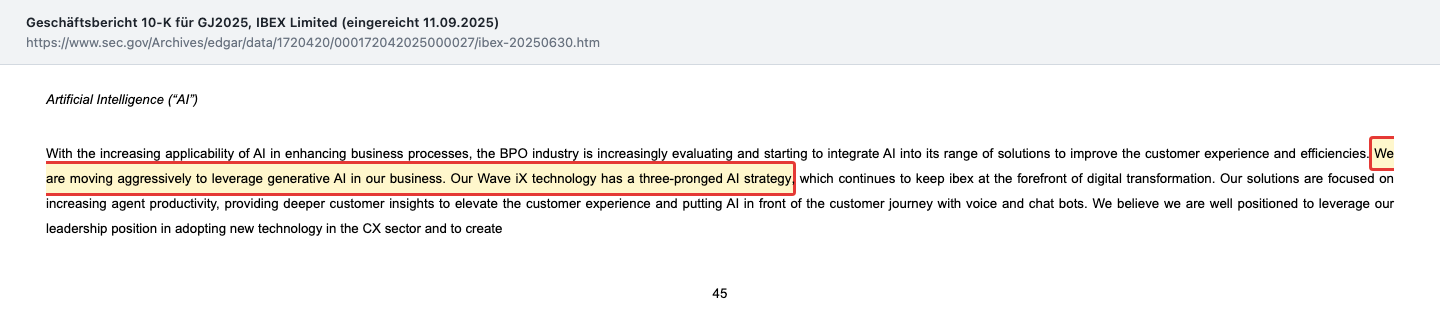
How seriously IBEX takes its own AI strategy, in the company's own words from the FY2025 annual report:
"We are moving aggressively to leverage generative AI in our business. Our Wave iX technology has a three-pronged AI strategy, which continues to keep ibex at the forefront of digital transformation."
— IBEX Limited, Form 10-K for fiscal 2025 (filed September 11, 2025)
Company history for investors
-
2017
Incorporated in Bermuda as IBEX Holdings Limited
The company is registered in November 2017; in December 2018 it is renamed IBEX Limited — the structure under which it still trades on the Nasdaq today.
-
2020
IPO on the Nasdaq as a foreign private issuer
The August 2020 IPO starts the five-year clock on "emerging growth company" status, which expires with the fiscal year ended June 30, 2026.
-
2023
Switch from 20-F to 10-K filer
With its first Form 10-K in September 2023, IBEX discloses in the standard U.S. format for the first time — more frequent and more detailed reporting than as a foreign private issuer.
-
2024
End of the "controlled company": IBEX buys back shares from TRGI
On November 19, 2024, anchor shareholder TRGI loses its right to appoint five of eight board seats after a share repurchase — the end of a structural majority control for shareholders.
-
2025
Record year and the start of the guidance raises
Fiscal 2025 beats management's own guidance; starting in September 2025, management raises fiscal 2026 guidance three times in a row — an unusual degree of reliability for shareholders.
-
2026
$20 million buyback and AI partnership with Sierra AI
In May 2026, the board authorizes a new share buyback and announces an AI partnership — two signals that management is putting capital into its own stock and its own technology rather than growth at any cost.
Where the Stock Landed on Our Desk
IBEX made our research list not through an analyst recommendation or a headline, but through the numbers themselves: five straight quarters of double-digit revenue growth, most recently a third guidance raise within twelve months. That's unusual for a company that has traded on the Nasdaq and reported public numbers for more than five years — yet is covered by exactly one analyst. A market that barely watches is either an overlooked bargain or a reason to look more closely before anyone else does. We did the latter: scrutinizing Wave iX, the BPO business and the governance structure more closely than a single analyst with limited time is likely to. If you're interested in the bigger picture around AI-powered customer service as an industry, our analysis of TaskUs offers a direct competitor comparison — it also examines concentrated control at a BPO provider, just with different parties involved.
The Numbers Over the Years
Let's start with the honest ups and downs before we get to the record run. Annual revenue in fiscal 2023 (ended June 30, 2023) was $523.1 million. In fiscal 2024 it slipped to $508.6 million — a 2.8 percent decline the FY2024 annual report attributes to lower revenue in FinTech (down 26.8 percent, or $26.0 million) and Telecommunications (down 10.5 percent, or $9.0 million). Fiscal 2025 reversed the trend: $558.3 million in revenue, up 9.8 percent — and, per the September 11, 2025 earnings release, the company "exceeded high end of Revenue and Adjusted EBITDA Guidance." Net income followed the same arc: $31.6 million (FY2023), $33.7 million (FY2024), $36.9 million (FY2025).
Since then, growth has accelerated rather than slowed. The third quarter of fiscal 2026 (ended March 31, 2026) brought revenue of $164.4 million, up 16.8 percent year over year — the fifth consecutive quarter of double-digit growth, as the May 6, 2026 earnings release itself points out. Net income and diluted earnings per share climbed 27.3 percent and 21.9 percent, respectively, in the same quarter, to $13.3 million and $0.89 per share. The chart below shows the past six quarters against the same quarter one year earlier:
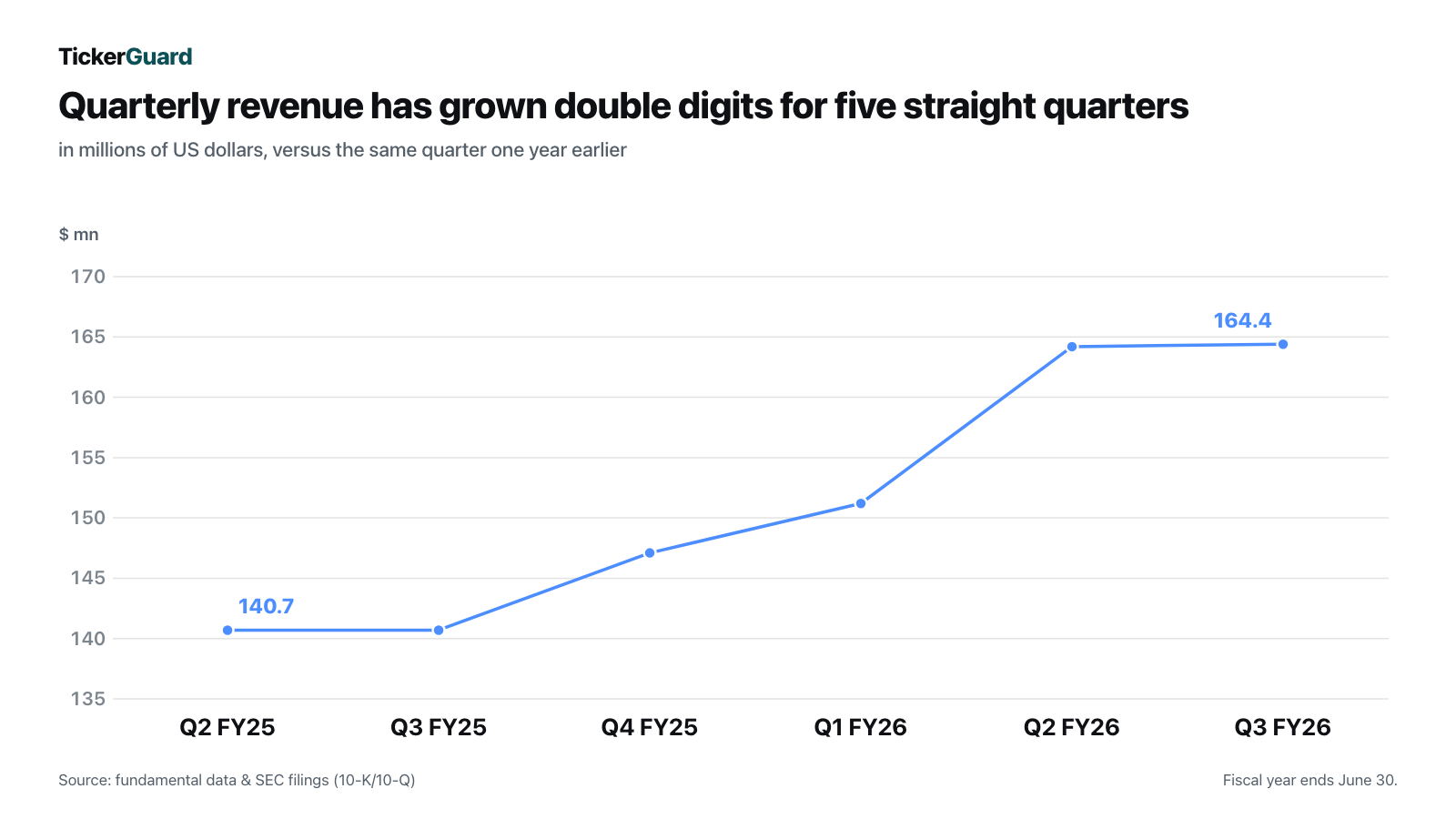
What's behind the record isn't a one-off effect: the May 6, 2026 earnings release cites "broad-based growth across four verticals" — HealthTech (+53.7 percent), Technology (+42.6 percent), Travel/Transportation/Logistics (+15.1 percent) and Retail & E-Commerce (+8.3 percent). And the client base is broader than one might expect from a BPO contractor: the largest client accounted for roughly 10 percent of revenue in the first nine months of fiscal 2026, the three largest combined for 25 percent — the quarterly report itself calls this a strength: "We believe our client diversification is a strength and mitigates risk." For a business that often carries the reputation of depending on a handful of large clients, that's an unusually healthy spread.
What Management Promised
An honest caveat first: unlike most of our deep dives, we could not review a single publicly available earnings-call transcript for IBEX. A systematic search on August 27, 2026 came back empty — of twelve candidate dates over the past twelve months, none were retrievable. That means the part that often reveals the most in other analyses — the analyst Q&A, where an uncomfortable number either gets answered or dodged — is entirely missing here. We say so openly rather than gloss over it, because it's part of the story: for a stock with only one analyst, there is also hardly anyone publicly pressing management for answers.
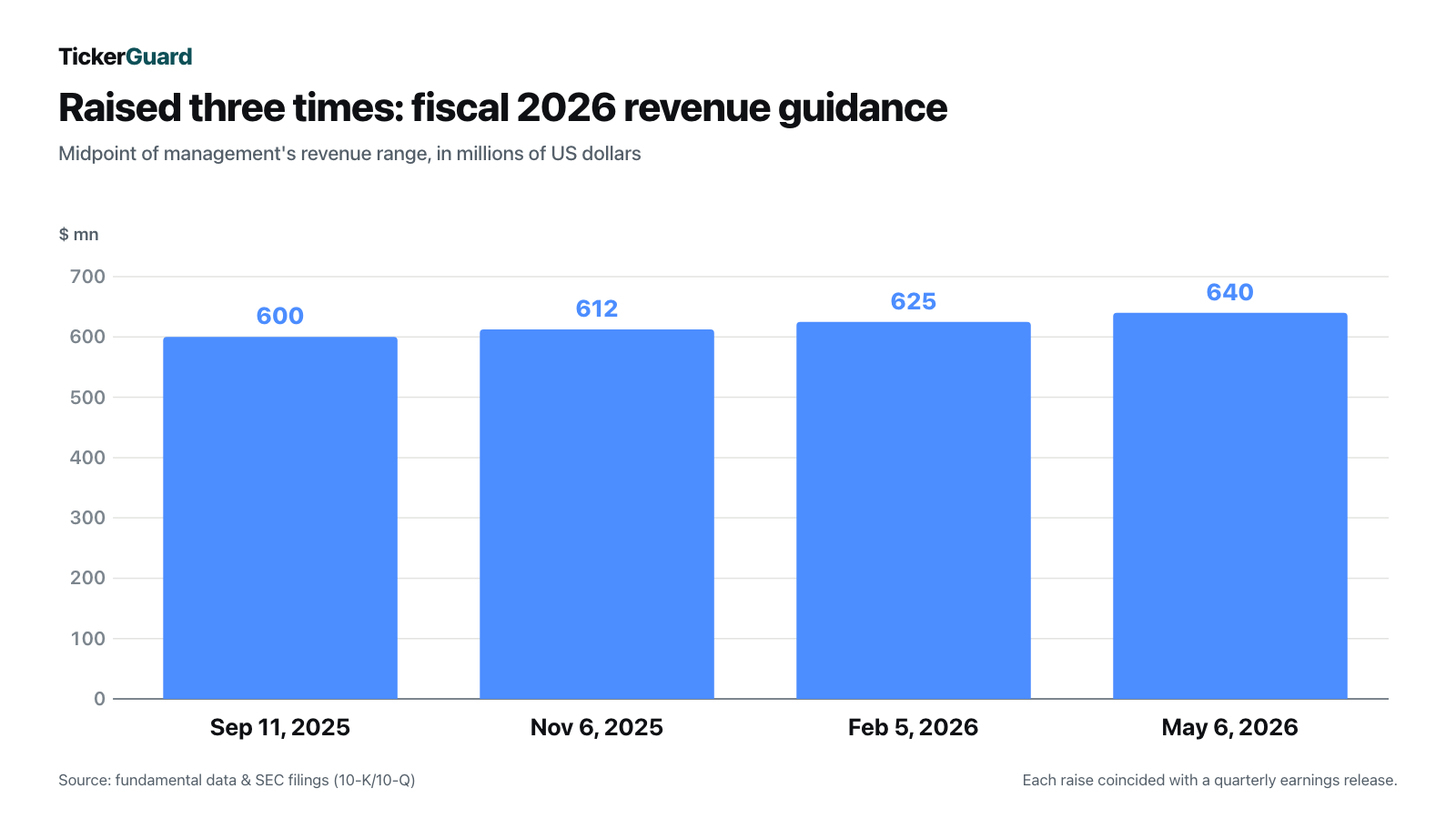
What can be assessed instead are the four published earnings releases of fiscal 2026 — and they show a remarkably consistent pattern of promises made and kept. On September 11, 2025, management issued its first fiscal 2026 guidance alongside the FY2025 results: revenue of $590 to $610 million, adjusted EBITDA of $75 to $79 million. On November 6, 2025 — after a first quarter that came in at $151.2 million, above management's own $143–146 million expectation — guidance was raised to $605–620 million. On February 5, 2026, following another record quarter, came the second raise, to $620–630 million. And on May 6, 2026, after a third consecutive record quarter, the third raise, to $638–642 million — explicitly called "the third time this year." Every single raise coincided with a quarterly report that had already beaten the prior guidance, never the reverse:
Commenting on the May 6, 2026 earnings release, CEO Robert Dechant said:
"Ibex delivered another record-breaking quarter with revenue growth of 17% to $164.4 million, our fifth straight double-digit growth quarter, and adjusted EPS growth of 11%, adding to the momentum we've amassed over the last two years. […] Going forward, we will continue to define the new era of BPO 3.0 […]"
— Robert Dechant, CEO, IBEX Limited, Form 8-K, May 6, 2026, Exhibit 99.1 (Q3 FY2026 earnings release)
Whether an earnings-call Q&A would carry the same optimism as the prepared press release, we cannot judge without a transcript — that is the limit of this analysis, and we'd rather state it than hide it. What the numbers themselves show: management has not lowered a single expectation, and has not missed a single guidance range, across four consecutive quarterly reports.
What the Filings Reveal — the Uncomfortable Truths
Uncomfortable Truth No. 1: Until Not Quite Two Years Ago, One Shareholder Controlled the Board
What's buried in the fine print of the 2025 proxy statement is not something you'd guess from a record quarter. The language is unambiguous:
"Prior to November 19, 2024, we qualified as a 'controlled company' because TRGI had the right to appoint five out of eight of the directors on our Board pursuant to our Bye-laws."
— IBEX Limited, SEC Proxy Statement DEF 14A 2025
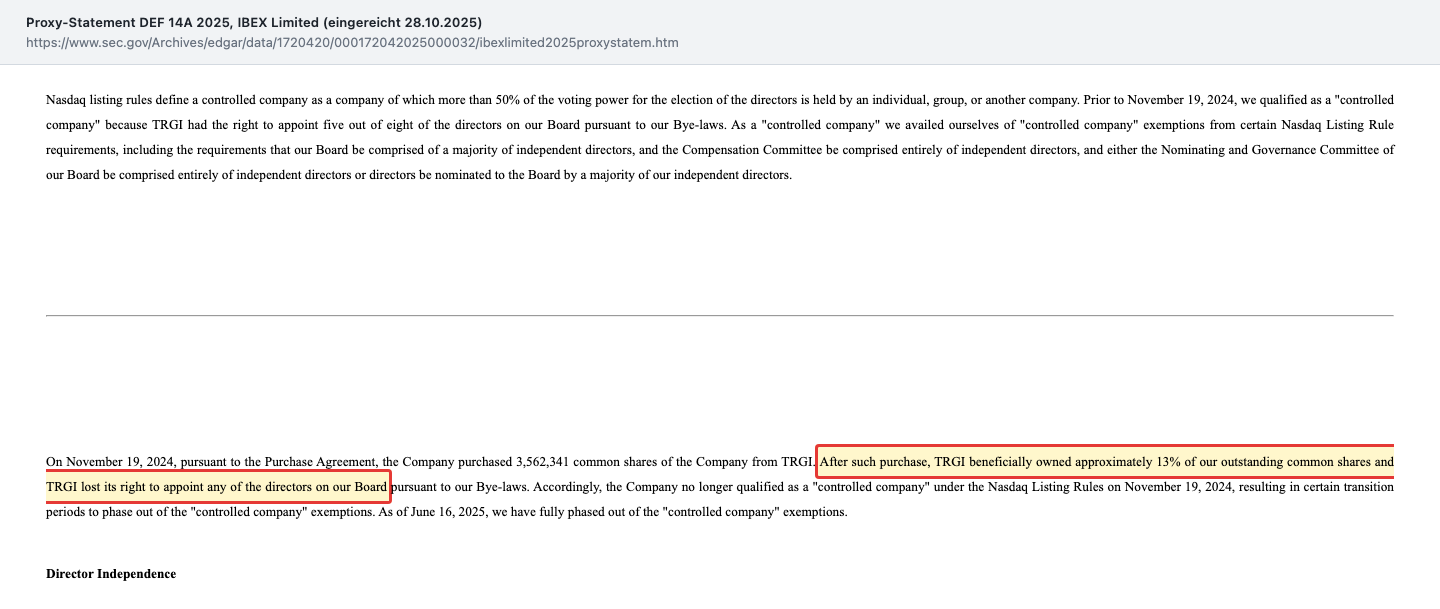
TRGI stands for The Resource Group International Limited, another Bermuda-based investment holding company. On November 19, 2024, IBEX repurchased 3,562,341 of its own shares directly from TRGI under a Purchase Agreement; TRGI held roughly 13 percent afterward and lost its right to appoint directors. The "controlled company" exemptions did not fully phase out, per the proxy statement, until June 16, 2025. What remains: TRGI is still, as of the proxy statement dated October 28, 2025, the largest single shareholder by far with 1,731,574 shares, or 12.9 percent — ahead of the entire management team combined, which holds only 3.4 percent. And the sitting Chairman, Mohammed Khaishgi, remains TRGI's founder and CEO to this day, as well as chairman of TRG Pakistan Limited, a company the proxy statement describes as "affiliated with TRGI." A further TRGI subsidiary, TRG Holdings LLC, still leases office space from IBEX in Washington as a "tenant at will," per the proxy statement, for $12,203 per month. None of this is hidden — it's all disclosed in the proxy statement. But anyone buying a stock whose board has only formally been free of a single controlling shareholder since late 2024 is buying a younger independence than the record quarter would suggest.
Uncomfortable Truth No. 2: A Regulatory Grace Period Is Running Out
IBEX has been classified as an "emerging growth company" since its August 2020 IPO — a status U.S. law grants smaller, newer public companies for a limited period, exempting them, among other things, from the full external auditor attestation on internal controls. The Form 10-K for fiscal 2025 (filed September 11, 2025) states the expiration date itself: "June 30, 2026 - the last day of the fiscal year ending after the fifth anniversary of our initial public offering." In other words: with the close of fiscal 2026 — June 30, 2026, a date already in the past as of this analysis — the special status falls away. The next annual report (Form 10-K for FY2026, typically due in September) will therefore likely need to include, for the first time, a full external auditor attestation on internal controls under U.S. securities law (SOX Section 404(b)) — a step many companies freshly graduated from this status experience alongside noticeably higher audit fees and, occasionally, newly disclosed control weaknesses that had never previously been tested. That's not a warning sign in itself, but a date worth watching so it isn't mistaken later for a sudden deterioration.
Uncomfortable Truth No. 3: The Entire Operating Business Rests on Four Countries
IBEX's business model works because labor costs in certain countries are lower than in the U.S. or Europe — that's the economic foundation of every offshore BPO provider, and nothing new by itself. What stands out is the concentration: the quarterly report names as a risk factor, in its own words, "our ability to manage our international operations, particularly in the Philippines, Jamaica, Pakistan and Nicaragua" — four countries across which most of the 32 delivery centers and roughly 36,000 employees are spread. Each carries its own political, currency or natural-disaster risk: Nicaragua draws international criticism over its political situation, Pakistan has a history of economic and political instability, and the Philippines sit in a region prone to frequent typhoons. None of these risks is new or unique to IBEX — practically every competitor in the industry carries a similar country concentration. But it means a single political event in any of these four countries could hit a disproportionate share of the operating business, and that dependency cannot be diversified away without calling the cost model itself into question.
Valuation
How expensive is a stock nobody is watching? At the August 26, 2026 closing price of $36.63, IBEX carries a market capitalization of roughly $490 million, based on 13,389,116 shares outstanding per the cover page of the quarterly report (as of April 30, 2026). That works out to a price-to-earnings ratio of roughly 11.6 on the trailing four quarters and an enterprise-value-to-adjusted-EBITDA ratio of roughly 7.1 — a strikingly sober valuation for a company that has grown double digits for five straight quarters and raised its own annual guidance three times. The single analyst covering the stock sees little room above his $37.50 price target — a picture worth reading cautiously when it rests on one institution's view alone. The 52-week range ($25.94 to $42.99, as of August 26, 2026) shows the market has, at times, priced the stock considerably higher than it trades today. The capital-allocation picture fits the valuation: on May 11, 2026, the board authorized a new share buyback of up to $20 million, funded from existing cash — on top of the 140,300 shares worth $4.5 million already repurchased under a prior program during the third quarter of fiscal 2026. IBEX pays no dividend. Trading liquidity is thin: of the roughly 10.9 million shares in free float, roughly 100,000 shares typically change hands per day — at this price, only about $4 million in daily dollar volume, consistent with the thin analyst coverage, and a factor that can make larger positions harder to exit.
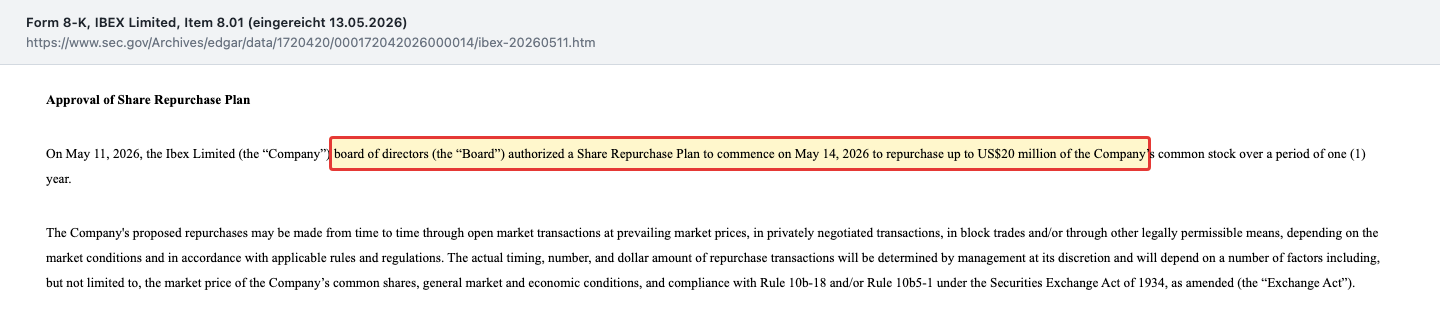
"...the Board authorized a Share Repurchase Plan to commence on May 14, 2026 to repurchase up to US$20 million of the Company's common stock over a period of one (1) year."
— IBEX Limited, Form 8-K, May 13, 2026, Item 8.01
Opportunities and Risks at a Glance
What speaks for IBEX:
- Five consecutive quarters of double-digit revenue growth, most recently +16.8 percent to $164.4 million (Q3 FY2026); fiscal 2026 guidance raised three times in a row, from $590–610 million to $638–642 million.
- A nearly debt-free balance sheet: total debt of just $1.4 million against $297.2 million in total assets and $160.8 million in equity (as of March 31, 2026); the $20 million buyback is funded entirely from existing cash.
- An unusually diversified client base for a BPO provider: largest client only about 10 percent, top three combined 25 percent of revenue (first nine months of FY2026) — called a strength by the company itself.
- Proprietary AI technology (Wave iX) rather than pure labor arbitrage, backed by a strategic partnership with Sierra AI (May 2026) — positions the business against fears that generative AI will make call centers obsolete.
- Moderate valuation: P/E around 11.6, enterprise value/EBITDA around 7.1 — no visible growth premium despite the pace of growth.
What speaks against it:
- Until November 19, 2024, IBEX was a "controlled company" under anchor shareholder TRGI; its founder and CEO, Mohammed Khaishgi, remains IBEX's Chairman to this day, TRGI still holds 12.9 percent, and a TRGI subsidiary leases office space from IBEX.
- Extremely thin external scrutiny: a single Wall Street analyst, no publicly available earnings-call transcripts (as of this research), and low trading liquidity in the free float.
- The "emerging growth company" status expires with the fiscal year ended June 30, 2026 — higher audit costs and a first full internal-controls attestation lie ahead.
- Operations concentrated in four countries (Philippines, Jamaica, Pakistan, Nicaragua), each carrying its own political, currency or natural-disaster risk — structural, not something that can be fixed quickly.
- No dividend, thin trading liquidity; a pullback from the 52-week high ($42.99) shows the market has already priced the story considerably higher at times.
A Human Takeaway
Back to the boring-business bias from the opening. Its core problem isn't that "call centers" make for a bad business — IBEX is currently proving the opposite: five record quarters, guidance raised three times, a balance sheet with barely any debt. Its core problem is that the "boring" label excuses you from the scrutiny a real investment thesis demands — and here, that missing scrutiny is even measurable: one analyst, no retrievable earnings-call transcript. Buying IBEX today means buying a company that delivers operationally, but whose recent past — an anchor shareholder that controlled the board until two years ago, whose chief still chairs it today — deserves closer attention than the growth rate alone provides. The honest question, then, isn't "Is this just a boring call center?" but: Do you trust a board whose chairman only stopped representing the majority shareholder two years ago to keep delivering record quarters the way the numbers so far suggest? If yes, you have a thesis built on more than the first line of a stock profile. What you do with that is your decision.
Sources
All original documents used in this analysis — for further reading:
- IBEX Limited — SEC Form 10-Q for the period ended March 31, 2026 (filed May 6, 2026)
- IBEX Limited — SEC Form 10-K for fiscal 2025 (filed September 11, 2025)
- IBEX Limited — SEC Proxy Statement DEF 14A 2025 (filed October 28, 2025)
- IBEX Limited — Form 8-K, May 6, 2026, Exhibit 99.1 (Q3 FY2026 earnings release)
- IBEX Limited — Form 8-K, May 13, 2026, Item 8.01 (share repurchase program)
- Full SEC filing history for IBEX Limited: EDGAR overview (sec.gov)
- Fundamental data (metrics, price anchor, valuation, analyst coverage; data as of August 26–27, 2026), cross-checked against the SEC filings.
- Earnings-call research: systematic search conducted August 27, 2026 — no publicly available transcript found (12 candidate dates over the past 12 months, 0 retrievable).
Transparency & disclaimer: This analysis is a journalistic assessment of publicly available information and does not constitute investment advice, a financial analysis under any regulatory framework, or a solicitation to buy or sell securities. Stock investments carry substantial risk, including total loss. All information is provided without guarantee; the as-of date for each figure is noted in the text. The author held no position in IBEX shares at the time of publication.
Key figures at a glance
All monetary figures in millions of $; earnings per share as reported.
| Metric | 2022 | 2023 | 2024 | 2025 | 2026 |
|---|---|---|---|---|---|
| Revenue | 492.9 | 523.1 | 508.6 | 558.3 | 644.1 |
| Operating Income (EBIT) | 20.6 | 40.5 | 39.4 | 46.6 | 55.0 |
| Net Income | 21.5 | 31.6 | 33.7 | 36.9 | 46.3 |
| Net Margin | 4.4% | 6.0% | 6.6% | 6.6% | 7.2% |
| Earnings Per Share | 1.15 $ | 1.67 $ | 1.84 $ | 2.34 $ | 3.13 $ |
Source: fundamental data & SEC filings (annual and quarterly reports, 10-K/10-Q)
Our Bottom Line at a Glance
- Operating momentum positive
- Five consecutive quarters of double-digit revenue growth, most recently +16.8% to $164.4 million (Q3 FY2026); fiscal 2026 guidance raised three times since September 2025, from $590–610 million to $638–642 million — each raise followed a quarter that had already beaten the prior guidance.
- Balance sheet & capital returns positive
- Nearly debt-free: total debt of just $1.4 million against $297.2 million in total assets and $160.8 million in equity (March 31, 2026). The board is funding a new $20 million buyback (May 2026) entirely from existing cash.
- Ownership control & governance negative
- A "controlled company" under anchor shareholder TRGI until November 19, 2024 (five of eight board seats); TRGI still holds 12.9%, Chairman Mohammed Khaishgi remains TRGI's founder and CEO, and a TRGI subsidiary leases office space from IBEX. Formally independent only since June 2025.
- External scrutiny & transparency negative
- Only a single Wall Street analyst covers the stock; no publicly available earnings-call transcript could be found for this analysis. Thin external coverage means less independent scrutiny of management's own numbers and statements.
- Country concentration neutral
- Delivery centers and staff are concentrated in four countries — the Philippines, Jamaica, Pakistan, Nicaragua — each carrying its own political, currency or natural-disaster risk. Common in the BPO industry, but structural and not quickly diversifiable.
- Valuation neutral
- P/E around 11.6, enterprise value/EBITDA around 7.1 (as of August 26, 2026) — moderate for the pace of growth, though the stock has traded notably higher within the past 52 weeks (high of $42.99); trading liquidity in the free float is thin.
IBEX delivers operationally what a record quarter promises: five consecutive quarters of double-digit growth, a fiscal 2026 guidance raised three times, and a nearly debt-free balance sheet. At the same time, IBEX was, until November 19, 2024, a "controlled company" under anchor shareholder TRGI, whose founder and CEO still sits on the board as Chairman — covered by a single analyst and with no earnings-call transcripts retrievable for this analysis. Not investment advice.
What Our Rating Means
Open questions
The business works in principle, but one material question is open. As long as it stays open, our findings do not carry a quality verdict.
Yellow, because the operating business clearly delivers based on the available numbers — five record quarters in a row, a guidance raised three times, and a nearly debt-free balance sheet are durable strengths, not a one-quarter fluke. Set against that is a governance history that only formally closed in June 2025: until November 2024, anchor shareholder TRGI controlled a majority of the board, and its chief still chairs the company today — a closeness that is neither illegal nor hidden, but merits closer attention. Add to that an unusually thin layer of external scrutiny (one analyst, no retrievable call transcripts) and an upcoming loss of regulatory relief effective June 30, 2026. None of this threatens the company itself — taken together, though, it justifies more vigilance than the growth numbers alone would suggest.
A journalistic assessment by our editorial team at the time of the deep dive, based on public sources — not investment advice and not a solicitation to buy or sell. Your personal circumstances (investment goals, risk capacity, taxes) cannot be taken into account. What our levels mean, how verdicts are formed, and what conflicts of interest exist →
Worth Noting
- Occasion for this analysis: the quarterly report (Form 10-Q) for the period ended March 31, 2026, filed May 6, 2026, and the subsequent share buyback program announced May 13, 2026.
- Data as of: annual and quarterly figures are drawn from the Form 10-K for FY2025 (filed September 11, 2025) and the Form 10-Q for the period ended March 31, 2026. Price, market cap and valuation figures are as of August 26–27, 2026.
- Methodological caveat: no publicly available transcripts of IBEX earnings calls could be found for this analysis (search conducted August 27, 2026; 12 candidate dates, 0 retrievable). The assessment of management relies on published earnings releases rather than the Q&A portion of a call.
Stock Watch
This analysis is as of August 27, 2026. Stock Watch will tell you what's changed at IBEX since then.
Later $1 a month per stock — signing up is free, and you'll be the first to know when it launches.
The full analysis as a PDF for later
We will send you this analysis as a PDF — to print, file away, and read at your own pace. And we will add you to the free Stock Watch list for IBEX Ltd (IBEX), so you hear about it when something material in this analysis changes.
Frequently Asked Questions
IBEX Limited (Nasdaq: IBEX) is a business process outsourcing (BPO) provider: the company handles customer service, technical support, sales tasks and digital customer acquisition for more than 140 corporate clients. Across 32 delivery centers and roughly 36,000 employees (as of March 31, 2026), concentrated in the Philippines, Jamaica, Pakistan and Nicaragua, IBEX manages customer interactions for brands in industries such as banking, healthcare and retail. The business is complemented by its own AI platform, Wave iX.
Revenue rose 16.8 percent to $164.4 million in the third quarter of fiscal 2026 (ended March 31, 2026) — the fifth consecutive quarter of double-digit growth. Per the May 6, 2026 earnings release, four verticals contributed broadly: HealthTech (+53.7%), Technology (+42.6%), Travel/Transportation/Logistics (+15.1%) and Retail & E-Commerce (+8.3%). Management has raised its fiscal 2026 guidance three times since September 2025.
TRGI (The Resource Group International Limited, Bermuda) was, until November 19, 2024, the anchor shareholder with the contractual right to appoint five of eight board seats — IBEX was, until then, classified as a "controlled company." After a share repurchase, TRGI holds roughly 12.9 percent (as of the proxy statement dated October 28, 2025) and no board seats. Chairman Mohammed Khaishgi, however, remains TRGI's founder and CEO to this day, and a TRGI subsidiary still leases office space from IBEX in Washington.
On August 27, 2026, we specifically searched for publicly available transcripts of IBEX's earnings calls over the past twelve months — and found none. Rather than invent quotes or leave the gap unmentioned, the assessment relies on the four published earnings releases of fiscal 2026, which consistently show that every guidance raise followed a quarter that had already beaten expectations. We could not, however, assess the analyst Q&A — often the most revealing part of a call.
At the August 26, 2026 closing price of $36.63, the price-to-earnings ratio is roughly 11.6 on the trailing four quarters, and the enterprise-value-to-adjusted-EBITDA ratio is roughly 7.1 — a sober valuation with no visible growth premium for a company with five straight record quarters. The single analyst covering the stock sees little room above his $37.50 price target.
IBEX has been classified as an "emerging growth company" since its August 2020 IPO — a status that exempts it, among other things, from the full external auditor attestation on internal controls. Per the quarterly report for the period ended March 31, 2026, this status ends with the fiscal year ended June 30, 2026. The next annual report will therefore likely include, for the first time, a full auditor attestation on internal controls — often accompanied by higher audit fees.
No. IBEX pays no dividend but returns capital to shareholders through buybacks: in the third quarter of fiscal 2026, the company repurchased 140,300 shares for $4.5 million, and on May 11, 2026, the board authorized a new one-year buyback program of up to $20 million, funded from existing cash.
Found an error?
Did you spot a factual error, an outdated number, or a typo in this deep dive? Let us know briefly — your report goes straight to the editorial team.