Digital Turbine stock: the business earns its interest again — the balance sheet does not yet
The apps waiting on a new Android phone before you unlock it for the first time often come from Digital Turbine. From April to June 2026 that business earned its interest almost twice over: $23.1 million of operating income against $12.9 million of interest expense. Behind it sit $387.8 million of debt, a fee deadline at year-end and an “if” in front of the promise that the cash lasts twelve months. We show why a strong quarter is not yet an all-clear here.
 Thomas Mücke
Founder & Publisher
As of Today
As of: November 2, 2026
- Closing price
- 8.50 $ -4.60%
- Market Capitalisation
- 1.0 $B
- Growth Score
- 5/10
- AAQS
- 4/10
Price change since July 24, 2026: +0.6%
This analysis has a cut-off date. The Stock Guard tells you when something material changes in the numbers. Reserve your free spot
Chart
Interactive price chart (TradingView).
52-week range: 2.80 $ to 14.40 $ · Last price: 8.50 $ (As of: November 2, 2026)
Note: pure fact-based analysis, not investment advice and not a solicitation to buy or sell. All figures without guarantee.
There is an investor trap that loves turnaround stories, and it feels like a reward for patience: the inflection trap. It works like this — a number that has fallen for years finally rises again, and your mind closes the file: “Done. The corner has been turned.” At Digital Turbine, Inc. (Nasdaq: APPS) of Austin, Texas, that corner is genuinely there. Revenue in fiscal 2026 rose 15.2 percent to $565.3 million, and after two loss years the books once again show an operating profit of $34.0 million. The arithmetic simply does not stop there. In the same fiscal year, servicing the debt cost $58.6 million in interest. So let us make a deal: before we trust the corner, we read together what Digital Turbine told the U.S. securities regulator, the SEC — the annual report (10-K) for fiscal 2026, the current report (8-K) of April 23, 2026, the proxy statement (DEF 14A) of July 13, 2026 and, since this update, the quarterly report (10-Q) for June 30, 2026. False statements in an SEC filing carry legal penalties. And these filings describe a business that is growing again, a credit covenant that was loosened for a fee of $5.0 million eight months after signing, and equity with nothing tangible behind it.
October 2026 update: what the first quarter of fiscal 2027 shows
This analysis was first published on July 26, 2026, based on the annual report for fiscal 2026. Since then Digital Turbine has filed its quarterly report (10-Q) for the first quarter of fiscal 2027 — the months April through June 2026, filed August 5, 2026 — together with the earnings release (8-K) of August 4 and an amended version (8-K/A) of August 5. We also read every filing through October 1, 2026 and the transcript of the August 4 earnings call. The chapters further down have been updated wherever the facts changed.
The quarter in numbers. Revenue rose 26.8 percent to $166.0 million from the prior-year quarter. The on-device business (On Device Solutions) grew 15.2 percent to $110.0 million, the advertising platform (App Growth Platform) 55.9 percent to $56.6 million. What is new is the breadth: this time every region grew — the United States and Canada by 16.0 percent to $62.1 million, Europe, the Middle East and Africa by 16.3 percent to $43.5 million, Asia Pacific and China by 49.1 percent to $58.8 million (plus $2.1 million from Latin America, less $0.6 million of intercompany revenue). A little over half of the increase (55 percent) still came from Asia, but no longer nearly all of it. Pass-through revenue share fell to 42.8 percent of revenue (prior-year quarter 44.4 percent), and general and administrative expense dropped 23.1 percent to $33.0 million.
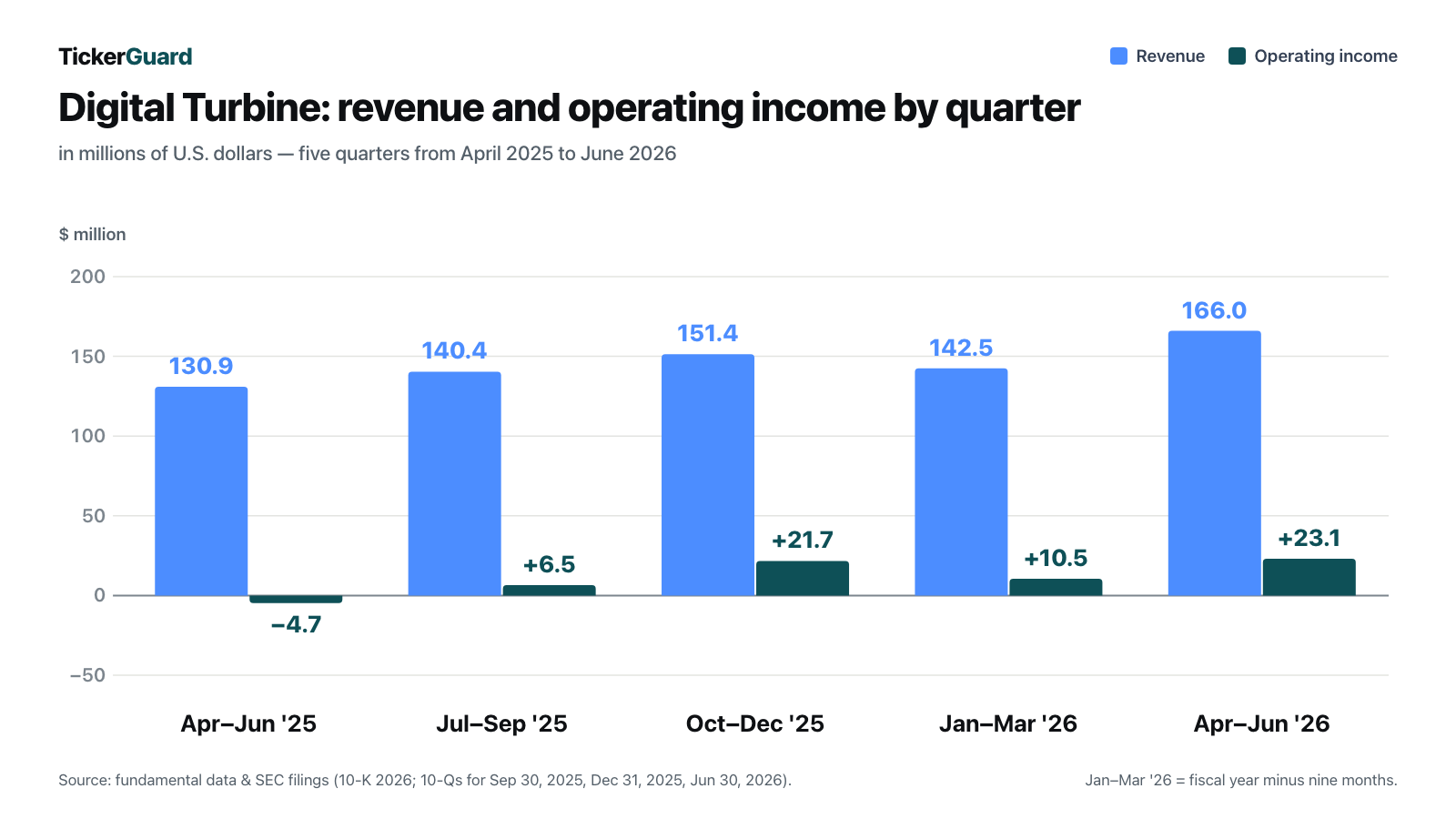
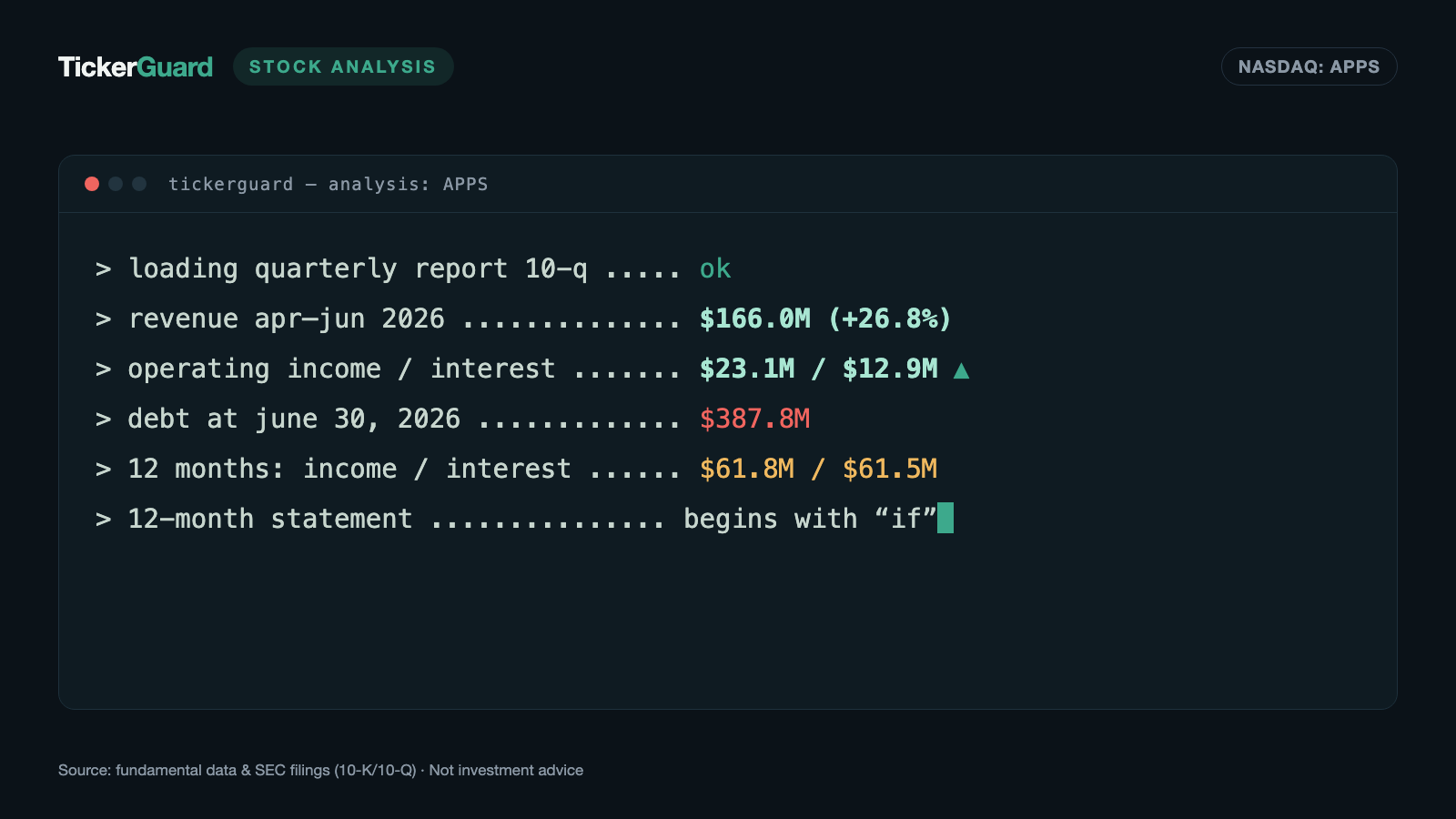
The interest arithmetic, redone. Operating income came to $23.1 million against minus $4.7 million in the prior-year quarter. Interest expense rose 29.5 percent to $12.9 million because the average rate climbed from 8.63 to 11.65 percent. Interest coverage for the quarter is therefore 1.8 — over these three months the business earned its interest almost twice. An honest reading needs the twelve-month view as well, though, because the January-to-March 2026 quarter was weak: from July 2025 through June 2026, roughly $61.8 million of operating income stands against roughly $61.5 million of interest expense. On a trailing basis, coverage is about 1.0 — better than the 0.58 of fiscal 2026, but with no cushion yet. Keep in mind: one strong quarter shifts the arithmetic. It does not yet flip it.
Why there is still a loss. The bottom line shows minus $11.3 million (minus $0.09 per share). Two non-cash items more than explain the loss: a $10.8 million book loss on the lenders' warrants — they gain value as the share price rises and then hit earnings — and a $9.3 million write-down of a privately held strategic investment. Cash, on the other hand, came in: operations produced $17.9 million (prior-year quarter $8.8 million), and after $6.7 million of capital expenditure about $11.2 million was left over. Interest paid, at $11.6 million, was — unlike in fiscal 2026 — clearly below operating cash flow. And the line that had inflated fiscal 2026 operating cash flow — revenue share owed to partners but not yet paid — stayed almost flat at $85.8 million (March 31, 2026: $87.2 million); it did not turn against the company.
A correction overnight. If you only read the earnings release of August 4, 2026, you know a different quarterly loss: minus $3.2 million, or minus $0.03 per share — the figure interim chief financial officer Josh Kinsell also gave on the call that evening, adding in the same breath that the company was “finalizing a non-cash adjustment in our Form 10-Q that may be recorded against beginning retained earnings” and that it “would impact the GAAP net loss.” One day later Digital Turbine replaced the release with an amended version (8-K/A) showing minus $11.3 million, or minus $0.09 per share. The $8.2 million difference is an accounting error from a past acquisition that the company itself classifies as immaterial: liabilities of that size should never have been recognized. In the first version their reversal ran through the quarter as income; in the amended version it is added retroactively to equity — as of March 31, 2026 equity rises from $192.2 million to $200.3 million. Cash flows and covenant compliance were unaffected, and both versions show the same equity of $190.6 million as of June 30, 2026. Keep in mind: the figure that counts is the one in the quarterly report — minus $11.3 million.
The outlook. On August 4 Digital Turbine raised its expectations for fiscal 2027 (ending March 31, 2027): revenue of $650 million to $670 million and $145 million to $155 million of adjusted EBITDA. The initial ranges of May 26, 2026 had been $630 million to $650 million and $135 million to $145 million. For context: "adjusted EBITDA" is a company metric that strips out interest, depreciation and amortization, stock-based compensation and valuation items. For the quarter it was $42.5 million — nearly twice operating income. The company explicitly gives no outlook for net income. Chief executive Bill Stone said on the same call that net leverage, on the company's own calculation, is now 2.5 times adjusted EBITDA, down from more than five times a year earlier; as a headwind he cited memory chip (DRAM) pricing issues in the supply chain weighing on global device volumes.
What moved on the debt side. As of June 30, 2026 Digital Turbine owed $387.8 million (March 31: $391.2 million) in two tranches: $285.0 million at an effective rate of 11.2 percent and $102.8 million at 11.6 percent. $4.7 million was repaid from the sale of a dormant ad exchange that had come with the 2021 AdColony acquisition. Shortly after quarter end the margin on the largest tranche fell by 0.5 percentage points because a leverage threshold under the financing agreement was reached. All covenants were met as of June 30. New in the picture: from September 30, 2026, $2.3 million is due every quarter; in addition, under the credit agreement half of any excess cash flow must go to the lenders from fiscal 2027. And the report contains a deadline worth remembering:
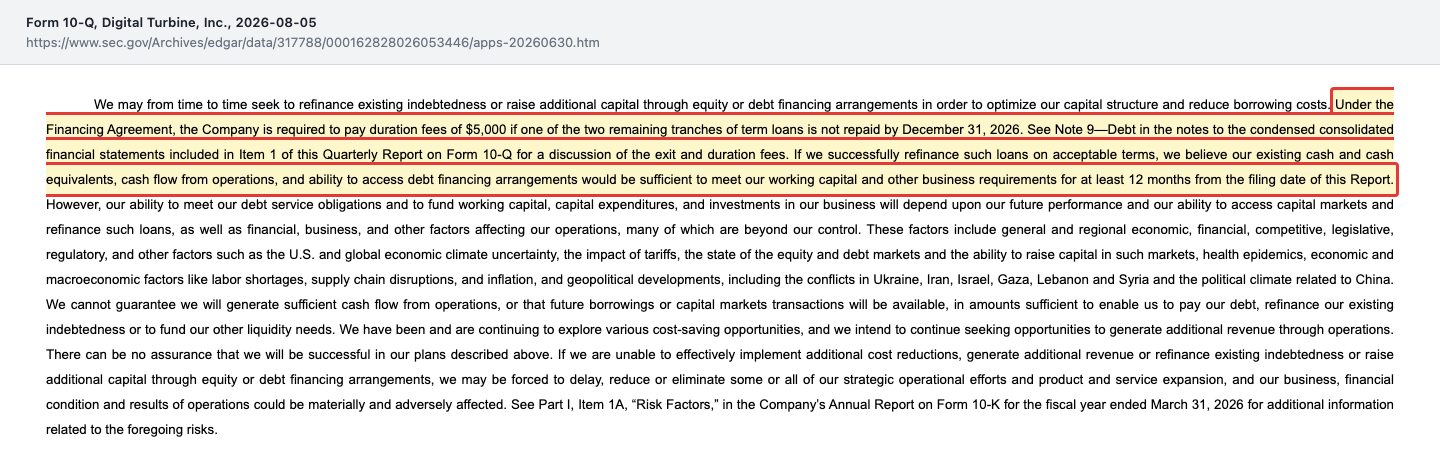
“Under the Financing Agreement, the Company is required to pay duration fees of $5,000 if one of the two remaining tranches of term loans is not repaid by December 31, 2026. See Note 9—Debt in the notes to the condensed consolidated financial statements included in Item 1 of this Quarterly Report on Form 10-Q for a discussion of the exit and duration fees. If we successfully refinance such loans on acceptable terms, we believe our existing cash and cash equivalents, cash flow from operations, and ability to access debt financing arrangements would be sufficient to meet our working capital and other business requirements for at least 12 months from the filing date of this Report.”
— Digital Turbine, Inc., SEC quarterly report on Form 10-Q for the period ended June 30, 2026, Item 2 “Liquidity and Capital Resources” (amounts in thousands)
What happened after the quarter. On August 25, 2026 the annual meeting approved the 10,630,000-share increase in the equity plan (61.3 million votes for, 3.1 million against). The non-binding say-on-pay vote was much closer: 37.9 million votes for, 26.5 million against — roughly 41 percent opposition. On September 2 the four named executive officers received new awards totaling 766,866 shares, half of them tied to performance goals through June 2029. On September 23 chief business officer Michael Akkerman resigned, effective October 30, 2026, to become chief executive elsewhere; the finance chief post is still filled on an interim basis. And on October 1, 2026 Digital Turbine filed a new universal shelf — a pre-cleared framework under which it could issue shares or debt without further waiting; the previous one, of August 5, 2025, had carried the at-the-market share sales — and again registered for resale the 1,222,418 shares underlying the lenders' warrants (first registered by a prospectus supplement of October 22, 2025). On September 30, 2026, according to the prospectus supplement, 121,721,855 shares were outstanding; the closing price that day was $11.10.
Our read of the quarter: it is the strongest operating quarter in this review, and it is more broadly based than the fiscal year before it. The central question of this analysis — whether the business grows faster than the capital structure consumes it — is not answered by it, but for the first time it is open rather than clearly negative. Trailing interest coverage is about 1.0, debt is $387.8 million, and the "if" in front of the twelve-month statement appears with the same condition in the new report. The next milestone is December 31, 2026.
Company history for investors
-
2022
Revenue peak
In fiscal 2022 revenue reached $747.6 million — then fell three years in a row to $490.5 million.
-
2024
Goodwill write-off
In fiscal 2024 Digital Turbine wrote off $336.6 million of goodwill; equity fell from $605.2 million to $213.9 million.
-
2025
Refinancing with Blue Torch
On August 29, 2025 a $430.0 million term loan replaced the bank revolver — more expensive and secured by substantially all assets.
-
2026
Covenant loosened
On April 20, 2026 minimum liquidity was cut from $20 million to $15 million against a $5.0 million fee — eight months after signing.
-
2026
Strong quarter, higher guidance
On August 4, 2026 Digital Turbine reported 26.8 percent revenue growth and raised full-year guidance; operating income covered interest 1.8 times in the quarter.
-
2026
Framework for new shares renewed
On October 1, 2026 Digital Turbine renewed its universal shelf — a possible route to refinancing through new shares, with dilution for existing shareholders.
What Digital Turbine actually does — the software in your phone's factory state
Digital Turbine is not an app publisher, whatever the ticker suggests. What the company sells is far less visible: the space on your phone before you ever use it. Picture the moment: you buy a new Android handset, unlock it for the first time, and during setup apps appear that you never downloaded. That process is what Digital Turbine runs — on behalf of the wireless carrier or the device maker, who take a cut of the advertising money. App publishers pay for the install, the carrier shares in it, and Digital Turbine keeps the difference.
The company reports in two segments. On Device Solutions is the on-handset business just described: app delivery through carriers and device makers, plus content tiles such as news and weather on the browser start page or the lock screen, and the in-house tool SingleTap, which installs an app with a single touch. That segment brought in $382.4 million of revenue in fiscal 2026. App Growth Platform is the advertising side: an exchange where ad slots inside other companies' apps are auctioned in real time, plus tools for advertisers and publishers. It contributed $185.7 million. Strip out $2.9 million of intersegment revenue and the total is $565.3 million.
One line item decides almost everything at Digital Turbine: revenue share, the money passed through to carriers, device makers and app publishers. It is by far the largest cost block — $243.6 million in fiscal 2026, or 43.1 percent of total revenue, down from 48.0 percent a year earlier. In plain terms: of every dollar collected, roughly 43 cents leaves immediately for a partner, before a single employee is paid. That the ratio dropped by almost five percentage points is one of the honestly good pieces of news in this fiscal year.
Which frames the central tension of this analysis, and it runs through every chapter: the operating business really did turn the corner in 2026 — but the capital structure left over from the acquisition spree of 2021 and 2022 consumes the profit faster than the business produces it.
How the stock reached our desk — rank 16 in the weekly list
What prompted the first edition in July 2026 — the rankings in this chapter are a snapshot of that week, not a current signal. Digital Turbine did not come to us through a press release but through a ranking produced by our in-house stock scanner. In the list Richard Moglen: 1 Week Top Performers (U.S. selection) the stock sat at rank 16 of 28, with a relative strength rating of 95 out of 100, as of July 25, 2026. The list is recalculated every day — the placement is a snapshot of that day, not a standing fact. To reproduce it: the ranking is open in the scanner overview and sorts by relative strength.
The three conditions of that list, translated and judged. At least 15 percent price gain over four trading days — pure momentum; it says nothing about the company, only about demand for its shares that week. Average dollar volume of at least $10 million a day — this filter keeps out names you cannot get back out of when it matters. A relative strength rating of at least 70 — the measure compares a stock's performance with the broad market on a scale to 100. A reading of 95 means only five percent of tracked stocks did better.
It is not the only list the stock appears in. As of July 26, 2026 Digital Turbine met 17 of our scanner strategies — among them Mark Minervini: Power Play, Stan Weinstein: Stage 2, RS Leader (90 and above), Qullamaggie: Top Gainers 1M and Institutional Accumulation. That confluence is notable, but it shares one denominator worth knowing: these are almost exclusively momentum and trend filters. They measure the same phenomenon from different angles — that plenty of people are buying this stock. Not one of them checks whether the interest is affordable. So keep this line from the start: a momentum scanner finds movement, not quality. Which means we open the books. For comparison, rank 5 in the same weekly list belongs to Bandwidth, which we have analyzed separately.
The numbers over the years — credit where it is due
First what genuinely impresses, and it is more than the headline “third loss-making year in a row” suggests. Digital Turbine peaked in 2022 and then fell hard: from a revenue high of $747.6 million in fiscal 2022 through $665.9 million and $544.5 million down to $490.5 million in fiscal 2025 — a decline of 34 percent in three years. In fiscal 2026 revenue rose for the first time since, by 15.2 percent to $565.3 million.

More important than the total is where the growth came from — and here any story about a broad recovery gets uncomfortable. By region, fiscal 2026 against the prior year looks like this: United States and Canada $227.7 million against $232.1 million — slightly down. Europe, the Middle East and Africa $162.5 million against $163.1 million — effectively flat. Asia Pacific and China $174.4 million against $95.5 million — up 82.6 percent. The entire group increase of $74.7 million in fiscal 2026 therefore came from a single region, while both established markets stalled or shrank. The annual report attributes the gain to higher device volumes internationally. In the first quarter of fiscal 2027 the picture broadened: the United States and Canada (up 16.0 percent) and Europe (up 16.3 percent) grew as well, although Asia, up 49.1 percent, remained the strongest driver.
Operationally, real things moved too. The biggest cost block, pass-through revenue share, rose only 3.5 percent while revenue rose 15.2 percent — the ratio fell from 48.0 percent to 43.1 percent. General and administrative expense dropped 18.2 percent to $142.1 million, partly because stock-based compensation was halved from $33.5 million to $16.4 million and amortization of old acquisitions ran off. Headcount fell from 647 to 620 full-time employees. The transformation program that began in October 2024 and included two rounds of layoffs was completed in the fourth quarter of fiscal 2025; in fiscal 2026 it cost only $0.6 million more. The savings plan delivered. It did not solve the interest problem.
One quarter deserves particular mention, because it is what made the inflection story plausible in the first place. In the third quarter of fiscal 2026 — the holiday quarter ended December 31, 2025 — Digital Turbine made money again: $151.4 million of revenue (up 12.4 percent), $21.7 million of operating income and $5.1 million of net income. Keep doing the arithmetic, though, and the fourth quarter appears as well: between the nine-month loss of $30.4 million and the full-year loss of $37.7 million lies an additional $7.3 million of loss in the January-to-March 2026 quarter. One good quarter is not yet a good year.
What the filings say — the uncomfortable truths
Uncomfortable truth No. 1: in fiscal 2026 the operating profit did not cover the interest
Interest coverage is one of the few ratios that needs no background: divide operating income by interest expense and you learn how many times a company could pay its interest out of the running business. A healthy reading is 3 or more; below 1 means simply that the business does not earn its interest. Digital Turbine in fiscal 2026: 34.0 divided by 58.6 — that is 0.58. In the first quarter of fiscal 2027 it was 1.8, and about 1.0 over the twelve months to June 2026 (details in the update above). The truth has not gone away — it has become smaller.
The route from operating profit to full-year loss is therefore short and instructive:

Interest expense rose 68.4 percent in a single year, from $34.8 million to $58.6 million. The annual report gives the reason: the weighted average interest rate on the company's debt climbed from 8.4 percent to 11.3 percent. That is not a market move, it is a decision — in August 2025 Digital Turbine swapped a bank revolver for a markedly more expensive term loan. Why, and at what price, is the next truth.
Uncomfortable truth No. 2: with fees, one tranche cost an effective 20.62 percent through March 2026
On August 29, 2025 Digital Turbine repaid its revolving credit facility with Bank of America and a syndicate of lenders and took on a term loan from Blue Torch Finance LLC instead — a lender specializing in private corporate credit, which typically charges more than a bank. The terms: three tranches totaling $430.0 million, a four-year term to August 29, 2029, a margin of 7.50 to 8.00 percentage points over the SOFR benchmark rate, secured by substantially all of the company's assets. As of March 31, 2026, $391.2 million was still outstanding at an effective rate of 11.7 percent; by June 30, 2026 it was $387.8 million at 11.2 and 11.6 percent.
The real price, however, is not in the coupon but in the fees. The original agreement provided for exit and duration fees that were to fall due if a particular tranche is not repaid by August 2026 — and are then simply added to the principal:
“In the event that the Company does not prepay the applicable term loan principal by August 2026, the Company would be required to add total exit fees of $8,100 and duration fees of $21,500 to its principal balance. The Company uses the effective interest method to recognize the exit and duration fees over the term of the debt. The effective interest rate for the period from the date of issuance through March 31, 2026 on the effected tranche was 20.62%.”
— Digital Turbine, Inc., SEC annual report on Form 10-K for fiscal 2026, Note 12 “Debt” (amounts in thousands)

Since the April 2026 amendment (next truth) those fees are capped: by June 30, 2026, $5.85 million of exit fees and $10.75 million of duration fees had been added to principal; still outstanding is a $5.0 million duration fee if a specific tranche remains unpaid on December 31, 2026. According to the quarterly report, the effective rate on the affected tranche fell to 17.21 percent — still about one and a half times the rest of the debt.
To bring the balance down, Digital Turbine sold shares into the market at the same time. On August 5, 2025 it signed an agreement with two banks for up to $150 million; it sold 9,945,136 shares at an average of $5.89, raising $58.6 million gross. Under the credit agreement the proceeds had to go straight into repayment — $55.0 million went back to Blue Torch during fiscal 2026. On February 2, 2026 Digital Turbine terminated that sales agreement of its own accord. Shares outstanding still rose during the fiscal year from 105,977,642 to 120,315,203 — a good 13.5 percent more pieces of the same company. On September 30, 2026 the count was 121,721,855.
Uncomfortable truth No. 3: eight months later the covenant was loosened — for a fee
Credit agreements contain covenants — promises by the borrower to keep certain metrics inside agreed limits. Break one and the whole loan can be called. Blue Torch required two: a maximum leverage ratio and minimum liquidity of $10 million until March 31, 2026 and $20 million thereafter, of which at least $10 million had to sit in the United States.
On April 20, 2026, three weeks after the higher threshold took effect, the agreement was amended:
“On April 20, 2026, Digital Turbine, Inc. (the ‚Company‘) amended its Financing Agreement (the ‚Financing Amendment‘) among the Company, certain other wholly owned subsidiaries of the Company, as guarantors, Blue Torch Finance LLC, as administrative agent and as collateral agent, and the lenders from time to time party thereto to, among other things, amend the liquidity covenant to reduce the liquidity requirement for the period between April 1, 2026 and December 31, 2026 to $15,000,000.”
— Digital Turbine, Inc., SEC current report on Form 8-K filed April 23, 2026, Item 1.01

The relief was not free; the current report gives no reason for the change. The notes to the annual report name the price: a $5.0 million amendment fee, capitalized as additional debt issuance cost and amortized over the remaining term. In exchange, remaining exit fees were limited to $1.35 million and future duration fees capped at $5.0 million — the latter waived entirely if a certain tranche is repaid by December 31, 2026. On the same day the company also suspended its obligation to register the shares underlying the lenders' warrants for resale until October 1, 2026 — on October 1, 2026 the 1,222,418 shares were then registered again, having first been registered for resale in October 2025. As of March 31, 2026 Digital Turbine was in compliance with all covenants, and cash of $37.7 million sat above both thresholds; the same held on June 30, 2026, with $42.9 million of unrestricted cash. Still: the relief had a price — a $5.0 million amendment fee.
Uncomfortable truth No. 4: the twelve-month statement comes with a condition
U.S. annual reports usually contain a paragraph experienced readers look for first: management's statement on whether the money lasts twelve months. Digital Turbine's is there — but it opens with an "if":
“If we successfully refinance such loans on acceptable terms, we believe our existing cash and cash equivalents, cash flow from operations, and ability to access debt financing arrangements would be sufficient to meet our working capital and other business requirements for at least 12 months from the filing date of this Annual Report.”
— Digital Turbine, Inc., SEC annual report on Form 10-K for fiscal 2026, Item 7 “Liquidity and Capital Resources”

To be clear and undramatic: this is not a formal going-concern doubt — the auditor would have to flag that separately, and Grant Thornton did not. On the contrary, the auditor also certified internal control over financial reporting as effective. But it is not the usual unconditional formula either. In the same section the company writes plainly that it is currently seeking to refinance certain loan tranches and exploring ways to raise additional capital through equity or equity-linked securities. An "if" in that paragraph is news. The quarterly report for June 30, 2026 repeats the sentence almost word for word, and the condition “If we successfully refinance such loans on acceptable terms” exactly — despite the strong quarter.
Uncomfortable truth No. 5: without goodwill and intangibles, equity is negative
As of March 31, 2026 Digital Turbine's annual report showed equity of $192.2 million; after the August 2026 correction the figure is $200.3 million. As of June 30, 2026 the balance sheet shows $190.6 million. The asset side explains what that equity consists of: $222.9 million of goodwill and $208.5 million of other intangible assets — together $431.4 million out of an $843.5 million balance sheet. Goodwill, in plain terms, is the premium a buyer paid above the value of the individual things acquired; it cannot be sold and cannot be pledged. Deduct goodwill and intangibles from equity and tangible book value is minus $240.8 million (March 31, 2026 after the correction: minus $240.2 million).
That these carrying values are no security is something the company has already demonstrated: in fiscal 2024 Digital Turbine wrote off $336.6 million of goodwill in a single year. Equity fell from $605.2 million to $213.9 million, and the annual loss came to $420.4 million, or $4.16 per share. Accumulated deficit stood at $728.3 million as of June 30, 2026. What that means for shareholders is stated unusually plainly in both the annual and the quarterly report: because substantially all assets are pledged to the lender, a foreclosure or forced sale would leave "little, if any" value for common stockholders.
Uncomfortable truth No. 6: few carriers, one customer at 20.6 percent of receivables — and an interim finance chief
The on-device business works only as long as carriers and device makers play along. The annual report is blunt about it:
“In our ODS business, we rely on wireless carriers and OEMs to distribute our products and services. A significant portion of our ODS business is derived from a limited number of wireless carriers. Our failure to maintain our relationships with these carriers, establish relationships with new carriers, or a loss or change of terms could materially reduce our revenue and thus harm our business, operating results, and financial condition.”
— Digital Turbine, Inc., SEC annual report on Form 10-K for fiscal 2026, Item 1A “Risk Factors”

How tight that dependence has become shows in a figure in the notes that did not exist a year earlier: as of March 31, 2026 one single customer accounted for 20.6 percent of receivables — as of March 31, 2025 no customer exceeded 10 percent. The annual report does not name the customer, and the quarterly report for June 30, 2026 adds nothing on it. On the revenue side no single partner crossed the ten percent mark in any of the three reported years, but the receivables picture has concentrated sharply within twelve months. A related detail sharpens the competitive question: the annual report names the Google Play app store as its primary competition — but as the more material competition, beyond smaller rivals, solutions built in house by the carriers and device makers, precisely the partners the revenue depends on.
And one personnel matter still open at the time of this update: chief financial officer Steve Lasher resigned on May 22, 2026, effective May 31. Chief accounting officer Josh Kinsell has run the finance function on an interim basis since June 1, 2026, and the company has engaged an executive search firm. As late as the filing of October 1, 2026, Kinsell still signs as "Chief Financial Officer (Interim)" — so the post has been unfilled on a permanent basis for four months, ahead of a pending refinancing. A second departure adds to it: chief business officer Michael Akkerman leaves the company on October 30, 2026 to become chief executive elsewhere.
Valuation — what the market pays for this business today
A word on honesty first: prices change daily, so what follows is a dated anchor for scale, not a buy argument. On September 30, 2026 the stock closed at $11.10 — as stated in the prospectus supplement of October 1, 2026. With 121,721,855 shares outstanding on the same date, that gives a market capitalization of roughly $1.35 billion. For comparison: when this analysis first appeared (closing price $8.45 on July 24, 2026) it was roughly $1.02 billion, so the price is a good 31 percent higher. The 52-week range ran from $2.74 to $15.34 (data as of October 2, 2026); the stock swings hard, with a beta of about 2.9 — on average it moves almost three times as much as the broad market.
Four orders of magnitude follow, all on the twelve months from July 2025 through June 2026. First, price to sales: revenue over those twelve months was $600.3 million, so the market capitalization equals roughly 2.25 times sales — a good quarter more than when the analysis first appeared. The market is pricing in a continued recovery. Second, enterprise value: market capitalization plus net debt of $344.9 million ($387.8 million of debt less $42.9 million of unrestricted cash, June 30, 2026) gives roughly $1.70 billion. Anyone buying the whole company would take on the debt as well. Third, leverage: operating income before depreciation and amortization over those twelve months was roughly $126.7 million ($61.8 million of operating income plus $64.9 million of depreciation and amortization). Net debt is therefore about 2.7 times that figure — clearly lower than the 3.4 times of fiscal 2026. The company itself cites 2.5, but on its adjusted EBITDA. Fourth, there is no price-earnings ratio, because there is still no profit on the bottom line.
One further number completes the picture. Free cash flow — cash from operations less capital expenditure — came to roughly $21.2 million over the twelve months to June 2026 ($50.9 million less $29.7 million). On that basis the stock costs roughly 64 times free cash flow. That price assumes the company will soon earn its interest with a comfortable margin — on a trailing twelve-month basis it is only just earning it so far.
The professionals have turned since July: all three houses tracked now rate the stock a buy, two of them a strong buy, with a consensus target price of roughly $16.33 (data as of October 2, 2026) — a narrow base of three houses. One possible reason for the gap to our red rating: the company guides on adjusted EBITDA, a metric in which interest does not appear — our rating, by contrast, starts from operating income after interest. The bet on falling prices remains considerable, though: 10.2 million shares are sold short, roughly 9.3 percent of the float (our own calculation: 10.2 million of 109.2 million freely traded shares per fundamental data). When prices rise, short sellers come under pressure to close their positions by buying back — which can amplify price swings in both directions.
Opportunities and risks at a glance
What speaks for Digital Turbine:
- The business is growing again — and more broadly. Revenue up 15.2 percent in fiscal 2026 and 26.8 percent in the first quarter of fiscal 2027, this time in every region; the advertising platform grew 55.9 percent in the quarter.
- The cost base has been cleaned up. General and administrative expense down 18.2 percent in fiscal 2026 and 23.1 percent in the first quarter of fiscal 2027; pass-through revenue share fell from 48.0 through 43.1 to 42.8 percent of revenue.
- In the quarter, operating income carried the interest. $23.1 million of operating income against $12.9 million of interest expense in the April-to-June 2026 quarter (coverage 1.8); full-year guidance was raised to $650 million to $670 million of revenue.
- Real cash is coming in. $17.9 million of operating cash flow in the quarter, roughly $21.2 million of free cash flow over twelve months; interest paid ($11.6 million) was clearly lower in the quarter.
- The position on the device is hard to replicate. Delivering apps during first-time setup requires contracts with carriers and manufacturers — Digital Turbine built those over years; in the April-to-June 2026 quarter the company announced a partnership with the carrier Orange.
What speaks against it:
- Over twelve months it only just covers. From July 2025 through June 2026 roughly $61.8 million of operating income stood against roughly $61.5 million of interest expense — coverage of about 1.0 and no cushion; in fiscal 2026 it was 0.58.
- $387.8 million of debt with a specialist lender (June 30, 2026), secured by substantially all assets, at effective rates of 11.2 and 11.6 percent and 17.21 percent on one tranche; if a specific tranche remains unpaid on December 31, 2026, it costs $5.0 million.
- The twelve-month statement still comes with an "if". The quarterly report for June 30, 2026 also makes it conditional on a successful refinancing; the liquidity covenant had been cut in April 2026 against a $5.0 million fee.
- Tangible equity is negative. Reported equity of $190.6 million faces $431.4 million of goodwill and intangibles (June 30, 2026); in fiscal 2024, $336.6 million of goodwill was written off in a single year.
- Dilution is prepared. The universal shelf was renewed on October 1, 2026, the annual meeting released 10.63 million additional shares for employee pay, and the credit agreement requires equity proceeds to go into repayment.
- Headwind on device volumes. On the August 4, 2026 call, chief executive Bill Stone cited memory chip (DRAM) pricing issues in the supply chain as a drag on global device volumes — and the on-device business depends on those volumes.
- Concentration and leadership. One customer represented 20.6 percent of receivables as of March 31, 2026, in-house solutions of the most important partners rank among the most material competition, the finance chief has been interim since June 1, 2026, and the chief business officer leaves at the end of October 2026.
A human conclusion
Back to the inflection trap. It is so persistent because it starts from a correct observation: Digital Turbine really did turn the corner in 2026. Revenue is growing again, the biggest cost block is shrinking as a share of it, administration costs almost a fifth less, and the operating line is positive again after two loss years. That is not a story; it is audited and available to read.
The mistake is not the observation but the point at which we stop reading. In fiscal 2026, two lines below operating income sat interest expense that was larger than it. The first quarter of fiscal 2027 made that line smaller: $23.1 million of operating income against $12.9 million of interest, growth in every region, raised guidance. And this is exactly where the inflection trap snaps shut a second time — because now the corner feels even more real. Read on and you find trailing interest coverage of about 1.0, $387.8 million of debt, a fee deadline of December 31, 2026, the same "if" in front of the twelve-month statement and a framework for new shares renewed on October 1. Digital Turbine is therefore neither a wreck nor a completed turnaround — it is a company whose business is catching up with its balance sheet but has not yet overtaken it. Whether it does is decided by the refinancing: if it comes on acceptable terms, the business has time; if it comes only through a large number of new shares, today's shareholders pay for the recovery.
You can read the outcome by year-end in three filings: first, a current report (8-K) on repaying or refinancing the Blue Torch tranche specified in the credit agreement before December 31, 2026 — if it is repaid in time, the $5.0 million fee falls away. Second, a prospectus supplement (424B5) under the new shelf registration — it shows whether, and how many, new shares are issued for it. Third, the quarterly report (10-Q) for September 30, 2026: if trailing interest coverage is then clearly above 1.0 and the “if” in front of the twelve-month statement is gone, that would be the documented step at which our rating would move from red to yellow.
What you make of that is your decision. And that is exactly as it should be.
Sources
- Digital Turbine, Inc. — quarterly report on Form 10-Q for the period ended June 30, 2026 (first quarter of fiscal 2027) (filed August 5, 2026)
- Digital Turbine, Inc. — current report on Form 8-K filed August 4, 2026, Item 2.02 (quarterly results and outlook)
- Digital Turbine, Inc. — amended current report on Form 8-K/A filed August 5, 2026, Item 2.02 (equity correction)
- Digital Turbine, Inc. — current report on Form 8-K filed August 25, 2026, Items 5.02 and 5.07 (annual meeting voting results)
- Digital Turbine, Inc. — current report on Form 8-K filed September 8, 2026, Item 5.02 (long-term awards to management)
- Digital Turbine, Inc. — current report on Form 8-K filed September 24, 2026, Item 5.02 (September 23 resignation of the chief business officer)
- Digital Turbine, Inc. — registration statement on Form S-3ASR filed October 1, 2026 (universal shelf)
- Digital Turbine, Inc. — prospectus supplement 424B7 filed October 1, 2026 (resale of 1,222,418 warrant shares; share count and closing price as of September 30, 2026)
- Transcript of the earnings call for the first quarter of fiscal 2027, August 4, 2026 (The Motley Fool, published via Webull)
- Digital Turbine, Inc. — annual report on Form 10-K for the fiscal year ended March 31, 2026 (filed May 26, 2026)
- Digital Turbine, Inc. — quarterly report on Form 10-Q for the period ended September 30, 2025 (filed November 4, 2025, quarterly figures for July to September 2025)
- Digital Turbine, Inc. — quarterly report on Form 10-Q for the period ended December 31, 2025 (filed February 3, 2026)
- Digital Turbine, Inc. — current report on Form 8-K filed April 23, 2026, Item 1.01 (amendment to the financing agreement)
- Digital Turbine, Inc. — current report on Form 8-K filed May 26, 2026, Item 2.02 (full-year results)
- Digital Turbine, Inc. — proxy statement on Form DEF 14A filed July 13, 2026
- Digital Turbine, Inc. — annual report on Form 10-K for the fiscal year ended March 31, 2024 (filed May 28, 2024, source of the fiscal 2022 and 2023 revenue figures)
- SEC EDGAR — filing history for Digital Turbine, Inc. (CIK 0000317788)
- Fundamental data (metrics, price series, analyst estimates, short interest), data as of October 2, 2026; first edition: data as of July 26, 2026, closing price of July 24, 2026
Disclaimer: This article is journalistic analysis of publicly available corporate filings. It is not investment advice, not a solicitation to buy or sell securities and not a personal recommendation. Shares can lose substantial value; a total loss of invested capital is possible. All figures come from the primary sources linked above and carry their respective as-of dates; we accept no liability for the completeness or accuracy of the underlying reports. Positions held by the operator are disclosed daily; where one exists, it appears as a notice at the top of this analysis.
Key figures at a glance
All monetary figures in millions of $; earnings per share as reported.
| Metric | 2022 | 2023 | 2024 | 2025 | 2026 |
|---|---|---|---|---|---|
| Revenue | 747.6 | 665.9 | 544.5 | 490.5 | 565.3 |
| Operating Income (EBIT) | 92.2 | 46.2 | -374.4 | -54.1 | 34.0 |
| Net Income | 35.5 | 16.7 | -420.2 | -92.1 | -37.7 |
| Net Margin | 4.8% | 2.5% | -77.2% | -18.8% | -6.7% |
| Earnings Per Share | 0.35 $ | 0.16 $ | -4.16 $ | -0.89 $ | -0.33 $ |
Source: fundamental data & SEC filings (annual and quarterly reports, 10-K/10-Q)
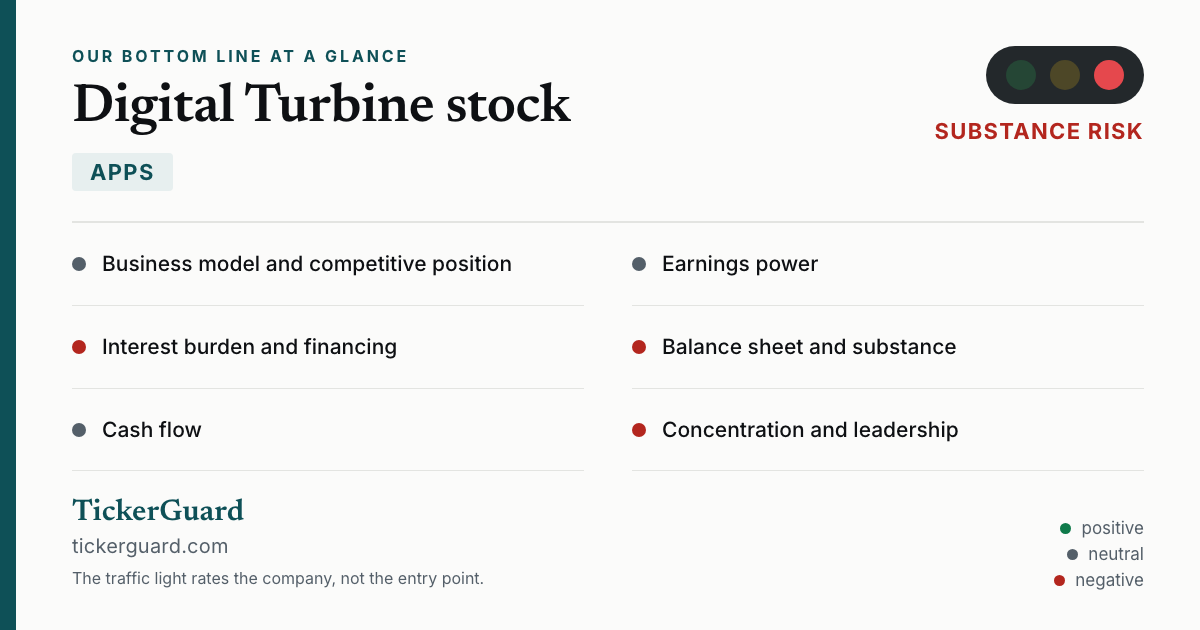
Our Bottom Line at a Glance
- Business model and competitive position neutral
- The slot on the handset before first use is hard to replicate and rests on years of contract work; in the April-to-June 2026 quarter a partnership with Orange was added. The annual report names the Google Play app store as its primary competition, but the in-house solutions of carriers and device makers as the more material competition — precisely the partners the revenue depends on.
- Earnings power positive
- Operating income swung to a positive $34.0 million in fiscal 2026 and reached $23.1 million in the first quarter of fiscal 2027, driven by 26.8 percent revenue growth across all regions and 23.1 percent lower administrative costs. Guidance was raised. Because of valuation items, the bottom line still shows a loss.
- Interest burden and financing negative
- In the quarter operating income covered interest 1.8 times, but over the twelve months to June 2026 only about 1.0 times (roughly $61.8 million against roughly $61.5 million). $387.8 million of debt costs 11.2 to 11.6 percent, 17.21 percent on one tranche; the refinancing is still pending, and a $5.0 million fee deadline runs to December 31, 2026.
- Balance sheet and substance negative
- Equity of $190.6 million (June 30, 2026) sits against $222.9 million of goodwill and $208.5 million of other intangibles; tangible book value is minus $240.8 million. Substantially all assets are pledged to the lender, and the twelve-month statement in the quarterly report is still conditional on a successful refinancing.
- Cash flow neutral
- Operations produced $17.9 million in the first quarter of fiscal 2027 and $50.9 million over twelve months; roughly $21.2 million was left as free cash flow. Interest paid in the quarter, at $11.6 million, was clearly lower, after exceeding operating cash flow in fiscal 2026 ($47.1 million against $41.8 million).
- Concentration, leadership and dilution negative
- As of March 31, 2026 one single customer accounted for 20.6 percent of receivables. The finance chief has been interim since June 1, 2026, the chief business officer leaves on October 30, 2026, and roughly 41 percent of votes cast opposed executive pay. Through the standing registration (universal shelf) renewed on October 1, 2026, the company could issue new shares without further waiting.
Digital Turbine is the inflection trap in its second edition: in fiscal 2026 the operating business pointed up and the capital structure down. The first quarter of fiscal 2027 narrowed the gap — 26.8 percent revenue growth in every region, $23.1 million of operating income against $12.9 million of interest, raised guidance. Over twelve months, however, operating income covers interest only about once, $387.8 million of debt is secured by substantially all assets, tangible equity is minus $240.8 million, and the twelve-month statement still begins with an "if". Not investment advice.
What Our Rating Means
Substance risk
We found at least one documented issue that threatens the company itself — regardless of how the stock is currently valued.
Red, because the substance behind the improving business does not yet hold: over the twelve months to June 2026 operating income covers interest only about once (roughly $61.8 million against roughly $61.5 million), equity without goodwill and intangibles is negative at minus $240.8 million, and the twelve-month statement in the quarterly report still depends on a successful refinancing — no formal going-concern doubt, but coverage sits right at the threshold, and between two grades the more cautious one applies.
A journalistic assessment by our editorial team at the time of the deep dive, based on public sources — not investment advice and not a solicitation to buy or sell. Your personal circumstances (investment goals, risk capacity, taxes) cannot be taken into account. What our levels mean, how verdicts are formed, and what conflicts of interest exist →
Worth Noting
- Update of October 3, 2026: the analysis of July 26, 2026 was extended with the quarterly report (10-Q) for June 30, 2026 (first quarter of fiscal 2027, filed August 5, 2026), the earnings releases on Form 8-K of August 4, 2026 and Form 8-K/A of August 5, 2026, all filings through October 1, 2026 and the transcript of the August 4, 2026 earnings call. The placement in our in-house stock scanner (rank 16 of 28 in “Richard Moglen: 1 Week Top Performers”, as of July 25, 2026) is a snapshot from the first edition.
- Every figure carries its own as-of date: annual figures from the Form 10-K for fiscal 2026 (filed May 26, 2026), quarterly figures from the 10-Qs for September 30, 2025, December 31, 2025 and June 30, 2026, equity at March 31, 2026 in the corrected version of the 8-K/A of August 5, 2026, share count and closing price as of September 30, 2026 from the 424B7 prospectus supplement of October 1, 2026. Twelve-month figures are our own calculation (fiscal 2026 plus the first quarter of fiscal 2027 minus the first quarter of fiscal 2026); for interest expense that is $58.6 million plus $12.9 million minus $10.0 million, or roughly $61.5 million. Valuation metrics as of October 2, 2026 — meant to be evergreen, with no daily price used as an argument.
- Risk of confusion: the ticker APPS belongs to Digital Turbine, Inc. of Austin (CIK 0000317788), not to an app store operator. The company was named Mandalay Digital Group until 2015, and NeuMedia and Mandalay Media before that; its SEC registration runs back to 1995 under changing names. One Store International Holding B.V., acquired in 2024, is a small holding (purchase price $1.9 million), not the Korean One Store app marketplace itself.
Download the verdict card (traffic light and rating of this analysis as an image, PNG)
Stock Watch
This analysis is as of October 3, 2026. Stock Watch will tell you what's changed at APPS since then.
Later $1 a month per stock — signing up is free, and you'll be the first to know when it launches.
The full analysis as a PDF for later
We will send you this analysis as a PDF — to print, file away, and read at your own pace. And we will add you to the free Stock Watch list for Digital Turbine Inc (APPS), so you hear about it when something material in this analysis changes.
Frequently Asked Questions
Digital Turbine supplies software that places apps on new Android devices during first-time setup, on behalf of wireless carriers and device makers who share in the proceeds (On Device Solutions segment, $382.4 million of revenue in fiscal 2026). It also runs an advertising marketplace for app publishers with real-time auctions (App Growth Platform, $185.7 million). The fiscal year ends March 31; fiscal 2026 largely corresponds to calendar year 2025.
From April to June 2026 revenue rose 26.8 percent to $166.0 million, driven by the advertising platform (up 55.9 percent) and, for the first time in a while, by every region. Operating income was $23.1 million against minus $4.7 million in the prior-year quarter. The net loss was $11.3 million, mainly because of a $10.8 million book loss on lender warrants and a $9.3 million write-down of an investment. The figures are in the quarterly report (10-Q) filed August 5, 2026.
In the April-to-June 2026 quarter, yes: $23.1 million of operating income stood against $12.9 million of interest expense, coverage of 1.8. Over the twelve months from July 2025 through June 2026, however, roughly $61.8 million of operating income stands against roughly $61.5 million of interest — coverage of about 1.0. In fiscal 2026 it was 0.58 ($34.0 million against $58.6 million).
As of June 30, 2026 Digital Turbine owed $387.8 million to Blue Torch Finance in two tranches of $285.0 million (effective rate 11.2 percent) and $102.8 million (11.6 percent), maturing August 29, 2029 and secured by substantially all assets. If a specific one of the two tranches remains unpaid on December 31, 2026, a $5.0 million duration fee falls due. Unrestricted cash was $42.9 million.
On August 4, 2026 the company raised its outlook for the fiscal year ending March 31, 2027 to $650 million to $670 million of revenue and $145 million to $155 million of adjusted EBITDA, up from $630 million to $650 million and $135 million to $145 million. Adjusted EBITDA strips out interest, depreciation and amortization, stock-based compensation and valuation items. Digital Turbine gives no outlook for net income.
By filing on Form S-3ASR, Digital Turbine renewed its pre-cleared framework (the previous one dated from August 5, 2025) to issue common stock, preferred stock, debt securities or warrants without waiting — amount, price and terms are set only at the time of an offering. No offering has taken place yet. On the same day the 1,222,418 shares underlying the lenders' warrants were again registered for resale (first in October 2025); 121,721,855 shares were outstanding on September 30, 2026.
Shares outstanding rose during fiscal 2026 from 105,977,642 to 120,315,203 — a good 13.5 percent more — mainly through the sale of 9,945,136 shares into the market at an average of $5.89. Through September 30, 2026 only a little over 1.4 million were added (121,721,855). On August 25, 2026, however, the annual meeting approved 10,630,000 additional shares for employee compensation.
By its own filings, Digital Turbine uses artificial intelligence but does not sell it as a product with its own revenue line. The fiscal 2026 annual report says the company is increasingly building AI into certain offerings and depends on third-party AI partners for core data and infrastructure. The quarterly report for June 30, 2026 cites collaborations with Google Cloud and Databricks and describes embedding AI directly into the systems for targeting and real-time optimization.
Found an error?
Did you spot a factual error, an outdated number, or a typo in this deep dive? Let us know briefly — your report goes straight to the editorial team.