Consolidated Water: Eight Years to Get the Cayman License — Hawaii Has Been Waiting Two Years and Counting
Consolidated Water Co. Ltd. (NASDAQ: CWCO) runs seawater desalination plants in the Cayman Islands, the Bahamas, and the United States — a business that reliably throws off cash: $132.6 million in cash, almost no debt, a dividend paid for years. Yet the company's single most important revenue source, the water license for two of Grand Cayman's three largest population centers, sat in limbo from 2018 until June 2026. A megaproject in Mexico was canceled by the government in 2020. And nearly two-thirds of the receivables from the government-owned water utility in the Bahamas are classified as delinquent, per the company's own filing. We read the annual and quarterly reports, the earnings calls, and the original filings — before you decide whether eight years of patience is a good omen for the next megaproject. Not investment advice, just a look at the filings before you decide.
 Thomas Mücke
Founder & Publisher
Thomas Mücke
Founder & Publisher
As of Today
As of: October 9, 2026
- Closing price
- 30.60 $ +0.80%
- Market Capitalisation
- 0.5 $B
- P/E
- 28.5
- Growth Score
- 5/10
- AAQS
- 7/10
Price change since August 26, 2026: +1.9%
This analysis has a cut-off date. The Stock Guard tells you when something material changes in the numbers. Reserve your free spot
Chart
Interactive price chart (TradingView).
52-week range: 27.50 $ to 38.40 $ · Last price: 30.60 $ (As of: October 9, 2026)
Note: pure fact-based analysis, not investment advice and not a solicitation to buy or sell. All figures without guarantee.
There's an investor trap that catches especially patient people — because patience is usually considered a virtue on the stock market: the patience trap. It works like this: a company struggles for years with an unresolved problem — an expiring license, a permit that never comes, a customer that doesn't pay. You hold on, believing that endurance eventually pays off. And then, after years, it actually happens: the problem gets resolved. Your mind immediately draws the next conclusion: "This company always delivers in the end — even on the next problem." That's exactly the moment Consolidated Water Co. Ltd. (NASDAQ Global Select Market: CWCO) is in right now. In June 2026, an eight-year standoff over the company's single most important license ended — the contract that secures its exclusive right to supply drinking water to two of Grand Cayman's three largest population centers. At the same time, a second megaproject, a roughly $204 million desalination plant in Hawaii, has been waiting roughly two years for a whole chain of permits. And nearly two-thirds of the receivables from the government-owned water utility in the Bahamas are classified as delinquent, per the company's own quarterly report. Before you conclude from one resolved wait that the other will resolve too, let's read the annual and quarterly reports, the earnings calls, and the original filings Consolidated Water submitted to the U.S. securities regulator, the SEC, together. In the end, you decide for yourself how much eight years of patience is worth.
What Consolidated Water actually does
Consolidated Water builds and operates seawater desalination plants — in everyday terms, plants that pull in seawater, force it through ultra-fine membranes at high pressure (the technical term is reverse osmosis), and produce drinking water at the other end. The company was founded in 1973, is headquartered in Grand Cayman, and has been listed on the Nasdaq since 1995. It reports as an ordinary U.S. domestic filer with an annual report (10-K) and quarterly reports (10-Q) to the SEC — its Cayman Islands headquarters doesn't change that, unlike some other companies based there that instead report as a "foreign private issuer" under a different rulebook. The business splits into four segments that together generated $132.1 million in revenue in 2025: Retail (26 percent) sells drinking water directly to households, businesses, and government agencies in Grand Cayman — a regional utility monopoly with government-set prices. Bulk (25 percent) delivers large volumes of water to government utilities across the Caribbean, chiefly the Bahamas, under long-term supply contracts. Services (35 percent) builds plants for third parties and operates them for a fee — this segment includes the large Hawaii project. And Manufacturing (14 percent) makes plant components such as membranes, filters, and piping systems through subsidiary Aerex. As of March 9, 2026, the company employed 293 people: 65 in the Cayman Islands, 206 in the U.S., 20 in the Bahamas, and two in the Netherlands — plus five employees managed at affiliate OC-BVI in the British Virgin Islands. That names the central tension of this analysis, and it runs through every chapter: a business whose core — Retail and Bulk — reliably throws off cash, while its biggest growth opportunities depend on institutions that don't move on the company's timetable: regulators, foreign governments, and a government customer that pays its bills only irregularly.
Company history for investors
-
1973
Founded as a Grand Cayman water utility
More than 50 years of experience in the core desalination business — not a young concept, but an established, regionally anchored one.
-
1990
First Grand Cayman water license granted
The Cayman government grants Cayman Water the exclusive right to supply Seven Mile Beach and West Bay — the foundation of today's Retail monopoly.
-
2016
Contract signed for the 100-million-gallon Mexico plant
The biggest growth step in company history — one that would turn into an expensive lesson in political project risk four years later.
-
2018
Cayman license expires without formal renewal
The start of a seven-year standoff over the company's single most important business — kept running operationally, but without a renewed contract.
-
2020
Mexico terminates the megaproject contract
Baja California's government cancels the project outright — the start of a years-long international arbitration over cost recovery.
-
2024
Mexico land sale for roughly $32.0 million
Partial compensation from the failed project, which lifted 2024 net income by roughly $10.4 million — a one-time gain, not an operating win.
-
2026
New 25-year Grand Cayman water license granted
After eight years of uncertainty, the core business rests on a written foundation through at least 2051.
How this stock landed on our desk
This analysis was prompted by the quarterly report (Form 10-Q) for the period ended June 30, 2026, filed August 10, 2026, together with the earnings release (Form 8-K, Exhibit 99.1) filed the same day. The report lands in an unusual moment: just weeks earlier, on June 18, 2026, Cayman regulator OfReg finally granted the company a new 25-year water license for Grand Cayman after eight years of negotiation. And just weeks before that, on July 22, 2026, the company had announced receiving a "Limited Notice to Proceed" for its Hawaii project — a partial go-ahead worth roughly $6 million for procuring long-lead equipment, but explicitly not yet a construction start. Two headlines from the same stretch of weeks, with opposite signals: one waiting line that finally ended, and one that keeps running. That simultaneity is exactly what makes Consolidated Water worth a closer look away from the daily headlines — not because the stock is trending anywhere in particular, but because the quarterly report itself tells the story.
Revenue and net income over the years — an honest look
First, what genuinely deserves credit: Consolidated Water is profitable, essentially debt-free, and has paid a dividend for years. As of June 30, 2026, $132.6 million in cash (December 31, 2025: $123.8 million) sat against total assets of $262.9 million and total liabilities of just $31.9 million — of which only about $16,000 is actual financial debt, with the rest being contract and order-related liabilities from ordinary operations. Stockholders' equity stood at $225.6 million, working capital at $144.6 million. Now for the chart that tells the real story — revenue and net income from 2021 through 2025:
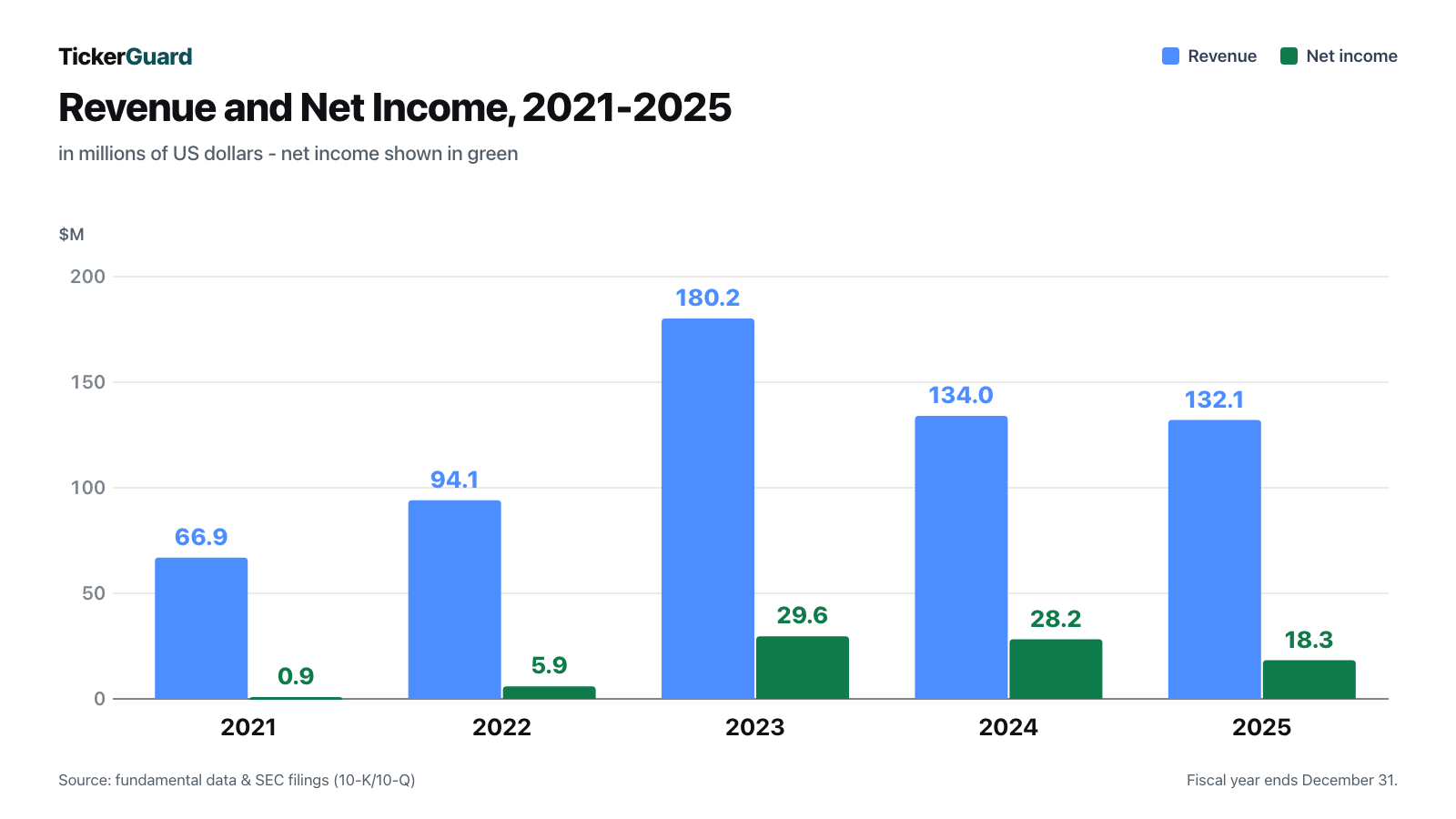
If you only look at the revenue line, you see a decline from $180.2 million (2023) to $132.1 million (2025) and think of a shrinking business. That's the wrong read. The 2023 spike came almost entirely from a single line item: construction revenue in the Services segment, which hit $77.3 million in 2023 — large, one-time build projects such as the new Bahamas plants and the design phase of the Hawaii project. Construction revenue is inherently lumpy, not a steady stream. The second chart shows what happened alongside it, in the same segment:
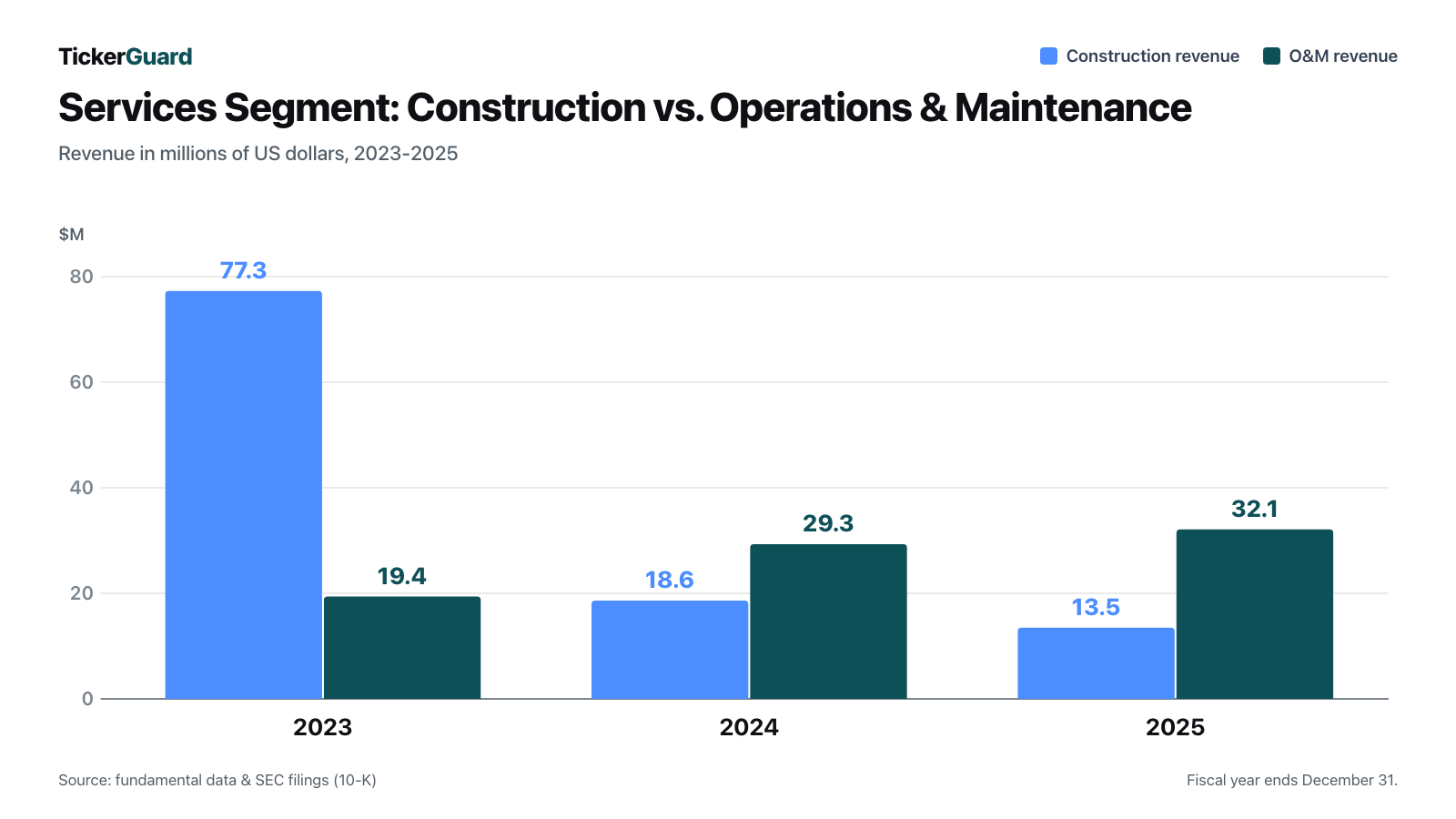
Remember this picture: the recurring part of the business is growing while the one-time construction share fades back down. That's exactly why net income stayed positive in every one of the five years — $18.3 million in 2025, after $28.2 million in 2024 (of which $10.4 million came from the Mexico land sale, more on that below) and $29.6 million in 2023. In the first half of 2026, Consolidated Water earned $7.7 million in net income on $62.8 million in revenue — down from $9.9 million on $67.3 million in the prior-year half. The decline stems mainly from the Manufacturing segment, whose order flow is lumpy; within Services, recurring operations-and-maintenance revenue shrank as operating contracts at subsidiary PERC in California expired, while construction revenue grew. Bulk also grew in the first half, while Retail slipped slightly on a 6.3 percent decline in water volume sold.
What management promised — and what actually happened
Consolidated Water has held public earnings calls for every quarter for years; we reviewed the five most recently available transcripts — from August 15, 2024 through August 11, 2026 — paying particular attention to the Q&A, since that's usually where more candor shows up than in the prepared remarks. The most revealing thread involves the Hawaii project, and it traces a timeline that slipped, step by step:
- August 2024: Management expects to move into "full construction" still "later next year" — that is, late 2025.
- November 2025: "Late 2025" has become "early next year." A single approval — the archaeological and historic-preservation permit — is described as the "key permit" and is said to be "in final review."
- March 2026 (full-year 2025 report): The first open admission: Services revenue fell short "entirely due to a permitting delay." By this point, the plant design is 100 percent complete — construction still isn't allowed.
- May 2026: The company still "cannot provide a firm construction start date."
- August 2026: Pressed by an analyst, CEO Frederick McTaggart clarifies that the archaeological permit is "not the last" approval needed, but a prerequisite for several others — he calls it a "painfully long" process.
In his own words during the Q&A on August 11, 2026, responding to a direct question from a ROTH Capital analyst about whether the archaeological permit was really the last hurdle:
"Just to clarify, it's not the last permit. […] So we're discussing ways to proceed with the applications with — on some of the other permits we need with the blessing of the archeological regulator. So, yes, I mean, it's definitely not the last one we need, but it is — we have to have that as a prerequisite for some other permits."
— Frederick W. McTaggart, CEO, Consolidated Water Co. Ltd., second-quarter 2026 earnings call, August 11, 2026
That answer is more candid than it first sounds guarded: it tells an attentive listener that even if the archaeological permit came through tomorrow, a chain of further approvals would still follow, including from the local drinking-water authority. The "Limited Notice to Proceed" announced in July 2026 is therefore exactly what its name says: a limited clearance to order materials — not a starting gun. In fairness: the company has delivered real, verifiable milestones — the pilot program and the completed plant design — and it isn't management dragging its feet on the permit; it's a chain of agencies outside its control. But anyone who assumes from the resolved Cayman license that Hawaii will resolve just as smoothly is transferring an experience from one institution (Cayman regulator OfReg) to a completely different one (several U.S. state and municipal agencies in Honolulu) — a leap the facts don't support so far. Reviewed honestly across two years of transcripts: no statement has actually predicted the construction start.
What the filings reveal — the uncomfortable truths
Uncomfortable truth No. 1: Cayman Water went eight years without a formally renewed license
Consolidated Water's core business — selling drinking water to households in Grand Cayman — rests entirely on a license the Cayman government granted in 1990. That license was originally set to expire in 2010, was extended several times — and the last express extension expired on January 31, 2018. From that day until February 18, 2025, the company kept operating under the old terms without a formal renewal in place — seven years in limbo. Only on February 18, 2025 did Cayman Water receive an interim concession maintaining the old terms while a new license was negotiated. And only on June 18, 2026 — more than eight years after the last extension expired — did regulator OfReg announce that its board had approved a new, 25-year license:
"The License establishes a long-term regulatory framework for Cayman Water's retail water operations in the License Area following an extended period of uncertainty and negotiations with OfReg."
— Consolidated Water Co. Ltd., Form 8-K filed June 24, 2026, Item 1.01
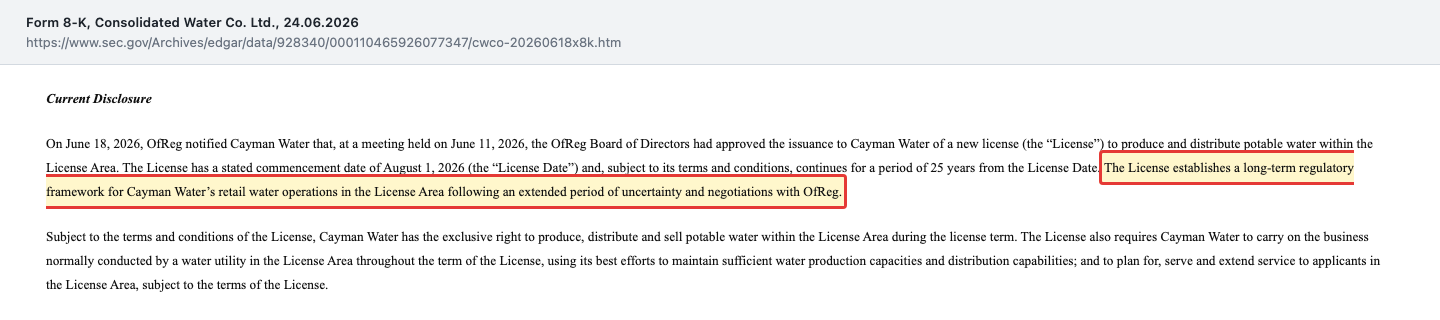
What the new license actually sets: fixed base rates (about CI$16.23 per 1,000 gallons for the first 3,000 gallons of residential use, roughly $19.48 at the exchange rate of $1.20 per Cayman dollar fixed since 1974), an annual price adjustment every July 1, an energy-cost pass-through with an efficiency mechanism — and a requirement that the license isn't renewed automatically but must be re-applied for no earlier than 36 and no later than 24 months before expiration. The upside outweighs the rest: for the next 25 years, Consolidated Water now has a clear, written framework for what has been its single most important business. The uncomfortable part: that very core business ran for eight years on a foundation that was explicitly only "negotiated, not renewed" — and the license can be revoked for certain violations, potentially forcing a transfer of the plants to the government. That a government permit can vanish again even after a years-long fight to obtain it is exactly what our analysis of DPM Metals shows, whose environmental license for a mine in Ecuador was revoked again just four months after it was granted — a reminder that "granted" isn't the same as "permanently safe."
Uncomfortable truth No. 2: nearly two-thirds of the Bahamas receivables are classified as delinquent
The Bulk segment — a quarter of consolidated revenue — delivers large volumes of water to government customers, the most important being the Bahamas' Water and Sewerage Corporation (WSC). The quarterly report for the period ended June 30, 2026 contains a number worth pausing on:
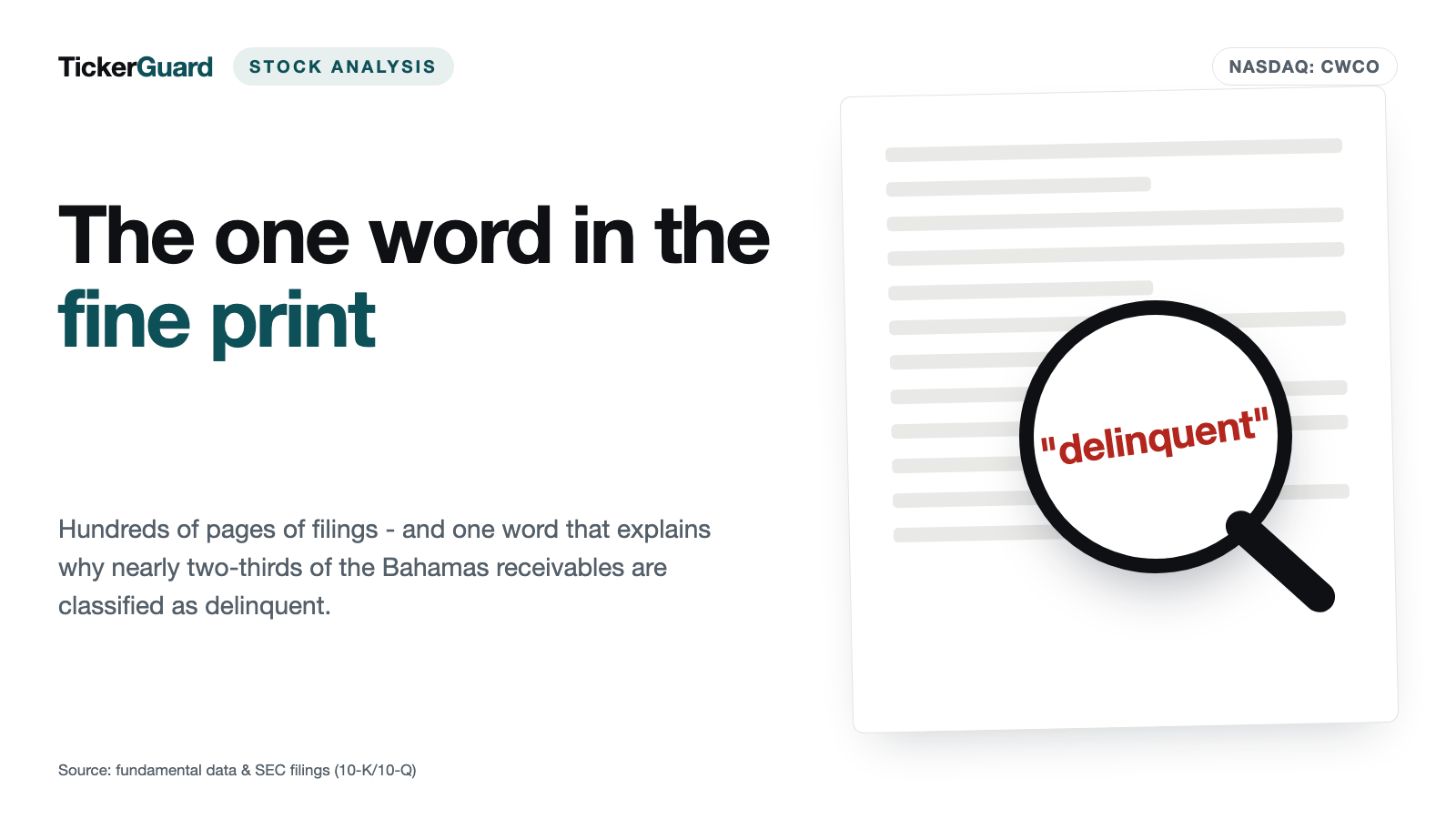
"CW-Bahamas' accounts receivable balances (which include accrued interest) due from the WSC amounted to $18.8 million and $20.7 million as of June 30, 2026 and December 31, 2025, respectively. Approximately 64% and 71% of the accounts receivable balances were delinquent as of those dates, respectively."
— Consolidated Water Co. Ltd., Form 10-Q for the period ended June 30, 2026
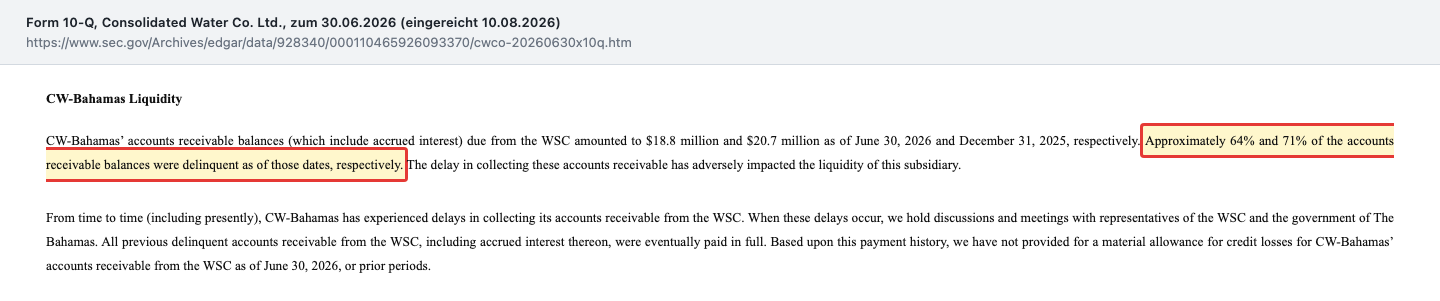
Picture it this way: imagine a contractor whose biggest client routinely pays months late — but, every single time, eventually pays in full. That's essentially Consolidated Water's track record: the filing notes that "all previous delinquent accounts receivable from the WSC … were eventually paid in full," and points to an April 2026 Moody's upgrade of the Bahamas (to Ba3 from B1) as further comfort. That's why the company records no material allowance for credit losses on these receivables. Still, the same report contains a sentence worth not skimming past: "The delay in collecting these accounts receivable has adversely impacted the liquidity of this subsidiary" — the company's own words. A track record of "the customer eventually pays" is not the same thing as proof it will happen again next time — especially when the customer is a single foreign government-owned utility, and the supply contracts (for example, the Blue Hills plant, running through 2032) obligate the company to guaranteed minimum delivery volumes regardless of whether it gets paid on time.
Uncomfortable truth No. 3: a 100-million-gallon megaproject already failed once — on the exact same pattern
The Hawaii project isn't the first time Consolidated Water has waited on a foreign government. In 2016, Mexican subsidiary AdR (Aguas de Rosarito) signed a contract with the Baja California water authority and the city of Tijuana to build a giant desalination plant — 100 million gallons per day of capacity, more than 50 times the size of the Hawaii project. Four years later, the project was history:
"In June 2020, the Director General of CEA and the Director General of CESPT terminated the APP Contract."
— Consolidated Water Co. Ltd., Form 10-K for fiscal year 2025
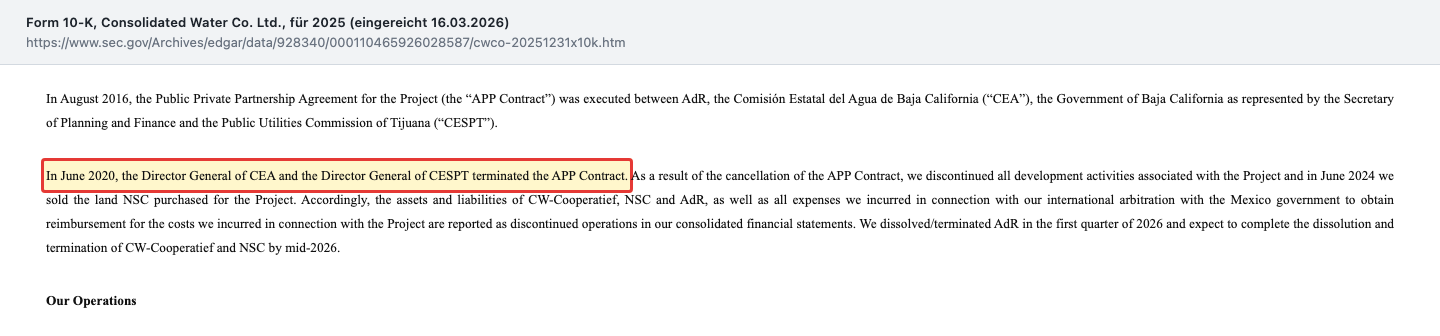
The termination was followed by years of international arbitration, through which Consolidated Water tried to recover its costs. A partial win came only in 2024: in June, subsidiary NSC sold the land parcel (20.1 hectares) purchased for the plant to a government trust for 596,144,000 Mexican pesos, roughly $32.0 million, plus 20 million pesos for design documents transferred to the government. That amount explains a good part of the unusually high 2024 net income ($28.2 million): the discontinued Mexico operations alone contributed roughly $10.4 million to 2024 earnings — without that one-time gain, 2024 would have landed much closer to 2025. The Mexican subsidiaries are now being wound down: AdR was dissolved in the first quarter of 2026, with CW-Cooperatief and NSC expected to follow by mid-2026. For sizing up the Hawaii project, the lesson is this: Consolidated Water has already spent four years developing a megaproject that a foreign government ultimately canceled outright — not for technical reasons, but because of a political decision outside the company's control.
Uncomfortable truth No. 4: even the company's own press release admits nobody knows the Hawaii start date
On July 22, 2026, Consolidated Water announced two pieces of good news in a single press release — the "Limited Notice to Proceed" for Hawaii and a record order from Florida. Buried in that upbeat announcement is a sentence that describes the actual situation more plainly than any earnings call:
"While the commencement date of construction has still not been established due to permitting delays that are outside the control of both Consolidated Water and the Board of Water Supply, the authorization of early procurement of long-lead equipment clearly demonstrates the Board of Water Supply's continued commitment […]"
— Consolidated Water Co. Ltd., Form 8-K filed July 22, 2026, Exhibit 99.1
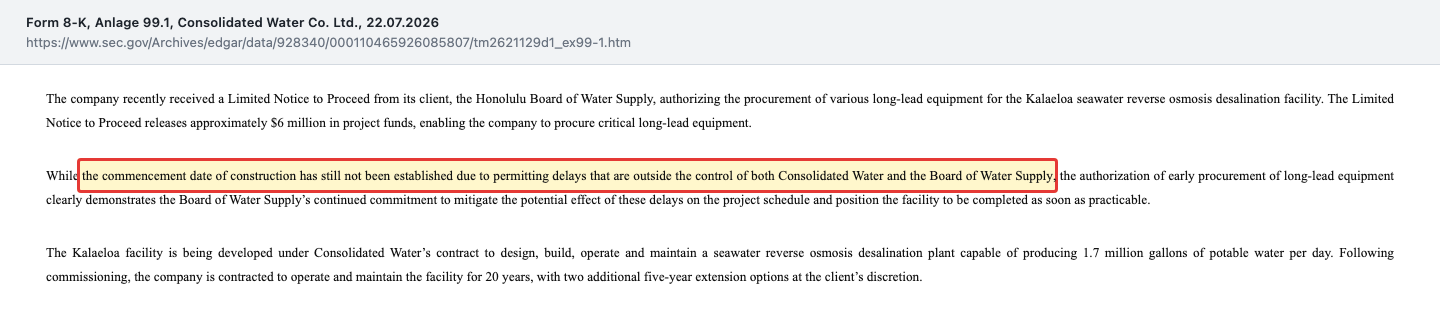
The Hawaii project has an estimated total value of roughly $204 million and, once complete, would give Consolidated Water 20 years of predictable additional operations-and-maintenance revenue — with two five-year extension options. The design is complete, the pilot program finished successfully, and the customer (the Honolulu Board of Water Supply) shows, in the company's own words, "continued commitment." But the sentence from the company's own press release is unambiguous: nobody — not the company, not the customer — can say today when construction will start. For a company whose construction revenue has already fallen from $77.3 million to $13.5 million, Hawaii is by far the largest single revenue driver of the coming years — and the least predictable.
Valuation
How expensive is Consolidated Water? At a closing price of $30.04 on August 26, 2026 and 16,012,865 shares outstanding (per the 10-Q cover page, as of August 5, 2026), the market cap works out to roughly $481 million. Measured against trailing-twelve-month earnings, the price-to-earnings ratio sits around 29-30 — a noticeable premium for a water utility with a regional monopoly business compared with classic, low-growth utilities, though not unusual for a company that also runs a higher-margin construction and equipment business on the side. The price-to-sales ratio is roughly 3.8, and enterprise value to EBITDA sits around 13. The stock pays a dividend yielding roughly 1.9 percent (as of August 27, 2026) — not the stock's defining feature, but evidence of the stable cash position. For context on how far the stock has run: it traded at $9.01 in February 2022, climbed to a high of $39.12 by January 2026 — a gain of roughly 334 percent — and has since given back nearly a quarter from that high. Much of that rise lines up in time with the resolution of the two big overhangs: the 2024 Mexico settlement and the prospect of the new Cayman license in 2025-2026. In other words, the current price already prices in a good deal of the "good news" — while the open Hawaii question has yet to find its own answer reflected in the stock.
Opportunities and risks at a glance
What speaks for Consolidated Water:
- An essentially debt-free balance sheet: $132.6 million in cash against roughly $16,000 in actual financial debt as of June 30, 2026, plus $225.6 million in stockholders' equity and $144.6 million in working capital.
- A regional utility monopoly (Retail, 26 percent of revenue) with pricing and terms now fixed in writing for 25 years — after eight years of regulatory uncertainty.
- Growing recurring revenue: operations-and-maintenance revenue in the Services segment rose from $19.4 million (2023) to $32.1 million (2025), up 66 percent, while volatile construction revenue faded.
- A record order from Florida (roughly $10.1 million, July 2026) and a new operating contract in Southern California (roughly $4.5 million over three years) show new business outside Hawaii is still coming in.
- Every one of the past five fiscal years (2021-2025) closed with positive net income, despite sharply swinging construction revenue.
What speaks against it:
- By far the largest growth project — the roughly $204 million Hawaii plant — still has no visible construction start, per the company's own July 22, 2026 press release; the past two years of earnings calls show a timeline that kept slipping.
- Roughly 64 percent of the Bahamas subsidiary's receivables from its most important customer, government-owned utility WSC, were classified as delinquent as of June 30, 2026 ($18.8 million total); the company itself describes an "adverse" liquidity effect.
- A comparable megaproject in Mexico (100 million gallons per day of capacity) was canceled outright by the government there in 2020 — a precedent for political project risk on large foreign contracts.
- Consolidated revenue has fallen from its 2023 peak of $180.2 million to $132.1 million (2025); without new megaprojects, growth stays dependent on the existing recurring business.
- The stock has already more than tripled from its 2022 low (at its January 2026 high it was up 4.3x); a portion of the good news (Cayman license, Mexico settlement) is likely already reflected in the current price of around $30.
A human bottom line
Back to the patience trap from the opening. Its lesson isn't that patience is a bad quality — quite the opposite: anyone who bought Consolidated Water in 2018 or 2022 and sat through the Cayman-license standoff was ultimately rewarded. The lesson is that one resolved wait is no guarantee for the next. The Cayman license depended on a single, domestic regulator the company has worked with for decades. The Hawaii project depends on a chain of U.S. agencies far less familiar with the company — and the Mexico project shows that a political "no" after years of preparation can genuinely happen, not just in theory. What speaks for Consolidated Water isn't the hope for Hawaii, but what's already throwing off cash today: a regional water-utility monopoly with a freshly secured 25-year contract, a growing recurring operating business, and a balance sheet with no meaningful debt. So the honest question for you isn't "has this company solved its problems before?" — the answer is yes — but rather: are you willing to pay for a promise whose timing even the company itself doesn't know, just because a different, similar promise eventually got kept? What you make of it is your decision. And that is exactly as it should be.
Sources
All original documents used in this analysis — for you to read yourself:
- Consolidated Water Co. Ltd. — Form 10-Q for the period ended June 30, 2026 (filed August 10, 2026)
- Consolidated Water Co. Ltd. — Form 8-K filed August 10, 2026 with the earnings release (Exhibit 99.1)
- Consolidated Water Co. Ltd. — Form 10-K for fiscal year 2025 (filed March 16, 2026)
- Consolidated Water Co. Ltd. — Form 8-K filed June 24, 2026 (new Cayman water license)
- Consolidated Water Co. Ltd. — Form 8-K filed July 22, 2026, Exhibit 99.1 (Hawaii project, Florida orders)
- Complete SEC filing history: EDGAR company page (sec.gov)
- Five public quarterly earnings calls (August 15, 2024; November 6, 2025 [Q3 2025]; March 17, 2026 [full-year 2025]; May 12, 2026 [Q1 2026]; August 11, 2026 [Q2 2026]) — transcripts fully reviewed, quotes verbatim.
- Fundamental data (metrics, price history, valuation; as of August 27, 2026), cross-checked against the SEC filings.
Transparency & disclaimer: This analysis is a journalistic contextualization of publicly available information and is not investment advice, not a regulated financial analysis, and not a solicitation to buy or sell any security. Stock investments carry substantial risk, including total loss. All figures are provided without guarantee; the data's as-of date is noted throughout the text. The author holds no position in Consolidated Water stock as of publication.
Key figures at a glance
All monetary figures in millions of $; earnings per share as reported.
| Metric | 2021 | 2022 | 2023 | 2024 | 2025 |
|---|---|---|---|---|---|
| Revenue | 66.9 | 94.1 | 180.2 | 134.0 | 132.1 |
| Operating Income (EBIT) | 2.0 | 9.3 | 37.2 | 18.3 | 18.3 |
| Net Income | 0.9 | 5.9 | 29.6 | 28.2 | 18.3 |
| Net Margin | 1.3% | 6.2% | 16.4% | 21.1% | 13.9% |
| Earnings Per Share | 0.06 $ | 0.38 $ | 1.86 $ | 1.77 $ | 1.15 $ |
Source: fundamental data & SEC filings (annual and quarterly reports, 10-K/10-Q)
Our Bottom Line at a Glance
- Balance sheet & liquidity positive
- Essentially debt-free: $132.6 million in cash against roughly $16,000 in actual financial debt as of June 30, 2026, $225.6 million in stockholders' equity, $144.6 million in working capital. Five straight years (2021-2025) of positive net income.
- Cayman core business positive
- After eight years of regulatory uncertainty, Cayman Water received a new 25-year water license on June 18, 2026, with fixed pricing and a clear adjustment mechanism — a long-term secured monopoly business (26 percent of 2025 revenue).
- Bahamas receivables negative
- About 64 percent of the $18.8 million owed by government-owned utility WSC was classified as delinquent as of June 30, 2026; the quarterly report itself describes an "adverse" liquidity effect. History shows eventual full payment, but that's no guarantee for the future.
- Hawaii project timing negative
- The single largest project at $204 million still has no visible construction start, per the company's own July 22, 2026 press release; five reviewed earnings calls show a timeline that kept slipping since August 2024.
- Revenue trajectory neutral
- Consolidated revenue fell from $180.2 million (2023) to $132.1 million (2025) as a one-time construction boom faded — recurring operations-and-maintenance revenue grew 66 percent over the same period. Without new megaprojects, growth depends on the existing business.
Consolidated Water is a financially solid water utility and desalination company with an essentially debt-free balance sheet and a core Grand Cayman business that just secured a 25-year foundation. Two operational questions remain open: whether the Bahamas subsidiary keeps reliably collecting its chronically delinquent receivables (64 percent as of June 30, 2026), and whether and when the roughly $204 million Hawaii project actually breaks ground. Not investment advice.
What Our Rating Means
Open questions
The business works in principle, but one material question is open. As long as it stays open, our findings do not carry a quality verdict.
Yellow, because alongside clearly documented financial substance, two material operational questions remain open. Much argues for green: essentially no debt, five straight years of positive earnings, a core license business just re-secured for 25 years, and growing recurring operations revenue (up 66 percent since 2023). Against green: by far the largest growth driver — the Hawaii project — has been stuck in an external permitting chain for over two years and, per the company's own July 22, 2026 press release, still has no construction-start date, and roughly 64 percent of receivables from its most important Bulk customer, WSC, are classified as delinquent. The evidence doesn't support red: there's no sign of going-concern doubt, negative equity, or existential dependency — both open issues are, relative to the company's size, operational risks, not solvency risks. A rich earnings multiple or a stock that has already run up is explicitly not a reason for the yellow rating — that's a pricing argument, not a quality argument.
A journalistic assessment by our editorial team at the time of the deep dive, based on public sources — not investment advice and not a solicitation to buy or sell. Your personal circumstances (investment goals, risk capacity, taxes) cannot be taken into account. What our levels mean, how verdicts are formed, and what conflicts of interest exist →
Worth Noting
- This analysis was prompted by the quarterly report (Form 10-Q) for the period ended June 30, 2026, filed August 10, 2026, shortly after the new Cayman water license (Form 8-K, June 24, 2026) and the "Limited Notice to Proceed" for the Hawaii project (Form 8-K, July 22, 2026).
- Transcripts of five public earnings calls are available (August 15, 2024 through August 11, 2026); they were fully reviewed, with particular attention to the Q&A. An automated re-sync for 2026 returned no additional transcripts beyond the existing set.
- Possible mix-up: Consolidated Water Co. Ltd. was named "Cayman Water Co Ltd" until 1997 — older sources under that name refer to the same company (CIK 0000928340). Price, market-cap, and valuation figures are as of August 26-27, 2026; every other figure carries its own filing date.
Stock Watch
This analysis is as of August 28, 2026. Stock Watch will tell you what's changed at CWCO since then.
Later $1 a month per stock — signing up is free, and you'll be the first to know when it launches.
The full analysis as a PDF for later
We will send you this analysis as a PDF — to print, file away, and read at your own pace. And we will add you to the free Stock Watch list for Consolidated Water Co Ltd (CWCO), so you hear about it when something material in this analysis changes.
Frequently Asked Questions
Consolidated Water Co. Ltd. (NASDAQ: CWCO) builds and operates seawater desalination plants and water utility systems in the Cayman Islands, the Bahamas, the British Virgin Islands, and the United States. Four segments split 2025 revenue ($132.1 million): Retail (water sold directly to end customers in Grand Cayman, 26 percent), Bulk (large-volume supply to government utilities, 25 percent), Services (building and operating plants for third parties, 35 percent), and Manufacturing (equipment via subsidiary Aerex, 14 percent).
The last express extension of the license granted in 1990 expired on January 31, 2018. The company kept operating without a formal renewal until February 18, 2025, when an interim concession followed. Only on June 18, 2026 did regulator OfReg approve a new 25-year license — in its own words, following "an extended period of uncertainty." The core Retail business (26 percent of revenue) ran for eight years on a contract that was never formally renewed.
As of June 30, 2026, government-owned utility WSC owed Bahamas subsidiary CW-Bahamas $18.8 million, of which roughly 64 percent was classified as delinquent (71 percent as of December 31, 2025). Historically, all delinquent receivables were eventually paid in full, which is why no material allowance for credit losses is recorded — but the quarterly report itself describes an "adverse" effect on the subsidiary's liquidity.
The roughly $204 million project in Kalaeloa, Hawaii (1.7 million gallons per day for the Honolulu Board of Water Supply) is fully designed and has completed a successful pilot phase. Construction still has no firm start date: an archaeological permit has blocked further required approvals since late 2025. In July 2026, the company received a "Limited Notice to Proceed" for roughly $6 million in equipment procurement — not a construction start.
Revenue in 2023 ($180.2 million) included unusually high, one-time construction revenue of $77.3 million tied to large Bahamas and Hawaii build projects. That figure fell to $13.5 million by 2025, while recurring operations-and-maintenance revenue in the same segment grew from $19.4 million to $32.1 million (up 66 percent). Total 2025 revenue was $132.1 million.
Yes, Consolidated Water has paid a dividend for years, most recently yielding roughly 1.9 percent (as of August 27, 2026). Debt is essentially nonexistent: as of June 30, 2026, $132.6 million in cash sat against roughly $16,000 in actual financial debt, with $225.6 million in stockholders' equity.
Found an error?
Did you spot a factual error, an outdated number, or a typo in this deep dive? Let us know briefly — your report goes straight to the editorial team.