Chain Bridge Bancorp: On one Tuesday in April this bank lost a third of its deposits — and stayed pristine
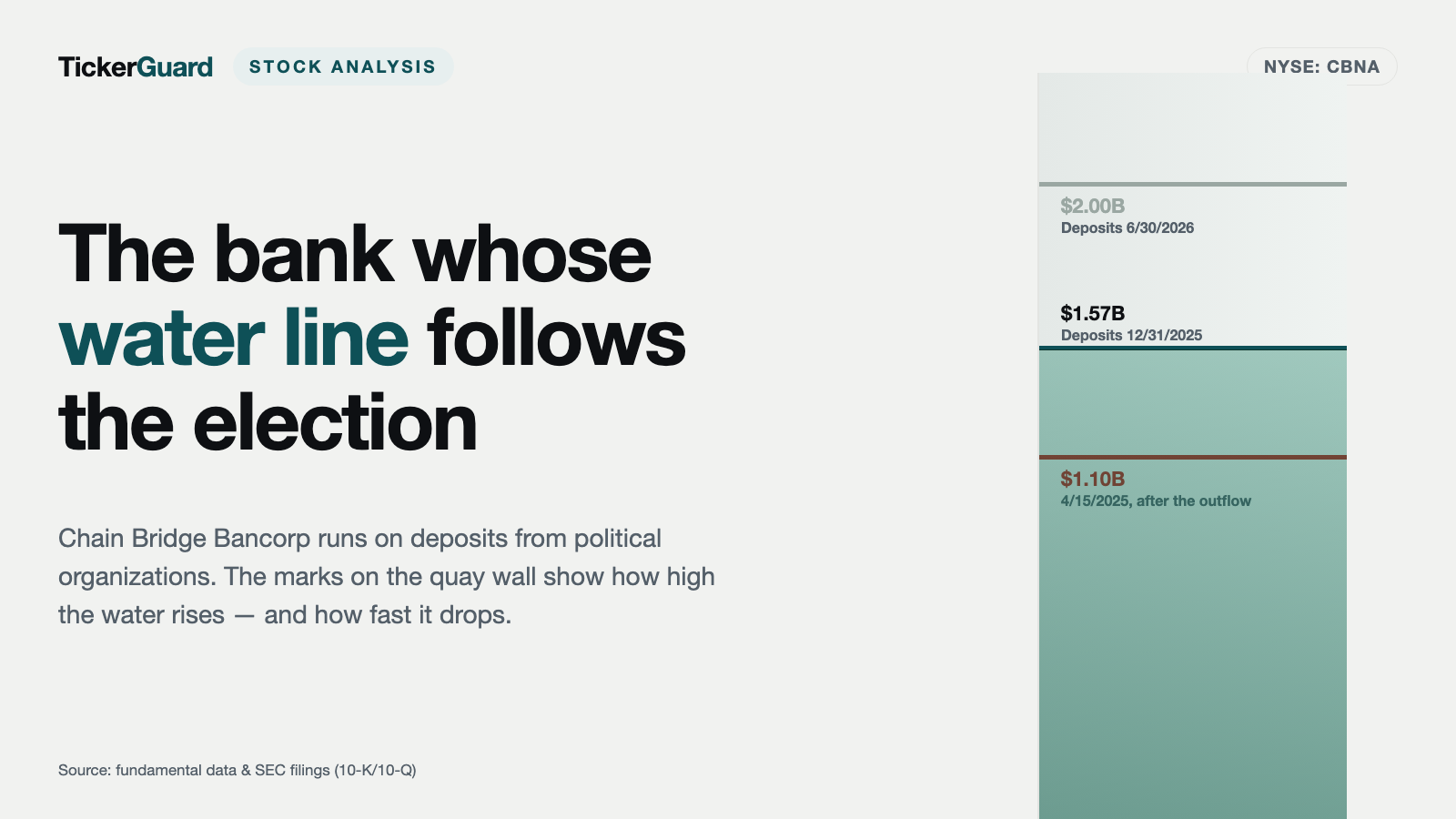
On every credit metric Chain Bridge Bancorp looks like a straight-A student: no non-performing assets since June 2012, a Tier 1 risk-based capital ratio of 49.46 percent as of June 30, 2026, a liquidity ratio of 94.03 percent. Only this bank barely lends — it safekeeps money. And much of that money belongs to political organizations: by its own annual report, Chain Bridge has been the depository bank for every Republican presidential nominee since the 2008 federal election cycle. On April 15, 2025, six accounts pulled $506.5 million in a single day and deposits fell from $1.57 billion to roughly $1.10 billion. As of June 30, 2026, 80.8 percent of deposits carried no federal insurance. Let us read what a bank looks like when its balance sheet breathes with the election calendar.
 Thomas Mücke
Founder & Publisher
Thomas Mücke
Founder & Publisher
As of Today
As of: October 9, 2026
- Closing price
- 49.30 $ -0.70%
- Market Capitalisation
- 0.3 $B
- Growth Score
- 8/10
- AAQS
- 6/10
Price change since August 26, 2026: +8.8%
This analysis has a cut-off date. The Stock Guard tells you when something material changes in the numbers. Reserve your free spot
Chart
Interactive price chart (TradingView).
52-week range: 29.10 $ to 49.60 $ · Last price: 49.30 $ (As of: October 9, 2026)
Note: pure fact-based analysis, not investment advice and not a solicitation to buy or sell. All figures without guarantee.
There is an investing trap that catches the diligent — the straight-A fallacy. It works like this: you check a company metric by metric, and every single one is spotless. No bad loans. No loss year. Capital ratios three times the regulatory minimum. After the fifth perfect number your brain flips a switch: anything this clean cannot have a problem. And that is precisely the moment you stop asking the one question that always comes first with a bank: whose money is it working with? Chain Bridge Bancorp, Inc. (NYSE: CBNA) of McLean, Virginia is the perfect test case. The bank has not reported a single non-performing asset since June 2012, has not charged off a loan since the third quarter of 2017, and reported a Tier 1 risk-based capital ratio of 49.46 percent as of June 30, 2026 — the regulatory threshold is 6. And on Tuesday, April 15, 2025, it lost $506.5 million of deposits in one day. So here is the deal: we read together what this bank told the U.S. securities regulator, the SEC — the annual report (10-K) for 2025, the quarterly report (10-Q) as of June 30, 2026, the IPO prospectus (424B4) from 2024 and eight earnings releases. The conclusion is yours.
What Chain Bridge Bancorp actually does — a bank without branches
Chain Bridge Bancorp is a Delaware corporation with exactly one holding: Chain Bridge Bank, N.A. The bank commenced operations on August 6, 2007 after the Office of the Comptroller of the Currency granted charter no. 24755. It is a member of the FDIC and has held full fiduciary powers since March 5, 2020; the trust and wealth business went live on September 18, 2020.
The unusual part sits in a subordinate clause of the 2025 annual report: the bank operates no branch network. In-person banking happens only at the McLean headquarters, in the Washington, D.C. metropolitan area. Everything else is digital. As of December 31, 2025 the company employed 92 full-time equivalents — and served deposit clients in 49 U.S. states, the District of Columbia and Puerto Rico. Of total deposits, 37.2 percent came from the District of Columbia and 24.6 percent from Virginia.
To understand the client base you have to read the election calendar. Chain Bridge serves political organizations: campaign committees, national, state and local party committees, corporate and trade association political action committees (PACs), Super PACs, Leadership PACs, joint fundraising committees and presidential inaugural committees. Add the vendors of that industry — advertising, polling, consulting — and social welfare organizations under Section 501(c)(4) of the Internal Revenue Code. As of December 31, 2025, roughly 87 percent of all deposits came from commercial entities, and 95.3 percent sat in transaction accounts, meaning day-to-day payment accounts.
And now the sentence that explains everything, written by the bank into its own risk factors:
“We have been the depository bank for every Republican presidential nominee since the 2008 federal election cycle, and substantially all of our political organization deposits, come from entities affiliated with the Republican Party.”
— Chain Bridge Bancorp, Inc., annual report on Form 10-K for 2025, Risk Factors
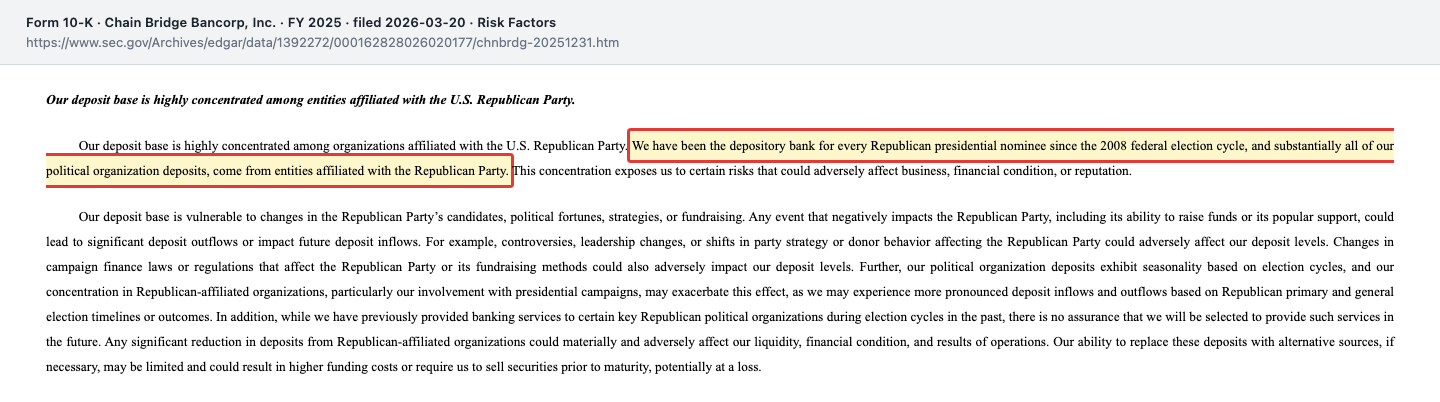
That frames the central tension of this analysis, and it runs through every chapter below: on the asset side Chain Bridge may be the most conservative bank you have ever seen. On the liability side it is one of the most concentrated.
Company history for investors
-
2007
The bank opens for business
On August 6, 2007 Chain Bridge Bank, N.A. begins operations under charter no. 24755 from the Office of the Comptroller of the Currency. Book value per share ends the year at $5.36.
-
2020
The trust business is added
The OCC grants full fiduciary powers on March 5, 2020, and the trust and wealth department goes live on September 18 — a second earnings source alongside net interest income.
-
2024
IPO at $22.00 per share
Trading begins on the NYSE on October 4, 2024. Net proceeds of roughly $33.6 million partly fund repayment of the $10.0 million credit line on October 10, 2024.
-
2025
One day costs $506.5 million
On April 15, 2025 six political organization accounts withdraw $506.5 million and deposits fall to roughly $1.1 billion. Not one security has to be sold — the first real stress test is passed.
-
2025
Added to the Russell 3000
FTSE Russell adds the stock to the Russell 3000 and other indices as of June 30, 2025. For a very thinly traded share that means structural index-fund demand for the first time.
-
2026
Record half-year before the midterms
The bank earns $16.6 million in the first half of 2026 — more than in all of 2023. Deposits reach $2.0 billion and three clients again each hold more than 5 percent.
How this stock landed on our desk
Through the IPO. On October 3, 2024 Chain Bridge Bancorp priced 1,850,000 Class A shares at $22.00; trading began on the New York Stock Exchange the next day under the ticker CBNA. The third-quarter 2024 earnings release puts net proceeds at roughly $33.6 million; with partial exercise of the underwriters' over-allotment option the deal grew to 1,992,897 shares and about $36.5 million. On October 10, 2024 the company used part of that to repay in full the $10.0 million drawn on its unsecured line of credit with a correspondent bank.
Why that stood out was said by chairman Peter G. Fitzgerald himself in the fourth-quarter 2024 earnings release: it was “the first by a U.S. banking institution in over two years”. Between the regional-bank failures of spring 2023 and October 2024, no American bank had dared to list. The second public marker came on June 30, 2025, when FTSE Russell added the company to the Russell 3000 and other indices in its annual reconstitution. Both are calendar events, not investment arguments — but they explain why an institution with 92 employees ends up on a research list at all.
If you want comparisons, we have covered two very different banks already: Pathward Financial also lives off cheap deposits rather than lending, and Carter Bankshares shows what happens when a regional bank hangs on a single borrower. Chain Bridge is the case where the cluster risk sits not in the loan book but in the funding.
The numbers over the years — given their due
First what genuinely impresses. Net income has compounded over five years in a range that is remarkable for a bank this size: $7.0 million (2021), $8.3 million (2022), $8.8 million (2023), $20.9 million (2024) and $20.2 million (2025). The figures for 2021 through 2023 come from the IPO prospectus (Form 424B4) filed October 7, 2024 — before the listing there were no quarterly reports, so the prospectus is the only audited source for those years. Per share, restated to today's share count, that is $1.77, $1.91, $1.93, $4.17 and $3.08. The first half of 2026 added $16.6 million, or $2.53 per share — more than the whole of 2023.
Return on average equity — profit measured against shareholders' capital — jumped from 10.18 percent (2021) and 11.90 percent (2023) to 20.05 percent in the 2024 election year, fell back to 12.88 percent in 2025, and stood at an annualized 21.20 percent in the second quarter of 2026. Book value per share climbed from $21.98 (December 31, 2024) through $25.79 (December 31, 2025) to $27.99 as of June 30, 2026. Because the bank carries neither goodwill nor other intangibles, that book value is also the tangible book value — an important distinction for banks, since goodwill is the first thing written off in a crisis and supports nothing afterwards.
And then the chart that explains the business model at a glance:
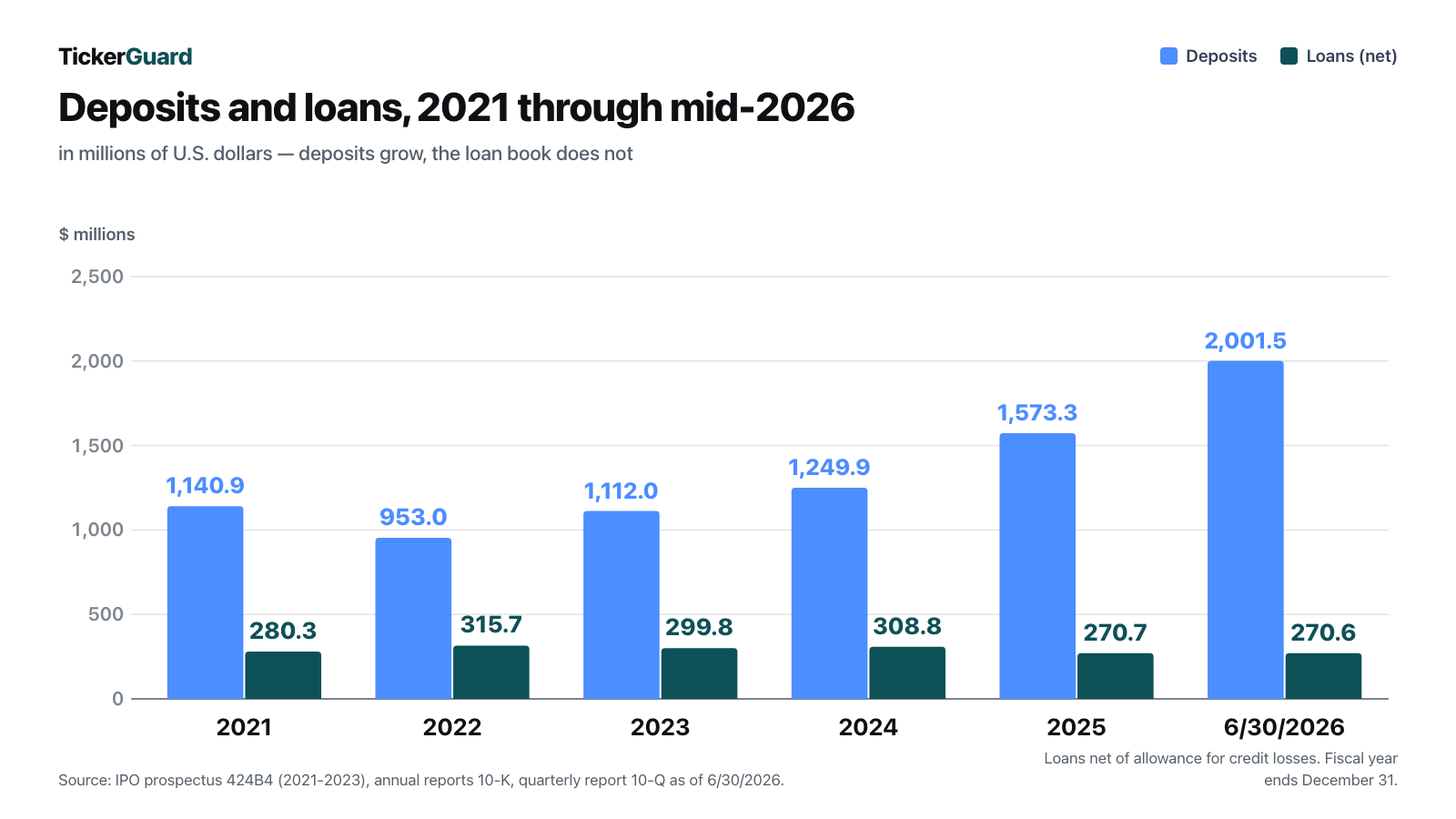
This is not a normal bank. As of June 30, 2026, $2,001.5 million in deposits faced only $270.6 million in loans — a loan-to-deposit ratio of 13.70 percent (December 31, 2025: 17.46 percent; June 30, 2025: 22.45 percent). For context, a typical U.S. regional bank runs at 70 to 90 percent. Where is the rest? $812.7 million in interest-bearing reserves at the Federal Reserve and $1,066.6 million in securities, of which $731.1 million are U.S. Treasuries. Chain Bridge is therefore less a lender than a money custodian with interest income: it takes deposits, invests them short and high-grade, and lives off the spread.
That spread is unusually wide because the deposits cost almost nothing. As of December 31, 2025, $1,254.7 million of $1,573.3 million — 79.8 percent — sat in noninterest-bearing accounts. In the second quarter of 2026 the average balance of those noninterest-bearing deposits was $1,536.3 million at a rate of 0.00 percent; across all funding the bank paid 0.14 percent. A quick word on that metric: an average is everything added up and spread evenly — here the balance smoothed across the quarter rather than a single reporting date; one very large inflow or outflow shifts it noticeably. The net interest margin — net interest income measured against interest-earning assets — was 3.45 percent in the second quarter of 2026 (prior quarter 3.41, year-ago quarter 3.39). The efficiency ratio, the share of costs in revenue, fell to 40.25 percent from 56.71 percent in the second quarter of 2025 — lower is better, and anything below 50 percent counts as very good in this industry.
Credit quality is the kind of number you read twice. The investor presentation of November 5, 2025 records: no non-performing assets since June 2012, no loan charge-off since the third quarter of 2017, and a total of $265,000 in net charge-offs since the bank opened in 2007. As of June 30, 2026 non-performing assets stood at 0.00 percent of total assets and the allowance for credit losses at 1.35 percent of gross loans. Capital and liquidity match: Tier 1 leverage 9.39 percent, Tier 1 risk-based capital 49.46 percent, total risk-based capital 50.45 percent, liquidity ratio 94.03 percent. Hold on to the image: the asset side of this bank is a vault. Which is exactly why the liability side deserves a closer look.
What management promised — and what came of it
A disclosure first, because honesty demands it: Chain Bridge Bancorp does not hold earnings calls. Not one of the eight earnings releases since the third quarter of 2024, no annual or quarterly report, and neither investor presentation mentions a conference call or webcast. There are therefore no earnings-call transcripts for this company — and no question-and-answer session in which an executive comes under pressure. What we can evaluate instead are the chairman's written comments in the earnings releases, the two investor presentations of September 3 and November 5, 2025, and the disclosures in the mandatory filings.
And there it gets interesting, because those comments tell a story in three acts. Act one, January 2025, fourth-quarter 2024 release: Peter G. Fitzgerald celebrates the listing as “the first by a U.S. banking institution in over two years” and writes that the milestone reflects “our focus on liquidity, asset quality, and financial strength”.
Act two, April 2025. The first-quarter 2025 comment contains the single most remarkable sentence of this entire research run:
“A substantial portion of these deposits flowed out shortly after quarter-end, a possibility management considered in determining the Company's asset allocation during the quarter.”
— Peter G. Fitzgerald, chairman, first-quarter 2025 earnings release, current report on Form 8-K filed April 28, 2025, exhibit 99.1
In plain English: management took in $472 million and deliberately did not invest it long, because it expected the money to leave again. It sat in Federal Reserve balances and short-dated Treasuries that matured within the same quarter. When $506.5 million actually left on April 15, 2025, not a single security had to be sold at a loss. That is the difference between a bank that knows its risk and one that did not in 2023. Promised: liquidity first. Delivered: liquidity first.
Act three, October 2025, third-quarter comment: Fitzgerald soberly lists capital and liquidity ratios and notes that deposit activity was “consistent with historical patterns for a non-election year”. And then something happens that you only notice with all the releases side by side: from the fourth-quarter 2025 release of January 28, 2026 onward there is no management comment at all — not in January 2026, not in April 2026, not in July 2026. Three consecutive quarters present the numbers without a single word from the leadership. Those three quarters happened to be the best in the company's history. We do not know why the quote disappeared — it may be pure housekeeping. But it is the only documented change of tone this company has shown so far, and it falls into the months before the November 2026 midterms.
What the investor presentations add: they show book value per share in an unbroken series from $5.36 at year-end 2007 to $24.86 as of September 30, 2025, and quarterly deposits since 2015 as a clearly visible wave, peaking in the quarter before each presidential or midterm election. In other words, the company explains its seasonality openly — it does not hide it.
What the filings say — the uncomfortable truths
Uncomfortable truth no. 1: one day cost a third of the deposits. As of March 31, 2025, three political accounts each held more than 5 percent of total deposits; together they came to $472.0 million, or 30.1 percent. The annual report describes what happened next:
“On April 15, 2025, the Company experienced outflows of approximately $506.5 million across six political organization accounts, including the three that exceeded the 5% threshold at March 31, 2025. Following these outflows, total consolidated deposits were $1.1 billion at the close of that day.”
— Chain Bridge Bancorp, Inc., annual report on Form 10-K for 2025, "Political organizations and federal election cycles"
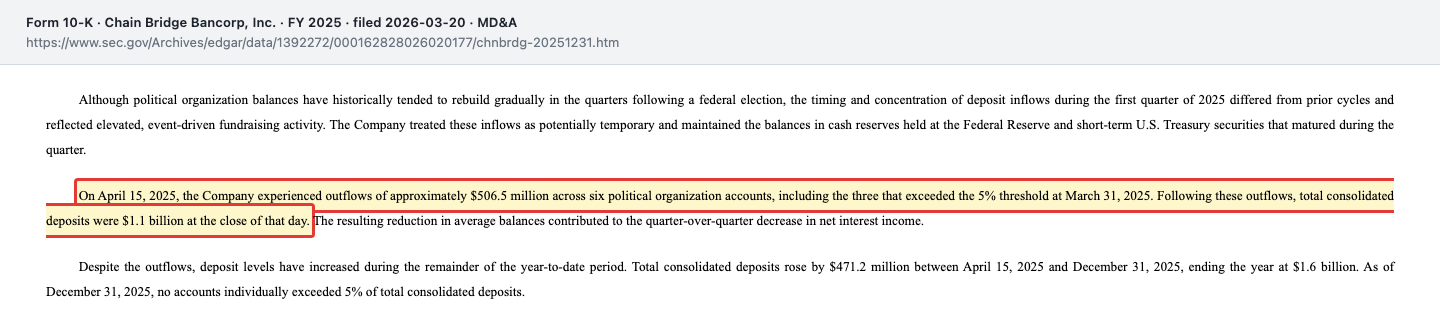
The bank came through without fire sales, without borrowings and without a loss. But the order of magnitude stands: a third of the balance sheet can leave on a business day. Here is how that looks over time.
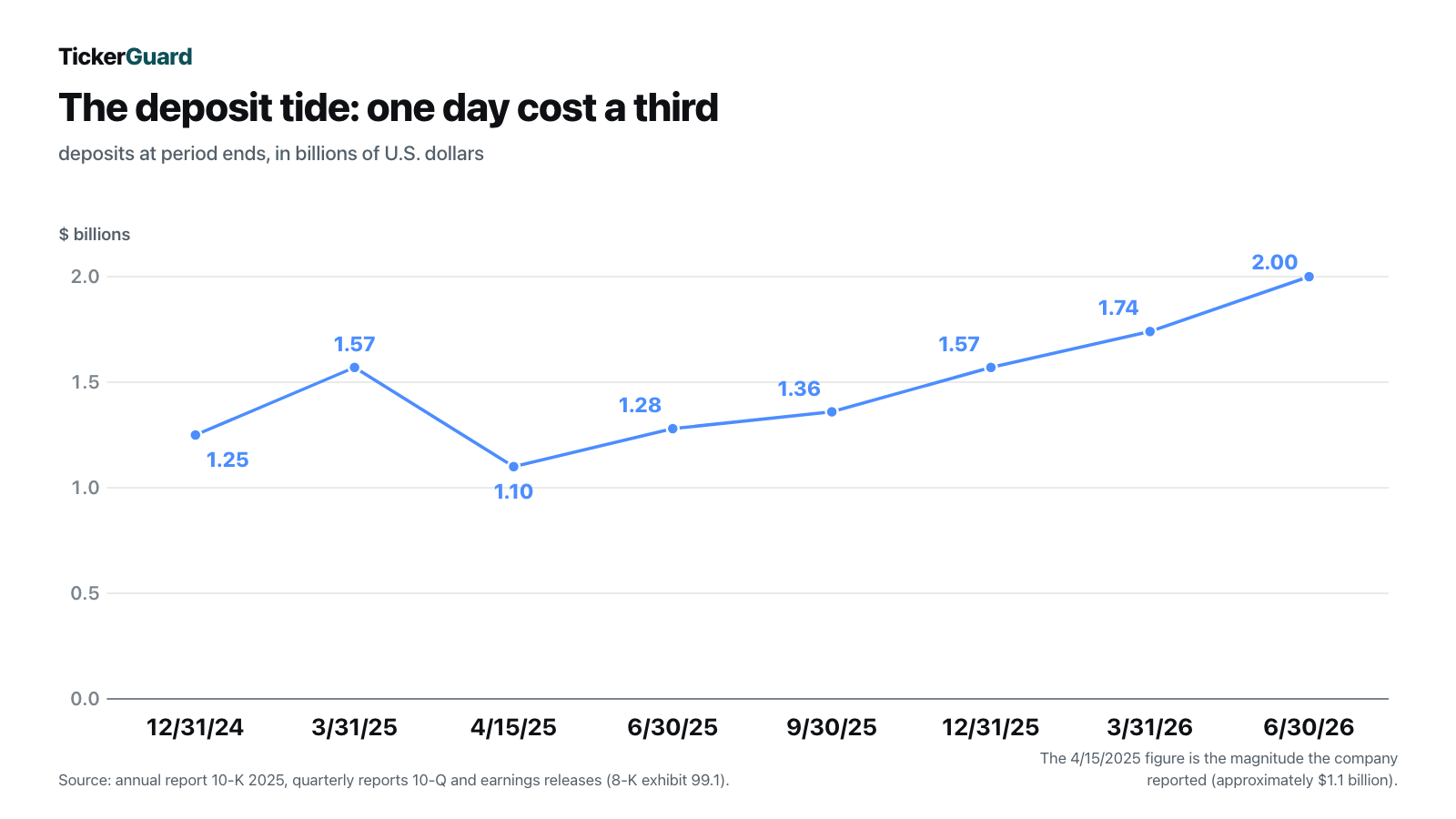
Uncomfortable truth no. 2: four fifths of deposits are uninsured — and the share is rising. Federal deposit insurance covers $250,000 per depositor per bank. Because Chain Bridge runs almost exclusively corporate and organizational accounts, balances sit far above that. The quarterly report as of June 30, 2026 puts uninsured deposits at roughly $1.6 billion, or 80.8 percent — after 75.0 percent on December 31, 2025 and 68.6 percent on December 31, 2024. The trend points the wrong way, and the bank states itself that it maintains no internal limits on that concentration.
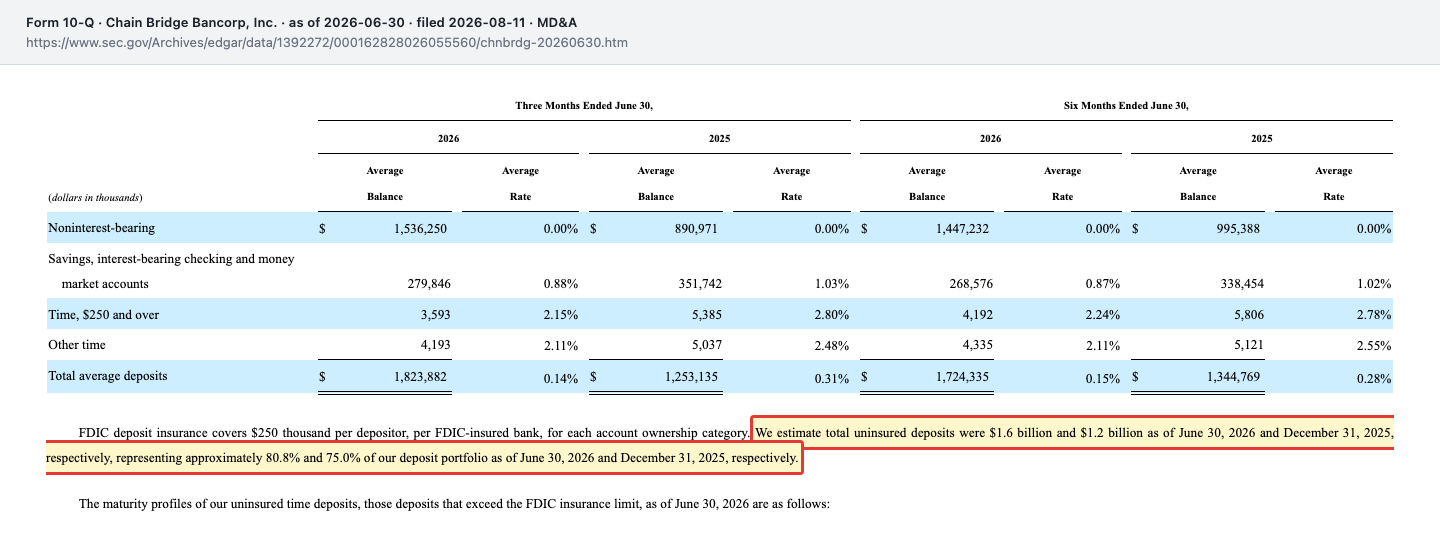
Uncomfortable truth no. 3: eleven clients, one cluster — and it is growing back. As of December 31, 2025, eleven clients each held more than 1 percent of deposits, together 31.0 percent; five of them were political organizations (15.4 percent) and five were 501(c)(4) organizations (14.5 percent). Five of those eleven accounts arrived through specialist firms that advise campaign organizations on treasury, legal and compliance matters — and the bank concedes the true degree of interlinkage may be higher than its tracking captures. At the end of 2025 no single account crossed the 5 percent mark. As of June 30, 2026 there are three clients again, together $401.2 million, or 20.0 percent. The trust business is tight too: four clients accounted for 32.2 percent of assets under administration as of December 31, 2025.
Uncomfortable truth no. 4: a quiet mark sits in the securities book. Roughly 49 percent of total assets were held in securities as of December 31, 2025. Part of that is classified as held to maturity and therefore carried at amortized cost rather than market value — price losses simply do not appear there. As of June 30, 2026 those securities were carried at $224.2 million against a fair value of $212.4 million. The annual report does the full arithmetic itself:
“As of December 31, 2025, our net unrealized losses on available-for-sale securities, after tax, totaled $1.7 million, while net unrealized losses on held-to-maturity securities, after tax, amounted to $9.0 million—a combined total representing 6.2% of our Tier 1 capital.”
— Chain Bridge Bancorp, Inc., annual report on Form 10-K for 2025, Risk Factors — Interest Rate Risk
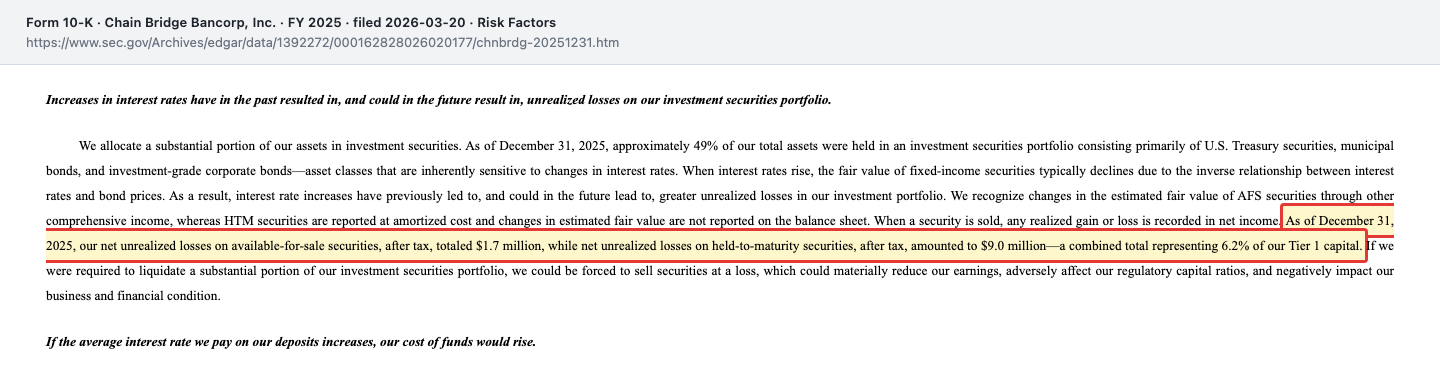
For scale: 6.2 percent of Tier 1 capital is manageable at a bank running 49.46 percent Tier 1 risk-based capital — at some of the institutions that failed in 2023 the equivalent share was a multiple of that. The catch is the side condition: if a bank sells even part of its held-to-maturity book, it must reclassify the entire portfolio and route all unrealized losses through equity. That pot is effectively frozen for as long as the bank prefers not to touch it.
Uncomfortable truth no. 5: earnings hang on the policy rate — and shareholders have no say. Because nearly all assets sit in short-dated, immediately repricing instruments, the company states itself that falling short-term rates would weigh on net interest income. The Federal Reserve cut three times in 2024 and again in September, October and December 2025. So far volume growth has absorbed that — the net interest margin even rose to 3.45 percent in the second quarter of 2026 as the cost of funds fell from 0.31 to 0.14 percent. But the leverage remains: this bank earns on the level of rates, not on lending spreads. And almost nobody gets a say in any of it: Class B shares carry ten votes, Class A one. As of December 31, 2025 Class B holders controlled 90.8 percent of all voting power; the Fitzgerald Family held 70.9 percent of Class B shares and 64.4 percent of total votes. There is no dividend, and the company states expressly that it does not intend to pay one for the foreseeable future.
Valuation: what the market pays for a money custodian
For a bank, revenue and gross margin are the wrong yardsticks. The right ones are book value and the return earned on it. At the closing price of $45.30 on August 26, 2026 and 6,561,817 shares outstanding, the market capitalization was roughly $297 million. Against tangible book value of $27.99 per share (June 30, 2026) that is a price-to-book ratio of about 1.6. Across the last four reported quarters — $0.72, $0.81, $1.08 and $1.45 of earnings per share, $4.06 combined — the price-to-earnings ratio is roughly 11. The 52-week range at that data date ran from $28.10 to $49.13.
What does that mean in orders of magnitude? U.S. regional banks trade through the cycle at roughly 0.8 to 1.8 times tangible book, with the upper end reserved for institutions with durable double-digit returns on equity and cheap funding. Chain Bridge delivers both — 12.88 percent return on average equity in the weak year 2025, 18.94 percent in the first half of 2026, and a 0.14 percent cost of funds in the second quarter of 2026. At around 1.6 the stock therefore sits in the upper third of that band. Not cheap; not inexplicable either. The analyst target price recorded in our fundamental data set on August 28, 2026 stood at $49 — though for a stock whose typical trading day in August 2026 covered about 16,000 shares — that is the median, the typical day: half the days were above it and half below; the average is markedly higher at roughly 20,600 shares because single days ran to 61,600 — the informational value of any such consensus is limited.
Two things distort every quick comparison. First, seasonality: the first half of 2026 falls into the build-up before the November 2026 midterms, so the $16.6 million of net income is a high-water mark, not a run rate. Doubling it assumes an election year is the permanent state; in the post-election year 2025 full-year income was $20.2 million, and in the post-election year 2023 it was $8.8 million. Second, tied-up capital: a Tier 1 risk-based capital ratio of 49.46 percent means a multiple of the regulatory requirement sits idle, earning no more than a bond yield. Without a dividend and without a buyback programme that capital pile keeps growing — a safety cushion and a return brake at the same time.
Upside and risks at a glance
What speaks for Chain Bridge Bancorp:
- Funding other banks envy: 79.8 percent of deposits sat in noninterest-bearing accounts as of December 31, 2025, and the cost of funds fell to 0.14 percent in the second quarter of 2026. That is the real earnings engine.
- Exceptional credit quality: no non-performing assets since June 2012, no charge-off since the third quarter of 2017, $265,000 of net charge-offs in total since 2007.
- Capital and liquidity buffers far above the norm: Tier 1 risk-based capital 49.46 percent, liquidity ratio 94.03 percent, $812.7 million at the Federal Reserve, plus $668.0 million of off-balance-sheet ICS deposits that can be pulled back on (all as of June 30, 2026).
- A second, growing leg: the trust and wealth department administered $772.8 million as of June 30, 2026 (of which $257.4 million actively managed), up from $445.4 million a year earlier.
- Proven under stress: the April 15, 2025 outflow was absorbed without a fire sale, without borrowings and without a loss — exactly as management had signalled.
What speaks against it:
- Political cluster risk: substantially all political organization deposits come from Republican-affiliated entities, and the company says political organizations at times make up the majority of all deposits. Election outcomes, donor behaviour and changes to campaign finance law feed straight into the balance sheet.
- 80.8 percent uninsured deposits (June 30, 2026, trend rising) with no internal limit — the combination that felled several U.S. banks in 2023.
- Concentration in few accounts: three clients each above 5 percent of deposits as of June 30, 2026 ($401.2 million, 20.0 percent); eleven clients each above 1 percent as of December 31, 2025 (31.0 percent).
- Rate dependence without a lending cushion: at a 13.70 percent loan-to-deposit ratio, income arises almost entirely from short-term rates. If the policy rate falls materially, net interest income falls with it.
- No say, no payout: 90.8 percent of votes sit with Class B holders and 64.4 percent with the Fitzgerald Family (December 31, 2025). No dividend is planned, and trading was very thin at roughly 16,000 shares on a typical day in August 2026.
A human conclusion
Back to the straight-A fallacy. Chain Bridge Bancorp passes every test you would normally set a bank: credit quality, capital, liquidity, cost ratio, return on equity. Tick that list and you conclude there is no risk here. The fallacy is not in the numbers — they are real — but in the fact that the decisive question appears on none of those lists. It reads: who can pull this money out tomorrow, and what happens then?
The bank answered that itself on April 15, 2025, and more honestly than many would have expected: six account holders withdrew $506.5 million in a day, and nothing happened. No fire sale, no loss, no central bank borrowing. That is a strong argument — but it is an argument about a single test case in which management was forewarned and had deliberately parked the money in maturing Treasuries. Whether the same buffer holds for an unplanned outflow at the wrong moment, nobody knows until it happens.
What you are buying, then, is not an ordinary regional bank but a two-legged bet: on unusually cheap funding sourced from a political niche — and on that niche still existing in five years and still wiring to the same address. The first leg is measurable and excellent. The second hangs on things no balance sheet contains: election outcomes, donor willingness, and a legislature that can rewrite campaign finance rules at any time. What you make of that is your decision. And that is exactly as it should be.
Sources
- Chain Bridge Bancorp, Inc. — annual report on Form 10-K for 2025, filed March 20, 2026
- Quarterly report on Form 10-Q as of June 30, 2026, filed August 11, 2026
- Quarterly report on Form 10-Q as of March 31, 2026, filed May 12, 2026
- IPO prospectus on Form 424B4, filed October 7, 2024 — source of the 2021 to 2023 figures
- Second-quarter 2026 earnings release (Form 8-K, exhibit 99.1) of July 28, 2026
- First-quarter 2025 earnings release (Form 8-K) of April 28, 2025
- Fourth-quarter 2024 earnings release (Form 8-K, exhibit 99.1) of January 28, 2025
- Investor presentation (Form 8-K, exhibit 99.1) of November 5, 2025
- Proxy statement on Form DEF 14A of April 28, 2026
- All SEC filings of Chain Bridge Bancorp, Inc. (CIK 0001392272)
- Price, market capitalization and ratio data: fundamental data, data date August 28, 2026, last close August 26, 2026.
Disclosure: This article is journalistic commentary on publicly available corporate filings. It is not investment advice, not a recommendation to buy or sell, and not a solicitation to buy or sell securities. Stocks can lose substantial value, up to and including the total loss of the capital invested. All figures are stated with their reporting date and may have changed since. Positions held by the operator are disclosed daily; where one exists, it appears as a notice at the top of this deep dive.
Key figures at a glance
All monetary figures in millions of $; earnings per share as reported.
| Metric | 2019 | 2022 | 2023 | 2024 | 2025 |
|---|---|---|---|---|---|
| Revenue | 18.4 | 30.5 | 34.3 | 57.0 | 59.4 |
| Operating Income (EBIT) | 7.4 | 10.2 | 10.9 | 26.3 | 25.4 |
| Net Income | 4.9 | 8.3 | 8.8 | 20.9 | 20.2 |
| Net Margin | 26.6% | 27.2% | 25.8% | 36.7% | 34.1% |
| Earnings Per Share | 1.23 $ | 1.29 $ | 1.38 $ | 4.17 $ | 3.08 $ |
Source: fundamental data & SEC filings (annual and quarterly reports, 10-K/10-Q)
Our Bottom Line at a Glance
- Credit quality & capital positive
- No non-performing assets since June 2012, no loan charge-off since the third quarter of 2017, $265,000 of net charge-offs in total since inception in 2007. As of June 30, 2026: Tier 1 risk-based capital 49.46 percent, total risk-based capital 50.45 percent, liquidity ratio 94.03 percent. That is the asset side of a vault, not of a normal regional bank.
- Funding & earning power positive
- As of December 31, 2025, 79.8 percent of deposits sat in noninterest-bearing accounts; the cost of funds fell to 0.14 percent in the second quarter of 2026 (year-ago quarter 0.31). That produced a 3.45 percent net interest margin, a 40.25 percent efficiency ratio and an annualized 21.20 percent return on average equity.
- Deposit concentration negative
- Substantially all political organization deposits come from Republican-affiliated entities (10-K 2025). On April 15, 2025, $506.5 million left across six accounts in one day. As of June 30, 2026 three clients again each hold more than 5 percent of deposits ($401.2 million, 20.0 percent), and 80.8 percent of all deposits are uninsured — with no internal limit.
- Rate dependence & securities book neutral
- At a 13.70 percent loan-to-deposit ratio (June 30, 2026) income hangs almost entirely on short-term rates; the company names falling policy rates as a drag itself. A quiet mark sits in the securities book: $224.2 million carrying value against $212.4 million fair value on held-to-maturity paper — manageable measured against Tier 1 capital.
- Governance & shareholder rights negative
- Class B shares with ten votes held roughly 90.8 percent of voting power as of December 31, 2025, the Fitzgerald Family alone 64.4 percent. No dividend is planned, there is no buyback programme, and trading was very thin at roughly 16,000 shares on a typical day in August 2026.
- Valuation neutral
- At the closing price of $45.30 on August 26, 2026 the market capitalization was roughly $297 million: about 1.6 times tangible book value of $27.99 per share and roughly eleven times the last four quarterly earnings ($4.06 per share). That sits in the upper third of the usual band for U.S. regional banks — and the first half of 2026 is an election-cycle high-water mark, not a run rate.
Chain Bridge Bancorp is the straight-A fallacy in pure form: on the asset side the bank passes every test — no non-performing assets since June 2012, 49.46 percent Tier 1 risk-based capital and a 94.03 percent liquidity ratio as of June 30, 2026. The risk sits on the liability side: 80.8 percent of deposits are uninsured, three clients each hold more than 5 percent, and substantially all political organization deposits come from Republican-affiliated entities. On April 15, 2025, $506.5 million vanished in a day — without a fire sale, because management had planned for exactly that. Investing here means buying exceptionally cheap funding and betting that its political source endures. Not investment advice.
What Our Rating Means
Open questions
The business works in principle, but one material question is open. As long as it stays open, our findings do not carry a quality verdict.
We find no substance risk in the narrow sense: the bank is over-capitalized, highly liquid, has gone years without a credit loss, and survived the largest stress test so far — a $506.5 million outflow in a single day — without one forced sale. What stays open is the operational question of whether funding holds that is 80.8 percent uninsured, hangs on three accounts above 5 percent each, and springs from a single political niche. April 2025 is evidence, not proof: management was forewarned and had deliberately parked the money in maturing Treasuries. If you wait, check three lines in every quarterly report: how many clients hold more than 5 percent of deposits, how large the uninsured share is, and how big the ICS buffer is that can absorb an outflow. The decision is yours.
A journalistic assessment by our editorial team at the time of the deep dive, based on public sources — not investment advice and not a solicitation to buy or sell. Your personal circumstances (investment goals, risk capacity, taxes) cannot be taken into account. What our levels mean, how verdicts are formed, and what conflicts of interest exist →
Worth Noting
- Chain Bridge Bancorp reached our research list through two public calendar events: the IPO on October 4, 2024 at $22.00 — per the chairman the first by a U.S. banking institution in over two years — and the addition to the Russell 3000 on June 30, 2025. Both are reasons to look, not reasons to buy.
- No earnings-call transcripts exist for this company because Chain Bridge Bancorp holds no earnings calls. We evaluated eight earnings releases since the third quarter of 2024, two investor presentations dated September 3 and November 5, 2025, and the mandatory filings instead. Notable: since the fourth-quarter 2025 release of January 28, 2026, three consecutive quarters have carried no management comment at all.
- The figures for 2021 through 2023 come from the IPO prospectus (Form 424B4) filed October 7, 2024 — there were no quarterly reports before the listing. Earnings per share for those years are restated to today's share count (each old share was reclassified into 170 Class B shares). Not to be confused: the listed class is Class A; the vote-heavy Class B does not trade.
Stock Watch
This analysis is as of August 29, 2026. Stock Watch will tell you what's changed at CBNA since then.
Later $1 a month per stock — signing up is free, and you'll be the first to know when it launches.
The full analysis as a PDF for later
We will send you this analysis as a PDF — to print, file away, and read at your own pace. And we will add you to the free Stock Watch list for Chain Bridge Bancorp, Inc. (CBNA), so you hear about it when something material in this analysis changes.
Frequently Asked Questions
Chain Bridge Bancorp, Inc. (NYSE: CBNA) is the holding company of Chain Bridge Bank, N.A. of McLean, Virginia. The bank runs no branch network, employed 92 full-time equivalents as of December 31, 2025 and serves clients in 49 U.S. states, the District of Columbia and Puerto Rico. Its focus is deposits from political organizations — campaign committees, party committees, PACs and Super PACs — plus a trust and wealth management business.
Because the deposits can leave at any time. As of June 30, 2026, $2,001.5 million of deposits faced only $270.6 million of loans — a loan-to-deposit ratio of 13.70 percent. The money sits instead in $812.7 million of Federal Reserve balances and $1,066.6 million of securities, mostly U.S. Treasuries. That posture lets the bank meet large outflows without selling below book value.
According to the 2025 annual report (10-K), roughly $506.5 million left across six political organization accounts that day. Consolidated deposits fell from $1,568.4 million on March 31, 2025 to about $1.1 billion at the close of April 15. The bank sold no securities and took on no borrowings, because the money had been parked in Federal Reserve balances and short-dated Treasuries. By December 31, 2025 deposits had recovered to $1,573.3 million.
As of June 30, 2026 roughly $1.6 billion, or 80.8 percent, of deposits were not covered by federal deposit insurance, up from 75.0 percent at the end of 2025 and 68.6 percent at the end of 2024. The company maintains no internal limits on that concentration. The counterweights are a 94.03 percent liquidity ratio and $668.0 million of off-balance-sheet ICS deposits that can be converted back onto the balance sheet at short notice.
The company has two share classes: listed Class A with one vote per share, and Class B with ten votes. As of December 31, 2025 Class B holders together controlled roughly 90.8 percent of all voting power; the Fitzgerald Family around chairman Peter G. Fitzgerald held roughly 70.9 percent of Class B shares and 64.4 percent of total votes. Class A holders therefore have effectively no influence over board composition.
No. The 2025 annual report (10-K) states expressly that the company does not intend to pay dividends on its common stock for the foreseeable future. Earnings stay in the company and lift book value per share, which rose from $21.98 (December 31, 2024) through $25.79 (December 31, 2025) to $27.99 as of June 30, 2026.
No. Not one of the eight earnings releases since the third quarter of 2024, no annual or quarterly report and no investor presentation announces a conference call or webcast, and no transcripts exist. Public statements from the leadership appear only as written comments in the earnings releases — and those have been absent for three consecutive quarters since the fourth-quarter 2025 release of January 28, 2026.
At the closing price of $45.30 on August 26, 2026 the market capitalization was roughly $297 million. Against tangible book value of $27.99 per share that is a price-to-book ratio of about 1.6; against the last four quarterly earnings ($4.06 per share combined) a price-to-earnings ratio of roughly 11. U.S. regional banks trade through the cycle at roughly 0.8 to 1.8 times tangible book, putting Chain Bridge in the upper third of that band.
Found an error?
Did you spot a factual error, an outdated number, or a typo in this deep dive? Let us know briefly — your report goes straight to the editorial team.