CareCloud: Ten Quarters of AI Story — and Not One AI Number in Any Filing
CareCloud (Nasdaq: CCLD) bills U.S. health insurers on behalf of roughly 44,000 clinicians. Since late 2023 it has been telling a second story: cirrusAI, stratusAI, a "world's largest" healthcare AI center. Its filings with the U.S. securities regulator, the SEC, tell a different one — on a comparable basis revenue fell 11.4 percent in the second quarter of 2026, equity dropped from $59.5 million to $17.4 million in six months, and the executive chairman pledged 4.3 million of his own shares for the company loan in exchange for a warrant on 4.3 million new ones. We read what sits behind the curtain.
 Thomas Mücke
Founder & Publisher
Thomas Mücke
Founder & Publisher
As of Today
As of: October 9, 2026
- Closing price
- 2.00 $ +3.10%
- Market Capitalisation
- 82.0 $M
- P/E
- 15.3
- Growth Score
- 6/10
- AAQS
- 7/10
Price change since August 27, 2026: -24.8%
This analysis has a cut-off date. The Stock Guard tells you when something material changes in the numbers. Reserve your free spot

Chart
Interactive price chart (TradingView).
52-week range: 1.90 $ to 3.80 $ · Last price: 2.00 $ (As of: October 9, 2026)
Note: pure fact-based analysis, not investment advice and not a solicitation to buy or sell. All figures without guarantee.
There is an investor weakness with no official name that has caught almost everyone: the announcement trap. Our minds file an announcement the way they file a delivery. When a company presents something new for ten quarters running — a new product, a new brand name, a new percentage from a pilot — it feels like progress, even if not a single new number has landed in the financial statements. Motion is not the same as result, but it looks identical. Let us do it differently here. We will read the numbers together, and not from a press release but from the filings CareCloud, Inc. (Nasdaq: CCLD) must submit under penalty of law to the U.S. securities regulator, the SEC — the quarterly report (Form 10-Q) for the period ended June 30, 2026, the annual report (Form 10-K) for 2025, and the transcripts of ten earnings calls spanning more than two years.
It helps to know the central puzzle up front: CareCloud reported 16 percent revenue growth for the second quarter of 2026 — and disclosed in the same filing that revenue fell 11.4 percent on a comparable basis. Both are true, both sit in the same document, and the gap between them is the real story of this stock. It runs through every chapter: a company that generates genuine cash, whose growth is bought, and whose promise of the future still carries no number.
What CareCloud actually does
CareCloud earns its money doing a job every U.S. medical practice has to solve on its own: getting paid by health insurers. The industry calls it revenue cycle management. Picture it this way: after every treatment, a form goes out to one of hundreds of insurers — with the right code, within the right deadline, in the right format. Make a mistake and no money arrives. Get the claim denied and somebody has to appeal. CareCloud takes that work off the practice and keeps a percentage of the payments it collects.
That is the largest revenue block, labeled "technology-enabled business solutions" in the filings: $47.0 million in the first half of 2026 against $36.7 million a year earlier. Three smaller lines sit beside it: consulting and staffing for hospital IT (professional services, $6.3 million for the half year against $10.0 million — down by more than a third), printing and mailing of patient statements ($1.9 million) and a group purchasing operation ($0.4 million). Since January 1, 2026 the company also reports in two segments: Healthcare IT ($55.7 million half-year revenue) and Medical Practice Management ($7.5 million) — the latter being the administration of three physician practices for cost reimbursement plus a share of operating profit.
The customer base: as of June 30, 2026 CareCloud served roughly 44,000 physicians, nurses and other clinicians across about 2,900 practices, hospitals and service organizations; a year earlier the figure was 40,000. As of December 31, 2025 the annual report still cited 45,000 — so the number actually fell during the first half of 2026, despite an acquisition in May. The annual report stresses that no single customer is large enough to create concentration risk: 80 specialties across 50 states, "allowing for low revenue concentration risk."
The second load-bearing pillar is not a product but a location. As of December 31, 2025 CareCloud employed roughly 3,650 people worldwide, about 3,300 of them offshore — and of those, by the company's own account, roughly 98 percent in the Pakistan offices, the rest in Sri Lanka. The quarterly report names the offshore locations as Pakistan, Azad Jammu and Kashmir — a region administered by Pakistan — and Sri Lanka; as of June 30, 2026 it counts roughly 3,100 staff there and about 250 specialists in the United States. The cost argument appears verbatim in the filing: this workforce costs "approximately 17% the cost of comparable U.S. employees." That is the real moat of this business model — not the software, but the wage differential. It is also the first item listed under "Risks Related to Our Business."
A word on history, because it causes confusion in research: the entity with SEC identifier 1582982 was called Medical Transcription Billing, Corp. until 2019, then MTBC, Inc., and since March 29, 2021 CareCloud, Inc. Older sources under "MTBC" refer to the same company. The initial public offering was on July 23, 2014. Stephen Snyder has been sole chief executive since January 1, 2026; A. Hadi Chaudhry served as co-chief executive alongside him from January to December 2025 and has been chief strategy officer since that same date (proxy statement dated April 7, 2026). Founder Mahmud Haq is executive chairman. Readers who want to see what a pure software vendor in healthcare looks like will find the counterpoint in our Veeva Systems analysis: there a company sells licenses, here a company mostly sells labor.
Company history for investors
-
2014
IPO as Medical Transcription Billing
The company lists on Nasdaq on July 23, 2014. To this day it has never declared a dividend on the common stock — price appreciation is the only source of return for common shareholders.
-
2021
Renamed CareCloud, revenue peak
On March 29, 2021 MTBC becomes CareCloud. Revenue reaches its all-time high of $139.6 million — still 13.7 percent above the 2025 level.
-
2023
Goodwill write-down and dividend suspension
Roughly $40 million of goodwill is written off and the year ends with a $48.7 million loss. On December 11, 2023 the board suspends the preferred dividends — the arrearage has still not been cleared.
-
2025
Forced conversion more than doubles the share count
On March 6, 2025, 3,541,701 Series A preferred shares are forcibly converted into roughly 26 million common shares. Prior common shareholders held only 38 percent of their previous stake the next day.
-
2026
Debt replaces preferred stock — and a warrant for the chairman
A $50 million facility retires the Series B in May; equity falls to $17.4 million. In July the executive chairman pledges 4.3 million of his own shares and receives a warrant on the same number of new ones.
How this stock reached our desk
The trigger is public and carries a date. On August 6, 2026, CareCloud filed its Form 10-Q for the second quarter of 2026 and published the earnings release the same day as exhibit 99.1 to a Form 8-K. Its headline reads: "Revenue Grows 16%; Ninth Consecutive Quarter of Positive GAAP Net Income." Both claims are accurate.
The chief executive summed up the quarter this way:
"This quarter we grew revenue 16%, delivered our ninth consecutive quarter of positive GAAP net income, and entered the compliance and audit-defense market through our acquisition of Empower Healthcare. We're investing deliberately in what we believe defines our next phase of growth — our AI solutions, our expanding capabilities, and the cross-sell opportunity across our more than 40,000 providers."
— CareCloud, Inc., earnings release dated August 6, 2026 (SEC exhibit 99.1 to Form 8-K)
And yet net income in the same quarter fell from $2.902 million to $1.122 million — down 61 percent. Adjusted EBITDA, the company's own preferred measure, slipped from $6.529 million to $5.947 million. Earnings per share after preferred dividends came in at $0.00; for the first half of 2026 at negative $0.01 — against full-year guidance of $0.20 to $0.23. That contradiction between headline and statements is exactly why one reads a filing rather than a headline.
The numbers over the years
First the part that genuinely impresses, and it is substantial. Between 2023 and 2025 CareCloud executed a real turnaround. In 2023 it posted a net loss of $48.7 million, driven by goodwill impairments of roughly $42 million. Then a cost program took hold: adjusted EBITDA rose from $15.4 million (2023) to $24.1 million (2024) and $27.5 million (2025) — while revenue was initially falling. Operating cash flow climbed from $15.5 million through $20.6 million to $28.6 million. And in 2025 the company reported positive annual earnings per common share for the first time since its 2014 initial public offering: $0.10. That is not a trivial achievement; it is the delivery of a promise made over two years.
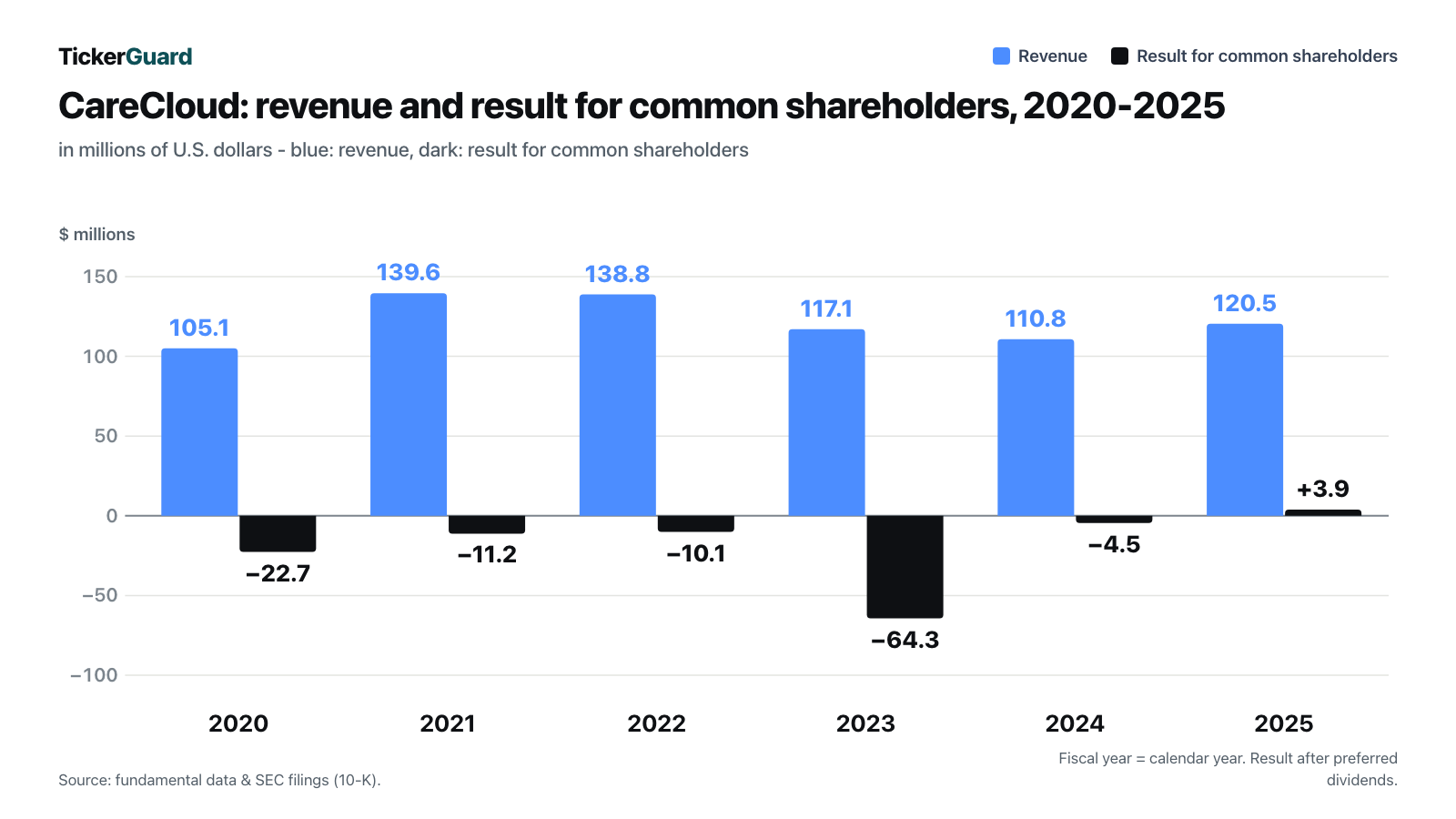
Now the part the headline leaves out. Revenue peaked not today but in 2021, at $139.6 million; 2022 brought $138.8 million. In 2025, at $120.5 million, CareCloud was still 13.7 percent below that high-water mark. The main reason sits in the consulting business: after acquiring medSR in 2021, CareCloud lost a major client — the chief executive at the time put the damage at "somewhere between $18 million to $20 million" on the November 12, 2024 call. Professional services kept shrinking, down another 36.4 percent in the first half of 2026.
Then there is the share count. It is the most painful part of the past, and you only see it over time.
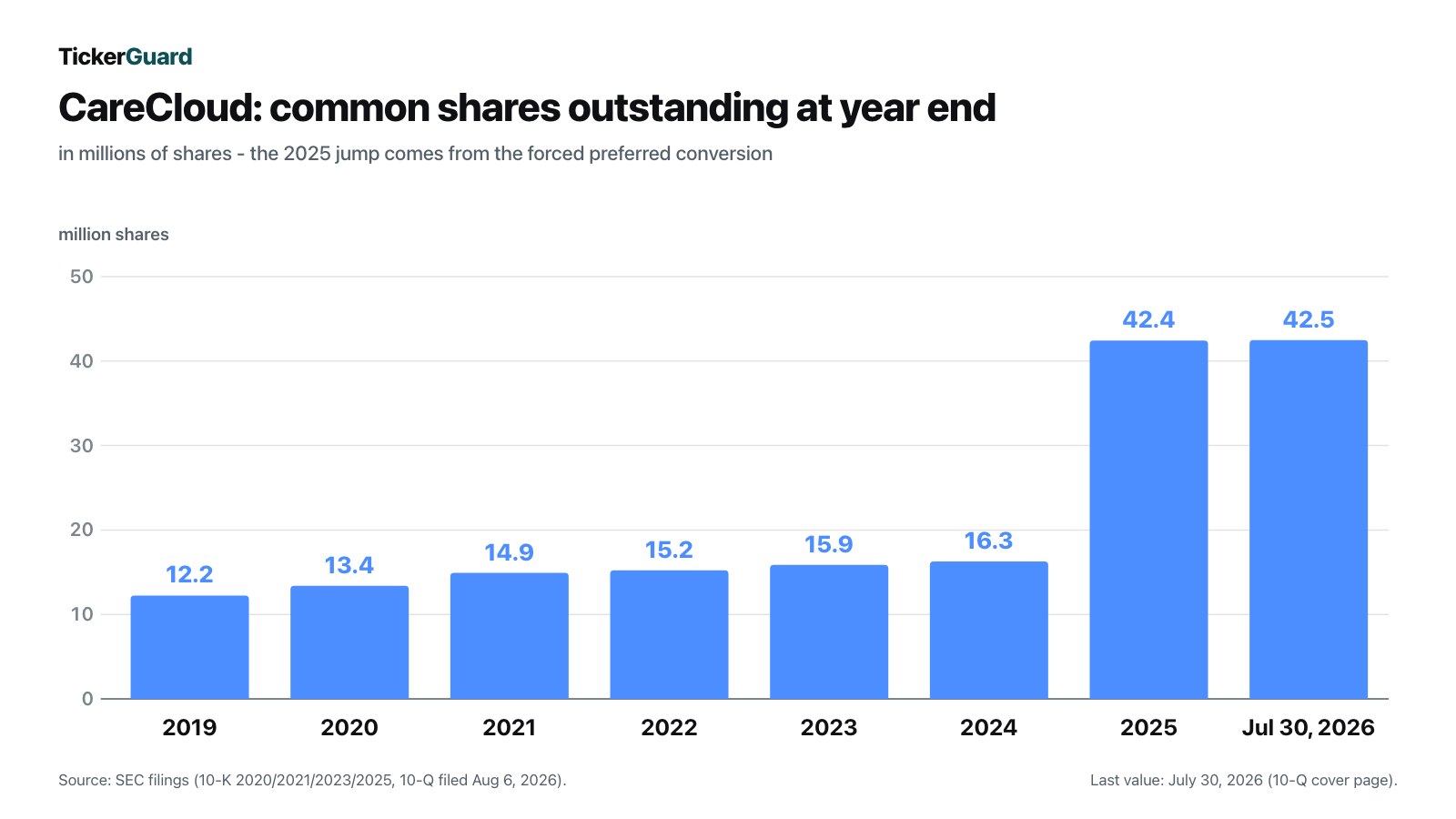
Dilution means your slice of the pie gets smaller without the pie getting bigger. That is precisely what happened in March 2025. On March 6, 2025, the board exercised the conversion right it had granted itself six months earlier: each Series A preferred share was exchanged for 7.3358 common shares — 3,541,701 preferred shares became 25,981,248 new common shares (statement of shareholders' equity, Form 10-K for 2025). The 16,256,236 shares outstanding as of December 31, 2024 thus became roughly 42.2 million at a stroke — up about 160 percent. Anyone holding common stock the day before owned only 38 percent of that stake the day after. By December 31, 2025 the books showed 42,437,949 shares; the difference of 200,465 shares came from employee equity plan grants. One detail is recorded verbatim in the annual report and deserves attention: holders of at least 100,000 Series A preferred shares kept with the company's transfer agent were not automatically converted and had to consent to the conversion themselves. Smaller holders had no such choice; for them the exchange was automatic.
The latest quarter in detail (Form 10-Q filed August 6, 2026, period ended June 30, 2026): revenue of $31.880 million against $27.377 million, up 16.4 percent. Research and development rose from $1.020 million to $2.194 million — more than doubling; for the half year from $2.255 million to $4.610 million. Interest expense climbed from $68,000 to $815,000, and for the half year from $126,000 to $873,000. Operating income therefore fell from $2.996 million to $1.862 million and net income from $2.902 million to $1.122 million. After preferred dividends of $941,000, $181,000 remains for common shareholders — across 42.5 million shares, that is $0.00 per share.
The balance sheet as of June 30, 2026 has two faces. The friendly one: $13.4 million of cash against $3.1 million at the end of 2025, operating cash flow of $10.7 million for the half year and a derived free cash flow of roughly $8.1 million (operating cash flow less property and equipment less capitalized software). The unfriendly one: equity fell from $59.506 million to $17.402 million, down 70.8 percent in six months. And not because of losses — the accumulated deficit actually shrank from $55.8 million to $53.8 million. It happened because the Series B redemption was charged directly against additional paid-in capital, which collapsed from $119.9 million to $75.7 million. Strip out goodwill ($31.8 million) and other intangibles ($14.9 million) and what remains is tangible equity of negative $29.4 million — not unusual in this industry, but it shows the drop height if goodwill ever has to be written down again. It already was once: by roughly $42 million in 2023.
What ten earnings calls reveal
We reviewed the transcripts of ten quarterly earnings calls in full — from May 14, 2024 to August 6, 2026, more than two years. Such transcripts are worth more than any press release: they record what management promised beforehand, and you can check it later. And the question-and-answer session weighs more than the prepared remarks, because that is where you see whether a number gets answered or sidestepped.
Promised and delivered. CareCloud honored three major commitments. First, the cost program: in May 2024 the then-president announced roughly $22 million of annualized savings, later raised to $26 million; looking back in May 2025 he cited "about $25 million worth of recurring expenses." The hard evidence sits in the numbers: adjusted EBITDA rose from $15.4 million to $24.1 million while revenue fell. Second, paying down the credit line: in November 2024 the chief executive reported "we have fully paid down our $10 million credit line." Third, the first positive earnings per share since the 2014 initial public offering — guided at $0.10 to $0.13 for 2025 and delivered at $0.10, that is, at the bottom of the range.
And now the places where the tone shifted. Four deserve attention.
First, the yardstick that moved. In May 2024 management set the measure itself, and explicitly:
"I think as you think about and kind of watch us this year, I think really test us and judge us in particular by our ability to generate free cash flow primarily."
— Stephen Snyder, then president, first quarter 2024 earnings call, May 14, 2024
From the first quarter of 2025 onward, AI headed every narrative. And the self-chosen metric turned down for the first time in the first half of 2026: $8.1 million against $9.1 million a year earlier, as the chief financial officer stated on the August 6, 2026 call.
Second, the guidance that landed nine million lower. In May 2024 the finance chief guided 2024 revenue to $118 million to $120 million with "steady quarterly revenue growth throughout the year." By November 2024 the wording had become: "We are reaffirming analyst expectations for our revenue guidance of $109 million to $111 million." The word "reaffirming" sits in front of a number $9 million below the company's own starting guidance. Actual 2024 revenue was $110.8 million — and the fourth quarter came in at $28.2 million against $28.5 million in the third, so without the promised steady growth.
Third, the headcount target that was never withdrawn. In May 2025 management announced an AI center of excellence — with a number:
"we believe it is set to become the world's largest dedicated healthcare AI center as we scale to 500 AI professionals by the end of this year."
— A. Hadi Chaudhry, then co-chief executive, first quarter 2025 earnings call, May 6, 2025
The highest level ever cited came in August 2025: 100 full-time hires plus 100 interns. After that, no call names a headcount at all. In March 2026 an analyst question produced this: "we can accomplish it with a smaller team than we had initially envisioned." The 500 target was neither met nor ever acknowledged as missed; it was repurposed into an efficiency message.
Fourth, the metrics promised twice and never delivered. In May 2025 management said it would report quarterly on product rollouts, "adoption metrics" and real-world impact. In March 2026 the promise was repeated with emphasis: "The measure of AI investment is not feature ship. It is revenue improvements, denial rate reductions, time saved per provider, patient satisfaction scores. Those are the metrics we track internally, and they are the ones we will be sharing with you as our AI business matures." In the same call, asked by an analyst about early results, the answer was: "While we are not disclosing a specific client count at this stage." And one quarter later, on August 6, 2026: "Revenue is still in its early stages […] We will report that revenue as it scales."
How good are the answers in the question-and-answer session? The finding is unusually clear-cut. On capital structure, balance sheet and acquisition mechanics, management answers in remarkable detail — in March 2025 the chief executive walked through the forced conversion step by step, including the uncomfortable rule that only large holders could opt out. In November 2024 the then-chief executive admitted a mistake of his own and quantified it: "In retrospect, for us, our mistake was it took too long for us to respond." That is the opposite of evasion. On the AI products, ten quarters produced not one hard number. Asked about the company's own AI rollout in November 2025, the answer covered venture capital flows in digital health and the market capitalization of an unrelated company — without a single customer or revenue figure of its own.
Fairness requires the counter-ledger. The product demonstrably exists: on the November 6, 2025 call an actual anonymized patient call handled by the AI assistant was played, and there are documented pilot statistics — more than 70 percent of inbound patient calls handled end to end without a human, and roughly 75 percent among early adopters as of May 2026. The efficiency claim is also supported by the numbers: in March 2026 the chief executive noted the company had grown the revenue base by 14 to 15 percent while reducing headcount versus 2024. What is missing is not the product. What is missing is the price somebody pays for it.
What the filings say: the uncomfortable truths
Uncomfortable truth No. 1: the growth is bought — and the company's own filing does the math. When you acquire a company, you may count its revenue from the closing date onward. So that investors can still compare, U.S. accounting rules require a pro forma calculation: what would the prior year have looked like if every acquisition had already been part of the group? CareCloud provides that table in the notes to its quarterly report — and it flips the sign.
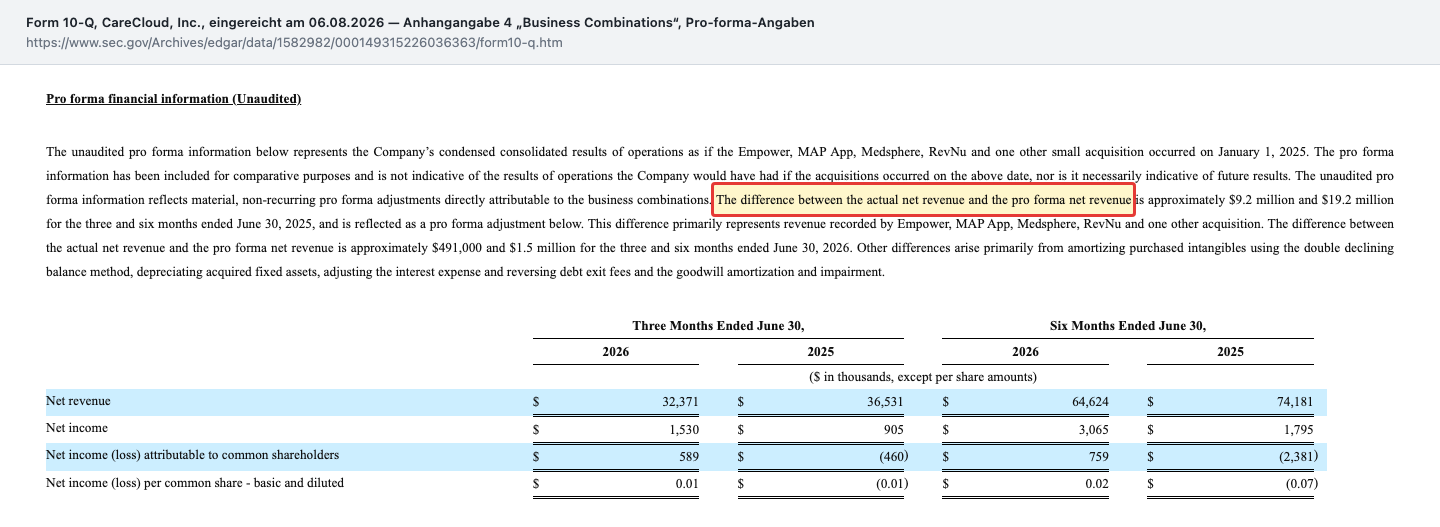
The arithmetic is simple: $32.371 million against $36.531 million is down 11.4 percent for the quarter; $64.624 million against $74.181 million is down 12.9 percent for the half year. The filing also names the cause of the gap: the difference between actual and pro forma revenue was $9.2 million in the prior-year quarter and $19.2 million in the prior-year half. So the reported 16 percent gain is not wrong — it simply does not measure the same company in both years. The same pattern held in 2025: the finance chief himself quantified the contribution of Medsphere, acquired in August 2025, at $3.4 million and $7.2 million across two calls; subtract those $10.6 million from full-year revenue of $120.5 million and roughly $109.9 million remains — below the $110.8 million of 2024.
Uncomfortable truth No. 2: the capital restructuring did not lower the burden, it hardened it. Between April and May 2026 CareCloud rebuilt its capital structure, and the narrative sounds good: swap expensive preferred dividends for cheaper bank debt. On April 13, 2026 the company took out a $40 million term loan plus a $10 million revolving line; on May 15, 2026 it redeemed all Series B preferred stock for roughly $41.6 million. The chief executive called it "exchanging high-cost preferred dividends for lower-cost senior debt" on the May 7, 2026 call.
Let us run the numbers. The Series B redemption saves roughly $3.3 million of annual preferred dividends by the company's own account. In exchange, the loan already cost $815,000 of interest in the second quarter of 2026 — annualized, just under $3.3 million. The annual cost of capital is therefore roughly unchanged. What has changed is its hardness: a board can suspend a preferred dividend, as CareCloud did in December 2023. It cannot suspend loan interest. Add amortization payments since June 1, 2026 and financial covenants — utilization stood at $48.2 million of the $50 million facility as of June 30, 2026, roughly 96 percent. The company confirms it is in compliance with all covenants. As an aside, a remnant of the old world lives on: 984,530 Series A preferred shares have been off the exchange since March 2025 but still accrue at 8.75 percent — and the arrearage from the 2023 suspension has still not been cleared.

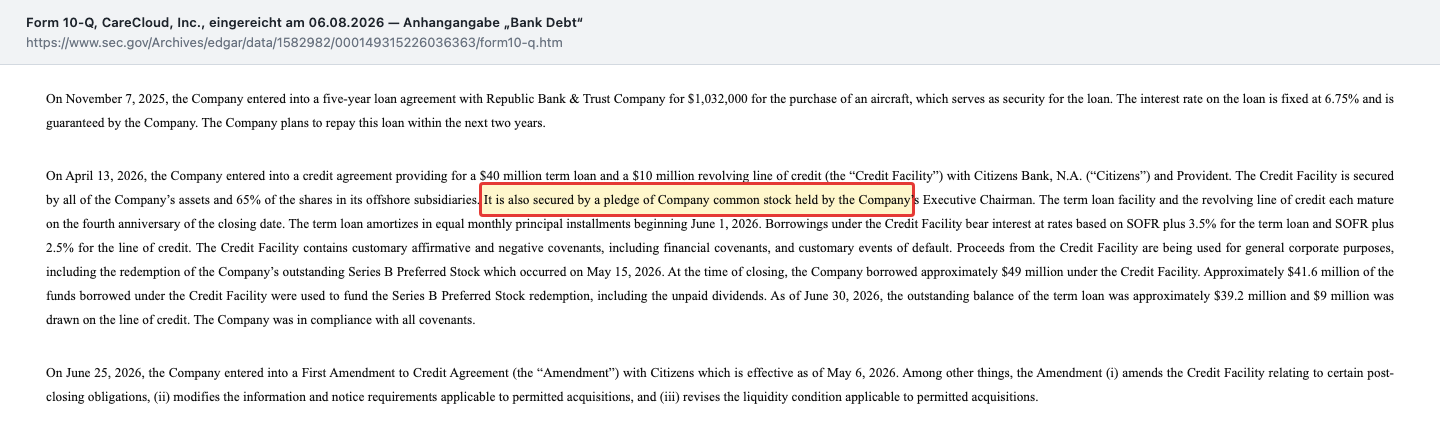
Uncomfortable truth No. 3: the executive chairman posts private shares as collateral — and received a warrant for it. The facility is not secured by company assets alone. On July 22, 2026, executive chairman Mahmud Haq and two trusts pledged 4.3 million private common shares to the bank. And the same day, the company gave him something back.

You can read this from two directions, and both belong here. Generously: a large shareholder puts private assets on the table so his company can borrow more cheaply — that is a vote of confidence, and at $5.00 the warrant is so far out of the money that it only pays him if the stock roughly doubles. Critically: 4.3 million shares are roughly 10.1 percent of the shares outstanding; if things go well, a tenth of the upside goes to one person while every other shareholder carries the risk. And if things go badly, the bank may sell 4.3 million shares into a stock where a typical trading day sees roughly 250,000 shares change hands (median of the 60 trading days through August 27, 2026 — the median is the typical day, with half of all days above and half below), after 15 business days of uncured default. One thing about the insider filings (Form 4) is worth noting: across the entire period reviewed there was not a single open-market purchase and not a single open-market sale by executives — every movement was a grant, a vesting or the forced preferred redemption.
The tie between company and chairman runs further, and the notes disclose it. CareCloud leases part of its facilities from him: the New Jersey headquarters, guest apartments, a warehouse, the operations center in Bagh, Pakistan, and an apartment in Dubai. The rent is small at $144,000 for the first half of 2026. The larger number sits beside it: the company spent roughly $671,000 in the first half of 2026 and roughly $838,000 in the prior-year period to upgrade "the related party leased facilities" — the buildings it leases from him; the 2025 spending related primarily to expanding the company's own AI center, per the filing. The first-half 2026 amount alone equals roughly a third of half-year net income of $2.0 million; across both half years the total is roughly $1.5 million. Improvements to a leased building stay with the landlord when the lease ends. The same note also discloses that a company controlled by the chairman's son has provided artificial intelligence consulting since July 2025 for $15,000 per month ($90,000 in the first half of 2026, roughly half of it capitalized as internally developed software), and that a customer who is the chairman's wife generated $120,000 of revenue in the half year. None of this is hidden — it is set out in the related party transactions note of the Form 10-Q filed August 6, 2026. But it belongs read together.
Uncomfortable truth No. 4: the company's own guidance requires a second half unlike any before it. On August 6, 2026, CareCloud reaffirmed its 2026 guidance: revenue of $128 million to $132 million, adjusted EBITDA of $29 million to $31 million and earnings per share of $0.20 to $0.23. Set that against the first half. Revenue: $63.2 million achieved, $64.9 million to $68.9 million must follow — feasible. Adjusted EBITDA: $11.3 million achieved, $17.7 million to $19.7 million must follow, that is 56 to 74 percent more than the first half. Earnings per share: negative $0.01 achieved, so the entire $0.20 to $0.23 must come from the second half. The chief executive names the gap himself, unusually openly — the company needs to move from roughly $32 million in the second quarter to $33 million or $34 million per quarter, and then comes a sentence that did not appear in earlier calls: "It is an important but demanding plan, and our team is working hard to deliver it." That is honestly framed. It remains the largest open promise attached to this stock.
Uncomfortable truth No. 5: the second concentration risk is not a customer, it is a map. CareCloud has no customer concentration, as the annual report stresses. It has a different one. Of roughly 3,650 employees as of December 31, 2025, about 3,300 worked offshore, and by the company's own account some 98 percent of those sat in the Pakistan offices, with the rest in Sri Lanka. As of June 30, 2026 the quarterly report cites roughly 3,100 offshore staff across Pakistan, Azad Jammu and Kashmir and Sri Lanka — and states the risk itself: "Because our offshore operations are concentrated in a small number of locations, a disruption affecting any one of them could have a disproportionate impact on our ability to deliver services." The annual report adds that Pakistan and Sri Lanka have experienced political and social unrest in the past and that changes in U.S. sanctions, export controls or cross-border data transfer requirements could restrict operations. Even the local bank balances carry a footnote: "The banking systems in these countries do not provide deposit insurance coverage." A second finding from the reporting year belongs here too. On March 16, 2026, CareCloud detected a security incident; the forensic investigation determined that an unauthorized third party had exfiltrated patient information from one of six electronic health record environments "associated with a substantial number of individuals." In June 2026 a U.S. federal court in Florida consolidated several class actions. The cyber insurance deductible is $100,000; management considers the coverage likely to be sufficient. The handling is notable: on the May 7, 2026 earnings call — seven weeks after the incident — the topic appears in no prepared remark. It came up only on August 6, 2026, because an analyst asked.
Valuation
Let us talk orders of magnitude, not daily prices. At a closing price of $2.66 on August 27, 2026 and 42,493,859 shares outstanding, market capitalization is roughly $113 million; fundamental data as of August 26, 2026 shows roughly $112 million — the two paths agree within one percent. Against 2025 revenue of $120.5 million, that is a price-to-sales ratio of about 0.9. That sounds cheap, and for a software company it would be. But CareCloud is predominantly a services business with a large, if inexpensive, workforce — and there, revenue multiples below one are normal rather than remarkable.
What matters more is what has to be added to market capitalization. As of June 30, 2026 there was $49.0 million of debt against $13.4 million of cash — roughly $35.6 million of net debt. Add the 984,530 delisted Series A preferred shares at a $25 liquidation preference, roughly $24.6 million, plus about $2.7 million of unpaid dividends. Those claims rank ahead of the common shareholder. Put it all together and enterprise value is roughly $176 million — and the ratio to 2025 revenue rises from 0.9 to about 1.5. Looking only at market capitalization shows two thirds of the price.
The earnings multiple is blurry, and that should be said plainly. For 2025, earnings per share were $0.10 — implying a price-to-earnings ratio of roughly 27. On a trailing twelve-month basis through June 30, 2026 the figure falls to roughly $0.07 and the multiple rises to about 38. If the company's own guidance of $0.20 to $0.23 is met, it drops to 12 or 13. The span from 12 to 38 is the whole bet in one number: it depends entirely on whether the second half of 2026 delivers.
Professional coverage is thin. Fundamental data as of August 26, 2026 shows two analyst opinions — one buy, one hold — and an average price target of $6.13. With two voices, an average is not the market's view but the view of two people, and should be weighted accordingly. Institutions hold roughly 23 percent of the shares, insiders roughly 15 percent. The 52-week range ran from $2.03 to $3.98 (as of August 26, 2026).
Upside and risks at a glance
Upside
- Real cash generation: $28.6 million of operating cash flow in 2025 and $10.7 million in the first half of 2026 — the business funds itself and paid for five acquisitions since 2025 without issuing shares.
- Demonstrated ability to restructure: roughly $25 million of recurring costs removed, adjusted EBITDA from $15.4 million to $27.5 million (2023 to 2025) while revenue was at times falling.
- A cost advantage with substance: a workforce the company says costs roughly 17 percent of comparable U.S. wages — in a business where personnel is the main expense.
- A broad customer base with no concentration: roughly 44,000 clinicians across about 2,900 entities, 80 specialties, 50 states; cross-selling new products into that base is the most plausible growth path.
- No going concern qualification and no auditor exception; interest coverage from operating income ran at roughly 3.3 times interest expense in the first half of 2026.
Risks
- On a comparable pro forma basis revenue fell 11.4 percent in the second quarter of 2026 and 12.9 percent for the half year — the reported growth came from acquisitions.
- Equity fell from $59.5 million to $17.4 million in six months; on a tangible basis, excluding goodwill and intangibles, it stands at negative $29.4 million. Goodwill was already written down once, by roughly $42 million in 2023.
- The credit facility is roughly 96 percent utilized ($48.2 million of $50 million as of June 30, 2026), the interest rate floats with the SOFR benchmark, and the loan is secured by all company assets.
- Guidance requires adjusted EBITDA of $17.7 million to $19.7 million in the second half of 2026 after $11.3 million in the first — up 56 to 74 percent.
- A $60 million at-the-market equity program stands ready; the prospectus itself calculates up to 22.2 million new shares, roughly 52 percent more stock.
- Roughly 88 percent of the workforce sat in the Pakistan offices as of December 31, 2025 (about 98 percent of some 3,300 offshore staff out of roughly 3,650 employees); the filings explicitly name political unrest in Pakistan and Sri Lanka, sanctions and data transfer risks, and the absence of deposit insurance.
- Open class actions following the March 16, 2026 data exfiltration, consolidated before a U.S. federal court in Florida in June 2026.
- After ten quarters the AI story carries no revenue, customer or margin figure; the chosen pricing model — efficiency features are not billed separately — makes clean disclosure structurally difficult.
A human conclusion
We started with the announcement trap: our minds record motion as progress. CareCloud is a case study in both directions. Read only the announcements and you see an AI company in motion — ten quarters of new products, brand names and pilot percentages, none of it invented. Read only the numbers and you see a billing company with decent cash flow, shrunken equity, fresh bank debt and revenue that falls on a comparable basis. Both pictures come from the same documents. The skill is not choosing between them but noticing the difference.
What stands out is the asymmetry in candor. On capital structure this management speaks precisely, at length and even self-critically — including the uncomfortable rule that only large holders could opt out of the forced conversion, and including an openly admitted mistake that cost $18 million to $20 million. On its own story about the future it has spoken for ten quarters without a single number. That proves nothing on its own. But it is a pattern, and patterns deserve attention.
There is a simple test you can apply yourself — it costs nothing and requires no forecast. When the next quarterly report lands, look at three lines. First: is the pro forma table still showing a minus? Second: does adjusted EBITDA in the second half reach the promised $17.7 million to $19.7 million? Third: does a number finally appear next to the word AI anywhere in the filing? Three lines, three answers. What you make of them is your decision. And that is exactly as it should be.
Sources and transparency
- Form 10-Q for the quarter ended June 30, 2026, CareCloud, Inc., filed August 6, 2026 (accession 0001493152-26-036363) — in particular the notes on bank debt, business combinations (pro forma figures), related party transactions and subsequent events, plus Item 3, Defaults Upon Senior Securities
- Form 10-K for 2025, filed March 12, 2026 (accession 0001493152-26-009872)
- Earnings release (Form 8-K, exhibit 99.1) dated August 6, 2026 — second quarter 2026 results and reaffirmed guidance
- Prospectus supplement (424B5) dated April 14, 2026 — $60 million at-the-market equity program
- Form 8-K/A dated July 24, 2026 — pledge agreement and warrant for the executive chairman
- Form 8-K dated May 15, 2026 — redemption and delisting of the Series B preferred stock
- Proxy statement (DEF 14A) dated April 7, 2026 — share ownership, compensation, voting rights
- Complete filing list at SEC EDGAR (CIK 0001582982) — Forms 10-K for 2023, 2021 and 2020, Form 25 dated March 21, 2025, two Forms 25-NSE dated May 14, 2026, insider filings (Form 4)
- Transcripts of ten quarterly earnings calls from May 14, 2024 to August 6, 2026 — reviewed in full, quotes verbatim
- Source: fundamental data & SEC filings (annual and quarterly reports, 10-K/10-Q); price, market capitalization and valuation figures as of August 26 to 27, 2026
Transparency and disclaimer: This article is journalistic analysis and expressly not investment advice, not a recommendation to buy or sell, and not a solicitation to buy or sell securities. All figures come from the original documents linked above and carry their respective reporting dates; they may have changed since publication. Small-company stocks are especially volatile — a total loss is possible. The author holds no position in CareCloud, Inc. at the time of publication. Not to be confused: the company was named Medical Transcription Billing, Corp. until 2019 and MTBC, Inc. until 2021; older sources under those names refer to the same entity (SEC identifier 0001582982).
Key figures at a glance
All monetary figures in millions of $; earnings per share as reported.
| Metric | 2021 | 2022 | 2023 | 2024 | 2025 |
|---|---|---|---|---|---|
| Revenue | 139.6 | 138.8 | 117.1 | 110.8 | 120.5 |
| Operating Income (EBIT) | 3.5 | 6.6 | -47.1 | 9.1 | 11.5 |
| Net Income | 2.8 | 5.4 | -48.7 | 7.9 | 10.8 |
| Net Margin | 2.0% | 3.9% | -41.6% | 7.1% | 9.0% |
| Earnings Per Share | 0.20 $ | 0.36 $ | -3.11 $ | 0.49 $ | 0.25 $ |
Source: fundamental data & SEC filings (annual and quarterly reports, 10-K/10-Q)
Our Bottom Line at a Glance
- Cash generation and turnaround positive
- Roughly $25 million of recurring costs removed turned into adjusted EBITDA of $15.4 million (2023), $24.1 million (2024) and $27.5 million (2025) while revenue was at times falling; operating cash flow rose to $28.6 million. In 2025 the company reported positive annual earnings per share for the first time since its 2014 IPO ($0.10).
- Quality of growth negative
- The reported 16.4 percent gain in the second quarter of 2026 came from acquisitions. The pro forma table in the same filing shows $32.4 million against $36.5 million on a comparable basis — down 11.4 percent for the quarter and 12.9 percent for the half year. In 2025 as well, revenue excluding the Medsphere contribution computes to below the prior year.
- Balance sheet after the restructuring negative
- Equity fell from $59.5 million to $17.4 million within six months, and to negative $29.4 million on a tangible basis. Debt went from $1.2 million on December 31, 2025 to $49.0 million on June 30, 2026, with the facility roughly 96 percent utilized. The roughly $3.3 million of annual preferred dividends saved is matched by a comparable annualized interest bill — except interest cannot be suspended.
- An AI story without figures negative
- Across ten earnings calls from May 14, 2024 to August 6, 2026 the company never disclosed AI revenue, a paying customer count or a share of total revenue; the target of 500 AI professionals by the end of 2025 stalled at the highest level ever cited, 100 full-time hires plus 100 interns, and was later recast as an efficiency message.
- Owner proximity and governance neutral
- On July 22, 2026 the executive chairman pledged 4.3 million private shares for the company facility and received a warrant on 4.3 million new shares at $5.00 — roughly 10 percent of shares outstanding. At the same time roughly $1.5 million across two half years went into upgrade costs for facilities the company leases from him, as disclosed in the related party transactions note of the Form 10-Q filed August 6, 2026. All disclosed, but worth watching.
- Guidance delivery for 2026 neutral
- Meeting the reaffirmed guidance requires adjusted EBITDA of $17.7 million to $19.7 million in the second half of 2026 (after $11.3 million in the first) and essentially the entire full-year $0.20 to $0.23 of earnings per share. Management itself calls the plan "important but demanding" — the candor is a plus, the gap remains.
CareCloud is a billing and software company for U.S. healthcare with genuine cash generation ($28.6 million of operating cash flow in 2025) and a demonstrated turnaround. At the same time its reported growth comes from acquisitions — on a comparable pro forma basis revenue fell 11.4 percent in the second quarter of 2026 — equity dropped from $59.5 million to $17.4 million in six months, and the AI story it has told for ten quarters carries no number in any filing. Its own guidance requires a second half markedly stronger than the first. Not investment advice.
What Our Rating Means
Open questions
The business works in principle, but one material question is open. As long as it stays open, our findings do not carry a quality verdict.
Yellow, because the business fundamentally works but several material operating questions are open. In the company's favor sits something solid: $28.6 million of operating cash flow in 2025 and $10.7 million in the first half of 2026, interest coverage of roughly 3.3 times, no going concern qualification, no customer concentration and five acquisitions paid for out of the operating business. Against a green rating stand four findings, all of them from the mandatory filings. On a comparable pro forma basis revenue fell 11.4 percent in the second quarter of 2026 and 12.9 percent for the half year — the growth is bought. Equity dropped 70.8 percent in six months to $17.4 million and is negative excluding goodwill and intangibles, while debt went from $1.2 million to $49.0 million. The reaffirmed guidance requires adjusted EBITDA 56 to 74 percent higher in the second half than in the first. And the central promise about the future has remained unquantified for ten quarters. A red rating, on the other hand, lacks the substance findings: equity is positive, operating cash flow is positive, there is no auditor exception and no listing risk for financial reasons. That the stock looks optically cheap at roughly 0.9 times revenue is a price argument, not a quality argument, and does not change the rating. The decision is yours.
A journalistic assessment by our editorial team at the time of the deep dive, based on public sources — not investment advice and not a solicitation to buy or sell. Your personal circumstances (investment goals, risk capacity, taxes) cannot be taken into account. What our levels mean, how verdicts are formed, and what conflicts of interest exist →
Worth Noting
- Trigger for this analysis: the Form 10-Q for the quarter ended June 30, 2026, filed August 6, 2026, together with the earnings release (Form 8-K, exhibit 99.1) of the same day. Also reviewed: ten complete quarterly earnings call transcripts from May 14, 2024 to August 6, 2026.
- Data basis: annual figures from the Forms 10-K for 2025, 2023, 2021 and 2020; quarterly figures from the Form 10-Q for the period ended June 30, 2026. The share count (42,493,859) comes from that filing's cover page as of July 30, 2026. Price, market capitalization and valuation figures are as of August 26 to 27, 2026.
- Not to be confused: the company was named Medical Transcription Billing, Corp. until 2019 and MTBC, Inc. until March 29, 2021 — older sources under those names refer to the same entity (SEC identifier 0001582982). The listings removed in 2025 and 2026, CCLDP and CCLDO, covered only the preferred stock; the CCLD common stock remains listed on Nasdaq.
Stock Watch
This analysis is as of August 28, 2026. Stock Watch will tell you what's changed at CCLD since then.
Later $1 a month per stock — signing up is free, and you'll be the first to know when it launches.
The full analysis as a PDF for later
We will send you this analysis as a PDF — to print, file away, and read at your own pace. And we will add you to the free Stock Watch list for CareCloud, Inc. (CCLD), so you hear about it when something material in this analysis changes.
Frequently Asked Questions
CareCloud handles insurance billing for U.S. physician practices, hospitals and physician networks, and sells cloud software for practice management, electronic health records and patient engagement alongside it. As of June 30, 2026 the company reported serving roughly 44,000 clinicians across about 2,900 practices and hospitals. In its largest business it is paid a percentage of the payments it collects for clients.
Two line items explain it. Research and development rose from $1.020 million to $2.194 million in the second quarter of 2026, and from $2.255 million to $4.610 million for the half year. And interest expense climbed from $68,000 to $815,000 in the quarter, because the Series B preferred stock was redeemed using bank debt. Net income accordingly fell from $2.902 million to $1.122 million.
The Form 10-Q filed August 6, 2026 answers this itself. As reported, second quarter 2026 revenue rose 16.4 percent to $31.9 million. The pro forma table in the notes, which counts all five acquisitions in both years, instead shows $32.4 million against $36.5 million — on a comparable basis a decline of 11.4 percent for the quarter and 12.9 percent for the half year.
Equity fell from $59.506 million as of December 31, 2025 to $17.402 million as of June 30, 2026. The cause was not losses — the accumulated deficit actually shrank slightly. On May 15, 2026 the company redeemed all Series B preferred stock for roughly $41.6 million and charged it against additional paid-in capital, which fell from $119.9 million to $75.7 million.
The company has never disclosed that figure. Across ten quarterly earnings calls between May 14, 2024 and August 6, 2026 it named no AI revenue, no paying customer count and no share of total revenue; its filings with the U.S. securities regulator, the SEC, contain no such disclosure either. The only price ever cited came on August 13, 2024: $199 per provider per month for cirrusAI Notes.
No. The Form 10-K for 2025 states that no dividend has been declared on the common stock since the initial public offering on July 23, 2014, and that none is anticipated. Dividends were paid only on the preferred stock. The Series B was fully redeemed in May 2026; the remaining 984,530 Series A preferred shares continue to accrue an 8.75 percent dividend.
On March 6, 2025 the board forcibly converted most of the Series A preferred stock into common shares — 7.3358 common shares per preferred share. 3,541,701 shares were converted into 25,981,248 new common shares; 984,530 preferred shares remained outstanding. The common share count rose from 16,256,236 (December 31, 2024) to roughly 42.2 million, and to 42,437,949 by December 31, 2025. Holders of at least 100,000 preferred shares kept with the transfer agent were not converted automatically and had to consent; smaller holders had no such choice.
On revenue yes, on enterprise value less so. At a closing price of $2.66 on August 27, 2026, market capitalization is roughly $113 million and the price-to-sales ratio against 2025 revenue about 0.9. Add $35.6 million of net debt and roughly $27.3 million of Series A preferred claims and enterprise value rises to roughly $176 million, lifting the revenue multiple to about 1.5.
Found an error?
Did you spot a factual error, an outdated number, or a typo in this deep dive? Let us know briefly — your report goes straight to the editorial team.