Cantourage: EUR 92.8 Million in Revenue — EUR 3.9 Million of It Audited
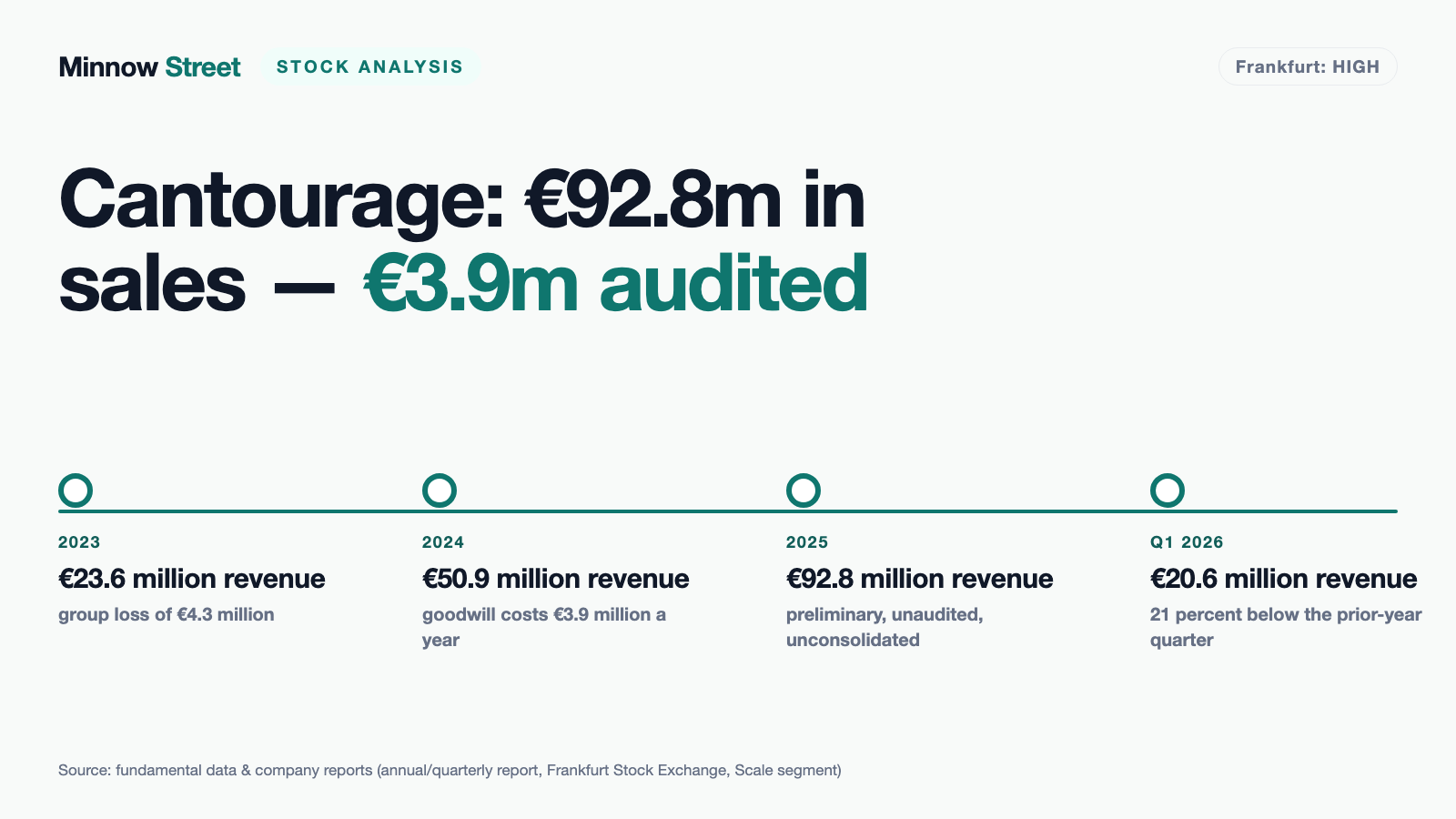
Cantourage reported group revenue of EUR 92.8 million for 2025, up 82.3 percent. By the company's own wording, that figure is preliminary, unconsolidated and unaudited. The only audited 2025 statement is the holding company's separate account — and it shows revenue of EUR 3,907,032.70, because it covers nothing but the administrative parent. Which is why data providers still carry key ratios built on EUR 3.9 million. We read both sets of statements in the original and sort out which number applies to what.
 Thomas Mücke
Founder & Publisher
Thomas Mücke
Founder & Publisher
Chart
Interactive price chart (TradingView).
Note: pure fact-based analysis, not investment advice and not a solicitation to buy or sell. All figures without guarantee.
There is a trick every good pharmacy knows: what sits in the window display is rarely what actually sells. Call it the display-case trap — we look at what is on show and forget to ask what is lying in the drawer behind it. At Cantourage Group SE, a Berlin-based importer and distributor of medical cannabis, that trap is set with unusual tidiness. In the window sits a number worth showing off: EUR 92.8 million in group revenue for 2025, up 82.3 percent. In the drawer behind it lies a different document — the only audited statement for that same year, and it shows revenue of EUR 3,907,032.70. Both numbers are correct. They simply describe different things. So let us make a deal: we read both sets of statements in the original together, sort out which number applies to what, and see what is left at the end. What you make of that is up to you.
What Cantourage actually does — the middleman in the prescription business
Cantourage Group SE (Feurigstrasse 54, 10827 Berlin, registered at Charlottenburg local court under HRB 248794 B) does not grow cannabis. The company is an importer, processor and wholesaler: it buys prescription cannabinoid medicines from producers around the world, walks them through Europe's approval and quality processes, and delivers them to pharmacies and wholesalers. Picture a wine importer who finds small growers overseas, guides them through customs and labelling rules, and then sells to the specialist trade — except that here, instead of customs and labels, you have pharmaceutical law, narcotics law and European manufacturing standards.
The company's core product is called the "Rapid Access Platform," billed in the reports as "RAP service fees": producers who could not open the European market on their own get the whole path from testing to pharmacy delivery handled by Cantourage. The audited 2024 consolidated statements break this down precisely. Of EUR 50,914,875.95 in group revenue, kEUR 46,457 came from pure product sales — "exclusively prescription cannabinoid medicines, mainly cannabis flowers and active-ingredient concentrates" — and kEUR 4,458 from services such as those RAP service fees, marketing and rebilled charges. In 2024, 77 percent of revenue was earned in Germany and 23 percent abroad.
Besides the listed holding company, the group comprises Cantourage GmbH and APSAT GmbH (both Berlin, 100 percent each) plus three companies in London — Cantourage Holdings LTD, Cantourage Clinic LTD and Cantourage UK LTD, in which the group holds 51 percent each. Poland's Cantourage Polska was not consolidated at all in the 2024 statements, on grounds of "minor significance" under section 296 of the German Commercial Code. On an average-headcount basis, the group employed 75 people in 2024 (2023: 63). Philip Schetter is chief executive; Monique Jaqqam has been chief financial officer since January 1, 2026.
Why there is no SEC filing here — and what counts as evidence instead
One point up front, because it shapes the entire evidence base: there is no 10-K and no 10-Q for Cantourage. The company is not a US reporting issuer; a search of the US Securities and Exchange Commission's EDGAR database returns no central index key and no filings under the ticker HIGH. Cantourage is listed in the Scale segment of the Frankfurt Stock Exchange — Germany's qualified open market — since trading began on November 11, 2022. And that distinction is not a footnote in this analysis; it is the main event.
The Scale segment is not a regulated market in the legal sense but a privately organized trading venue with markedly lighter reporting duties. In plain terms for you as a reader: no audited quarterly report, no mandatory group management report, no compulsory cash flow statement at group level. Every figure in this analysis is therefore attributed as "Source: fundamental data & company reports (annual/quarterly report, Frankfurt Stock Exchange, Scale segment)" rather than "SEC filings." For contrast, look at a German name listed in the strictly regulated Prime Standard in our SUSS MicroTec stock analysis: audited IFRS consolidated statements there, complete with a full cash flow statement — voluntarily prepared German-GAAP consolidated statements without one here.
How this stock landed on our desk — through the forum charts
Honesty first: Cantourage did not come to us through our in-house stock scanner — that covers primarily US-listed names, and for this micro cap the fundamental-data feed does not even carry complete quarterly series. The trigger was something else: in August 2026, Cantourage ranked high in the forum charts of wallstreet-online, meaning it was among the names retail investors were talking about most. That is neither a buy argument nor a sell argument — it is a reason to go looking. When a lot of people talk about a stock, it pays to read the documents nobody reads.
And that is exactly where the first oddity shows up. Call up Cantourage on a typical financial portal or through a fundamental-data feed and you get trailing twelve-month revenue of roughly EUR 3.9 million. Against a market value in the mid double-digit millions, that produces a price-to-sales ratio of about 17 — a number at which any value investor reflexively turns the page. Except that this figure does not describe the business that sells cannabis. It describes the administrative holding company above it. How that comes about is the subject of the next sections, and it is the core of this analysis.
The numbers over the years — credit where credit is due
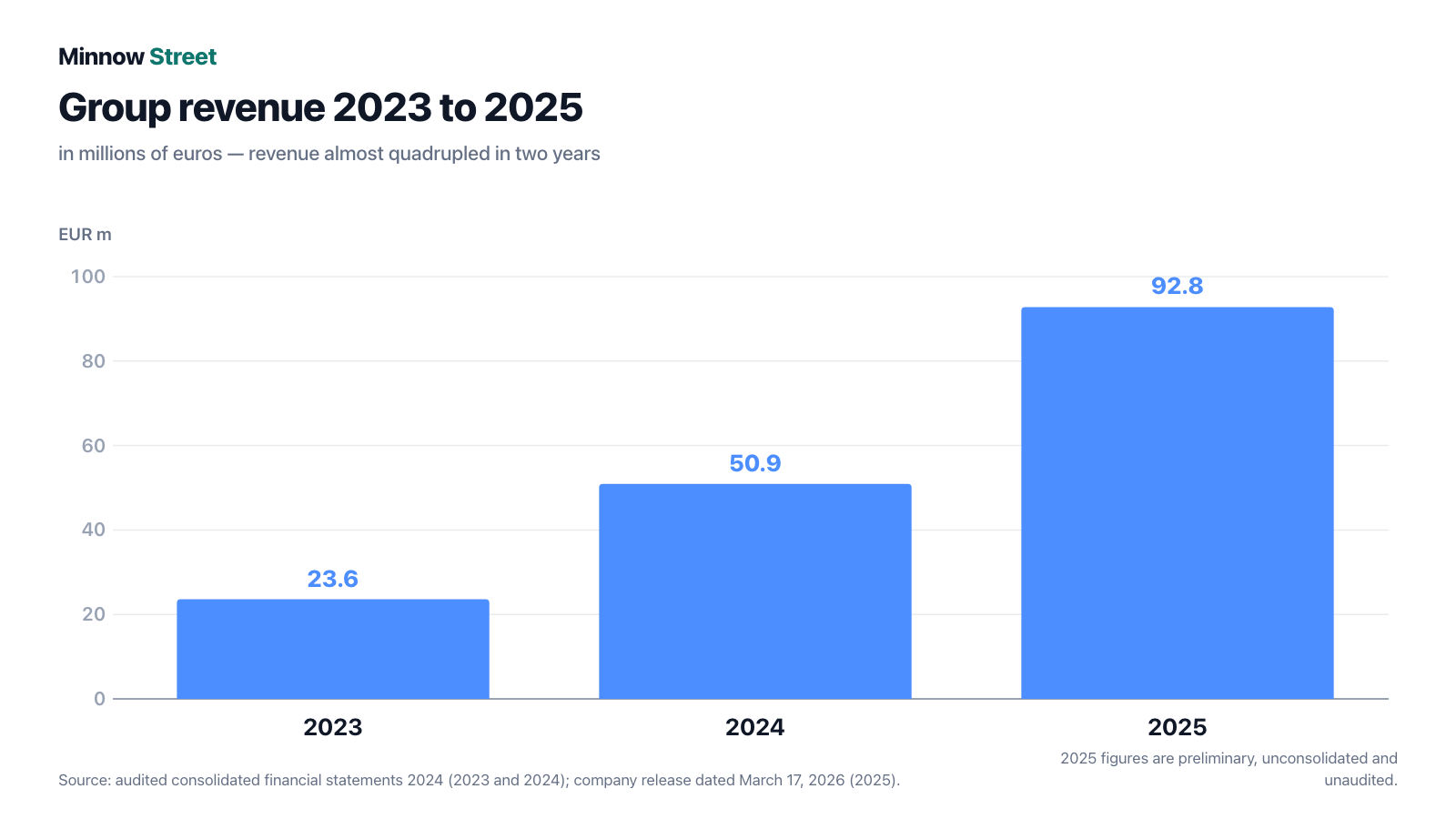
First, what genuinely impresses: Cantourage is growing fast, and has been for several years. Audited group revenue rose from EUR 23,556,739.95 (2023) to EUR 50,914,875.95 (2024) — more than a doubling. For 2025, the company reported group revenue of EUR 92.8 million on March 17, 2026, up 82.3 percent. In two years, revenue has therefore almost quadrupled. That is no small thing, and it fits a German market that exploded after medical cannabis rules were overhauled in April 2024: in the first half of 2025 alone, imports into Germany rose by more than 400 percent according to figures cited in the legislative process, from around 19 to around 80 tonnes.
Earnings are improving too, if from a deep hole: operating profit (EBIT) went from minus EUR 4,328,501.13 (2023) to minus EUR 722,704.72 (2024). The consolidated net loss attributable to the parent shrank from EUR 4,272,777.74 to EUR 1,249,895.84. EBITDA — earnings before interest, taxes, depreciation and amortization — as reported by the company came to EUR 3.8 million in 2024 and a preliminary EUR 5.7 million in 2025. In the first quarter of 2026, Cantourage reported EBITDA of EUR 2.2 million at a margin of 10.6 percent.
And the balance sheet? At first glance it is reassuring. As of December 31, 2024, equity stood at EUR 38,902,876.55 against total assets of EUR 51,051,510.83 — an equity ratio of roughly 76 percent. Liabilities to banks: EUR 0.00. The company carries no bank debt, and net cash stood at EUR 8.8 million as of March 31, 2026. Anyone hunting for existential financing risk will not find it here. The uncomfortable parts sit elsewhere.
What the reports actually say — the uncomfortable truths
Uncomfortable truth no. 1: there are no audited consolidated statements for 2025 — only the holding company's
Here the display-case trap becomes concrete. On May 15, 2026, Cantourage published its audited annual financial statements 2025. That sounds like the document containing the EUR 92.8 million. It is, however, the separate account of the holding company — the entity that sells no cannabis itself but merely holds the subsidiaries and charges them for administrative services. The notes say so in dry terms:
"Revenue relates to sales to affiliated companies of EUR 3,907,032.70 (prior year: EUR 2,195,385.79), arising from one service agreement each with Cantourage GmbH, Berlin, and APSAT GmbH, Berlin."
— Cantourage Group SE, audited annual financial statements 2025, notes, section D item 2, published May 15, 2026 (translated from the German original)

Those EUR 3.9 million are therefore intragroup revenue — money moving from one pocket of the same group to the other. In consolidated accounting, that gets eliminated. In the holding company's accounts, it appears as "revenue." And because many data providers pull the most recent audited separate account for small caps, that exact figure ends up in the key ratios you see on financial portals. The holding company's net income of EUR 126,456.68 tells the same story: it says nothing about whether the operating business earns money — only that the administrative entity covered its own costs.
The last audited consolidated statements are for fiscal 2024. The EUR 92.8 million for 2025 exists to this day only in a company release dated March 17, 2026, whose own small print notes that the group figures are "preliminary, unconsolidated and unaudited." That is neither an accusation nor a complaint — in the Scale segment it is permissible. It simply matters when you build valuation ratios on top of it.
One detail about the pace that is easy to miss: the auditor's report under the audited consolidated statements for 2024 is dated Stuttgart, March 5, 2026. Roughly fourteen months therefore passed between the December 31, 2024 reporting date and the audit opinion. Anyone hoping for a reliable look at the group in the spring of 2026 was looking at numbers that were already a year old — and the 2025 statements had not even begun at that point.
Uncomfortable truth no. 2: the consolidated cash flow statement and management report are expressly waived
If you want to know whether a fast-growing distributor is actually taking in cash or merely piling up inventory and receivables, you normally turn to the cash flow statement. It shows how much money genuinely comes in from operations. At Cantourage there is none. The 2024 notes put it in a single sentence:
"The preparation of a consolidated cash flow statement, a consolidated statement of changes in equity and a group management report is waived."
— Cantourage Group SE, audited consolidated financial statements 2024, notes, section A item 1 (translated from the German original)

The sentence immediately before it is at least as remarkable: "The consolidated financial statements are prepared voluntarily." Cantourage is under no obligation to present consolidated statements at all and does so anyway — credit where it is due. But "voluntarily" also means the scope is self-determined. Translated into everyday terms: you get an invoice with a bottom line, but no bank statement. Whether there is actually money in the account at the end of a growth year, or whether it is tied up in inventory and unpaid bills, cannot be recomputed from the published documents. You learn it only indirectly — through the net cash figure the company gives in its quarterly statements (most recently EUR 8.8 million as of March 31, 2026).
That pre-financing growth was in fact an issue is confirmed elsewhere in the 2024 notes: Cantourage had sold receivables of kEUR 4,500 to a factoring company, expressly to "improve short-term liquidity." That arrangement was terminated early as of June 30, 2025 against a break fee of kEUR 200.

Uncomfortable truth no. 3: four fifths of equity is goodwill that costs EUR 3.9 million every year
Now to the balance sheet, and here it pays to look closely. Of total assets of EUR 51,051,510.83 as of December 31, 2024, EUR 31,380,185.49 was goodwill. Goodwill arises when a company pays more for an acquisition than the acquired tangible assets are worth on their own. It is not a warehouse, not a machine and not a bank balance; it is a book entry representing an expectation about the future. Measured against equity of EUR 38,902,876.55, that single item made up roughly 81 percent.
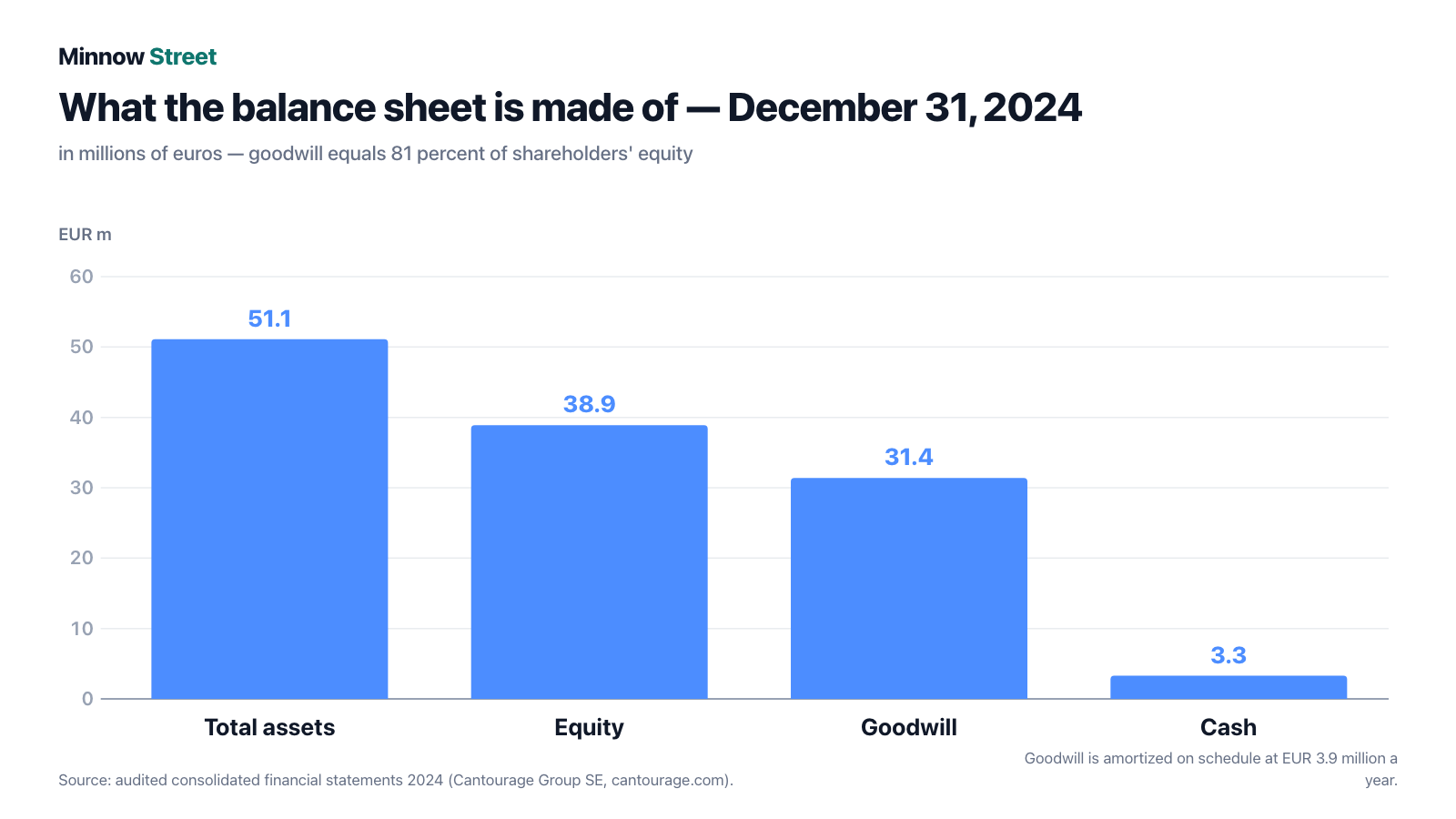
Because Cantourage reports under German commercial law rather than international standards, this goodwill is not tested annually for impairment but simply amortized on schedule — year after year, in equal instalments. The notes state the amount:
"Amortization and depreciation of intangible fixed assets and property, plant and equipment are predominantly driven by the amortization of goodwill of kEUR 3,923 (prior year: kEUR 3,923)."
— Cantourage Group SE, audited consolidated financial statements 2024, notes, section D item 5 (translated from the German original)

The fixed-asset movement schedule shows the full mechanics: acquisition cost of goodwill EUR 39,225,231.87, accumulated amortization as of December 31, 2024 already EUR 7,845,046.38 — exactly twice EUR 3,922,523.19, for 2023 and 2024. At an unchanged rate, the amortization runs for roughly another eight years. And this is precisely why a positive EBITDA and a loss can both be true at once: the preliminary 2025 EBITDA of EUR 5.7 million is earnings before amortization. Subtract the goodwill charge of EUR 3.9 million alone and less than half is left before interest and taxes. In 2024, EBITDA of EUR 3.8 million was not enough to cover amortization and depreciation of EUR 4,205,811.59 — hence the consolidated net loss of EUR 1,249,895.84. Remember the picture: an EBITDA figure says nothing about what a past acquisition still costs every year.
Uncomfortable truth no. 4: growth turned during the course of 2025
The annual figure of plus 82.3 percent conceals a movement you only see by laying the quarters side by side. Revenue was EUR 26.1 million in the first quarter of 2025 and EUR 27.9 million in the second — EUR 54.0 million in the first half combined. In the third quarter of 2025 it was down to EUR 20.1 million; after nine months the group stood at EUR 74.9 million. Set that against the full-year figure of EUR 92.8 million and the closing quarter is left with markedly less than any quarter of the first half.
For the first quarter of 2026, Cantourage reported EUR 20.6 million in revenue — the company itself framed this as a gain of 11.0 percent over the fourth quarter of 2025. Against the first quarter of 2025 (EUR 26.1 million), however, it is a decline of roughly 21 percent. The reason does not lie abroad: in the first quarter of 2026, the United Kingdom accounted for 41.3 percent of group revenue and Poland for 7.3 percent — both growing. Germany came to 51.5 percent, down from a 77 percent domestic share in 2024. Chief executive Philip Schetter had already described the home market as "challenging" in a "difficult regulatory and economic environment" in the nine-month statement of October 30, 2025.
To be fair: profitability held up better than revenue. The EBITDA margin came to 10.6 percent in the first quarter of 2026 (EUR 2.2 million) — well above the 6.1 percent that EUR 5.7 million of EBITDA on EUR 92.8 million of revenue implies for full-year 2025. The company attributes this to a shift toward higher-margin premium products and targets an EBITDA margin of 11.5 percent for 2026.
The market around it: two laws that could move everything
A distributor of prescription medicines lives by the rules that govern how they may be prescribed. In Germany, two of those rules are currently in play — and both matter for Cantourage.
The first is already law: on July 30, 2026, Germany's statutory health insurance contribution rate stabilisation act took effect. Cannabis flowers no longer fall under the special entitlement of section 31(6) of the Fifth Book of the German Social Code, meaning statutory health insurers no longer reimburse them by the same route as before. On August 6, 2026, the National Association of Statutory Health Insurance Physicians and the umbrella association of statutory health insurers published a joint clarification: patients already being treated with cannabis extracts or dronabinol and nabilone preparations may continue their therapy without having to try a finished medicinal product first. Cantourage welcomed that clarification on August 7, 2026 and stated at the same time that it has no material effect on its own business development, since its dependence on reimbursement rules is low. That is plausible: since 2024 the German medical cannabis market has run overwhelmingly on private prescriptions, meaning self-payers.
The second law is the real open flank, and it has not been passed. The federal government intends to amend the Medical Cannabis Act: an initial prescription would require in-person contact with a doctor, follow-up prescriptions by telemedicine would be allowed only where an in-person visit took place at the same practice within the last four quarters — and mail-order dispatch of medical cannabis would be ruled out, while pharmacy courier services would remain untouched. The draft was with the health committee in the summer of 2026, the Bundestag vote had been postponed, and entry into force was seen as realistic no earlier than the second half of 2026. For Cantourage this cuts twice, because the company says it is expanding telemedicine platforms — Telecan in Germany, Can Clinic in the United Kingdom. Should the amendment arrive in its planned form, it hits precisely that channel.
On the opportunity side stands a step Cantourage took on July 15, 2026: the launch of its first own brand, "gramz.," for the German market. The decisive difference is not the label but the business model behind it. Instead of taking a share of revenue on third-party flowers as before, Cantourage buys the goods for "gramz." itself and keeps a wider margin. According to the company, the first batches sold out within two days.
Valuation: what can be calculated — and what cannot
Start with what is solid. The share count is 12,970,672, with share capital of EUR 12,970,672 and a par value of EUR 1.00 per share (investor relations page, retrieved August 7, 2026). That number has risen since 2025: as of December 31, 2024 there were 12,467,479 shares; in fiscal 2025 another 503,193 were added, because the VSOP employee programme launched in 2022 vested after a four-year waiting period and beneficiaries contributed their claims as a contribution in kind. And the room keeps being used: on June 5, 2026, Cantourage published two directors' dealings notifications under which chief executive Philip Schetter and chief financial officer Monique Jaqqam each accepted 25,000 stock options under the 2023 stock option plan approved by the annual general meeting — 50,000 subscription rights combined, or roughly 0.4 percent of today's share count. The exercise price follows the volume-weighted Xetra closing auction price over the ten trading days before each issue date. That is little in itself; it does show that the authorizations are not sitting idle on paper.
Instead of a daily quote, we take a range: in the twelve months to August 7, 2026, the stock moved between EUR 2.35 and EUR 6.86. Multiplied by 12,970,672 shares, that gives a market value between roughly EUR 30 million and EUR 89 million — against preliminary 2025 group revenue of EUR 92.8 million, a price-to-sales ratio between about 0.3 and 1.0. For a distributor with a single-digit EBITDA margin, that is not a stretched valuation. Take instead the EUR 3.9 million of revenue from the audited holding-company account and you arrive at a price-to-sales ratio of 8 to 23 — which is exactly the range you land in if you rely on portal data without reading the footnote. Same stock, two valuation worlds, depending on which document you open.
And what do the professionals say? Three houses cover the stock, and all three rate it a buy: First Berlin (analyst Ellis Acklin) with a price target of EUR 11.00, NuWays (Christian Sandherr) at EUR 10.00 and Montega (Ingo Schmidt) at EUR 9.00 (per the investor relations page, retrieved August 7, 2026). All three targets therefore sit above the 52-week high of EUR 6.86. Context belongs here: with Scale-segment micro caps, analyst coverage is frequently commissioned and paid for by the company itself — that is industry practice, but it does not carry the same independence as a blue chip followed by a dozen houses. For a case of how far analyst expectations and operating reality can drift apart, see our Serviceware stock analysis.
Opportunities and risks at a glance
What speaks for Cantourage:
- Group revenue has almost quadrupled in two years — from EUR 23.6 million (2023) through EUR 50.9 million (2024, audited) to EUR 92.8 million (2025, preliminary).
- The balance sheet carries no debt: EUR 0.00 in liabilities to banks as of December 31, 2024, an equity ratio of roughly 76 percent, net cash of EUR 8.8 million as of March 31, 2026.
- Internationalization is working: the United Kingdom accounted for 41.3 percent of revenue in the first quarter of 2026 and Poland for 7.3 percent — leaving the group less exposed to German regulatory risk than in 2024, when 77 percent of revenue was domestic.
- Margins are rising: an EBITDA margin of 10.6 percent in the first quarter of 2026 against an implied 6.1 percent for full-year 2025; the own brand "gramz." (launched July 15, 2026) is meant to widen the spread further, because the goods are bought outright rather than revenue-shared.
- The contribution rate stabilisation act of July 30, 2026 does not materially affect the business, by the company's own account, because the German market runs overwhelmingly on private prescriptions.
What speaks against it:
- No audited consolidated statements exist for 2025. The EUR 92.8 million in revenue and the EUR 5.7 million of EBITDA are, by the company's own wording, "preliminary, unconsolidated and unaudited"; the only audited 2025 statement is the holding company's separate account showing revenue of EUR 3,907,032.70.
- A consolidated cash flow statement, a consolidated statement of changes in equity and a group management report are expressly waived — the operating cash inflow cannot be recomputed from any published document.
- Goodwill of EUR 31,380,185.49 equals 81 percent of equity and costs EUR 3,922,523.19 a year on schedule — more than two thirds of preliminary 2025 EBITDA.
- Revenue fell during the course of 2025: from EUR 27.9 million in the second quarter to EUR 20.1 million in the third; the first quarter of 2026, at EUR 20.6 million, was roughly 21 percent below the prior-year quarter.
- The planned amendment to the Medical Cannabis Act would ban initial prescriptions by telemedicine and rule out mail-order dispatch of medical cannabis — precisely the channels Cantourage is building out with Telecan and Can Clinic. The draft had not been passed as of the summer of 2026.
- Authorized and contingent capital add up to as many as 6,937,500 potential new shares — 53.5 percent of today's share count on paper; the authorized-capital mandate runs to June 7, 2027 and permits exclusion of subscription rights.
A human bottom line
Back to the display-case trap from the opening. Its point is not that Cantourage hides anything — quite the opposite: every uncomfortable number in this analysis sits in a document the company published itself, some of it voluntarily. Its point is that two completely different pictures of the same company are in circulation at once, and both can cite genuine paperwork. One picture shows a distributor that grew from EUR 24 million to EUR 93 million in revenue in two years, carries no debt and is improving its margin. The other shows an administrative entity with EUR 3.9 million of intragroup revenue, EUR 126,456.68 of net income and goodwill that makes up four fifths of equity and eats almost four million euros a year. Anyone who knows only one of the two pictures has the wrong picture.
The honest question for you, then, is not "is Cantourage cheap or expensive?" but this: are you buying the number in the window — or the company behind it, with growth that turned during the year, a draft law hanging over its sales channel, and audited consolidated statements for 2025 still outstanding? The half-year 2026 interim statement on August 13, 2026 delivers the next piece of the picture. What you make of that is your decision. The decision is yours.
Sources
All original documents used in this analysis — for you to read yourself:
- Cantourage Group SE — investor relations page with all financial reports, share count, analyst coverage and financial calendar (retrieved August 7, 2026)
- Cantourage Group SE — audited consolidated financial statements 2024 (German GAAP/HGB, prepared voluntarily): consolidated balance sheet, income statement, notes and fixed-asset movement schedule; auditor's report dated Stuttgart, March 5, 2026 (PDF, available via the investor relations page)
- Cantourage Group SE — audited annual financial statements 2025 (HGB separate financial statements of the holding company, published May 15, 2026) with balance sheet, income statement, notes and auditor's report (PDF)
- Cantourage Group SE — interim financial statements as of June 30, 2025 (unaudited, separate account, PDF)
- Cantourage Group SE — release: preliminary group figures 2025 (March 17, 2026) — expressly "preliminary, unconsolidated and unaudited"
- Cantourage Group SE — quarterly statement for the first quarter of 2026 (May 11, 2026) and nine-month statement 2025 (October 30, 2025)
- Cantourage Group SE — release on the first quarter of 2025
- Cantourage Group SE — two directors' dealings notifications dated June 5, 2026: acceptance of 25,000 stock options each by Philip Schetter and Monique Jaqqam under the 2023 stock option plan
- Cantourage Group SE — press release "Cantourage presents its own brand gramz. for the German market" (July 15, 2026)
- Cantourage Group SE — press release welcoming the clarification on the statutory health insurance contribution rate stabilisation act (August 7, 2026)
- German Federal Ministry of Health — act amending the Medical Cannabis Act: status of the legislative process
- Fundamental data (Xetra price range, master data; as of August 7, 2026), reconciled against the company reports.
Transparency & disclaimer: this analysis is journalistic commentary on publicly available information. It is not investment advice, not a financial analysis in the regulatory sense, and not an invitation to buy or sell securities. Equity investments carry substantial risk up to and including total loss; with micro caps in the open market, thin trading and larger price swings come on top. All information without warranty; the as-of date for each figure is noted in the text. Positions held by the operator are disclosed daily; where one exists, it appears as a notice at the top of this deep dive.
Our Bottom Line at a Glance
- Growth positive
- Group revenue rose from EUR 23.6 million (2023) through EUR 50.9 million (2024, audited) to EUR 92.8 million (2025, preliminary) — almost a quadrupling in two years, carried by a European market whose German imports grew by more than 400 percent in the first half of 2025.
- Reporting quality negative
- No audited consolidated statements exist for 2025; the only audited statement is the holding company's separate account with revenue of EUR 3,907,032.70. A consolidated cash flow statement, statement of changes in equity and management report are expressly waived per the 2024 notes — the operating cash inflow cannot be recomputed.
- Balance sheet substance neutral
- The balance sheet carries no bank debt (EUR 0.00 in liabilities to banks as of December 31, 2024) at an equity ratio of roughly 76 percent and net cash of EUR 8.8 million (March 31, 2026). At the same time, EUR 31,380,185.49 — or 81 percent of equity — is goodwill that costs EUR 3,922,523.19 a year on schedule.
- Earnings neutral
- EBITDA improved from EUR 3.8 million (2024) to a preliminary EUR 5.7 million (2025), and the EBITDA margin reached 10.6 percent in the first quarter of 2026. Below the line, however, 2024 ended in a consolidated net loss of EUR 1,249,895.84, because amortization and depreciation of EUR 4,205,811.59 exceeded EBITDA.
- Regulation negative
- The contribution rate stabilisation act (in force since July 30, 2026) has no material effect according to the company's statement of August 7, 2026. The planned amendment to the Medical Cannabis Act, by contrast, would ban initial prescriptions by telemedicine and rule out mail-order dispatch — channels Cantourage is currently building out. The draft had not been passed as of the summer of 2026.
- Ownership and dilution negative
- Authorized capital 2022/I (up to EUR 5,937,500, valid until June 7, 2027, subscription rights excludable) and contingent capital 2023/I (up to EUR 1,000,000) cover as much as 53.5 percent of today's 12,970,672 shares on paper. In 2025, 503,193 shares were already issued out of the VSOP programme.
Cantourage has almost quadrupled group revenue in two years and carries no bank debt — except that the figure documenting that success is, for 2025, preliminary, unconsolidated and unaudited by the company's own account. The only audited 2025 statement is the holding company's separate account with EUR 3.9 million in revenue, and a consolidated cash flow statement does not exist at all. On top of that come goodwill amounting to 81 percent of equity, growth that turned during 2025, and a draft law that would hit the telemedicine and mail-order channel. Not investment advice.
What Our Rating Means
Open questions
The business works in principle, but one material question is open. As long as it stays open, our findings do not carry a quality verdict.
Yellow here is not about an existential question — the balance sheet is solid, with an equity ratio of roughly 76 percent, zero bank debt and net cash of EUR 8.8 million (March 31, 2026); there is no going-concern qualification and no accounting breach, and the audit opinion on the 2025 annual statements is unqualified. Yellow stands because two material operating questions are open. First, earnings quality: preliminary 2025 EBITDA of EUR 5.7 million faces scheduled goodwill amortization of EUR 3,922,523.19 a year that runs for roughly another eight years; in 2024, EBITDA was not enough to cover it. Second, verifiability: no audited consolidated statements exist for 2025, and a consolidated cash flow statement is expressly waived — for a distributor that has to pre-finance growth in inventory and receivables, that is the single most important missing number. The fact that receivables of EUR 4.5 million were sold to a factoring company in 2024 to improve liquidity, and that the arrangement ended early against a break fee in mid-2025, does not make the question smaller. The business model itself — importing and distributing prescription medicines with a rising margin and a growing international share — clearly works. Whether it still works under a tightened Medical Cannabis Act is the real open question. The decision is yours.
A journalistic assessment by our editorial team at the time of the deep dive, based on public sources — not investment advice and not a solicitation to buy or sell. Your personal circumstances (investment goals, risk capacity, taxes) cannot be taken into account. What our levels mean, how verdicts are formed, and what conflicts of interest exist →
Worth Noting
- The hook for this analysis is Cantourage's prominence in the retail-investor forum charts of wallstreet-online in August 2026 — a reason to research, not a valuation argument. All company figures come from the audited consolidated statements 2024, the audited annual statements 2025, the interim statements as of June 30, 2025 and the company's quarterly statements.
- Important when comparing against data providers: the revenue figure of roughly EUR 3.9 million frequently shown on financial portals is the revenue of the holding company's separate account (intragroup service charges to its own subsidiaries), not group revenue. Ratios such as price-to-sales or margin built on it are useless for judging the operating business. All valuation and price data as of August 7, 2026.
- Cantourage is not a US reporting issuer: there is no 10-K, no 10-Q and no registration with the US Securities and Exchange Commission (an EDGAR query for the ticker HIGH returns nothing). The stock trades in the Scale segment of the Frankfurt Stock Exchange, meaning the qualified open market, with markedly lighter reporting duties than the regulated market. Notations such as "HIGH.DE" are data-vendor shorthand, not an official exchange code.
The full analysis as a PDF for later
We will send you this analysis as a PDF — to print, file away, and read at your own pace.
Frequently Asked Questions
Cantourage Group SE of Berlin does not grow cannabis. It imports, processes and distributes prescription cannabinoid medicines to pharmacies and wholesalers across Europe. In 2024, kEUR 46,457 of group revenue came from product sales — mainly cannabis flowers and active-ingredient concentrates — and kEUR 4,458 from services. On an average-headcount basis, the group employed 75 people in 2024.
Because they use the most recent audited separate account of the holding company. For 2025 it shows revenue of EUR 3,907,032.70 — purely service agreements with its own subsidiaries Cantourage GmbH and APSAT GmbH. Group revenue for 2025 was EUR 92.8 million according to the company, though that figure is preliminary, unconsolidated and unaudited.
No. As of August 7, 2026, the only audited consolidated statements covered fiscal 2024. The audited annual statements published on May 15, 2026 are the holding company's separate account; the 2025 group figures come from a company release dated March 17, 2026 and are expressly labelled preliminary and unaudited there.
The 2024 consolidated notes state that the consolidated statements are prepared "voluntarily" and that a consolidated cash flow statement, a consolidated statement of changes in equity and a group management report are waived. In the Scale segment of the Frankfurt Stock Exchange that is permitted. For investors it means the group's operating cash inflow cannot be recomputed from published documents.
Goodwill arises when more is paid for an acquisition than the acquired tangible assets are worth on their own. At Cantourage it equalled roughly 81 percent of equity of EUR 38,902,876.55 as of December 31, 2024. Under German commercial law it is amortized on schedule — at EUR 3,922,523.19 a year, more than two thirds of preliminary 2025 EBITDA.
The act took effect on July 30, 2026; cannabis flowers no longer fall under the special entitlement of section 31(6) of the Fifth Book of the German Social Code. On August 7, 2026, Cantourage stated that the August 6, 2026 clarification issued by the physicians' and insurers' associations has no material effect on its business development, as its dependence on reimbursement rules is low.
The planned amendment to the Medical Cannabis Act. It would allow initial prescriptions only after in-person contact with a doctor and would rule out mail-order dispatch of medical cannabis. Those are exactly the channels Cantourage is building out with the Telecan and Can Clinic telemedicine platforms. The draft was with the health committee in the summer of 2026 and had not been passed.
Cantourage is listed in the Scale segment of the Frankfurt Stock Exchange — Germany's qualified open market — and is not a US reporting issuer. There is no 10-K, no 10-Q and no registration with the US Securities and Exchange Commission. This analysis therefore rests on the audited consolidated statements 2024, the audited annual statements 2025 and the company's quarterly statements.
Found an error?
Did you spot a factual error, an outdated number, or a typo in this deep dive? Let us know briefly — your report goes straight to the editorial team.