Atos Group: The Margin Is Rising — and Equity Sits 1.3 Billion Euros Below Zero
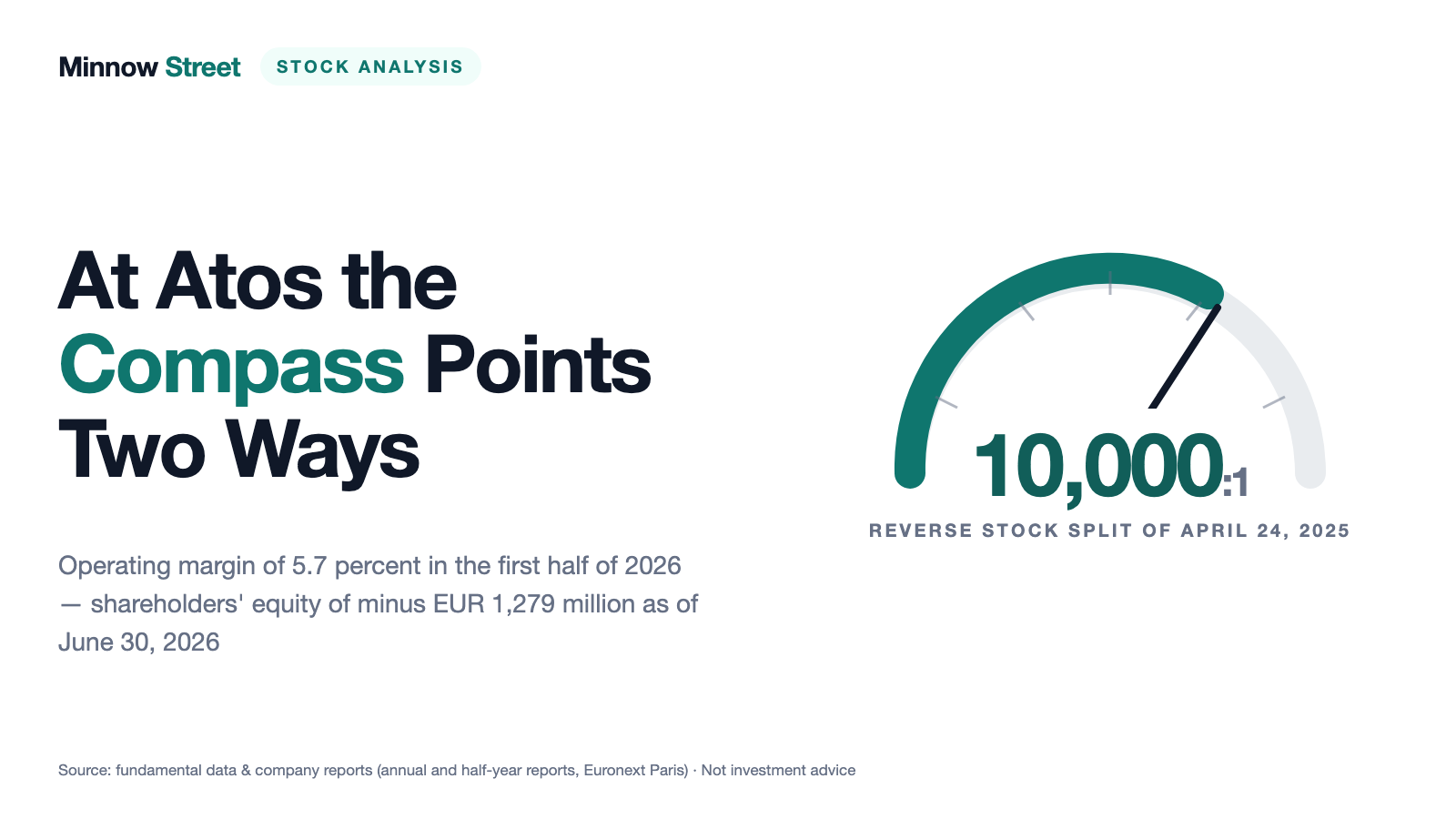
New name, new ticker chart, new savings programme: Atos Group consolidated its 179 billion shares at a ratio of 10,000 to 1 in 2025, dropped the name "Atos SE" on May 22, 2026, and reported an operating margin of 5.7 percent at current perimeter for the first half of 2026, against 3.7 percent a year earlier. The half-year report as of June 30, 2026 also carries the other half of the story: total shareholders' equity of minus EUR 1,279 million, free cash flow of minus EUR 302 million for the half year, and revenue that has fallen every year since 2022 — from EUR 11,341 million to EUR 8,001 million. Not a recommendation, but the question of which of the two compass needles you believe.
 Thomas Mücke
Founder & Publisher
Thomas Mücke
Founder & Publisher
There is an investor trap that catches you precisely when you are doing the right thing — namely checking whether something has improved: the fresh-start trap. It works like this. A company was deep in trouble. Then a run of things happen that all look like a line being drawn. The ticker chart is reset, because 10,000 old shares become one new one. The name changes. A savings programme is running, and it happens to be called "Genesis" — creation, beginning. And sure enough: the margin rises. Your mind draws the obvious line: "The worst is over." That is exactly where the trap closes, because a new share price, a new name and a new programme change nothing about the balance sheet that keeps running underneath. Atos Group (Euronext Paris: ATO) of Bezons near Paris is the textbook case. So let us make a deal: before you look at the reset chart, we read together what the company itself reported — the half-year financial report as of June 30, 2026, filed with the French markets regulator AMF on July 30, 2026, and the 2025 annual report, known as the Universal Registration Document, filed with the same authority on March 10, 2026. These are mandatory disclosures; anyone who misstates them is liable for it. And they tell two stories at once. In the end you decide which one you believe.
What Atos Group Actually Does — the Invisible Engine Room of Large Organisations
Atos is an IT services provider. Put in everyday terms: when a corporation, a bank or a government ministry does not want to run its own computers, it hires Atos — caretaker, electrician and locksmith for the digital infrastructure, all in one. Concretely that means four things. First, running data centres and cloud systems, including "sovereign cloud", meaning servers guaranteed to sit in Europe and fall under European law. Second, the digital workplace: laptops, telephony, user helpdesk and access management for tens of thousands of a client's staff. Third, cybersecurity — Atos operates security operations centres that monitor client networks for attacks. And fourth, under the Eviden brand, the technically most demanding business: high-performance computing and mission-critical systems, including for defence and research.
As of June 30, 2026 the group employed 54,476 people — down from 63,194 at the start of the year, a drop of 13.8 percent in six months. Its customers are public sector and defence, manufacturing, banks and insurers, telecoms, energy, retail, transport and healthcare. This is a long-contract business: the order backlog stood at EUR 9.1 billion at the end of June 2026, equivalent to roughly 1.4 years of revenue. Where management wants to take it is spelled out in the 2025 annual report's letter to shareholders:
"Our ambition is clear: to become a global AI-powered technology partner shaping secure, end-to-end digital journeys for our clients."
— Atos Group, 2025 annual report (Universal Registration Document), letter to shareholders
That names the central tension of this analysis, and it runs through every chapter that follows: the operations at Atos Group really are getting better — and the balance sheet is getting worse at the same time. Both are documented in the same report, and both point in a different direction. A compass with two needles is no longer a compass; it is a decision you have to make yourself.
How the Stock Landed on Our Desk
Not through one of our scanners — those are fed with U.S. names. Atos came in through the reporting calendar of European issuers: on July 30, 2026 the company filed its half-year financial report as of June 30, 2026 with the French markets regulator AMF, accompanied by a press release headlined "Strong first-half performance". That headline was the trigger. Because when a company whose shares have lost practically all of their value in a few years calls its half year strong, the 68 pages behind the headline are worth reading. That is exactly the work a headline cannot replace — as with other IT services firms we have examined, such as the research and advisory house Information Services Group, whose numbers show the same industry from a completely different angle.
One note up front so you are not confused: since the annual general meeting of May 22, 2026 the company is called "Atos Group"; before that it was "Atos SE". Many databases, price lists and older articles therefore still carry the old name. It is the same company, the same ISIN (FR001400X2S4), the same ATO ticker on Euronext Paris.
The Numbers Over the Years — and What Really Did Improve
Let us start with what speaks for Atos, because there is something. At current perimeter — that is, adjusted for the businesses sold in the first half of 2026 — the operating margin in the first half of 2026 rose to EUR 190 million, or 5.7 percent of revenue, from EUR 133 million, or 3.7 percent, a year earlier. That is a jump of 2.1 percentage points, and it is not merely an arithmetic trick: as reported, without any adjustment, operating margin came to EUR 169 million against EUR 113 million a year earlier. The savings programme with the telling name "Genesis" had, according to the July 30, 2026 half-year release, already reached 112 percent of its savings target. And in individual regions Atos is growing again: the United Kingdom and Ireland added 7.1 percent in the first half, to EUR 606 million.
New business is picking up too. The metric for this is called book-to-bill, and it describes in one image whether more is flowing into the order funnel than is coming out of it as revenue: above 100 percent the funnel fills, below 100 percent it empties. In the second quarter of 2026 the ratio was 91 percent, roughly 7 percentage points above the year-earlier quarter — 89 percent for the half year. Let us grade that honestly: 91 percent is a clear improvement, but it is still below 100. The funnel is emptying more slowly; it is not filling. And the revenue curve looks exactly the same:
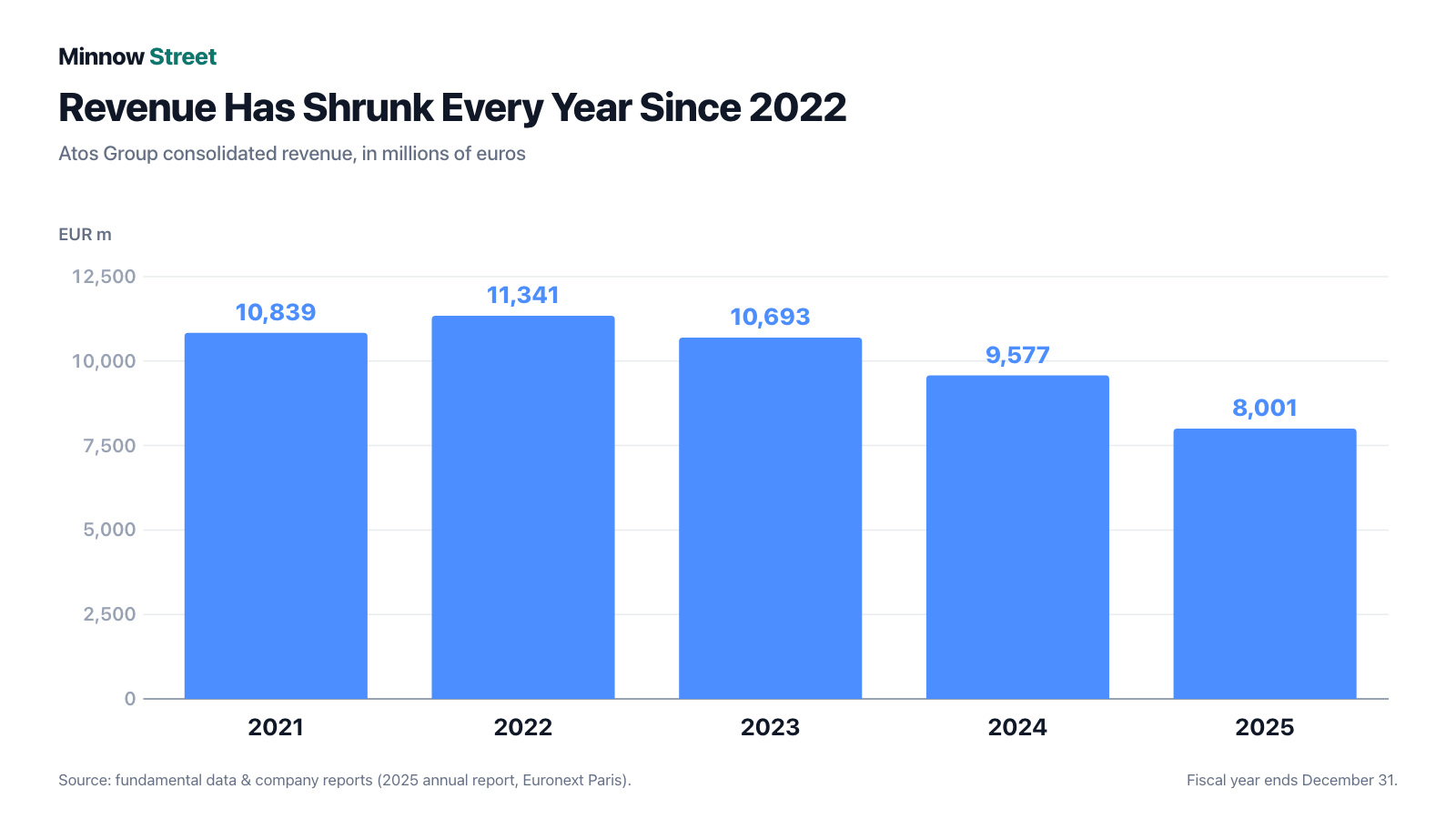
In the first half of 2026 that continued: EUR 3,410 million of revenue against EUR 4,020 million a year earlier. At current perimeter it was EUR 3,304 million versus EUR 3,626 million — an organic decline of 8.9 percent. The group itself expects roughly minus 5 percent organic growth for full-year 2026 at an operating margin of about 7 percent, and is targeting a margin of around 10 percent for 2028. Remember the finding: Atos earns more on every euro — but there are fewer euros every year. Which brings us to the uncomfortable truths.
What the Reports Say — the Uncomfortable Truths
Uncomfortable Truth No. 1: Equity Is Negative — and Going Negative Faster
Shareholders' equity is the balance sheet line that would be left if you sold everything and paid off every debt. When it is negative, the assets do not arithmetically cover the liabilities. At Atos Group that line showed minus EUR 1,279 million as of June 30, 2026 — after minus EUR 790 million as of December 31, 2025. In six months the hole deepened by EUR 489 million. And the longer view shows how fast it happened:
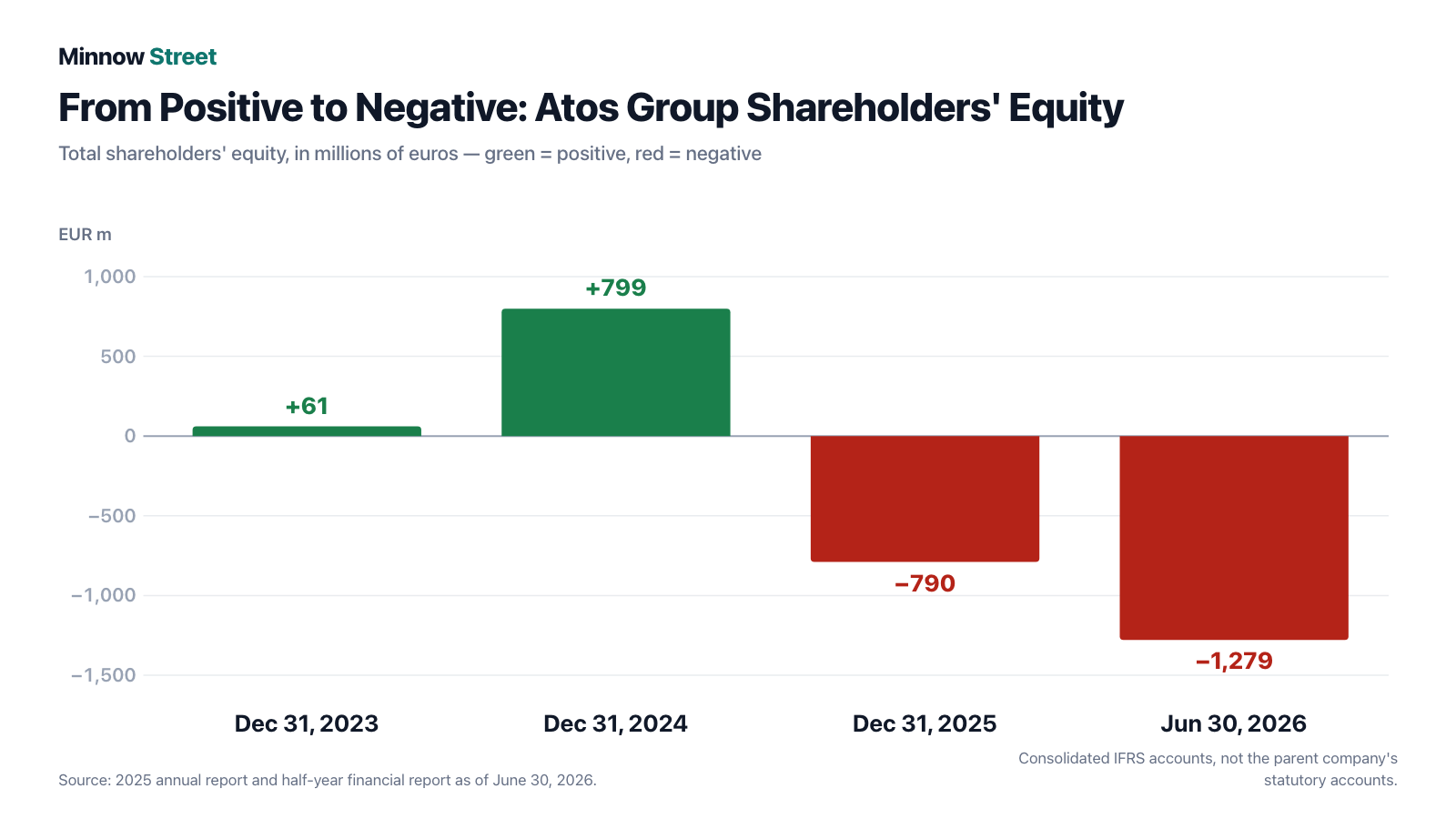
The plus of EUR 799 million as of December 31, 2024 was not money earned but the result of the restructuring: creditors swapped claims for shares, which lifted equity arithmetically. The following year the loss burned it off again — a net loss of EUR 1,404 million for 2025 attributable to the owners of the parent, after net income of EUR 248 million in 2024. The first half of 2026 added another EUR 503 million of loss (prior-year period: EUR 696 million). Here is the line in the original:

Negative equity is not an insolvency trigger and does not mean the lights go out tomorrow — as long as the company can pay its bills, operations continue. But it is the reason why classic valuation ratios do not work at Atos: you cannot build a meaningful price-to-book ratio on a negative book value, and you cannot build a return on equity either. And it means that every further month of losses deepens the hole rather than eating into a reserve. There is no reserve left.
Uncomfortable Truth No. 2: 10,000 Shares Became One — and the Chart Started From Zero
Now to the event that reset the chart. Dilution in everyday language means: your slice of the cake gets smaller because new slices are cut — the cake itself does not get bigger. At Atos this was not dilution but a flood. At the end of 2023 there were 111,439,307 shares. A year later, after the accelerated safeguard restructuring, there were 179,035,979,643 shares — more than 179 billion. Anyone who owned one percent of the company beforehand owned roughly one sixteen-hundredth of that afterwards.
Because a price of fractions of a cent is unworkable on any exchange, the consolidation followed:
"On April 24, 2025, the Company carried out a reverse stock split, exchanging 10,000 old shares with a nominal value of €0.0001 each for 1 new share with a nominal value of €1, in accordance with the decision of the Board of Directors dated March 6, 2025, following delegation of authority granted by the Combined General Meeting of 31 January 2025 (29th resolution)."
— Atos Group, half-year financial report as of June 30, 2026, Note 11 (Equity)

As of June 30, 2026 there were 19,750,179 shares outstanding. And here is the core of the fresh-start trap: a reverse split is purely cosmetic. It changes neither the company's assets nor your share of them — it merely swaps ten thousand small notes for one large one. What it does change is the optical impression: the price is suddenly back in double digits, and in many chart displays the history begins anew. Remember the sentence: a reverse split is new packaging, not new content. What the consolidation also did not end is the issuance of further shares — there is more on that in our side finds.
Uncomfortable Truth No. 3: The Cash Keeps Draining — and the Buffer Shrank Sharply in July
Free cash flow is the most honest number a group publishes: what is left in the till after all running costs and investments have been paid? At Atos it is negative, and has been for years:
"As a result of the above impacts, the Group reported negative free cash flow (FCF) of -€302 million in the first half of 2026 (-€271 million in the first half of 2025)."
— Atos Group, half-year financial report as of June 30, 2026, section 3.2 (Cash flow statement and net debt)

That outflow is paid out of the cash pile, and the pile is well stocked — at first glance. As of June 30, 2026 Atos held liquidity of EUR 1,805 million: EUR 1,735 million of cash plus EUR 70 million of undrawn credit line. The credit agreements require minimum liquidity of EUR 650 million, tested quarterly — so the cushion was EUR 1,155 million. Comfortable, it sounds. Except: on July 6, 2026, six days after the balance sheet date, Atos repaid EUR 857 million of the former first lien facility. The report puts liquidity after that at roughly EUR 948 million. The EUR 1,155 million of headroom above the minimum became barely EUR 300 million — against a half-year outflow of EUR 302 million. That is the real reason the half-year report has to be read carefully: the reassuring number on the balance sheet date was already out of date by the time it was published.
And another part of the cash belongs to Atos only in a restricted sense:
"For the purposes of the net debt calculation, the Group also took into account a financial asset of €255 million corresponding to the cash deposit pledged as collateral in connection with the TriZetto litigation. Given the restrictions on its use, this financial asset is excluded from the Group's cash and cash equivalent."
— Atos Group, half-year financial report as of June 30, 2026, section 3.2 (Net debt)
Net debt itself stood at EUR 1,193 million as of June 30, 2026 — or EUR 1,998 million once you strip out the fair value adjustment that carries the debt revalued in the restructuring below its nominal amount. The debt structure has three floors: EUR 1,250 million of new senior secured notes due May 2031 (EUR 950 million at a fixed 8.125 percent, EUR 300 million floating rate, rated B+ by S&P and BB- by Fitch), subordinated beneath them roughly EUR 1,562 million from the restructuring due 2030 and a further roughly EUR 359 million due 2032. Translated: the most pressing maturities have been pushed out to 2030 and 2031 — time has been bought, but it costs 8.125 percent in interest.
Uncomfortable Truth No. 4: A U.S. Judgment for $297.9 Million Hangs Over the Balance Sheet
In 2018 Atos bought the U.S. company Syntel. The acquisition brought a lawsuit into the house that is still not settled. In 2020 a U.S. jury found that Syntel had misappropriated trade secrets of Cognizant and its subsidiary TriZetto and infringed copyrights. The amount originally awarded was roughly $855 million and was reduced over the years across several instances. On April 29, 2026 the amended final judgment was entered:
"In total, Syntel, an Atos Group subsidiary in the United States, was ordered to pay approximately US$297.9 million to TriZetto."
— Atos Group, half-year financial report as of June 30, 2026, Note 12.1.1 (Litigation)

Roughly $297.9 million equals about EUR 255.7 million — more than 40 percent of the entire market value of Atos Group. Syntel filed a notice of appeal on May 19, 2026, and TriZetto a cross-appeal on June 1, 2026. So the judgment is not final, but it is not off the table either. To stay enforcement pending appeal, Syntel posted a supersedeas bond of roughly $309 million, secured by a cash deposit of $290 million — of which $203 million was added on top of the amount already on deposit. That is precisely the money excluded from cash and cash equivalents above. In everyday terms: Atos put up a security deposit for the right to appeal. Until the U.S. appeals court has ruled, the money is tied up — and if Atos loses, it is gone.
Valuation: Cheap on Revenue, Impossible on Book Value
How expensive is the stock? You cannot build a price-to-earnings ratio, because Atos is losing money. You cannot build a price-to-book ratio, because book value is negative. That leaves revenue as the yardstick — and on that measure the stock looks extremely cheap: a market value of roughly EUR 620 million (data as of August 3, 2026) stands against 2025 revenue of EUR 8,001 million. That is a price-to-sales ratio of roughly 0.08 — eight cents for every euro of revenue. At a healthy IT services provider that figure is typically one to two times revenue.
This apparent cheapness has a precise reason, and the right calculation shows it. Market value is only what belongs to shareholders. Enterprise value is what the whole company costs — market value plus net debt. At roughly EUR 620 million of market value and EUR 1,998 million of net debt (excluding the fair value adjustment) that comes to roughly EUR 2.6 billion. Put differently: of every euro that Atos Group as a whole is worth, only about 24 cents belong to shareholders; the other 76 cents belong to creditors. Whoever buys the stock buys the junior residual — the part that is worth something only once every loan has been served. That is precisely the price the market demands for negative equity.
The professionals take a friendlier view than this arithmetic: the average analyst price target as of August 3, 2026 was EUR 37.70 per share, above the market price. Take that for what it is — an opinion with an expected value, not evidence. How far expectations and balance sheet reality can diverge in this industry we also saw at the services provider TaskUs: the business can work and the stock can still tell a completely different story.
Opportunities and Risks at a Glance
What speaks for Atos Group:
- The margin is measurably rising: at current perimeter, EUR 190 million or a 5.7 percent operating margin in the first half of 2026, after EUR 133 million or 3.7 percent a year earlier; the "Genesis" savings programme reached 112 percent of its target (as of July 30, 2026).
- The order backlog of EUR 9.1 billion equals 1.4 years of revenue and gives the business a plannable base; the book-to-bill ratio improved to 91 percent in the second quarter of 2026, roughly 7 points above the year-earlier quarter.
- Maturities have been pushed out: EUR 1,250 million of new senior secured notes run to May 2031, the subordinated tranches to 2030 and 2032. There is no large repayment due before 2030.
- Liquidity stood at EUR 1,805 million as of June 30, 2026, far above the contractual minimum of EUR 650 million; the covenant was met in the first half of 2026.
- The end markets are in demand: sovereign European cloud, cybersecurity and high-performance computing for defence and the public sector are politically favoured growth markets, and individual regions are already growing again (the United Kingdom and Ireland up 7.1 percent in the first half of 2026).
What speaks against it:
- Total shareholders' equity is negative and deepening: minus EUR 1,279 million as of June 30, 2026, after minus EUR 790 million as of December 31, 2025 and plus EUR 799 million as of December 31, 2024. There is no reserve left to eat into.
- Revenue has fallen every year since 2022 — from EUR 11,341 million to EUR 8,001 million in 2025 — and by a further 8.9 percent organically in the first half of 2026; the company's own guidance calls for roughly minus 5 percent in 2026.
- The cash keeps draining: free cash flow of minus EUR 302 million in the first half of 2026, after minus EUR 271 million a year earlier. After the July 6, 2026 repayment of EUR 857 million, liquidity fell to roughly EUR 948 million — barely EUR 300 million above the EUR 650 million minimum.
- The U.S. judgment in the TriZetto case hangs over the balance sheet at roughly $297.9 million (about EUR 255.7 million) plus running interest of $21,604 per day; $290 million sits locked up as a cash deposit and is unavailable to the group.
- Headcount is shrinking fast: from 63,194 to 54,476 employees in six months, down 13.8 percent. At a services provider the workforce is the production line — every departure is also lost capacity and lost client knowledge.
A Human Conclusion
Back to the fresh-start trap from the opening. Its trick is not that it lies — at Atos Group a great deal really is new. The name is new, since May 22, 2026. The ticker chart is new, since April 24, 2025. The savings programme is literally named creation, and it delivers: 5.7 instead of 3.7 percent operating margin, 112 percent of the savings target reached. Its trick is that all these new things are visible, while the old things sit in the balance sheet and wait there patiently: minus EUR 1,279 million of equity, minus EUR 302 million of free cash flow for the half year, revenue down for the fourth year running, and a U.S. judgment for $297.9 million that has not been decided. The compass points two ways, and neither needle is lying.
The honest question for you is therefore not "is the turnaround done?" but: do you trust the operations to catch up with the balance sheet before the balance sheet catches up with the operations? The company has committed itself: roughly 7 percent margin in 2026, roughly 10 percent and leverage below 1.5 times by 2028. Those are checkable promises with a date on them — you can track them in every report without relying on anyone's opinion. If you take that on, do it with your eyes open: shareholders hold roughly a quarter of the enterprise value, the rest belongs to creditors, and with negative equity the distance to zero is not a reserve but an arithmetic problem. What you make of that is your decision. And that is exactly as it should be.
Sources
Every original document used in this analysis — for you to read yourself:
- Atos Group — half-year financial report as of June 30, 2026 (filed with the French markets regulator AMF on July 30, 2026)
- Atos Group — 2025 annual report (Universal Registration Document) (filed with the AMF on March 10, 2026 under number D.26-0075)
- Atos Group — press release on the 2026 half-year results, July 30, 2026
- Atos Group — monthly disclosure of shares and voting rights as of July 31, 2026 (published August 3, 2026): 19,750,179 shares, unchanged from June 30, 2026
- Atos Group — list of all financial press releases (atosgroup.com), checked on August 4, 2026: after the half-year report of July 30, 2026 the only further publication was the monthly disclosure as of July 31, 2026 named above.
- Fundamental data (market value, enterprise value, analyst consensus; data as of August 3, 2026), reconciled against the annual and half-year reports.
Transparency & disclaimer: this analysis is journalistic commentary on publicly available information. It is not investment advice, not a regulated investment recommendation and not a solicitation to buy or sell securities. Equity investments carry substantial risk up to and including total loss. All information without warranty; the as-of date of each figure is stated in the text. Positions held by the operator are disclosed daily; where one exists, it appears as a notice at the top of this deep dive.
Our Bottom Line at a Glance
- Balance sheet & substance negative
- Total shareholders' equity is negative and deepening: minus EUR 1,279 million as of June 30, 2026, after minus EUR 790 million as of December 31, 2025 and plus EUR 799 million as of December 31, 2024. The end-2024 surplus came from swapping claims for shares, not from money earned — and it was burned off by the 2025 net loss of EUR 1,404 million. There is no reserve left.
- Cash flow & liquidity negative
- Free cash flow was minus EUR 302 million in the first half of 2026, after minus EUR 271 million a year earlier. Liquidity of EUR 1,805 million as of June 30, 2026 fell to roughly EUR 948 million after the July 6, 2026 repayment of EUR 857 million — against a contractually required minimum liquidity of EUR 650 million that is tested quarterly.
- Operating trend positive
- At current perimeter, first-half 2026 operating margin rose to EUR 190 million or 5.7 percent, from EUR 133 million or 3.7 percent a year earlier; as reported, EUR 169 million after EUR 113 million. The "Genesis" savings programme reached 112 percent of its target (as of July 30, 2026), and the book-to-bill ratio improved to 91 percent in the second quarter of 2026.
- Revenue trend negative
- Revenue has fallen every year since 2022: EUR 11,341 million (2022), 10,693 (2023), 9,577 (2024), 8,001 million (2025). In the first half of 2026 it came to EUR 3,410 million against EUR 4,020 million, an organic decline of 8.9 percent at current perimeter. Company guidance for 2026 calls for roughly minus 5 percent; headcount fell from 63,194 to 54,476 in six months.
- Litigation risk negative
- The amended final judgment of April 29, 2026 orders the subsidiary Syntel to pay roughly US$297.9 million (about EUR 255.7 million) to TriZetto, plus $60.9 million of pre-judgment interest and $21,604 for each further day. Syntel filed a notice of appeal on May 19, 2026. To stay enforcement, $290 million sits as a cash deposit and is excluded from cash and cash equivalents.
- Financing structure neutral
- Maturities have been pushed out: EUR 1,250 million of senior secured notes run to May 2031 (EUR 950 million at 8.125 percent fixed, EUR 300 million floating; rated B+ by S&P, BB− by Fitch), the subordinated tranches to 2030 and 2032. No large repayment is due before 2030 — but the time was bought at a high price, and net debt stands at EUR 1,998 million excluding the fair value adjustment.
Atos Group is the fresh-start trap in pure form: a new corporate name since May 22, 2026, a reset ticker chart since the 10,000-to-1 consolidation of April 24, 2025, a savings programme called "Genesis" that has reached 112 percent of its target, and an operating margin that rose at current perimeter from 3.7 to 5.7 percent. All of that is real. The same report also carries total shareholders' equity of minus EUR 1,279 million, free cash flow of minus EUR 302 million for the half year, revenue down for the fourth year running, and a U.S. judgment for $297.9 million. Whoever buys the stock buys roughly a quarter of an enterprise value whose other three quarters belong to creditors. Not investment advice.
What Our Rating Means
Substance risk
We found at least one documented issue that threatens the company itself — regardless of how the stock is currently valued.
Red here stands for a documented risk to the substance of the business, not for a judgment on the share price. Two of the hard criteria are met at the same time: total shareholders' equity is negative and deepening (minus EUR 1,279 million as of June 30, 2026, after minus EUR 790 million six months earlier), and the cash outflow continues (free cash flow of minus EUR 302 million in the first half of 2026, after minus EUR 271 million a year earlier). On top of that, liquidity fell to roughly EUR 948 million after the EUR 857 million repayment on July 6, 2026, leaving barely EUR 300 million above the contractual minimum of EUR 650 million, while an undecided U.S. judgment for $297.9 million hangs over the balance sheet. Explicitly not part of this assessment is the price question: that the stock looks optically cheap at a price-to-sales ratio of roughly 0.08 makes it neither better nor worse. And the operating improvement is explicitly acknowledged — 5.7 instead of 3.7 percent margin at current perimeter is real progress. Yellow would apply once equity turned positive again or free cash flow reached zero; green only once both hold together with revenue growing again. The decision is yours.
A journalistic assessment by our editorial team at the time of the deep dive, based on public sources — not investment advice and not a solicitation to buy or sell. Your personal circumstances (investment goals, risk capacity, taxes) cannot be taken into account. What our levels mean, how verdicts are formed, and what conflicts of interest exist →
Worth Noting
- Atos Group landed on our research list through the reporting calendar of European issuers: on July 30, 2026 the company filed its half-year financial report as of June 30, 2026 with the French markets regulator AMF, accompanied by a press release headlined "Strong first-half performance". Atos is a French issuer listed on Euronext Paris; there are no filings with the U.S. securities regulator, the SEC, so the evidence comes from the company's own annual and half-year reports.
- Data basis: annual figures as of December 31, 2025 from the 2025 annual report (Universal Registration Document, filed March 10, 2026), half-year figures as of June 30, 2026 from the half-year financial report (filed July 30, 2026), market value, enterprise value and analyst consensus as of August 3, 2026. The company's release list and regulated information list were checked on August 4, 2026: after the half-year report of July 30, 2026 the only further mandatory publication was the monthly disclosure of shares and voting rights as of July 31, 2026 (published August 3, 2026), which states 19,750,179 shares unchanged.
- On the share count: the half-year report states 19,750,179 shares as of June 30, 2026, and the monthly disclosure of shares and voting rights as of July 31, 2026 confirms exactly that level, while price databases in part still use 19,412,501 shares (as of December 31, 2025). The difference of roughly 1.7 percent does not change the order of magnitude of the market value. Share counts before April 24, 2025 are comparable with those after it only once the 10,000-to-1 consolidation is applied.
- Not to be confused: Atos Group (Euronext Paris: ATO, an IT services provider based in Bezons, France) is a different company from Atmos Energy Corporation (NYSE: ATO), a U.S. natural gas utility based in Dallas. Both trade under the ATO ticker on different exchanges and have nothing to do with one another. Nor should the former name "Atos SE", used until the annual general meeting of May 22, 2026, be confused with it.
The full analysis as a PDF for later
We will send you this analysis as a PDF — to print, file away, and read at your own pace.
Frequently Asked Questions
Atos Group (Euronext Paris: ATO), headquartered in Bezons near Paris, is one of Europe's largest IT services providers. It runs data centres and cloud systems for corporations, banks and public authorities, sets up digital workplaces, monitors networks against cyberattacks, and under the Eviden brand builds high-performance computers and mission-critical systems, including for defence and research. As of June 30, 2026 the group employed 54,476 people.
Because losses have burned off the capital injected by the restructuring. At the end of 2024 total shareholders' equity stood at plus EUR 799 million, because creditors had swapped claims for shares. In 2025 a net loss of EUR 1,404 million followed, and in the first half of 2026 a further loss of EUR 503 million. As of June 30, 2026 equity stood at minus EUR 1,279 million, after minus EUR 790 million as of December 31, 2025.
On April 24, 2025 Atos exchanged 10,000 old shares with a nominal value of EUR 0.0001 each for one new share with a nominal value of EUR 1. The restructuring had previously created 179,035,979,643 shares (December 31, 2024), up from 111,439,307 a year earlier. Such a consolidation is purely cosmetic: it changes neither the company's assets nor your share of them, only the optical price. As of June 30, 2026 there were 19,750,179 shares outstanding.
In the first half of 2026 free cash flow was minus EUR 302 million, after minus EUR 271 million in the first half of 2025. Liquidity stood at EUR 1,805 million as of June 30, 2026. After the July 6, 2026 repayment of EUR 857 million, the report puts it at roughly EUR 948 million. The credit agreements require at least EUR 650 million of liquidity, tested quarterly.
Trade secrets and copyrights. A U.S. jury found in 2020 that Syntel, which Atos bought in 2018, had infringed rights held by Cognizant and its subsidiary TriZetto. The amended final judgment of April 29, 2026 puts the payment at roughly $297.9 million, about EUR 255.7 million. Syntel filed a notice of appeal on May 19, 2026 and TriZetto a cross-appeal on June 1, 2026. To stay enforcement, $290 million is tied up as a cash deposit.
On revenue yes, on substance no. A market value of roughly EUR 620 million (data as of August 3, 2026) against 2025 revenue of EUR 8,001 million gives a price-to-sales ratio of roughly 0.08. There is no price-to-earnings ratio because there are no earnings, and no price-to-book ratio because equity is negative. Adding net debt of EUR 1,998 million puts enterprise value at roughly EUR 2.6 billion — only about a quarter of which belongs to shareholders.
The annual general meeting of May 22, 2026 resolved to change the corporate name from "Atos SE" to "Atos Group". The half-year report explains that the change aligns the corporate name with the "Atos Group" brand used since the capital markets day. It is the same company with the same ISIN FR001400X2S4 and the same ATO ticker on Euronext Paris. Older databases and articles therefore often still show "Atos SE".
For fiscal 2026 the group confirmed on July 30, 2026 organic revenue growth of around minus 5 percent, an operating margin of about 7 percent, and a positive net change in cash before debt repayment and acquisitions. By 2028 Atos is targeting organic growth averaging 5 to 7 percent a year, an operating margin of around 10 percent, and a leverage ratio below 1.5 times.
Found an error?
Did you spot a factual error, an outdated number, or a typo in this deep dive? Let us know briefly — your report goes straight to the editorial team.