Aehr Test Systems: The Order Book Quintupled, Revenue Shrank — and the Market Is Already Pricing In 2027
Aehr Test Systems tortures computer chips with heat and power before they ship into AI data centers and electric vehicles. In fiscal 2026 revenue fell to $50.0 million and pre-tax losses reached $11.7 million — yet $80.6 million of orders sit in the backlog, and management promises up to $150 million for fiscal 2027. From its high on August 17, 2026 ($145.61) to October 16, 2026 ($60.60), the stock lost about 58 percent. We went through the annual and quarterly reports, earnings releases and 123 insider filings (Form 4) plus 3 corrections (Form 4/A) with the SEC. Not investment advice — just one question: how much of 2027 is already in the price?
 Thomas Mücke
Founder & Publisher
Thomas Mücke
Founder & Publisher
As of Today
As of: October 16, 2026
- Closing price
- 60.60 $ -12.40%
- Market Capitalisation
- 1.9 $B
- Growth Score
- 4/10
- AAQS
- 5/10
This analysis has a cut-off date. The Stock Guard tells you when something material changes in the numbers. Reserve your free spot
Chart
Interactive price chart (TradingView).
52-week range: 19.40 $ to 145.60 $ · Last price: 60.60 $ (As of: October 16, 2026)
Note: pure fact-based analysis, not investment advice and not a solicitation to buy or sell. All figures without guarantee.
There is an investor weakness that does not feel like a weakness at all — it feels like information: anchoring. Someone gives you a number, and it sticks, even when it is only a hope. On July 14, 2026, Aehr Test Systems put exactly such a number into the world: $130 million to $150 million in revenue for the fiscal year ending June 2027, two and a half to three times the prior year. Then the stock turned into a roller coaster. According to the price data, it closed at $9.54 on May 30, 2025, the last day of fiscal 2025; at $145.61 on August 17, 2026; and at $60.60 on October 16, 2026. The anchor stayed put. The price did not. So let us make a deal: before you cling to the guidance or get spooked by the slide, let us read together what Aehr actually told the U.S. securities regulator, the SEC — the annual report (10-K) for fiscal 2026, the quarterly reports (10-Q) before it, the earnings releases and 123 insider filings (Form 4) and 3 corrections (Form 4/A) since April 2026. False statements in SEC filings are punishable by law. And these documents tell the story of an order book that quintupled, of revenue that shrank two years in a row, and of shares sold at the same time by the company and by its own executives. In the end, you decide.
What Aehr Test Systems Actually Does — a Stress Test for Chips
Aehr Test Systems was incorporated in California in 1977 and is based in Fremont, in the heart of Silicon Valley. It builds machines for a manufacturing step most investors have never heard of: burn-in. Think of it as the stress test before shipping. A chip is run for hours under heat and electrical load so that the weak ones fail while they are still in the factory — not in an electric vehicle on the highway or in a data center, where a single failure gets expensive. It is like breaking in a new car for a few hundred miles before delivery, only done systematically, for thousands of chips at once.
Aehr does this at two levels. Its home turf is the FOX systems (FOX-XP, FOX-NP, FOX-CP), which test the entire silicon wafer before it is diced into individual chips. Every customer fab needs matching contact plates for that, the WaferPak contactors — a consumables business that keeps running after the machine is sold. The second level arrived on July 31, 2024, with the acquisition of Incal Technology for about $22.2 million: burn-in of finished, packaged chips with the Sonoma, Tahoe and Echo product lines. The annual report describes the Sonoma line this way:
"The Sonoma line, with its ultra-high-power capabilities, is specifically designed to address the reliability and burn-in needs of the burgeoning demand for AI accelerators, GPUs, HPC processors, and devices that can reach levels of power as high as 1600 or more watts."
— Aehr Test Systems, SEC annual report 10-K for fiscal year 2026, Item 1 "Business"
In fiscal 2026, $31.5 million (63 percent) came from the wafer-level business and $18.5 million (37 percent) from testing packaged chips. Sounds like AI marketing? Partly. But the orders are real, and they come from three directions: AI processors for a large data center operator, silicon photonics (chips that move data with light instead of electricity) and — picking up again — silicon carbide for electric vehicles. That defines the central tension of this analysis, and it runs through every chapter: an order book that quintupled within a year stands against revenue that shrank two years in a row — and against a share price that at times had already paid for the 2027 promise several times over.
Company history for investors
-
1977
Founded in California
Aehr is no start-up but a specialist with almost 50 years of history — and with it, experience across several semiconductor cycles.
-
2024
Peak of the EV boom
$66.2M in revenue, 92% of it from EV and power semiconductors, one customer alone at 67%: a record year and maximum concentration risk at once.
-
2024
Acquisition of Incal Technology
For about $22.2M, Aehr adds the Sonoma systems for AI processors — the foundation of a second leg after the electric vehicle.
-
2026
$60M share program sold out in nine days
In April 2026 Aehr sells 812,185 new shares at $73.87; from April 9 to 22, executives and board directors sell roughly 513,000 of their own shares for about $40.2M.
-
2026
Record orders and 2027 guidance
$60.7M in fourth-quarter bookings, $80.6M backlog, $130M–$150M revenue guidance: the bar for the new fiscal year is set high.
-
2026
Automatic shelf registration (S-3ASR)
Since July 27, 2026, Aehr can issue new securities at any time — a signal to shareholders that further dilution remains possible.
How This Stock Landed on Our Desk
Aehr did not make our research list because of a metric, but because of a chart. A stock that, according to the price data, climbs from $9.54 (May 30, 2025) to $145.61 (August 17, 2026) and falls back to $60.60 by October 16, 2026, raises a simple question: what actually changed inside the company during that time — and what changed only in expectations? The professionals are of one mind: all six analyst ratings on record are "Strong Buy," with an average price target of $128 (fundamental data, as of October 18, 2026) — third-party figures that we do not adopt as our own. Unanimity is reassuring — but it is also an anchor. A word on timeliness: Aehr is changing its fiscal year. Instead of ending in late May, it will now end on the Friday closest to June 30; fiscal 2027 runs from June 27, 2026, to June 25, 2027. The four weeks in between (May 30 to June 26, 2026) will be included in the first quarterly report of the new year, for the quarter that ended September 25, 2026. That report had not been filed when we went to press on October 18, 2026 — so the annual report filed July 27, 2026, is the most recent periodic report in this analysis.
The Numbers Over the Years — Honestly Appraised
First, what is genuinely impressive. Aehr pulled off a steep upswing — revenue quadrupled within three fiscal years: from $16.6 million in revenue in fiscal 2021 to $50.8 million (2022), $65.0 million (2023) and $66.2 million (2024). Pre-tax income swung from −$2.2 million to +$9.5 million, +$14.6 million and +$12.5 million. Back then, the driver was almost entirely the electric vehicle: silicon carbide chips for drivetrain electronics need particularly thorough burn-in, and Aehr had the right wafer-level machine for it.
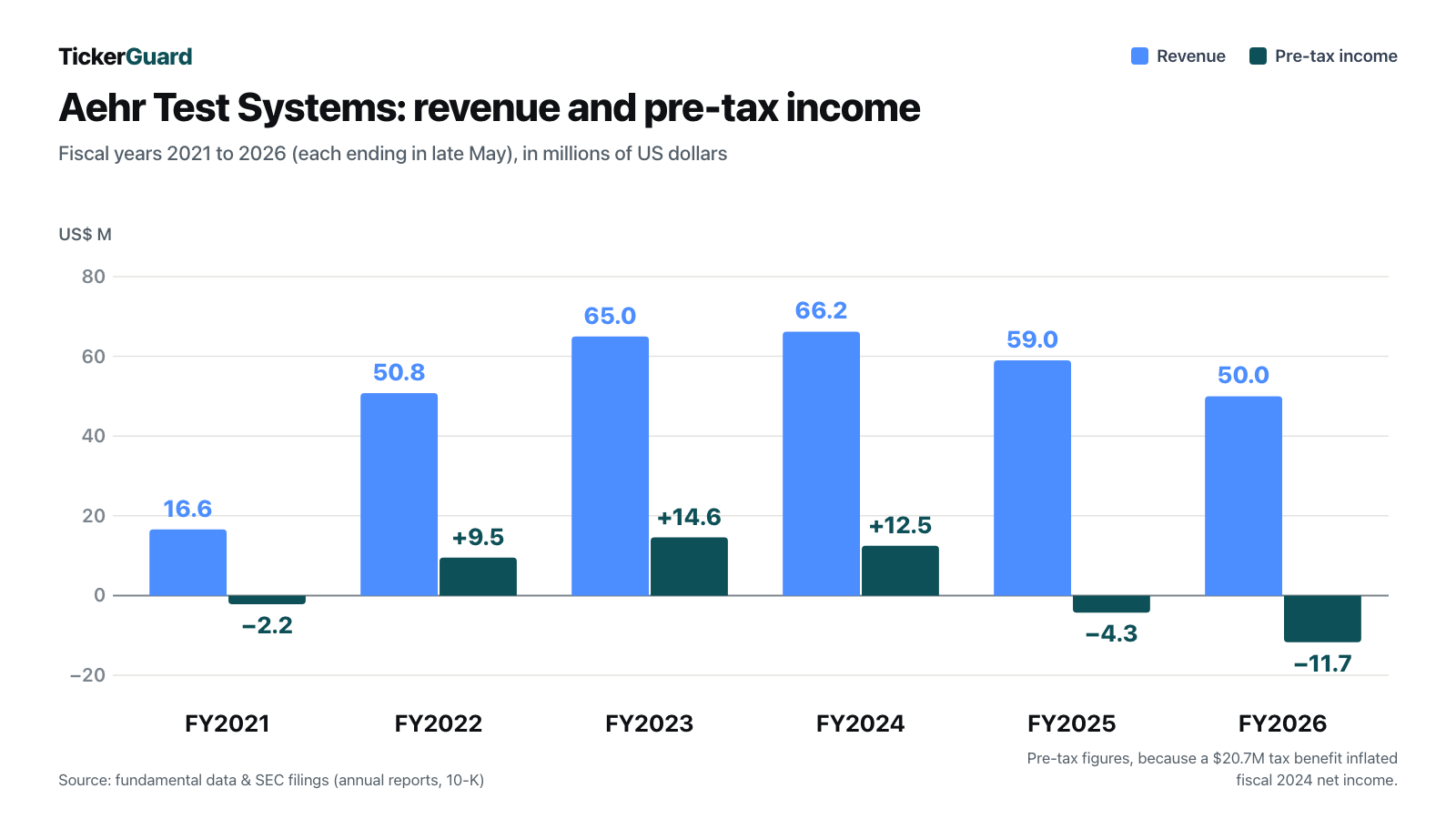
Then came the break. In fiscal 2025 revenue fell to $59.0 million, and in fiscal 2026 to $50.0 million; pre-tax results were −$4.3 million and −$11.7 million, net results −$3.9 million and −$7.1 million. Gross margin — what is left of revenue after production costs — slid from 49.1 percent (2024) to 40.6 percent (2025) and 35.3 percent (2026). The annual report gives the reason: the wafer-level contactor business alone dropped by $19.9 million in fiscal 2026 because demand from the electric vehicle market dried up; a $10.4 million gain in wafer-level systems, mostly for silicon photonics, made up only half of that.
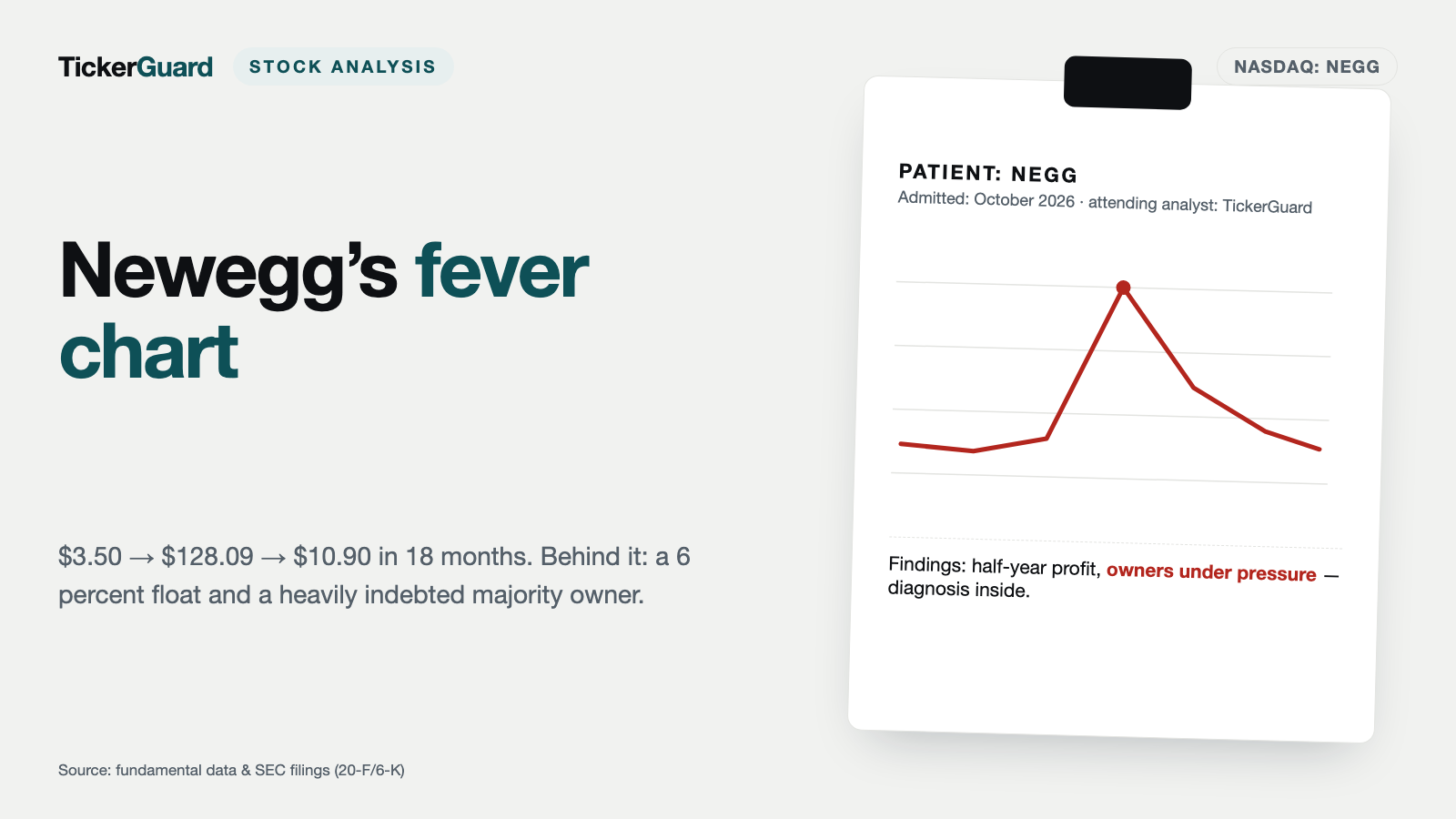
And now the second half of the story — the half the market paid for. Over the course of fiscal 2026, bookings went from $11.4 million and $6.2 million in the first two quarters to $37.2 million and then a record $60.7 million. Revenue lagged behind: $11.0 million, $9.9 million, $10.3 million and $18.8 million.
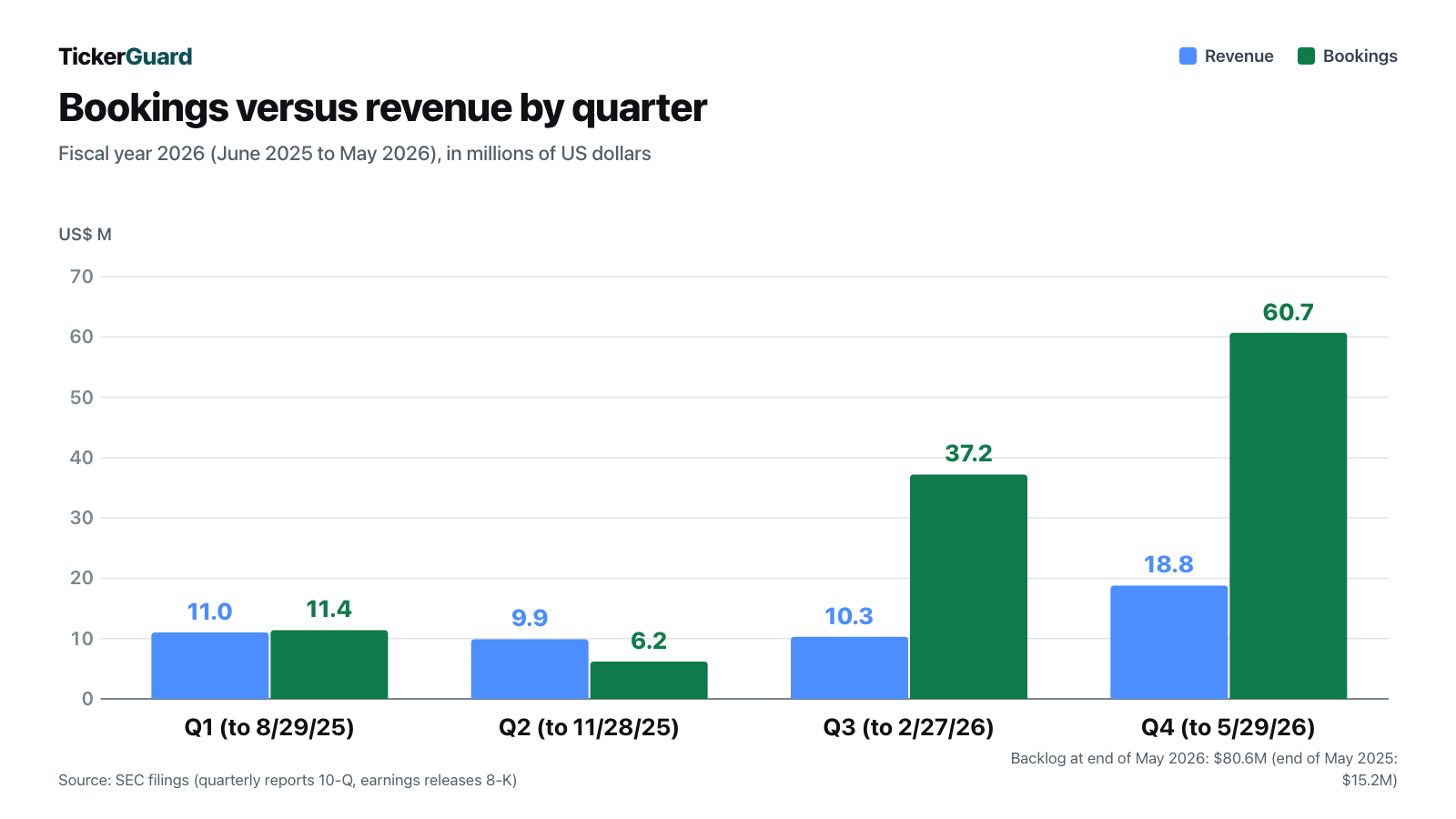
As a result, backlog — machines ordered but not yet delivered — climbed from $15.2 million (May 30, 2025) to $80.6 million (May 29, 2026), a factor of 5.3. Including orders received through mid-July, Aehr cited $100.6 million. That is the foundation of the guidance management published on July 14, 2026:
"For the fiscal year ending June 25, 2027, Aehr expects total company revenue to be between $130 million and $150 million, representing approximately 160%-200% year-over-year growth. Aehr also expects non-GAAP net income to be 18% to 22% of total revenue."
— Aehr Test Systems, earnings release of July 14, 2026 (Form 8-K, exhibit 99.1), section "Financial Guidance"
The fourth quarter offers a first taste: $18.8 million in revenue, a 42.6 percent gross margin and net income of $1.4 million. An honest appraisal, though, also means this: even in that record quarter, the pre-tax line showed a loss of $0.5 million; the profit came only from a $1.8 million tax benefit. And the annual report itself warns how reliable a backlog is:
"Due to the possibility of customer changes in delivery schedules or cancellations and potential delays in product shipments or development projects, the Company’s backlog as of a particular date may not be indicative of net revenues for any succeeding period."
— Aehr Test Systems, SEC annual report 10-K for fiscal year 2026, Item 1 "Backlog"
Keep this in mind: the order book proves demand; revenue has not proven it yet. Between the two lie shipments, customer acceptance — and a fiscal year that does not end until June 2027.
What the Filings Say — Four Uncomfortable Truths
Uncomfortable Truth No. 1: A Handful of Customers Carries Everything — Only the Names Change
Imagine a neighbor telling you his business is doing great — and mentioning in passing that a single customer brings in a quarter of his revenue. Would you swallow hard for a second? At Aehr, that is the normal state of affairs, and the filings say so openly:
"Sales to our five largest customers accounted for approximately 70%, 77%, and 93% of our net sales in fiscal 2026, 2025, and 2024, respectively. During fiscal 2026, three customers accounted for approximately 26%, 14% and 11% of our net sales. During fiscal 2025, two customers accounted for approximately 39% and 15% of our net sales. During fiscal 2024, two customers accounted for approximately 67% and 17% of our net sales."
— Aehr Test Systems, SEC annual report 10-K for fiscal year 2026, Item 1A "Risk Factors"
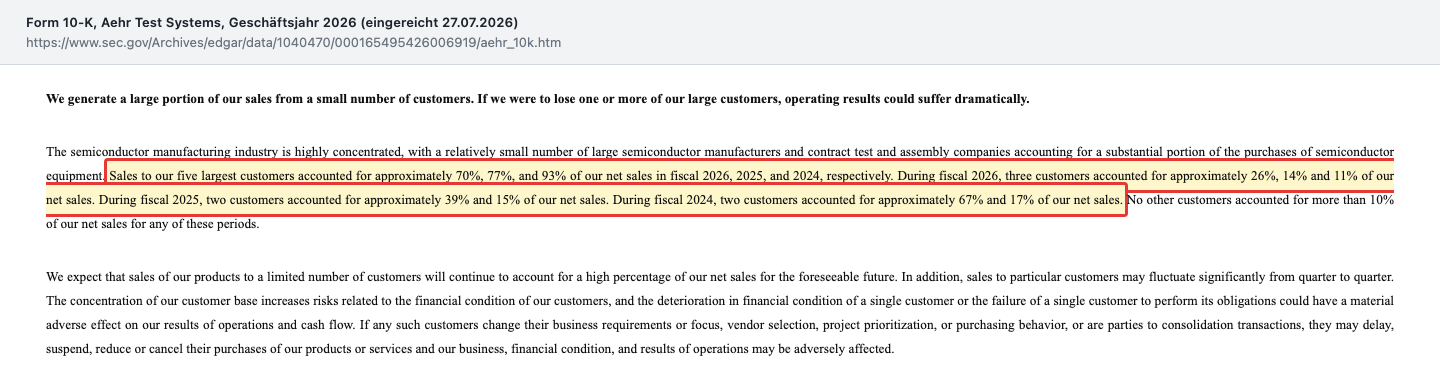
The good news is in the series itself: dependence has come down, from 93 to 70 percent for the top five. The uncomfortable news is that the pattern has merely shifted. The annual report names no names; the July 14, 2026, earnings release refers to a "lead hyperscale customer" for Sonoma systems, a "lead AI production customer" for wafer-level burn-in and a "lead silicon photonics customer." A company with $50 million in annual revenue whose $130 million to $150 million guidance hinges on a handful of such anchor customers is not a diversified business — it is a handful of bets that all have to pay off at the same time.
Uncomfortable Truth No. 2: The Old Engine Has Stalled — the New One Has Yet to Prove It Can Pull
Anyone who bought Aehr two years ago bought an electric vehicle stock. The annual report puts a number on what is left of that:
"EV and power semiconductor revenues accounted for 17%, 41%, and 92% of total revenues in fiscal 2026, 2025, and 2024, respectively."
— Aehr Test Systems, SEC annual report 10-K for fiscal year 2026, Item 1 (section "Environmental")
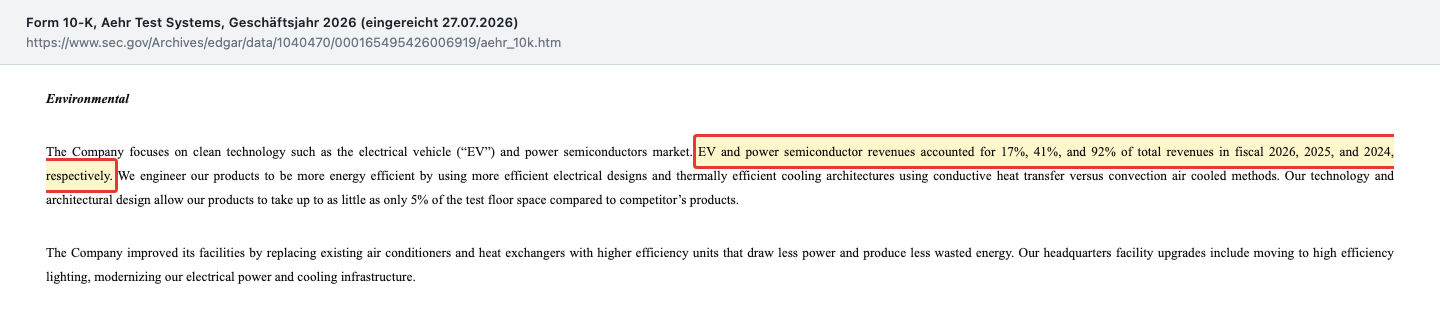
Convert that into dollars and it becomes tangible: 92 percent of $66.2 million is roughly $61 million in fiscal 2024; 17 percent of $50.0 million is roughly $8.5 million in fiscal 2026. EV revenue shrank by more than four-fifths in two years. How brutal that market is shows in the story of the silicon carbide maker we traced in our Wolfspeed stock analysis. That Aehr came through this collapse without debt — albeit with net losses of $3.9 million and $7.1 million in fiscal 2025 and 2026 — is an achievement. But it also means the 2027 guidance rests mostly on customer groups that barely registered in revenue three years ago — on AI-processor testing that, according to the earnings release, is only now supposed to move into a pilot phase at one large chip supplier, and on photonics customers that are just ramping. The picture behind it: a company whose last boom shrank from 92 to 17 percent of revenue within two years is promising the next one.
Uncomfortable Truth No. 3: $23.8 Million in Tax Assets Rest on the Forecast
The balance sheet as of May 29, 2026, carries deferred tax assets of $23.8 million — a store of future tax savings that is only worth something if the company earns profits later. That is 10.9 percent of shareholders' equity of $219.5 million. Under the accounting rules, losses in several years tend to argue for a valuation allowance; Aehr nevertheless records none — and says openly why:
"Although we incurred pretax losses in fiscal 2025 and fiscal 2026, we concluded as of May 29, 2026 that a valuation allowance against our U.S. DTAs was not required."
— Aehr Test Systems, SEC annual report 10-K for fiscal year 2026, Item 7 "Critical Accounting Estimates" (Income Taxes)
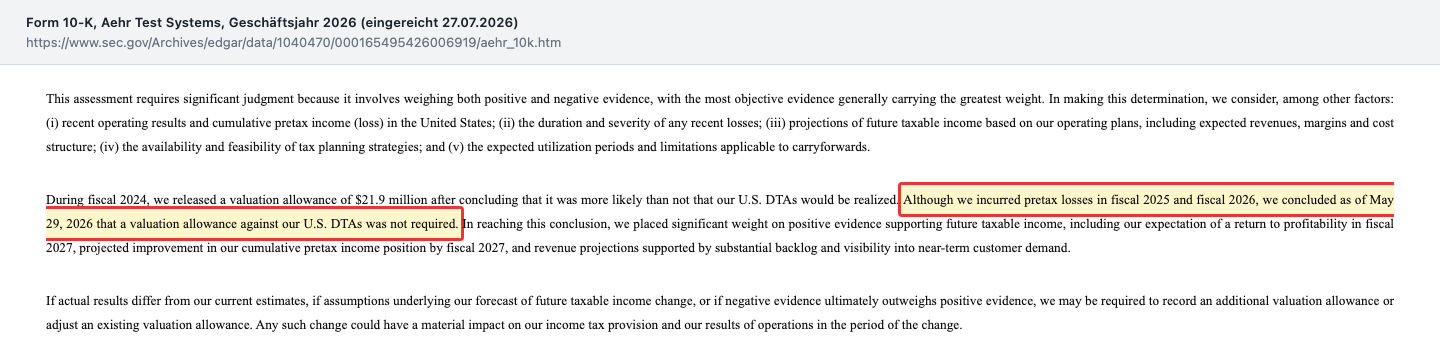
The very next sentence names "our expectation of a return to profitability in fiscal 2027" as the key support. Add up fiscal 2024 through 2026 (+$12.5 million, −$4.3 million and −$11.7 million before taxes), and the consolidated total is a loss of roughly $3.6 million. This is not an accounting trick, and the auditor signed off on it. But it shows how much rides on a single year: the same guidance that props up the share price also props up a balance-sheet item. And past tax effects already distort the picture: the record net income of $33.2 million in fiscal 2024 included the release of an earlier $21.9 million valuation allowance; after current tax expense, the total tax benefit came to $20.7 million — pre-tax income was $12.5 million.
Uncomfortable Truth No. 4: The Company Sold Shares — and So Did Its Executives
How did Aehr fund the lean stretch? With the simplest tool a listed company has: new shares. Through at-the-market (ATM) programs — shares dribbled out directly on the exchange — the company raised net proceeds of $97.4 million in fiscal 2026. In everyday terms: your slice of the pie gets smaller when new slices keep being cut. In November 2025, Aehr sold 384,380 shares at an average of $25.89; in February 2026, 269,439 shares at $39.20; in March, 476,649 shares at $40.88. On April 8, 2026, the day of the quarterly report, a new $60 million program followed — and it sold out in nine days:
"In April 2026, the Company sold 812,185 shares of common stock at an average selling price of $ 73.87 per share. The gross proceeds to the Company were approximately $ 60.0 million, before professional fees of $ 1.2 million. The ATM offering program has been fully utilized."
— Aehr Test Systems, SEC annual report 10-K for fiscal year 2026, Note 10 "Equity"
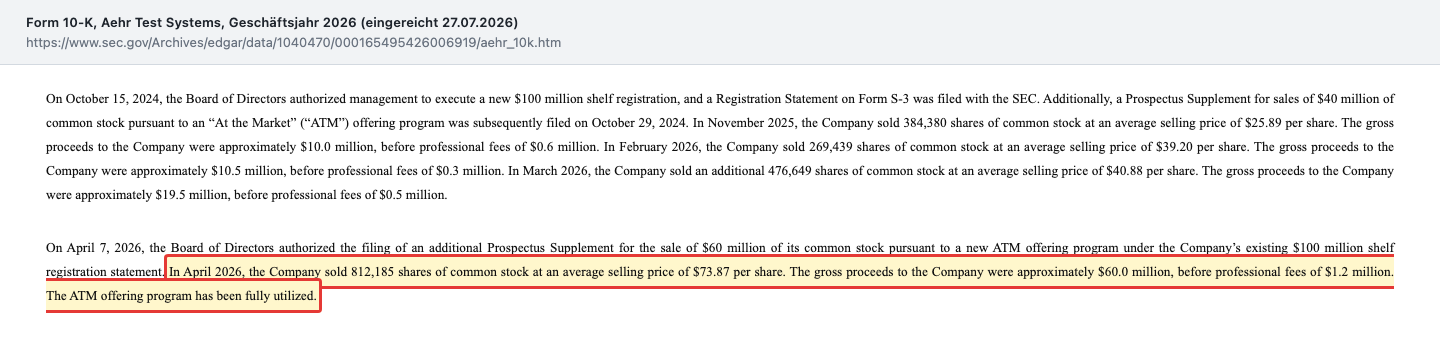
In total, that was roughly 1.94 million new shares for about $100 million in gross proceeds. The share count rose from 29.9 million (May 30, 2025) to 32.66 million (August 27, 2026), an increase of just over 9 percent. To be fair, the timing was smart. The company sold in April at almost three times its November price, now sits on $116.4 million in cash with no bank debt — and on July 27, 2026, it filed an automatic shelf registration (Form S-3ASR) that already opens the door to further offerings of any size. The uncomfortable part is something else. While the company's ATM program ran from April 8 to 17, 2026, insiders were selling too. According to their Form 4 filings (including a correction on Form 4/A filed April 15, 2026), executives and board directors sold roughly 513,000 shares for about $40.2 million in the open market (transaction code "S") between April 9 and April 22, 2026; from April 9 through August 17, 2026, the total reached roughly 677,000 shares for about $60.1 million. Of these, roughly 47,000 shares were sold on days on which the same person had exercised options (code "M"); the remaining roughly 630,000 came out of existing holdings. Not counted are roughly 77,000 shares withheld over the same period to cover taxes on vested stock awards (code "F") — those are not sales. CEO Gayn Erickson alone sold 152,824 shares at $70.58 on April 10, 2026, and another 40,000 in August at just over $130. None of these filings has the box checked for a pre-arranged trading plan (Rule 10b5-1). That is legal; selling once the trading window opens after a quarterly report is common, and taxes owed on vested shares can be one reason. The filings state no reasons, and we do not impute a motive. For scale: the proxy statement puts the combined holdings of all executives and board directors at 1,488,042 shares (4.6 percent) as of August 27, 2026. The roughly 677,000 shares sold equal, by our calculation, about 31 percent of their holdings before the sales (shares sold plus shares remaining). Remember: in April 2026, the company and its leadership sold shares in the same window — at prices well above where the stock stood on October 16, 2026 ($60.60).
Valuation: The Market Is Paying for 2027 Today
With 32,659,546 shares outstanding (August 27, 2026) and a closing price of $60.60 on October 16, 2026, the market value came to roughly $2.0 billion. The share count matches the proxy statement; at the $76.32 price Aehr itself cited in its July 27, 2026, prospectus, it would have been about $2.5 billion. For comparison: on May 30, 2025, at $9.54 per share and roughly 29.9 million shares, Aehr was worth only about $285 million — on higher annual revenue ($59.0 million) than today. Measured against fiscal 2026 revenue of $50.0 million, that is a price-to-sales ratio of about 40 — the market pays $40 for every dollar of annual revenue. Against the 2027 guidance ($130 million to $150 million), the ratio drops to roughly 13 to 15. A price-to-earnings ratio cannot be calculated on the 2026 loss; on the promised adjusted profit of 18 to 22 percent of guided revenue (roughly $23 million to $33 million), it would be somewhere between 60 and 85. So even if everything plays out the way management promises, the stock is no bargain — it pays for growth several years in advance. The $116.4 million in cash does little to change that order of magnitude; it is about 6 percent of the market value. The unanimity of the six analyst ratings on record does little to change that either: they all rely on the same company guidance. If you want to read about a large, broadly diversified test-equipment maker for comparison: our Teradyne stock analysis.
Opportunities and Risks at a Glance
What speaks for Aehr Test Systems:
- A full order book: $80.6 million in backlog as of May 29, 2026 (prior year: $15.2 million), record fourth-quarter bookings of $60.7 million and guidance of $130 million to $150 million in revenue for the fiscal year ending June 25, 2027.
- Three growth fields instead of one: AI processors (Sonoma systems for 1,600 watts and more, wafer-level burn-in), silicon photonics and a recovering silicon carbide business; the largest customer accounted for 26 percent in fiscal 2026, down from 67 percent in fiscal 2024.
- A strong balance sheet: $116.4 million in cash, no financial debt, total liabilities of just $27.2 million, shareholders' equity of $219.5 million (May 29, 2026).
- Consumables: every FOX machine needs matching WaferPak contactors; as the installed base grows, so does a recurring revenue stream.
- Proven cycle experience: the company has existed since 1977 and came through the collapse of its EV business (from 92 to 17 percent of revenue) without debt.
What speaks against it:
- Revenue shrank two years in a row ($66.2 million → $59.0 million → $50.0 million), gross margin fell from 49.1 to 35.3 percent, and the pre-tax loss reached $11.7 million in fiscal 2026 — the turnaround is announced, not proven.
- Customer concentration: the five largest customers accounted for 70 percent in fiscal 2026; the guidance depends on a few anchor customers whose orders, according to the annual report, can be rescheduled or canceled with limited penalties.
- Dilution: roughly 1.94 million new shares in fiscal 2026, share count up just over 9 percent; an automatic shelf registration (S-3ASR) dated July 27, 2026, allows further offerings.
- Open-market insider sales of roughly 677,000 shares for about $60.1 million between April 9 and August 17, 2026 (by our calculation about 31 percent of their holdings before the sales), with no flagged trading plan.
- Valuation: a price-to-sales ratio of about 40 on fiscal 2026 revenue and 13 to 15 on the 2027 guidance leaves little room for delays; $23.8 million in tax assets on the balance sheet hinge on the same guidance.
A Human Conclusion
Back to the anchoring effect from the beginning. The "$130 million to $150 million" figure is not a fantasy — behind it are $80.6 million in real orders, a record quarter and anchor customers that Aehr itself describes as hyperscale and AI production customers. But an anchor is not dangerous because it is wrong; it is dangerous because it crowds out everything else: that this revenue shrank for two years, that this company's last boom collapsed from 92 to 17 percent of revenue within two years, that the company and its insiders sold shares at the same time in the spring of 2026, and that even a balance-sheet item is built on the same guidance. So the honest question for you is not "Will Aehr hit $150 million?" but: how much of it have you already paid for — and what are you left with if it turns out to be $100 million? If you have an answer to that, you have a thesis. If not, you had an anchor. What you do with it is your call. And that is exactly how it should be.
Sources
All original documents used in this analysis — so you can read them yourself:
- Aehr Test Systems — SEC annual report 10-K for fiscal year 2026 (period ended May 29, 2026, filed July 27, 2026)
- Aehr Test Systems — SEC annual report 10-K for fiscal year 2025 (filed July 28, 2025)
- Aehr Test Systems — SEC quarterly report 10-Q for the quarter ended February 27, 2026 (filed April 8, 2026)
- Aehr Test Systems — SEC quarterly report 10-Q for the quarter ended November 28, 2025 (filed January 12, 2026)
- Aehr Test Systems — SEC quarterly report 10-Q for the quarter ended August 29, 2025 (filed October 8, 2025)
- Aehr Test Systems — Fiscal 2026 earnings release with fiscal 2027 guidance (Form 8-K, exhibit 99.1, July 14, 2026)
- Aehr Test Systems — Form 8-K of April 7, 2026 (Item 5.03: change in fiscal year)
- Aehr Test Systems — earnings releases (Form 8-K, exhibit 99.1) with quarterly bookings and backlog: October 6, 2025, January 8, 2026, April 7, 2026
- Aehr Test Systems — Form 8-K of April 8, 2026 ($60 million ATM agreement) and Form 8-K of April 20, 2026 (program fully utilized)
- Aehr Test Systems — Registration statement on Form S-3ASR, July 27, 2026
- Aehr Test Systems — Proxy statement (DEF 14A) for the 2026 annual meeting (filed September 9, 2026)
- Insider filings (Form 4) from April 2 to October 13, 2026, including the Form 4/A correction of April 15, 2026, and the full filing history: EDGAR overview for Aehr Test Systems (sec.gov)
- Fundamental data (price series, analyst ratings; data as of October 18, 2026), cross-checked against the SEC filings and the SEC’s XBRL financial data.
Transparency & disclaimer: This analysis is a journalistic contextualization of publicly available information. It is not investment advice, not a financial analysis in the regulatory sense and not a solicitation to buy or sell securities. Investing in stocks carries significant risks, up to and including a total loss. All information without guarantee; the date of each data point is stated in the text. At the time of publication, the author holds no position in Aehr Test Systems (AEHR).
Key figures at a glance
All monetary figures in millions of $; earnings per share as reported.
| Metric | 2022 | 2023 | 2024 | 2025 | 2026 |
|---|---|---|---|---|---|
| Revenue | 50.8 | 65.0 | 66.2 | 59.0 | 50.0 |
| Operating Income (EBIT) | 7.8 | 13.4 | 10.1 | -4.3 | -14.1 |
| Net Income | 9.5 | 14.6 | 33.2 | -3.9 | -7.1 |
| Net Margin | 18.6% | 22.4% | 50.1% | -6.6% | -14.3% |
| Earnings Per Share | 0.34 $ | 0.50 $ | 1.12 $ | -0.13 $ | -0.23 $ |
Source: fundamental data & SEC filings (annual and quarterly reports, 10-K/10-Q)
Our Bottom Line at a Glance
- Order situation positive
- Backlog rose from $15.2 million (May 30, 2025) to $80.6 million (May 29, 2026), and fourth-quarter bookings hit a record $60.7 million; management guides to $130 million to $150 million in revenue for the fiscal year ending June 25, 2027 (8-K, July 14, 2026).
- Revenue and profitability negative
- Revenue fell two years in a row ($66.2 million → $59.0 million → $50.0 million), gross margin dropped from 49.1 to 35.3 percent, and fiscal 2026 brought a pre-tax loss of $11.7 million; even the record fourth quarter of fiscal 2026 was −$0.5 million before taxes (10-K, July 27, 2026).
- Customer concentration negative
- The five largest customers accounted for 70 percent of fiscal 2026 revenue, the largest for 26 percent; in fiscal 2024 a single customer had brought in 67 percent. Dependence is declining, but the 2027 guidance hinges on a few anchor customers (10-K 2026, Item 1A).
- Balance sheet and liquidity positive
- $116.4 million in cash, no financial debt, total liabilities of $27.2 million and shareholders' equity of $219.5 million as of May 29, 2026; operating cash outflow was just $3.3 million in fiscal 2026 (10-K, July 27, 2026).
- Dilution and insiders negative
- Roughly 1.94 million new shares in fiscal 2026 (share count up just over 9 percent through August 27, 2026); in parallel, executives and board directors sold roughly 677,000 shares for about $60.1 million in the open market between April 9 and August 17, 2026, with no flagged 10b5-1 plan (Form 4 incl. Form 4/A).
Aehr Test Systems sits between an order book that quintupled within a year to $80.6 million and revenue that shrank two years in a row to $50.0 million. The old engine, electric vehicles (92 percent of revenue in fiscal 2024, 17 percent in fiscal 2026), has stalled; AI processors and silicon photonics are meant to replace it, and management promises $130 million to $150 million for fiscal 2027. The balance sheet is debt-free and well stocked — paid for with roughly 1.94 million new shares while insiders sold roughly 677,000 in the open market. Not investment advice.
What Our Rating Means
Open questions
The business works in principle, but one material question is open. As long as it stays open, our findings do not carry a quality verdict.
No substance risk: $116.4 million in cash, no financial debt, minimal cash burn, a clean audit opinion. But the central operating question is open — whether $80.6 million in backlog really turns into $130 million to $150 million in revenue and a pre-tax profit is announced, not proven, and it depends on a few large customers. At a market value of roughly $2.0 billion, that outcome is already largely priced in. The decision is yours.
A journalistic assessment by our editorial team at the time of the deep dive, based on public sources — not investment advice and not a solicitation to buy or sell. Your personal circumstances (investment goals, risk capacity, taxes) cannot be taken into account. What our levels mean, how verdicts are formed, and what conflicts of interest exist →
Worth Noting
- Fiscal year: fiscal 2026 ran from May 31, 2025, through May 29, 2026. From 2027 on, the fiscal year ends on the Friday closest to June 30 (fiscal 2027: June 27, 2026, to June 25, 2027); the four weeks in between will be included in the first quarterly report for the quarter ended September 25, 2026, which had not been filed as of our press date (October 18, 2026).
- Price data dated and evergreen: $9.54 (May 30, 2025), high of $145.61 (August 17, 2026), price anchor $60.60 (October 16, 2026); analyses are evergreen, daily prices are not a buy argument.
- Fiscal 2024 net income ($33.2 million) includes the release of a $21.9 million valuation allowance on deferred tax assets; pre-tax income was $12.5 million. For year-over-year comparisons, pre-tax income is therefore more meaningful.
Stock Watch
This analysis is as of October 18, 2026. Stock Watch will tell you what's changed at AEHR since then.
Later $1 a month per stock — signing up is free, and you'll be the first to know when it launches.
The full analysis as a PDF for later
We will send you this analysis as a PDF — to print, file away, and read at your own pace. And we will add you to the free Stock Watch list for Aehr Test Systems (AEHR), so you hear about it when something material in this analysis changes.
Frequently Asked Questions
Aehr Test Systems, based in Fremont, California, builds machines for semiconductor burn-in: chips are stressed with heat and power so that weak units fail while still in the factory. The FOX systems test entire silicon wafers using WaferPak contactors; the Sonoma, Tahoe and Echo systems acquired in 2024 test finished, packaged chips. In fiscal 2026, 63 percent of $50.0 million in revenue came from the wafer-level business.
Because the electric vehicle business collapsed. EV and power semiconductor revenues were 92 percent of the total in fiscal 2024 and only 17 percent in fiscal 2026. The wafer-level contactor business alone fell by $19.9 million in fiscal 2026; wafer-level systems for silicon photonics offset $10.4 million. Overall, revenue declined from $66.2 million (2024) to $59.0 million (2025) and $50.0 million (2026).
For the fiscal year ending June 25, 2027, management expects revenue of $130 million to $150 million, according to the July 14, 2026, earnings release — growth of roughly 160 to 200 percent over fiscal 2026 — and non-GAAP net income of 18 to 22 percent of revenue. The basis is a backlog of $80.6 million as of May 29, 2026, or about $100.6 million including new orders through mid-July.
Heavily. According to the fiscal 2026 annual report, the five largest customers accounted for about 70 percent of revenue, three customers individually for 26, 14 and 11 percent. In fiscal 2024, a single customer still brought in 67 percent. Aehr names no names; the July 2026 earnings release refers to lead customers in AI processors, data centers (Sonoma) and silicon photonics.
Yes. Through at-the-market (ATM) programs, Aehr issued roughly 1.94 million shares for about $100 million in gross proceeds in fiscal 2026, most recently 812,185 shares at an average of $73.87 in April 2026. The share count rose from 29.9 million (May 30, 2025) to 32.66 million (August 27, 2026). Since July 27, 2026, an automatic shelf registration (S-3ASR) also allows further offerings.
On April 2, 2026, the board decided to move the fiscal year-end from the Friday closest to May 31 to the Friday closest to June 30. Fiscal 2027 runs from June 27, 2026, to June 25, 2027. The four weeks from May 30 to June 26, 2026, will be included in the first quarterly report (10-Q) of the new year, for the quarter ended September 25, 2026; no separate transition report is required.
Measured by revenue, yes. With 32.66 million shares and a closing price of $60.60 on October 16, 2026, the market value was roughly $2.0 billion, about 40 times fiscal 2026 revenue of $50.0 million. Against the 2027 guidance, it is 13 to 15 times; against the promised adjusted profit, roughly 60 to 85 times. The market is paying for the expected growth several years in advance.
Found an error?
Did you spot a factual error, an outdated number, or a typo in this deep dive? Let us know briefly — your report goes straight to the editorial team.