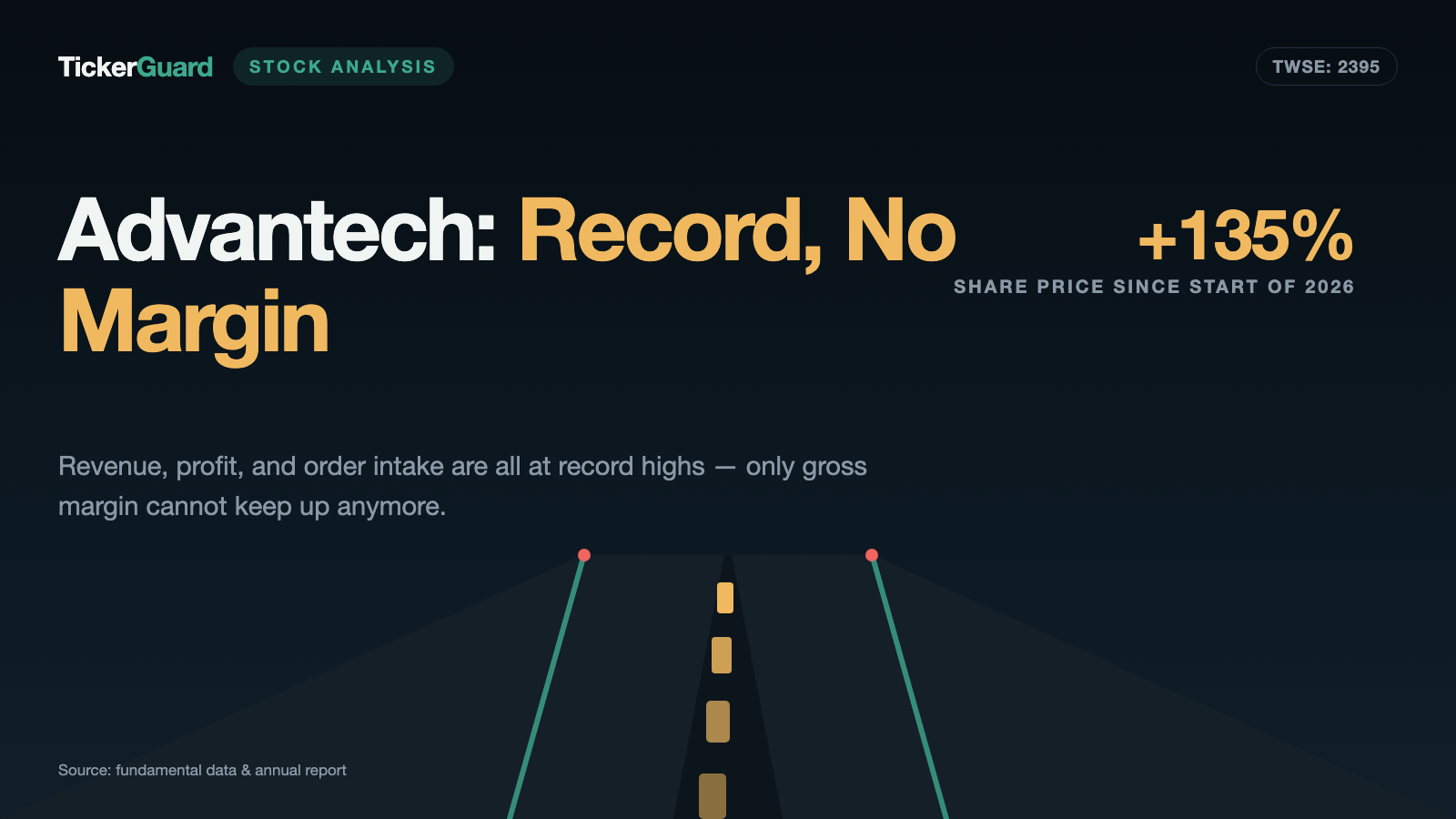
Advantech: One Record Chases the Next — and Margin Cannot Keep Up
Advantech builds the industrial computers and edge-AI hardware behind factory robots, X-ray machines, and server racks — and the stock has more than doubled since the start of 2026 (up 135 percent as of August 28, 2026). Revenue, order intake, and profit all hit record highs in the second quarter of 2026. The same report shows something else: gross margin fell from roughly 40 percent to 37.7 percent because Advantech can only partially pass through higher memory-chip and SSD costs. Not investment advice — just the question of whether the order record can outrun the margin record.
 Thomas Mücke
Founder & Publisher
Thomas Mücke
Founder & Publisher
There is a moment every investor recognizes: a stock lands in the headlines because it has more than doubled in a few months. The first impulse is rarely a balance-sheet review — it is the fear of missing out. Let's call it what it is: FOMO. With Advantech, the trigger is easy to spot. The stock hit a 52-week low of NT$273.50 in December 2025 — and stood at NT$677 on August 28, 2026, with an intraday high of NT$698 on August 13, 2026. That is a 135 percent gain year-to-date. So let's make a deal: we'll leave the chart alone for a moment and read what Advantech says about itself instead — the 2025 annual report, the quarterly financial statements, and the transcript of the August 5, 2026 earnings call. For scale: at an exchange rate of roughly NT$31.6 per U.S. dollar (August 28, 2026), NT$677 is about $21.4; at roughly NT$36.7 per euro, about €18.4 — rough approximations for orientation only, not a historically precise conversion.
What Advantech Actually Does — Computers Nobody Recognizes as Computers
Advantech Co., Ltd., headquartered in Taipei, was founded in 1981 and has traded on the Taiwan Stock Exchange since December 13, 1999. In plain terms: when a factory robot, a hospital X-ray machine, or a highway toll booth needs to "think," it needs a small, rugged computer somewhere that runs reliably around the clock in dust, heat, or vibration — no fan, no keyboard, often never seen by a human being. That is what Advantech builds: embedded computing boards, industrial PCs, digital signage players, and, increasingly, hardware for edge AI — artificial intelligence that computes right where the action happens instead of first sending data to a distant cloud.
The company reports in five segments: IoT Automation (factory and transportation automation), Intelligent Systems (servers, cloud infrastructure, semiconductor-equipment computing), Embedded (the classic computing boards for medical devices, gaming, and industry), Intelligent Service, and Advantech Service+/Others. In the first half of 2026, Intelligent Systems delivered the largest contribution at $546 million (37 percent of consolidated revenue), closely followed by Embedded at $510 million (35 percent) — both segments, the company says, were driven mainly by semiconductor-equipment, cloud-infrastructure, and network-security demand. As of June 30, 2026, the group employed 9,512 people (end of 2025: 9,494; end of 2024: 8,849), with an average age of 38.9.
On the software side, Advantech positions itself under the brand promise "Edge Computing & AI-Powered WISE Solutions" as more than a pure hardware vendor: WISE is its proprietary AI application-software platform, WEDA (WISE Edge Developer Architecture) containerizes its own hardware across different chip architectures, and since 2026, IWS (Integrated WISE Solution & Station) bundles servers, edge hardware, WISE software, and AI agents into a ready-made system deployed directly at a customer's site. Edge-computing business now contributes nearly 50 percent of consolidated revenue, the company says. Worth a side-by-side glance with our still-fresh Quanta Computer stock analysis: while Quanta builds complete AI-server racks for hyperscalers like Google or Meta, Advantech sits one step further out — not in the data center, but in the factory hall, the ambulance, the train platform.
Company history for investors
-
1981
Advantech Co., Ltd. is founded
The company starts as an industrial-computer maker in Taiwan — the foundation of today's core business, decades before the AI boom.
-
1999
IPO on the Taiwan Stock Exchange
Advantech has traded under TWSE: 2395 since December 13, 1999 — since then a publicly traded name with a long balance-sheet history.
-
2025
Memory-chip and SSD cost surge begins
Starting in the fourth quarter of 2025, per the annual report, costs for key components rise sharply — the origin of the later margin weakness.
-
2026
New dividend policy approved
The board approves an all-cash dividend with a higher payout ratio and a special dividend through 2028 on February 26, 2026 — a clearer return promise for shareholders.
-
2026
Record quarter and an open margin admission
On August 5, 2026, Advantech reports its highest-revenue quarter ever — and in the same reporting period admits a gross margin below its own expectations.
Where This Stock Landed on Our Desk
The trigger for this analysis isn't an internal signal — it's simply the chart. Advantech was one of the most conspicuous movers in 2026 among Taiwanese technology names riding the global AI-infrastructure buildout, visible in a 52-week low of NT$273.50 on December 17, 2025 and a 52-week high of NT$698 on August 13, 2026. Anyone discovering the stock only after a run like that is in good — and dangerous — company: the price chart itself is the story, not any single headline. That's exactly why it deserves a second, sober look at the underlying numbers before getting swept up in it.
The Numbers Over the Years — Fairly Assessed
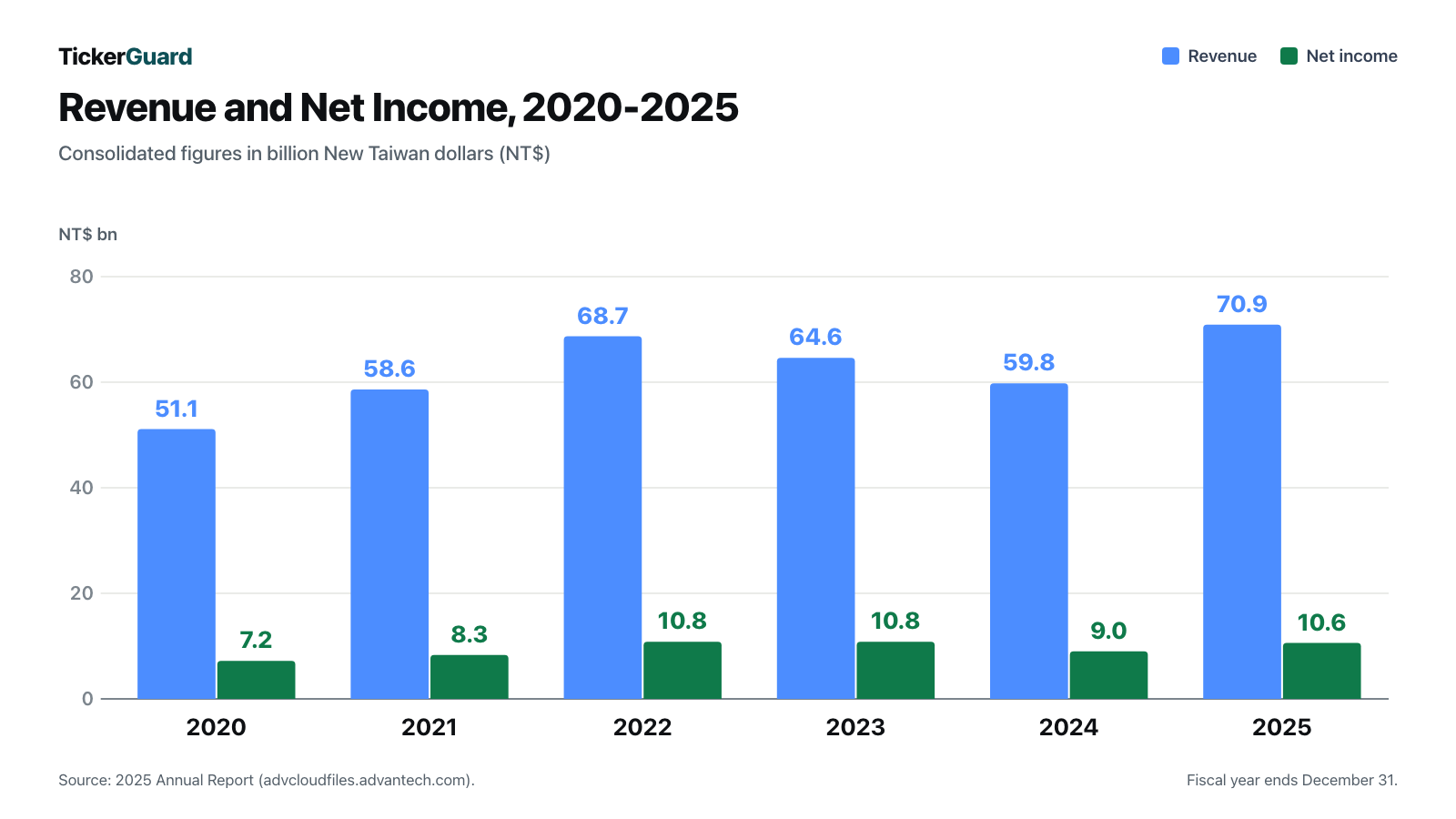
First, what genuinely impresses. Advantech has grown steadily for years: consolidated revenue of NT$51.1 billion (2020), past NT$68.7 billion (2022), then a dip to NT$59.8 billion (2024) — before a new record of NT$70.9 billion in 2025, up 18.56 percent from 2024 (in U.S. dollars, per the annual report, up 22 percent to $2,274 million). Net income followed the same pattern: from NT$7.2 billion (2020) through an interim peak of NT$10.8 billion (2022/2023) and a dip to NT$9.0 billion (2024) to NT$10.6 billion in record year 2025 (up 17.6 percent), with earnings per share of NT$12.25.
First-half 2026 growth accelerated sharply: revenue of NT$46,512 million (up 32 percent year-over-year; $1,470 million in U.S. dollars, up 33 percent), net income of NT$7,852 million (up 66 percent), earnings per share of NT$9.05. The second quarter of 2026 alone was, per the company, the strongest single quarter in its history: NT$26,126 million in revenue (up 46 percent year-over-year, up 28 percent quarter-over-quarter, roughly $825 million converted), net income of NT$4,518 million (up 127 percent), earnings per share of NT$5.20. Every major region grew double digits in the first half of 2026: North America $432 million (up 30 percent, 29 percent of revenue), Europe $233 million (up 29 percent), China $353 million (up 51 percent, now 24 percent of consolidated revenue), and Taiwan itself $124 million (up 67 percent). Order intake hit a fresh record of $574 million in July 2026, with the book-to-bill ratio climbing from 1.44 in the second quarter to roughly 1.64 in July.
What the Earnings Call Shows — and What Has Shifted Since November 2025
A published transcript is a rarity for non-U.S. names — Advantech has one. On August 5, 2026, the company released a full transcript of its second-quarter earnings call, including a Q&A section with questions from firms such as UBS, Morgan Stanley, Daiwa, and Fubon Securities. The Q&A section tends to reveal more than the prepared remarks, because nobody is reading from a slide.
A concrete promise-versus-actual comparison is possible. On the November 5, 2025 call, management guided fourth-quarter 2025 revenue to $550-570 million, gross margin to 38.0-40.0 percent, and operating margin to 15.0-17.0 percent (assuming an exchange rate of NT$30.4 per dollar). Actual fourth-quarter 2025 revenue came in at NT$17,921 million — roughly $589 million at that exchange rate, above the top of its own guided range —, gross margin at 39.78 percent (inside the range, near the top), and operating margin at 15.69 percent (inside the range, nearer the bottom). Management delivered more than it had promised for Q4 2025 — and gross margin was still comfortably within the guided range at that point.
Nine months later, in the August 5, 2026 Q&A, the same executives sounded more cautious. Asked when gross margin would return to its historical level of roughly 40 percent, CFO Eric Chen and COO Linda Tsai answered evasively — flagging the risk of another round of price increases from suppliers such as Nvidia and Intel — and offered only that third-quarter 2026 margin would stay "broadly in line with" the second quarter, i.e., no recovery. Asked about capacity, Eric Chen said utilization at the Kunshan, Taiwan, and Japan plants stood at 106 percent, 94.1 percent, and 94.7 percent in the second quarter; for the third quarter, management flagged rates of up to 110 percent, to be absorbed through overtime and partial outsourcing. The tone shifted from "we beat our own guidance" (November 2025) to "we're fighting material costs and no longer giving a hard number" (August 2026) — not dramatic, but noticeably more defensive.
Also from the Q&A, unrelated to the numbers: asked about succession planning, Chairman KC Liu confirmed the leadership transition is expected to complete by the end of 2026. Succession runs through three co-presidents (Eric Chen, Linda Tsai, and Miller Chang); KC Liu himself plans to remain Chairman for the next three years and, from 2027, to focus solely on that role plus brand-building and new business development.
What the Reports Show — The Uncomfortable Truths
Uncomfortable Truth No. 1: The Margin That "Fell Short of Expectations"
The clearest evidence of the flip side of the record year isn't buried in a footnote — it's in the CEO's own letter to shareholders, the first chapter of the 2025 annual report:
"However, affected by the rising costs of key components such as DDR4 and SSD, the gross margin fell short of expectations. The pressure on profitability was primarily due to two factors: first, long-term contracts limited the immediate pass-through of cost increases; second, there was a time lag between procurement costs and order fulfillment."
— Advantech Co., Ltd., 2025 Annual Report, "Letter to Shareholders" (page 5)
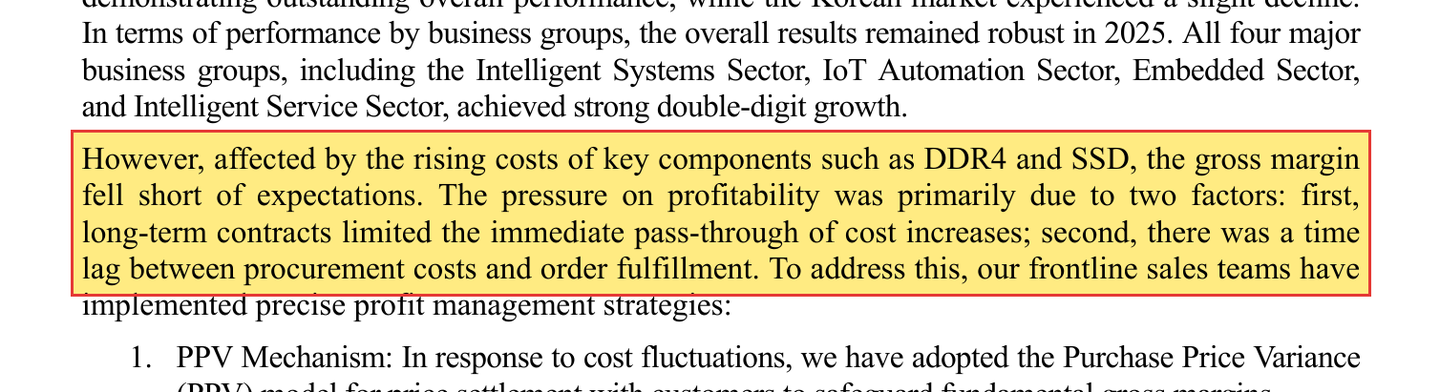
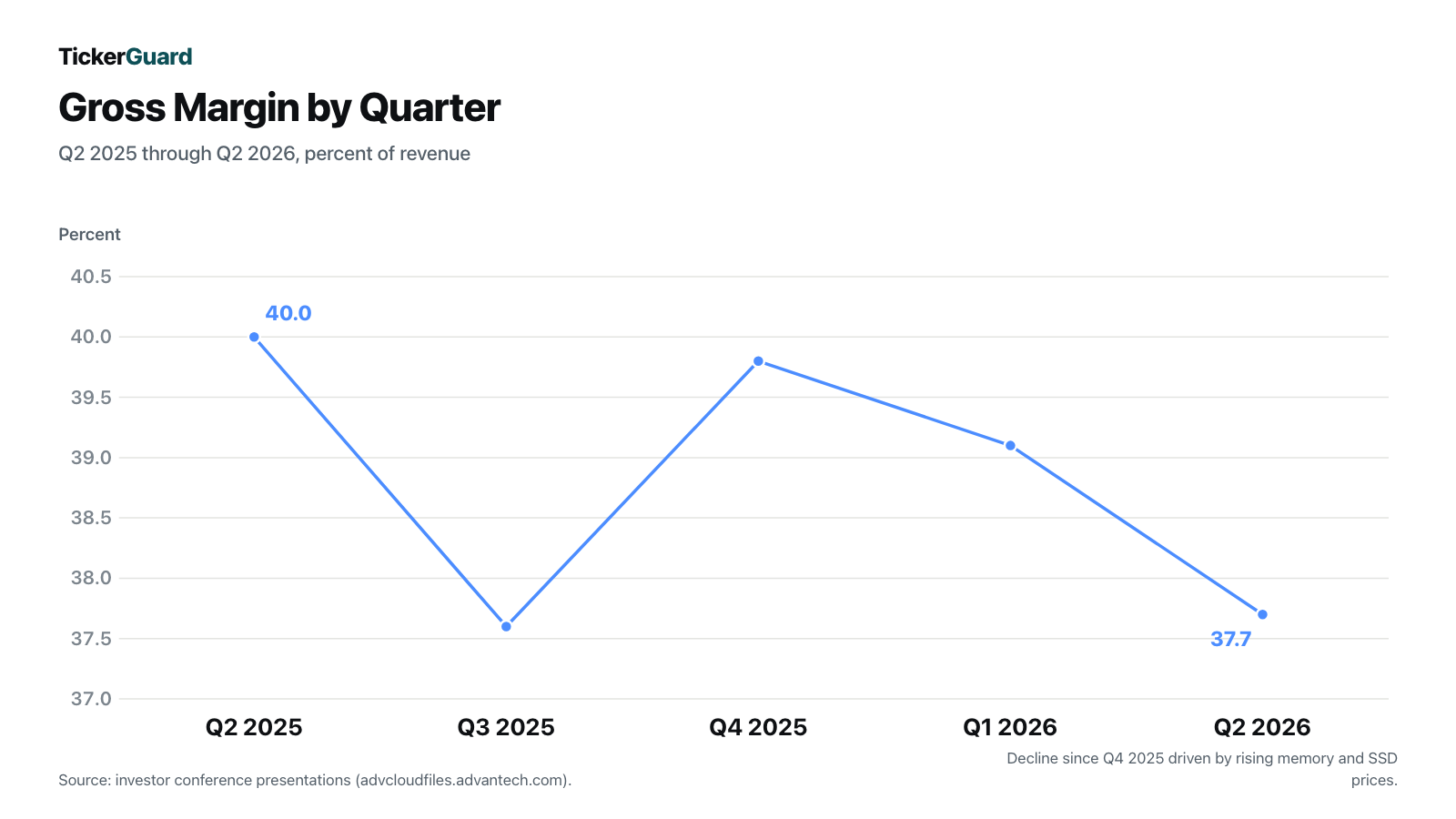
The numbers back up the sentence. Gross margin stood at 40.5 percent and 40.8 percent in 2023 and 2024 — it slipped to 39.8 percent in 2025, and the quarterly trend made it more visible: 40.0 percent in Q2 2025, a low of 37.6 percent in Q3 2025, a brief recovery to 39.8 percent in Q4 2025 (helped by seasonally higher volumes), then back down to 39.1 percent in Q1 2026 and 37.7 percent in Q2 2026 — the second-lowest reading in the entire series.
Important context: operating margin actually rose — from 17.5 percent (Q2 2025) to 19.6 percent (Q2 2026) — because Advantech has kept selling and administrative costs under tight discipline (the expense ratio dropped from 22.5 percent to 18.1 percent). So far, the company is offsetting weaker gross margin with cost discipline elsewhere, not by solving the pricing question. The annual report itself names two countermeasures: a "Purchase Price Variance" model that passes cost swings directly to customers, and a "bi-weekly pricing" system for individual components. Whether that's enough remains open — in the August 5, 2026 Q&A, management guided third-quarter 2026 margin only to be "broadly in line with" the second quarter, still below historical levels.
Uncomfortable Truth No. 2: The Largest Shareholder Isn't a Fund — It's a Company From the Same Industry
Anyone expecting a broadly diversified institutional shareholder base for a Taiwanese technology stock will be surprised by the annual report's shareholder list. Topping it is not BlackRock or Vanguard, but PC and component maker ASUSTEK COMPUTER Inc. — holding 113,483,106 shares, or 13.07 percent, the single largest shareholder.
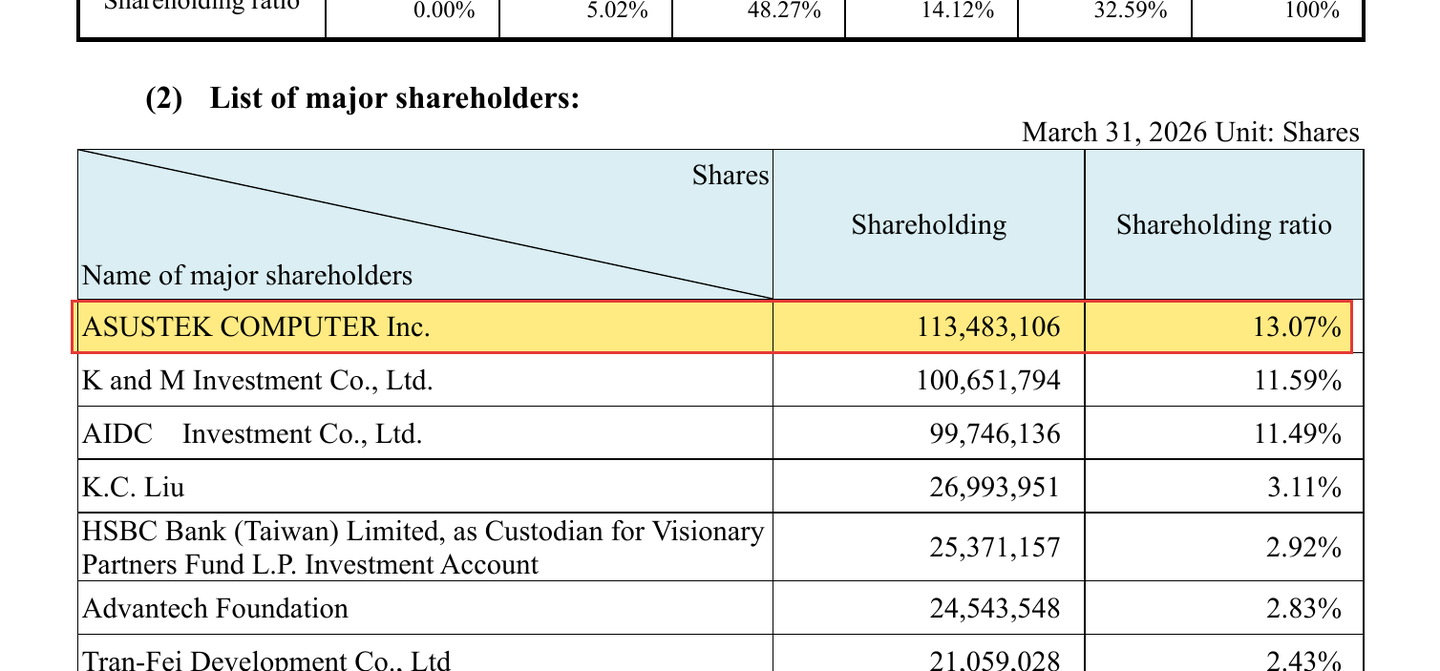
Right behind it are two investment vehicles the annual report itself identifies as linked to Chairman K.C. Liu: K and M Investment Co., Ltd. (11.59 percent) and AIDC Investment Corp. (11.49 percent, represented by Mary Chang). K.C. Liu personally holds a further 3.11 percent, and the nonprofit Advantech Foundation — also listed as a related party — holds 2.83 percent. Combined, these four positions total roughly 29 percent — more than double ASUSTEK's stake. In plain terms: at the table for the decisions that really matter sit the founding family and a single outside shareholder from the same industry, not a diversified fund consortium.
This is not a governance breach — there's no indication of improper influence, and foreign institutional investors hold the single largest block at 32.59 percent per the shareholder-structure table. But it's a concentration investors should know about before relying on broad diversification as a safety net: a stock whose largest shareholder is itself a technology manufacturer, and whose second- and third-largest positions belong to the founding family, behaves differently from one in broad public float.
Uncomfortable Truth No. 3: No Firm Guidance, but an Openly Flagged Supply Risk
In the August 5, 2026 Q&A, CFO Eric Chen was blunt: "Due to restrictions imposed by Taiwan's regulatory authorities, the Company is unable to provide specific quarterly financial guidance." What investors get instead is qualitative language: third-quarter 2026 revenue will grow "both year-over-year and quarter-over-quarter," with "a meaningful increase" — no number attached. For readers used to hard guidance ranges from U.S. filers, that's a structural difference from SEC-style reporting, not an Advantech-specific problem — but it does make the growth trajectory harder to pin down than for a comparable U.S. name.
The supply chain gets more concrete. Pressed on it, management named printed circuit boards (PCBs) as the primary risk for the fourth quarter of 2026 — citing upstream material shortages and some suppliers discontinuing production. Plant utilization in the second quarter of 2026 stood at 106 percent in Kunshan, 94.1 percent in Taiwan, and 94.7 percent in Japan; for the third quarter, management flagged rates of up to 110 percent. That's a factory running at the edge of capacity — backed by a record $574 million order intake in July 2026, but with no guarantee every one of those orders ships in the fourth quarter.
Valuation: A Price That Has Already Banked the Good News
At the August 28, 2026 price (NT$677; market capitalization of roughly NT$581.4 billion, or roughly $18.4 billion / €15.8 billion — approximations at the current exchange rate), Advantech trades at a trailing price-to-earnings ratio of roughly 43 (based on the trailing four quarters, EPS of NT$15.72) or roughly 34 on the 2026 consensus estimate (NT$19.81). Price-to-sales sits around 7.1, price-to-book around 10.6 — valuation levels closer to a software company than a hardware manufacturer, leaving little room for disappointment.
For comparison: at the start of 2026, near the 52-week low of NT$273.50, the same price-to-earnings ratio (on then-known figures) was less than half today's level. The stock hasn't only risen because the numbers improved — the valuation multiple itself has expanded substantially. On the dividend, the board approved a payout of NT$9.2 per share for fiscal 2025 plus NT$2.0 from capital reserve, NT$11.2 total (subject to the May 29, 2026 shareholders' meeting) — a yield of roughly 1.7 percent at the August 28, 2026 price. Starting with the 2026 distribution year, Advantech is also overhauling its dividend policy: no more stock dividends, an all-cash model with a payout ratio of 70-80 percent (up from 70-75 percent), plus a time-limited special cash dividend of NT$2 per share annually from 2026 through 2028, funded from capital reserve.
Opportunities and Risks at a Glance
What favors Advantech:
- Record order book with visibility into the future: order intake hit a fresh high of $574 million in July 2026 (book-to-bill 1.64), plus 123 North American design-win projects in the first half of 2026 with an estimated $440 million in annual revenue potential — full-year potential is expected to exceed $900 million.
- Core-healthy balance sheet: an equity ratio of 59 percent as of June 30, 2026, virtually debt-free (combined short- and long-term financial liabilities of just NT$1,939 million against NT$55,454 million of equity), and NT$18,729 million in cash.
- Operating profitability climbing despite margin pressure: operating margin rose from 17.5 to 19.6 percent (Q2 2025 to Q2 2026) via disciplined cost control, with Q2 2026 net income up 127 percent.
- Regional capacity expansion on a clear timeline: a new Tustin, California site (roughly $97 million invested, operational October 20, 2026, targeting $1.5 billion in North American revenue capacity), the Huaya plant expansion in Taiwan (roughly NT$4 billion, completing early 2028), and the Nogata plant renovation in Japan (roughly ¥5.5 billion, completing 2028).
- A more shareholder-friendly dividend policy starting in 2026: an all-cash model, a 70-80 percent payout ratio, and an additional special cash dividend of NT$2 per share annually through 2028.
What argues against it:
- Gross margin fell from roughly 40 percent (2023/2024) to 37.7 percent (Q2 2026) — per the company's own annual report, because higher memory-chip and SSD costs cannot be immediately passed through under long-term customer contracts. Management itself offered no recovery for the third quarter of 2026.
- The largest single shareholder, ASUSTEK COMPUTER (13.07 percent), is a company from the same industry; combined with the four positions linked to Chairman K.C. Liu (roughly 29 percent), control sits clearly outside a broadly diversified free float.
- No firm quarterly guidance: Taiwanese regulations, per the company, prevent specific figures — for Q3 2026, there is only qualitative language ("a meaningful increase"), no range.
- Valuation is already rich: a trailing price-to-earnings ratio of roughly 43 (or roughly 34 on 2026 consensus) and a price-to-sales ratio of roughly 7.1 — substantially higher than at the start of 2026, on comparable operating figures.
- Plants are already running at or above capacity by the company's own account (utilization up to 106 percent in Q2 2026), and for Q4 2026 management itself names PCB shortages as the primary risk to shipping the record order book.
A Human Takeaway
Back to the FOMO trap from the opening. The chart was right: 2026 really is a record year for Advantech — revenue, order intake, and profit all at highs. Anyone reading only the headline "stock up 135 percent" isn't being told a false story. But the same reports that document the record also document that the company itself openly says gross margin "fell short of expectations," that a single company from the same industry is the largest shareholder, and that its plants are already running near their limits without a quarterly forecast in hard numbers. None of that disproves the growth story — a supplier at the center of the AI-infrastructure boom grows under full load, and full load always has a price. But both sets of numbers live in the same annual report, and only one of them makes the headlines. What you do with that is your decision. And that's exactly as it should be.
Sources
All original documents used in this analysis — for further reading:
- Advantech Co., Ltd. — 2025 Annual Report
- Advantech Co., Ltd. — Q2 2026 earnings call transcript (August 5, 2026)
- Advantech Co., Ltd. — Q2 2026 investor conference presentation (August 5, 2026)
- Advantech Co., Ltd. — Q3 2025 investor conference presentation (November 5, 2025) — source of the 4Q25 guidance
- Advantech Co., Ltd. — Q2 2026 consolidated financial statements
- Advantech Co., Ltd. — Company history and milestones — founding year and IPO date
- Investor relations page advantech.com/investor — financial reports, presentations, financial calendar
- Fundamental data (price, valuation, balance-sheet metrics; data as of August 28-31, 2026), cross-checked against the annual report and quarterly statements.
Transparency & Disclaimer: This analysis is journalistic coverage of publicly available information and does not constitute investment advice, a regulated financial analysis, or a solicitation to buy or sell any securities. Equity investments carry substantial risk, including total loss. All figures are provided without guarantee; the data date for each figure is noted in the text, and the overall data date of this article is September 1, 2026. The author holds no position in Advantech shares at the time of publication.
Our Bottom Line at a Glance
- Growth and order book positive
- Revenue and profit hit record highs in Q2 2026, at NT$26,126 million (up 46 percent) and NT$4,518 million (up 127 percent). Order intake reached a fresh high of $574 million in July 2026, with a book-to-bill of 1.64.
- Balance-sheet quality positive
- As of June 30, 2026, cash of NT$18,729 million stands against just NT$1,939 million of financial liabilities, with an equity ratio of 59 percent. No sign of liquidity or covenant problems.
- Margin trend negative
- Gross margin fell from roughly 40 percent (2023/2024) to 37.7 percent in Q2 2026 — per the company's own annual report, because rising memory-chip and SSD costs could only be partially passed through. Management offered no recovery for the third quarter of 2026.
- Ownership structure neutral
- The largest single shareholder, at 13.07 percent, is PC and component maker ASUSTEK COMPUTER; four positions linked to Chairman K.C. Liu together hold roughly 29 percent (as of 03/31/2026). No governance breach, but a control structure far outside broad public float.
- Guidance transparency neutral
- Taiwanese regulations, per the company, prevent specific quarterly guidance. For the fourth quarter of 2026, management itself names PCB shortages as the primary risk to shipping the record order book.
- Capacity and expansion positive
- A new Tustin, California site (operational October 20, 2026, targeting $1.5 billion in North American revenue capacity), plant expansions in Taiwan (Huaya, completing early 2028) and Japan (Nogata, completing 2028), each with a clear timeline and stated investment volume.
Advantech is delivering record operating results: revenue, order intake, and profit all hit highs in the second quarter of 2026, and the balance sheet is virtually debt-free. At the same time, gross margin fell to 37.7 percent because Advantech can only partially pass through higher component costs, and the stock has more than doubled since the start of 2026 — leaving the valuation little room for disappointment. Not investment advice.
What Our Rating Means
Quality confirmed
Business model, numbers and balance sheet hold up to our review. Whether the current price supports an entry is a separate question — it hangs on the price, not on the company.
Green reflects a business model that carries its own numbers: Advantech has grown for years, the second quarter of 2026 was its strongest single quarter ever at NT$26,126 million in revenue and NT$4,518 million in profit, operating margin rose from 17.5 to 19.6 percent despite margin pressure, and the balance sheet is core-healthy, with a 59 percent equity ratio and virtually no financial debt. There is no sign of going-concern risk, negative equity, or existential dependence on a single counterparty. The margin decline from roughly 40 to 37.7 percent is real and openly acknowledged by management — but it has a clear, traceable cause (memory-chip and SSD prices) and is already being met with concrete countermeasures (pricing pass-through mechanisms); it pressures profitability temporarily rather than threatening the business. The ownership concentration (ASUSTEK plus the Chairman-linked positions, roughly 42 percent combined) and the lack of firm quarterly guidance are watch items, not substance risk — both are openly documented in the annual report and the earnings-call Q&A, not concealed. Whether to buy at this price is a separate, purely valuation-driven question — this rating isn't built to answer that. The next checkable milestone is the nine-month 2026 report (expected November 2026), which will show whether margin stabilizes and whether the PCB shortage actually slows delivery of the record order book.
A journalistic assessment by our editorial team at the time of the deep dive, based on public sources — not investment advice and not a solicitation to buy or sell. Your personal circumstances (investment goals, risk capacity, taxes) cannot be taken into account. What our levels mean, how verdicts are formed, and what conflicts of interest exist →
Worth Noting
- This analysis was published on September 1, 2026, drawing on the 2025 annual report (dated 02/26/2026), the quarterly statements through 03/31 and 06/30/2026, and the transcript and presentation from the August 5, 2026 earnings call.
- No internal transcript database returned results for 2395.TW (transcripts:sync, 09/01/2026: 0 candidates). This analysis instead evaluates Advantech's own officially published earnings call transcript from August 5, 2026.
- All euro and U.S. dollar figures without their own cited source are approximations at the August 28, 2026 exchange rate (approx. NT$31.6/$, approx. NT$36.7/€) for scale only, not a historically precise conversion. U.S. dollar figures Advantech itself converted (e.g., 2025 annual revenue, H1 2026 revenue) are marked as such.
- The market capitalization cited was checked against 869,046,000 shares (fundamental data, as of 06/30/2026) and the 08/28/2026 price (deviation from the stated market cap roughly 1.2 percent, within tolerance). The annual report's shareholder list states a slightly different total share count as of 03/31/2026 (868,254,487) — both dates are noted in the text.
- Not to be confused with: Advantech Co., Ltd. (TWSE: 2395) is not the same company as Advantest Corporation (semiconductor test systems, Tokyo Stock Exchange) or other brands using the "Advantage" name family.
The full analysis as a PDF for later
We will send you this analysis as a PDF — to print, file away, and read at your own pace.
Frequently Asked Questions
Advantech Co., Ltd. of Taipei, Taiwan, builds industrial computers, embedded computing boards, and edge-AI hardware and software (WISE, WEDA, IWS) for factory automation, medical devices, semiconductor-equipment computing, and cloud infrastructure. Founded in 1981, the company has traded on the Taiwan Stock Exchange since December 13, 1999, and employed roughly 9,512 people as of June 30, 2026.
Record results: revenue of NT$26,126 million (up 46 percent year-over-year, up 28 percent quarter-over-quarter), net income of NT$4,518 million (up 127 percent), earnings per share of NT$5.20. Gross margin fell from 40.0 to 37.7 percent over the same period, while operating margin rose from 17.5 to 19.6 percent.
Per the 2025 annual report, costs for key components such as DDR4 memory and SSDs rose significantly starting in the fourth quarter of 2025. Advantech could only partially pass those costs on because of long-term customer contracts and a time lag between procurement and order fulfillment — gross margin fell from roughly 40 percent (2023/2024) to 37.7 percent in the second quarter of 2026.
As of March 31, 2026, the largest single shareholder, at 13.07 percent, is PC and component maker ASUSTEK COMPUTER Inc. Four positions linked to Chairman K.C. Liu — K and M Investment (11.59 percent), AIDC Investment (11.49 percent), K.C. Liu personally (3.11 percent), and the Advantech Foundation (2.83 percent) — together hold roughly 29 percent.
Only qualitative guidance. Per CFO Eric Chen on the August 5, 2026 earnings call, Taiwanese regulations prevent Advantech from publishing a specific quarterly forecast. Management expects a meaningful revenue increase versus the second quarter, with gross margin roughly in line with Q2 levels — i.e., still no recovery to the historical range of roughly 40 percent.
Yes. For fiscal 2025, the board approved on February 26, 2026 a payout of NT$9.2 per share plus NT$2.0 from capital reserve (NT$11.2 total, subject to the May 29, 2026 shareholders' meeting). Starting in 2026, Advantech is switching to an all-cash dividend with a 70-80 percent payout ratio, plus a time-limited special cash dividend of NT$2 per share annually through 2028.
Advantech trades on the Taiwan Stock Exchange, not in the United States — there is no 10-K, no 10-Q, no SEC registration. Its obligations are an annual report, quarterly financial statements, and investor conferences with presentations and, at times, transcripts. This analysis draws on the 2025 annual report, the Q2 2026 consolidated statements, and the August 5, 2026 earnings call transcript.
From a 52-week low of NT$273.50 on December 17, 2025 to a high of NT$698 on August 13, 2026 — up 135 percent year-to-date (as of August 28, 2026, price NT$677). The valuation multiple has expanded considerably faster than the operating numbers themselves.
Found an error?
Did you spot a factual error, an outdated number, or a typo in this deep dive? Let us know briefly — your report goes straight to the editorial team.