Pro-Dex Stock: One Customer Holds 79 Percent of Revenue — and the Record Profit Came From a Stock Portfolio, Not the Operating Room
Pro-Dex builds the surgical power tools doctors use to open skull and joint bones to the millimeter — yet not a single device carries the manufacturer's name. When net income jumped 39 percent in the first nine months of fiscal year 2026, that was the kind of headline that sends investors reaching for the buy button. Do the math yourself, though, and you find a stock sale that explains nearly the whole jump — and one customer, kept anonymous by contract, carrying 79 percent of revenue.
 Thomas Mücke
Founder & Publisher
Thomas Mücke
Founder & Publisher
As of Today
As of: October 15, 2026
- Closing price
- 60.00 $ +0.30%
- Market Capitalisation
- 0.2 $B
- P/E
- 15.3
- Growth Score
- 5/10
- AAQS
- 8/10
Price change since August 31, 2026: -3.4%
This analysis has a cut-off date. The Stock Guard tells you when something material changes in the numbers. Reserve your free spot
Chart
Interactive price chart (TradingView).
52-week range: 23.90 $ to 73.40 $ · Last price: 60.00 $ (As of: October 15, 2026)
Note: pure fact-based analysis, not investment advice and not a solicitation to buy or sell. All figures without guarantee.
There's a reflex every investor knows: the headline reflex. You read "net income up 39 percent, record quarter" and reach for the buy button before reading a line of the filing. That reflex would have been almost justified with Pro-Dex, Inc. (Nasdaq: PDEX) in spring 2026 — which is exactly why the second look matters. Pro-Dex has two faces: from the front, a solid niche manufacturer with a healthy balance sheet and growing revenue; behind the curtain, a single customer, kept anonymous by contract, supplying 79 percent of revenue, and a stock portfolio that inflates profit one year and wrecks it the next. Let's look at both faces together, using what Pro-Dex reported, under penalty of law, to the U.S. securities regulator, the SEC. At the end, you decide.
What Pro-Dex actually makes — the invisible manufacturer behind other people's brand names
Pro-Dex, Inc., based in Irvine, California, designs and manufactures surgical power screwdrivers and shavers, mainly for orthopedic, thoracic, and craniomaxillofacial (CMF) surgery. Picture a power drill that automatically stops before over-tightening — except the other end holds a plate anchored to a skull bone. That's Pro-Dex's patented "torque-limiting software," paired with sealing technology that makes the device autoclavable — reusable after high-pressure steam sterilization instead of thrown away.
No device carries the name "Pro-Dex." The company sells to medical device makers who resell the handpieces under their own brand — the invisible manufacturer behind other people's brand names, a pattern we saw in our Treace Medical analysis. Seventy-two percent of fiscal 2025 revenue came from these sales, another 28 percent from the repair business for older handpieces — shrinking structurally, more shortly. Since February 9, 2026, the company also owns Advanced Precision Machining (APM), a Costa Mesa shop that both makes Pro-Dex parts and, as an ITAR-registered prime contractor, supplies U.S. defense and aerospace programs — notably, its own former largest supplier.
Company history for investors
-
2017
Stake in Monogram Technologies
Pro-Dex invests in robotics specialist Monogram and secures exclusive rights to certain products — the foundation for the profit windfall nine years later.
-
2019
New share buyback program
Up to 1 million shares may now be repurchased — a building block of the shareholder-friendly capital policy that has meaningfully cut the share count since.
-
2023
Restatement over the Monogram warrant
On October 13, 2023, Pro-Dex retroactively corrects 2021 and 2022 profits — over the very position that delivers the record profit in 2026.
-
2025
New handpiece hits a delivery pause
The large customer slows deliveries of the new handpiece generation in the third quarter — an early warning shot about this one customer's leverage.
-
2025
Contract with large customer extended to 2028
The most important customer commits for three more years on December 17, 2025, with minimum purchase volumes — easing the concentration risk without removing it.
-
2025
Zimmer Biomet acquires Monogram
Pro-Dex collects $8.9 million and a $6.8 million gain on October 7, 2025 — the starting shot for the profit jump that makes headlines in 2026.
-
2026
Acquisition of machining firm APM
Pro-Dex buys one of its own major suppliers for $8.65 million on February 9, 2026, entering the defense and aerospace business at the same time.
How this stock landed on our desk
Pro-Dex reached our research list through the fresh 10-Q for the third quarter of fiscal year 2026, filed April 30, 2026, and our in-house stock scanner (data as of August 31, 2026). Relative strength sits at 85 — well ahead of most of the market. The growth score reads 6 of 10: decent, not exceptional — a truly healthy grower sits closer to 8 or 9. Two balance-sheet metrics look stronger: the Altman Z-Score, a bankruptcy early-warning gauge that condenses several balance-sheet ratios into one number, stands at 11.8, far above the roughly 3.0 danger line, and the Piotroski F-Score, a nine-point balance-sheet health test, reads 7 of 9.
Worth pausing on: short interest — the share of tradeable stock investors are betting against via short sales — sits at 21.9 percent of the float (data as of August 31, 2026), explosive because the float itself is tiny at only about 1.7 million shares. It takes just a handful of buyers or a surprise headline to force short sellers to cover, sending the price sharply higher (a "short squeeze") — likely part of why the stock has risen to 2.6 times its October 2025 low.
The numbers over the years — honestly appraised
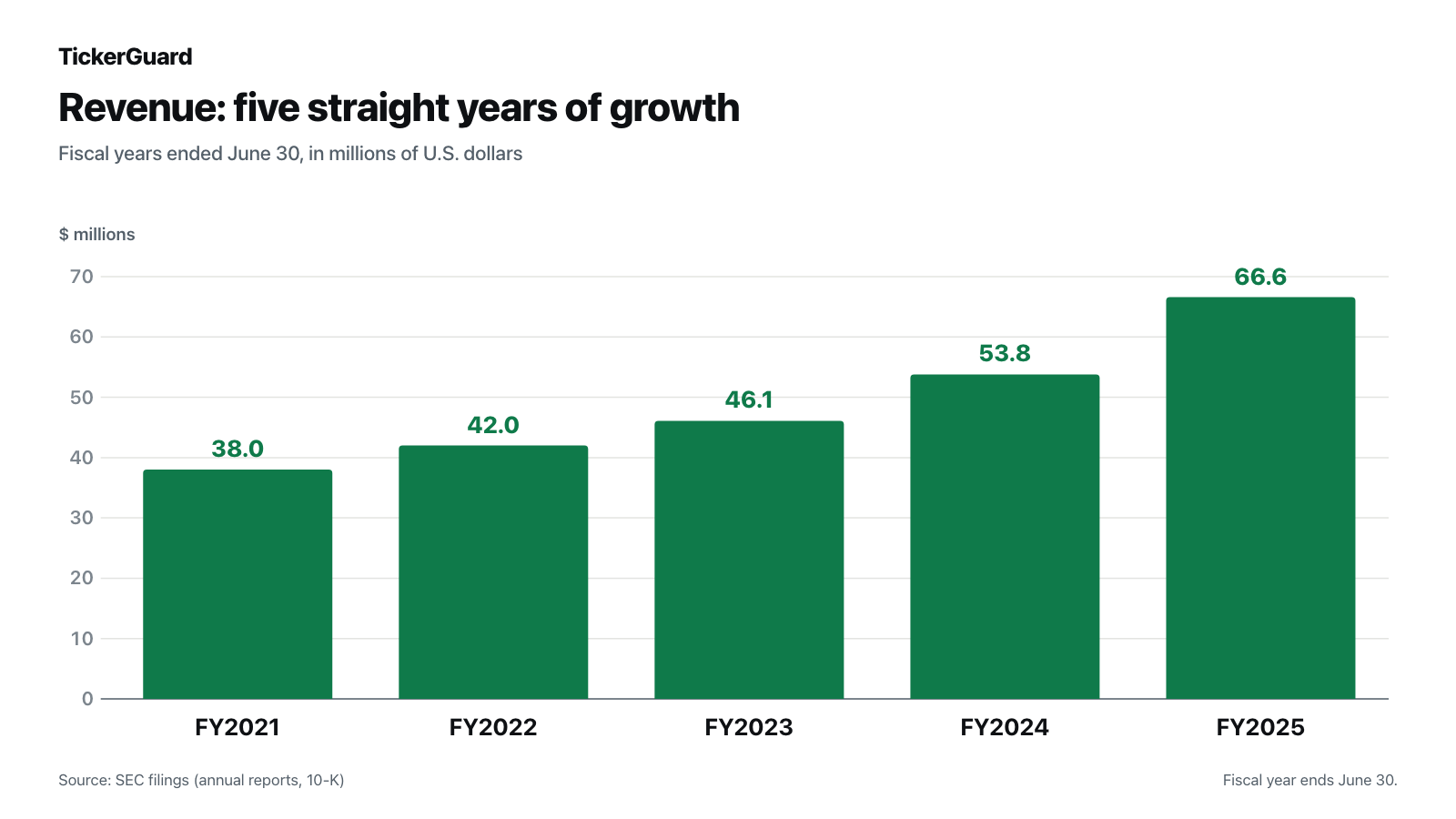
Start with what genuinely impresses. Revenue has grown almost without interruption: from $38.0 million in fiscal year 2021 to $42.0 million (2022), $46.1 million (2023), $53.8 million (2024), and $66.6 million in fiscal year 2025 — up 75 percent in four years. One clarification: Pro-Dex's fiscal year ends June 30, so fiscal 2026 ends June 30, 2026; wherever "fiscal 2025" appears below, it means the period through June 30, 2025. In the first nine months of fiscal 2026 (through March 31, 2026), the trend held: $57.1 million in revenue, up 16 percent year over year.
Operating income — profit from the core manufacturing business, before taxes and one-time items — looks just as clean: $4.5 million (2021), $5.1 million (2022), $5.8 million (2023), $7.2 million (2024), $10.7 million (2025). Capital policy is shareholder-friendly: buybacks since 2013, and since December 2019 under a program covering up to 1 million shares; 1,580,919 shares repurchased for $27.0 million cumulatively. Share count fell from 3,645,660 (June 30, 2021) to 3,192,759 (April 28, 2026) — down roughly 12 percent in under five years. Still no dividend: existing credit agreements prohibit it.
There's a dent, though: gross margin — revenue left after manufacturing costs — fell from a comfortable 35.7 percent (fiscal 2021) to just 27.0 percent (fiscal 2024), a nine-point slide from an unfavorable product mix and rising costs. It has been recovering since, to 29.3 percent (2025) and roughly 30 percent (9M fiscal 2026) — a recovery, not yet a full restoration. Operating cash flow swung too: negative $1.7 million in fiscal 2025 (largely a $6.9 million inventory build), then positive $7.5 million in 9M fiscal 2026 — driven by the stock sale covered next, not the core business.
What the filings say — the uncomfortable truths
So far, this reads like a solid, slightly margin-thin growth story. Now for the part the annual report (10-K) and quarterly report (10-Q) exist for — where companies are legally required to be honest.
Uncomfortable truth no. 1: one customer, 79 percent of revenue, name kept confidential by contract
In fiscal year 2025, 75 percent of revenue came from the single largest customer (fiscal 2024: 71 percent); together with the next two largest, the top three reached 94 percent (fiscal 2024: 88 percent). In the first nine months of fiscal 2026, that customer's share climbed to 79 percent ($44.9 million of $57.1 million) — also 79 percent in the third quarter alone — and as of March 31, 2026, 75 percent of outstanding receivables were owed by this one customer. We've seen this kind of danger before, in our Lantheus analysis, where a single product carried most of the revenue; at Pro-Dex it's a single, unnamed customer instead. The fiscal 2025 annual report (10-K) is blunt:
"A substantial portion of our revenue is derived from a few customers. If we were to lose a key customer, it would have a material adverse effect on our business, financial condition, and results of operations. In fiscal 2025, our top three customers accounted for 94% of our sales, with our current largest customer accounting for 75% of our sales. This customer has made purchase commitments to us through a supply agreement to purchase surgical handpieces through calendar 2025, and has placed purchase orders for deliveries in 2026, but there can be no assurance that this customer will extend purchase commitments to us beyond that date. The loss of, or a material reduction in purchases from, this customer or any of our other significant customers would severely impact us, including having a material adverse effect on our business, financial condition, cash flows, revenue, and results of operations."
— Pro-Dex, Inc., Form 10-K for fiscal year 2025, Risk Factors

This customer's name appears in no audited filing — confidentiality agreements bar it. Per CEO commentary, the relationship will reach "more than fifteen years" of collaboration by the time this contract extension runs out, and centers on an orthopedic handpiece. In fairness, there's a real mitigant: on December 17, 2025, Pro-Dex extended the supply contract with this exact customer three years, through December 31, 2028, now with fixed minimum purchase volumes:
"The contract, which was scheduled to terminate on December 31, 2025, has now been extended through December 31, 2028. The contract also contains minimum purchase volumes for each of the 2026 and 2027 calendar years."
— Pro-Dex, Inc., Form 8-K, filed December 19, 2025, press release (Exhibit 99.1)

The Q3 fiscal 2026 10-Q confirms it again: supply "through calendar 2028," with "higher volumes of their newest surgical handpiece" — a real mitigant, though the dependency itself remains. Moving the other way, the repair business (28 percent of fiscal 2025 revenue) is shrinking structurally as this same customer replaces old handpieces with the new generation — down roughly 48 percent in Q3 fiscal 2026.
Uncomfortable truth no. 2: the profit jump is mostly a market windfall, not operating performance
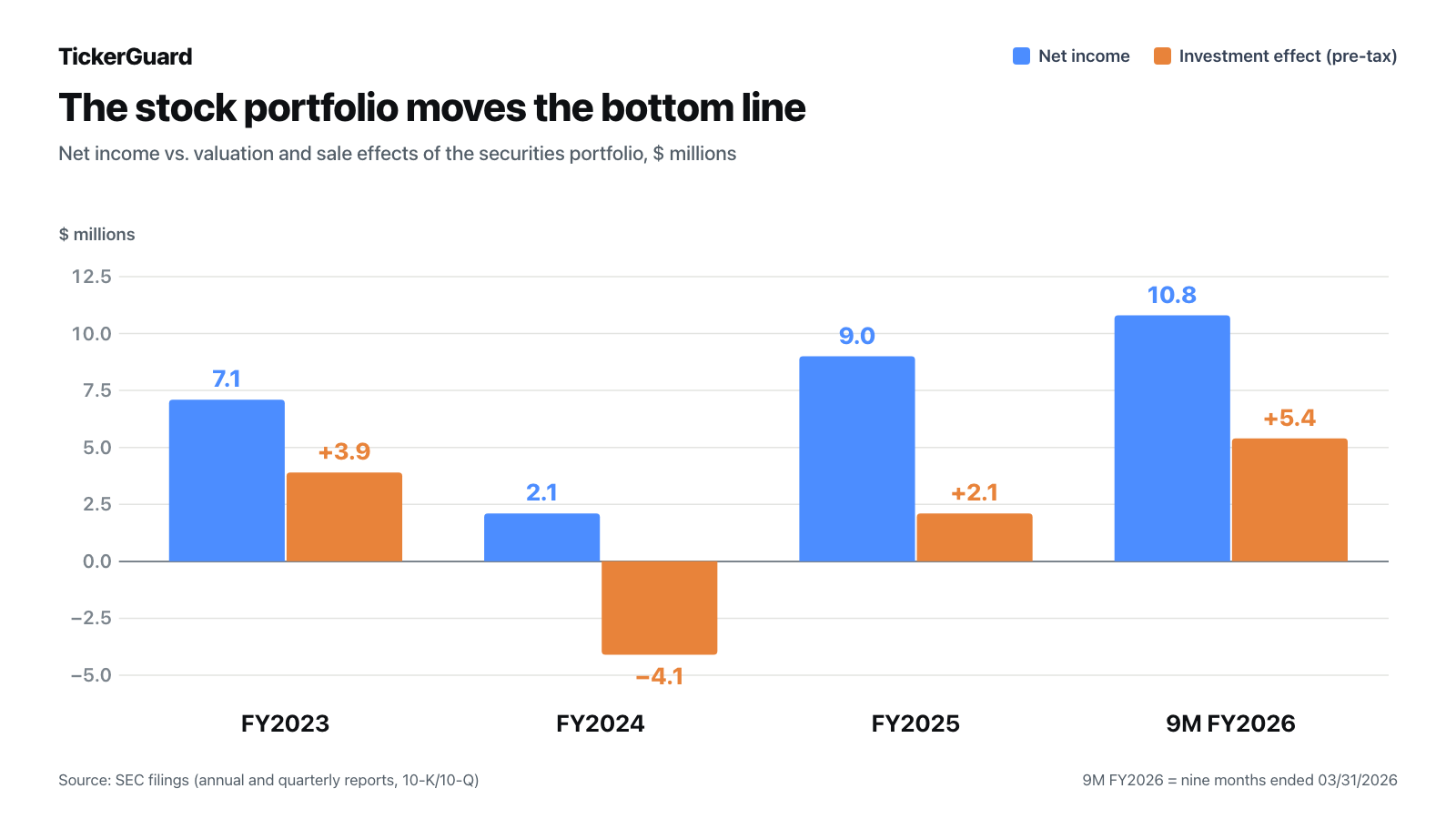
Alongside its device business, Pro-Dex holds a securities portfolio in other, partly publicly traded companies, and its swings run straight through the income statement — hence net income's roller-coaster look: $7.1 million (fiscal 2023), just $2.1 million (fiscal 2024, a $4.1 million portfolio markdown), $9.0 million (fiscal 2025), $10.8 million in the first nine months of fiscal 2026. The pretax investment effect: +$3.9 million (2023), −$4.1 million (2024, real losses), +$2.1 million (2025), +$5.4 million (9M 2026). Strip it out, and adjusted pretax income rose every year: $4.3 million (2021) to $9.9 million (2025) — no zigzag.
What's behind the jump? On October 7, 2025, Zimmer Biomet completed its acquisition of robotics firm Monogram Technologies, in which Pro-Dex had held a stake since fiscal 2017. Pro-Dex received $8.9 million cash and booked a $6.8 million gain in Q2 fiscal 2026, plus 2,212,378 non-tradeable "Contingent Value Rights" (CVRs) tied to five milestones; the first, hit in Q3, added $2.3 million more. All five could theoretically pay up to $12.37 per CVR — as much as $27.4 million, roughly 14 percent of market value. Pro-Dex tempers expectations itself:
"In our third quarter of fiscal 2026, Monogram achieved the first of five milestones, and accordingly we earned and recorded an additional gain in the amount of $2.3 million. There is no guarantee or assurance that any additional milestones will be achieved."
— Pro-Dex, Inc., Form 10-Q as of March 31, 2026, Note 5 "Fair Value Measurements"
Do the math yourself: 9M fiscal 2026 pretax income was $14.49 million; subtract the $5.44 million investment gain and $9.05 million of operating pretax income remains — versus $8.80 million a year earlier. After tax, adjusted net income grew only about 4 percent — against the reported 39 percent. The gap is starker in Q3 alone: reported profit rose 20 percent (EPS $0.98 to $1.20), but adjusted it fell roughly 11 percent (about $0.74 to $0.67) — matching operating income, which genuinely dropped 15 percent as costs rose 41 percent, partly one-time APM costs. Nearly the entire "up 39 percent" headline came from the portfolio, not more handpieces sold.
Uncomfortable truth no. 3: the directors' portfolio
Who is Pro-Dex's largest shareholder? Per a Schedule 13D/A filed June 26, 2026, the AO Partners group led by Chairman Nicholas J. Swenson holds 1,017,817 shares, 31.88 percent. With director Raymond E. Cabillot, the two controlled roughly 39 percent of voting power as of August 20, 2025. Swenson chairs not just the board but the Investment Committee, which decides how Pro-Dex invests surplus cash. The Q3 fiscal 2026 10-Q describes it this way:
"We invest surplus cash from time to time through our Investment Committee, which is comprised of one management director, Mr. Van Kirk, and two non-management directors, Mr. Cabillot and Mr. Swenson, who chairs the committee. … We leverage the experience of these committee members to make investment decisions for our surplus operating capital or borrowed funds. Additionally, many of our securities holdings include stocks of public companies that either Messrs. Swenson or Cabillot or both may own from time to time either individually or through the investment funds that they manage, or other companies whose boards they sit on, such as Air T, Inc."
— Pro-Dex, Inc., Form 10-Q as of March 31, 2026, Note 5 "Fair Value Measurements"

In plain terms: a medical device maker invests not just cash but explicitly borrowed money in stocks — some of them shares the deciding directors may hold personally or through their own funds. As of March 31, 2026, $986,000 of the portfolio sat in Air T, Inc. shares — a company where the same Pro-Dex chairman serves as CEO, and another Pro-Dex board member as "Chief of Staff." Picture your own CFO putting company money, even a credit-line draw, into stock of a business he personally runs — legal, disclosed, reviewed by other directors, but a conflict worth watching. This is the exact portfolio swinging profit so wildly, per truth no. 2.
This has history. On October 13, 2023 — a month late — Pro-Dex filed its fiscal 2023 10-K with a restatement for fiscal 2021 and 2022:
"The restatement corrects the error related to the fair value of the Monogram Warrant which had been understated (See Note 5)."
— Pro-Dex, Inc., Form 10-K for fiscal year 2023
The restatement didn't touch revenue, operating income, or cash, but retroactively raised fiscal 2022 net income — ironically, over the same Monogram position behind the 2026 windfall. Add two years of documented material weaknesses: 2023 in valuing certain securities, 2024 in inventory accounting and another valuation. There's a one-way pattern among insiders too: in May 2026, CEO Rick Van Kirk sold 10,000 shares at $62.09–$63.92 (about $628,000), roughly 10 percent of his holdings — no open-market insider purchase appears in the audited filings.
Uncomfortable truth no. 4: an AI-driven false report and a crypto mix-up
One last, more curious uncomfortable truth, briefly: the 10-Q for the first quarter of fiscal 2026 (filed October 30, 2025) introduced a new, very specific risk factor for the first time — artificial intelligence, not as a business threat but as a capital-markets sentiment risk.
"Artificial intelligence ("AI") may be generating information that is used incorrectly and may lead to an adverse effect on our business. In August 2025, a law firm that practices securities litigation posted a press release … The press release erroneously attributed a Form 8-K that we had filed nearly two years earlier, as well as other stale information, to a 20 percent decline in our stock price that occurred in August 2025. … While we have no way of knowing for certain that AI led to the generation of the press release, it seems possible to us that misinformation was attributable to AI."
— Pro-Dex, Inc., Form 10-Q as of September 30, 2025, Risk Factors

Pro-Dex also flags a second mix-up risk in the same section: the ticker PDEX is also used by the cryptocurrency "Polkadex" — there is "no relationship or affiliation between Pro-Dex, Inc., and Polkadex," and Pro-Dex says it simply doesn't know whether shareholders mistakenly apply automated crypto alerts to the stock. Both are more of a curious sentiment risk than a threat to the core surgical business — but in a stock this thinly traded, a single piece of misinformation can be enough to move the price.
Management promises vs. delivery
Unlike most public companies, Pro-Dex holds no analyst conference calls — not a single audited earnings release names a dial-in number or webcast link. What's left are the press releases (Exhibit 99.1) attached to each quarterly filing, in which CEO Rick Van Kirk comments on results. Only on June 17, 2026 did Pro-Dex file an investor presentation for the first time ever — a break from its usual reticence. Read roughly eight quarters of CEO statements back to back, and a clear pattern emerges: consistently upbeat, often phrased almost verbatim ("We are pleased with our … results"), with setbacks acknowledged only in hindsight, never in the moment.
- Q2 fiscal 2024 (Feb 2024): new buyback plan, plus "have begun to decrease our inventory levels." Broken — inventory rose to $22.2 million by June 30, 2025 (+45 percent); only edged down in 9M fiscal 2026.
- Q1 fiscal 2025 (Oct 2024): new-handpiece volumes promised for "the second half of this fiscal year." Partly kept — volumes came, but the large customer itself paused new-generation deliveries in Q3, lifted only in Q4.
- Fiscal year-end 2025 (Sep 2025): guided fiscal 2026 growth off a $50.4 million backlog. Revenue kept (+16 percent 9M); operating income grew a thin 1.3 percent, and the backlog itself shrank to $39.0 million by March 31, 2026, though this series has always swung wildly.
- Q1 fiscal 2026 (Oct 2025): after the Monogram windfall, said the company was "thoughtfully considering how to best utilize it." Answer: the APM deal four months later, with the CEO's own caveat it "may not be immediately accretive" — accurate, as selling, general and administrative expenses jumped 83 percent in Q3 (total operating expenses: 41 percent).
- Q3 fiscal 2026 (Apr 2026): "new quarterly record," "well positioned for sustained success" — no mention of the falling margin, customer concentration, or the collapsing repair business.
- August 28, 2026: discretionary bonuses for the CEO ($140,000) and CFO ($60,000), citing results "exceeding plan" — the only public signal yet on the unpublished full year; the 10-K for the year ended June 30, 2026 was still outstanding as this was written.
What's missing matters more than what's said: no audited CEO quote mentions customer concentration, margin erosion, or the shrinking repair business.
Valuation: an order of magnitude, not a bargain price
How expensive is Pro-Dex? As of August 31, 2026, market capitalization stood at roughly $198 million (3,192,759 shares at $62.10 = $198.3 million). Against fiscal 2025 revenue ($66.6 million), that's a price-to-sales ratio of about 3.0 — not outlandish for a growing, profitable niche manufacturer. The P/E is messier: based on fiscal 2025 net income ($9.0 million), it works out to roughly 22. The data-feed figure of just 15.8 looks cheaper, but uses trailing-twelve-month earnings that include the Monogram windfall from truth no. 2 — a P/E swallowing a one-time gain always looks cheaper than the ongoing business justifies.
The stock's run has been remarkable: from a $23.90 low on October 16, 2025 to $62.10 by August 31, 2026 — 2.6 times its low, partly explained by the tight float discussed earlier. Analyst coverage is thin: exactly one estimate is on record, rated "Strong Buy" — for a microcap this small, one voice isn't a consensus, and you should weight that label accordingly. On the plus side, no filing shows a going-concern doubt; Pro-Dex points to an $11.0 million undrawn credit line as extra cushion.
Opportunities and risks at a glance
What speaks for Pro-Dex:
- Continuous revenue growth: from $38.0 million (fiscal year 2021) to $66.6 million (fiscal year 2025), up 16 percent in the first nine months of fiscal year 2026 ($57.1 million).
- Solid balance-sheet metrics: Altman Z-Score of 11.8 and Piotroski F-Score of 7 of 9 (data as of August 31, 2026), no going-concern doubt, and an $11.0 million undrawn credit line (as of March 31, 2026).
- Shareholder-friendly capital policy: share count down roughly 12 percent since mid-2021, 1.58 million shares repurchased since 2013 for $27.0 million.
- Freshly extended supply contract with the largest customer through the end of 2028, including contractual minimum purchase volumes for 2026 and 2027, plus a second leg in defense and aerospace machining via subsidiary APM since February 2026.
- Adjusted pretax income rose every single year from 2021 to 2025 ($4.3 million to $9.9 million) — the operating business stands on its own, independent of the stock portfolio.
What speaks against it:
- Existential customer concentration: a single, contractually unnamed customer supplied 79 percent of revenue and 75 percent of outstanding receivables in the first nine months of fiscal year 2026.
- The reported profit jump is mostly a one-time securities effect: adjusted, only about plus 4 percent (9M fiscal 2026), and roughly minus 11 percent adjusted in the third quarter alone.
- Conflict of interest on the Investment Committee: company funds, even borrowed funds, flow in part into shares of Air T, Inc., a company the chairman himself runs as CEO; plus a 2023 restatement and two years of documented material weaknesses in internal controls.
- Shrinking, historically volatile backlog: from $50.4 million (June 30, 2025) to $39.0 million (March 31, 2026), of which only $15.6 million is scheduled for the fourth quarter.
- Tight float of only about 1.7 million shares against short interest of 21.9 percent of the float — high volatility risk in both directions, compounded by the structurally shrinking repair business (down roughly 48 percent in the third quarter of fiscal year 2026).
A human conclusion
Back to the headline reflex from the start. "Net income up 39 percent" is a true statement about Pro-Dex — and, on its own, a misleading one. Buy on that number alone, and you're really buying a stock sale in the engine room, not more surgical handpieces sold: adjusted for the Monogram windfall, the profit jump shrinks to roughly plus 4 percent, and in the third quarter the adjusted figure actually turned negative. Pro-Dex's operating business is real nonetheless — it grows year after year, carries a healthy balance sheet, and just locked in its most important customer through 2028. But that one customer alone carries 79 percent of revenue, and the very portfolio that delivered the record profit is co-managed by an Investment Committee whose chairman invests in stocks he partly holds personally or whose companies he runs. Two faces, one stock. The question worth asking yourself isn't "was the quarter good?" — it was — but: would you still want to own this company if the headline had read "operating income barely up, one customer keeps the lights on" instead of "profit up 39 percent"? What you make of that is your decision.
Sources
All original documents used in this analysis — for you to read yourself:
- Pro-Dex, Inc. — Form 10-K for fiscal year 2025 (filed September 4, 2025)
- Pro-Dex, Inc. — Form 10-K for fiscal year 2024 (filed September 5, 2024)
- Pro-Dex, Inc. — Form 10-K for fiscal year 2023, with restatement (filed October 13, 2023)
- Pro-Dex, Inc. — Form 10-Q as of March 31, 2026 (filed April 30, 2026)
- Pro-Dex, Inc. — Form 10-Q as of December 31, 2025 (filed January 29, 2026)
- Pro-Dex, Inc. — Form 10-Q as of September 30, 2025 (filed October 30, 2025)
- Pro-Dex, Inc. — Form 8-K with Q3 fiscal year 2026 earnings release (filed April 30, 2026)
- Pro-Dex, Inc. — Form 8-K on the contract extension with the large customer (filed December 19, 2025)
- Pro-Dex, Inc. — Form 8-K on the acquisition of Advanced Precision Machining (filed February 12, 2026)
- Pro-Dex, Inc. — Form 8-K on discretionary bonuses for the CEO and CFO (filed August 28, 2026)
- Pro-Dex, Inc. — Schedule 13D/A filed by Chairman Nicholas J. Swenson (filed June 26, 2026)
- Complete SEC filing history for Pro-Dex, Inc.: EDGAR overview (sec.gov)
- Fundamental data (price, market capitalization, scanner metrics, short interest; data as of August 31, 2026), cross-checked against the SEC filings.
Transparency & disclaimer: This analysis is a journalistic contextualization of publicly available information and is not investment advice, not a financial analysis in the regulatory sense, and not a solicitation to buy or sell securities. Stock investments carry substantial risk, including total loss. All figures are provided without guarantee; data cut-off dates are noted throughout the text. The author holds no position in Pro-Dex stock at the time of publication.
Key figures at a glance
All monetary figures in millions of $; earnings per share as reported.
| Metric | 2022 | 2023 | 2024 | 2025 | 2026 |
|---|---|---|---|---|---|
| Revenue | 42.0 | 46.1 | 53.8 | 66.6 | 77.5 |
| Operating Income (EBIT) | 5.1 | 5.8 | 7.2 | 10.7 | 13.0 |
| Net Income | 4.6 | 7.1 | 2.1 | 9.0 | 13.7 |
| Net Margin | 10.9% | 15.3% | 4.0% | 13.5% | 17.6% |
| Earnings Per Share | 1.21 $ | 1.95 $ | 0.60 $ | 2.67 $ | 4.12 $ |
Source: fundamental data & SEC filings (annual and quarterly reports, 10-K/10-Q)
Our Bottom Line at a Glance
- Customer concentration negative
- A single, contractually unnamed customer supplied 79 percent of revenue in the first nine months of fiscal year 2026 (through March 31, 2026) — the top three customers combined reached as much as 94 percent in fiscal year 2025. The supply contract extended through the end of 2028 with minimum purchase volumes eases this risk but does not eliminate it.
- Earnings quality negative
- Reported net income rose 39 percent in the first nine months of fiscal year 2026 — adjusted for gains from the company's own stock and equity portfolio, only about 4 percent of that growth remained. In the third quarter, the adjusted figure actually turned negative, roughly minus 11 percent.
- Balance sheet & liquidity positive
- No going-concern doubt, cash of $9.99 million as of March 31, 2026 (up from just $0.42 million at the June 30, 2025 fiscal year-end), an $11.0 million undrawn credit line, and an Altman Z-Score of 11.8 (as of August 31, 2026) point to solid financial substance.
- Governance negative
- An Investment Committee chaired by the chairman invests company funds, even borrowed funds, in shares of Air T, Inc., a company the same chairman runs as CEO; the CEO sold roughly 10 percent of his shares in May 2026, while not a single open-market insider purchase is documented. Add to that a 2023 restatement and two years of documented material weaknesses in internal controls.
- Operating growth positive
- Revenue grew from $38.0 million (fiscal year 2021) to $66.6 million (fiscal year 2025), and adjusted pretax income rose every single year over the same period. Subsidiary APM (since February 2026) adds a second leg in defense and aerospace machining.
Pro-Dex is a solidly built niche manufacturer with two faces: profitable, balance-sheet-strong, and free of going-concern warnings on one side — existentially dependent on a single, unnamed customer (79 percent of revenue, 9M fiscal 2026) and a profit-distorting stock portfolio overseen by the chairman's own Investment Committee on the other. The widely cited 39 percent profit jump is mostly a one-time gain from selling a stake, not an operating improvement. Not investment advice.
What Our Rating Means
Substance risk
We found at least one documented issue that threatens the company itself — regardless of how the stock is currently valued.
Despite a healthy balance sheet, consistently positive operating results, and no going-concern warning, we rate Pro-Dex red because a single, unnamed customer carries 79 percent of revenue (9M fiscal 2026, through March 31, 2026) — a documented existential dependency on one counterparty. Should this customer walk away, the company's own risk disclosure says the impact on its business, financial condition, and results would be "severely" felt. That is a substance risk, not a price question — whether the stock is attractive at its current price is for the scanners to decide, not this light. The decision is yours.
A journalistic assessment by our editorial team at the time of the deep dive, based on public sources — not investment advice and not a solicitation to buy or sell. Your personal circumstances (investment goals, risk capacity, taxes) cannot be taken into account. What our levels mean, how verdicts are formed, and what conflicts of interest exist →
Worth Noting
- Data cut-off: all metrics are drawn from the 10-Q for the third quarter of fiscal year 2026 (period ended March 31, 2026, filed April 30, 2026); price and market data as of August 31, 2026.
- Fiscal year end June 30: fiscal year 2026 ended June 30, 2026. The corresponding annual report (10-K) was still outstanding as this analysis was written — all fiscal 2026 figures come from the most recent quarterly report and press releases.
- Mix-up risk: the ticker PDEX is also used by the cryptocurrency "Polkadex." Pro-Dex, Inc. and Polkadex have no connection to one another.
Stock Watch
This analysis is as of September 1, 2026. Stock Watch will tell you what's changed at PDEX since then.
Later $1 a month per stock — signing up is free, and you'll be the first to know when it launches.
The full analysis as a PDF for later
We will send you this analysis as a PDF — to print, file away, and read at your own pace. And we will add you to the free Stock Watch list for Pro-Dex Inc (PDEX), so you hear about it when something material in this analysis changes.
Frequently Asked Questions
Pro-Dex, Inc. (Nasdaq: PDEX), based in Irvine, California, designs and manufactures surgical power screwdrivers and shavers with patented torque-limiting technology, primarily for orthopedic, thoracic, and craniomaxillofacial surgery. The company sells to medical device makers who resell the devices under their own brand names. Since February 2026, it also owns the machining shop APM, which serves the defense and aerospace industries.
Because Pro-Dex essentially manufactures a specialized surgical handpiece for one large customer. In the first nine months of fiscal year 2026 (through March 31, 2026), this single, contractually unnamed customer supplied 79 percent of revenue. A supply contract extended on December 17, 2025 through the end of 2028, with minimum purchase volumes, eases this risk but does not eliminate it.
Reported net income for the first nine months of fiscal year 2026 was boosted mainly by the sale of the Monogram Technologies stake to Zimmer Biomet ($6.8 million in gains) and a first milestone bonus payout ($2.3 million). Strip out these securities gains, and the operating business grew only about 4 percent.
No. Pro-Dex states in its fiscal 2025 annual report (10-K) that it has never paid a cash dividend, and its existing credit agreements explicitly prohibit dividend payments. Instead, the company has repurchased its own shares since 2013 — 1.58 million shares for $27.0 million cumulatively, including 69,422 shares for $2.8 million in the first nine months of fiscal year 2026.
No, there is no connection whatsoever. Both happen to share the ticker PDEX — Pro-Dex, Inc. on the Nasdaq, and Polkadex as a cryptocurrency on trading exchanges. Pro-Dex itself flags this mix-up risk explicitly in its 10-Q as of September 30, 2025, because it could lead investors to buy or sell based on confused information.
As of August 31, 2026, market capitalization stood at roughly $198 million, with a price-to-sales ratio of about 3.0 (based on fiscal year 2025 revenue). The price-to-earnings ratio of roughly 15.8 shown in the data feed looks cheap, but it includes one-time gains from the stock portfolio; adjusted, it's closer to about 22.
Found an error?
Did you spot a factual error, an outdated number, or a typo in this deep dive? Let us know briefly — your report goes straight to the editorial team.