loanDepot: Once $31, Now Less Than a Dollar — and About $797 Million of Bonds Come Due by April 2028
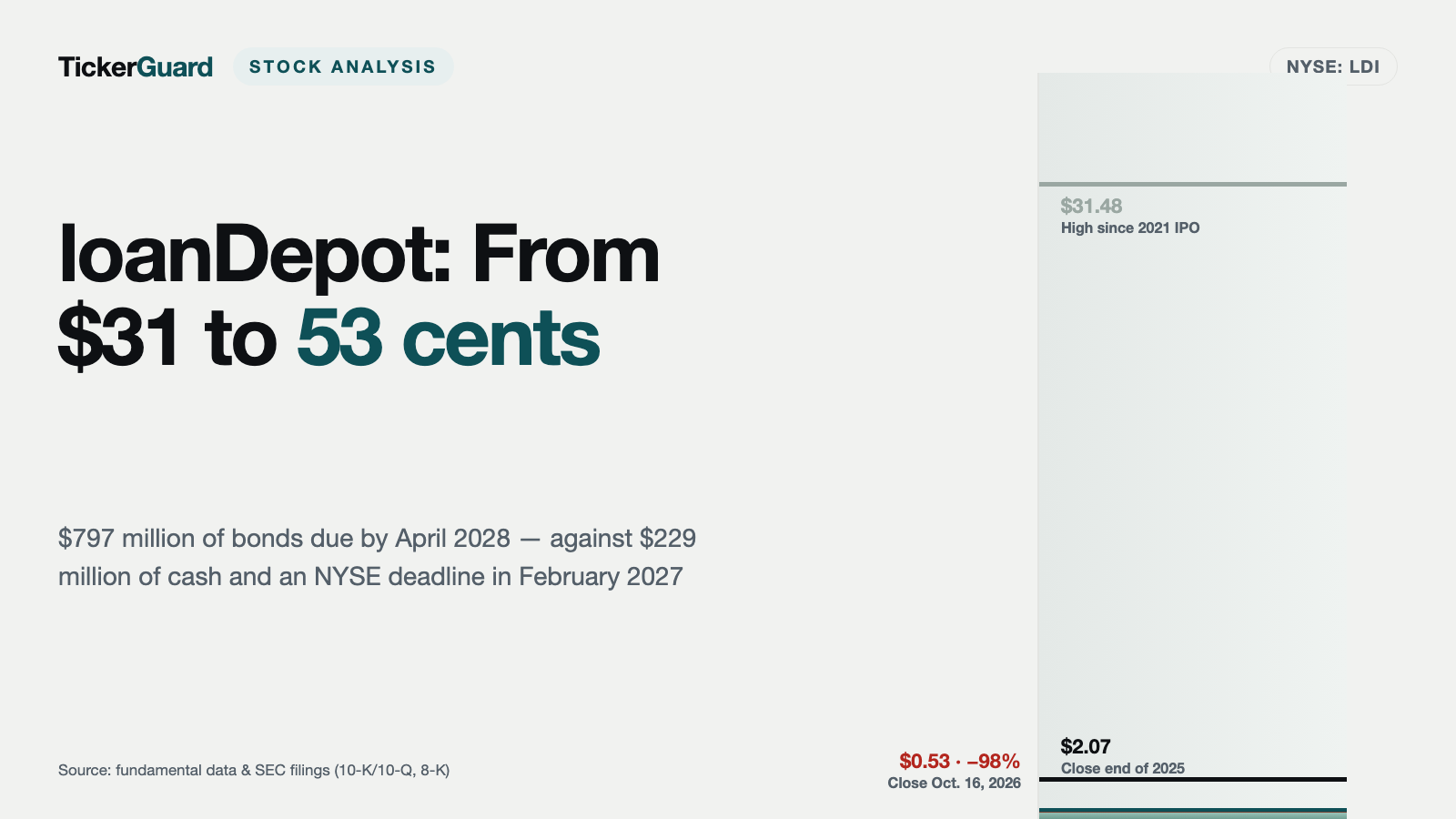
Mortgage lender loanDepot has fallen from $31.48 (the highest close according to its annual report) to $0.53 (October 16, 2026) — and has to service about $797 million of bonds by April 2028, against $229.1 million of cash at June 30, 2026. If your first thought is “it has never been this cheap,” that is anchoring at work. The filings with the U.S. securities regulator, the SEC, show four straight years of losses, an equity cushion that has melted away and, since August, a warning from the New York Stock Exchange. A look at what is left once you let go of the anchor.
 Thomas Mücke
Founder & Publisher
As of Today
As of: October 16, 2026
- Closing price
- 0.53 $ -5.82%
- Market Capitalisation
- 0.2 $B
- Growth Score
- 4/10
- AAQS
- 0/10
Price change since October 16, 2026: -0.7%
This analysis has a cut-off date. The Stock Guard tells you when something material changes in the numbers. Reserve your free spot
Chart
Interactive price chart (TradingView).
52-week range: 0.4958 $ to 3.60 $ · Last price: 0.53 $ (As of: October 16, 2026)
Note: pure fact-based analysis, not investment advice and not a solicitation to buy or sell. All figures without guarantee.
There is an investor trap that feels like common sense. It is called anchoring, and it works like this: you see a stock that once traded at $31 and now costs a few cents. Your brain does not compare it with what the company is worth today, but with the first number it ever saw — and whispers: “It can hardly go any lower. If it just gets back to two dollars, that’s a multiple.” loanDepot (NYSE: LDI) is exactly that kind of case. The annual report names its highest close since the IPO itself: $31.48. On October 16, 2026, the stock closed at $0.53. So let’s make a deal: before you hold on to the 31, let’s read together what the company has told the U.S. securities regulator, the SEC — the annual report (10-K) for 2025, the quarterly report (10-Q) for June 30, 2026 and the current reports (8-K) through October 2026. Making false statements to the SEC carries penalties, which is why these filings are among the most reliable sources there are. And they tell the story of a company whose business is slowly recovering — while the clocks of its bondholders and its stock exchange are running faster. In the end, the decision is yours.
What loanDepot actually does — make loans, sell them on, keep collecting the payments
loanDepot is a non-bank mortgage lender. The Irvine, California, company launched in 2010 and makes home loans to U.S. consumers — online, through call centers, through branches, through a network of independent brokers (wholesale) and through joint ventures with home builders. The trick of the business model: loanDepot does not keep the loans. It usually sells them within weeks to the government-sponsored buyers Fannie Mae and Freddie Mac or pools them into Ginnie Mae securities, booking a gain on sale. Until the sale, it funds the loans with short-term bank credit lines, so-called warehouse lines — think of a trader who buys goods on credit and resells them before the invoice is due. Often loanDepot keeps the right to collect the payments (mortgage servicing rights, or MSRs) and earns an annual fee for it, much like a property manager who collects the rent for the owner. At June 30, 2026, loanDepot serviced 465,089 loans with $123.4 billion of unpaid principal; 1.7 percent of that was 60 days or more delinquent.
In 2025 the company originated loans worth $26.48 billion and, by its own account, was the fifth-largest retail-focused non-bank mortgage originator in the U.S. At December 31, 2025 it had about 4,700 employees and 960 independent contractors. Since early 2026, management has been pushing the business toward home equity — loans against the paid-off part of a house that let an owner raise cash without giving up an old, cheap first mortgage. Founder Anthony Hsieh is back at the helm, having taken over again in 2025. How a much larger competitor with a similar business model is positioned is covered in our Rocket Companies analysis. That defines the central tension of this analysis, and it runs through every chapter: the business is showing first signs of recovery — but the notes come due in 2027 and 2028, and the exchange has set a deadline that will not wait for the recovery.
Company history for investors
-
2010
Launch as an online mortgage lender
Anthony Hsieh launches loanDepot to make the mortgage business digital. The model: originate loans, sell them on and collect the payments for a fee.
-
2020
Exceptional low-rate year: $2.01 billion profit
On $4.31 billion of revenue, loanDepot earns $2.01 billion net — an exceptional refinancing-boom year that later sticks in many investors’ minds as the yardstick.
-
2021
IPO on the NYSE
Trading as LDI starts on 02/11/2021. The founder and private equity firm Parthenon keep control through five-vote shares; the highest close since then was $31.48 per the 10-K.
-
2022
Rate shock: $610.4 million loss
As rates rise, the refinancing business collapses. It is the start of four straight loss-making years that shrink equity from $1.63 billion to $386.0 million (2025).
-
2026
NYSE notice, and the founder buys more
On 08/21/2026 loanDepot discloses the NYSE notice for a price below one dollar. Soon after, Anthony Hsieh buys one million shares; about $797 million of notes come due by April 2028.
How the stock landed on our desk
loanDepot made our research list through our in-house Reddit hype scanner: 4 mentions in 24 hours, rank 77 (ApeWisdom, retrieved on October 19, 2026). That is not a storm, more of a murmur — but it is the typical murmur around stocks that have dropped below a dollar. Anchoring weighs especially heavily on those names, because a price under a dollar looks like a bargain. How far away the anchor is, the company writes into its own risk factors:
“In fact, the closing market price of our Class A Common Stock has ranged between $1.02 and $31.48 since our IPO priced in February 2021.”
— loanDepot, Inc., SEC annual report 10-K for 2025, Item 1A “Risk Factors”
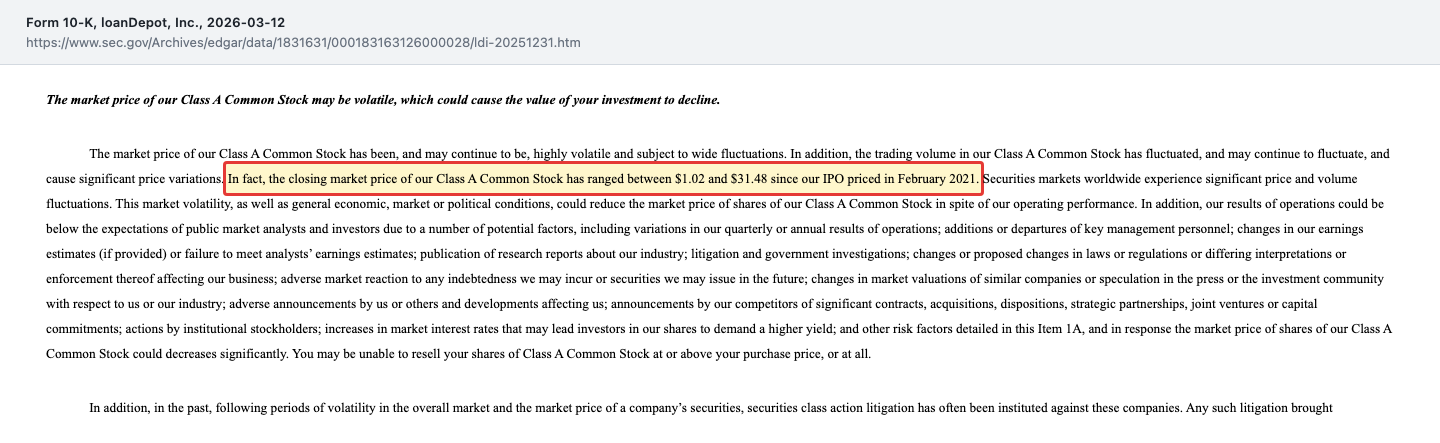
At the end of 2025 the stock still closed at $2.07; on October 16, 2026 it closed at $0.53 — down roughly three quarters in less than ten months (fundamental data). Classic metrics from our scanners are of little help here: there is no price-to-earnings ratio without earnings, and a very low price-to-sales ratio says little about what is left for shareholders at a highly leveraged loan originator. The professionals who cover the stock are cautious: of four analysts, two rate it hold, one sell and one strong sell; their average price target is $1.13 (fundamental data, as of October 19, 2026). So keep this in mind from the start: for a mortgage lender with debt maturities, the most important number is not the old share price but the date on which the money has to be paid back.
The numbers over the years, given their due
First, what loanDepot can do — and that is a lot. In the pandemic’s low-rate era, the company became a cash machine: 2020 brought $4.31 billion of revenue and net income of $2.01 billion, 2021 still $3.72 billion of revenue and $623.1 million of profit. When rates rose in 2022, the refinancing business collapsed. Since then loanDepot has grown revenue again from $974.0 million (2023) to $1.06 billion (2024) and $1.19 billion (2025); origination volume rose from $22.67 billion (2023) to $24.50 billion (2024) and $26.48 billion (2025). The net loss got smaller every year.
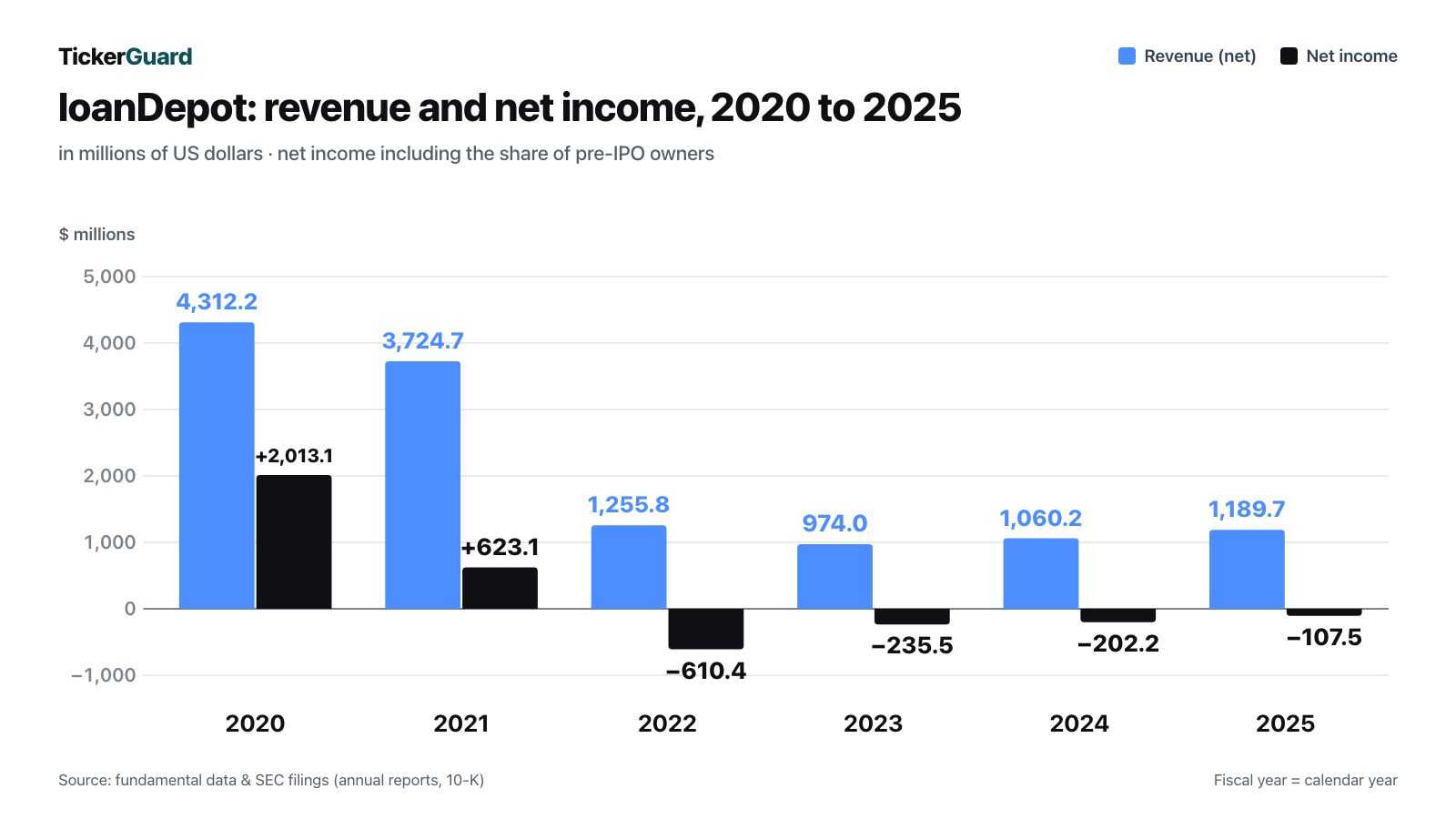
The second quarter of 2026 was the best in a long time: $337.3 million of revenue and a net loss of only $6.6 million, after $54.9 million in the first quarter. The number of loans funded rose 25 percent from the prior quarter, mainly thanks to the new home equity loans. In fairness, though: part of the improvement came from a revaluation of the servicing rights (+$36.7 million from changed valuation inputs, after +$0.4 million in the prior quarter). Adjusted for such effects, the company itself reports a second-quarter loss of $29.2 million. For the third quarter of 2026, loanDepot expects origination volume of $6.25 billion to $8.25 billion (8-K of August 4, 2026). Remember the picture: the business is running faster again — but it is not making money yet.
What the filings say: the uncomfortable truths
Uncomfortable truth #1: four straight loss-making years — and the interest is not being earned
From 2022 through mid-2026, loanDepot posted net losses of about $1.22 billion in total ($610.4 million in 2022, $235.5 million in 2023, $202.2 million in 2024, $107.5 million in 2025 and $61.6 million in the first half of 2026; each including the share of the Hsieh stockholders — more on that shortly). These losses have eaten into the cushion that carries everything in a lending business: equity.
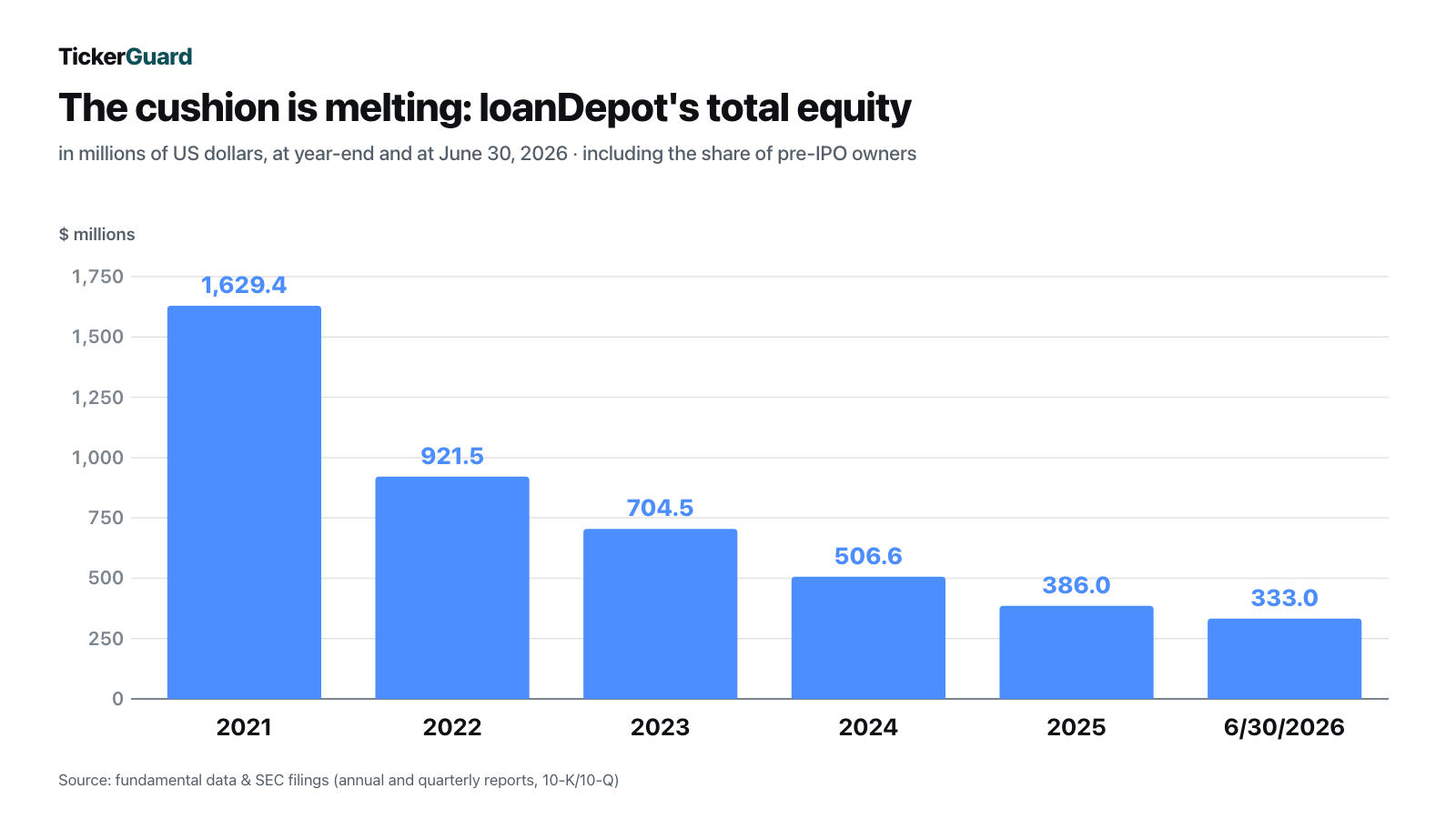
How tight things are shows in interest coverage — in plain terms: how many times operating earnings could pay the interest on the debt. A healthy company manages that several times over. In 2025, loanDepot paid $175.2 million of interest on its debt outside the warehouse lines (senior notes, MSR financing, securitizations). Earnings before taxes and before exactly that interest came to about $54.7 million — so only a little under a third of the interest was earned. The first half of 2026 looked similar: about $23.2 million against $84.9 million of interest. Remember: a company that cannot pay its interest out of current business pays it out of its substance.
Uncomfortable truth #2: about $797 million of notes come due — the cash pile was $229 million
loanDepot has two series of senior notes outstanding. The first, carrying 8.75 percent and secured by collateral, matures in November 2027; at June 30, 2026, $334.5 million of it was outstanding. The second, carrying 6.125 percent, matures in April 2028; here the figure was $489.5 million. In July 2026 the company repurchased another $5.2 million and $21.4 million, leaving roughly $329 million and $468 million, about $797 million in total. Against that stood $229.1 million of unrestricted cash at June 30, 2026. The annual report itself describes what happens if the money is not enough:
“If we do not have enough funds, we may be required to refinance all or part of our then existing indebtedness, sell assets or borrow additional funds, in each case on terms that may not be acceptable to us, if at all. For example, we have sold, and we may need to sell, MSRs to meet liquidity needs.”
— loanDepot, Inc., SEC annual report 10-K for 2025, Item 1A “Risks Related to Our Indebtedness”
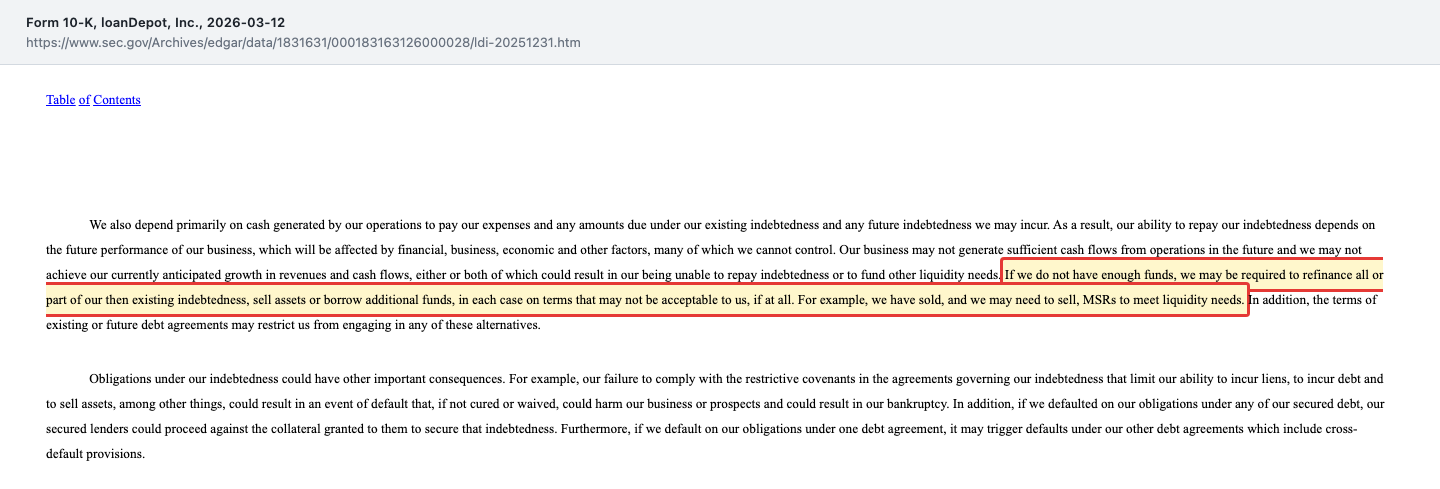
That is exactly what is happening now. In July 2026, loanDepot agreed to sell servicing rights on loans with $9.7 billion of unpaid principal; the deal was expected to settle in the third quarter. The company is buying back its notes at a discount — $16 million in the second quarter at an average of 90 percent of par, and another $27 million at 86 percent through July 30, 2026. That reduces debt, but it also shows how the market prices the risk: a 14 percent discount suggests the market prices the risk higher. CFO David Hayes put it this way in the earnings release of August 4, 2026:
“Addressing the Company’s bond maturities remains a high priority for management, and we are evaluating a range of options with the support of retained advisors.”
— loanDepot, Inc., SEC current report 8-K of August 4, 2026, Exhibit 99.1 (second-quarter 2026 earnings release)
In fairness: the quarterly report states that management believes cash and funding sources will be sufficient for the next twelve months, and at June 30, 2026 loanDepot was in compliance with all financial covenants. New funding lines were added — a $500 million securitization facility running to April 2029 (8-K of April 30, 2026) and a repurchase agreement with Nomura for up to $125 million through September 2027 (8-K of October 7, 2026). Both, however, fund the ongoing lending business, not the notes. The twelve months run to roughly August 2027 — the first notes mature in November 2027.
Uncomfortable truth #3: below one dollar — the exchange has set a deadline
On August 21, 2026, loanDepot disclosed in a current report (8-K, Item 3.01) that the New York Stock Exchange (NYSE) had written to the company:
“The notice was received because as of August 20, 2026, the average closing price of loanDepot’s Class A Common Stock (the “Common Stock”) was less than $1.00 per share over a consecutive 30 trading-day period (the “Notice”).”
— loanDepot, Inc., SEC current report 8-K of August 21, 2026, Exhibit 99.1
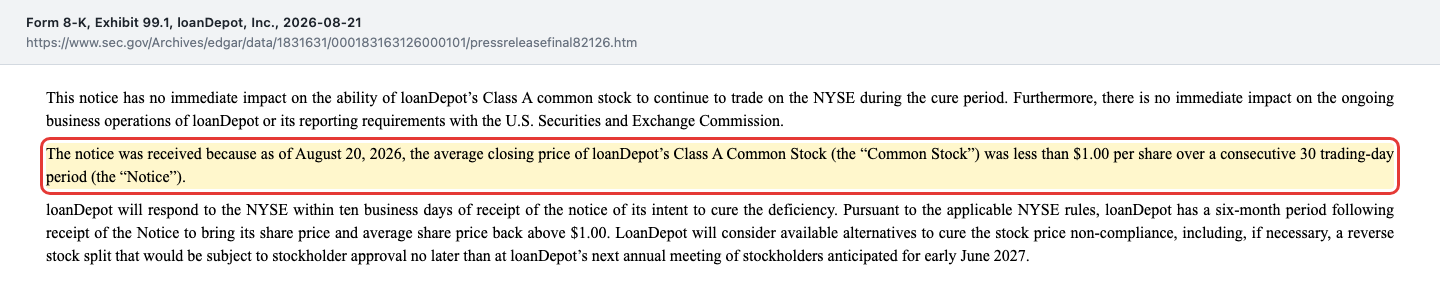
loanDepot has six months from receipt of the notice. The deficiency is cured if, on the last trading day of any month, the stock closes at $1.00 or more and its 30-day average through that day is also at least $1.00. If that fails, the NYSE will start procedures to suspend and delist the stock. The company explicitly mentions a reverse stock split — a consolidation in which, say, ten old shares become one new one; your stake stays the same, only the quoted price changes. Shareholder approval for that would have to come no later than the next annual meeting, which the company expects in early June 2027. The latest data point: on October 16, 2026 the stock closed at $0.53 (fundamental data); no notice of a cure had been filed by October 19, 2026.
Uncomfortable truth #4: the fresh money may also come from new shares
On May 15, 2026 — the day after the stock had closed at $1.32 — loanDepot signed an agreement with the investment bank BTIG: since then, the company may sell new shares into the market from time to time, up to a total of $100 million (a so-called at-the-market program). The prospectus states the purpose:
“We intend to use the net proceeds of this offering, after deducting the Sales Agent’s commissions and our offering expenses, to reduce outstanding indebtedness and for general corporate purposes.”
— loanDepot, Inc., SEC prospectus supplement 424B5 of May 15, 2026, “Use of Proceeds”
In everyday terms: your slice of the pie gets smaller every time a new slice is cut — and the cheaper the stock, the more slices it takes to raise the same amount. At $1.32, $100 million would have meant roughly 76 million new shares on our math; at the October 16, 2026 close it would be roughly 187 million — a little over 80 percent of the 232.2 million Class A shares the company reported for August 3, 2026. Judging by the share count, little of it had been used by then (231.7 million on May 4, 232.2 million on August 3, 2026). But the program is ready.
Uncomfortable truth #5: two camps decide, everyone else votes along
loanDepot has a layered structure dating back to its 2021 IPO. The listed loanDepot, Inc. owns only about 68.6 percent of the actual operating holding company; the remaining 31.4 percent belongs to the Hsieh stockholders around founder Anthony Hsieh, who can exchange their stake (Holdco units plus Class B shares) for Class A shares at any time. The private equity firm Parthenon Capital, by contrast, holds about 103.6 million Class A shares directly in the listed loanDepot, Inc. — 44.9 percent of the Class A and 30.7 percent of the voting power (proxy statement DEF 14A, filed April 23, 2026). The special IPO shares carrying five votes each were automatically converted into one-vote shares on February 11, 2026, five years after the IPO (Class D into Class A, Class C into Class B); according to the 2024 annual report, the two camps previously held about 92.6 percent of the votes. The majority still sits in two pairs of hands:
“The Hsieh Stockholders and Parthenon Stockholders together hold in the aggregate approximately 62.7% of the voting power of our outstanding capital stock, and therefore between them will be able to control all matters submitted to our stockholders for approval (other than those matters requiring a 66 2/3% supermajority vote).”
— loanDepot, Inc., SEC annual report 10-K for 2025, Item 1A “Risk Factors”
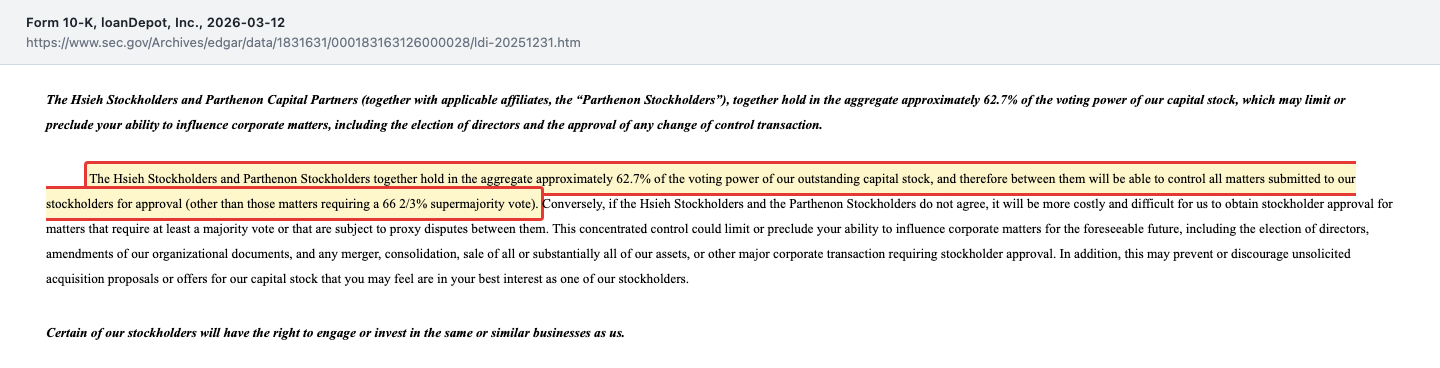
Two details belong here. First, the founder’s pay: his employment agreement of May 6, 2026 provides for a $1 million base salary, a 2026 target bonus of 225 percent of that, and reimbursement of up to $400,000 a year for business use of his own aircraft or watercraft. Second, a tax receivable agreement from the IPO under which loanDepot owes the Parthenon stockholders and certain other pre-IPO owners payments once it realizes tax savings; at June 30, 2026 the balance sheet carried a $111.5 million liability for it. On the other side stands a signal that should not be played down: Anthony Hsieh bought exactly one million Class A shares between August 24 and September 1, 2026 at $0.89 to $0.94, about $0.91 million in total (insider filings, Form 4). A founder who puts his own money in after an NYSE notice is sending a signal of confidence in his company. He is also the one with the most to lose — and he has a Rule 10b5-1 selling plan (a pre-arranged share sale) that he adopted on December 9, 2025 for up to 9.6 million Class A shares, running until March 8, 2027 at the latest (2025 annual report, Item 9B).
Valuation: half of book value — for a melting cushion
At the October 16, 2026 close of $0.53, the 232.2 million Class A shares are worth roughly $124 million on the market. Including the 105.9 million units held by the Hsieh stockholders, which can be exchanged into Class A shares, the figure is roughly $181 million. (We did not use the market value from the price feed: it stood at $237.5 million and does not match the current price.) Against that stands total equity of $333.0 million at June 30, 2026, about $0.98 per share and unit. The stock therefore trades at a little over half of book value — in plain terms, the market only trusts about half of the balance sheet. The price-to-sales ratio is about 0.14 (revenue for the four quarters through June 2026: $1.26 billion).
Sounds cheap. But book value is only worth what it would fetch in an emergency, and at loanDepot it has shrunk every year since 2021. A large part of the assets are servicing rights whose value swings with interest rates: when mortgage rates fall, homeowners refinance and the rights lose value. And ahead of shareholders’ equity in the queue stand about $797 million of notes that have to be repaid or rolled over by April 2028. How strongly a whole business model depends on the level of mortgage rates is also shown in our Opendoor analysis. Remember: at a company with losses and maturities, a discount to book value is not a bargain but a risk premium.
Upside and risks at a glance
What speaks for loanDepot:
- The business is growing again: origination volume of $26.48 billion in 2025 (2023: $22.67 billion), revenue of $1.19 billion (2023: $974.0 million), and a second-quarter 2026 net loss of only $6.6 million.
- A well-known brand with a large customer base: 465,089 serviced loans with $123.4 billion of unpaid principal (June 30, 2026) — homeowners loanDepot can offer new loans as soon as rates fall.
- The founder is putting in his own money: Anthony Hsieh bought one million shares for about $0.91 million in August and September 2026.
- Valuable rights it can sell: servicing rights with a fair value of $1.78 billion (June 30, 2026) that loanDepot can turn into cash, as with the sale covering $9.7 billion of unpaid principal agreed in July 2026.
- Covenants met, liquidity sufficient for twelve months according to management, new funding lines through 2027 and 2029.
What speaks against it:
- Four straight loss-making years (2022 to 2025) and another $61.6 million loss in the first half of 2026; equity has fallen from $1.63 billion (2021) to $333.0 million.
- The interest is not being earned: in 2025, earnings before taxes and debt interest covered only a little under a third of the $175.2 million interest bill.
- About $797 million of notes mature in November 2027 and April 2028, against $229.1 million of cash at June 30, 2026; management is evaluating “a range of options” with advisors.
- NYSE notice since August 21, 2026: without a price above one dollar or a reverse split, delisting procedures loom.
- Dilution risk from the $100 million program and a voting majority of about 62.7 percent held by Hsieh and Parthenon.
A human conclusion
Back to anchoring. The problem is not that $31.48 is a wrong number — it is right, it is in the annual report. The problem is that it has nothing to do with today’s loanDepot. The company that earned two billion dollars in 2020 was living on the cheapest money in decades. Today’s company is working its way back — with growing origination volume, smaller losses and a founder who is putting in his own money. But it is working its way back with equity that has shrunk to a fifth in four and a half years, with interest it is not earning, with about $797 million of notes due by April 2028, and with an exchange that wants to see a price of at least one dollar by February 2027. So the honest question is not “How far is it back to $31?” but: can loanDepot handle its notes before they come due — and who will own the company afterward? If you have an answer that satisfies you, you have a thesis. If not, you just had an anchor. What you make of it is your call. The decision is yours.
Sources
All original documents used in this analysis — so you can check them yourself:
- loanDepot, Inc. — SEC quarterly report 10-Q for June 30, 2026 (filed August 6, 2026)
- loanDepot, Inc. — SEC quarterly report 10-Q for March 31, 2026 (filed May 7, 2026)
- loanDepot, Inc. — SEC annual report 10-K for 2025 (filed March 12, 2026)
- loanDepot, Inc. — SEC annual report 10-K for 2024 (filed March 13, 2025)
- loanDepot, Inc. — SEC current report 8-K of April 30, 2026 (new $500 million securitization facility)
- loanDepot, Inc. — SEC current report 8-K of May 15, 2026 (at-the-market program) and 424B5 prospectus supplement of May 15, 2026
- loanDepot, Inc. — SEC current report 8-K of August 4, 2026, Exhibit 99.1 (second-quarter 2026 results and outlook)
- loanDepot, Inc. — SEC current report 8-K of August 21, 2026 (Item 3.01, NYSE notice)
- loanDepot, Inc. — SEC current report 8-K of October 7, 2026 (repurchase agreement with Nomura)
- Proxy statement (DEF 14A), filed April 23, 2026 — voting power and share ownership: sec.gov
- Quarterly report (10-Q) for March 31, 2026, filed May 7, 2026 — employment agreement of Anthony Hsieh dated May 6, 2026: sec.gov
- Insider filings (Form 4) of Anthony Hsieh dated August 26 and 27 and September 2, 2026: EDGAR Form 4 overview (sec.gov)
- Full SEC filing history: EDGAR overview for loanDepot (sec.gov)
- Fundamental data (price, analyst ratings; data as of October 16 and 19, 2026), cross-checked against the SEC filings and the SEC’s XBRL data series.
- Reddit mentions: ApeWisdom (as of October 19, 2026); accessed via our in-house Reddit hype scanner.
Transparency & disclaimer: this analysis is journalistic commentary on publicly available information. It is not investment advice, not a regulated investment research product and not a solicitation to buy or sell securities. Equity investments carry substantial risk up to and including total loss. All information is provided without warranty; the as-of date for each figure is stated in the text. Positions held by the operator are disclosed daily; where one exists, it appears as a notice at the top of this analysis.
Key figures at a glance
All monetary figures in millions of $; earnings per share as reported.
| Metric | 2021 | 2022 | 2023 | 2024 | 2025 |
|---|---|---|---|---|---|
| Revenue | 3,757.1 | 1,412.3 | 1,043.5 | 1,117.0 | 1,536.8 |
| Operating Income (EBIT) | 666.5 | -690.0 | -278.3 | -242.8 | 203.2 |
| Net Income | 113.5 | -273.0 | -110.1 | -98.3 | -62.6 |
| Net Margin | 3.0% | -19.3% | -10.6% | -8.8% | -4.1% |
| Earnings Per Share | 0.83 $ | -1.75 $ | -0.63 $ | -0.53 $ | -0.30 $ |
Source: fundamental data & SEC filings (annual and quarterly reports, 10-K/10-Q)
Our Bottom Line at a Glance
- Business model & market position neutral
- Fifth-largest retail-focused non-bank mortgage originator in the U.S. (2025), $26.48 billion of originations in 2025 and 465,089 serviced loans (06/30/2026). But the model depends heavily on interest rates and on short-term bank credit lines.
- Earnings power negative
- Four straight loss-making years (2022 to 2025: −$610.4 million, −$235.5 million, −$202.2 million and −$107.5 million) and −$61.6 million in the first half of 2026. In 2025, earnings before taxes and debt interest covered only a little under a third of the $175.2 million interest bill.
- Debt & refinancing negative
- About $797 million of senior notes mature in November 2027 and April 2028, against $229.1 million of cash at 06/30/2026. Management is evaluating “a range of options” with advisors and is selling servicing rights; notes were repurchased at 86 to 90 percent of par.
- Listing & dilution negative
- NYSE notice of 08/21/2026 for a price below one dollar, six months to cure, reverse split if necessary. Plus an at-the-market program of up to $100 million that would mean roughly 187 million new shares at the 10/16/2026 price on our math.
- Signs of a turn positive
- Second-quarter 2026 net loss down to $6.6 million (prior quarter $54.9 million), funded loan count +25 percent quarter over quarter, covenants met, and founder Anthony Hsieh bought one million shares for about $0.91 million in August/September 2026.
loanDepot is anchoring in its purest form: the highest close since the IPO was $31.48, and on October 16, 2026 the stock closed at $0.53. The business is slowly recovering — more loans, smaller losses, a founder buying shares. But after four loss-making years, equity has melted to $333.0 million, the interest is not being earned, about $797 million of notes come due by April 2028, and the NYSE has set a deadline. Buying means betting that the recovery outruns these clocks. Not investment advice.
What Our Rating Means
Substance risk
We found at least one documented issue that threatens the company itself — regardless of how the stock is currently valued.
A little under a third: that is how much of the $175.2 million of debt interest 2025 earnings covered — the traffic light is red because several documented substance risks come together. Interest coverage is below one (about 0.3 in 2025, similar in the first half of 2026), about $797 million of notes come due by April 2028 against $229.1 million of cash, and since August 21, 2026 an NYSE deadline has been running because the stock trades below one dollar. The second-quarter 2026 signs of a turn and the founder’s share purchases are real, but they do not yet prove lasting earnings power. If you wait, check the next quarterly report: does the business turn profitable? How will the 2027 and 2028 notes be handled — and with whose money? The decision is yours.
A journalistic assessment by our editorial team at the time of the deep dive, based on public sources — not investment advice and not a solicitation to buy or sell. Your personal circumstances (investment goals, risk capacity, taxes) cannot be taken into account. What our levels mean, how verdicts are formed, and what conflicts of interest exist →
Worth Noting
- loanDepot made our research list through our in-house Reddit hype scanner (4 mentions in 24 hours, rank 77, ApeWisdom, as of October 19, 2026).
- Earnings and equity figures include the share of the Hsieh stockholders (noncontrolling interest), who hold about 31.4 percent of the operating holding company; the loss attributable to the listed loanDepot, Inc. is correspondingly smaller (2025: −$62.6 million). Interest coverage is our own calculation from pre-tax earnings plus “other interest expense” as reported in the annual report.
- Valuation dated and evergreen: close of $0.534 on 10/16/2026, price cross-checked against the prospectus supplement of 05/15/2026 ($1.32 on 05/14/2026). The market value from the price feed ($237.5 million) was not used because it deviates by more than a fifth from share count times price.
Stock Watch
This analysis is as of October 19, 2026. Stock Watch will tell you what's changed at LDI since then.
Later $1 a month per stock — signing up is free, and you'll be the first to know when it launches.
The full analysis as a PDF for later
We will send you this analysis as a PDF — to print, file away, and read at your own pace. And we will add you to the free Stock Watch list for Loandepot Inc (LDI), so you hear about it when something material in this analysis changes.
Frequently Asked Questions
loanDepot, Inc. (NYSE: LDI) of Irvine, California, is a non-bank mortgage lender. It makes home loans to consumers, sells them to Fannie Mae, Freddie Mac or into Ginnie Mae securities, and often keeps the right to collect the payments for a fee. In 2025 loanDepot originated $26.48 billion of loans; at June 30, 2026 it serviced 465,089 loans with $123.4 billion of unpaid principal.
There is an open deadline. On August 21, 2026, loanDepot disclosed an NYSE notice because its average closing price over 30 trading days through August 20, 2026 was below one dollar. The company has six months to cure and is considering a reverse stock split if necessary, which shareholders would have to approve by early June 2027 at the latest. On October 16, 2026 the stock closed at $0.53.
At June 30, 2026, the balance sheet carried $2.13 billion of debt obligations, plus $2.44 billion of short-term warehouse lines that fund day-to-day lending. The critical pieces are two note series: about $329 million due in November 2027 and about $468 million due in April 2028 (after buybacks through the end of July 2026). Unrestricted cash was $229.1 million at June 30, 2026.
Not yet. After record profits in 2020 and 2021, loanDepot posted losses for four straight years from 2022 to 2025: $610.4 million, $235.5 million, $202.2 million and $107.5 million. Another $61.6 million followed in the first half of 2026, only $6.6 million of it in the second quarter. Adjusted for valuation effects, the company reported a second-quarter 2026 loss of $29.2 million.
Since May 15, 2026, loanDepot may sell new shares into the market through the investment bank BTIG, up to a total of $100 million; the proceeds are mainly meant to reduce debt. The lower the share price, the more new shares it takes: at the October 16, 2026 close, it would be roughly 187 million shares on our math, a little over 80 percent of the 232.2 million Class A shares reported for August 3, 2026.
Founder and CEO Anthony Hsieh and the private equity firm Parthenon Capital together hold about 62.7 percent of the voting power according to the 2025 annual report, with the Hsieh stockholders alone at about 31.8 percent (as of March 10, 2026). Hsieh holds his stake mostly as exchangeable Class B shares and Holdco units; Parthenon holds about 103.6 million Class A shares directly, which is 44.9 percent of the Class A (proxy statement of April 23, 2026). Hsieh also bought one million Class A shares between August 24 and September 1, 2026.
Found an error?
Did you spot a factual error, an outdated number, or a typo in this deep dive? Let us know briefly — your report goes straight to the editorial team.