Even FDA Approval Loses: The Median Approved Case Falls 7.9% Over 120 Trading Days
Buying two trading days before an FDA decision is supposed to be the safest moment to catch an approval — the science is finished, only the signature is missing. We backtested that exact trade across 80 measurable drug decisions from 2011 to 2026, holding for three trading days and again for 120. The median trade loses money at both checkpoints, and it keeps losing even in the cases the agency went on to approve: −7.9% over 120 trading days. A correct forecast is worth only 6.7 percentage points over a wrong one, not enough to turn either outcome into a profit. Every group measured trails the S&P 500 index fund over the long window, some by close to 19 percentage points.
 Thomas Mücke
Founder & Publisher
Thomas Mücke
Founder & Publisher
The hardest scientific work is already behind a drug by the time its FDA decision day arrives. The pivotal trial has reported, the application has been filed and accepted, and the agency has set a public date on which it will say yes or no. Buying two trading days before that date looks like the safest way to catch an approval: nothing scientific is left to happen, and the only open question is a signature.
It does not pay off. We backtested that exact rule — buy two trading days before the decision, sell either three trading days or 120 trading days later — across 80 measurable drug decisions from the FDA between 2011 and 2026. The median trade loses money at both checkpoints, and it keeps losing even among the cases the agency went on to approve: −2.8% after three trading days and −7.9% after 120 trading days, for the subgroup that was actually approved.
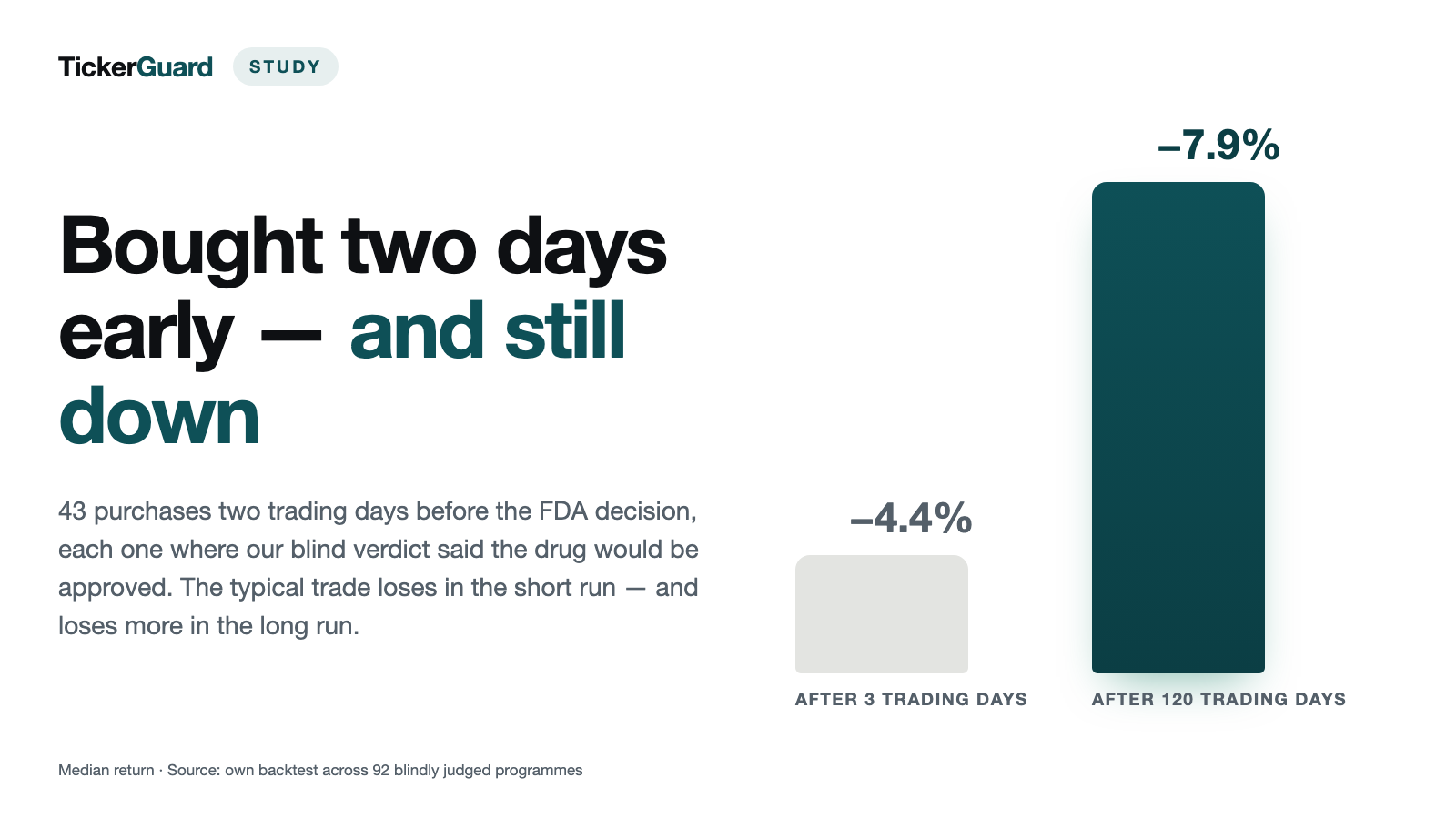
The gap between guessing right and guessing wrong is smaller than it looks. A case that ended in approval beat a case that ended in rejection by 4.6 percentage points after three trading days and by 6.7 percentage points after 120 trading days — real money, but not enough to turn either outcome into a winning trade. Filtering for a favorable verdict does not rescue the rule either: among the case files a blind review judged approvable, the three-day median comes in at −4.4%, worse than the unfiltered −3.3%, and the share of winning trades falls from 37.5% to 32.6%.
Against the broad market, nearly every group measured loses, and by the 120-day mark every single one does, by 15.2 to 19.0 percentage points. Sell the news is, on this evidence, the more accurate rule than buy the rumor.
A note on median and mean. The median is the trade sitting exactly in the middle of the ranking — half did better, half did worse — and it answers what is most likely to happen to a single investor. The mean spreads the result of every trade evenly across the group and answers a different question: what the rule returns if every signal is bought, rare large winners included. Among the case files a blind review judged approvable, the 120-day mean is positive at +2.5% while the median is negative at −7.9% — a handful of large winners carrying an average the typical trade never reaches. Even that mean trails the market by 4.2 percentage points. Where the two diverge this far, the gap is itself the finding.
This study has three parts. Where the sample comes from and what had to be measured around a decision day. What buying two trading days early actually returned, against the market and by hit rate. And what a correct forecast is worth — surprisingly little, and why filtering for it does not help. The core finding sits first, in the box The result in four numbers.
The result in four numbers
The rule tested: buy two trading days before the FDA decision, sell either three or 120 trading days later — across 80 measurable case files with decisions between 2011 and 2026. Four numbers carry the result:
- −8.5% is what the median trade returned after 120 trading days, measured across 77 of the 80 measured case files with a complete 120-day window — after three trading days, across all 80 case files, the median stood at −3.3%.
- −7.9% is what the median trade still lost even among the case files that were actually approved: after three trading days that subgroup stood at −2.8%.
- 17.0 percentage points is the gap between the median trade and an S&P 500 index fund held over the same 120 trading days.
- −4.4% is what the three-day median returned when only case files with a blind "approve" verdict were bought — worse than the unfiltered −3.3%, at a hit rate of 32.6% instead of 37.5%.
In the tested window (decisions from 2011 to 2026), buying two trading days before an FDA decision lost money at the median across the unfiltered sample in both holding periods — including where the agency said yes in the end.
Where the numbers come from
The rule is narrow by design: buy at the close two trading days before the FDA's decision day, sell at the close three trading days after it, and again at the close 120 trading days after it. The benchmark for every comparison is an S&P 500 index fund held over the identical span, and every price used is a closing price, with no allowance for the gap between bid and ask.
The sample is 92 case files — drug programs a blind review judged without any knowledge of the eventual decision — covering FDA decisions from 2011 to 2026. Twelve of the 92 could not be measured: nine tickers were delisted before their decision day, almost always because the company had been acquired; two had no price series on the report date; one ticker was missing from the price source entirely. That leaves 80 measured case files.
| Sample | Case files |
|---|---|
| programs judged blind | 92 |
| of those, verdict "approve" | 54 |
| of those, verdict "evidence insufficient" | 32 |
| of those, verdict "do not approve" | 6 |
| actually approved | 79 |
| received a Complete Response Letter | 13 |
| measurable and calculated | 80 |
| not measurable — stock removed from trading before the decision date | 9 |
| not measurable — no price series on the announcement day | 2 |
| not measurable — ticker missing from the price source | 1 |
The blind review split its verdicts three ways: 54 case files were judged "approve," 32 "evidence insufficient," and 6 "do not approve." The FDA's actual record shows 79 approvals and 13 Complete Response Letters among the 92. Decision day itself comes from three sources: 76 times the agency's own action date, three times an action date with no independent confirmation, and 13 times — for the rejected cases — the day the company disclosed the Complete Response Letter rather than the day the agency issued it.
One further qualification belongs here, and it returns in the caveats below: for 87 of the 92 case files, the review that produced the blind verdict could not be shown to be free of prior knowledge of the actual outcome. The verdicts in this study read as a reconstruction, not a genuine advance call.
The result: even the winning cases lose
| Group | Exit | Cases | Median | Mean | Hit rate | Median vs. the market |
|---|---|---|---|---|---|---|
| A — only where the blind verdict said "approve" | after 3 trading days | 43 | −4.4% | −3.1% | 32.6% | −3.3 pp |
| A — only where the blind verdict said "approve" | after 120 trading days | 42 | −7.9% | +2.5% | 38.1% | −15.2 pp |
| B — every decided case, no verdict filter | after 3 trading days | 80 | −3.3% | −3.5% | 37.5% | −3.1 pp |
| B — every decided case, no verdict filter | after 120 trading days | 77 | −8.5% | −3.5% | 35.1% | −17.0 pp |
| B1 — of those, actually approved | after 3 trading days | 67 | −2.8% | −1.9% | 40.3% | −2.8 pp |
| B1 — of those, actually approved | after 120 trading days | 64 | −7.9% | −2.7% | 34.4% | −16.7 pp |
| B2 — of those, rejected (Complete Response Letter) | after 3 trading days | 13 | −7.4% | −11.7% | 23.1% | −6.8 pp |
| B2 — of those, rejected (Complete Response Letter) | after 120 trading days | 13 | −14.6% | −7.1% | 38.5% | −18.5 pp |
| C — verdict "evidence insufficient" | after 3 trading days | 31 | −3.2% | −5.3% | 41.9% | −3.2 pp |
| C — verdict "evidence insufficient" | after 120 trading days | 29 | −7.9% | −10.3% | 34.5% | −17.0 pp |
| C1 — of those, approved anyway | after 3 trading days | 21 | +1.8% | +0.6% | 57.1% | +0.6 pp |
| C1 — of those, approved anyway | after 120 trading days | 19 | −6.3% | −11.2% | 31.6% | −17.0 pp |
| C2 — of those, rejected | after 3 trading days | 10 | −15.9% | −17.5% | 10.0% | −16.2 pp |
| C2 — of those, rejected | after 120 trading days | 10 | −14.0% | −8.5% | 40.0% | −18.8 pp |
| D — verdict "do not approve" | after 3 trading days | 6 | +1.0% | +2.9% | 50.0% | −0.2 pp |
| D — verdict "do not approve" | after 120 trading days | 6 | −20.3% | −12.6% | 16.7% | −19.0 pp |
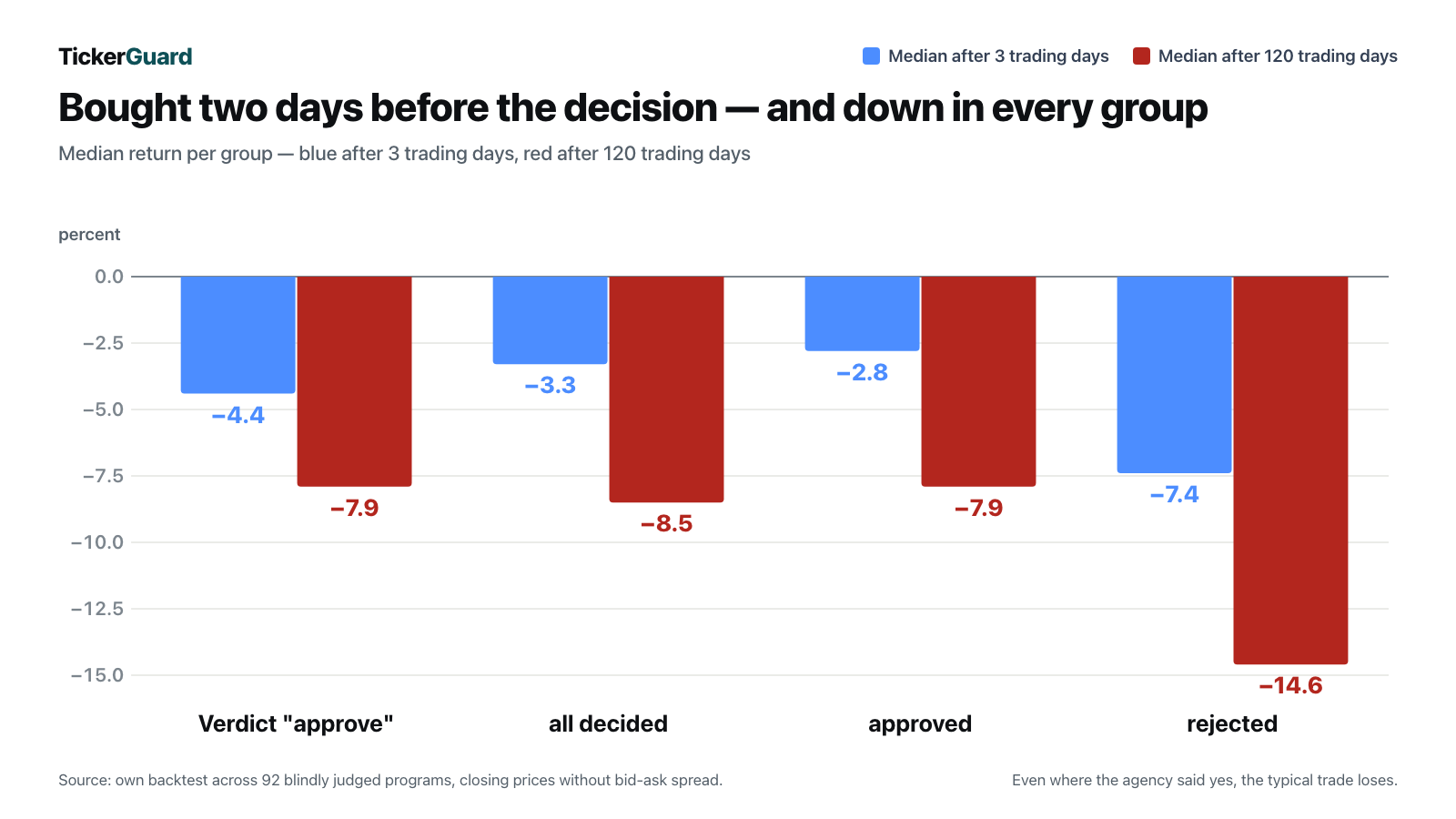
Read the table by its central comparison first. Among the case files that were later approved — group B1, 64 to 67 trades depending on the window — the median trade is negative at both checkpoints: −2.8% after three trading days, −7.9% after 120 trading days. This is the sharpest finding in the study. Even in the cases where the FDA said yes, buying two trading days before the decision loses money for the typical trade. By decision day, the approval was already in the price.
Set that against the rejected cases, group B2: −7.4% after three trading days and −14.6% after 120. The direction is right — rejection costs more than approval — but the size of the gap is what stands out. A correct forecast is worth 4.6 percentage points after three trading days and 6.7 percentage points after 120. That is real money, but it is a discount on a loss, not a path to a gain.
The pattern mirrors what we found at the other end of the same drug's path to market. Our study of buying after a positive Phase 3 trial readout measured the earlier moment in this same process and reached the same conclusion from the opposite direction: the signal in the data carries real information, but the trading recipe built on it still loses. There, the news was the trial result; here, it is the regulatory decision itself. Both moments are, by the time an investor can act on them, largely already priced.
Filtering does not rescue the rule. Group A — case files where the blind verdict was "approve" — should, on paper, be the safest way to play this trade. Instead its three-day median is −4.4%, worse than the unfiltered group B at −3.3%, and its hit rate is lower too: 32.6% against 37.5%. After 120 trading days the filtered group edges narrowly ahead on the median (−7.9% versus −8.5%) and further ahead on the mean (+2.5% versus −3.5%), but that longer-window advantage is carried by a small number of large winners, not by the typical trade.
Measured against the market
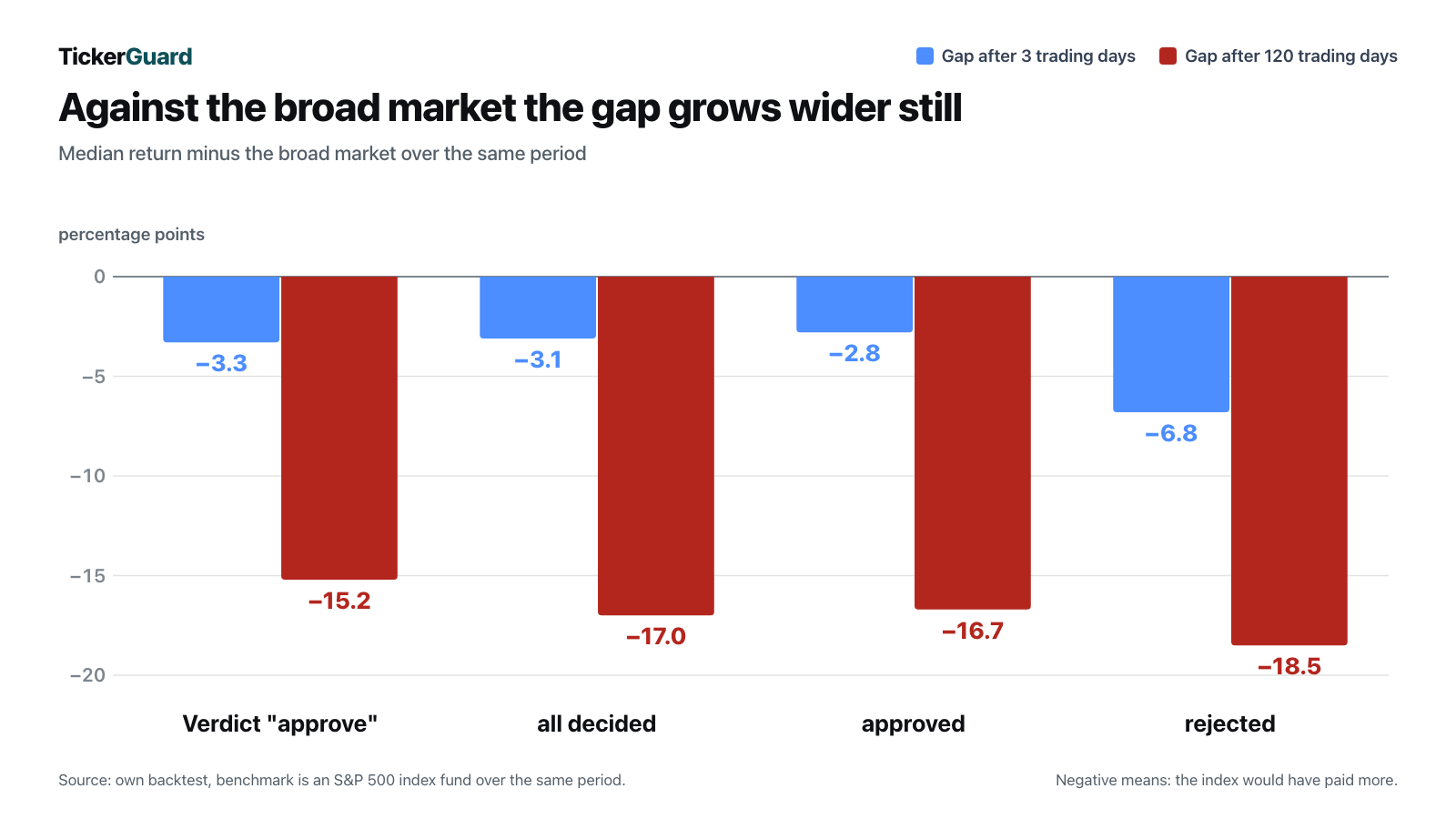
Measured against the S&P 500 index fund, the picture is uniform in the long window and nearly uniform in the short one. After 120 trading days every one of the eight groups trails the index, by 15.2 to 19.0 percentage points. After three trading days seven of the eight groups also trail it, by as little as 0.2 percentage points for group D and as much as 16.2 for group C2. The one exception is group C1 — case files judged "evidence insufficient" that were approved anyway — whose median edges 0.6 percentage points ahead of the index, but only in the short window.
The hit rate
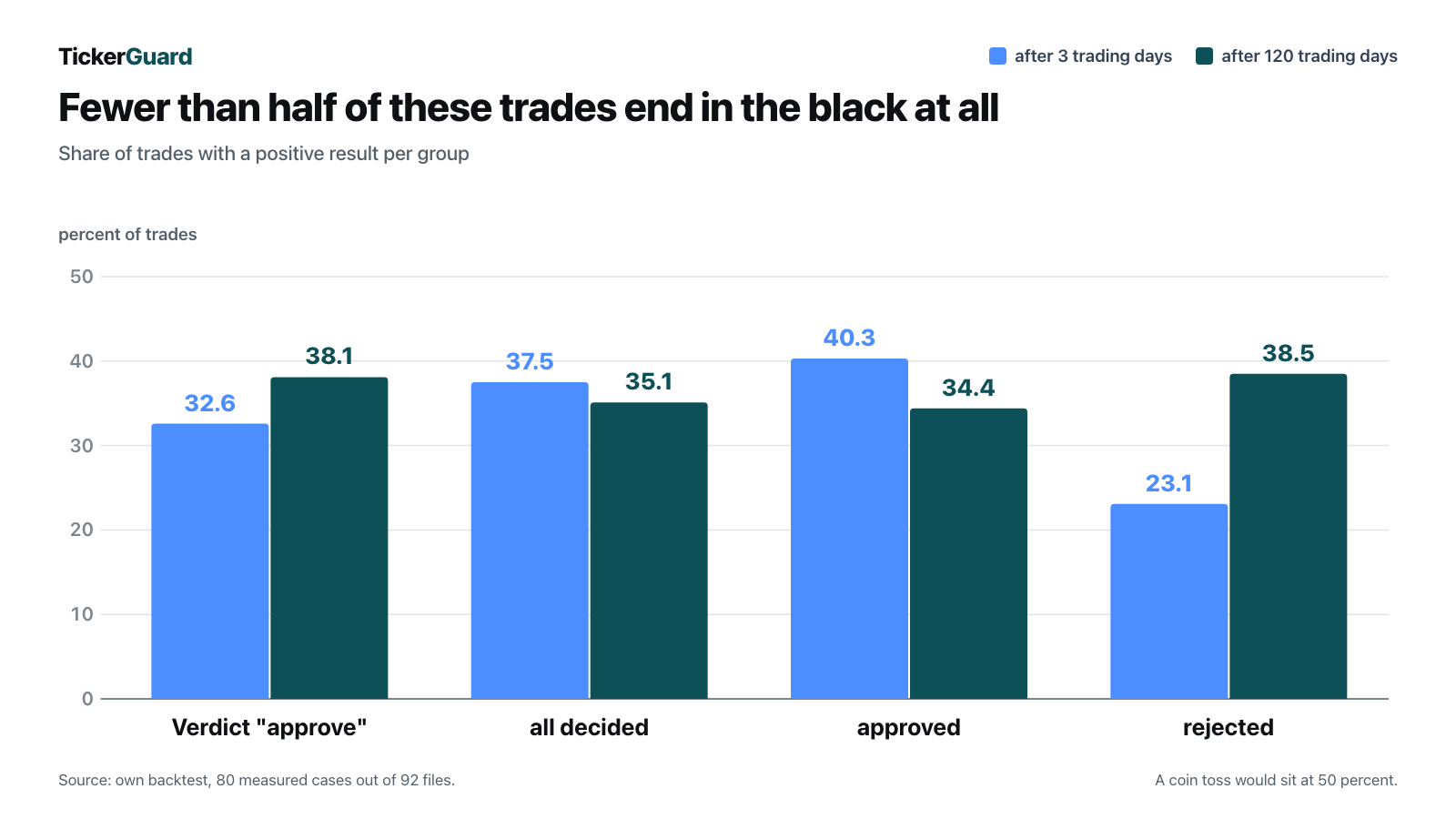
The share of trades that finished in the black tells the same story. In the short window it sits below 50% for six of the eight groups; only group C1 (57.1%) clears that mark, and group D lands exactly on it at 50.0%. After 120 trading days it is below 50% for every group without exception, ranging from 16.7% for group D up to 40.0% for group C2. Group D's six case files show why we treat single-digit groups as illustrative rather than as a rule: a short-window mean of +2.9% and an even hit rate give way, by 120 trading days, to a hit rate of just 16.7%.
What a correct forecast is actually worth
Set the two directional outcomes side by side and the value of being right becomes concrete. Cases later approved returned a median of −2.8% after three trading days against −7.4% for cases later rejected — a gap of 4.6 percentage points. After 120 trading days the approved cases held a median of −7.9% against −14.6% for the rejected ones — a gap of 6.7 percentage points. Both gaps run the right direction. Neither is large enough to turn a losing trade into a winning one; a correct forecast buys a smaller loss, not a profit.
That is also why filtering by verdict fails as a strategy. Restricting the trade to group A — only the case files a blind review judged approvable — should concentrate the good outcomes and exclude the bad ones. It does the opposite in the window that matters most for a two-day trade: the three-day median is worse than the unfiltered sample, and fewer of the filtered trades end in the black. The verdict correlates with the eventual decision reasonably well, but a correct read on whether a drug will be approved is not the same question as whether the stock is still worth buying two days before the decision. By decision day, the market has usually already done the same reading.
The rejected cases in this study did not receive a plain "no." They received a Complete Response Letter, the FDA's formal mechanism for saying an application is not ready for approval in its current form:
"FDA will send the applicant a complete response letter if the agency determines that we will not approve the application or abbreviated application in its present form for one or more of the reasons given in § 314.125 or § 314.127, respectively." — 21 CFR § 314.110(a)
A Complete Response Letter is not necessarily the end of the road for a drug: the regulation obliges the agency to spell out the deficiencies it found, and a company can address them and file again. It is, however, always the end of the two-day trade this study measures — the decision day it responds to has already passed by the time the letter is disclosed.
The largest wins and losses
Eight individual cases show the spread — the four largest losses and the four largest gains, each measured in the short window of three trading days.
| Drug | Company | Indication | Decision date | Blind verdict | Outcome | After 3 trading days | After 120 trading days |
|---|---|---|---|---|---|---|---|
| lpcn 1021 | Lipocine Inc. | testosterone deficiency (oral testosterone replacement) | June 29, 2016 | evidence insufficient | rejected | −52.2% | −48.0% |
| zuranolone | Sage Therapeutics, Inc. | major depressive disorder (MDD) | August 4, 2023 | do not approve | approved | −48.3% | −28.3% |
| solithromycin | CEMPRA, INC. | community-acquired bacterial pneumonia (CABP) | December 29, 2016 | evidence insufficient | rejected | −44.9% | −22.9% |
| pegunigalsidase alfa | Protalix BioTherapeutics, Inc. | Fabry disease | May 9, 2023 | evidence insufficient | approved | −31.8% | −54.4% |
| angiotensin ii | LA JOLLA PHARMACEUTICAL CO | distributive shock (catecholamine-resistant hypotension) | December 21, 2017 | approve | approved | +27.6% | +19.6% |
| daxibotulinumtoxina | Revance Therapeutics, Inc. | cervical dystonia | September 7, 2022 | approve | approved | +29.3% | +48.4% |
| setmelanotide | RHYTHM PHARMACEUTICALS, INC. | acquired hypothalamic obesity | November 25, 2020 | evidence insufficient | approved | +48.2% | −2.7% |
| tivozanib | AVEO PHARMACEUTICALS INC | advanced renal cell carcinoma | March 10, 2021 | do not approve | approved | +54.6% | −20.6% |
The largest loss in the three-day window belonged to lpcn 1021, Lipocine's testosterone-deficiency therapy, which fell 52.2% on its June 2016 decision — a case file judged "evidence insufficient," correctly, as the drug was rejected. The largest gain in the same window belonged to tivozanib, AVEO's kidney-cancer therapy, which rose 54.6% on its March 2021 decision, on a case file the blind review had judged "do not approve." That call turned out to be wrong: the drug was approved.
The most instructive case, though, is a loss. Zuranolone, Sage Therapeutics' drug for major depressive disorder, fell 48.3% on its August 2023 decision day despite the FDA formally granting an approval that same day. The agency ruled on two applications for the same drug at once — one for postpartum depression, which it approved, and one for major depressive disorder, which it rejected with a Complete Response Letter. The case file in this study concerned major depressive disorder specifically; the stock priced in the rejection that applied to it, not the approval that did not.
What these numbers do not say
- Prior knowledge cannot be ruled out. For 87 of the 92 case files, the review that produced the blind verdict could already have known the FDA's actual decision from its training data. The verdicts in group A are therefore an upper bound on forecasting skill, a reconstruction rather than proof of genuine advance prediction.
- The trade is measured against the real decision day, not the announced one. This backtest buys two trading days before the day the FDA actually decided. An investor acting in real time only knows the agency's announced target date, and decisions routinely land earlier or later than that target. "Two days before" is not a date that can be reliably hit in advance.
- Rejections are measured from a report date, not an event date. For the 13 rejected case files, decision day is the day the company disclosed its Complete Response Letter, not the day the FDA issued it. That can shift the measured window by up to one trading day.
- This is a sample, not a census. The 92 case files are a selection from 560 documented drug pathways to the FDA: a file was included where a decision existed and the published trial data could be found, which leaves programs with thin publication records underrepresented. Some groups are single digits — group D holds six case files — and in those groups the median describes that handful of cases more than it describes a general rule.
- Acquired companies are missing, and missing in one direction. Nine of the 92 tickers were delisted before their decision day, almost always because the company was acquired first. An acquisition is usually a favorable outcome for a shareholder, and these nine cases are absent from every number in this study. If anything, that makes the measured results too pessimistic rather than too optimistic — and the finding does not change, because even the more favorable reading still loses.
Seven decisions still to come
The same blind process that produced the 92 case files above has also judged seven ongoing FDA reviews with a published target date, without any knowledge of how they will be decided. The earliest of those target dates is 22 August 2026, the point from which this commitment becomes checkable against a real outcome for the first time.
| Drug | Indication | Agency target date | Blind verdict | Confidence |
|---|---|---|---|---|
| deramiocel | Duchenne muscular dystrophy (cardiomyopathy) | August 22, 2026 | evidence insufficient | high |
| zanidatamab | HER2-positive gastric and gastroesophageal junction cancer, first line | August 25, 2026 | approve | high |
| BBP-418 (Ribitol) | limb-girdle muscular dystrophy type 2I/R9 | November 27, 2026 | approve | medium |
| bezuclastinib + Sunitinib | gastrointestinal stromal tumor after imatinib | November 30, 2026 | approve | high |
| bezuclastinib | non-advanced systemic mastocytosis | December 30, 2026 | approve | medium |
| z-rostudirsen | Duchenne muscular dystrophy, exon 51 | January 21, 2027 | evidence insufficient | medium |
| encaleret | autosomal dominant hypocalcemia type 1 | May 8, 2027 | approve | medium |
Seven further reviews were judged as well but carry no published target date, and are not listed here for that reason. This table is a pre-registration that makes the method checkable, not a list to act on — this study has just shown that buying before an FDA decision loses money even when the forecast is right. The verdicts above concern the strength of the evidence in each case file, not whether the underlying stock is worth buying. No prices, no price targets, no buy dates, and no ticker symbols appear here for that reason.
What follows from this
Buying two trading days before an FDA decision is, on this evidence, closer to buying a lottery ticket after the numbers were drawn than to buying ahead of an uncertain event. The typical trade loses whether the drug is approved or rejected, the gap between a right and a wrong guess is smaller than it looks, and filtering for a favorable blind verdict makes the short-window result worse rather than better. Sell the news applies here in its starkest form: by the time the signature is public, the market has usually already priced it.
Read together with our earlier study of buying after a positive Phase 3 readout, a pattern emerges across both ends of a drug's regulatory path: by the moment an investor can act on the news, the news is already in the price. Neither the trial readout nor the decision itself leaves a trade that beats simply holding the index. Readers interested in the same pattern elsewhere can find the rest of our published work under Studies.
This study is a historical analysis of publicly available regulatory filings and FDA approval letters. It does not evaluate any individual stock, is not investment advice, and is not medical advice. The drugs and companies named appear as illustrative case files for the method, not as a judgment of the company or the drug in question. The verdicts on the pending reviews assess the published evidence only.
Frequently Asked Questions
Buying a drug's stock two trading days before its FDA decision day, and selling either three trading days or 120 trading days afterward. Both sale points are compared against a case file's blind evidence review and against an S&P 500 index fund held over the identical span. Prices used are closing prices, with no allowance for the bid-ask spread.
Rarely, and not at the median. Among case files that were later approved, the median trade still lost 2.8% after three trading days and 7.9% after 120. A handful of large winners lift the mean in some groups, but the typical trade, filtered for approval or not, loses money against a simple buy-and-hold of the S&P 500 index fund.
Less than it looks. Cases that were later approved beat cases that were later rejected by 4.6 percentage points after three trading days and by 6.7 percentage points after 120. That gap softens a loss; it does not turn the trade profitable. Getting the outcome right buys a smaller loss, not a gain.
In the three-day window, restricting trades to case files a blind review judged "approve" produces a median of −4.4%, worse than the −3.3% median of the unfiltered sample, and lowers the hit rate from 37.5% to 32.6%. The filter's advantage only shows up later, in the 120-day mean, carried by a few large winners.
It is the FDA's formal notice that it will not approve an application in its present form, issued under 21 CFR § 314.110(a) for one or more of the deficiencies the rules list. Thirteen of the 92 case files in this study ended in such a letter; their median trade lost 7.4% three trading days later and 14.6% after 120 — worse than the approved cases, which lost as well.
No. The study argues the opposite: after 120 trading days, buying two trading days before a decision loses money at the median in every group measured, and it trails the index in all of them. It evaluates a trading rule against historical filings; it is not investment advice, not medical advice, and does not judge any single stock. The seven pending reviews it lists are a pre-registered test of the method, not a trading list.